Speed of Light – Speed of Sound 
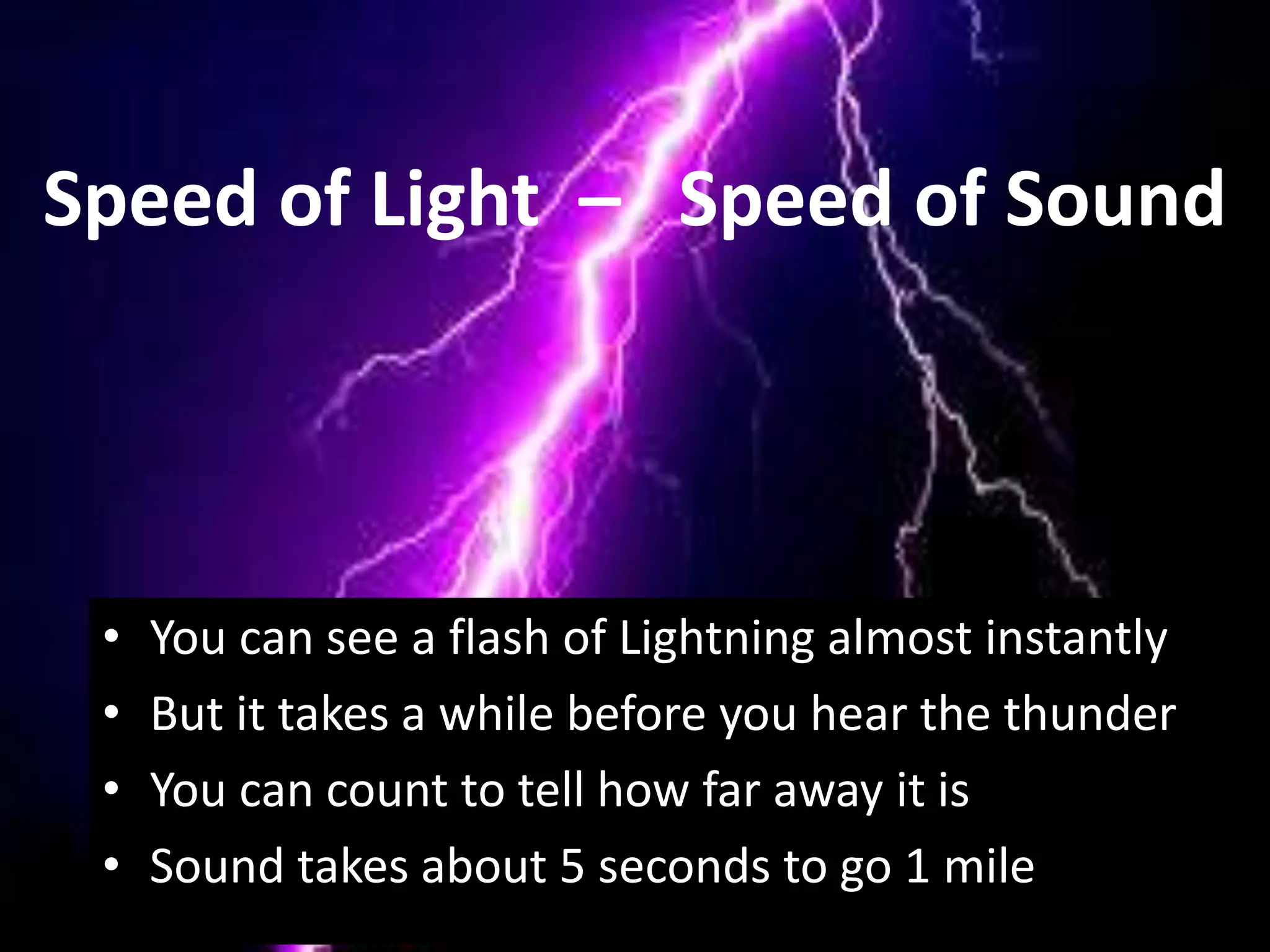
• You can see a flash of Lightning almost instantly 
• But it takes a while before you hear the thunder 
• You can count to tell how far away it is 
• Sound takes about 5 seconds to go 1 mile
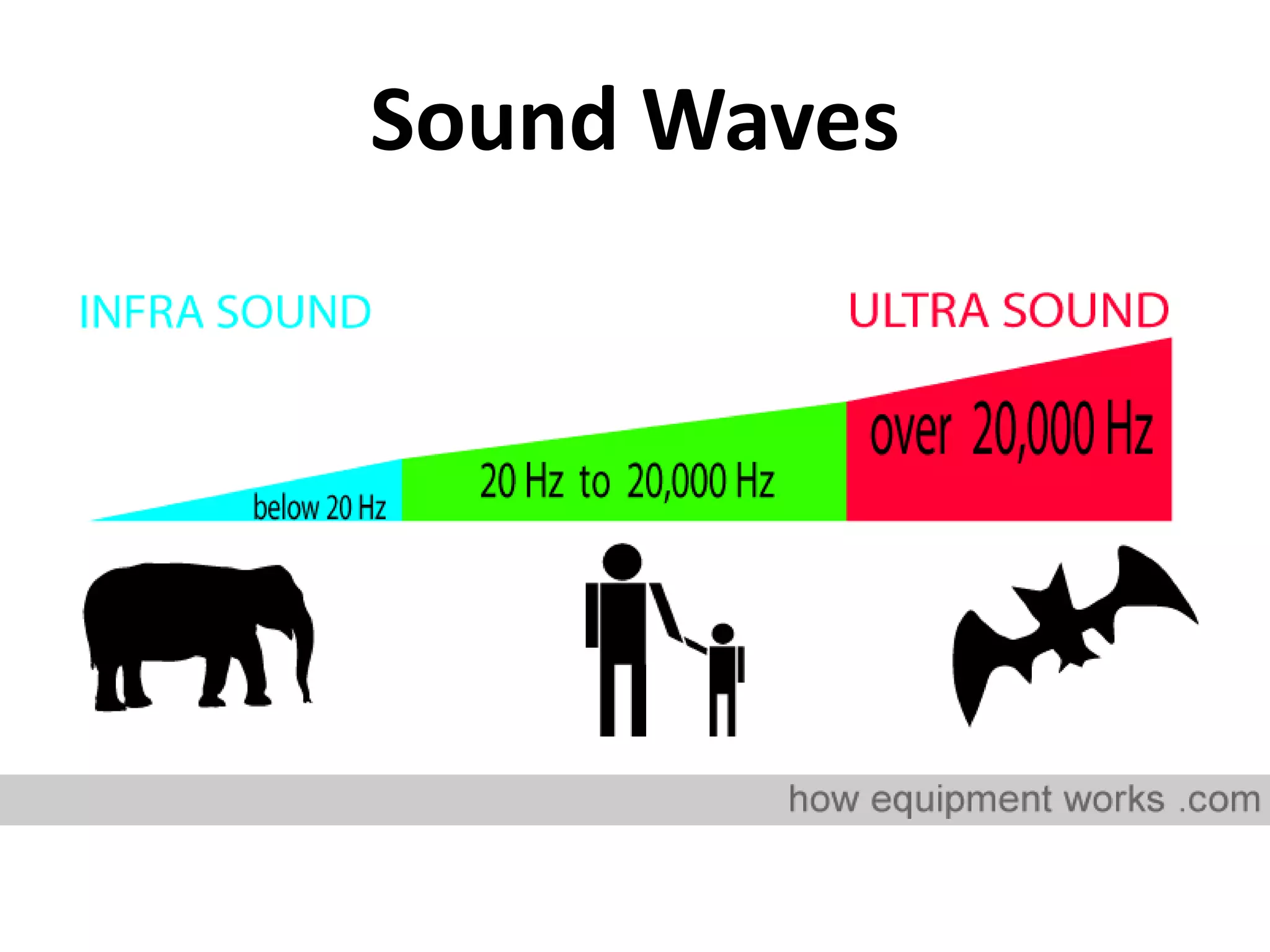
Sound Waves
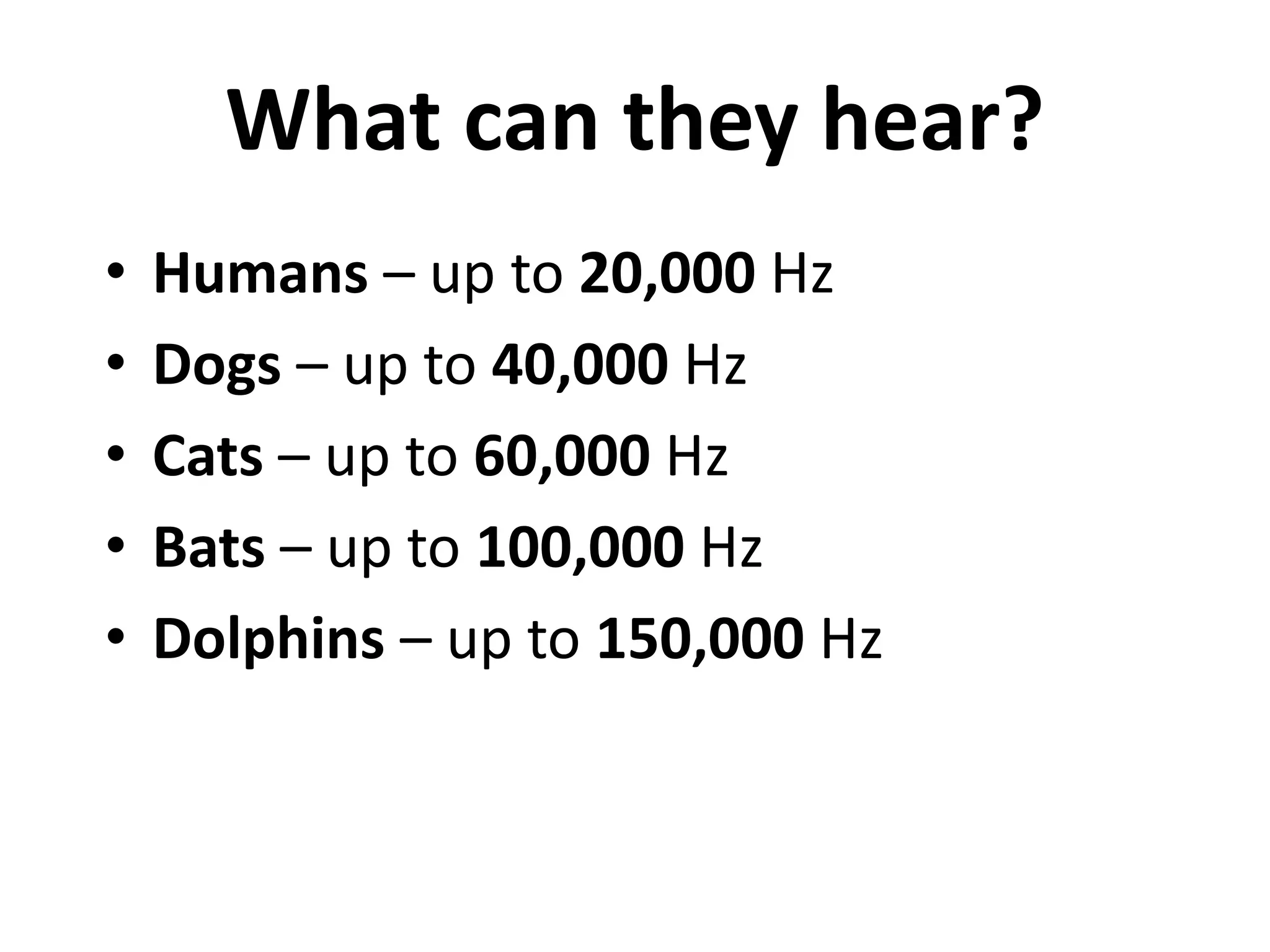
What can they hear? 
• Humans – up to 20,000 Hz 
• Dogs – up to 40,000 Hz 
• Cats – up to 60,000 Hz 
• Bats – up to 100,000 Hz 
• Dolphins – up to 150,000 Hz
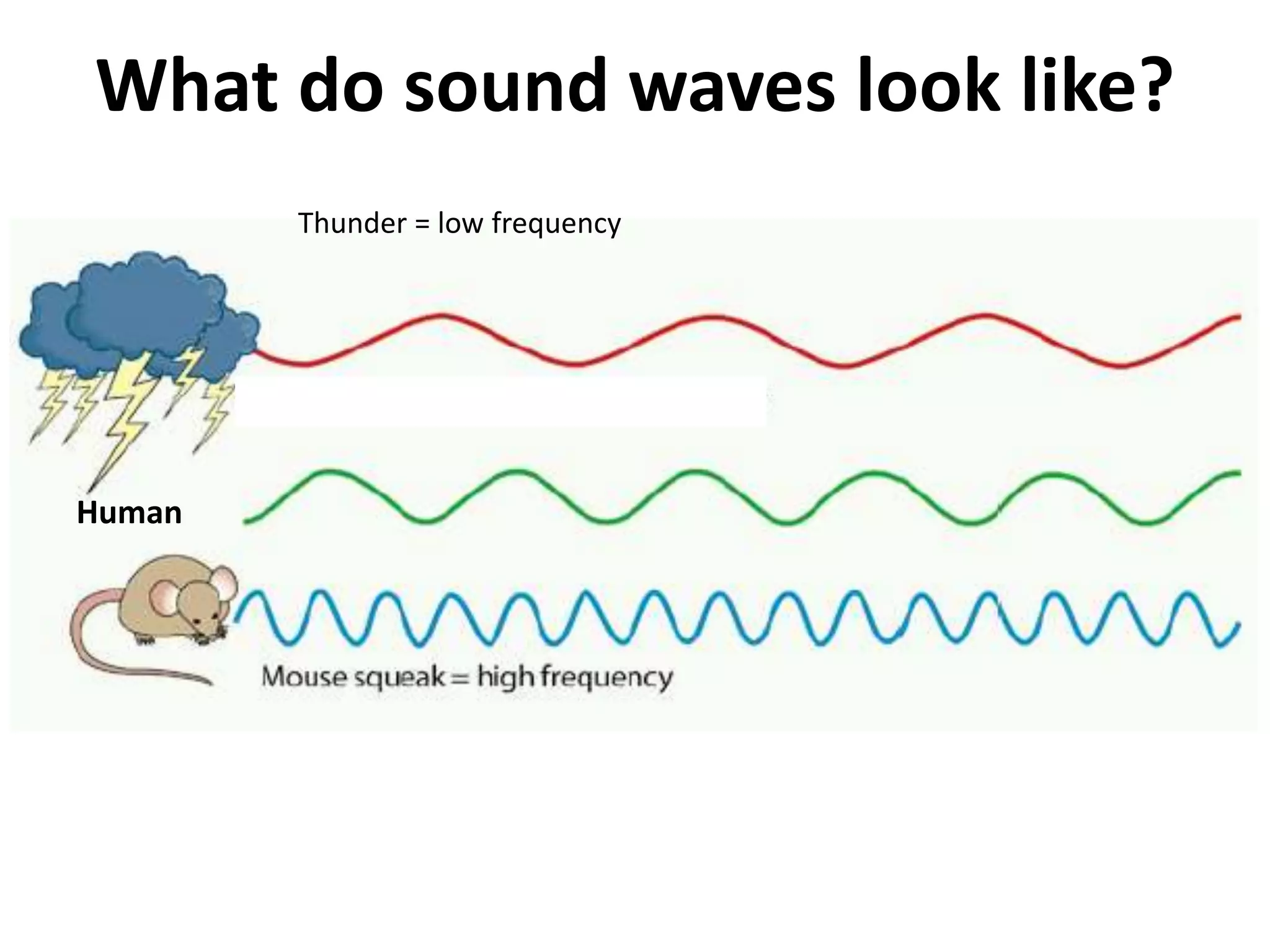
What do sound waves look like? 
Human 
Thunder = low frequency
What are echoes?
What is Echolocation ? 
"Echolocation is the use of sound waves 
and echoes to determine where objects 
are in space” 
In other words, echoes help to find the 
location of an object. 
http://askabiologist.asu.edu/echolocation
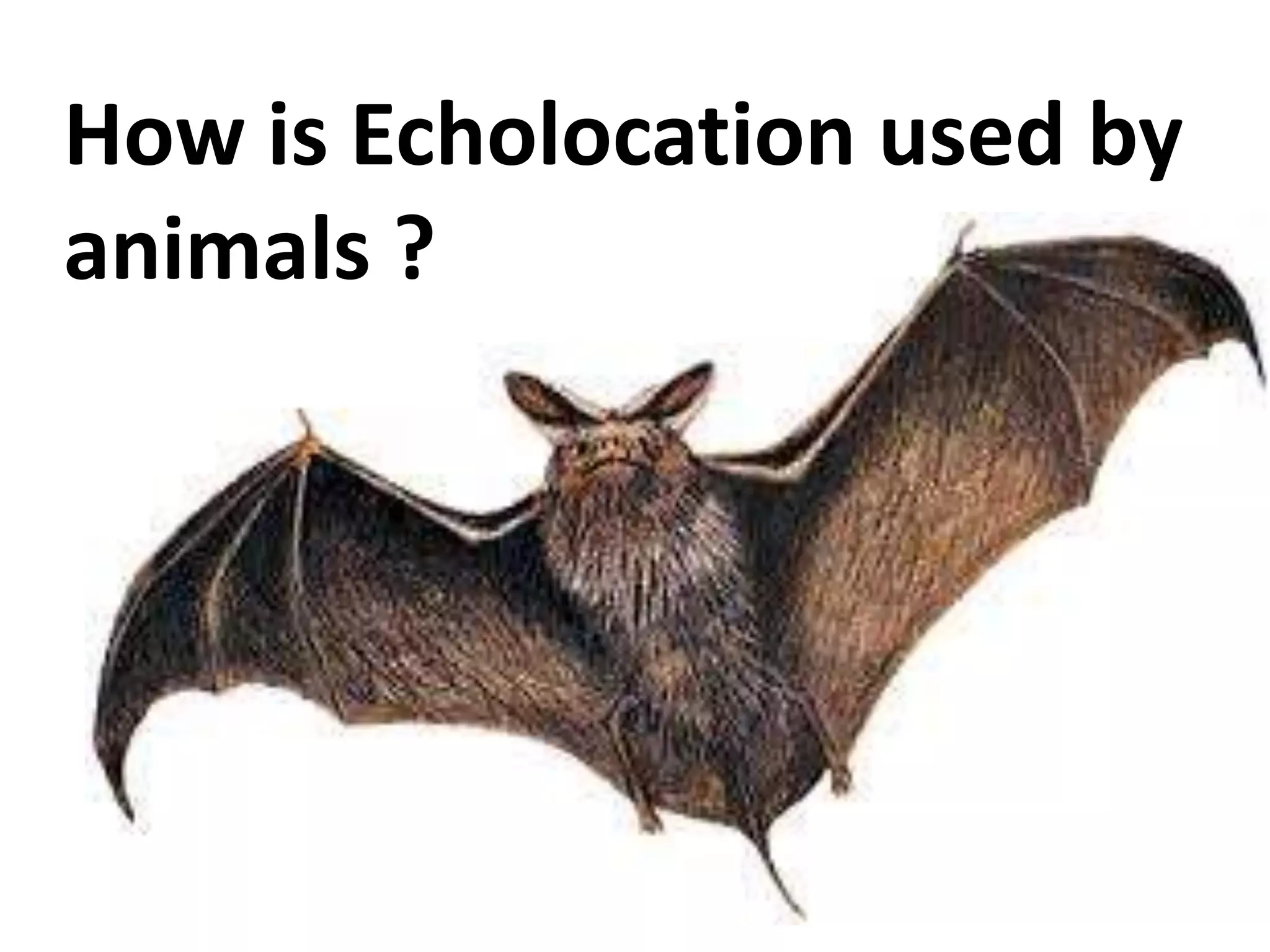
How is Echolocation used by 
animals ?
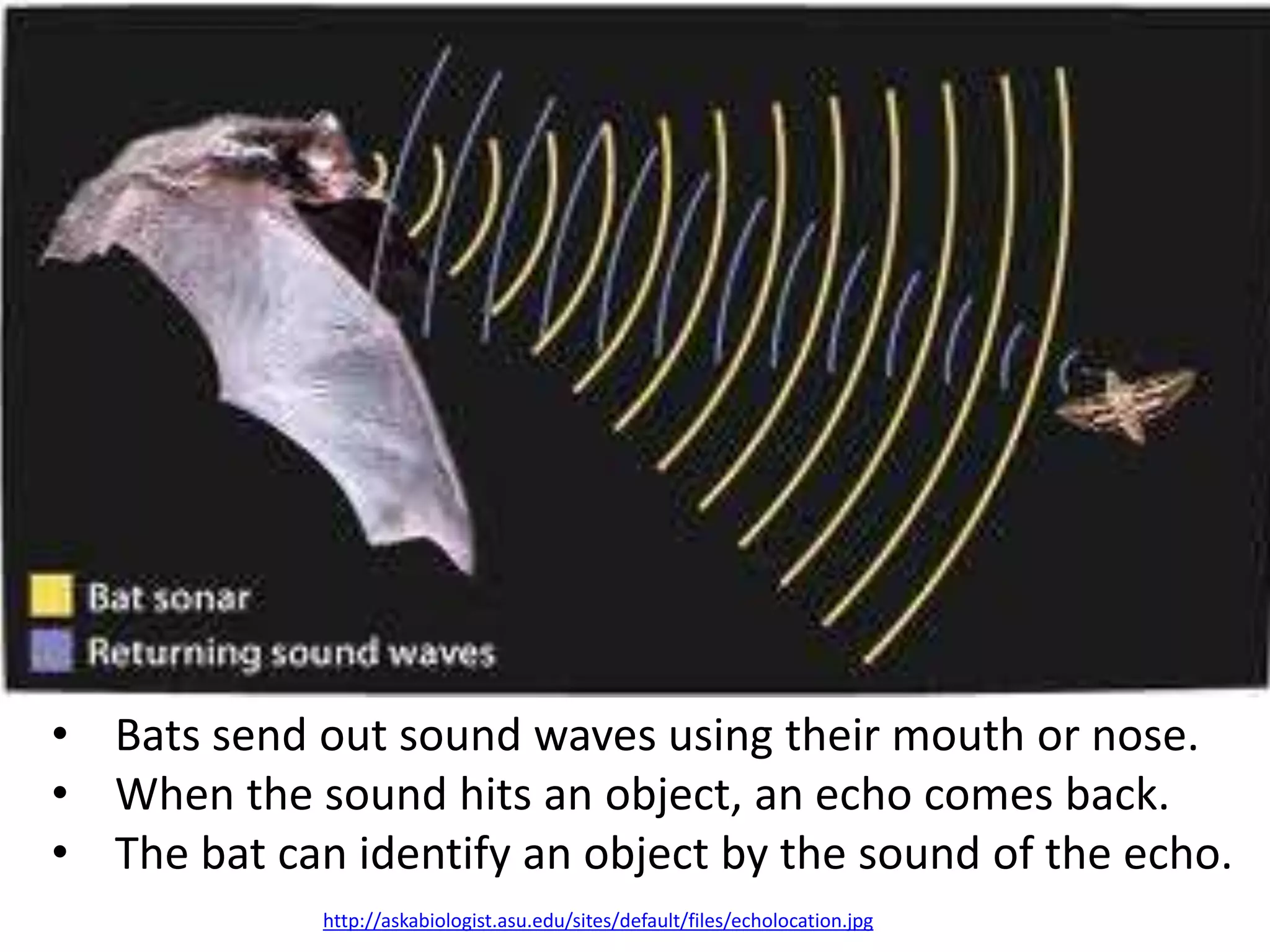
• Bats send out sound waves using their mouth or nose. 
• When the sound hits an object, an echo comes back. 
• The bat can identify an object by the sound of the echo. 
http://askabiologist.asu.edu/sites/default/files/echolocation.jpg
Blind as a Bat? 
• Most bats regularly eat flying insects. 
• Bats can see as well as humans, but 
echolocation is much more important to 
them than their eyesight for finding food. 
• Bat’s Echolocation is so precise that it can 
detect an object the width of a human hair. 
• Mother bats who are feeding their babies, 
may catch and eat up to 4500 insects in one 
night!
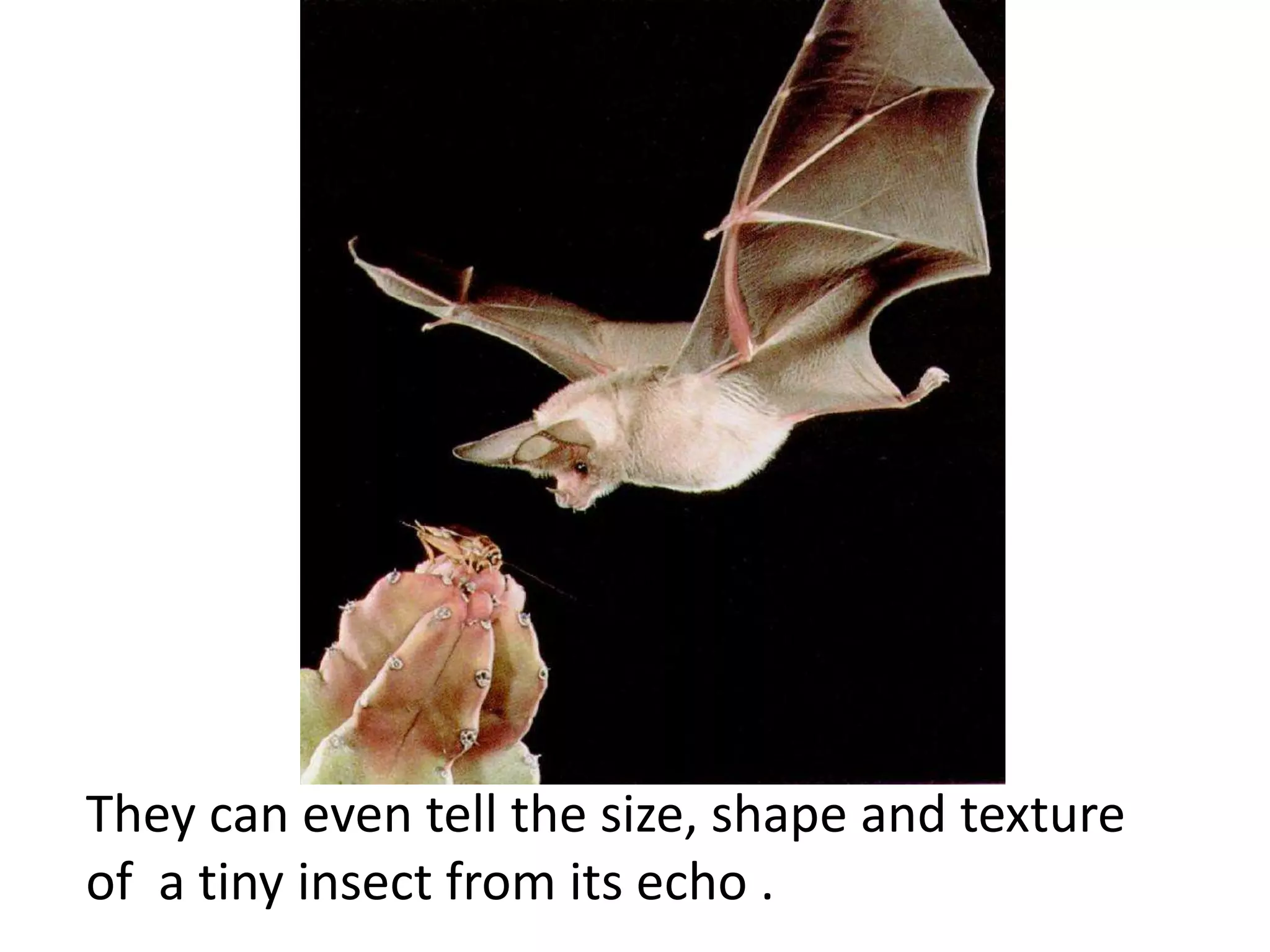
They can even tell the size, shape and texture 
of a tiny insect from its echo .
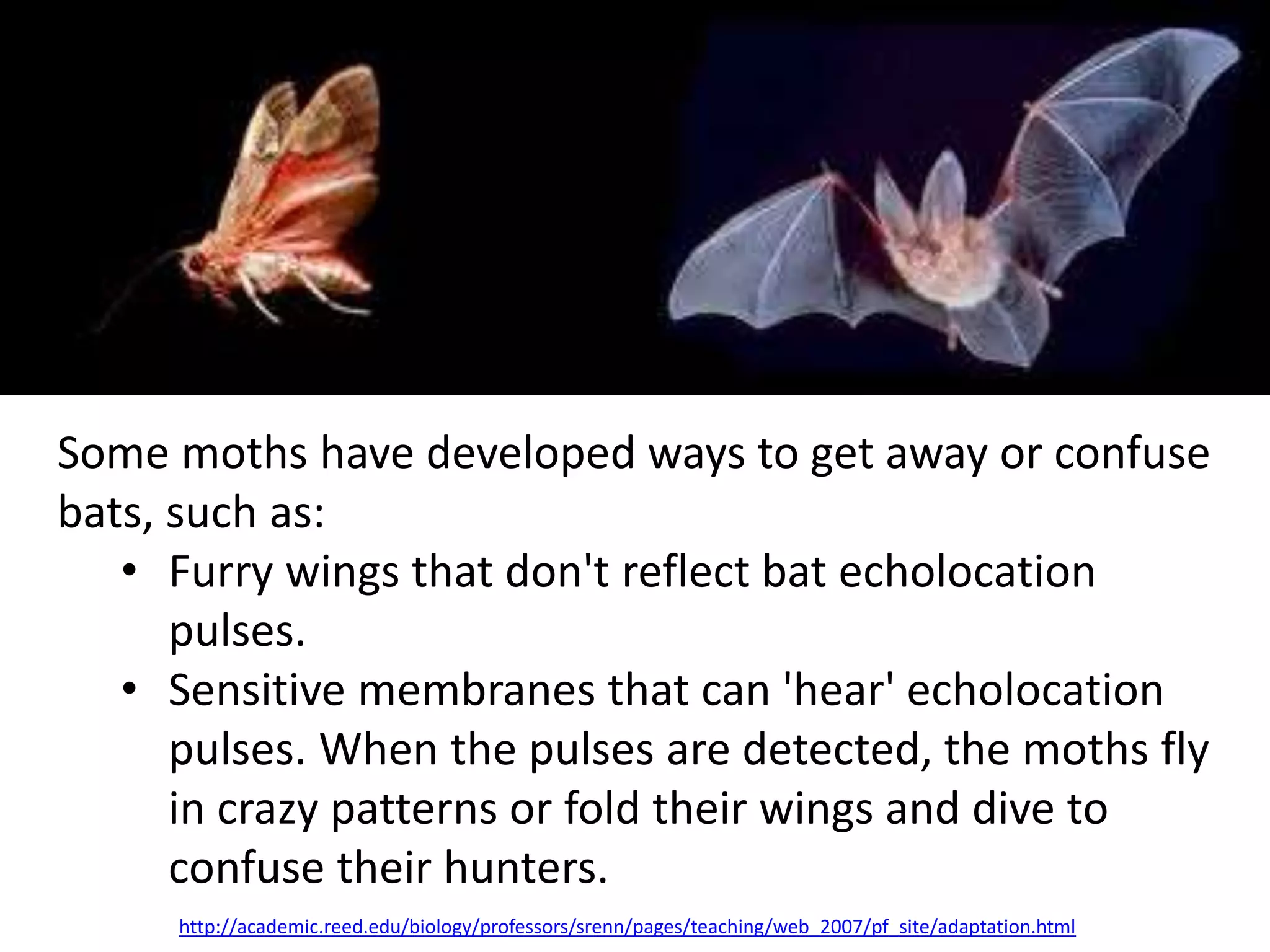
Some moths have developed ways to get away or confuse 
bats, such as: 
• Furry wings that don't reflect bat echolocation 
pulses. 
• Sensitive membranes that can 'hear' echolocation 
pulses. When the pulses are detected, the moths fly 
in crazy patterns or fold their wings and dive to 
confuse their hunters. 
http://academic.reed.edu/biology/professors/srenn/pages/teaching/web_2007/pf_site/adaptation.html
Bats using Ultrasound to Catch Prey 
Click on photo to start video
Books you might enjoy!
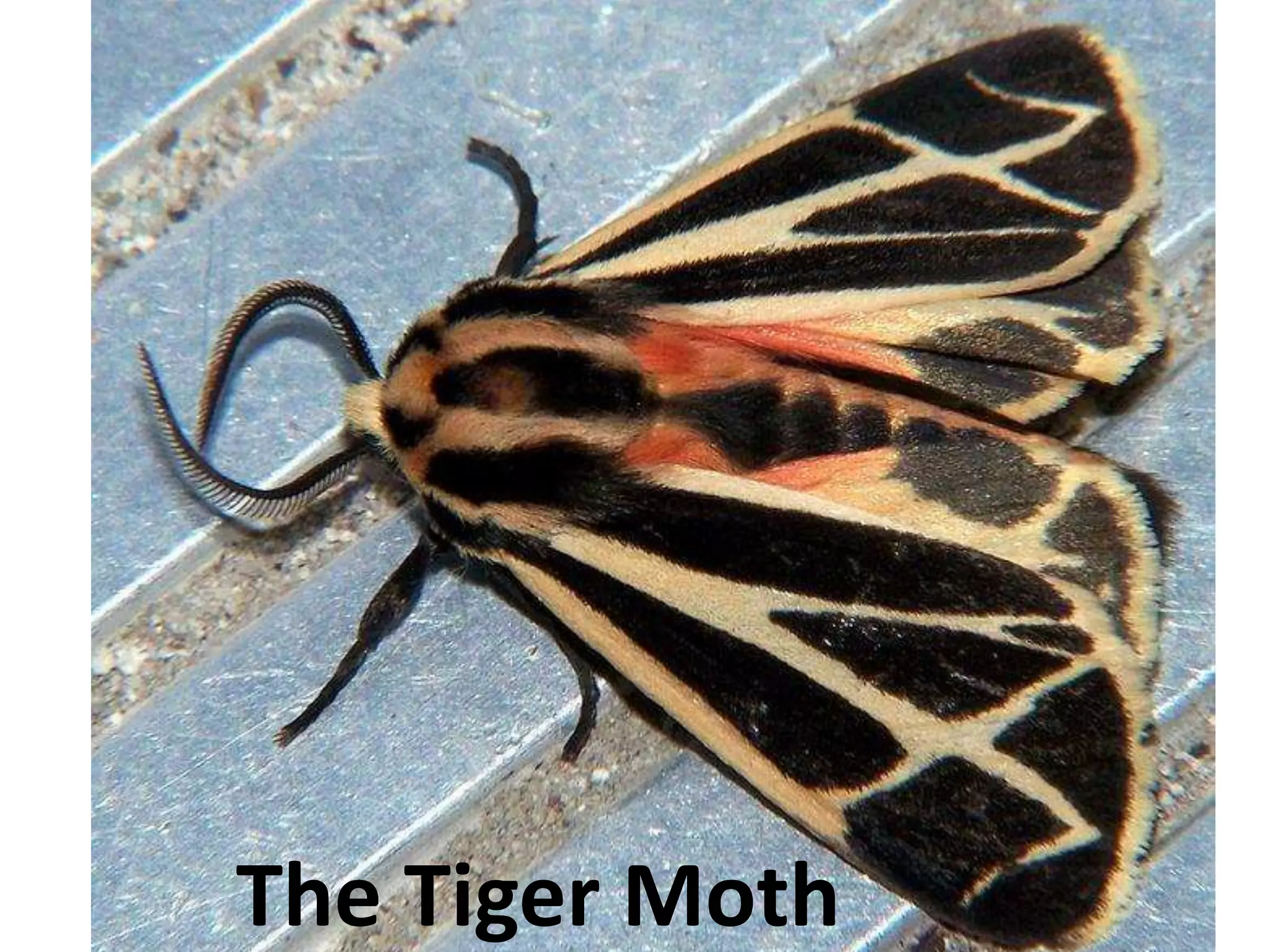
The Tiger Moth
The Tiger Moth Can can emit ultrasonic clicks 
to "jam" a Bat's sonar! 
This moth produces ultrasound not to 
communicate, but as a way to protect itself. By 
producing ultrasound of its own, it is able to 
ward off bats by acting as a radar jammer, 
confusing the bats so that the moth cannot be 
located. By doing this, they add another 
weapon to their survival mechanisms that also 
includes poison. http://en.wikipedia.org/wiki/Arctiidae
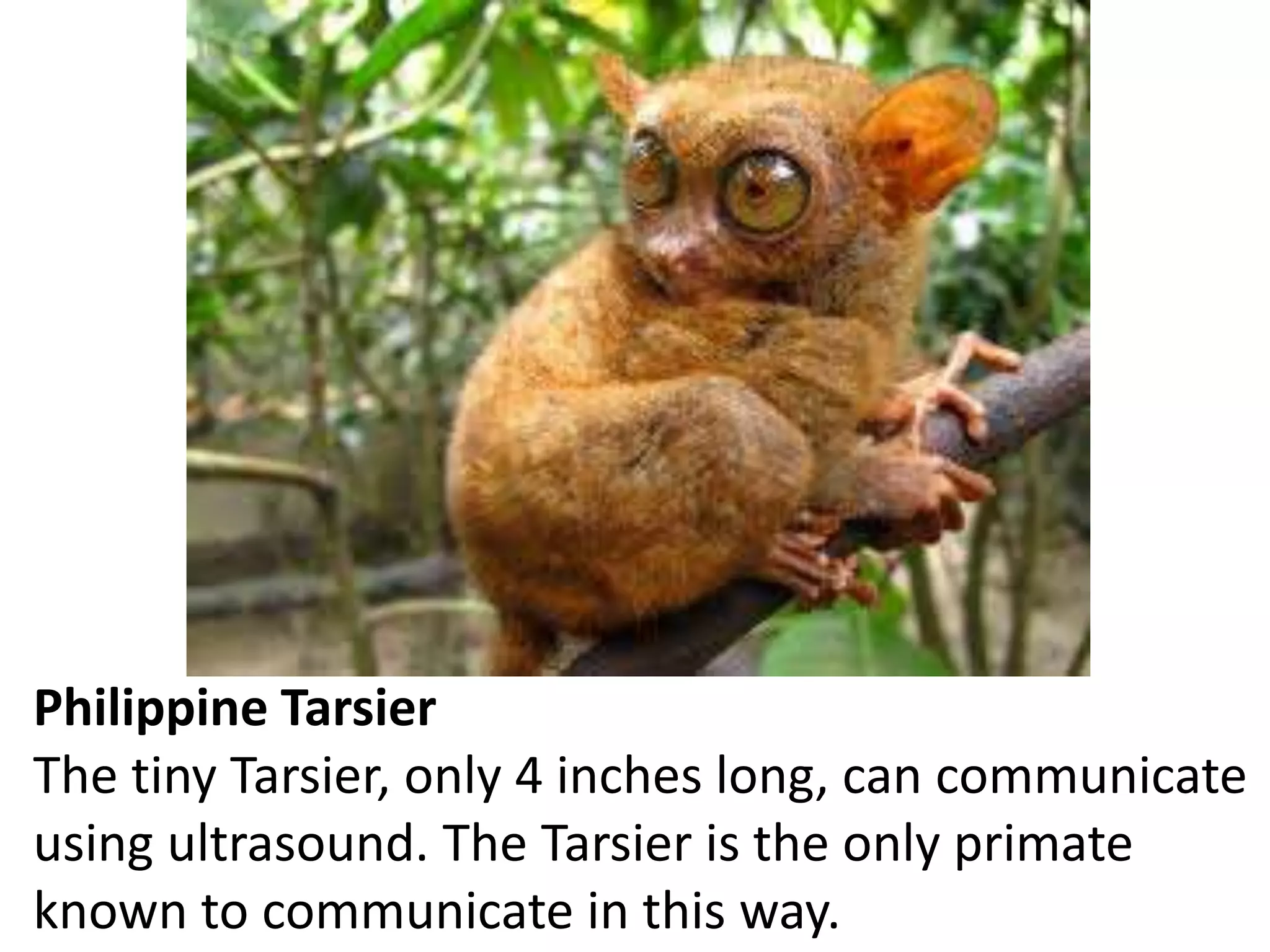
Philippine Tarsier 
The tiny Tarsier, only 4 inches long, can communicate 
using ultrasound. The Tarsier is the only primate 
known to communicate in this way.
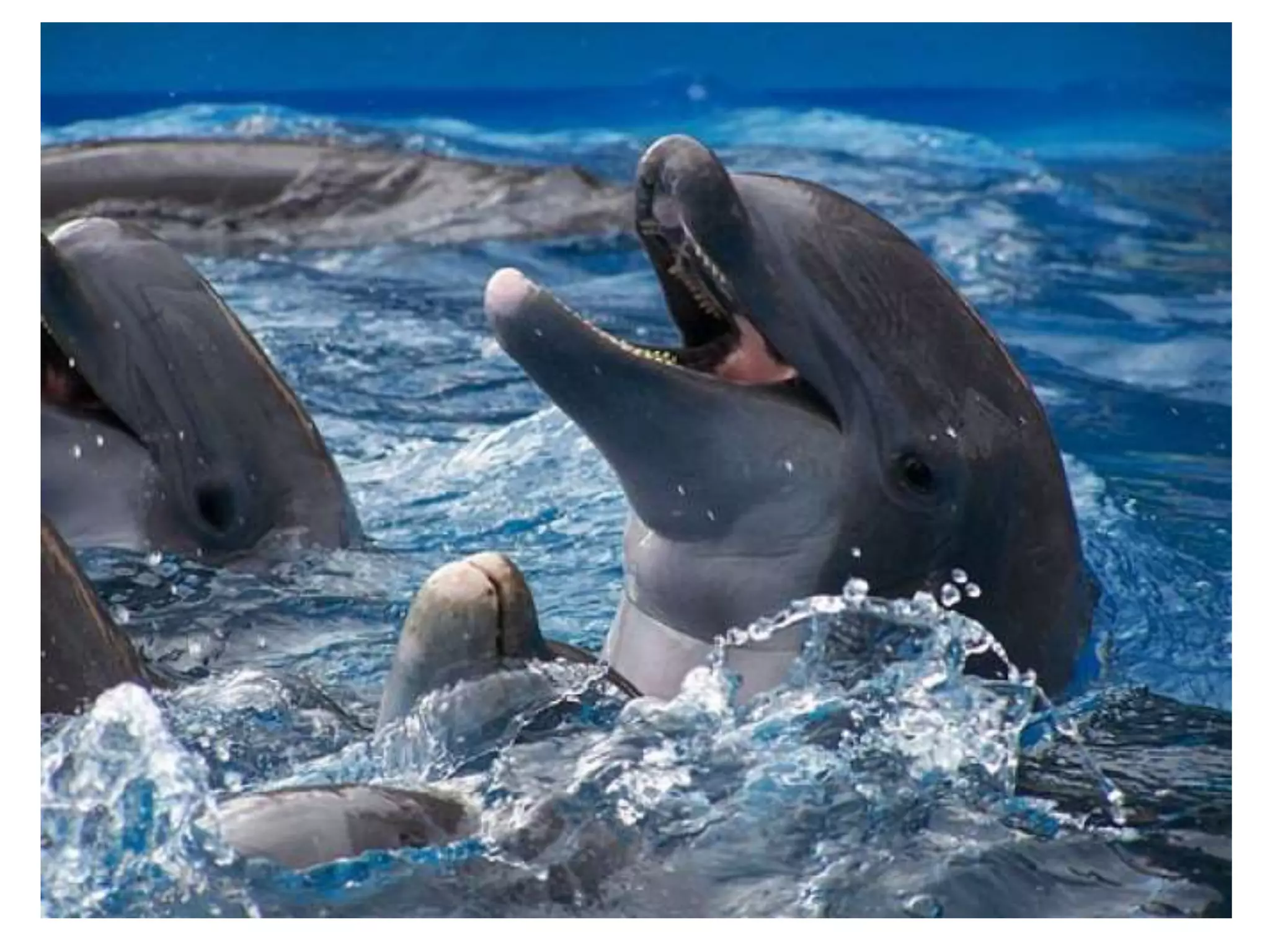
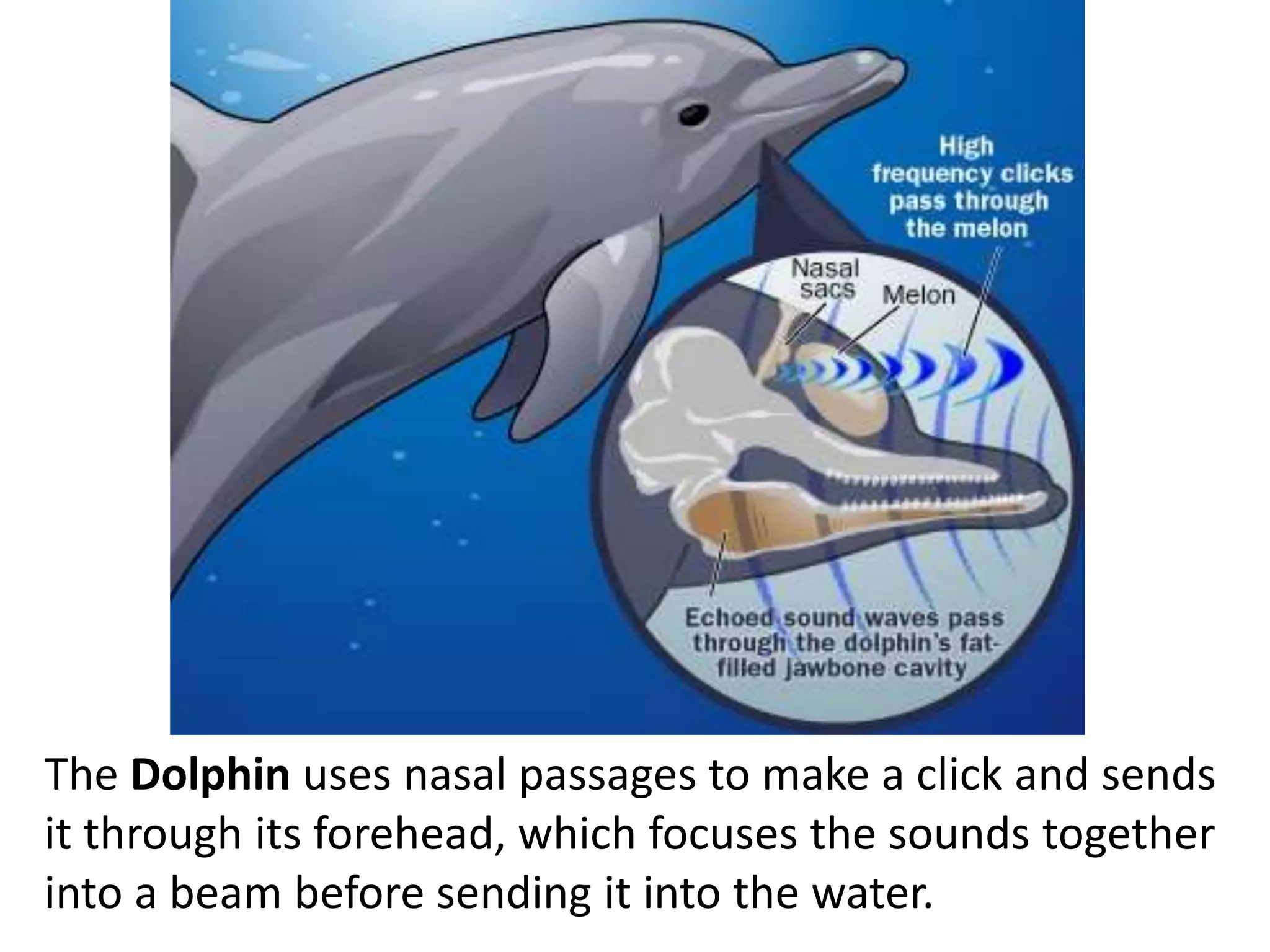
The Dolphin uses nasal passages to make a click and sends 
it through its forehead, which focuses the sounds together 
into a beam before sending it into the water.
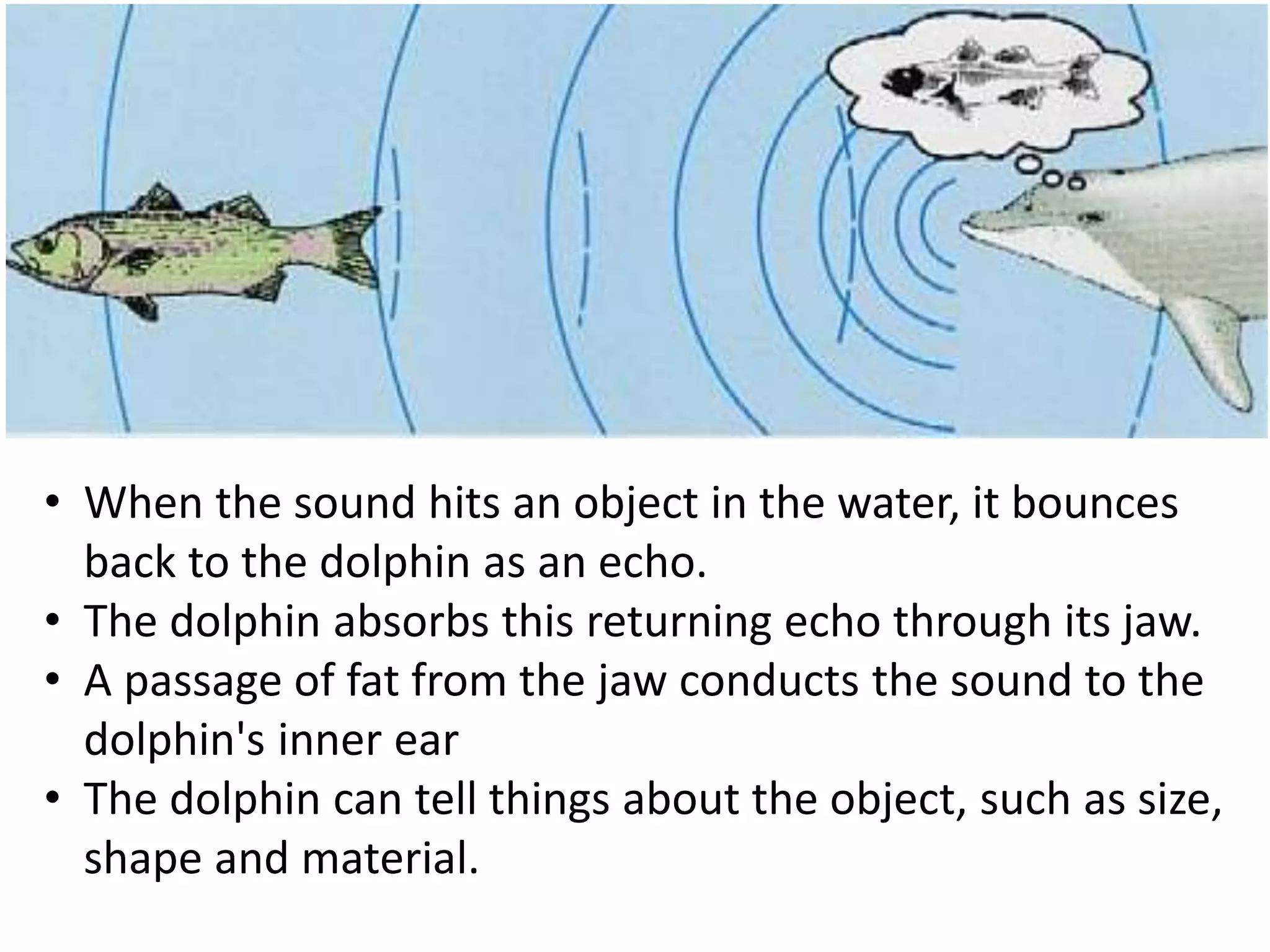
• When the sound hits an object in the water, it bounces 
back to the dolphin as an echo. 
• The dolphin absorbs this returning echo through its jaw. 
• A passage of fat from the jaw conducts the sound to the 
dolphin's inner ear 
• The dolphin can tell things about the object, such as size, 
shape and material.
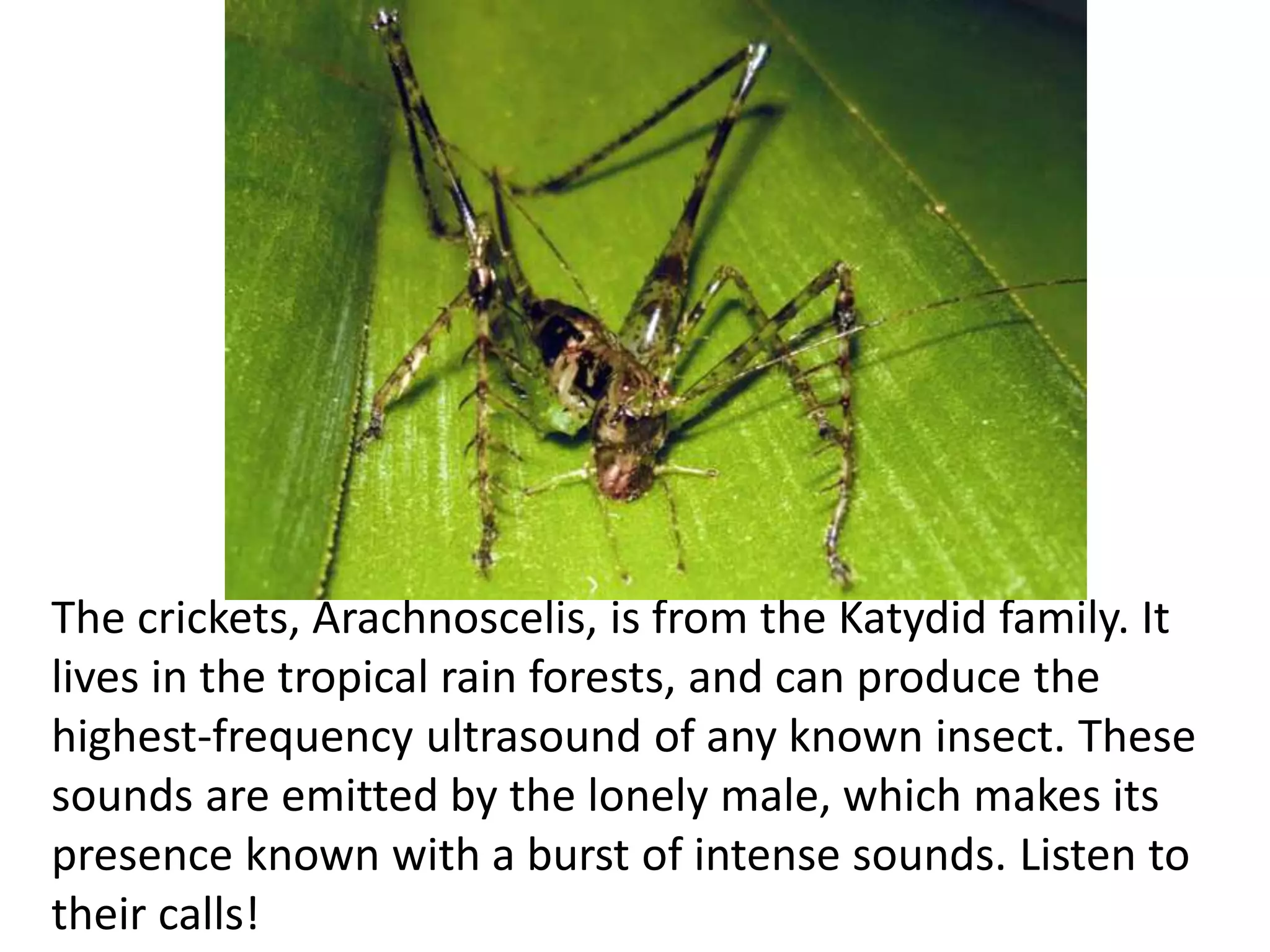
The crickets, Arachnoscelis, is from the Katydid family. It 
lives in the tropical rain forests, and can produce the 
highest-frequency ultrasound of any known insect. These 
sounds are emitted by the lonely male, which makes its 
presence known with a burst of intense sounds. Listen to 
their calls!
Arachnoscelis arachnoids, a rare species of katydid from Central 
Northeast of Colombia, uses elastic energy and wing movement 
to reach volumes greater than 110 decibels, which is louder than 
a diesel truck or a subway train. 
http://www.sci-news.com/biology/science-bushcricket-colombia-01265.html
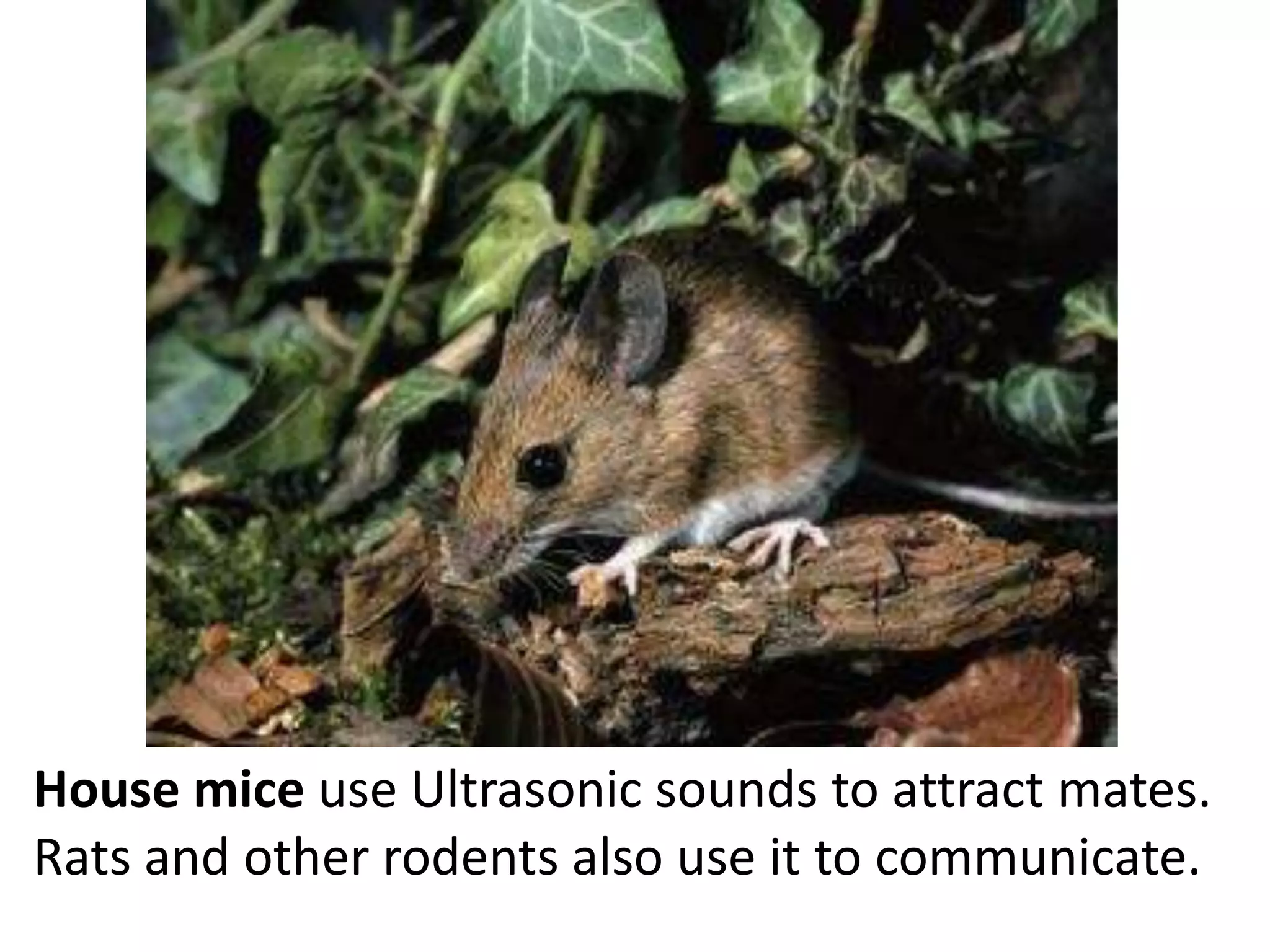
House mice use Ultrasonic sounds to attract mates. 
Rats and other rodents also use it to communicate.
The Huia Cavitympanum is the only known frog species 
that can communicate using purely ultrasonic calls. This 
unusual frog lives in the Philippines. These frogs can hear 
sounds up to 38 kilohertz, the highest frequency any 
amphibian species has been known to hear.
What are some of the 
ways animals use 
Ultrasound and 
Echolocation?
As you have seen, many animals use 
Echolocation to help them move about in 
low light and to locate food. They also use 
Ultrasonic sounds to communicate. 
From watching animals and through 
scientific experiments, humans have 
learned to use Echolocation, SONAR and 
also RADAR in many different ways.
Science Technology Engineering 
• Science looks at Nature and explains it 
• Technology figures out how to make 
Science useful 
• Engineering builds new things using 
Technology
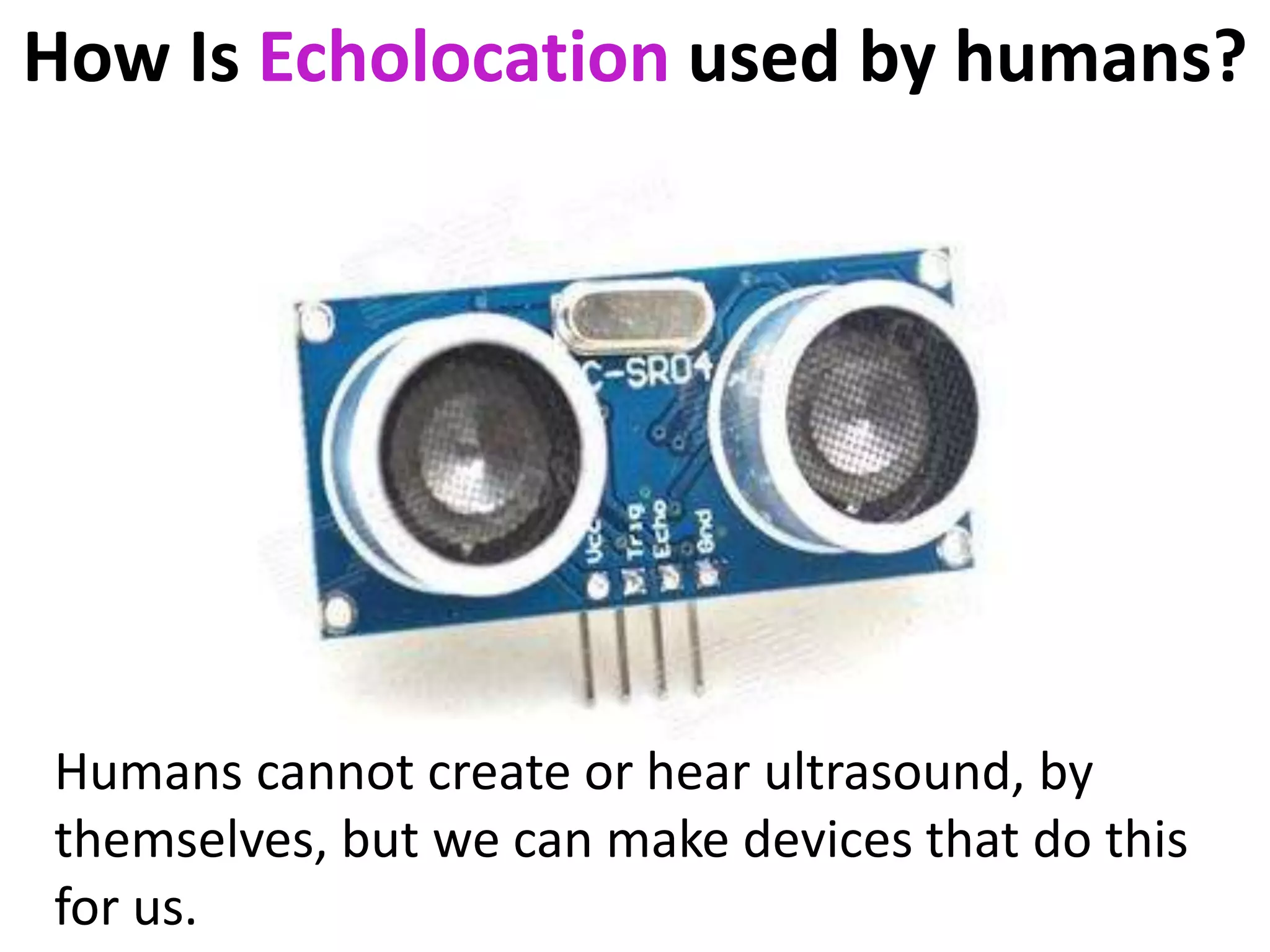
How Is Echolocation used by humans? 
Humans cannot create or hear ultrasound, by 
themselves, but we can make devices that do this 
for us.
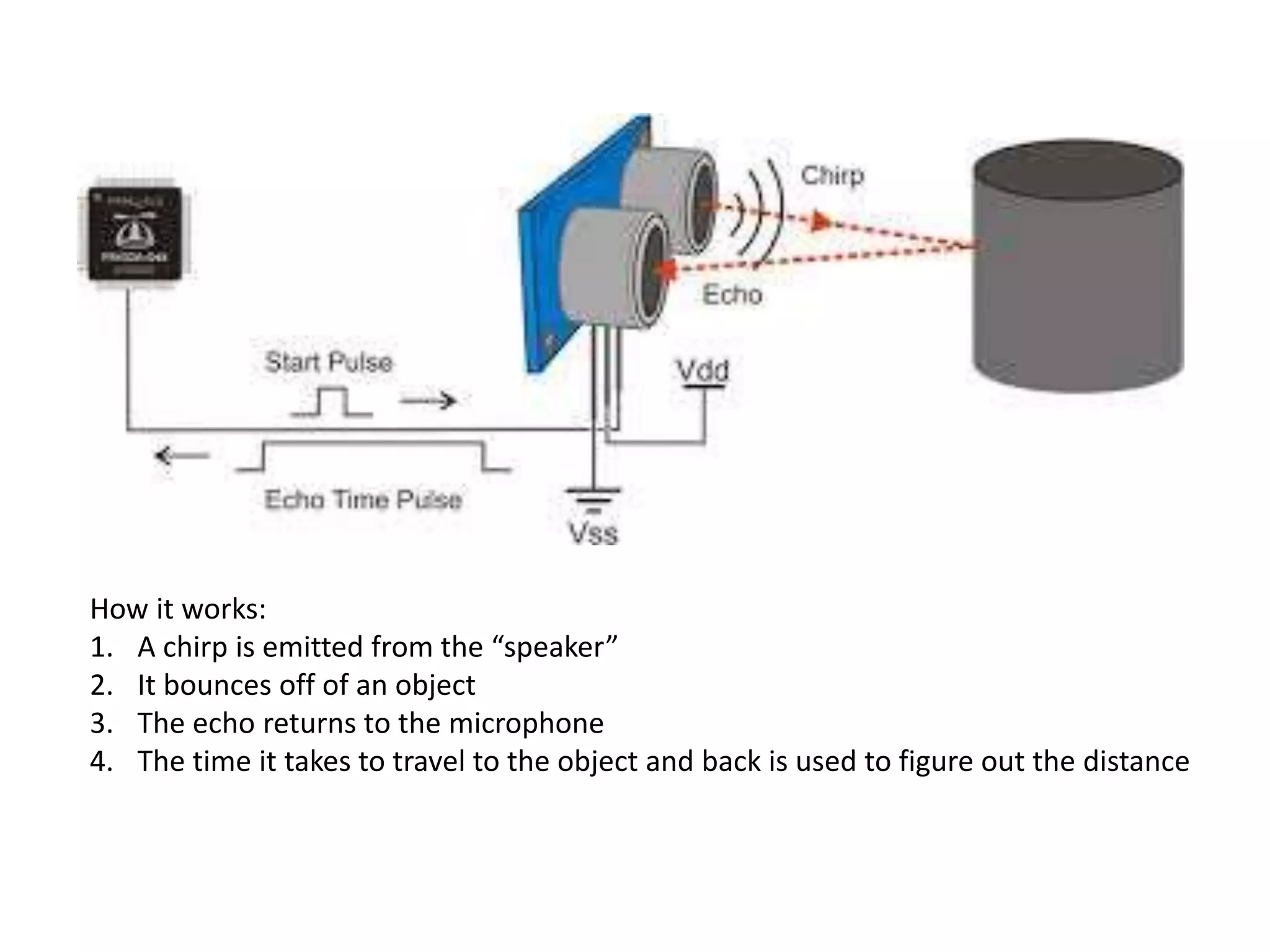
How it works: 
1. A chirp is emitted from the “speaker” 
2. It bounces off of an object 
3. The echo returns to the microphone 
4. The time it takes to travel to the object and back is used to figure out the distance
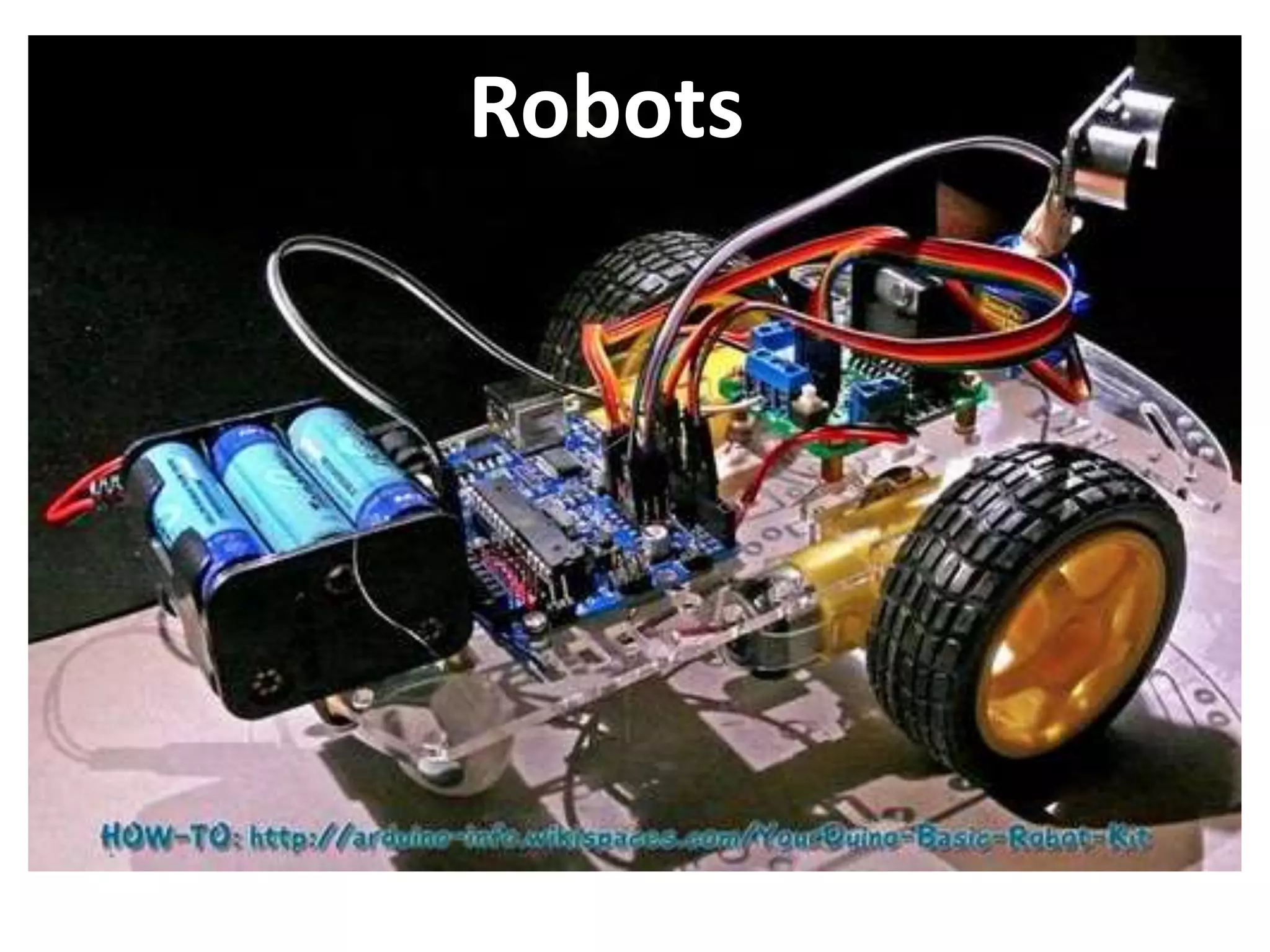
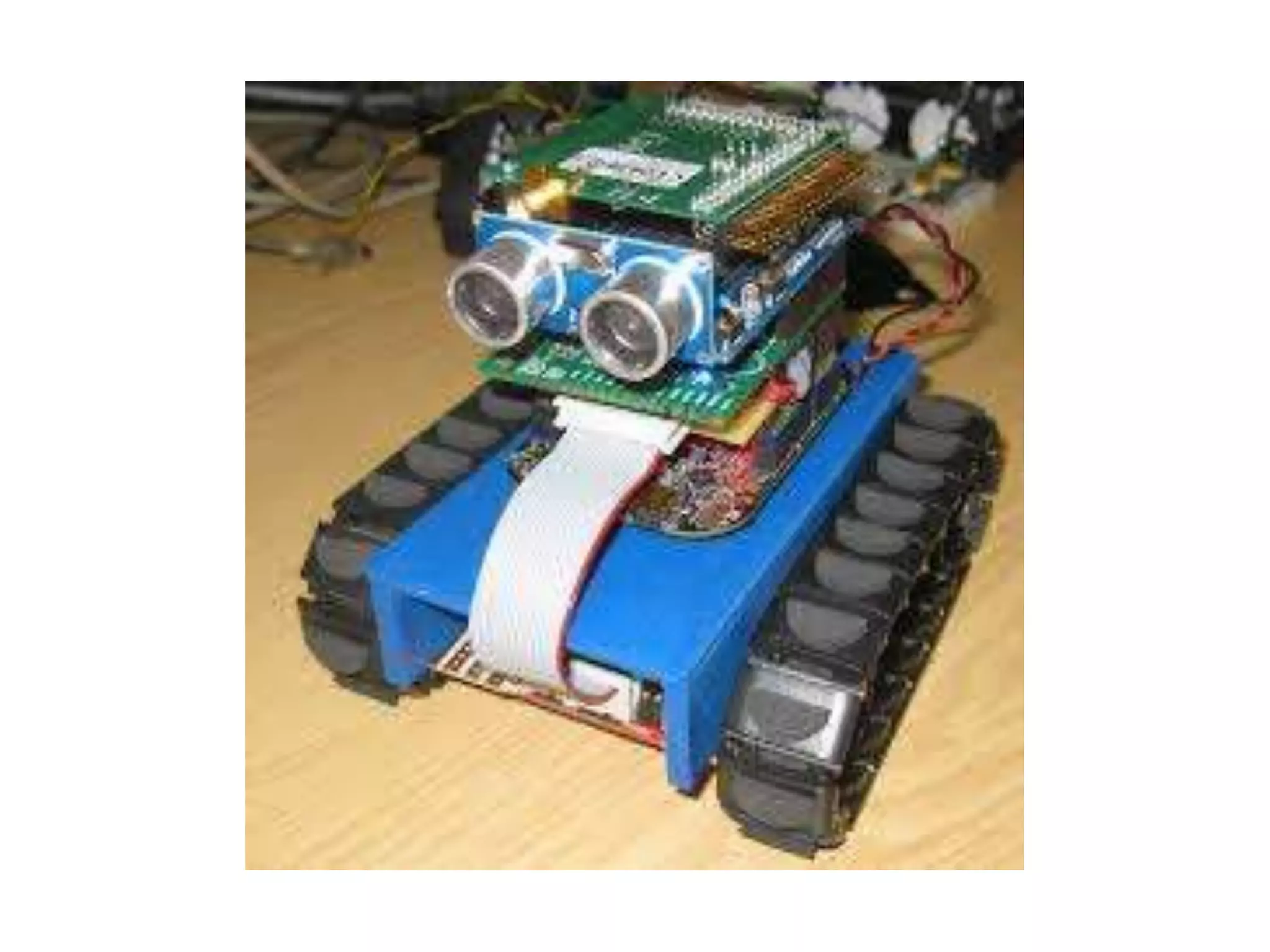
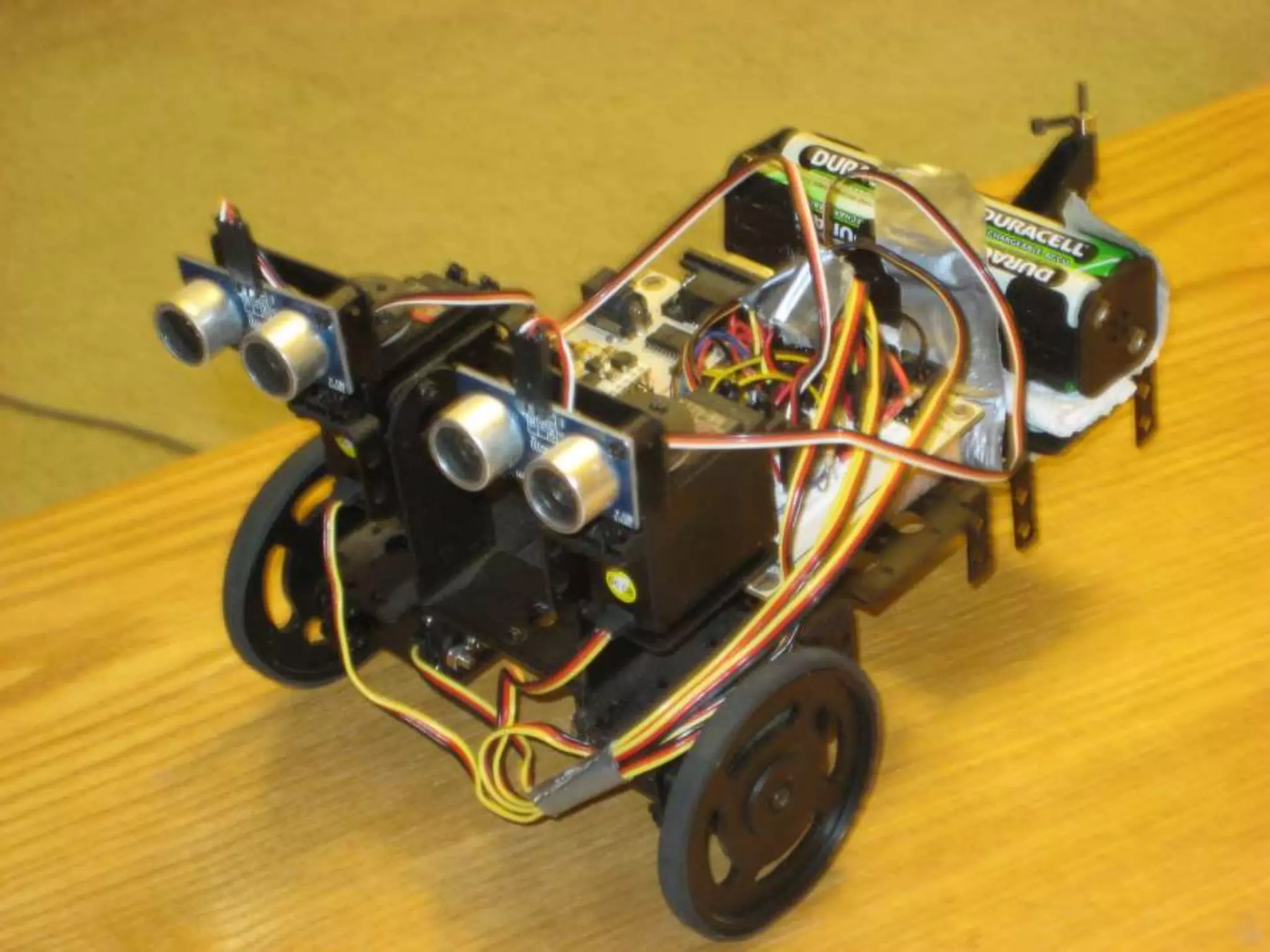
Robots
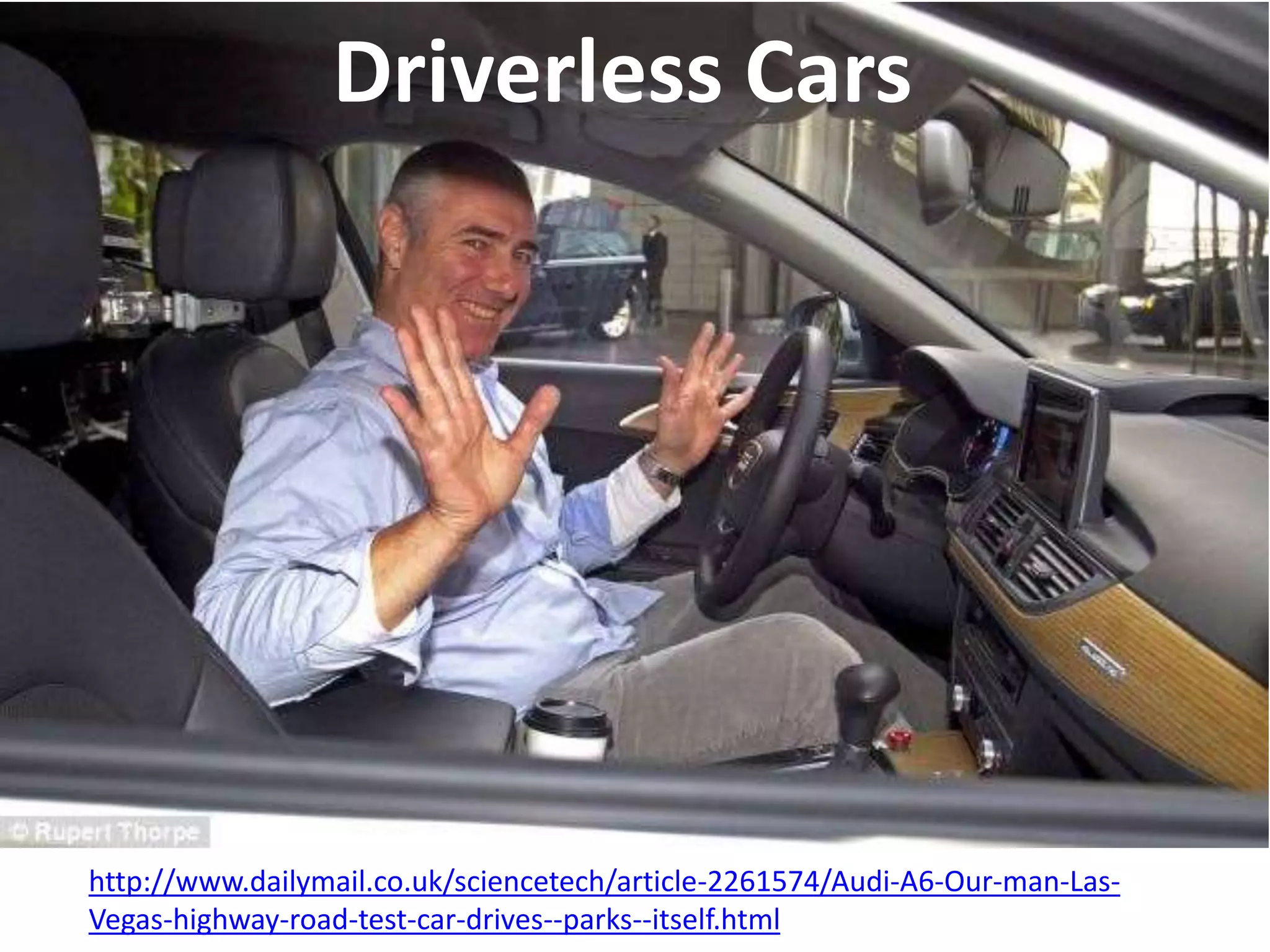
Driverless Cars 
http://www.dailymail.co.uk/sciencetech/article-2261574/Audi-A6-Our-man-Las- 
Vegas-highway-road-test-car-drives--parks--itself.html
http://wbbw1.bwbx.io/cms/2012-04-09/0409_GigaOM_car_630x420.jpg
http://www.economist.com/node/21560989
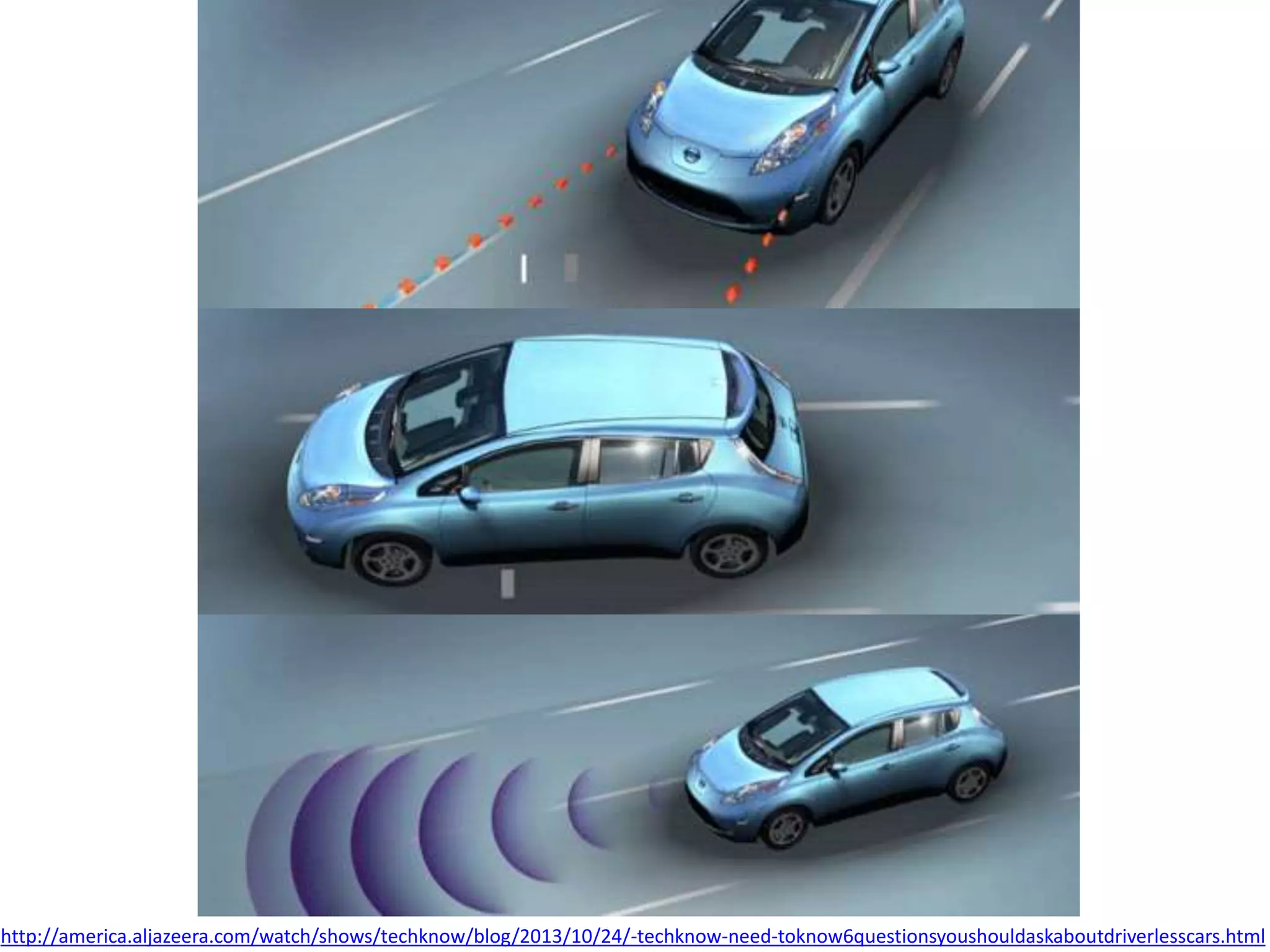
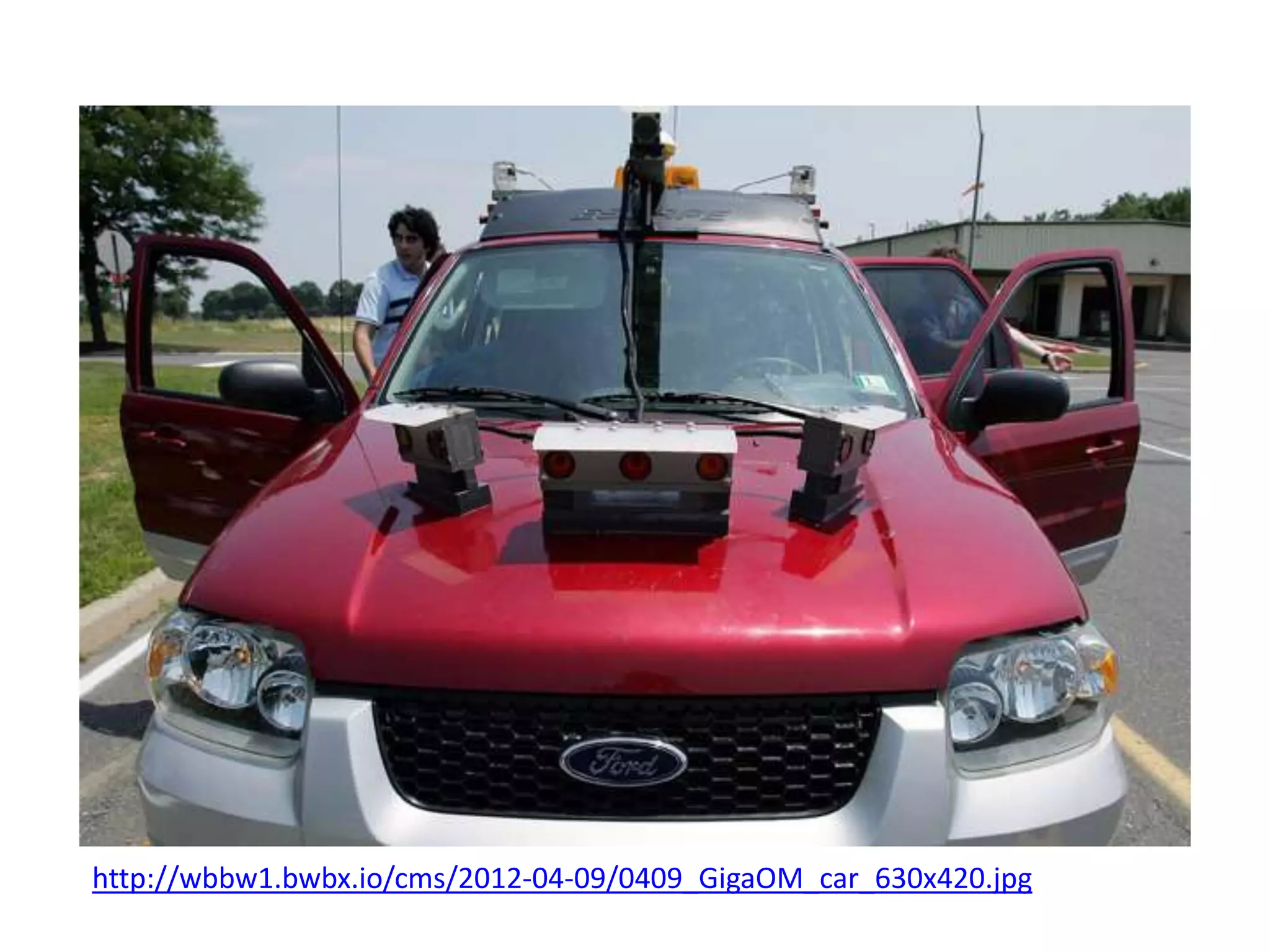
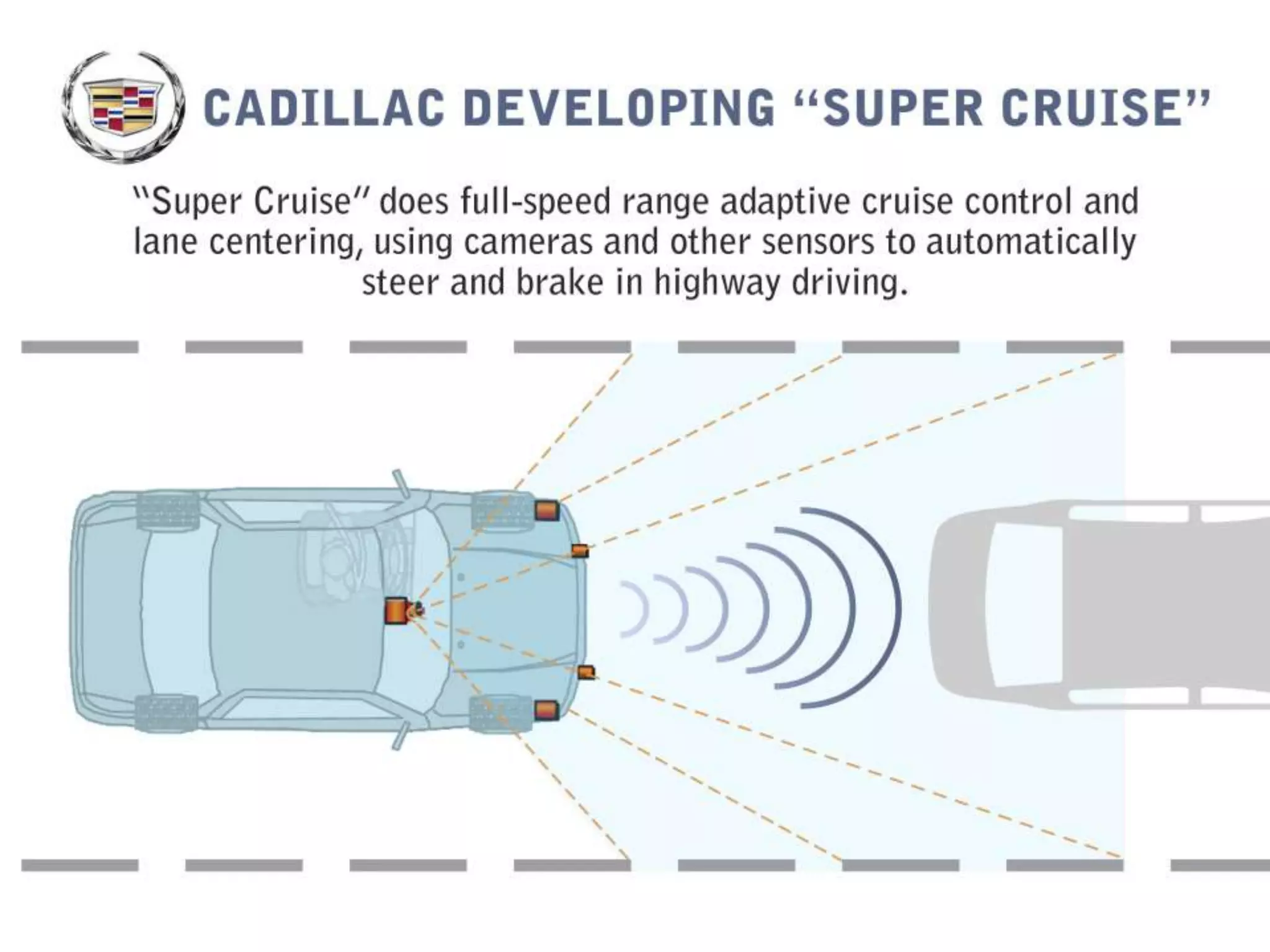
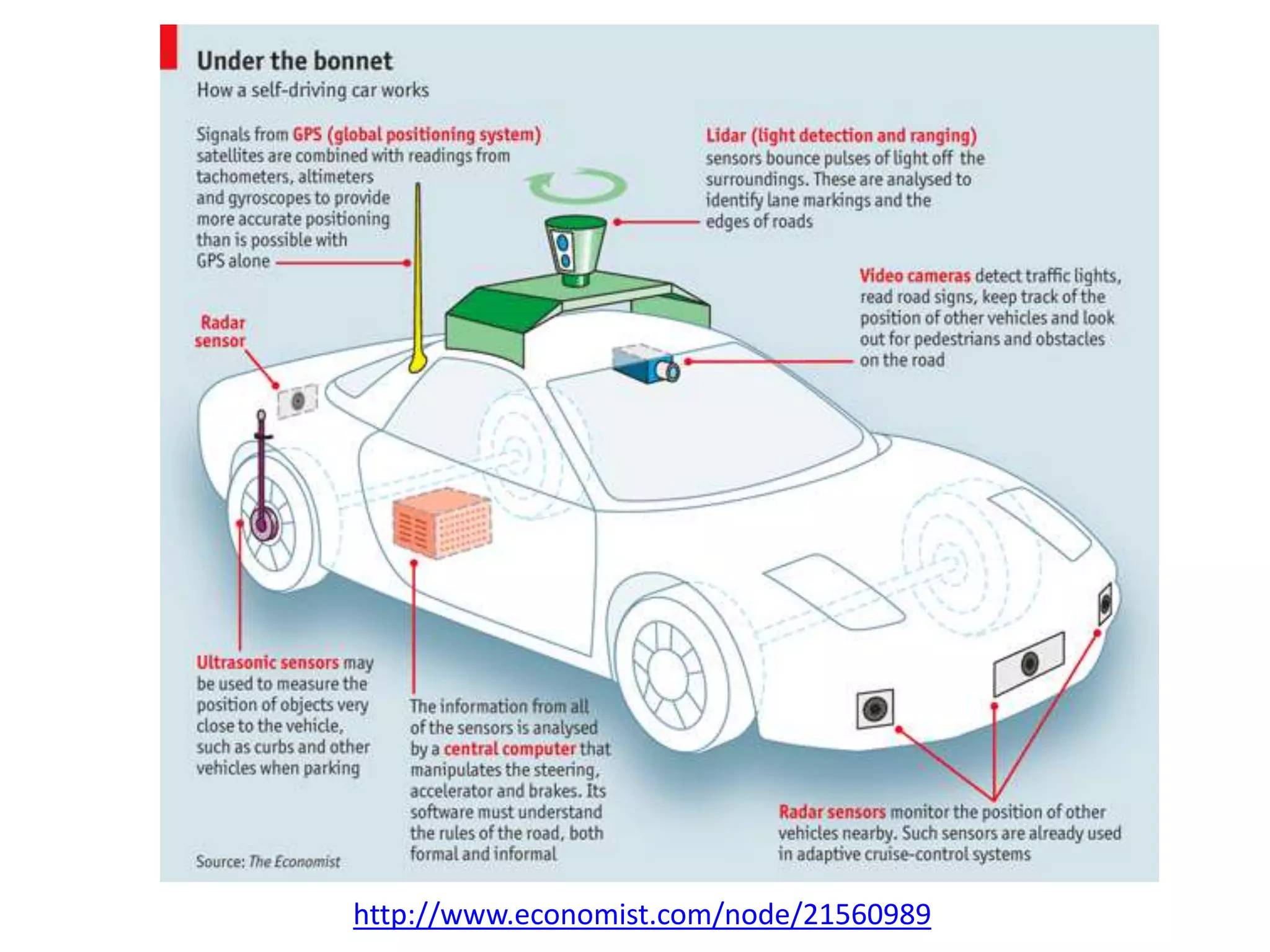
The Driverless Car is equipped with 
radar sensors monitoring up to 820ft 
ahead, a wide-angle video camera that 
monitors lane markings. It also has 8 
Ultrasonic Sensors. It can even park 
itself, squeezing in to within 4in of 
another car. 
Read more: http://www.dailymail.co.uk/sciencetech/article-2261574/Audi-A6- 
Our-man-Las-Vegas-highway-road-test-car-drives--parks-- 
itself.html#ixzz2xT65l5od
http://america.aljazeera.com/watch/shows/techknow/blog/2013/10/24/-techknow-need-toknow6questionsyoushouldaskaboutdriverlesscars.html
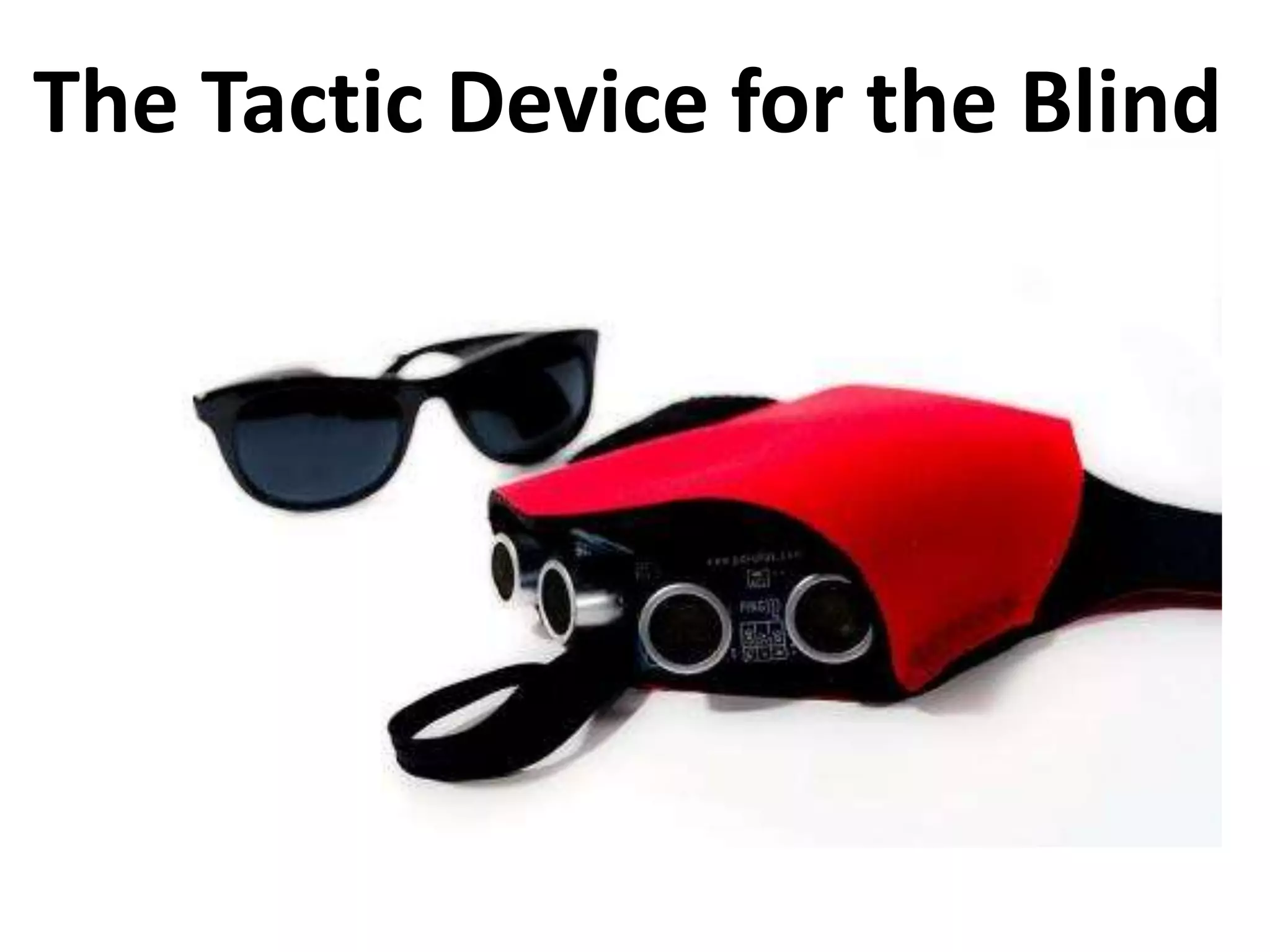
The Tactic Device for the Blind
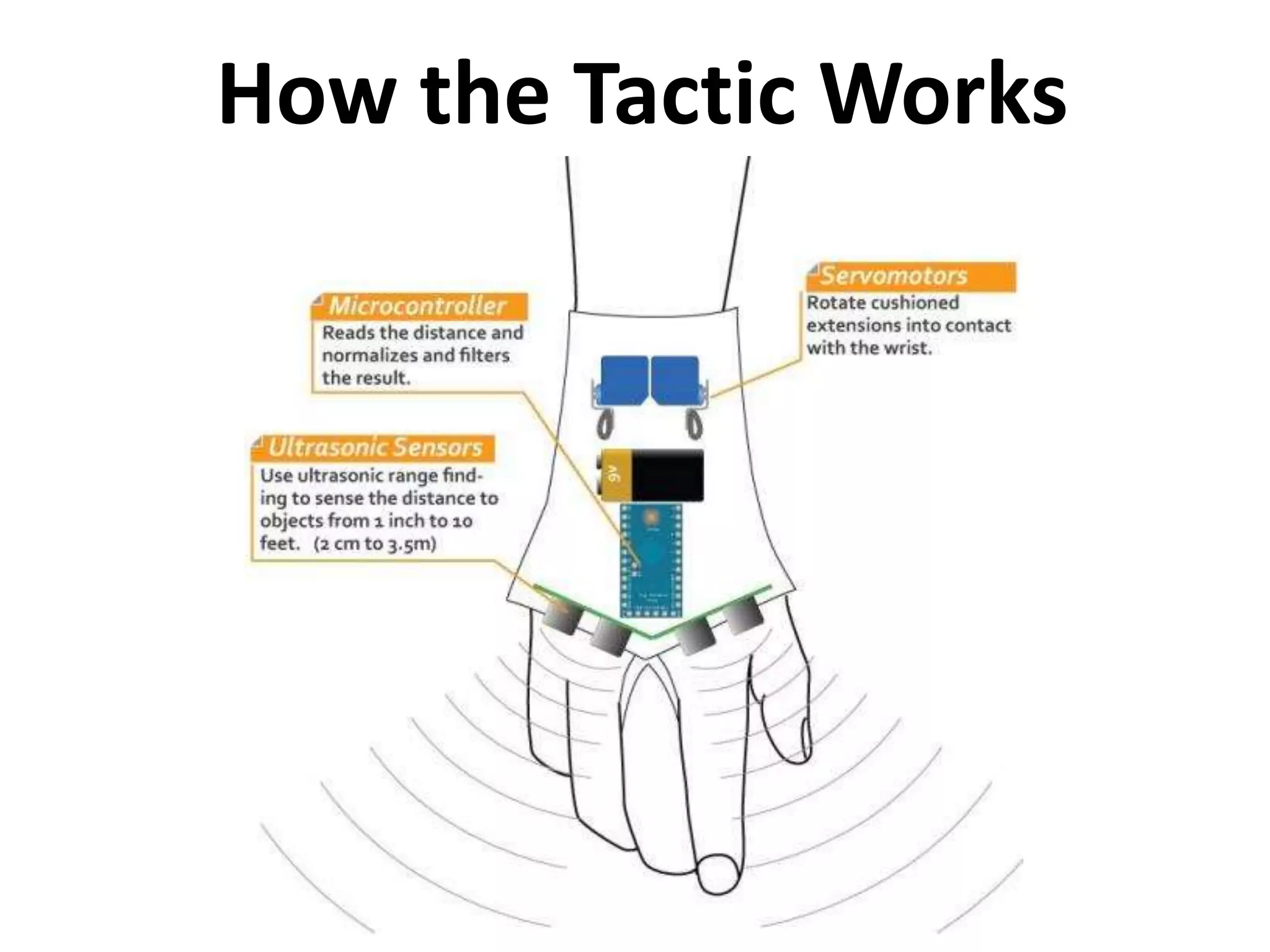
How the Tactic Works
• The Tactic can help the blind move around 
safely. 
• It is mounted on your wrist and uses ultrasonic 
sensors set above the knuckles that can pick up 
the distance of objects from one inch to 10 feet 
away 
• It then translates that distance to pressure on 
the wrist--the closer the object, the more 
pressure on the wrist. 
Read more at: http://phys.org/news/2011-09-tacit-device-safety-video.html#jCp
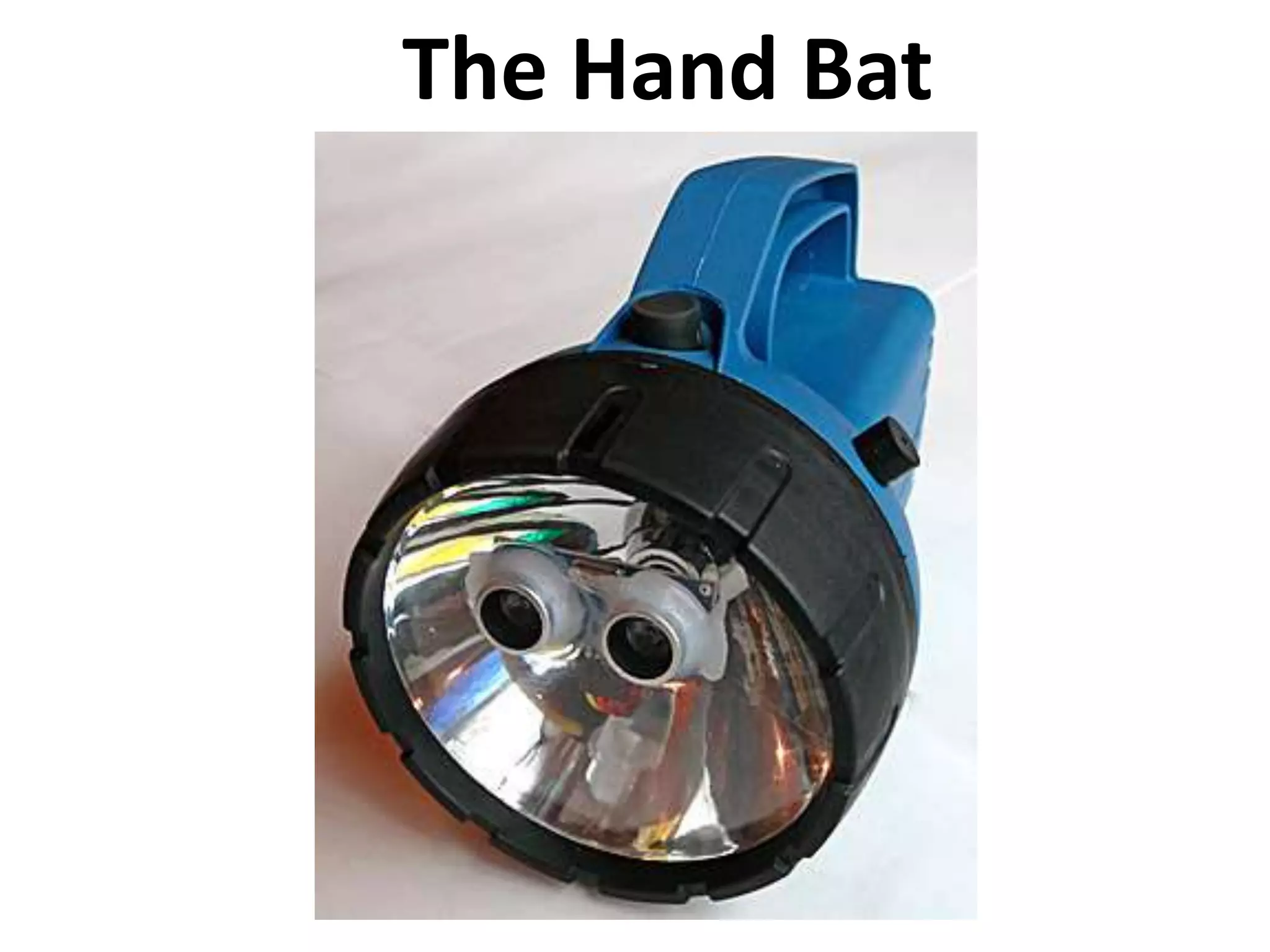
The Hand Bat
• The Hand Bat is a simple Do It Yourself (DIY) 
device similar to the Tactic 
• It uses an Arduino Microcomputer, an 
ultrasonic sensor and a beeper 
• It is built in a low-cost waterproof flashlight 
case 
• When you point it in different directions, it 
sends out an ultrasonic sound and listens for 
the echo 
• It figures out the distance and tells the user 
how far away an object is with different sounds
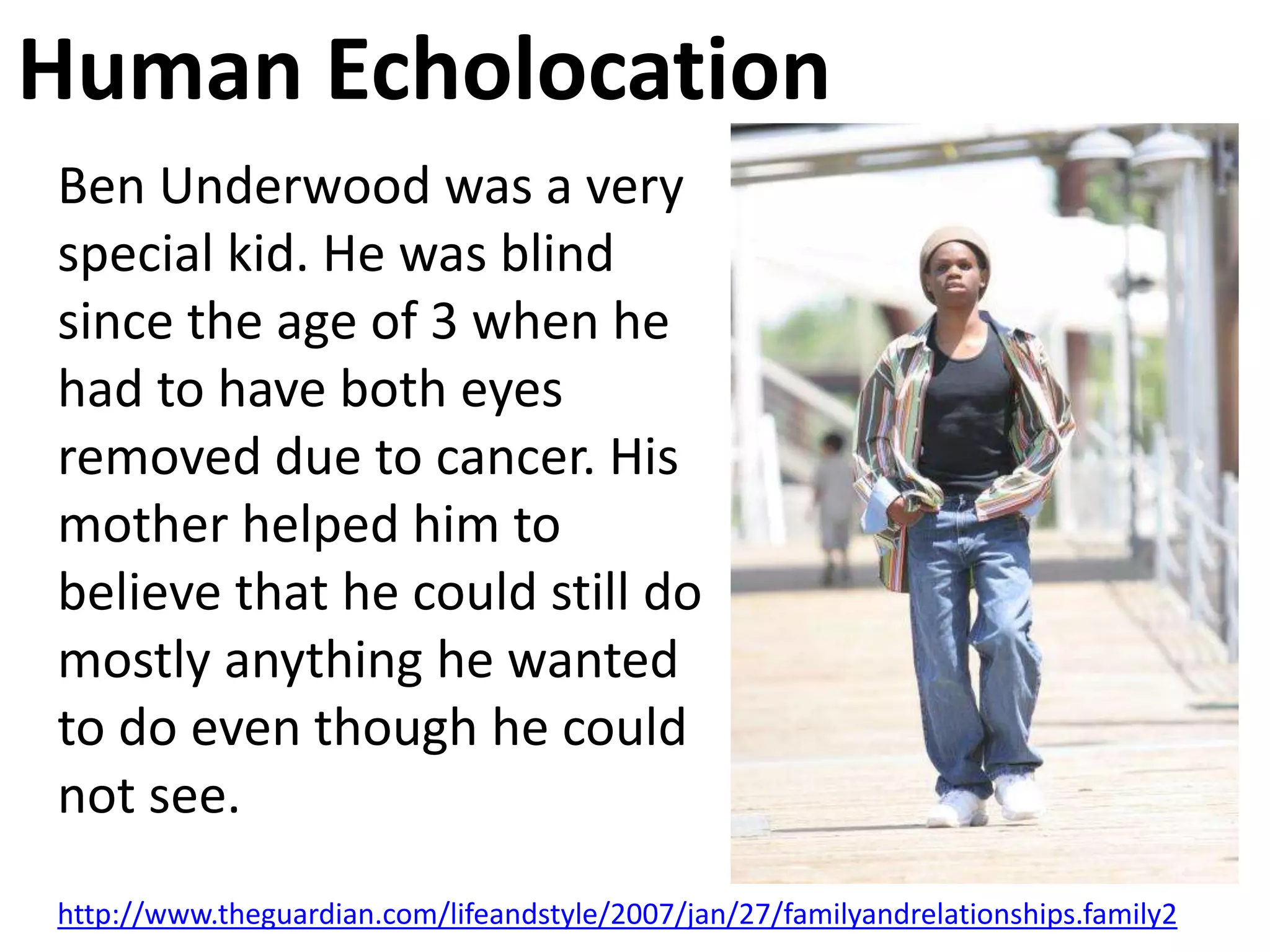
Human Echolocation 
Ben Underwood was a very 
special kid. He was blind 
since the age of 3 when he 
had to have both eyes 
removed due to cancer. His 
mother helped him to 
believe that he could still do 
mostly anything he wanted 
to do even though he could 
not see. 
http://www.theguardian.com/lifeandstyle/2007/jan/27/familyandrelationships.family2
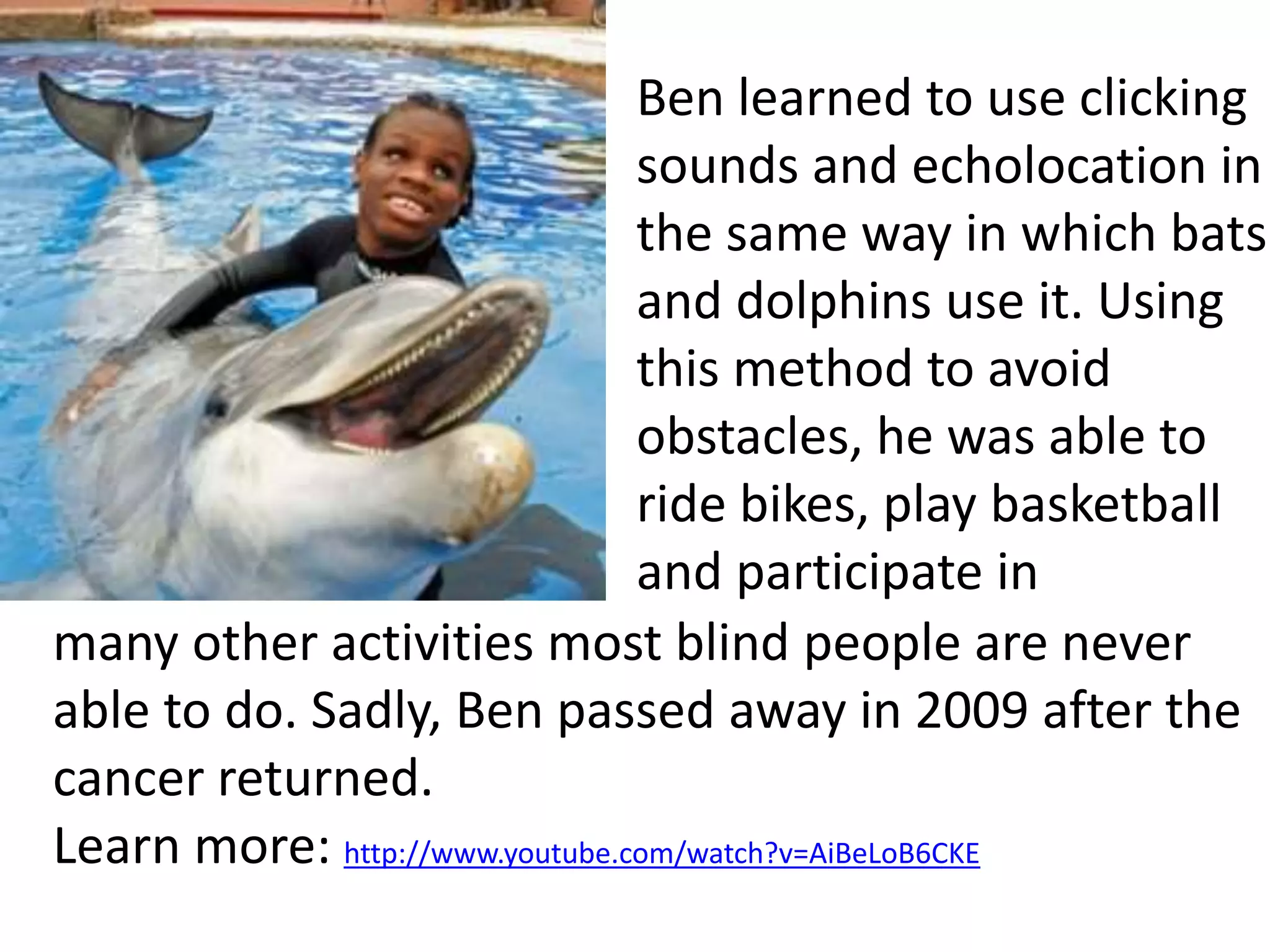
Ben learned to use clicking 
sounds and echolocation in 
the same way in which bats 
and dolphins use it. Using 
this method to avoid 
obstacles, he was able to 
ride bikes, play basketball 
and participate in 
many other activities most blind people are never 
able to do. Sadly, Ben passed away in 2009 after the 
cancer returned. 
Learn more: http://www.youtube.com/watch?v=AiBeLoB6CKE
The True Story of Ben Underwood

Echolocation

  • 2.
    Speed of Light– Speed of Sound • You can see a flash of Lightning almost instantly • But it takes a while before you hear the thunder • You can count to tell how far away it is • Sound takes about 5 seconds to go 1 mile
  • 3.
  • 4.
    What can theyhear? • Humans – up to 20,000 Hz • Dogs – up to 40,000 Hz • Cats – up to 60,000 Hz • Bats – up to 100,000 Hz • Dolphins – up to 150,000 Hz
  • 5.
    What do soundwaves look like? Human Thunder = low frequency
  • 6.
  • 7.
    What is Echolocation? "Echolocation is the use of sound waves and echoes to determine where objects are in space” In other words, echoes help to find the location of an object. http://askabiologist.asu.edu/echolocation
  • 8.
    How is Echolocationused by animals ?
  • 9.
    • Bats sendout sound waves using their mouth or nose. • When the sound hits an object, an echo comes back. • The bat can identify an object by the sound of the echo. http://askabiologist.asu.edu/sites/default/files/echolocation.jpg
  • 11.
    Blind as aBat? • Most bats regularly eat flying insects. • Bats can see as well as humans, but echolocation is much more important to them than their eyesight for finding food. • Bat’s Echolocation is so precise that it can detect an object the width of a human hair. • Mother bats who are feeding their babies, may catch and eat up to 4500 insects in one night!
  • 12.
    They can eventell the size, shape and texture of a tiny insect from its echo .
  • 13.
    Some moths havedeveloped ways to get away or confuse bats, such as: • Furry wings that don't reflect bat echolocation pulses. • Sensitive membranes that can 'hear' echolocation pulses. When the pulses are detected, the moths fly in crazy patterns or fold their wings and dive to confuse their hunters. http://academic.reed.edu/biology/professors/srenn/pages/teaching/web_2007/pf_site/adaptation.html
  • 14.
    Bats using Ultrasoundto Catch Prey Click on photo to start video
  • 15.
  • 16.
  • 17.
    The Tiger MothCan can emit ultrasonic clicks to "jam" a Bat's sonar! This moth produces ultrasound not to communicate, but as a way to protect itself. By producing ultrasound of its own, it is able to ward off bats by acting as a radar jammer, confusing the bats so that the moth cannot be located. By doing this, they add another weapon to their survival mechanisms that also includes poison. http://en.wikipedia.org/wiki/Arctiidae
  • 18.
    Philippine Tarsier Thetiny Tarsier, only 4 inches long, can communicate using ultrasound. The Tarsier is the only primate known to communicate in this way.
  • 20.
    The Dolphin usesnasal passages to make a click and sends it through its forehead, which focuses the sounds together into a beam before sending it into the water.
  • 21.
    • When thesound hits an object in the water, it bounces back to the dolphin as an echo. • The dolphin absorbs this returning echo through its jaw. • A passage of fat from the jaw conducts the sound to the dolphin's inner ear • The dolphin can tell things about the object, such as size, shape and material.
  • 23.
    The crickets, Arachnoscelis,is from the Katydid family. It lives in the tropical rain forests, and can produce the highest-frequency ultrasound of any known insect. These sounds are emitted by the lonely male, which makes its presence known with a burst of intense sounds. Listen to their calls!
  • 24.
    Arachnoscelis arachnoids, arare species of katydid from Central Northeast of Colombia, uses elastic energy and wing movement to reach volumes greater than 110 decibels, which is louder than a diesel truck or a subway train. http://www.sci-news.com/biology/science-bushcricket-colombia-01265.html
  • 25.
    House mice useUltrasonic sounds to attract mates. Rats and other rodents also use it to communicate.
  • 27.
    The Huia Cavitympanumis the only known frog species that can communicate using purely ultrasonic calls. This unusual frog lives in the Philippines. These frogs can hear sounds up to 38 kilohertz, the highest frequency any amphibian species has been known to hear.
  • 28.
    What are someof the ways animals use Ultrasound and Echolocation?
  • 29.
    As you haveseen, many animals use Echolocation to help them move about in low light and to locate food. They also use Ultrasonic sounds to communicate. From watching animals and through scientific experiments, humans have learned to use Echolocation, SONAR and also RADAR in many different ways.
  • 30.
    Science Technology Engineering • Science looks at Nature and explains it • Technology figures out how to make Science useful • Engineering builds new things using Technology
  • 31.
    How Is Echolocationused by humans? Humans cannot create or hear ultrasound, by themselves, but we can make devices that do this for us.
  • 32.
    How it works: 1. A chirp is emitted from the “speaker” 2. It bounces off of an object 3. The echo returns to the microphone 4. The time it takes to travel to the object and back is used to figure out the distance
  • 33.
  • 36.
  • 37.
  • 39.
  • 40.
    The Driverless Caris equipped with radar sensors monitoring up to 820ft ahead, a wide-angle video camera that monitors lane markings. It also has 8 Ultrasonic Sensors. It can even park itself, squeezing in to within 4in of another car. Read more: http://www.dailymail.co.uk/sciencetech/article-2261574/Audi-A6- Our-man-Las-Vegas-highway-road-test-car-drives--parks-- itself.html#ixzz2xT65l5od
  • 41.
  • 42.
    The Tactic Devicefor the Blind
  • 43.
  • 44.
    • The Tacticcan help the blind move around safely. • It is mounted on your wrist and uses ultrasonic sensors set above the knuckles that can pick up the distance of objects from one inch to 10 feet away • It then translates that distance to pressure on the wrist--the closer the object, the more pressure on the wrist. Read more at: http://phys.org/news/2011-09-tacit-device-safety-video.html#jCp
  • 45.
  • 46.
    • The HandBat is a simple Do It Yourself (DIY) device similar to the Tactic • It uses an Arduino Microcomputer, an ultrasonic sensor and a beeper • It is built in a low-cost waterproof flashlight case • When you point it in different directions, it sends out an ultrasonic sound and listens for the echo • It figures out the distance and tells the user how far away an object is with different sounds
  • 47.
    Human Echolocation BenUnderwood was a very special kid. He was blind since the age of 3 when he had to have both eyes removed due to cancer. His mother helped him to believe that he could still do mostly anything he wanted to do even though he could not see. http://www.theguardian.com/lifeandstyle/2007/jan/27/familyandrelationships.family2
  • 48.
    Ben learned touse clicking sounds and echolocation in the same way in which bats and dolphins use it. Using this method to avoid obstacles, he was able to ride bikes, play basketball and participate in many other activities most blind people are never able to do. Sadly, Ben passed away in 2009 after the cancer returned. Learn more: http://www.youtube.com/watch?v=AiBeLoB6CKE
  • 49.
    The True Storyof Ben Underwood

Editor's Notes

  • #2 What happens when you throw a pebble into a pond? Some energy causes waves to travel. In this case it’s you throwing a pebble into the water.Those are visible waves. Do you know any other kinds of waves that are invisible? Sound, radio, light… ----- Meeting Notes (10/28/14 20:49) ----- Both light and sound travel in waves, but light is much faster than sound
  • #3 Why do you think this happens? Answer: Light travels much faster than sound ----- Meeting Notes (10/28/14 20:49) ----- infrasound is too low for humans to hear, and ultrasound is too high for humans to hear
  • #4 There are some sounds we cannot hear as humans because the sound waves are either too low pitched (too spaced apart) or too high pitched (too close together) for our ears to receive them.
  • #5 Wow! Other animals can hear much higher sounds than we can! ----- Meeting Notes (10/28/14 20:28) -----
  • #6 Low sounds have waves which are far apart, high sounds like ultrasound have waves that are closer together
  • #7 Sound bounces off of objects and comes back to you. Have you heard echoes?
  • #8 If something is close by the echo comes back quickly. If it is far away the echo takes much longer to come back.
  • #9 They can listen for echoes to help them find food and use it to navigate
  • #10  ----- Meeting Notes (4/7/14 11:09) ----- In this drawing of a bat, you can see the nose, mouth and large ears of this bat very clearly
  • #12  Bats use their special skill of echolocation to be able to "see in low light! Wish we could do that!
  • #16 In Code of Claw, Gregor learns echolocation, a valuable skill for fighting in the dark.
  • #17  ----- Meeting Notes (4/7/14 11:09) ----- This moth can make sounds which are too high for us to hear, but they can be heard by the bat
  • #18  ----- Meeting Notes (4/7/14 11:09) ----- Mammals also use ultrasounds but not in the same way that bats or moths do! They use them to talk to each other, but humans cannot hear these sounds!
  • #19  ----- Meeting Notes (4/7/14 11:09) ----- Dolphins also use echolocation
  • #22  ----- Meeting Notes (4/7/14 11:09) ----- Let's take a look at how dolphins are able to use echolocation
  • #23  ----- Meeting Notes (4/7/14 11:09) ----- Insects also can use ultrasound for communication
  • #24  What does a katydid sound like? Let's listen to their calls
  • #25  ----- Meeting Notes (4/7/14 11:09) ----- Mice and other rodents can also use ultrasound to communicate
  • #26  ----- Meeting Notes (4/7/14 11:09) ----- Frogs use ultrasound also!
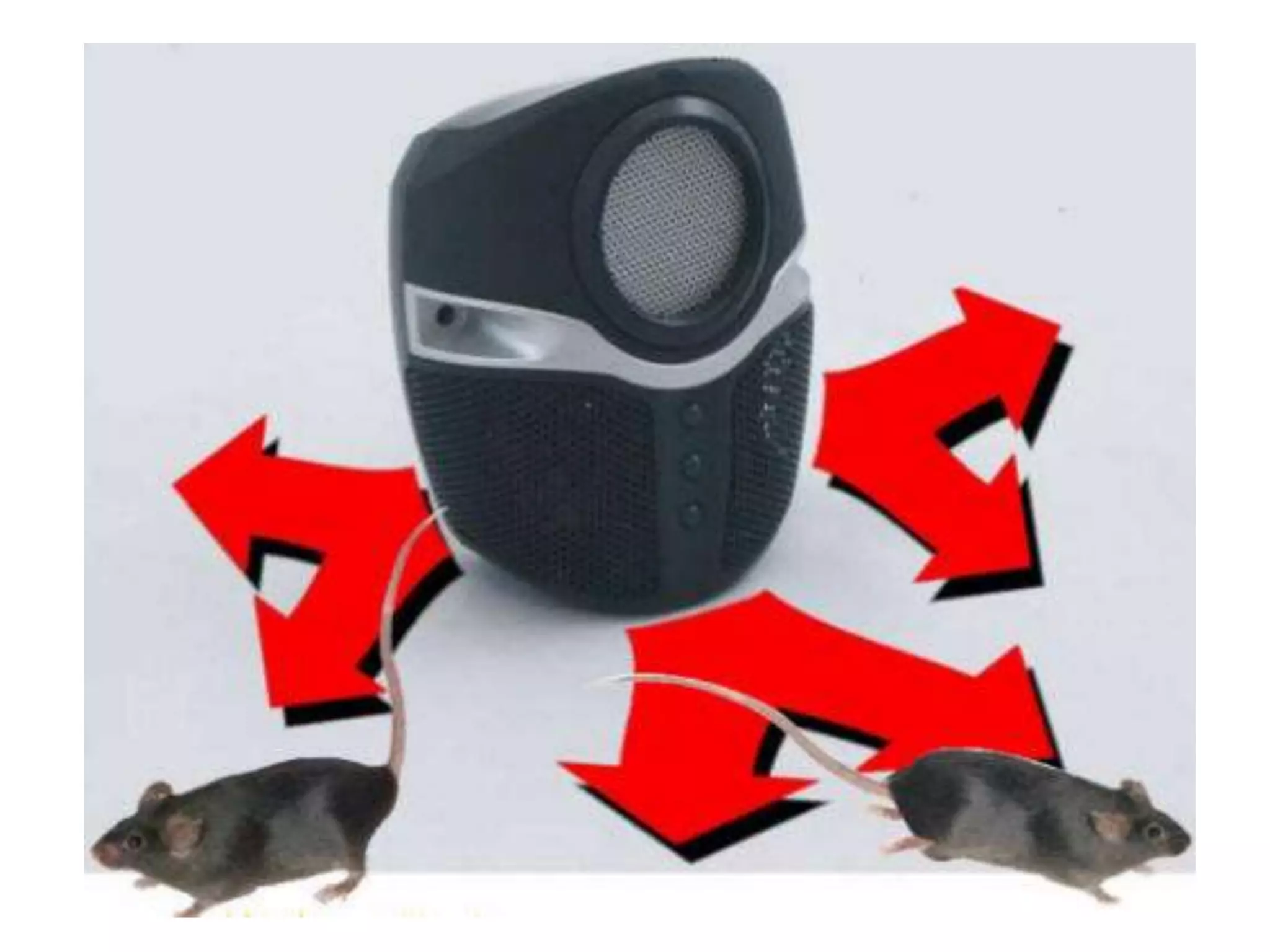
  • #27 What do you think this is? A Ultrasonic rodent repellent
  • #28 Later on I will show you a robot that also communicates at 38 kilohertz
  • #31 Everything we have been looking at so far is science, looking at nature and explaining how it works. Now lets see how technology can figure out how to make echolocation useful to us
  • #32 Here’s an example of echolocation technology that is based on the echolocation science we just looked at
  • #33 Just like the dolphin this device has one section that sends out ultrasonic sounds and a different one that listens for the echo (Handout)
  • #34 Robots are programmed to make decisions based on input from sensors. What decisions is the robot you saw before making?
  • #35 Here is where engineers took that technology that came from the science and invented a new thing
  • #37 A driverless car is a robot car. A robot car is programmed to be able to move about on its own using input from sensors
  • #38 University students added lots of sensors to a Ford to try to create a driverless car
  • #40 Ultrasonic sensors are used to measure the position of objects very close to the vehicle, such as curbs and other vehicles when parking
  • #42 This is using high frequency radar instead of ultrasound but it is the same principle
  • #46 Show then pass it around