Mimicry and Camouflage By Monika and Nicole
Why do animals use mimicry and camouflage? Survival Capture prey or hide from predators Live longer to be old enough to reproduce Protect eggs / young from predators
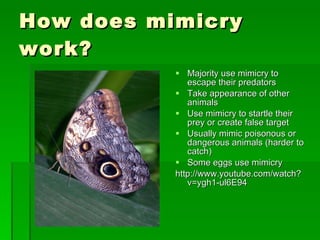
How does mimicry work? Majority use mimicry to escape their predators Take appearance of other animals Use mimicry to startle their prey or create false target Usually mimic poisonous or dangerous animals (harder to catch) Some eggs use mimicry http://www.youtube.com/watch?v=ygh1-ul6E94
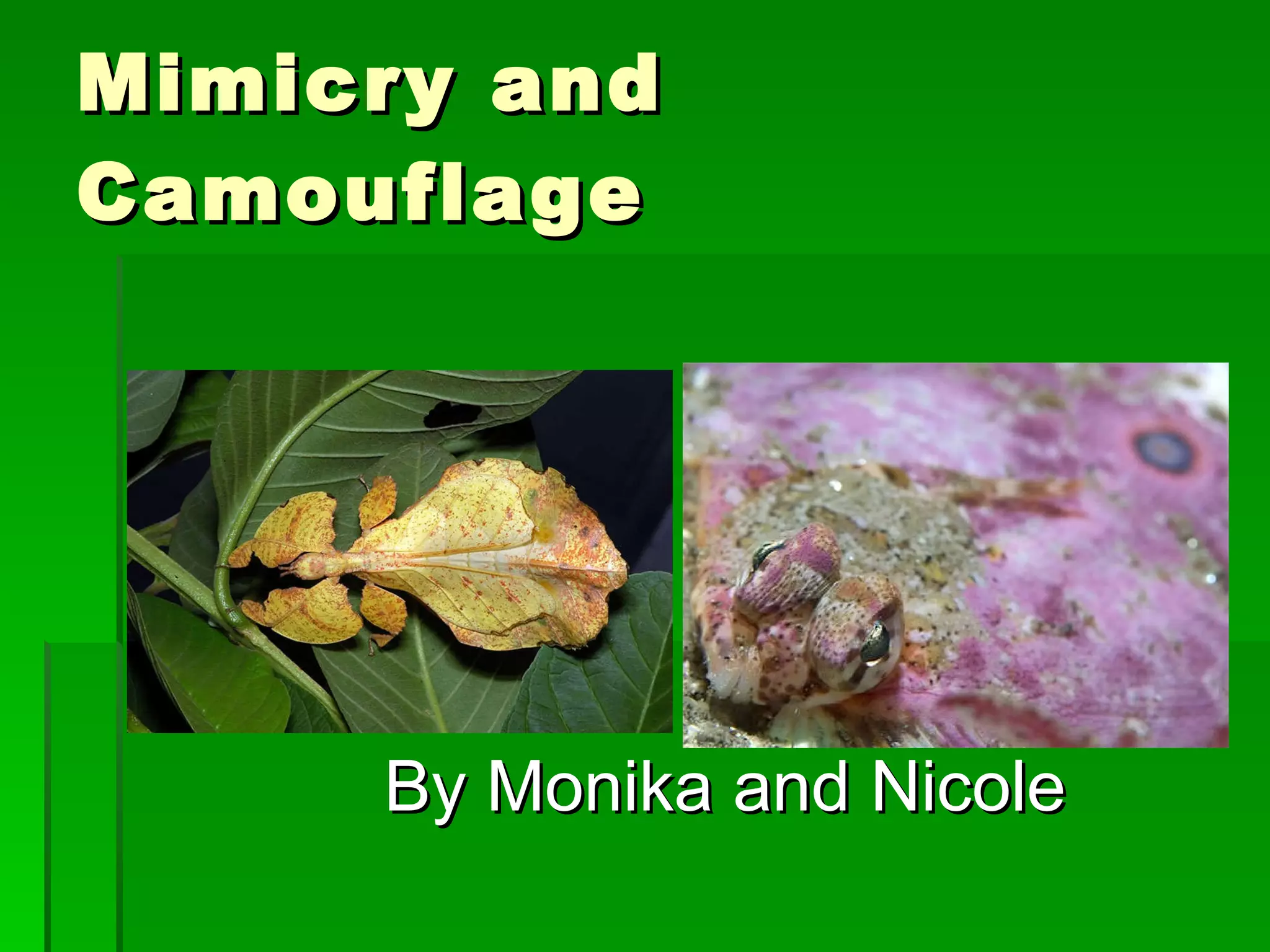
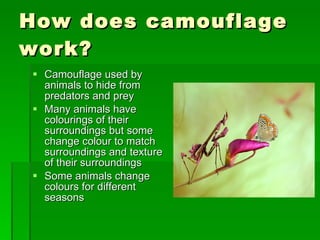
How does camouflage work? Camouflage used by animals to hide from predators and prey Many animals have colourings of their surroundings but some change colour to match surroundings and texture of their surroundings Some animals change colours for different seasons
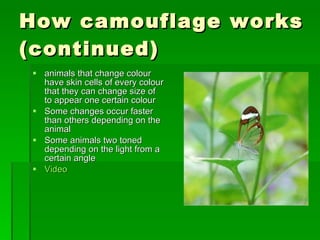
How camouflage works (continued) animals that change colour have skin cells of every colour that they can change size of to appear one certain colour  Some changes occur faster than others depending on the animal Some animals two toned depending on the light from a certain angle Video
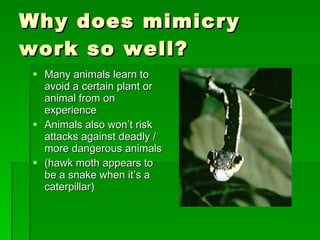
Why does mimicry work so well? Many animals learn to avoid a certain plant or animal from on experience Animals also won’t risk attacks against deadly / more dangerous animals (hawk moth appears to be a snake when it’s a caterpillar)
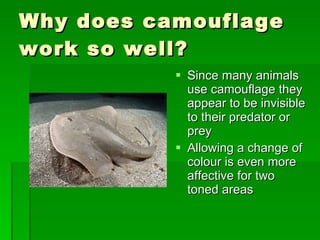
Why does camouflage work so well? Since many animals use camouflage they appear to be invisible to their predator or prey Allowing a change of colour is even more affective for two toned areas
Definitions Mimicry: An anti-predatory device where a species copies the appearance, sound or form of a model species in order to survive.  Camouflage: A survival technique in which an otherwise visible organism may be unseen or indiscernible from its surrounding environment.
Definitions Continued Batesian Mimicry: A type of mimicry where the mimic resembles a model species that has spines, stingers, toxic chemicals or another form of defense from predators. The mimic has none of these.
Definitions Continued Muellerian Mimicry: A type of mimicry where an entire group of organisms bear similar markings or colours that distinguish them as inedible by predators. This means that every species with this appearance is unpalatable or toxic, not just one model species.
Definitions continued Chromatophores: Pigment containing or light reflecting cells that generate colour in certain animals. Chromatophores in camouflaging animals (like chameleons) change size and shape (by the muscles surrounding it) creating different colours in the animals skin.
sources http://animals.howstuffworks.com/animal-facts/animal-camouflage3.htm http://www.biologyreference.com/Ma-Mo/Mimicry-Camouflage-and-Warning-Coloration.html http://www.greenwing.org/teachersguide/fall00activity/fall00ma.html http://rainforests.mongabay.com/0306.htm

Mimicry and Camouflage

  • 1.
    Mimicry and CamouflageBy Monika and Nicole
  • 2.
    Why do animalsuse mimicry and camouflage? Survival Capture prey or hide from predators Live longer to be old enough to reproduce Protect eggs / young from predators
  • 3.
    How does mimicrywork? Majority use mimicry to escape their predators Take appearance of other animals Use mimicry to startle their prey or create false target Usually mimic poisonous or dangerous animals (harder to catch) Some eggs use mimicry http://www.youtube.com/watch?v=ygh1-ul6E94
  • 4.
    How does camouflagework? Camouflage used by animals to hide from predators and prey Many animals have colourings of their surroundings but some change colour to match surroundings and texture of their surroundings Some animals change colours for different seasons
  • 5.
    How camouflage works(continued) animals that change colour have skin cells of every colour that they can change size of to appear one certain colour Some changes occur faster than others depending on the animal Some animals two toned depending on the light from a certain angle Video
  • 6.
    Why does mimicrywork so well? Many animals learn to avoid a certain plant or animal from on experience Animals also won’t risk attacks against deadly / more dangerous animals (hawk moth appears to be a snake when it’s a caterpillar)
  • 7.
    Why does camouflagework so well? Since many animals use camouflage they appear to be invisible to their predator or prey Allowing a change of colour is even more affective for two toned areas
  • 8.
    Definitions Mimicry: Ananti-predatory device where a species copies the appearance, sound or form of a model species in order to survive. Camouflage: A survival technique in which an otherwise visible organism may be unseen or indiscernible from its surrounding environment.
  • 9.
    Definitions Continued BatesianMimicry: A type of mimicry where the mimic resembles a model species that has spines, stingers, toxic chemicals or another form of defense from predators. The mimic has none of these.
  • 10.
    Definitions Continued MuellerianMimicry: A type of mimicry where an entire group of organisms bear similar markings or colours that distinguish them as inedible by predators. This means that every species with this appearance is unpalatable or toxic, not just one model species.
  • 11.
    Definitions continued Chromatophores:Pigment containing or light reflecting cells that generate colour in certain animals. Chromatophores in camouflaging animals (like chameleons) change size and shape (by the muscles surrounding it) creating different colours in the animals skin.
  • 12.
    sources http://animals.howstuffworks.com/animal-facts/animal-camouflage3.htm http://www.biologyreference.com/Ma-Mo/Mimicry-Camouflage-and-Warning-Coloration.htmlhttp://www.greenwing.org/teachersguide/fall00activity/fall00ma.html http://rainforests.mongabay.com/0306.htm