Reflective Practice and Self-Assessment
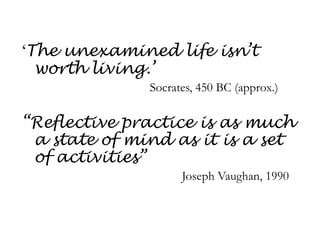
‘The unexamined life isn’t worth living.’					Socrates, 450 BC (approx.)“Reflective practice is as much a state of mind as it is a set of activities”						Joseph Vaughan, 1990
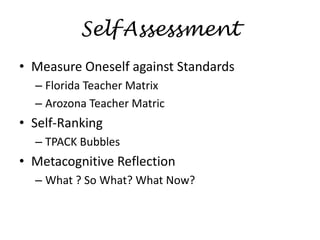
SelfAssessmentMeasure Oneself against StandardsFlorida Teacher MatrixArozona Teacher MatricSelf-RankingTPACK BubblesMetacognitive ReflectionWhat ? So What? What Now?
ReflectivePracticeteacher as "reflective decision makers“reflection begins with the recognition of a dilemma and an affective responseuse intrinsic motivation to analyze situations, set goals, plan and monitor actions, evaluate results, and reflect on their own professional thinking (Colton & Langer, 1993).
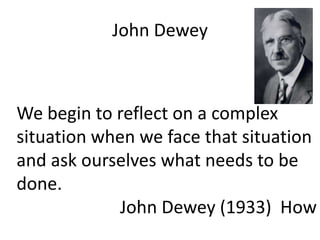
John DeweyWe begin to reflect on a complex situation when we face that situation and ask ourselves what needs to be done.  John Dewey (1933)  How
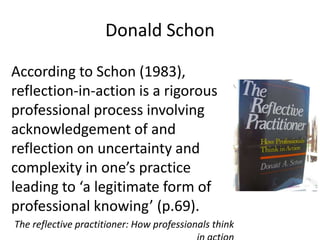
Donald SchonAccording to Schon (1983), reflection-in-action is a rigorous professional process involving acknowledgement of and reflection on uncertainty and complexity in one’s practice leading to ‘a legitimate form of professional knowing’ (p.69). The reflective practitioner: How professionals think in action
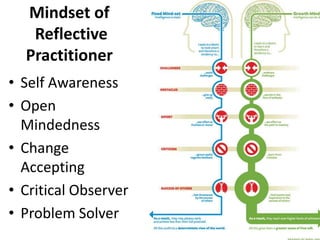
Mindset of Reflective PractitionerSelf AwarenessOpen MindednessChange AcceptingCritical ObserverProblem Solver
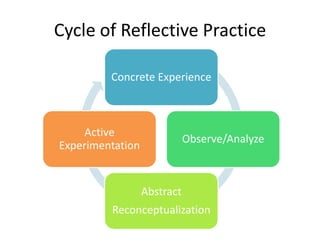
Cycle of Reflective Practice
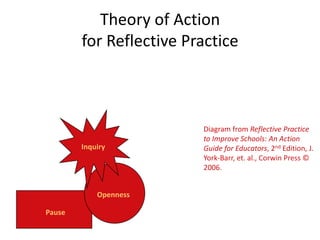
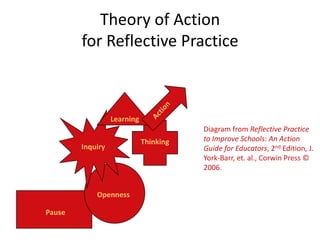
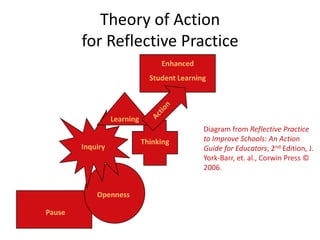
Theory of Action for Reflective PracticeDiagram from Reflective Practice to Improve Schools: An Action Guide for Educators, 2nd Edition, J. York-Barr, et. al., Corwin Press © 2006.
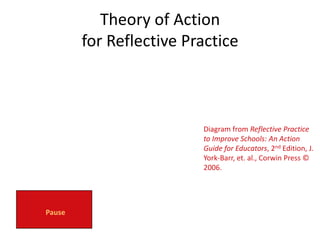
Theory of Action for Reflective PracticeDiagram from Reflective Practice to Improve Schools: An Action Guide for Educators, 2nd Edition, J. York-Barr, et. al., Corwin Press © 2006.Pause
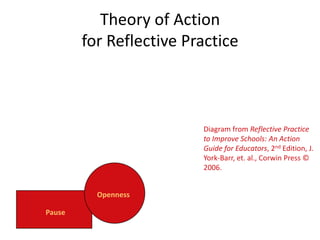
Theory of Action for Reflective PracticeDiagram from Reflective Practice to Improve Schools: An Action Guide for Educators, 2nd Edition, J. York-Barr, et. al., Corwin Press © 2006.OpennessPause
Theory of Action for Reflective PracticeDiagram from Reflective Practice to Improve Schools: An Action Guide for Educators, 2nd Edition, J. York-Barr, et. al., Corwin Press © 2006.InquiryOpennessPause
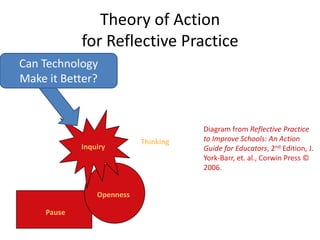
Theory of Action for Reflective PracticeCan Technology Make it Better?Diagram from Reflective Practice to Improve Schools: An Action Guide for Educators, 2nd Edition, J. York-Barr, et. al., Corwin Press © 2006.ThinkingInquiryOpennessPause
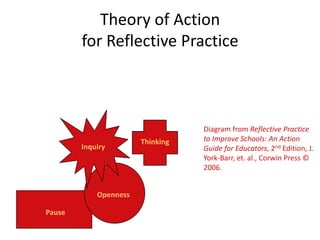
Theory of Action for Reflective PracticeDiagram from Reflective Practice to Improve Schools: An Action Guide for Educators, 2nd Edition, J. York-Barr, et. al., Corwin Press © 2006.ThinkingInquiryOpennessPause
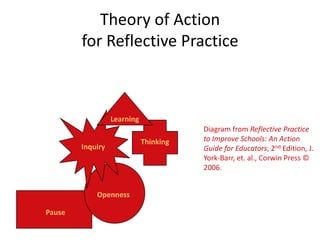
Theory of Action for Reflective PracticeLearningDiagram from Reflective Practice to Improve Schools: An Action Guide for Educators, 2nd Edition, J. York-Barr, et. al., Corwin Press © 2006.ThinkingInquiryOpennessPause
Theory of Action for Reflective PracticeActionLearningDiagram from Reflective Practice to Improve Schools: An Action Guide for Educators, 2nd Edition, J. York-Barr, et. al., Corwin Press © 2006.ThinkingInquiryOpennessPause
Theory of Action for Reflective PracticeActionEnhancedStudent LearningLearningDiagram from Reflective Practice to Improve Schools: An Action Guide for Educators, 2nd Edition, J. York-Barr, et. al., Corwin Press © 2006.ThinkingInquiryOpennessPause
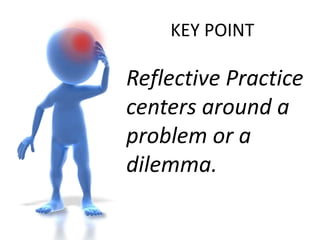
KEY POINTReflective Practice centers around a problem or a dilemma.
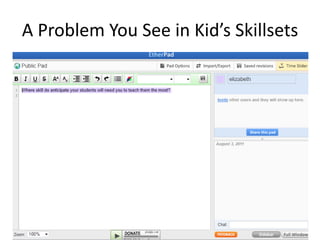
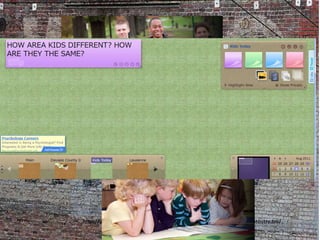
A Problem You See in Kid’s Skillsets
Share a Problem You Need to Work on
TIMER
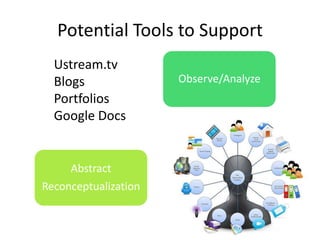
Potential Tools to SupportUstream.tvBlogsPortfoliosGoogle DocsObserve/AnalyzeAbstractReconceptualizationUstream.tvBlogsPortfolios
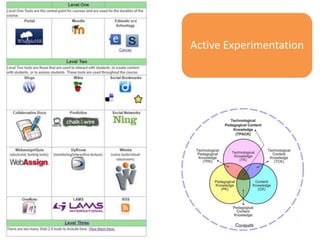
Active Experimentation
http://www.flickr.com/photos/brittanyg/1305797552/sizes/z/in/photostream/
A New Culture of Learning: Cultivating the Imagination for a World of Constant Change
“What happens to learning when we move from the stable infrastructure of the twentieth century to the fluid infrastructure of the twenty-first century, where technology is constantly creating and responding to change?”
“therefore, the primary difference between the teaching-based approach to education and the learning–based approach is that in the first case the culture is the environment, while in the second case, the culture emerges from the environment—and grows along with it.”Can we create a culture of thinking? Of collaboration? Of questioning? Of contemporary learning?
“A second difference is that the teaching-based approach focuses on teaching us about the world, while the new culture of learning focuses on learning through engagement within the world. “
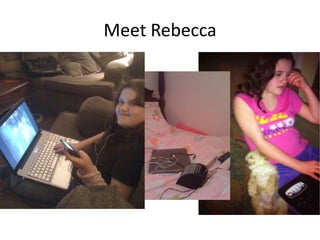
Meet Rebecca
What ‘Rebeccas’ Teach UsHanging Out Messing AroundGeeking OutDouglas Thomas, John Seely Brown
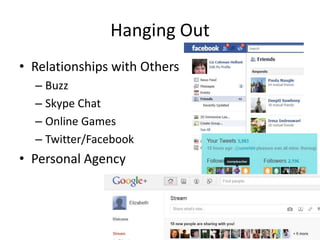
Hanging OutRelationships with Others BuzzSkype ChatOnline GamesTwitter/FacebookPersonal Agency
Messing AroundWhat Can I Explore? Who Can I Explore It With?Social Agency
Geeking OutHow can I utilize these tools for Deep Exploration?Academic Collateral
New Culture of Learning is based on three principles:The old ways of learning are unable to keep up with our rapidly changing world.  New media forms are making peer-to-peer learning easier and more natural. Peer-to-peer learning is amplified by emerging technologies that shape the collective nature of participation with those new media.
MO LAW
Not Public and PrivatePersonalCollectiveTeach Skills and Citizenship
Collective DefinitionWe call this environment a collective. As the name implies, it is a collection of people, skills, and talent that produces a result greater than the sum of its parts. For our purposes, are not solely defined by shared intention, action, or purpose (though those elements may exist and often do). Rather, they are defined by an active engagement with the process of learning.. In communities, people learn in order to belong. In a collective, people belong in order to learn. Communities derive their strength from creating a sense of belonging, while collectives derive theirs from participation.
Authentic, Passion/Interest, Motivated Learning THE COLLECTIVEvsOur Classrooms
“wisdom holds that different people learn in different ways. Something is missing from that idea, however, so we offer a corollary: Different people, when presented with exactly the same information in exactly the same way, will learn different things. Most models of education and learning have almost no tolerance for this kind of thing. As a result, teaching tends to focus on eliminating the source of the problem: the student’s imagination. Imagine a situation”Seeley/Brown
A Reflective Practice Question for 2011 How can I turn my classroom into a “collective” that ensures my students get the skills to acquire learning capital?
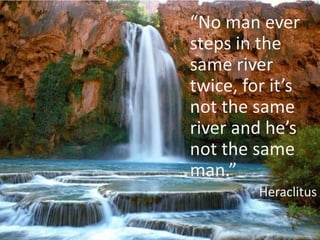
“No man ever steps in the same river twice, for it’s not the same river and he’s not the same man.”Heraclitus
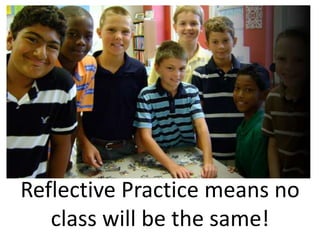
Reflective Practice means no class will be the same!

Reflective practice

  • 1.
  • 2.
    ‘The unexamined lifeisn’t worth living.’ Socrates, 450 BC (approx.)“Reflective practice is as much a state of mind as it is a set of activities” Joseph Vaughan, 1990
  • 3.
    SelfAssessmentMeasure Oneself againstStandardsFlorida Teacher MatrixArozona Teacher MatricSelf-RankingTPACK BubblesMetacognitive ReflectionWhat ? So What? What Now?
  • 4.
    ReflectivePracticeteacher as "reflectivedecision makers“reflection begins with the recognition of a dilemma and an affective responseuse intrinsic motivation to analyze situations, set goals, plan and monitor actions, evaluate results, and reflect on their own professional thinking (Colton & Langer, 1993).
  • 5.
    John DeweyWe beginto reflect on a complex situation when we face that situation and ask ourselves what needs to be done. John Dewey (1933) How
  • 6.
    Donald SchonAccording toSchon (1983), reflection-in-action is a rigorous professional process involving acknowledgement of and reflection on uncertainty and complexity in one’s practice leading to ‘a legitimate form of professional knowing’ (p.69). The reflective practitioner: How professionals think in action
  • 7.
    Mindset of ReflectivePractitionerSelf AwarenessOpen MindednessChange AcceptingCritical ObserverProblem Solver
  • 8.
  • 9.
    Theory of Actionfor Reflective PracticeDiagram from Reflective Practice to Improve Schools: An Action Guide for Educators, 2nd Edition, J. York-Barr, et. al., Corwin Press © 2006.
  • 10.
    Theory of Actionfor Reflective PracticeDiagram from Reflective Practice to Improve Schools: An Action Guide for Educators, 2nd Edition, J. York-Barr, et. al., Corwin Press © 2006.Pause
  • 11.
    Theory of Actionfor Reflective PracticeDiagram from Reflective Practice to Improve Schools: An Action Guide for Educators, 2nd Edition, J. York-Barr, et. al., Corwin Press © 2006.OpennessPause
  • 12.
    Theory of Actionfor Reflective PracticeDiagram from Reflective Practice to Improve Schools: An Action Guide for Educators, 2nd Edition, J. York-Barr, et. al., Corwin Press © 2006.InquiryOpennessPause
  • 13.
    Theory of Actionfor Reflective PracticeCan Technology Make it Better?Diagram from Reflective Practice to Improve Schools: An Action Guide for Educators, 2nd Edition, J. York-Barr, et. al., Corwin Press © 2006.ThinkingInquiryOpennessPause
  • 14.
    Theory of Actionfor Reflective PracticeDiagram from Reflective Practice to Improve Schools: An Action Guide for Educators, 2nd Edition, J. York-Barr, et. al., Corwin Press © 2006.ThinkingInquiryOpennessPause
  • 15.
    Theory of Actionfor Reflective PracticeLearningDiagram from Reflective Practice to Improve Schools: An Action Guide for Educators, 2nd Edition, J. York-Barr, et. al., Corwin Press © 2006.ThinkingInquiryOpennessPause
  • 16.
    Theory of Actionfor Reflective PracticeActionLearningDiagram from Reflective Practice to Improve Schools: An Action Guide for Educators, 2nd Edition, J. York-Barr, et. al., Corwin Press © 2006.ThinkingInquiryOpennessPause
  • 17.
    Theory of Actionfor Reflective PracticeActionEnhancedStudent LearningLearningDiagram from Reflective Practice to Improve Schools: An Action Guide for Educators, 2nd Edition, J. York-Barr, et. al., Corwin Press © 2006.ThinkingInquiryOpennessPause
  • 18.
    KEY POINTReflective Practicecenters around a problem or a dilemma.
  • 19.
    A Problem YouSee in Kid’s Skillsets
  • 20.
    Share a ProblemYou Need to Work on
  • 21.
  • 22.
    Potential Tools toSupportUstream.tvBlogsPortfoliosGoogle DocsObserve/AnalyzeAbstractReconceptualizationUstream.tvBlogsPortfolios
  • 23.
  • 24.
  • 25.
    A New Cultureof Learning: Cultivating the Imagination for a World of Constant Change
  • 26.
    “What happens tolearning when we move from the stable infrastructure of the twentieth century to the fluid infrastructure of the twenty-first century, where technology is constantly creating and responding to change?”
  • 27.
    “therefore, the primarydifference between the teaching-based approach to education and the learning–based approach is that in the first case the culture is the environment, while in the second case, the culture emerges from the environment—and grows along with it.”Can we create a culture of thinking? Of collaboration? Of questioning? Of contemporary learning?
  • 28.
    “A second differenceis that the teaching-based approach focuses on teaching us about the world, while the new culture of learning focuses on learning through engagement within the world. “
  • 29.
  • 30.
    What ‘Rebeccas’ TeachUsHanging Out Messing AroundGeeking OutDouglas Thomas, John Seely Brown
  • 31.
    Hanging OutRelationships withOthers BuzzSkype ChatOnline GamesTwitter/FacebookPersonal Agency
  • 32.
    Messing AroundWhat CanI Explore? Who Can I Explore It With?Social Agency
  • 33.
    Geeking OutHow canI utilize these tools for Deep Exploration?Academic Collateral
  • 34.
    New Culture ofLearning is based on three principles:The old ways of learning are unable to keep up with our rapidly changing world. New media forms are making peer-to-peer learning easier and more natural. Peer-to-peer learning is amplified by emerging technologies that shape the collective nature of participation with those new media.
  • 35.
  • 36.
    Not Public andPrivatePersonalCollectiveTeach Skills and Citizenship
  • 37.
    Collective DefinitionWe callthis environment a collective. As the name implies, it is a collection of people, skills, and talent that produces a result greater than the sum of its parts. For our purposes, are not solely defined by shared intention, action, or purpose (though those elements may exist and often do). Rather, they are defined by an active engagement with the process of learning.. In communities, people learn in order to belong. In a collective, people belong in order to learn. Communities derive their strength from creating a sense of belonging, while collectives derive theirs from participation.
  • 38.
    Authentic, Passion/Interest, MotivatedLearning THE COLLECTIVEvsOur Classrooms
  • 39.
    “wisdom holds thatdifferent people learn in different ways. Something is missing from that idea, however, so we offer a corollary: Different people, when presented with exactly the same information in exactly the same way, will learn different things. Most models of education and learning have almost no tolerance for this kind of thing. As a result, teaching tends to focus on eliminating the source of the problem: the student’s imagination. Imagine a situation”Seeley/Brown
  • 40.
    A Reflective PracticeQuestion for 2011 How can I turn my classroom into a “collective” that ensures my students get the skills to acquire learning capital?
  • 41.
    “No man eversteps in the same river twice, for it’s not the same river and he’s not the same man.”Heraclitus
  • 42.
    Reflective Practice meansno class will be the same!

Editor's Notes

  • #21 OneNote reflection- Think of one problem/dielmna that you need to work on this year-