







cReATiVe
pEdaGoGy
n
a
g
a
R
A
J
cReAtiVe PeDaGoGy

What?
 Why?
 hoW?nagaRAJU 2
 The art & science of creative teaching
 Teaches how to learn creatively
 Produces creative learners
 Learner evolves from an object of influence
to the rank of a creator
 Class turns a creative environment
nagaRAJU 3
wHaT iS iT?
Multi dimensional
Founder – Dr Andrei Aleinikov
nagaRAJU 4
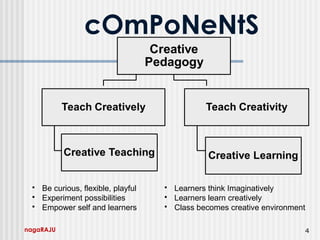
cOmPoNeNtS
 Learners think Imaginatively
 Learners learn creatively
 Class becomes creative environment
 Be curious, flexible, playful
 Experiment possibilities
 Empower self and learners
 What?
 Why?
 hoW?
nagaRAJU 5
cReAtiVe PeDaGoGy
nagaRAJU 6
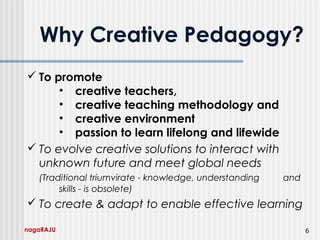
Why Creative Pedagogy?
 To promote
• creative teachers,
• creative teaching methodology and
• creative environment
• passion to learn lifelong and lifewide
 To evolve creative solutions to interact with
unknown future and meet global needs
(Traditional triumvirate - knowledge, understanding and
skills - is obsolete)
 To create & adapt to enable effective learning
nagaRAJU 7
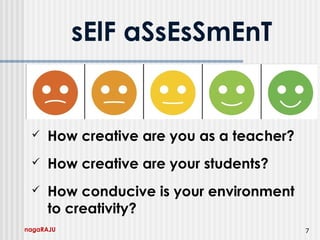
 How creative are you as a teacher?
 How creative are your students?
 How conducive is your environment
to creativity?
sElF aSsEsSmEnT
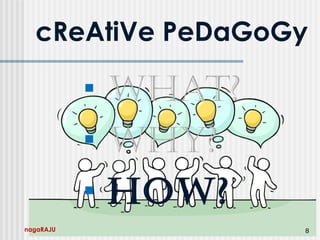
 What?
 Why?
 hoW?
nagaRAJU 8
cReAtiVe PeDaGoGy
nagaRAJU 9
WHAT IS HALF OF
FULL
nagaRAJU
10
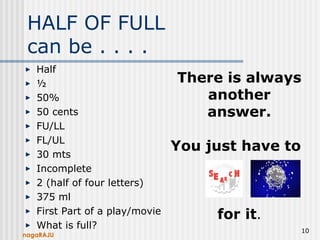
HALF OF FULL
can be . . . .
Half
½
50%
50 cents
FU/LL
FL/UL
30 mts
Incomplete
2 (half of four letters)
375 ml
First Part of a play/movie
What is full?
There is always
another
answer.
You just have to
for it.
nagaRAJU 11
Qualities of a Creative Teacher
 Curiosity, open to new ideas
 Unconventional thoughts
 Intuition
 Adventurous nature
 Persistence
nagaRAJU 12
Creative Pedagogic Practice
 Know your students
 Empower students
 Ask open ended questions
 Offer time for reflection
 Help find relevance
nagaRAJU 13
Tips to be a Creative Teacher
 Become knowledgeable
 Online resources, courses, blogs etc
 Connect with other teachers
 Collect teaching ideas
 Share your learning
 Enjoy teaching
nagaRAJU 14
Tips to be a Creative Teacher
 Remember past successes
 Remove mental blocks
 Take risks
 Practise mental games/puzzles
 Think of outcomes
nagaRAJU 15
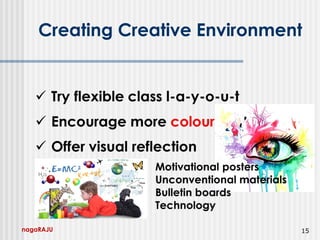
Creating Creative Environment
nagaRAJU 16
 bELIEVE that iDEAS eXIST
 tHINK aFRESH
 lEARN tO lAUGH
 bECOME a cHILD
 dEFINE tHE pROBLEM
 lEARN tO lOOK
 bE cOURAGEOUS
 lEARN hOW tO cOMBINE
idea idea idea idea idea idea idea idea idea idea idea idea
nagaRAJU 17
Do ideas exhaust?
IDEAS ARE
INEXHAUSITBLE
Song tunes,
Recipes,
2,000 kinds of
barbed wire
patented
nagaRAJU 18
 bELIEVE that iDEAS eXIST
 tHINK aFRESH
 lEARN tO lAUGH
 bECOME a cHILD
 dEFINE tHE pROBLEM
 lEARN tO lOOK
 bE cOURAGEOUS
 lEARN hOW tO cOMBINE
nagaRAJU 19
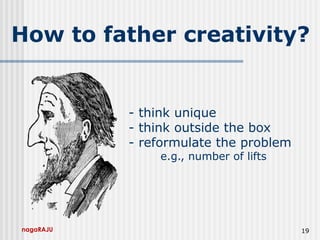
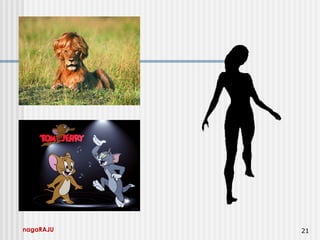
- think unique
- think outside the box
- reformulate the problem
e.g., number of lifts
How to father creativity?
nagaRAJU 20
 bELIEVE that iDEAS eXIST
 tHINK aFRESH
 lEARN tO lAUGH
 bECOME a cHILD
 dEFINE tHE pROBLEM
 lEARN tO lOOK
 bE cOURAGEOUS
 lEARN hOW tO cOMBINE
nagaRAJU 21
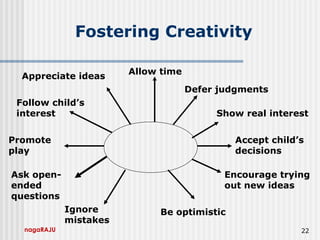
Fostering Creativity
Allow time
Defer judgments
Show real interest
Accept child’s
decisions
Appreciate ideas
Follow child’s
interest
Promote
play
Ask open-
ended
questions
Encourage trying
out new ideas
Be optimisticIgnore
mistakes
nagaRAJU 22
nagaRAJU 23
 bELIEVE that iDEAS eXIST
 tHINK aFRESH
 lEARN tO lAUGH
 bECOME a cHILD
 dEFINE tHE pROBLEM
 lEARN tO lOOK
 bE cOURAGEOUS
 lEARN hOW tO cOMBINE
nagaRAJU 24
nagaRAJU 25
 bELIEVE – iDEAS eXIST
 tHINK aFRESH
 lEARN tO lAUGH
 bECOME a cHILD
 dEFINE tHE pROBLEM
 lEARN tO lOOK
 bE cOURAGEOUS
 lEARN hOW tO cOMBINE
nagaRAJU 26
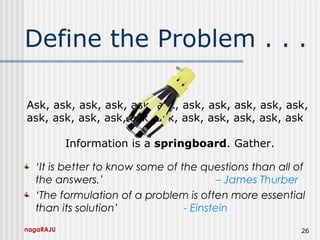
Define the Problem . . .
‘It is better to know some of the questions than all of
the answers.’ – James Thurber
‘The formulation of a problem is often more essential
than its solution’ - Einstein
Ask, ask, ask, ask, ask, ask, ask, ask, ask, ask, ask,
ask, ask, ask, ask, ask, ask, ask, ask, ask, ask, ask
Information is a springboard. Gather.
nagaRAJU 27
 bELIEVE – iDEAS eXIST
 tHINK aFRESH
 lEARN tO lAUGH
 bECOME a cHILD
 dEFINE tHE pROBLEM
 lEARN tO lOOK
 bE cOURAGEOUS
 lEARN hOW tO cOMBINE
‘The seeing see little’
– Helen Keller’s Speech
LEARN HOW TO
White car Game
Heads down – and answer questions
- discover the magic of seeing
nagaRAJU 28
nagaRAJU 29
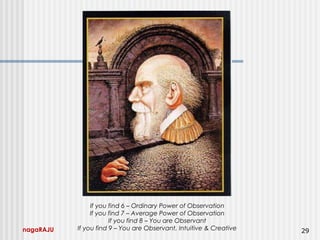
If you find 6 – Ordinary Power of Observation
If you find 7 – Average Power of Observation
If you find 8 – You are Observant
If you find 9 – You are Observant, Intuitive & Creative
nagaRAJU 30
 bELIEVE – iDEAS eXIST
 tHINK aFRESH
 lEARN tO lAUGH
 bECOME a cHILD
 dEFINE tHE pROBLEM
 lEARN tO lOOK
 bE cOURAGEOUS
 lEARN hOW tO cOMBINE
nagaRAJU 31
Whether
you think
you can
or you can’t,
you are right.
– Henry Ford
nagaRAJU 32
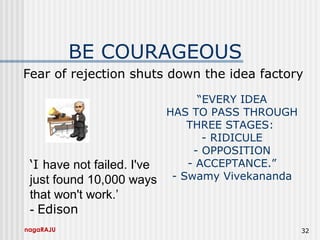
BE COURAGEOUS
Fear of rejection shuts down the idea factory
“EVERY IDEA
HAS TO PASS THROUGH
THREE STAGES:
- RIDICULE
- OPPOSITION
- ACCEPTANCE.”
- Swamy Vivekananda
‘I have not failed. I've
just found 10,000 ways
that won't work.’
- Edison
nagaRAJU 33
FAILURES? STEPPING STONES!
Every rejection is an opportunity
Ray Bradbury – Weekly stories for ten
years before the smash hit
Kepler – Nine years of work before finding
the elliptical paths of planets
Galileo
Jesus
nagaRAJU 34
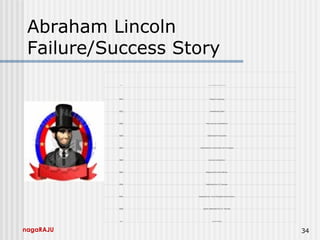
1832 Lost job & Defeated for st at e legislat ure
1833 Failed in business
1835 Sweetheart died
1836 Had nervous breakdown
1838 Defeated for Speaker
1843 Defeated for nomination for Congress
1848 Lost re-nomination
1849 Rejected for land officer
1854 Defeated for U.S. Senate
1856 Defeated for Vice President Nomination
1858 Again defeated for U.S. Senate
1860  Elected President
Abraham Lincoln
Failure/Success Story
nagaRAJU 35
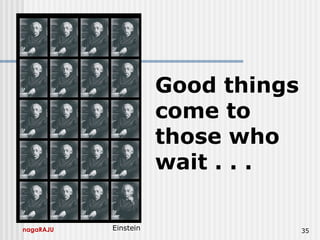
Good things
come to
those who
wait . . .
Einstein
nagaRAJU 36
NO IDEA IS A BAD IDEA!
 Madam Curie – Radium
 Roentgen – X-rays
 Fleming – Penicillin
 Somebody – Potato chips
Moral? Never cry over spilled
milk. Find a use for it!!
nagaRAJU 37
 bELIEVE – iDEAS eXIST
 tHINK aFRESH
 lEARN tO lAUGH
 bECOME a cHILD
 dEFINE tHE pROBLEM
 lEARN tO lOOK
 bE cOURAGEOUS
 lEARN hOW tO cOMBINE
nagaRAJU 38
LEARN HOW TO COMBINE
Find Analogues
(similar, dissimilar)
Break the Rules
Play ‘what if?’
Look to Other Fields
Take Chances
nagaRAJU 39
nagaRAJU 40
Break the Rules
Rules are a great way to get ideas -
All you have to do is to break them!
Picasso
Freud
Pasteur
G M Hopkins
e e cummins
nagaRAJU 41
PLAY ‘WHAT IF?’
What if a product were
smaller, larger, thinner, fatter,
faster, slower, darker, brighter,
cheaper, costlier, a different color,
more convenient, less convenient.
If it were a person, an animal.
nagaRAJU 42
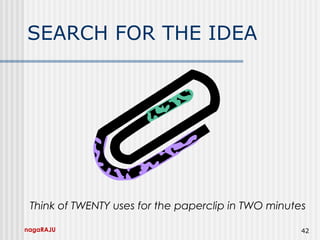
SEARCH FOR THE IDEA
Think of TWENTY uses for the paperclip in TWO minutes
nagaRAJU 43
tHaNk yOu
lionnagaraju@gmail.com
www.slideshare.net/lionnnagaraju
www.authorstream.com/tag/lionnagaraju

Creative Pedagogy

  • 1.
  • 2.
  • 3.
     The art& science of creative teaching  Teaches how to learn creatively  Produces creative learners  Learner evolves from an object of influence to the rank of a creator  Class turns a creative environment nagaRAJU 3 wHaT iS iT? Multi dimensional Founder – Dr Andrei Aleinikov
  • 4.
    nagaRAJU 4 cOmPoNeNtS  Learnersthink Imaginatively  Learners learn creatively  Class becomes creative environment  Be curious, flexible, playful  Experiment possibilities  Empower self and learners
  • 5.
     What?  Why? hoW? nagaRAJU 5 cReAtiVe PeDaGoGy
  • 6.
    nagaRAJU 6 Why CreativePedagogy?  To promote • creative teachers, • creative teaching methodology and • creative environment • passion to learn lifelong and lifewide  To evolve creative solutions to interact with unknown future and meet global needs (Traditional triumvirate - knowledge, understanding and skills - is obsolete)  To create & adapt to enable effective learning
  • 7.
    nagaRAJU 7  Howcreative are you as a teacher?  How creative are your students?  How conducive is your environment to creativity? sElF aSsEsSmEnT
  • 8.
     What?  Why? hoW? nagaRAJU 8 cReAtiVe PeDaGoGy
  • 9.
    nagaRAJU 9 WHAT ISHALF OF FULL
  • 10.
    nagaRAJU 10 HALF OF FULL canbe . . . . Half ½ 50% 50 cents FU/LL FL/UL 30 mts Incomplete 2 (half of four letters) 375 ml First Part of a play/movie What is full? There is always another answer. You just have to for it.
  • 11.
    nagaRAJU 11 Qualities ofa Creative Teacher  Curiosity, open to new ideas  Unconventional thoughts  Intuition  Adventurous nature  Persistence
  • 12.
    nagaRAJU 12 Creative PedagogicPractice  Know your students  Empower students  Ask open ended questions  Offer time for reflection  Help find relevance
  • 13.
    nagaRAJU 13 Tips tobe a Creative Teacher  Become knowledgeable  Online resources, courses, blogs etc  Connect with other teachers  Collect teaching ideas  Share your learning  Enjoy teaching
  • 14.
    nagaRAJU 14 Tips tobe a Creative Teacher  Remember past successes  Remove mental blocks  Take risks  Practise mental games/puzzles  Think of outcomes
  • 15.
  • 16.
    nagaRAJU 16  bELIEVEthat iDEAS eXIST  tHINK aFRESH  lEARN tO lAUGH  bECOME a cHILD  dEFINE tHE pROBLEM  lEARN tO lOOK  bE cOURAGEOUS  lEARN hOW tO cOMBINE
  • 17.
    idea idea ideaidea idea idea idea idea idea idea idea idea idea idea idea idea idea idea idea idea idea idea idea idea idea idea idea idea idea idea idea idea idea idea idea idea idea idea idea idea idea idea idea idea idea idea idea idea idea idea idea idea idea idea idea idea idea idea idea idea idea idea idea idea idea idea idea idea idea idea idea idea idea idea idea idea idea idea idea idea idea idea idea idea idea idea idea idea idea idea idea idea idea idea idea idea idea idea idea idea idea idea idea idea idea idea idea idea idea idea idea idea idea idea idea idea idea idea idea idea idea idea idea idea idea idea idea idea idea idea idea idea idea idea idea idea idea idea idea idea idea idea idea idea idea idea idea idea idea idea idea idea idea idea idea idea idea idea idea idea idea idea idea idea idea idea idea idea idea idea idea idea idea idea idea idea idea idea idea idea idea idea idea idea idea idea idea idea idea idea idea idea idea idea idea idea idea idea idea idea idea idea idea idea idea idea idea idea idea idea idea idea idea idea idea idea nagaRAJU 17 Do ideas exhaust? IDEAS ARE INEXHAUSITBLE Song tunes, Recipes, 2,000 kinds of barbed wire patented
  • 18.
    nagaRAJU 18  bELIEVEthat iDEAS eXIST  tHINK aFRESH  lEARN tO lAUGH  bECOME a cHILD  dEFINE tHE pROBLEM  lEARN tO lOOK  bE cOURAGEOUS  lEARN hOW tO cOMBINE
  • 19.
    nagaRAJU 19 - thinkunique - think outside the box - reformulate the problem e.g., number of lifts How to father creativity?
  • 20.
    nagaRAJU 20  bELIEVEthat iDEAS eXIST  tHINK aFRESH  lEARN tO lAUGH  bECOME a cHILD  dEFINE tHE pROBLEM  lEARN tO lOOK  bE cOURAGEOUS  lEARN hOW tO cOMBINE
  • 21.
  • 22.
    Fostering Creativity Allow time Deferjudgments Show real interest Accept child’s decisions Appreciate ideas Follow child’s interest Promote play Ask open- ended questions Encourage trying out new ideas Be optimisticIgnore mistakes nagaRAJU 22
  • 23.
    nagaRAJU 23  bELIEVEthat iDEAS eXIST  tHINK aFRESH  lEARN tO lAUGH  bECOME a cHILD  dEFINE tHE pROBLEM  lEARN tO lOOK  bE cOURAGEOUS  lEARN hOW tO cOMBINE
  • 24.
  • 25.
    nagaRAJU 25  bELIEVE– iDEAS eXIST  tHINK aFRESH  lEARN tO lAUGH  bECOME a cHILD  dEFINE tHE pROBLEM  lEARN tO lOOK  bE cOURAGEOUS  lEARN hOW tO cOMBINE
  • 26.
    nagaRAJU 26 Define theProblem . . . ‘It is better to know some of the questions than all of the answers.’ – James Thurber ‘The formulation of a problem is often more essential than its solution’ - Einstein Ask, ask, ask, ask, ask, ask, ask, ask, ask, ask, ask, ask, ask, ask, ask, ask, ask, ask, ask, ask, ask, ask Information is a springboard. Gather.
  • 27.
    nagaRAJU 27  bELIEVE– iDEAS eXIST  tHINK aFRESH  lEARN tO lAUGH  bECOME a cHILD  dEFINE tHE pROBLEM  lEARN tO lOOK  bE cOURAGEOUS  lEARN hOW tO cOMBINE
  • 28.
    ‘The seeing seelittle’ – Helen Keller’s Speech LEARN HOW TO White car Game Heads down – and answer questions - discover the magic of seeing nagaRAJU 28
  • 29.
    nagaRAJU 29 If youfind 6 – Ordinary Power of Observation If you find 7 – Average Power of Observation If you find 8 – You are Observant If you find 9 – You are Observant, Intuitive & Creative
  • 30.
    nagaRAJU 30  bELIEVE– iDEAS eXIST  tHINK aFRESH  lEARN tO lAUGH  bECOME a cHILD  dEFINE tHE pROBLEM  lEARN tO lOOK  bE cOURAGEOUS  lEARN hOW tO cOMBINE
  • 31.
    nagaRAJU 31 Whether you think youcan or you can’t, you are right. – Henry Ford
  • 32.
    nagaRAJU 32 BE COURAGEOUS Fearof rejection shuts down the idea factory “EVERY IDEA HAS TO PASS THROUGH THREE STAGES: - RIDICULE - OPPOSITION - ACCEPTANCE.” - Swamy Vivekananda ‘I have not failed. I've just found 10,000 ways that won't work.’ - Edison
  • 33.
    nagaRAJU 33 FAILURES? STEPPINGSTONES! Every rejection is an opportunity Ray Bradbury – Weekly stories for ten years before the smash hit Kepler – Nine years of work before finding the elliptical paths of planets Galileo Jesus
  • 34.
    nagaRAJU 34 1832 Lostjob & Defeated for st at e legislat ure 1833 Failed in business 1835 Sweetheart died 1836 Had nervous breakdown 1838 Defeated for Speaker 1843 Defeated for nomination for Congress 1848 Lost re-nomination 1849 Rejected for land officer 1854 Defeated for U.S. Senate 1856 Defeated for Vice President Nomination 1858 Again defeated for U.S. Senate 1860  Elected President Abraham Lincoln Failure/Success Story
  • 35.
    nagaRAJU 35 Good things cometo those who wait . . . Einstein
  • 36.
    nagaRAJU 36 NO IDEAIS A BAD IDEA!  Madam Curie – Radium  Roentgen – X-rays  Fleming – Penicillin  Somebody – Potato chips Moral? Never cry over spilled milk. Find a use for it!!
  • 37.
    nagaRAJU 37  bELIEVE– iDEAS eXIST  tHINK aFRESH  lEARN tO lAUGH  bECOME a cHILD  dEFINE tHE pROBLEM  lEARN tO lOOK  bE cOURAGEOUS  lEARN hOW tO cOMBINE
  • 38.
    nagaRAJU 38 LEARN HOWTO COMBINE Find Analogues (similar, dissimilar) Break the Rules Play ‘what if?’ Look to Other Fields Take Chances
  • 39.
  • 40.
    nagaRAJU 40 Break theRules Rules are a great way to get ideas - All you have to do is to break them! Picasso Freud Pasteur G M Hopkins e e cummins
  • 41.
    nagaRAJU 41 PLAY ‘WHATIF?’ What if a product were smaller, larger, thinner, fatter, faster, slower, darker, brighter, cheaper, costlier, a different color, more convenient, less convenient. If it were a person, an animal.
  • 42.
    nagaRAJU 42 SEARCH FORTHE IDEA Think of TWENTY uses for the paperclip in TWO minutes
  • 43.

Editor's Notes

  • #2 How long can we live without ideas? Physical brain can create abstract ideas. Everyone is equally gifted. No physical deficiency that prevents one from getting ideas. Nothing called ideation talent, or laser beam like insight, or anything extraordinary. Not true that some see order where others see chaos. If necessity is the mother of invention, creativity is the father; necessity and creativity together make the most ideal atmosphere for generating new ideas.
  • #3 What is an idea? Difficult to define, such as what is a tiger? Everybody knows what a tiger is, but it is very difficult to say what it is. There is nothing unusual about creative activity. – Bronowski Getting a new idea is like creating a new recipe. It does not require genius, or a Nobel laureate, or an advertising hotshot or a first class inventor.
  • #9 How can we get more ideas, more frequently. Those who know ideas exist, come up with ideas. Those who don’t believe ideas exist, don’t come up with them.
  • #10 Exactly. Exactly. Exactly. Exactly. Exactly. Exactly. And what else could be half of FULL? Search for more answers, newer answers. You are full of ideas.
  • #11 The more you rack your brains, the more you search, the more you dare, the more you explore, the more you try, the more answers you will find. It does not stop here. Continue thinking about this. Ask your friends, your relatives, your mother, your children, your teachers, your neighbors, your strangers, everybody and anybody. More important than any of these, ask yourself, as frequently and as repeatedly as possible. Every time, come up with a different answer.
  • #12 Exactly. Exactly. Exactly. Exactly. Exactly. Exactly. And what else could be half of FULL? Search for more answers, newer answers. You are full of ideas.
  • #13 Exactly. Exactly. Exactly. Exactly. Exactly. Exactly. And what else could be half of FULL? Search for more answers, newer answers. You are full of ideas.
  • #14 Exactly. Exactly. Exactly. Exactly. Exactly. Exactly. And what else could be half of FULL? Search for more answers, newer answers. You are full of ideas.
  • #15 Exactly. Exactly. Exactly. Exactly. Exactly. Exactly. And what else could be half of FULL? Search for more answers, newer answers. You are full of ideas.
  • #17 Ramanujam solved a problem because he thought there was a solution. Real life problems are not like yes-no questions. They can be resolved in various ways. Arthur Koestler – the mere belief that a problem is soluble means half the game is won. If you have understood the question, you have earned half the marks. There is always another idea. Another solution. Accept it. Edison believed, he knew, there were ideas in the air. So he found them.
  • #18 Long ago I used to tell my students that for every problem there was a solution, I was wrong. Now I know that for every problem, there are many solutions, may be thousands, may be innumerable. I was worried about the quick exhausting repertoire of filmi tunes. 2000 different kinds of barbed wire. Recipe books – countless in number. Lions International Peace Poster Contest – in 190 countries – several thousands of entries every year. In 1931, Lincoln Steffen said nothing in this world is done yet. Everything remains to be accomplished still. There is so much more to do. The best poem is not yet written. The best book is not yet written. The best athlete is not yet born. The best structure is not yet built. The perfect railroad, the perfect roadway, the perfect television, the perfect microphone are awaiting you. Every subject is waiting for a Darwin of Newton. Nothing is done yet. Everything awaits you. Students in colleges are told what is known, this is nothing. Some people believe that they are surrounded by ideas. They are the ones who get them. Getting an idea doesn’t depend upon the time, the place or the occasion – what you are eating, how you are dressed, when you have time to think. Ideas can occur anytime, anywhere, to anybody – when you are eating your lunch, when you are taking your bath, when you are riding your bike, as long as you believe they exist. Believe. Ideas do exist.
  • #19 There are many different factors contributing to creation of new ideas. These are some. Let us see each one of them in detail. What is thinking afresh?
  • #20 Joke: Write in your own words. Joke: Write an essay on cow. James Thurber – going a different way in the NCC parade. Puzzles, illusions are good examples of lateral thinking.
  • #21 Fun is the best way to get into the idea conditon. People with ideas are usually not serious. Humor and ideas go together. The best creative outputs are achieved by the teams that have the most fun. Ideas come where fun is, not the other way around. In every field people who enjoy doing what they are doing, do it best.
  • #22 Comics and children’s literature are some wonderful resources of creativity.
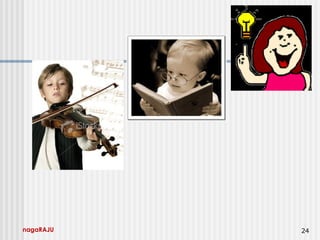
  • #24 Children find extraordinary and exciting relationships among seemingly unrelated things. They paint trees orange, they hang cars in the sky. They study intently a blade of grass, a butterfly, a spoon with a sense of wonder – things that we take for granted. Children are natural born scientists – Carl Sagan They ask deep probing scientific questions – why is the sky blue, not orange, why do we have toes, why do we go to temples, why do not cars have petrol caps on either side, why do we not have foot pedals for all taps, why do not refrigerators have pullout drawers, why does a certain TC look like it its, why something is the way it is. As they grow older, they lose that curiosity and get used to the routine and hardly ask questions. Neil Postman said children enter schools as question marks and leave as periods. Become a question mark again.
  • #25 Become a child again. Ask yourself why something is the way it is. If you don’t find an answer that makes sense to you, there is room for improvement. Let the child in you come out. Be not afraid. Ask yourself – how you would solve a problem if you were just six or four.
  • #27 We don’t know one millionth of one percent about anything, Example: a meatpacker was asked a million questions before ‘another session’ of questions. Don’t skip this. This is very important. Gather information from every possible source.
  • #29 When we did not play the game we did not see any. When we are not looking for it, we don’t find any. When we look for the white car, we see it all over. When I decided to a buy a new car, I saw them everywhere. Seeing is just keeping your eyes open. It doesn’t require an effort. But looking is different. It requires effort and commitment. Discover the magic of looking. Drop your heads down and recall what and how much have you seen. Keep your eyes open. If there is nothing physical that prevents you from learning painting, there must be something mental that prevents you from doing it. – Hal Silverman Buy a good note book, write in it everyday something that you saw that day. Once a month sit down and read what you have written. When the book is full, fill another, yet another – all your life.
  • #33 Difficult to say how to get courage, but you must get courage. Courage is not the absence of fear, it is the ability to move forward in spite of being afraid, in spite of the danger lurking, in spite of the despair.
  • #34 Every time your idea is rejected, you find a new opportunity to improve upon it. Every failure is a stepping stone. You can always get another idea – maybe a better one. Today, as an author, essayist, playwright, screenwriter, lecturer, poet and visionary, Ray Bradbury is known as one of America's greatest creative geniuses
  • #36 Original ideas can challenge fundamental issues. They question beliefs, values, established principles. Original ideas can change things drastically. Everyone is afraid, everyone. We cannot propose new ideas without offending some, without risking disapproval, or outright rejection. He who sneers, also is afraid Ideas can be potentially destructive Ideas question beliefs and actions Just blurt out your idea
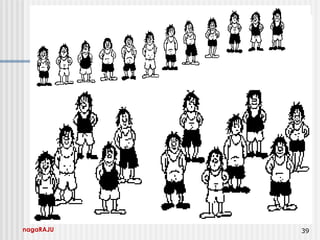
  • #38 Take a chance. Combine things in a way they were never combined before. If you don’t take a chance, you don’t get the idea.
  • #39 If speed is the major advantage of your product, ask what is the slowest, what is the fastest, what is the most convenient, what is the unique. Its economy, dependability, durability, simplicity.
  • #41 Rules are etched in the minds of people. The greatest of the achievement in science or arts or any field are the result of breaking the rules.