Problems in Curriculum
Implementation in Pakistan
Made by :
Jamila Saleem
M. A EPM 1st Semester
Definition of Curriculum
 Hilda Taba (1962) defines a curriculum as
“containing a statement of the aims and of the
specific objectives; it indicates some selection and
organization of content; it either implies or
manifest certain patterns of learning and
teaching. It includes a program of evaluation of
the outcomes”.
Definition:
David G. Armstrong (1989):
"is a master plan for
selecting content and
organizing learning
experiences for the purpose
of changing and developing
learners' behaviors and
insights."
What is Curriculum Implementation?
“Is a network of varying activities involved in
translating curriculum designs into classroom
activities and changing people’s attitudes to
accept and participate in these activities”.
Curriculum implementation, according to Okello and Kagoire (1996:124)
Implementation is the process of making
something active or effective
Definition of problem:
Problem is a question raised
for inquiry, consideration, or
solution.
A problem is a situation that
is unsatisfactory and causes
difficulties for people.
Types of Curriculum
 Explicit curriculum:
Subjects that chosen to support the intentional instructional agenda of a school.
 Implicit curriculum:
The implicit curriculum refers to the lessons that arise from the culture of the school
 Null curriculum:
Topics or perspectives that are specifically excluded from the curriculum
 Extra curriculum:
School-sponsored programs that are intended to supplement the academic
aspect of the school experience
 Concomitant curriculum
What is taught, or emphasized at home
 Phantom curriculum
The messages prevalent in and through exposure to any type of media.
Problems in curriculum implantations
1) Economic Problems
2) Political Problems
3) Lack of teachers training
4) Teachers reluctant to accept the change
5) Lack of sequence
6) Feeling of uncertainty in parents
7) Unavailability of teaching resources
Continue …….
8) Mismanagement of time by administrator
9) Lack of qualified staff
10) Curriculum outdated
11) Teacher – student ratio
12) Less linkage with industry
13) Monitoring and evaluation of teachers
Economic Problems
• It is very difficult to implement a
curriculum successfully if the
education system has limited
funding capacities.
• The economy of a nation will
determine the success of
curriculum implementation.
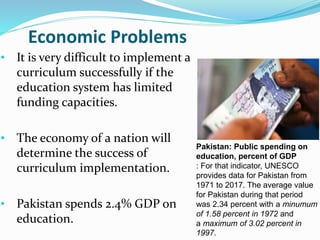
• Pakistan spends 2.4% GDP on
education.
Pakistan: Public spending on
education, percent of GDP
: For that indicator, UNESCO
provides data for Pakistan from
1971 to 2017. The average value
for Pakistan during that period
was 2.34 percent with a minumum
of 1.58 percent in 1972 and
a maximum of 3.02 percent in
1997.
Economic Problems
 At national level, 89% education expenditure
comprises of current expenses such as teachers’
salaries, while only 11% comprises of development
expenditure which is not sufficient to raise quality of
education.
 Money allocated to education is absorbed by salaries
leaving very little for teaching materials, books, in-
service training, monitoring and other things needed
for the smooth implementation the of curriculum
Political Problems
 Education and information are tools to reach the
heights of the development and prosperity
 Every political party has its own policy and program
for each sector and education is most neglected area
 No uniform policy for the whole country that has its
particular aims and goals
Lack of teachers training
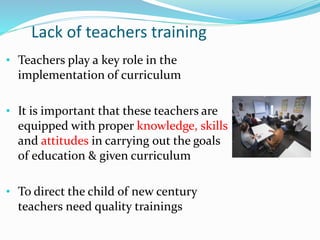
• Teachers play a key role in the
implementation of curriculum
• It is important that these teachers are
equipped with proper knowledge, skills
and attitudes in carrying out the goals
of education & given curriculum
• To direct the child of new century
teachers need quality trainings
Teachers reluctant to accept the change
• Teachers are suppose to give more attention to
new ideas and concept
• Among the reasons for the reluctance is low
salaries, unattractive working conditions
• Less involvement of teachers in bringing out
change in curriculum
That teachers, who are involved in bringing out educational change,
accept and adopt the new ideas more quickly than those teachers who
are not involved in carrying out change
• Teachers are not given related training regarding
changes made in curriculum
Lack of sequence
• Lack of consistency in learning
• Books does not match to their educational
skills due to which students take less
interest, feel difficulty in understanding
content, lack of motivation can be seen
• Activity-based learning does not takes
place
• Our students are forced to know scientific
concepts through rote memorization
• Lack of age appropriate activities
Feeling of uncertainty of parents
• Institution do not bother counselling of parents,
so that they can choose a career for their child
which is market friendly
• Parents do not prefer sudden changes in
curriculum because they are unable to
understand by their own
• Can’t compete with new trends professionally
Unavailability of teaching resources
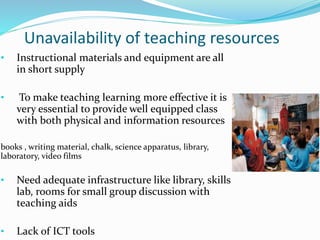
• Instructional materials and equipment are all
in short supply
• To make teaching learning more effective it is
very essential to provide well equipped class
with both physical and information resources
books , writing material, chalk, science apparatus, library,
laboratory, video films
• Need adequate infrastructure like library, skills
lab, rooms for small group discussion with
teaching aids
• Lack of ICT tools
Mismanagement of Time by Administrator
• Pupils’ learning time is mismanaged by
administrators and the class teacher.
• Curriculum implementation is also hindered
by what goes on in learning institutions
• In most schools, a lot of time is taken up by
activities such as assemblies, meetings held by
visiting government officials and other co-
curricular activities
• Unplanned holidays
Lack of qualified staff/ Less involvement of teachers
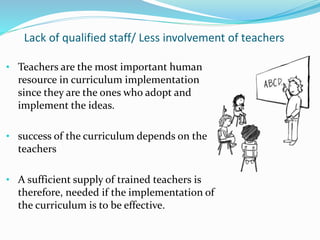
• Teachers are the most important human
resource in curriculum implementation
since they are the ones who adopt and
implement the ideas.
• success of the curriculum depends on the
teachers
• A sufficient supply of trained teachers is
therefore, needed if the implementation of
the curriculum is to be effective.
Curriculum is outdated
• Raja Omer Shabbir in his article, “The
curriculum problems,” notes that our present
generation is learning the same knowledge
that previous two generations have learnt.
• Due to which student do not give maximum
output
• Can not estimate the worth of curriculum
• Entry level, phycology, interest and
comprehension level should be considered
Teacher-Student ratio – over
enrolment
• Teacher pupil ratio is too high
and in some cases, untrained
teachers are involved.
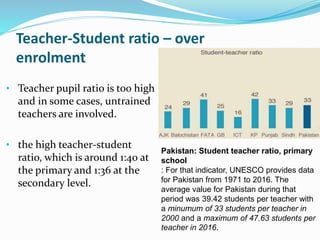
• the high teacher-student
ratio, which is around 1:40 at
the primary and 1:36 at the
secondary level.
Pakistan: Student teacher ratio, primary
school
: For that indicator, UNESCO provides data
for Pakistan from 1971 to 2016. The
average value for Pakistan during that
period was 39.42 students per teacher with
a minumum of 33 students per teacher in
2000 and a maximum of 47.63 students per
teacher in 2016.
Less Linkage with Industries
• No opportunity to practice what they
learn
• Exposure visits to related field of study
can enhance students curiosity and
motivation
• Less involvement of experts from
industry
Monitor and evaluate teachers
• To achieve the educational objectives it is
important to assess teacher’s competency
in given subjects
• There is no proper teacher's assessment
system in our country
• Teachers should be given an opportunity
to improve themselves through in-
service trainings
Solutions:
 Develop an overall district level plan for development
and implementation of curriculum
 Make necessary organizational change
 Provide quality training for teachers
 Develop a bridge between teacher and curriculum
developers
 Availability of all teaching aids
 Monitor and evaluate teachers
 Increase administrative pressure to adopt new trends
and curriculum
 Solve initial and emerging problems
Thank you

Problems in curriculum implementation

  • 1.
    Problems in Curriculum Implementationin Pakistan Made by : Jamila Saleem M. A EPM 1st Semester
  • 2.
    Definition of Curriculum Hilda Taba (1962) defines a curriculum as “containing a statement of the aims and of the specific objectives; it indicates some selection and organization of content; it either implies or manifest certain patterns of learning and teaching. It includes a program of evaluation of the outcomes”.
  • 3.
    Definition: David G. Armstrong(1989): "is a master plan for selecting content and organizing learning experiences for the purpose of changing and developing learners' behaviors and insights."
  • 4.
    What is CurriculumImplementation? “Is a network of varying activities involved in translating curriculum designs into classroom activities and changing people’s attitudes to accept and participate in these activities”. Curriculum implementation, according to Okello and Kagoire (1996:124) Implementation is the process of making something active or effective
  • 5.
    Definition of problem: Problemis a question raised for inquiry, consideration, or solution. A problem is a situation that is unsatisfactory and causes difficulties for people.
  • 6.
    Types of Curriculum Explicit curriculum: Subjects that chosen to support the intentional instructional agenda of a school.  Implicit curriculum: The implicit curriculum refers to the lessons that arise from the culture of the school  Null curriculum: Topics or perspectives that are specifically excluded from the curriculum  Extra curriculum: School-sponsored programs that are intended to supplement the academic aspect of the school experience  Concomitant curriculum What is taught, or emphasized at home  Phantom curriculum The messages prevalent in and through exposure to any type of media.
  • 7.
    Problems in curriculumimplantations 1) Economic Problems 2) Political Problems 3) Lack of teachers training 4) Teachers reluctant to accept the change 5) Lack of sequence 6) Feeling of uncertainty in parents 7) Unavailability of teaching resources
  • 8.
    Continue ……. 8) Mismanagementof time by administrator 9) Lack of qualified staff 10) Curriculum outdated 11) Teacher – student ratio 12) Less linkage with industry 13) Monitoring and evaluation of teachers
  • 9.
    Economic Problems • Itis very difficult to implement a curriculum successfully if the education system has limited funding capacities. • The economy of a nation will determine the success of curriculum implementation. • Pakistan spends 2.4% GDP on education. Pakistan: Public spending on education, percent of GDP : For that indicator, UNESCO provides data for Pakistan from 1971 to 2017. The average value for Pakistan during that period was 2.34 percent with a minumum of 1.58 percent in 1972 and a maximum of 3.02 percent in 1997.
  • 10.
    Economic Problems  Atnational level, 89% education expenditure comprises of current expenses such as teachers’ salaries, while only 11% comprises of development expenditure which is not sufficient to raise quality of education.  Money allocated to education is absorbed by salaries leaving very little for teaching materials, books, in- service training, monitoring and other things needed for the smooth implementation the of curriculum
  • 11.
    Political Problems  Educationand information are tools to reach the heights of the development and prosperity  Every political party has its own policy and program for each sector and education is most neglected area  No uniform policy for the whole country that has its particular aims and goals
  • 12.
    Lack of teacherstraining • Teachers play a key role in the implementation of curriculum • It is important that these teachers are equipped with proper knowledge, skills and attitudes in carrying out the goals of education & given curriculum • To direct the child of new century teachers need quality trainings
  • 13.
    Teachers reluctant toaccept the change • Teachers are suppose to give more attention to new ideas and concept • Among the reasons for the reluctance is low salaries, unattractive working conditions • Less involvement of teachers in bringing out change in curriculum That teachers, who are involved in bringing out educational change, accept and adopt the new ideas more quickly than those teachers who are not involved in carrying out change • Teachers are not given related training regarding changes made in curriculum
  • 14.
    Lack of sequence •Lack of consistency in learning • Books does not match to their educational skills due to which students take less interest, feel difficulty in understanding content, lack of motivation can be seen • Activity-based learning does not takes place • Our students are forced to know scientific concepts through rote memorization • Lack of age appropriate activities
  • 15.
    Feeling of uncertaintyof parents • Institution do not bother counselling of parents, so that they can choose a career for their child which is market friendly • Parents do not prefer sudden changes in curriculum because they are unable to understand by their own • Can’t compete with new trends professionally
  • 16.
    Unavailability of teachingresources • Instructional materials and equipment are all in short supply • To make teaching learning more effective it is very essential to provide well equipped class with both physical and information resources books , writing material, chalk, science apparatus, library, laboratory, video films • Need adequate infrastructure like library, skills lab, rooms for small group discussion with teaching aids • Lack of ICT tools
  • 17.
    Mismanagement of Timeby Administrator • Pupils’ learning time is mismanaged by administrators and the class teacher. • Curriculum implementation is also hindered by what goes on in learning institutions • In most schools, a lot of time is taken up by activities such as assemblies, meetings held by visiting government officials and other co- curricular activities • Unplanned holidays
  • 18.
    Lack of qualifiedstaff/ Less involvement of teachers • Teachers are the most important human resource in curriculum implementation since they are the ones who adopt and implement the ideas. • success of the curriculum depends on the teachers • A sufficient supply of trained teachers is therefore, needed if the implementation of the curriculum is to be effective.
  • 19.
    Curriculum is outdated •Raja Omer Shabbir in his article, “The curriculum problems,” notes that our present generation is learning the same knowledge that previous two generations have learnt. • Due to which student do not give maximum output • Can not estimate the worth of curriculum • Entry level, phycology, interest and comprehension level should be considered
  • 20.
    Teacher-Student ratio –over enrolment • Teacher pupil ratio is too high and in some cases, untrained teachers are involved. • the high teacher-student ratio, which is around 1:40 at the primary and 1:36 at the secondary level. Pakistan: Student teacher ratio, primary school : For that indicator, UNESCO provides data for Pakistan from 1971 to 2016. The average value for Pakistan during that period was 39.42 students per teacher with a minumum of 33 students per teacher in 2000 and a maximum of 47.63 students per teacher in 2016.
  • 21.
    Less Linkage withIndustries • No opportunity to practice what they learn • Exposure visits to related field of study can enhance students curiosity and motivation • Less involvement of experts from industry
  • 22.
    Monitor and evaluateteachers • To achieve the educational objectives it is important to assess teacher’s competency in given subjects • There is no proper teacher's assessment system in our country • Teachers should be given an opportunity to improve themselves through in- service trainings
  • 23.
    Solutions:  Develop anoverall district level plan for development and implementation of curriculum  Make necessary organizational change  Provide quality training for teachers  Develop a bridge between teacher and curriculum developers  Availability of all teaching aids  Monitor and evaluate teachers  Increase administrative pressure to adopt new trends and curriculum  Solve initial and emerging problems
  • 24.