Kolb Theory Presentation by Theresa Bridges, James Cardin, and Amanda Walker
Outline Historical Overview Kolb Theory Assessment Instruments Research Applications Critique and Future Directions
What is Typological Theory? Reflects different learning styles Non-evaluative Explains interpersonal interactions Patterned after Jung’s work
Learning depends on: Heredity Present environment Past life experiences
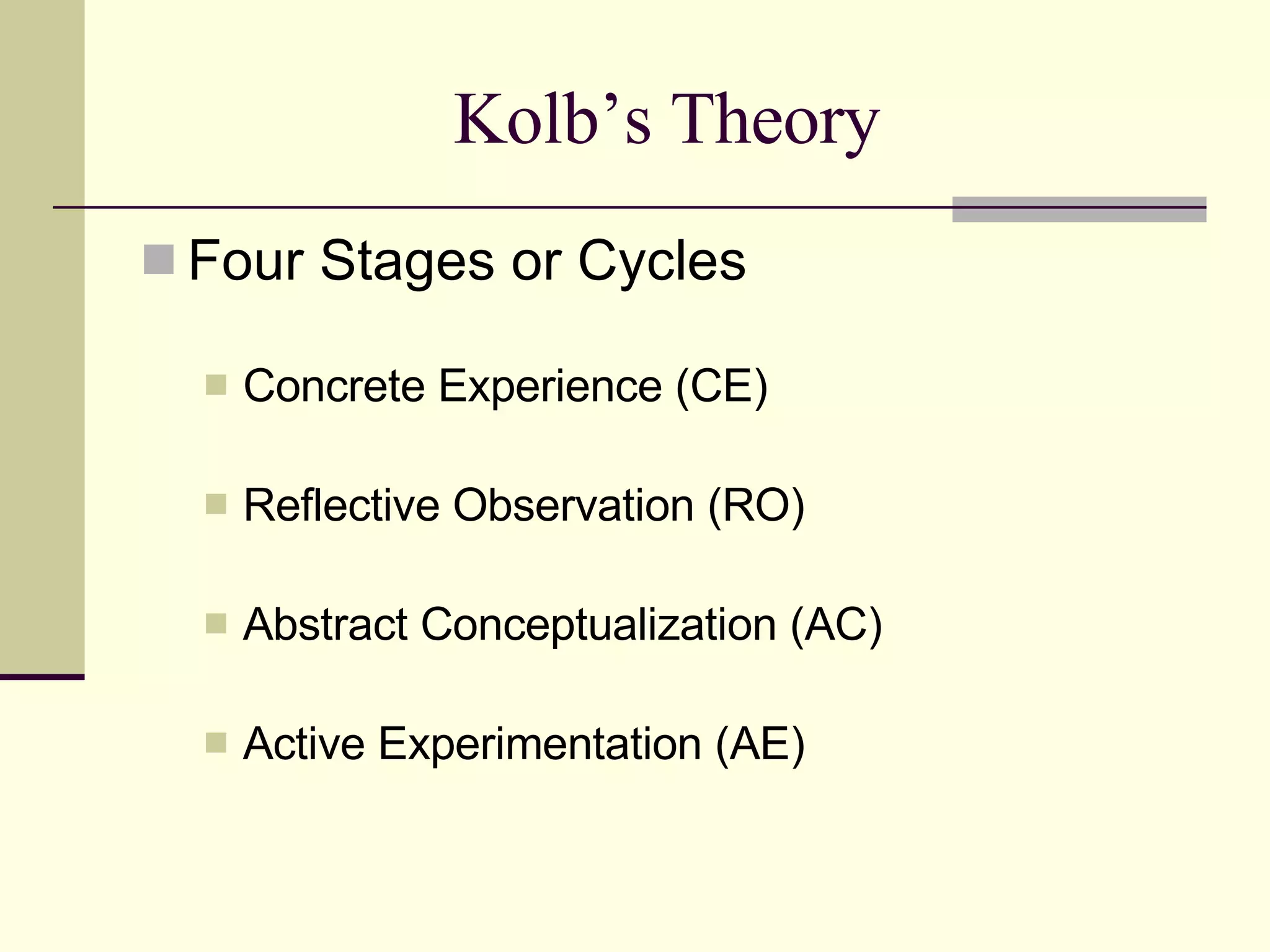
Kolb’s Theory Four Stages or Cycles Concrete Experience (CE) Reflective Observation (RO) Abstract Conceptualization (AC) Active Experimentation (AE)
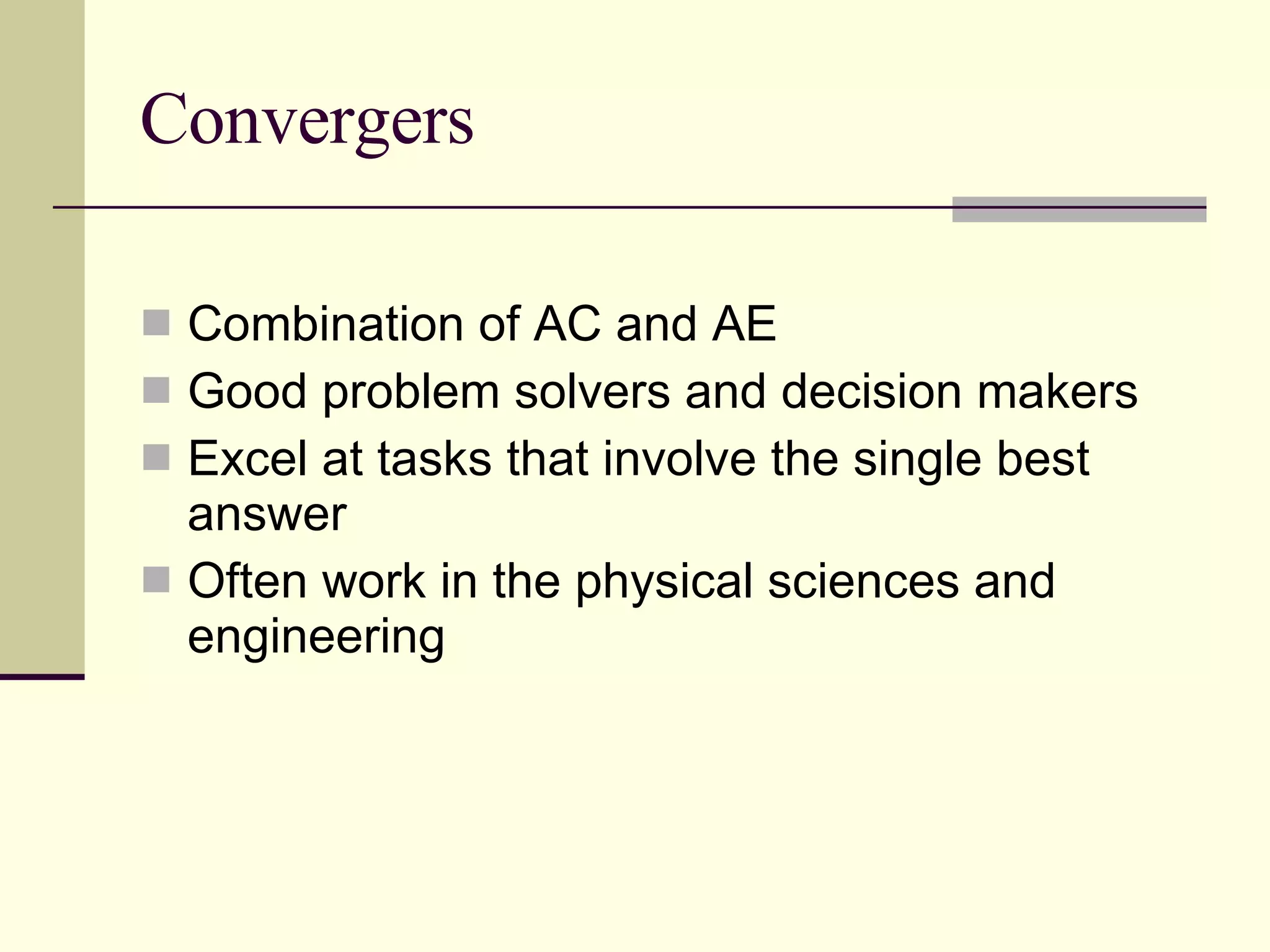
Convergers Combination of AC and AE Good problem solvers and decision makers Excel at tasks that involve the single best answer Often work in the physical sciences and engineering
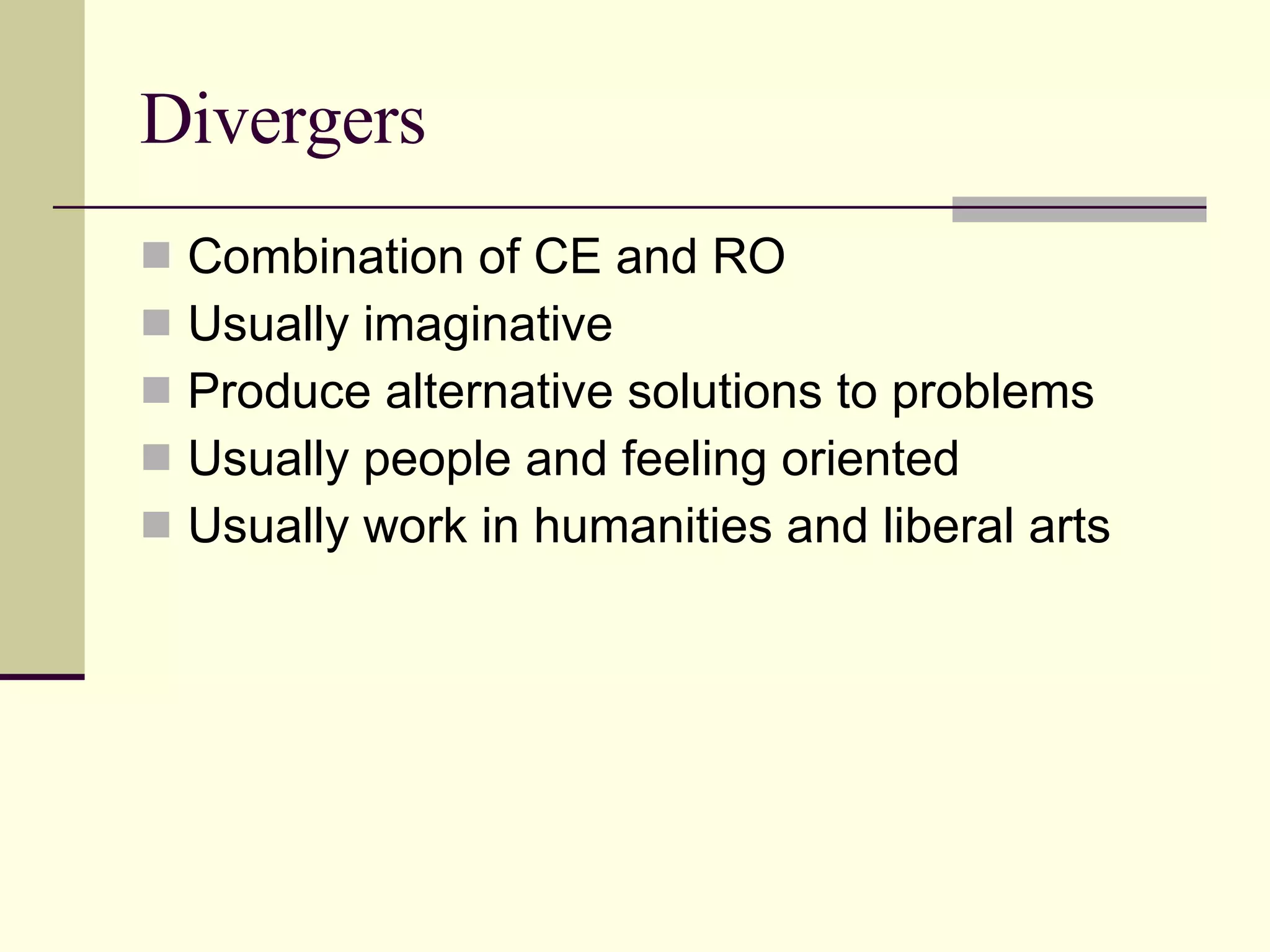
Divergers Combination of CE and RO Usually imaginative Produce alternative solutions to problems Usually people and feeling oriented Usually work in humanities and liberal arts
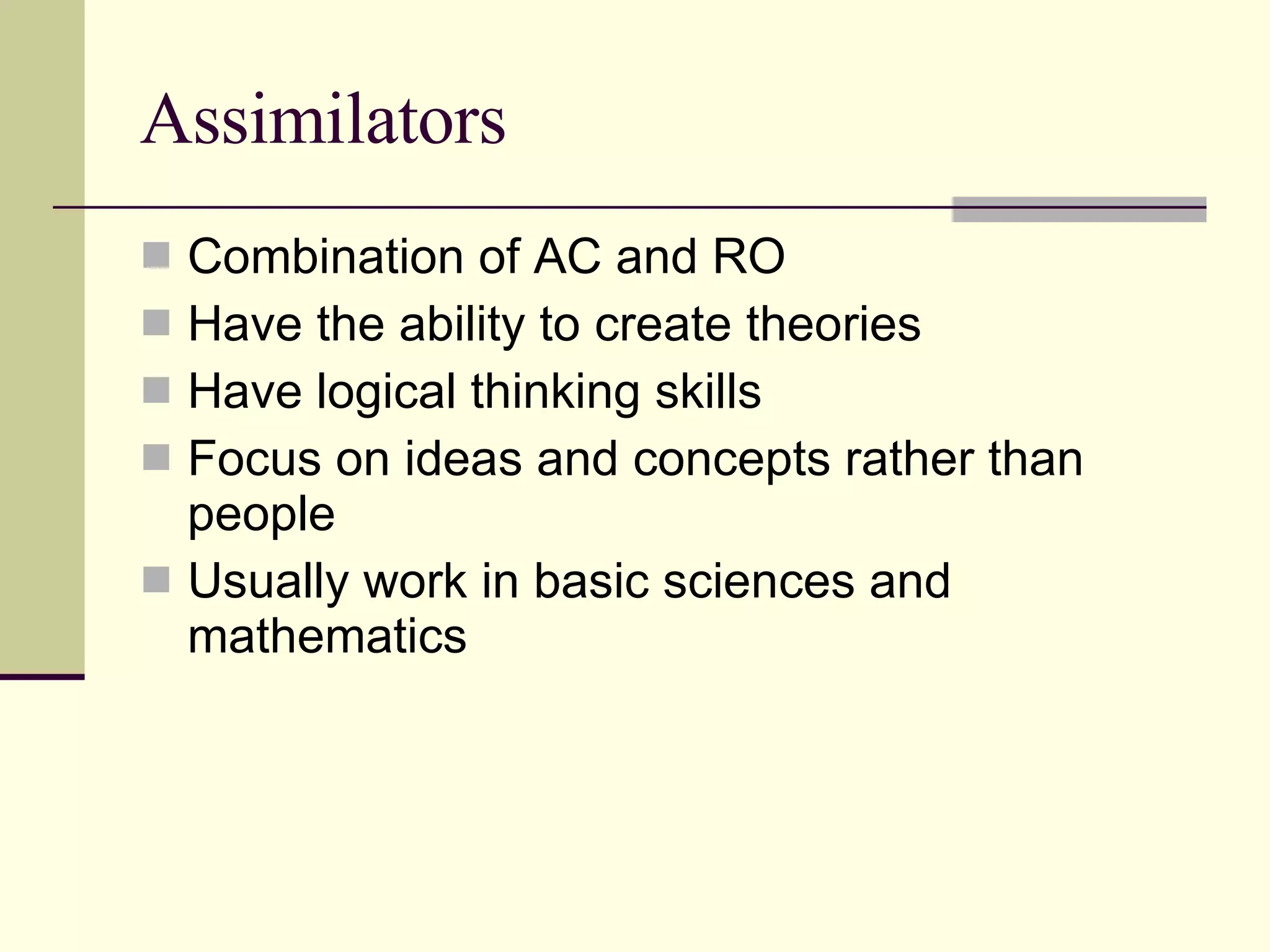
Assimilators Combination of AC and RO Have the ability to create theories  Have logical thinking skills Focus on ideas and concepts rather than people Usually work in basic sciences and mathematics
Accommodators Combination of CE and AE Action oriented Plan and complete tasks Open to new experiences and change Comfortable with people Usually work in practical fields, such as business
Experiential Learning Concrete Experience Involving the learner in the experience Field experience, role play, interviews Reflective Observation Engage in activities that require him/her to step back and look at the experience or get others’ perspectives Small Group Sessions
Experiential Learning (con’t) Abstract Conceptualization Student using research and methods of their discipline to develop hypotheses when engaging in films, lectures or computer assisted instruction Active Experimentation Students can apply principles or theories in problem solving Role play, “what if” situations, action planning
Typological Theorists Kolb (1984) Myers-Briggs (1980) Holland (1985/1992)
Assessment According to Kolb (1984, 41), "learning is the process whereby knowledge is created through the transformation of experience. Knowledge results from the combination of grasping experience and transforming it." He proposes that experiential learning has six main characteristic:  Learning is best conceived as a process, not in terms of outcomes.
Six Characteristics of Learning Learning is a continuous process grounded in experience.  Learning requires the resolution of conflicts between dialectically opposed modes of adaptation to the world (learning is by its very nature full of tension).  Learning is a holistic process of adaptation to the world.  Learning involves transactions between the person and the environment.  Learning is the process of creating knowledge that is the result of the transaction between social knowledge and personal knowledge.
"The Learning Style Inventory (LSI) is a simple self-description test, based on experiential learning theory, that is designed to measure your strengths and weaknesses as a learner.  Experiential learning is conceived as a four stage cycle:     (1) immediate concrete experience is the basis for     (2) observation and reflection;     (3) these observations are assimilated into a "theory" from which new implications for action can be deduced;    (4) these implications or hypotheses then serve as guides in acting to create new experiences.  Kolb’s Learning Style Inventory (LSI)
Assessment Tool LSI Complete the Learning Styles Inventory handout See handout for detailed explanation of results. Discuss results
References Chickering, A.W. & Associates. (1981). The modern  American college. San Francisco: Jossey-Bass. Chickering, A.W. & Reisser, L. (1993). Education and  identity (2nd  ed.). San Francisco: Jossey-Bass. Delworth, U., Hanson, G. & Associates. (1989).  Student services. (2nd ed.). San Francisco:  Jossey-Bass. Evans, N., Forney, D., & Guido-DiBrito, F. (1998).  Student development in college. San Francisco:  Jossey-Bass. Komives, S.R., Woodard, D.B. & Associates. (2003).  Student services: A handbook for the profession.  (4th ed.). San Francisco: Jossey-Bass.
References (continued) Kolb, D. A. (1981) 'Learning styles and disciplinary differences'. in A. W. Chickering (ed.)  The Modern American College , San Francisco: Jossey-Bass. Kolb, D. (1985).  Learning style inventory.  Boston, MA: McBer and Company

Kolb Theory

  • 1.
    Kolb Theory Presentationby Theresa Bridges, James Cardin, and Amanda Walker
  • 2.
    Outline Historical OverviewKolb Theory Assessment Instruments Research Applications Critique and Future Directions
  • 3.
    What is TypologicalTheory? Reflects different learning styles Non-evaluative Explains interpersonal interactions Patterned after Jung’s work
  • 4.
    Learning depends on:Heredity Present environment Past life experiences
  • 5.
    Kolb’s Theory FourStages or Cycles Concrete Experience (CE) Reflective Observation (RO) Abstract Conceptualization (AC) Active Experimentation (AE)
  • 6.
    Convergers Combination ofAC and AE Good problem solvers and decision makers Excel at tasks that involve the single best answer Often work in the physical sciences and engineering
  • 7.
    Divergers Combination ofCE and RO Usually imaginative Produce alternative solutions to problems Usually people and feeling oriented Usually work in humanities and liberal arts
  • 8.
    Assimilators Combination ofAC and RO Have the ability to create theories Have logical thinking skills Focus on ideas and concepts rather than people Usually work in basic sciences and mathematics
  • 9.
    Accommodators Combination ofCE and AE Action oriented Plan and complete tasks Open to new experiences and change Comfortable with people Usually work in practical fields, such as business
  • 10.
    Experiential Learning ConcreteExperience Involving the learner in the experience Field experience, role play, interviews Reflective Observation Engage in activities that require him/her to step back and look at the experience or get others’ perspectives Small Group Sessions
  • 11.
    Experiential Learning (con’t)Abstract Conceptualization Student using research and methods of their discipline to develop hypotheses when engaging in films, lectures or computer assisted instruction Active Experimentation Students can apply principles or theories in problem solving Role play, “what if” situations, action planning
  • 12.
    Typological Theorists Kolb(1984) Myers-Briggs (1980) Holland (1985/1992)
  • 13.
    Assessment According toKolb (1984, 41), "learning is the process whereby knowledge is created through the transformation of experience. Knowledge results from the combination of grasping experience and transforming it." He proposes that experiential learning has six main characteristic: Learning is best conceived as a process, not in terms of outcomes.
  • 14.
    Six Characteristics ofLearning Learning is a continuous process grounded in experience. Learning requires the resolution of conflicts between dialectically opposed modes of adaptation to the world (learning is by its very nature full of tension). Learning is a holistic process of adaptation to the world. Learning involves transactions between the person and the environment. Learning is the process of creating knowledge that is the result of the transaction between social knowledge and personal knowledge.
  • 15.
    "The Learning StyleInventory (LSI) is a simple self-description test, based on experiential learning theory, that is designed to measure your strengths and weaknesses as a learner. Experiential learning is conceived as a four stage cycle:    (1) immediate concrete experience is the basis for    (2) observation and reflection;    (3) these observations are assimilated into a "theory" from which new implications for action can be deduced;   (4) these implications or hypotheses then serve as guides in acting to create new experiences. Kolb’s Learning Style Inventory (LSI)
  • 16.
    Assessment Tool LSIComplete the Learning Styles Inventory handout See handout for detailed explanation of results. Discuss results
  • 17.
    References Chickering, A.W.& Associates. (1981). The modern American college. San Francisco: Jossey-Bass. Chickering, A.W. & Reisser, L. (1993). Education and identity (2nd ed.). San Francisco: Jossey-Bass. Delworth, U., Hanson, G. & Associates. (1989). Student services. (2nd ed.). San Francisco: Jossey-Bass. Evans, N., Forney, D., & Guido-DiBrito, F. (1998). Student development in college. San Francisco: Jossey-Bass. Komives, S.R., Woodard, D.B. & Associates. (2003). Student services: A handbook for the profession. (4th ed.). San Francisco: Jossey-Bass.
  • 18.
    References (continued) Kolb,D. A. (1981) 'Learning styles and disciplinary differences'. in A. W. Chickering (ed.) The Modern American College , San Francisco: Jossey-Bass. Kolb, D. (1985). Learning style inventory. Boston, MA: McBer and Company