Reflective Practice and Critical Evaluation Associate Teachers’ Course 27 March 09
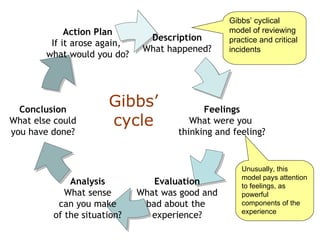
Gibbs’ cycle Gibbs’ cyclical model of reviewing practice and critical incidents Unusually, this model pays attention to feelings, as powerful components of the experience Description What happened? Conclusion What else could you have done? Action Plan If it arose again,  what would you do? Feelings What were you  thinking and feeling? Evaluation What was good and bad about the  experience? Analysis What sense can you make of the situation?
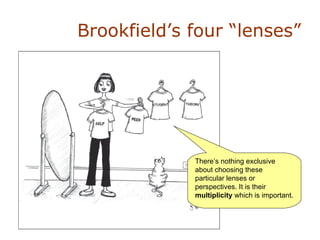
Brookfield’s four “lenses” There’s nothing exclusive about choosing these particular lenses or perspectives. It is their  multiplicity  which is important.
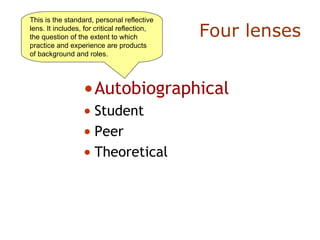
Four lenses Autobiographical Student Peer Theoretical This is the standard, personal reflective lens. It includes, for critical reflection, the question of the extent to which practice and experience are products of background and roles.
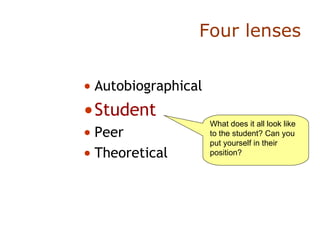
Four lenses Autobiographical Student Peer Theoretical What does it all look like to the student? Can you put yourself in their position?
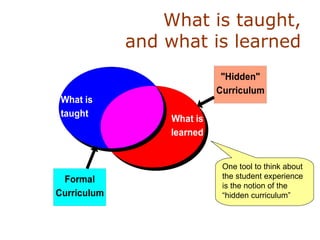
What is taught, and what is learned One tool to think about the student experience is the notion of the “hidden curriculum”
“ Sending messages” All social practices have a sub-text, or send a message. …  usually about values and relationships There is no way to avoid these messages The only question is whether they are “good” messages or “bad” ones
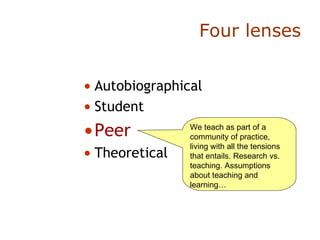
Four lenses Autobiographical Student Peer Theoretical We teach as part of a community of practice, living with all the tensions that entails. Research vs. teaching. Assumptions about teaching and learning…
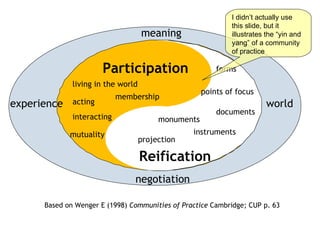
I didn’t actually use this slide, but it illustrates the “yin and yang” of a community of practice Based on Wenger E (1998)  Communities of Practice  Cambridge; CUP p. 63 Participation Reification meaning world experience negotiation living in the world membership acting interacting mutuality forms points of focus documents monuments instruments projection
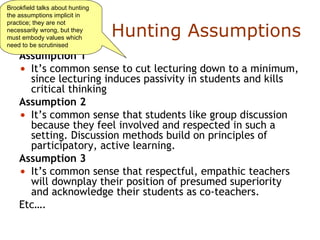
Hunting Assumptions Assumption 1 It’s common sense to cut lecturing down to a minimum, since lecturing induces passivity in students and kills critical thinking Assumption 2 It’s common sense that students like group discussion because they feel involved and respected in such a setting. Discussion methods build on principles of participatory, active learning. Assumption 3  It’s common sense that respectful, empathic teachers will downplay their position of presumed superiority and acknowledge their students as co-teachers.  Etc…. Brookfield talks about hunting the assumptions implicit in practice; they are not necessarily wrong, but they must embody values which need to be scrutinised
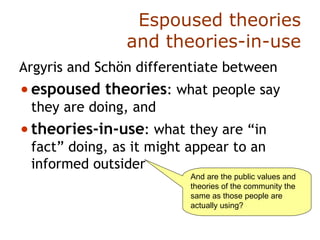
Espoused theories and theories-in-use Argyris and Schön differentiate between espoused theories : what people say they are doing, and theories-in-use : what they are “in fact” doing, as it might appear to an informed outsider And are the public values and theories of the community the same as those people are actually using?
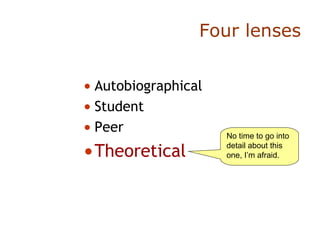
Four lenses Autobiographical Student Peer Theoretical No time to go into detail about this one, I’m afraid.
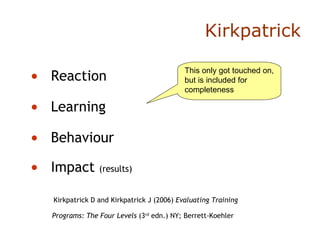
Kirkpatrick Reaction Learning Behaviour Impact  (results) Kirkpatrick D and Kirkpatrick J (2006)  Evaluating Training Programs: The Four Levels  (3 rd  edn.) NY; Berrett-Koehler   This only got touched on, but is included for completeness

Criticial Evaluation

  • 1.
    Reflective Practice andCritical Evaluation Associate Teachers’ Course 27 March 09
  • 2.
    Gibbs’ cycle Gibbs’cyclical model of reviewing practice and critical incidents Unusually, this model pays attention to feelings, as powerful components of the experience Description What happened? Conclusion What else could you have done? Action Plan If it arose again, what would you do? Feelings What were you thinking and feeling? Evaluation What was good and bad about the experience? Analysis What sense can you make of the situation?
  • 3.
    Brookfield’s four “lenses”There’s nothing exclusive about choosing these particular lenses or perspectives. It is their multiplicity which is important.
  • 4.
    Four lenses AutobiographicalStudent Peer Theoretical This is the standard, personal reflective lens. It includes, for critical reflection, the question of the extent to which practice and experience are products of background and roles.
  • 5.
    Four lenses AutobiographicalStudent Peer Theoretical What does it all look like to the student? Can you put yourself in their position?
  • 6.
    What is taught,and what is learned One tool to think about the student experience is the notion of the “hidden curriculum”
  • 7.
    “ Sending messages”All social practices have a sub-text, or send a message. … usually about values and relationships There is no way to avoid these messages The only question is whether they are “good” messages or “bad” ones
  • 8.
    Four lenses AutobiographicalStudent Peer Theoretical We teach as part of a community of practice, living with all the tensions that entails. Research vs. teaching. Assumptions about teaching and learning…
  • 9.
    I didn’t actuallyuse this slide, but it illustrates the “yin and yang” of a community of practice Based on Wenger E (1998) Communities of Practice Cambridge; CUP p. 63 Participation Reification meaning world experience negotiation living in the world membership acting interacting mutuality forms points of focus documents monuments instruments projection
  • 10.
    Hunting Assumptions Assumption1 It’s common sense to cut lecturing down to a minimum, since lecturing induces passivity in students and kills critical thinking Assumption 2 It’s common sense that students like group discussion because they feel involved and respected in such a setting. Discussion methods build on principles of participatory, active learning. Assumption 3 It’s common sense that respectful, empathic teachers will downplay their position of presumed superiority and acknowledge their students as co-teachers. Etc…. Brookfield talks about hunting the assumptions implicit in practice; they are not necessarily wrong, but they must embody values which need to be scrutinised
  • 11.
    Espoused theories andtheories-in-use Argyris and Schön differentiate between espoused theories : what people say they are doing, and theories-in-use : what they are “in fact” doing, as it might appear to an informed outsider And are the public values and theories of the community the same as those people are actually using?
  • 12.
    Four lenses AutobiographicalStudent Peer Theoretical No time to go into detail about this one, I’m afraid.
  • 13.
    Kirkpatrick Reaction LearningBehaviour Impact (results) Kirkpatrick D and Kirkpatrick J (2006) Evaluating Training Programs: The Four Levels (3 rd edn.) NY; Berrett-Koehler This only got touched on, but is included for completeness