CILIP Reflective Practice
28th October 2013
Dr. Paula Nottingham
Reflective Practice
Reflective practice Feedback
Postgraduate Courseis a valuable way of

understanding how professionals
evaluate what they do in order to improve
their performance in the workplace.
Reflective practice

THOUGHT/COMMENT
Strategies for reflective practice can help save time, but time is
sometimes difficult to find in a busy work/life schedule.
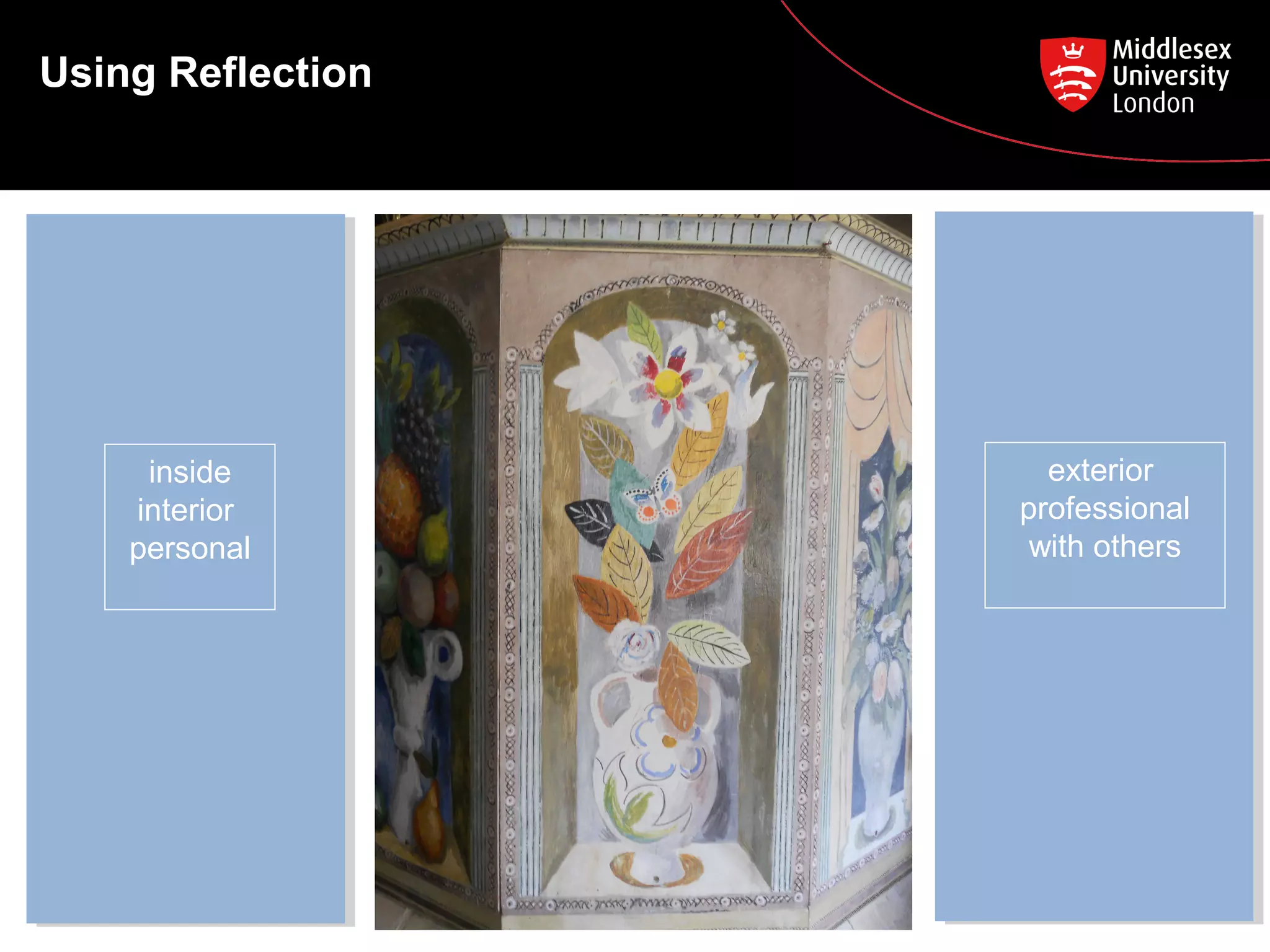
Using Reflection

inside
interior
personal

exterior
professional
with others
Using Reflection

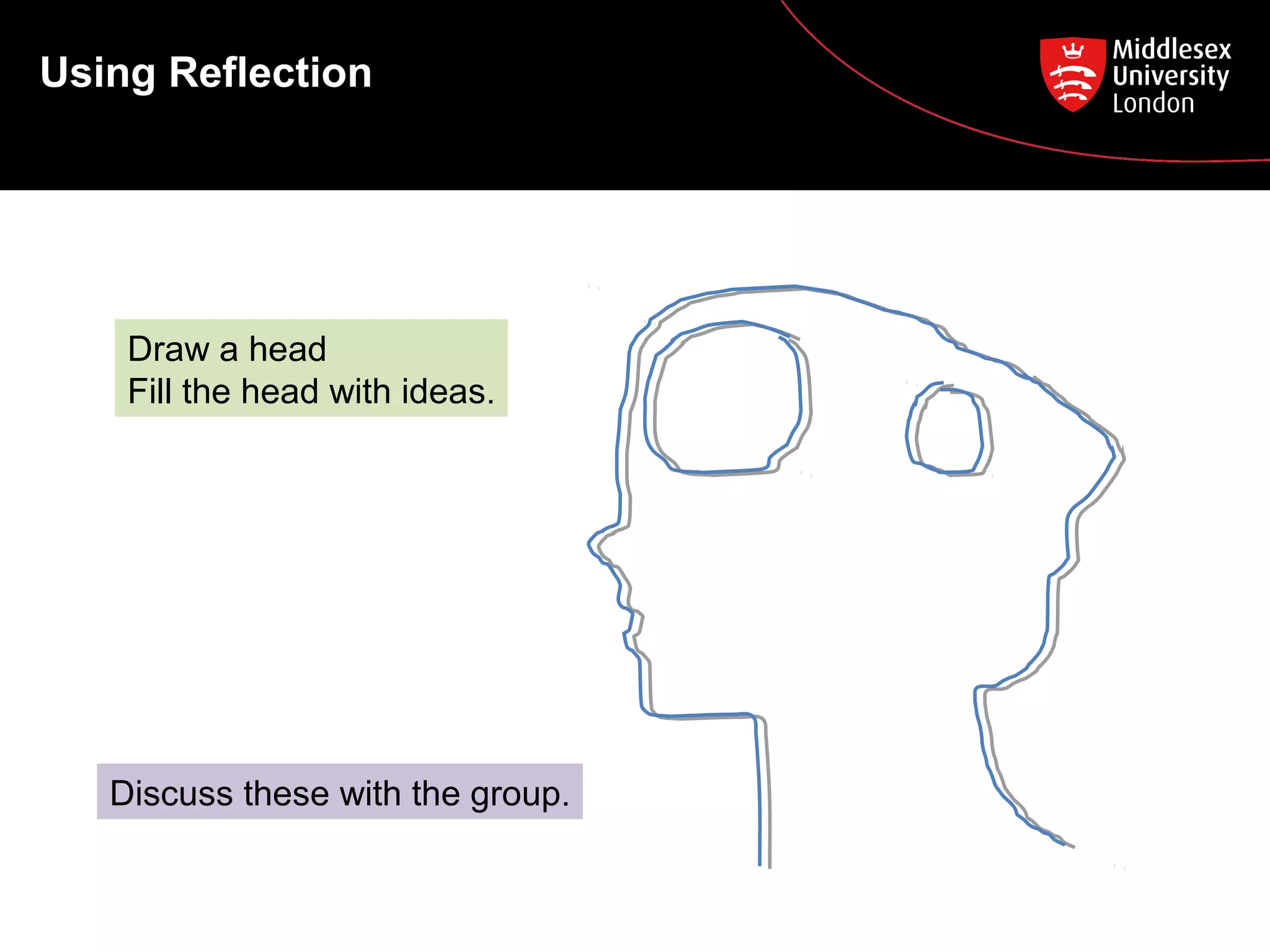
Draw a head
Fill the head with ideas.

Discuss these with the group.
Using Reflection

Concept drawings are
devices for visualising
ideas

inside
interior
personal

exterior
professional
with others

The only rules say not to draw recognised figurative
imagery – you can use shapes, lines, arrows,
patterns. Three minutes…
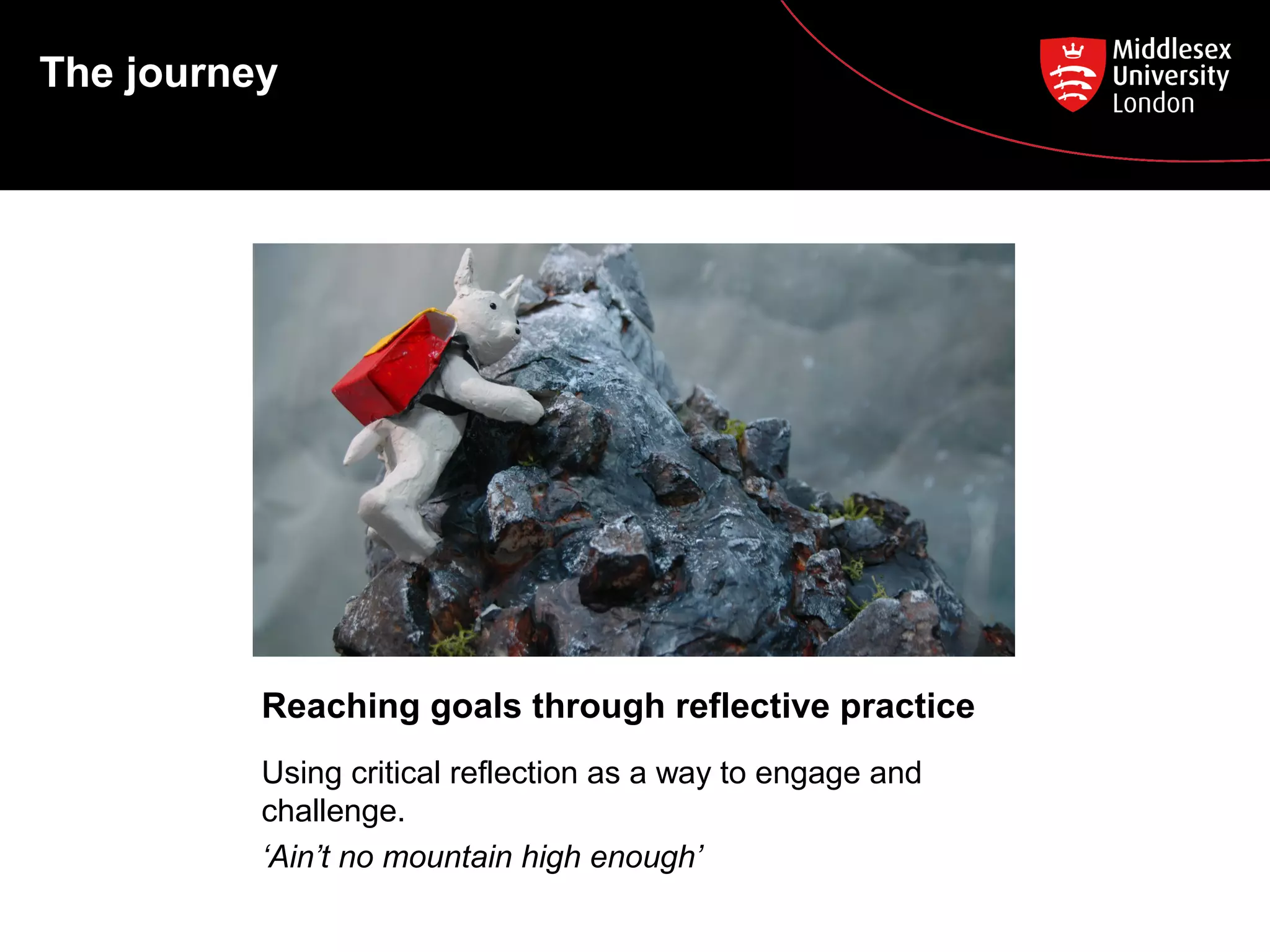
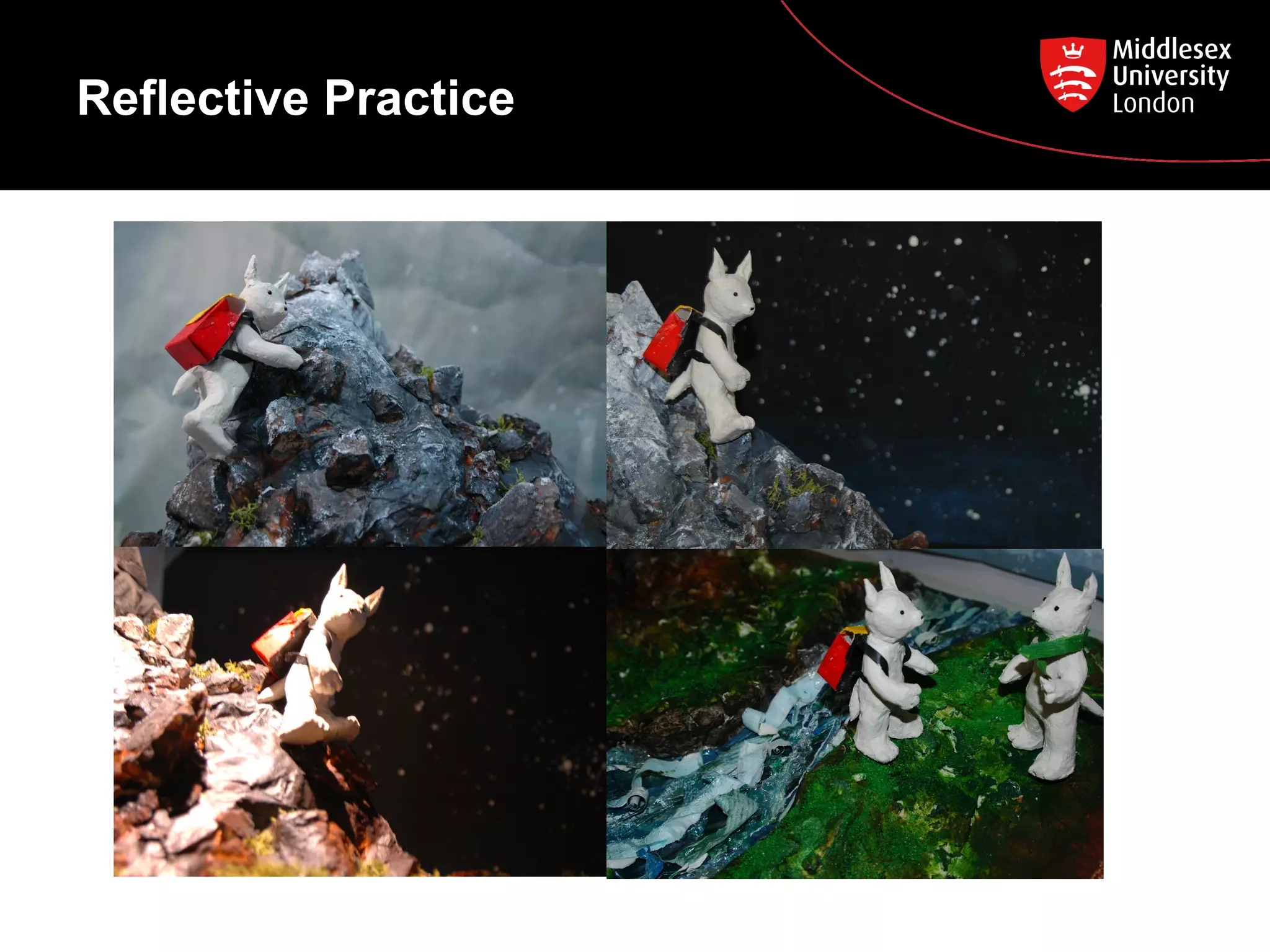
The journey

Reaching goals through reflective practice
Using critical reflection as a way to engage and
challenge.
‘Ain’t no mountain high enough’
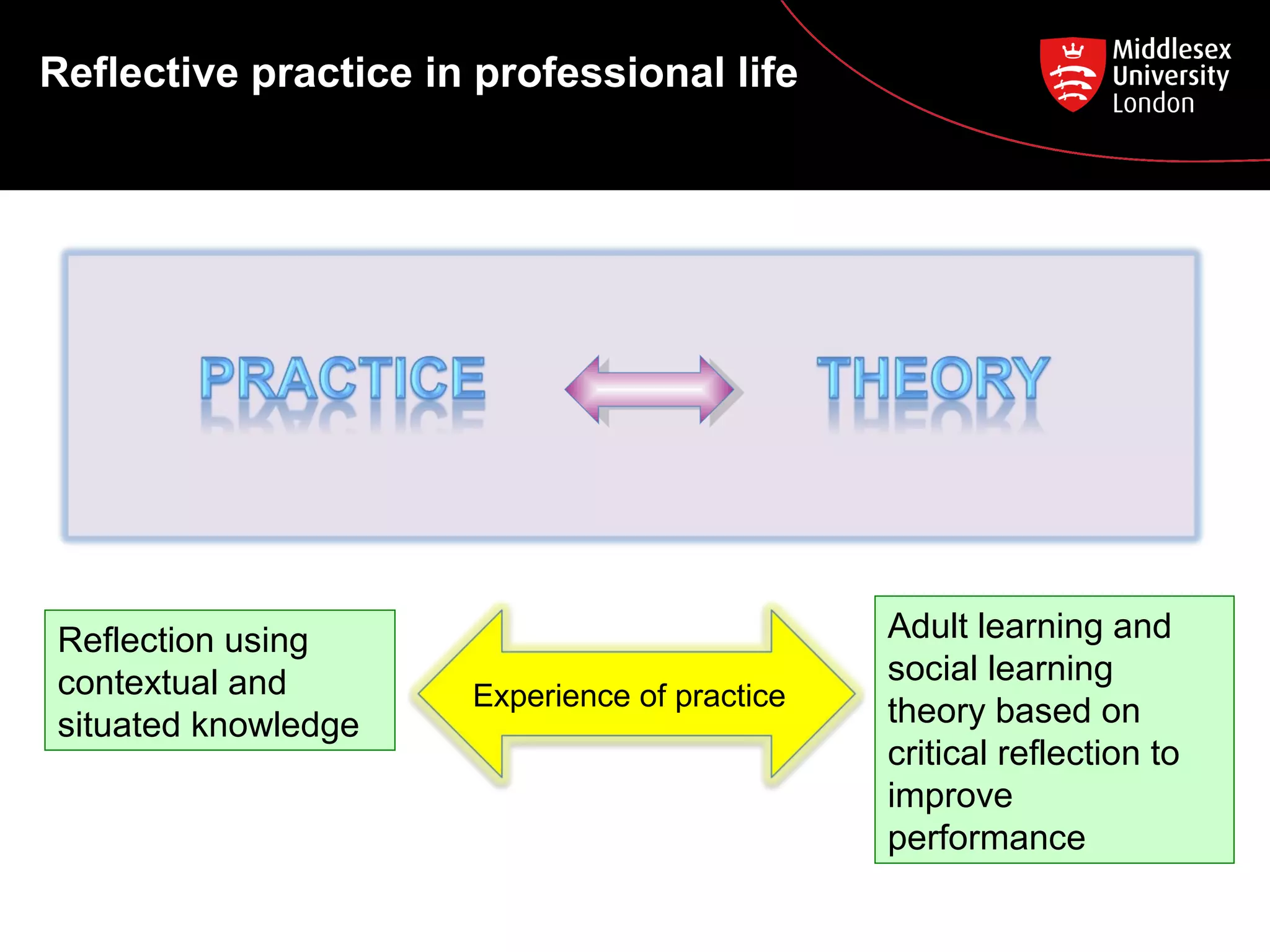
Reflective practice in professional life

Reflection using
contextual and
situated knowledge

Experience of practice

Adult learning and
social learning
theory based on
critical reflection to
improve
performance
Work based learning

transdisciplinarity

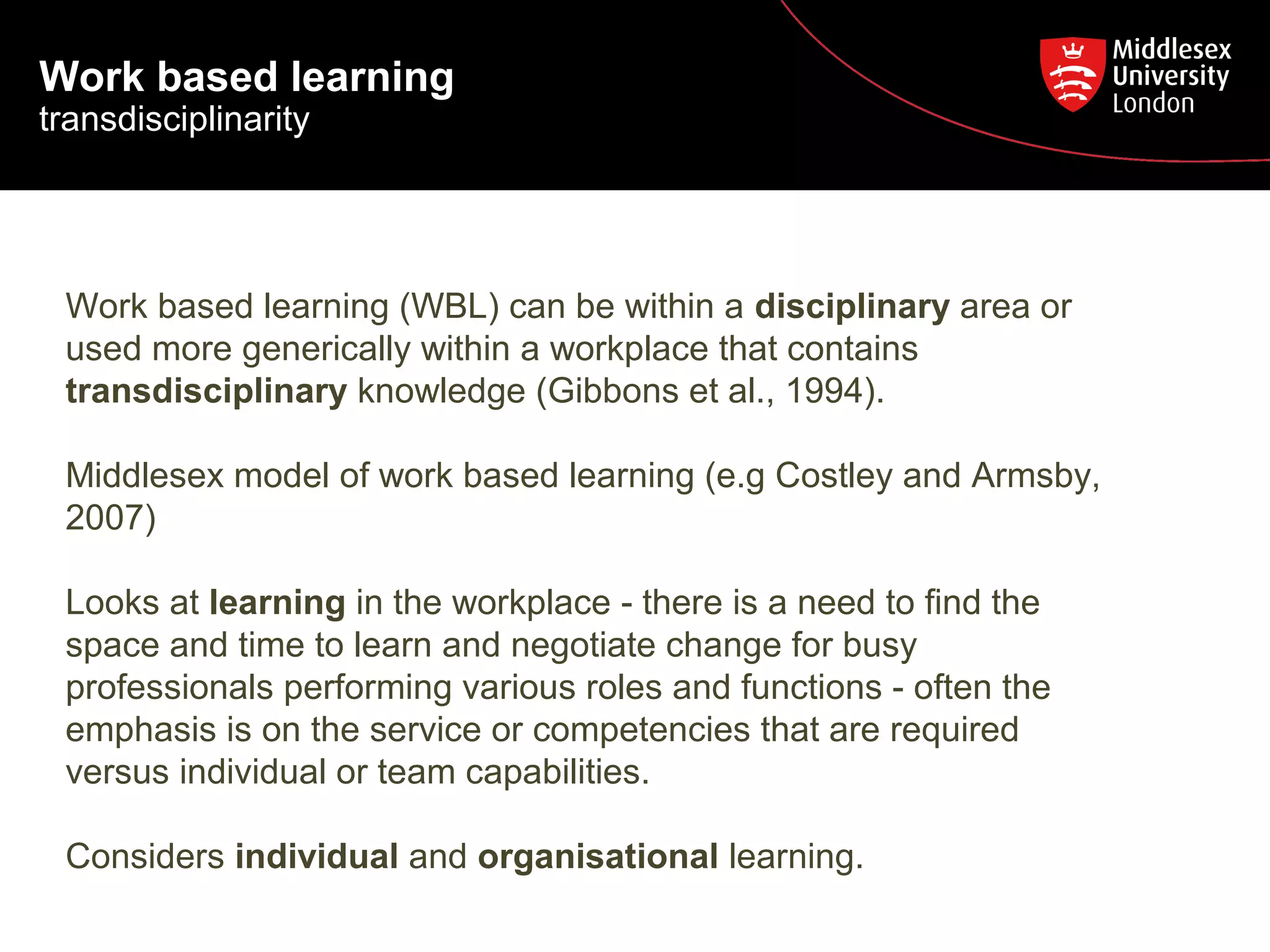
Work based learning (WBL) can be within a disciplinary area or
used more generically within a workplace that contains
transdisciplinary knowledge (Gibbons et al., 1994).
Middlesex model of work based learning (e.g Costley and Armsby,
2007)
Looks at learning in the workplace - there is a need to find the
space and time to learn and negotiate change for busy
professionals performing various roles and functions - often the
emphasis is on the service or competencies that are required
versus individual or team capabilities.
Considers individual and organisational learning.
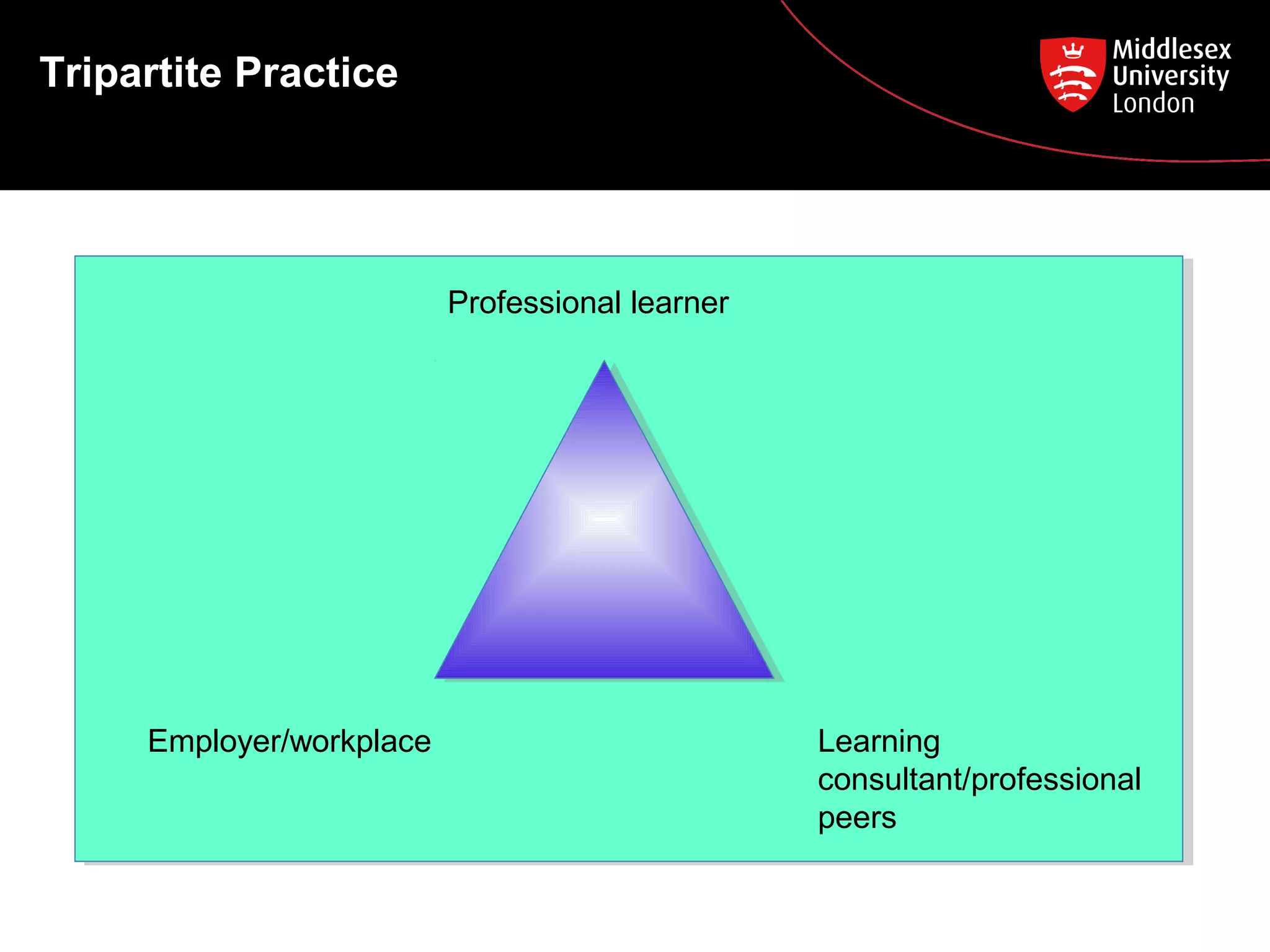
Tripartite Practice

Professional learner

Employer/workplace

Learning
consultant/professional
peers
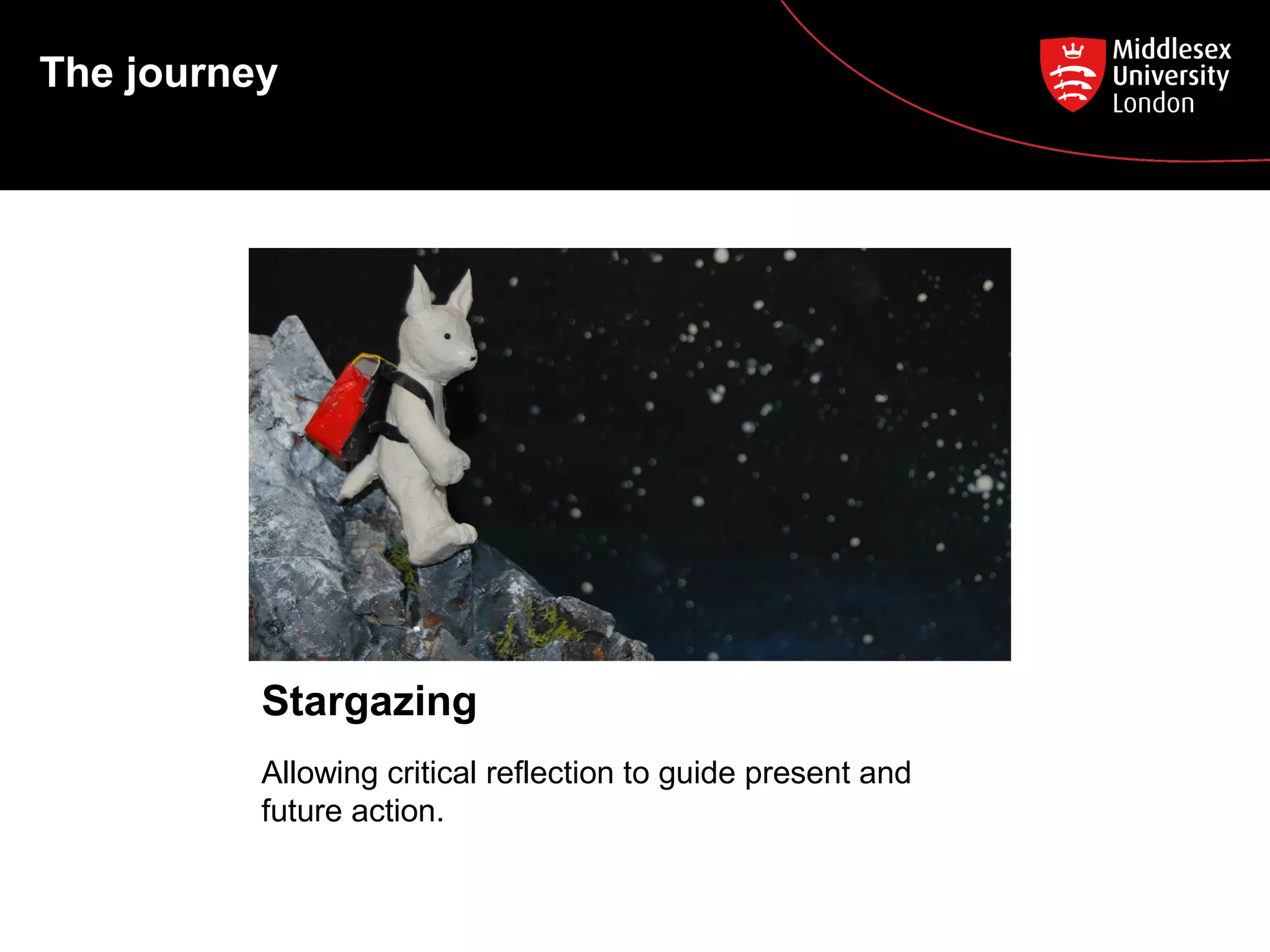
The journey

Stargazing
Allowing critical reflection to guide present and
future action.
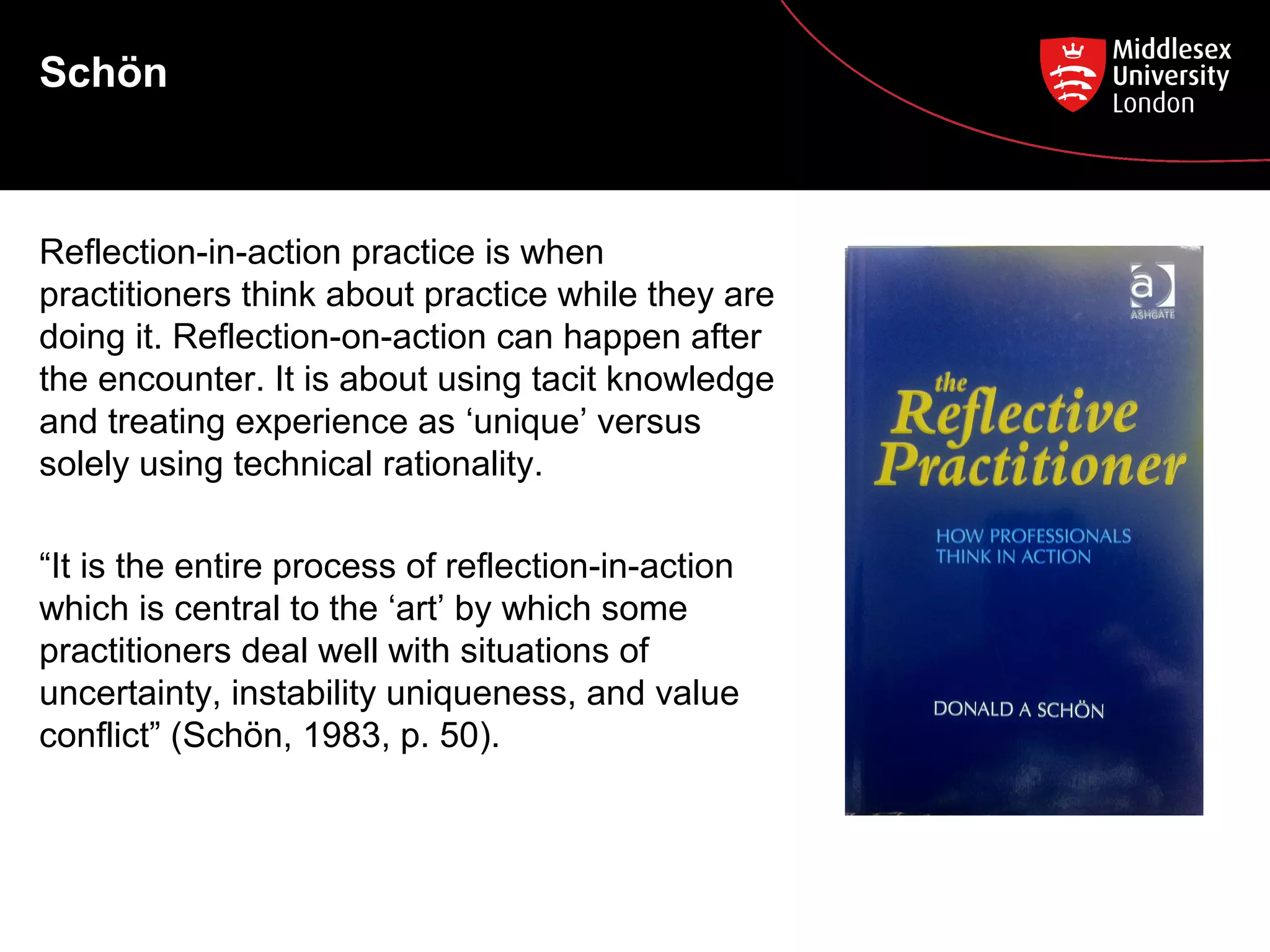
Schön

Reflection-in-action practice is when
practitioners think about practice while they are
doing it. Reflection-on-action can happen after
the encounter. It is about using tacit knowledge
and treating experience as ‘unique’ versus
solely using technical rationality.
“It is the entire process of reflection-in-action
which is central to the ‘art’ by which some
practitioners deal well with situations of
uncertainty, instability uniqueness, and value
conflict” (Schön, 1983, p. 50).
Argyris and Schön

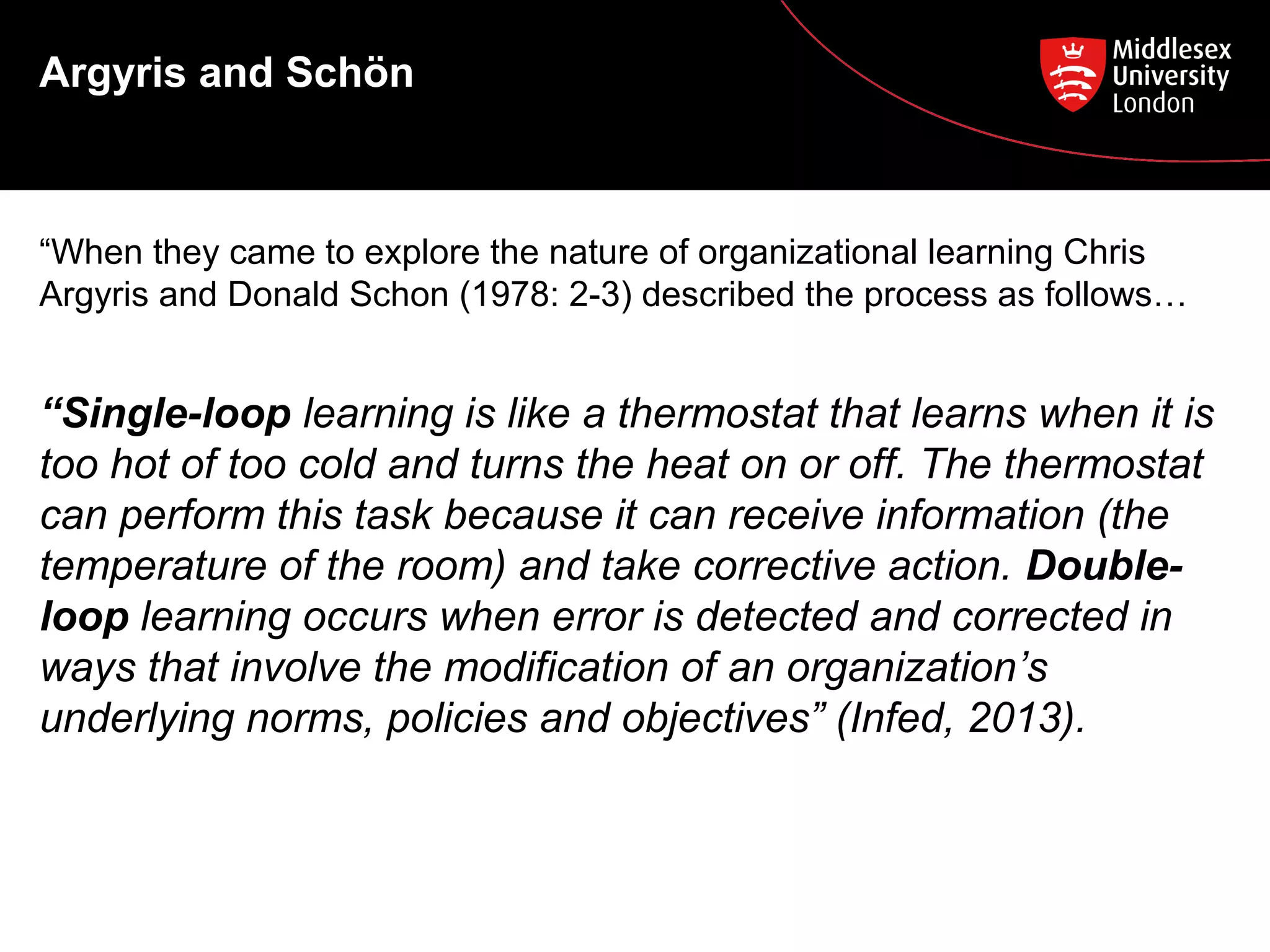
“When they came to explore the nature of organizational learning Chris
Argyris and Donald Schon (1978: 2-3) described the process as follows…

“Single-loop learning is like a thermostat that learns when it is
too hot of too cold and turns the heat on or off. The thermostat
can perform this task because it can receive information (the
temperature of the room) and take corrective action. Doubleloop learning occurs when error is detected and corrected in
ways that involve the modification of an organization’s
underlying norms, policies and objectives” (Infed, 2013).
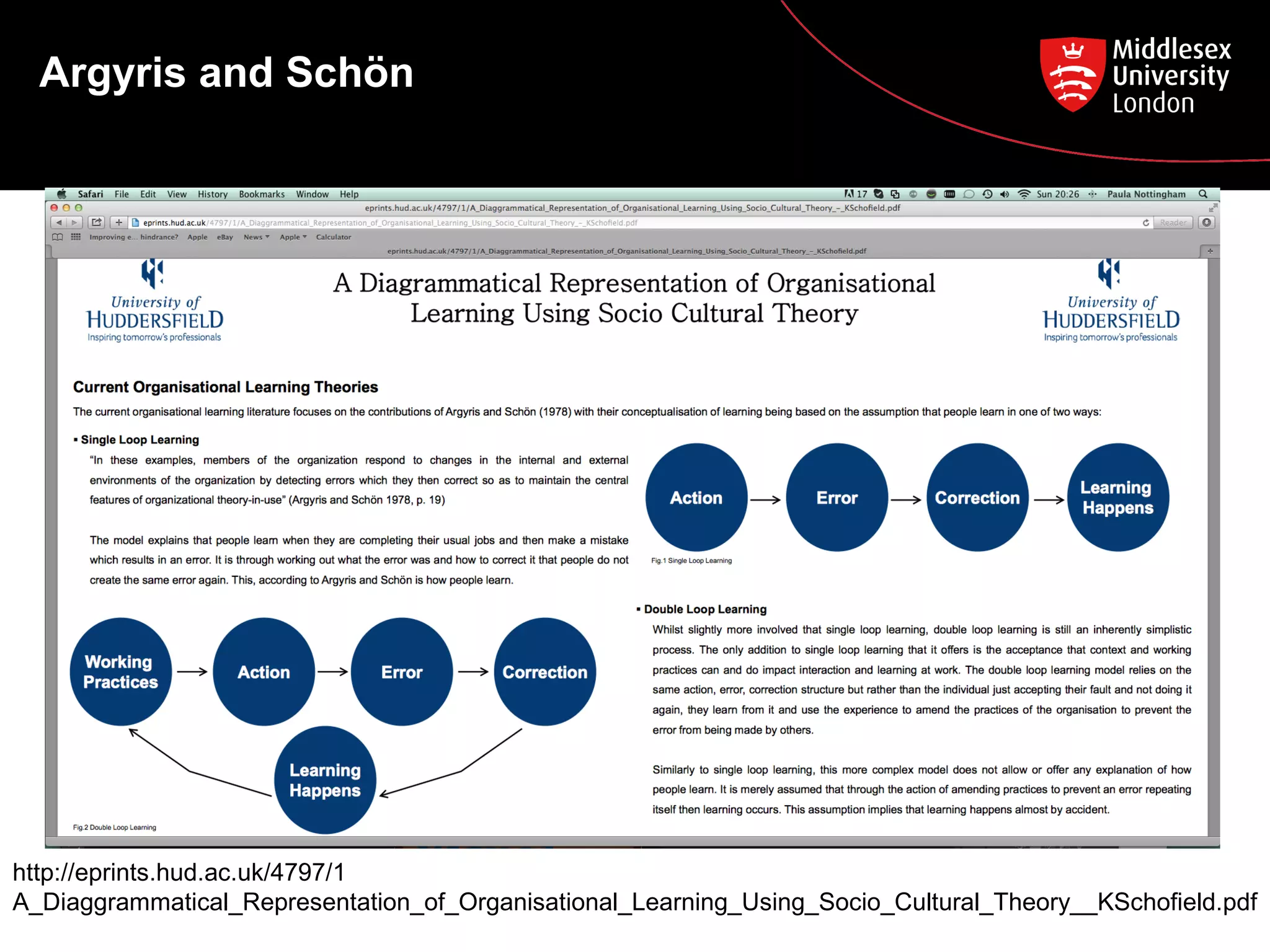
Argyris and Schön

http://eprints.hud.ac.uk/4797/1
A_Diaggrammatical_Representation_of_Organisational_Learning_Using_Socio_Cultural_Theory__KSchofield.pdf
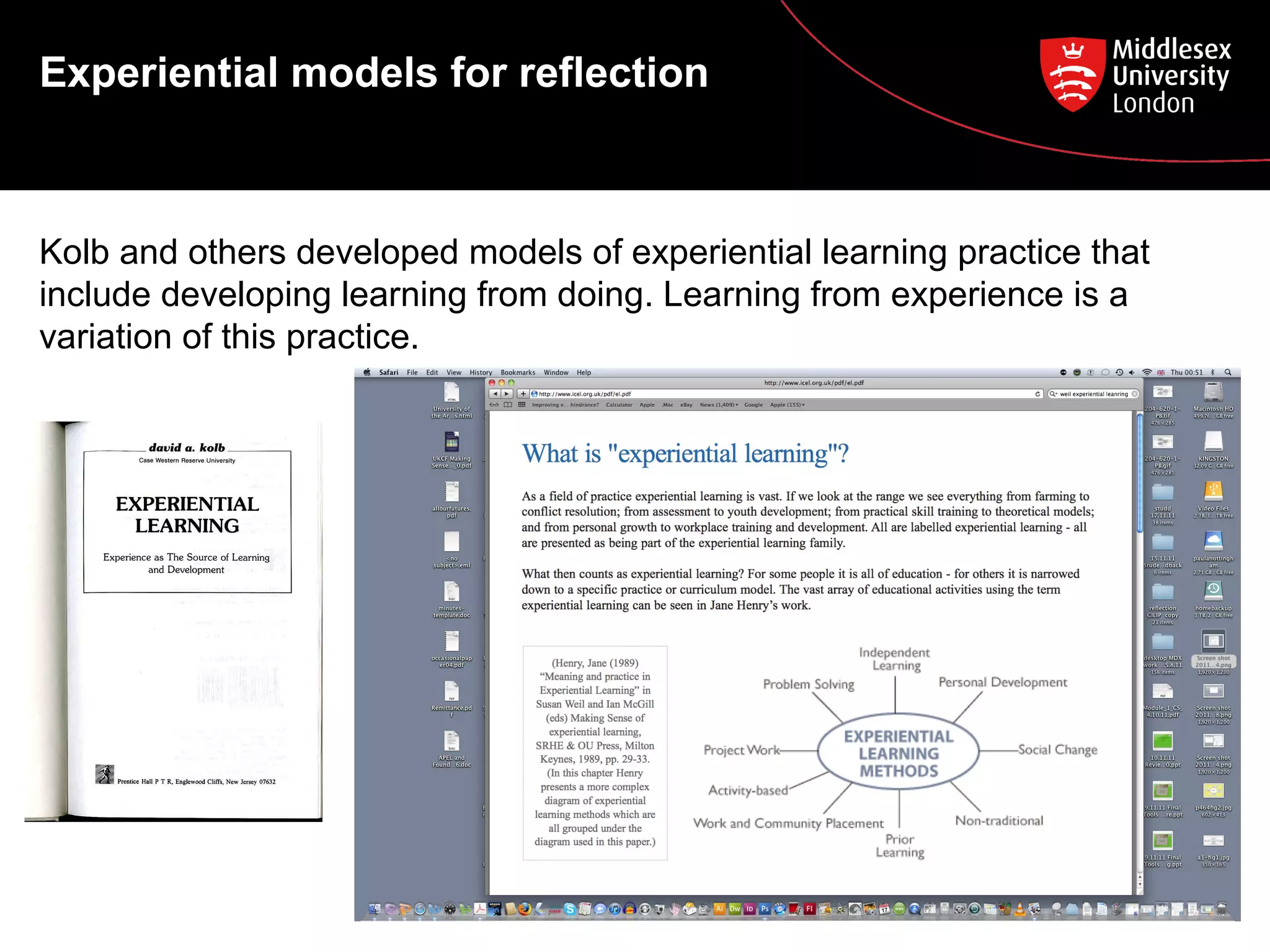
Experiential models for reflection

Kolb and others developed models of experiential learning practice that
include developing learning from doing. Learning from experience is a
variation of this practice.
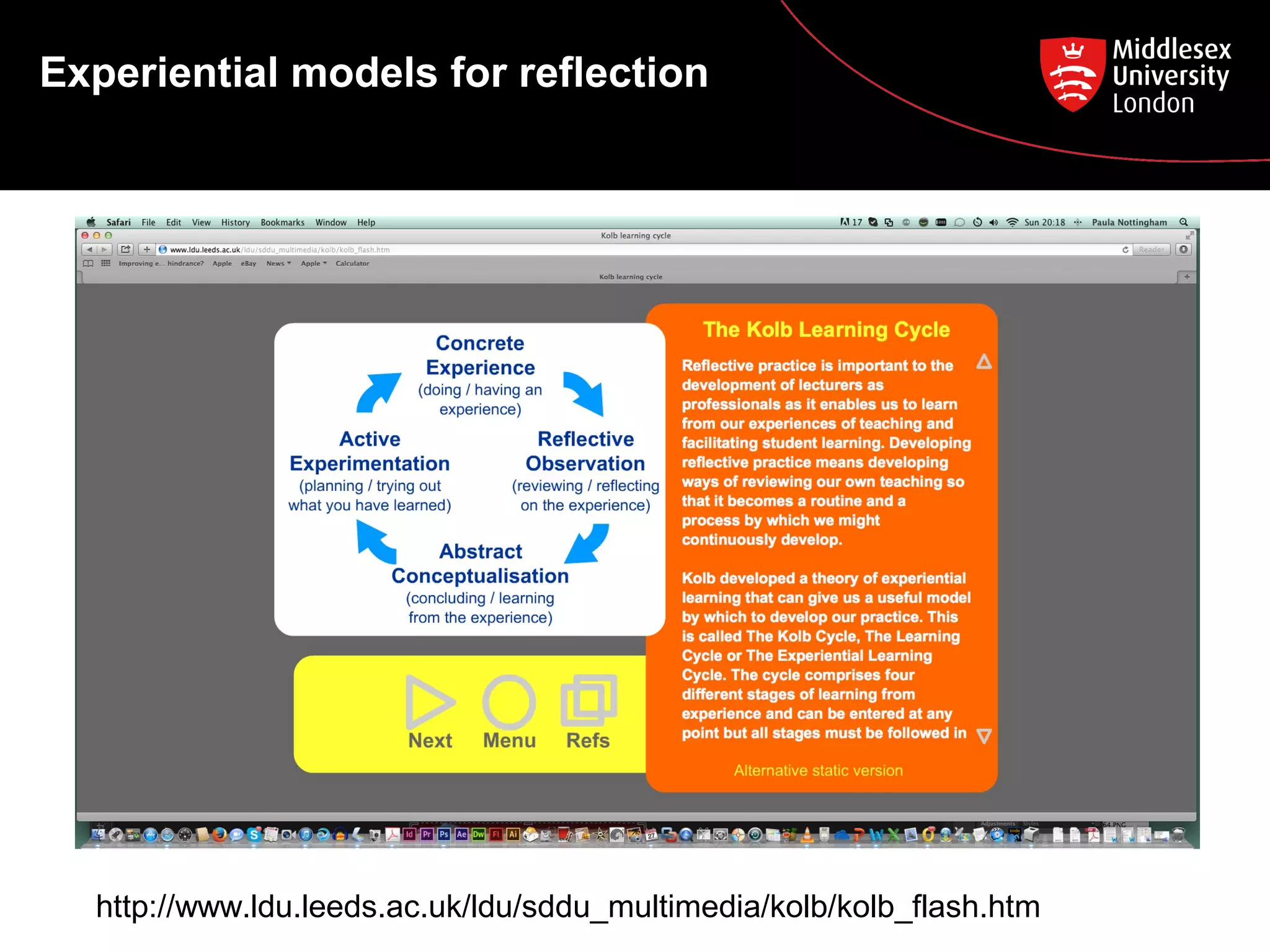
Experiential models for reflection

http://www.ldu.leeds.ac.uk/ldu/sddu_multimedia/kolb/kolb_flash.htm
Honey and Mumford

We learn in different ways
– Activist - learning by doing
– Reflectors - learning by observing
– Theorist - learning by thinking through in a logical manner
– Pragmatist - learning through putting ideas into practice
and testing them out
“Honey and Alan Mumford developed their learning styles system as a
variation on the Kolb model…” (Infed, 2013, online).
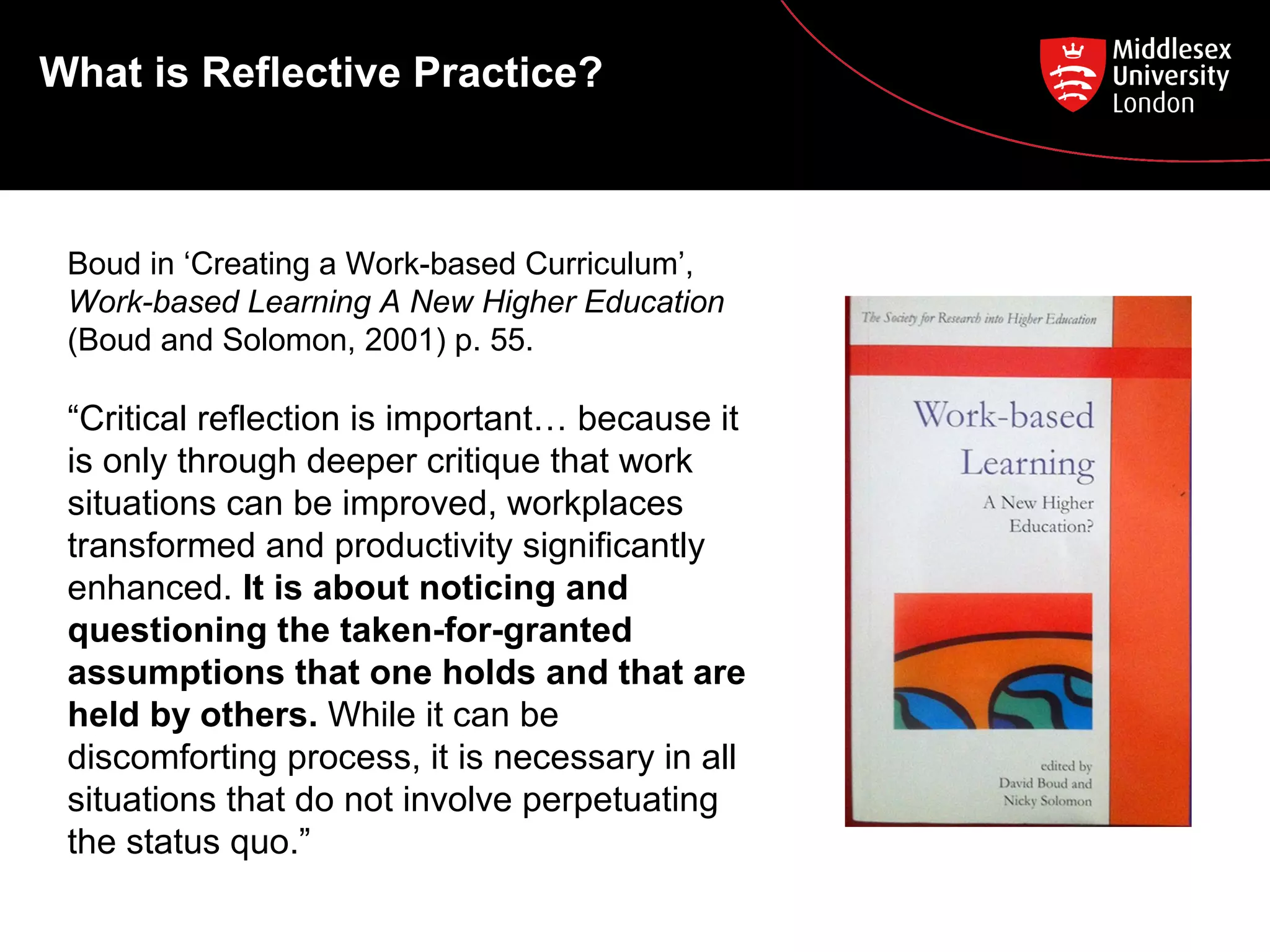
What is Reflective Practice?

Boud in ‘Creating a Work-based Curriculum’,
Work-based Learning A New Higher Education
(Boud and Solomon, 2001) p. 55.

“Critical reflection is important… because it
is only through deeper critique that work
situations can be improved, workplaces
transformed and productivity significantly
enhanced. It is about noticing and
questioning the taken-for-granted
assumptions that one holds and that are
held by others. While it can be
discomforting process, it is necessary in all
situations that do not involve perpetuating
the status quo.”
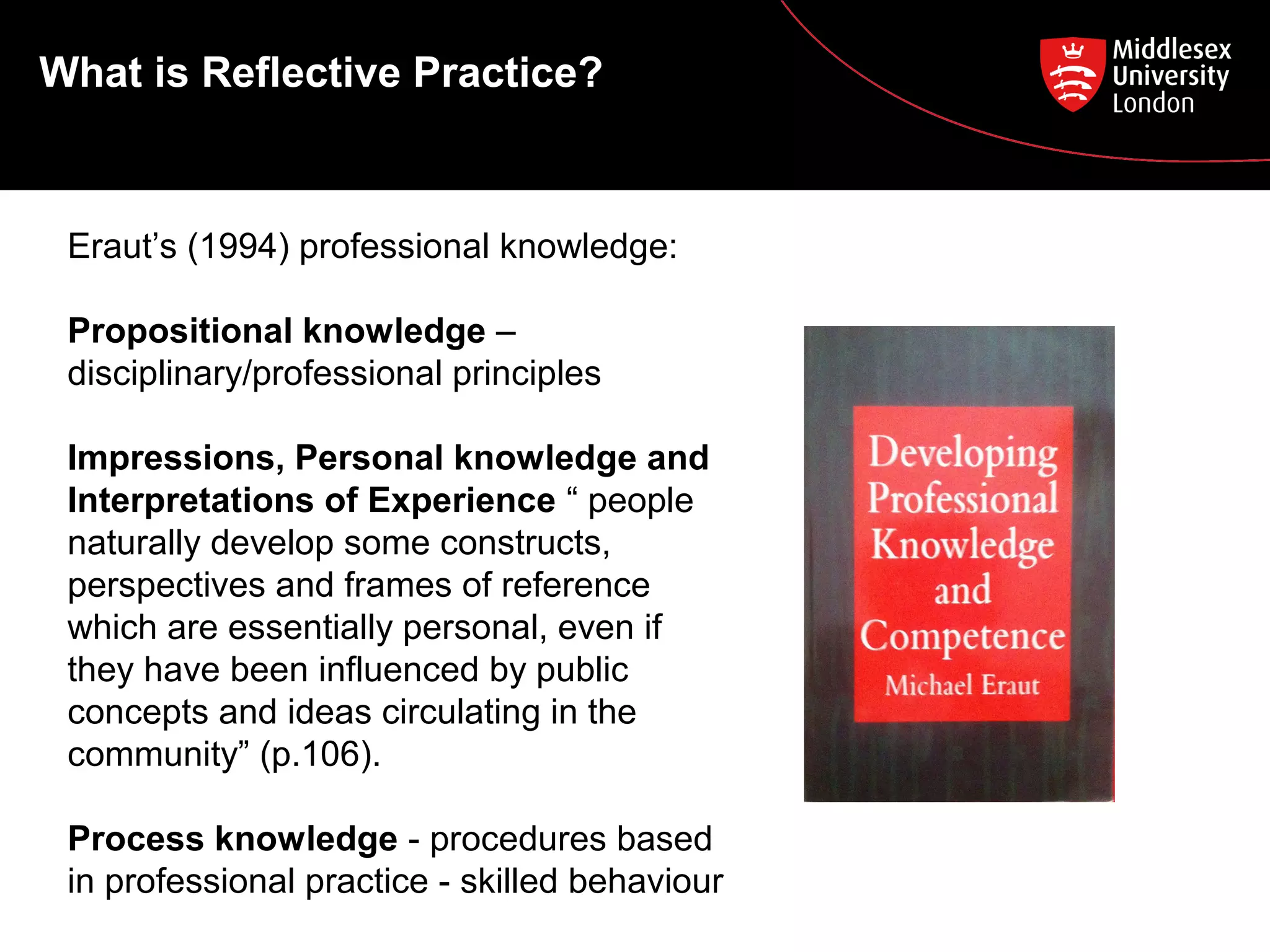
What is Reflective Practice?

Eraut’s (1994) professional knowledge:
Propositional knowledge –
disciplinary/professional principles
Impressions, Personal knowledge and
Interpretations of Experience “ people
naturally develop some constructs,
perspectives and frames of reference
which are essentially personal, even if
they have been influenced by public
concepts and ideas circulating in the
community” (p.106).
Process knowledge - procedures based
in professional practice - skilled behaviour
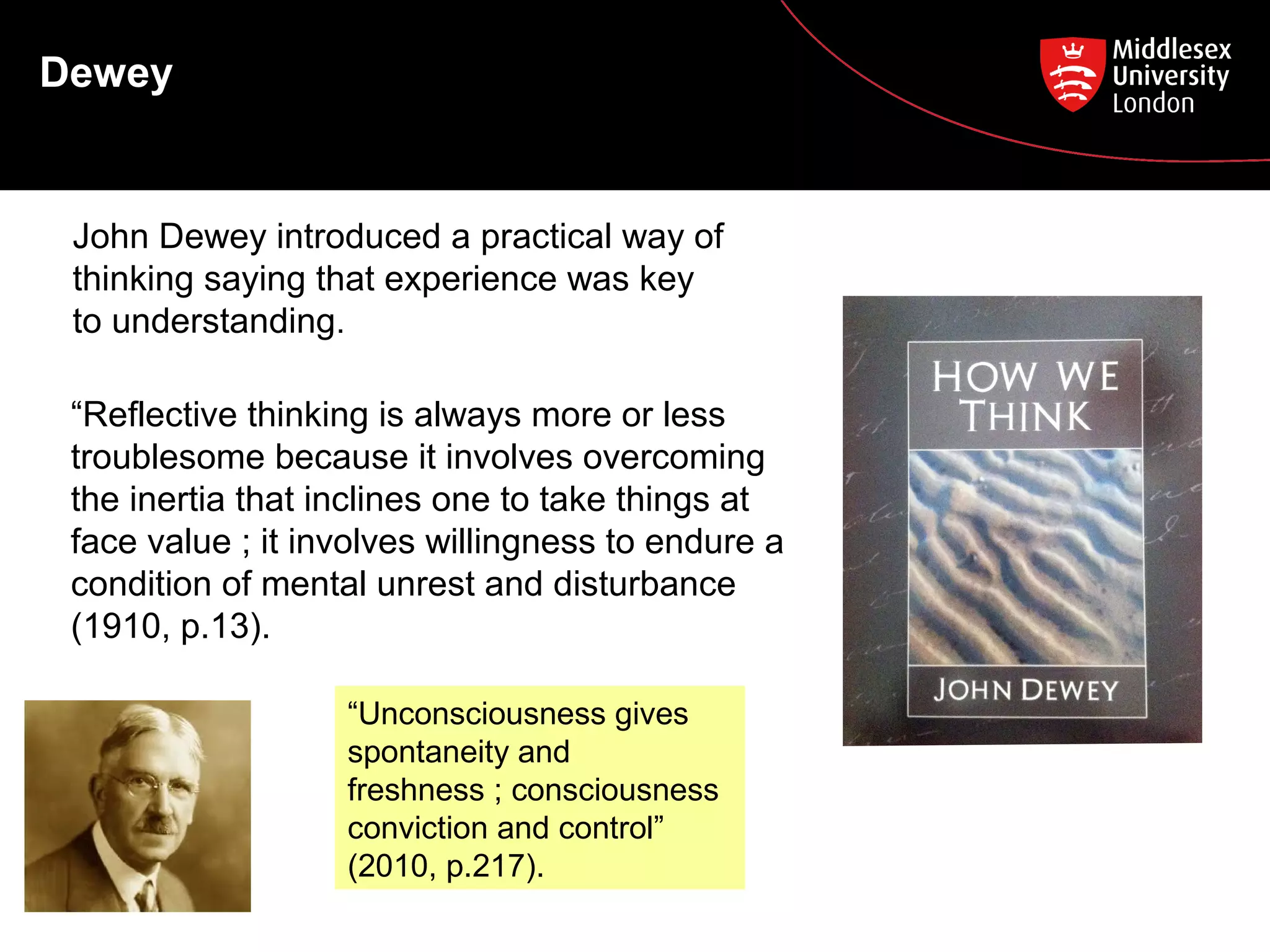
Dewey

John Dewey introduced a practical way of
thinking saying that experience was key
to understanding.
“Reflective thinking is always more or less
troublesome because it involves overcoming
the inertia that inclines one to take things at
face value ; it involves willingness to endure a
condition of mental unrest and disturbance
(1910, p.13).
“Unconsciousness gives
spontaneity and
freshness ; consciousness
conviction and control”
(2010, p.217).
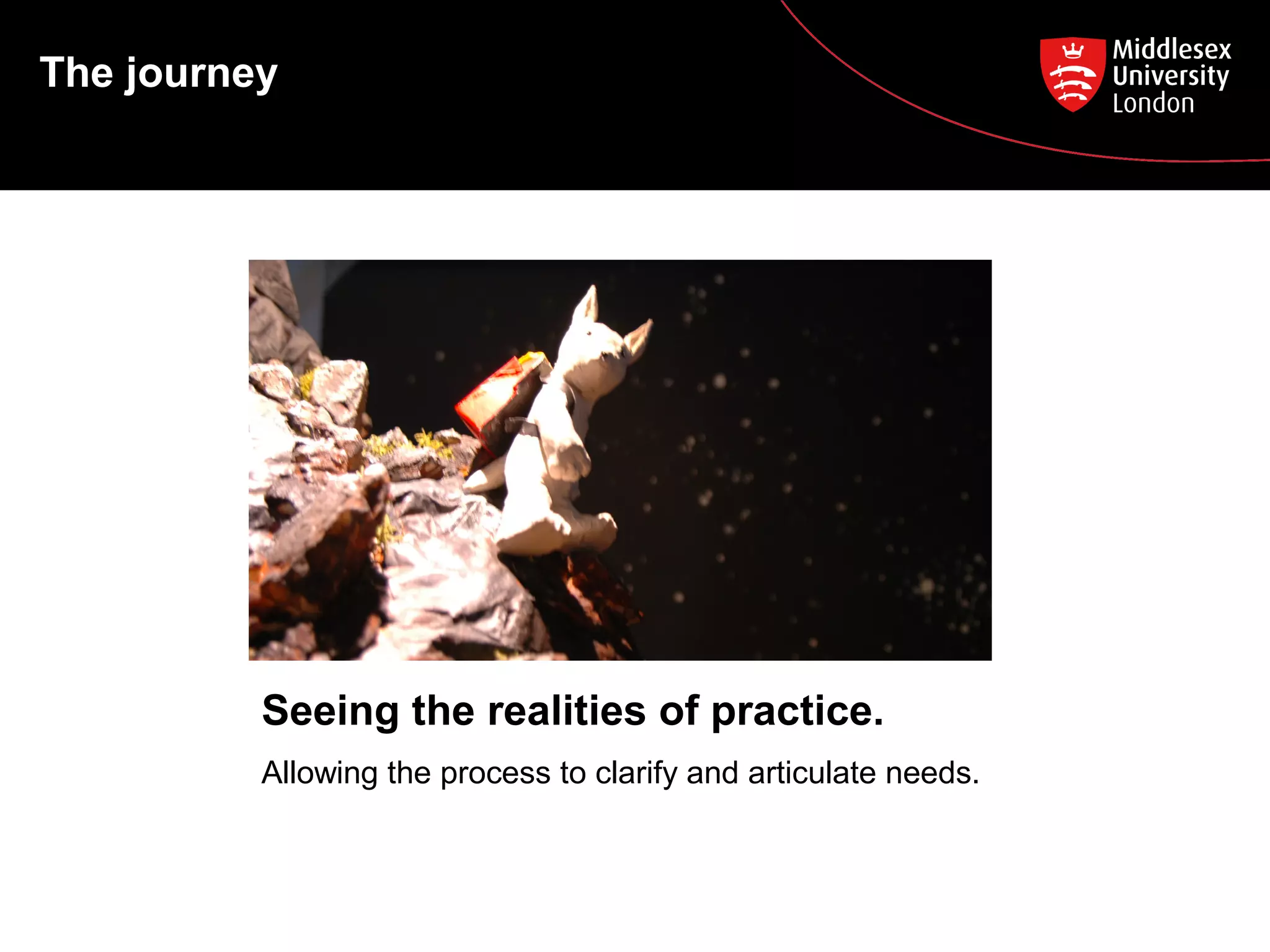
The journey

Seeing the realities of practice.
Allowing the process to clarify and articulate needs.
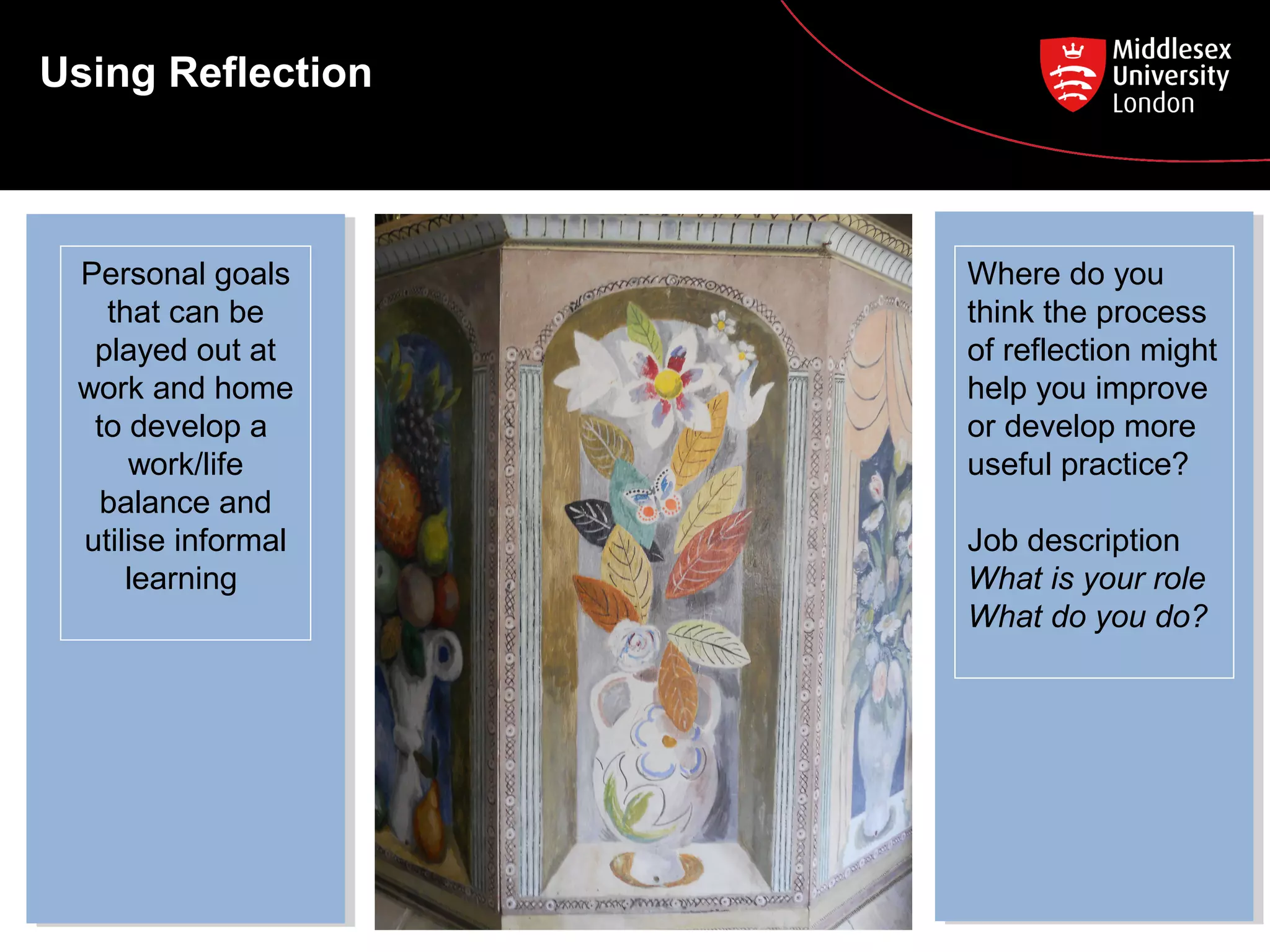
Using Reflection

Personal goals
that can be
played out at
work and home
to develop a
work/life
balance and
utilise informal
learning

Where do you
think the process
of reflection might
help you improve
or develop more
useful practice?
Job description
What is your role
What do you do?
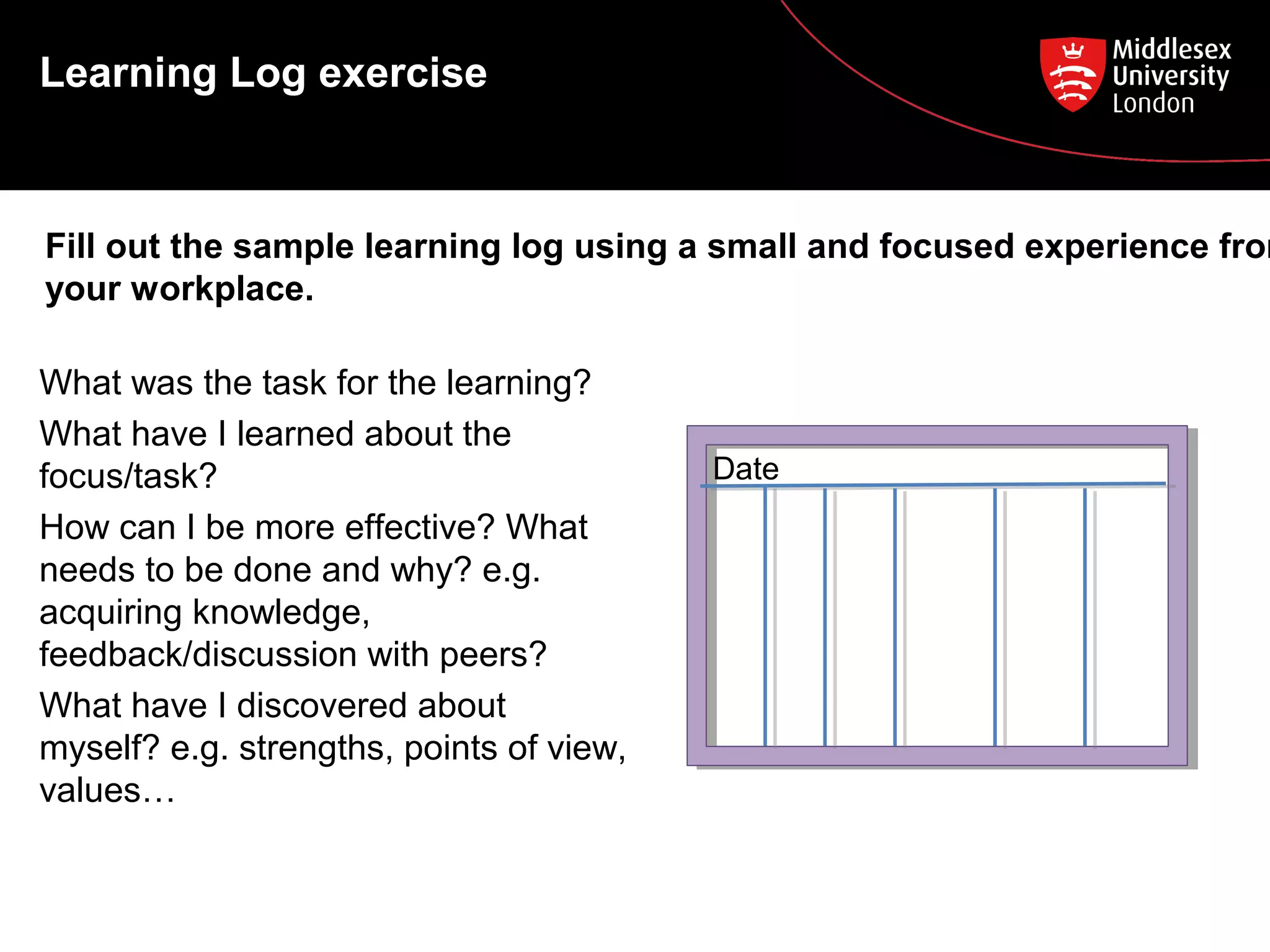
Learning Log exercise

Fill out the sample learning log using a small and focused experience from
your workplace.
What was the task for the learning?
What have I learned about the
focus/task?
How can I be more effective? What
needs to be done and why? e.g.
acquiring knowledge,
feedback/discussion with peers?
What have I discovered about
myself? e.g. strengths, points of view,
values…

Date
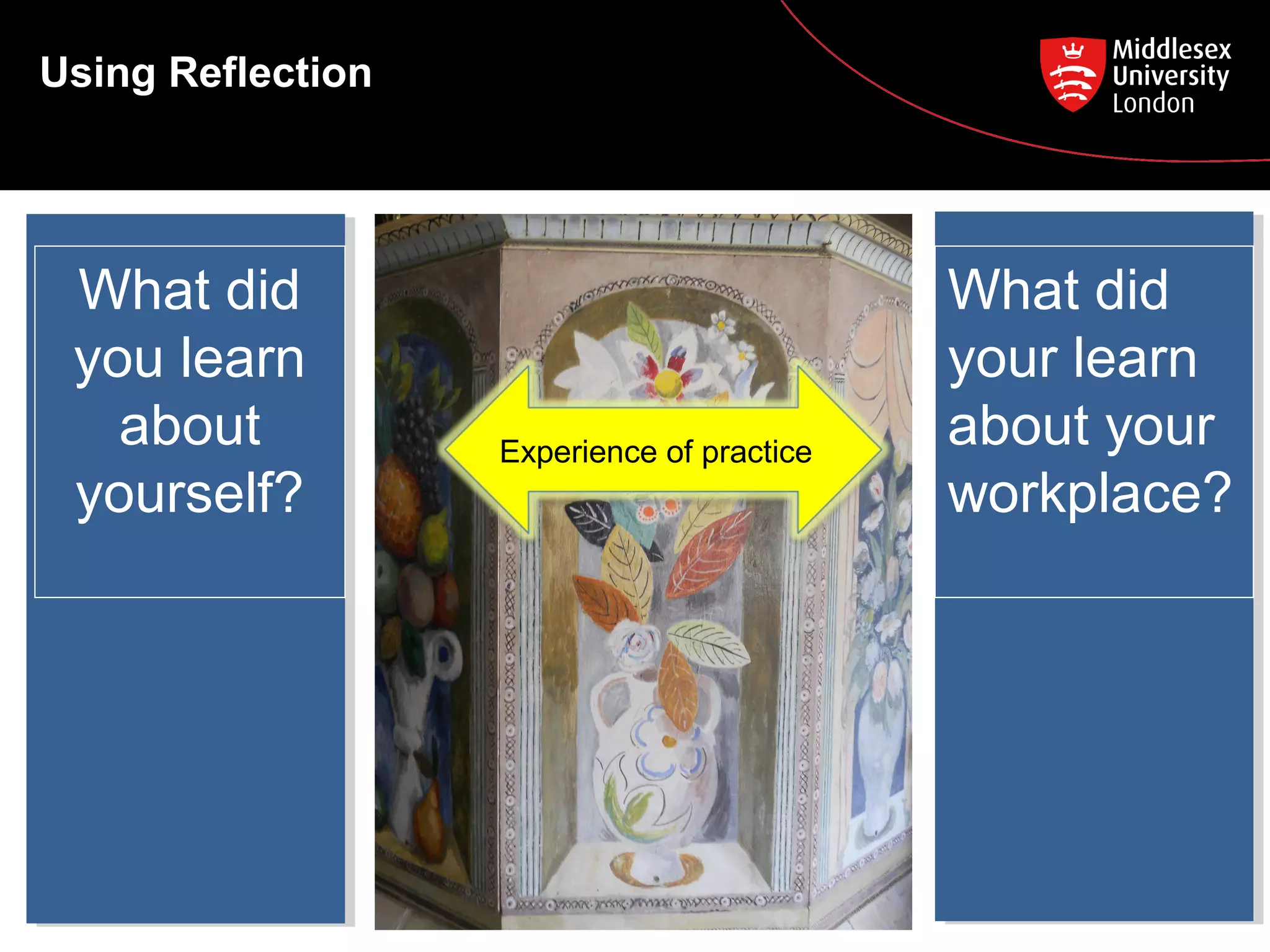
Using Reflection

What did
you learn
about
yourself?

Experience of practice

What did
your learn
about your
workplace?
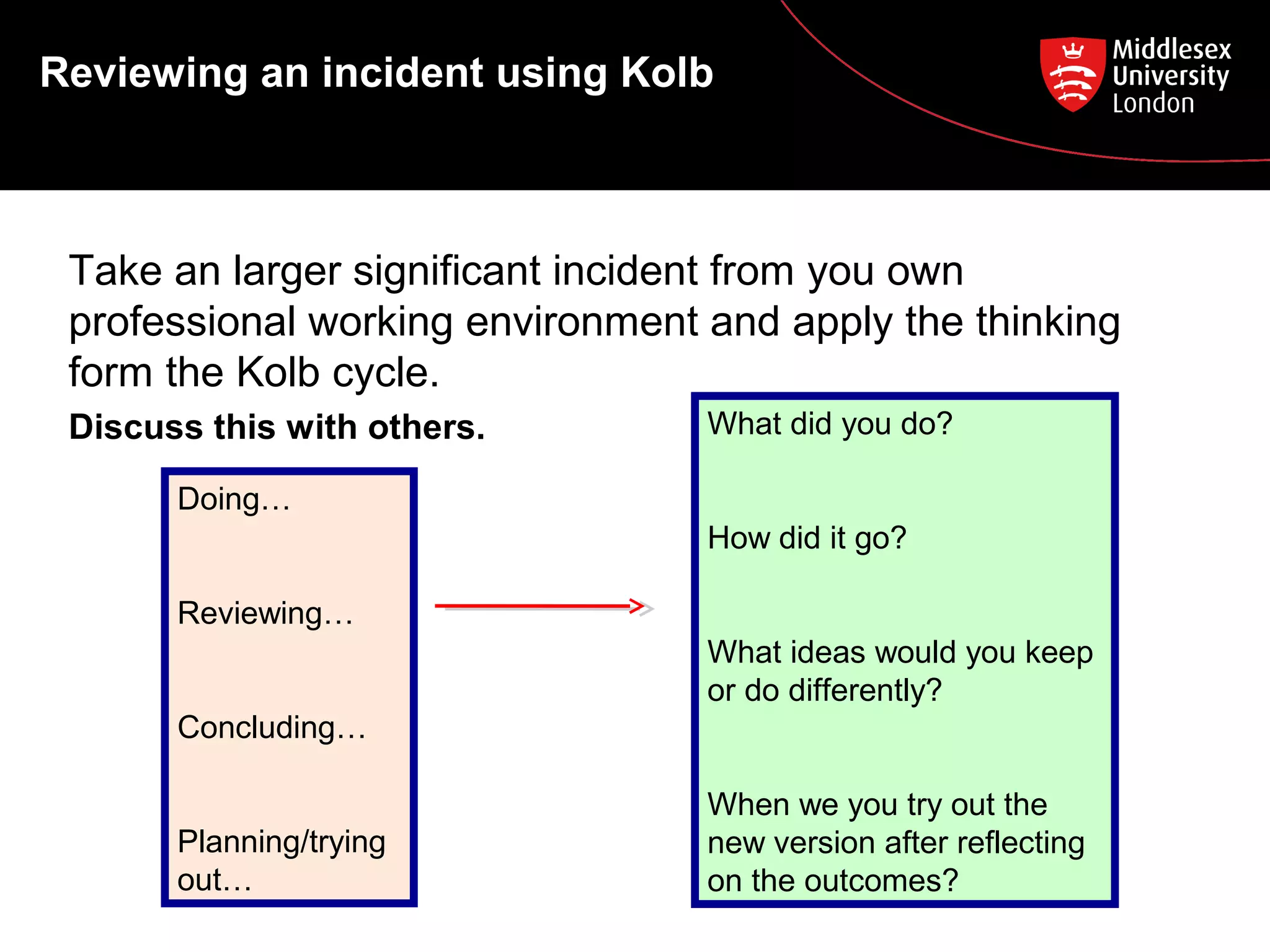
Reviewing an incident using Kolb

Take an larger significant incident from you own
professional working environment and apply the thinking
form the Kolb cycle.
Discuss this with others.

What did you do?

Doing…
How did it go?
Reviewing…
What ideas would you keep
or do differently?
Concluding…
Planning/trying
out…

When we you try out the
new version after reflecting
on the outcomes?
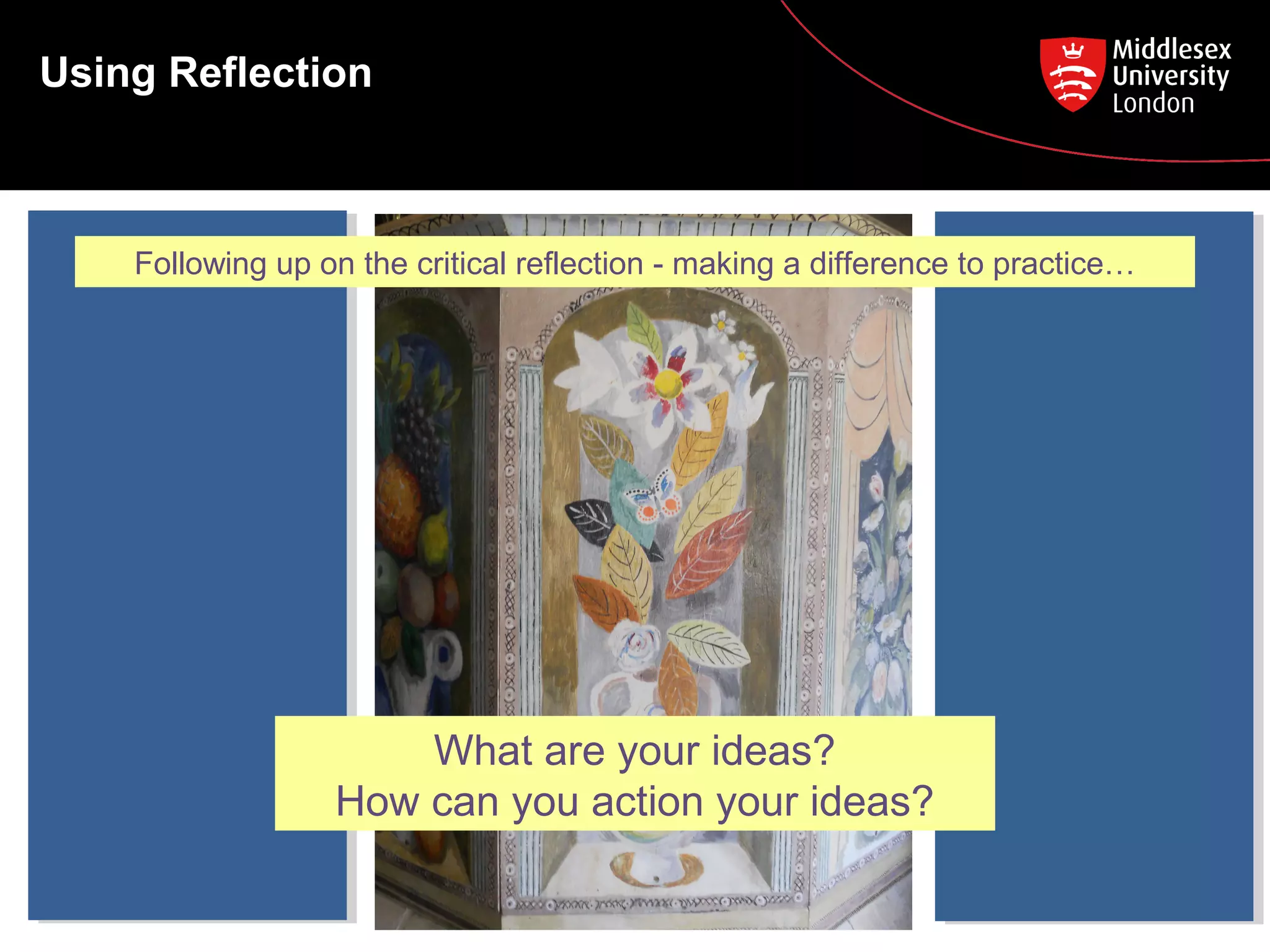
Using Reflection

Following up on the critical reflection - making a difference to practice…

What are your ideas?
How can you action your ideas?
Closing the shutter for a break
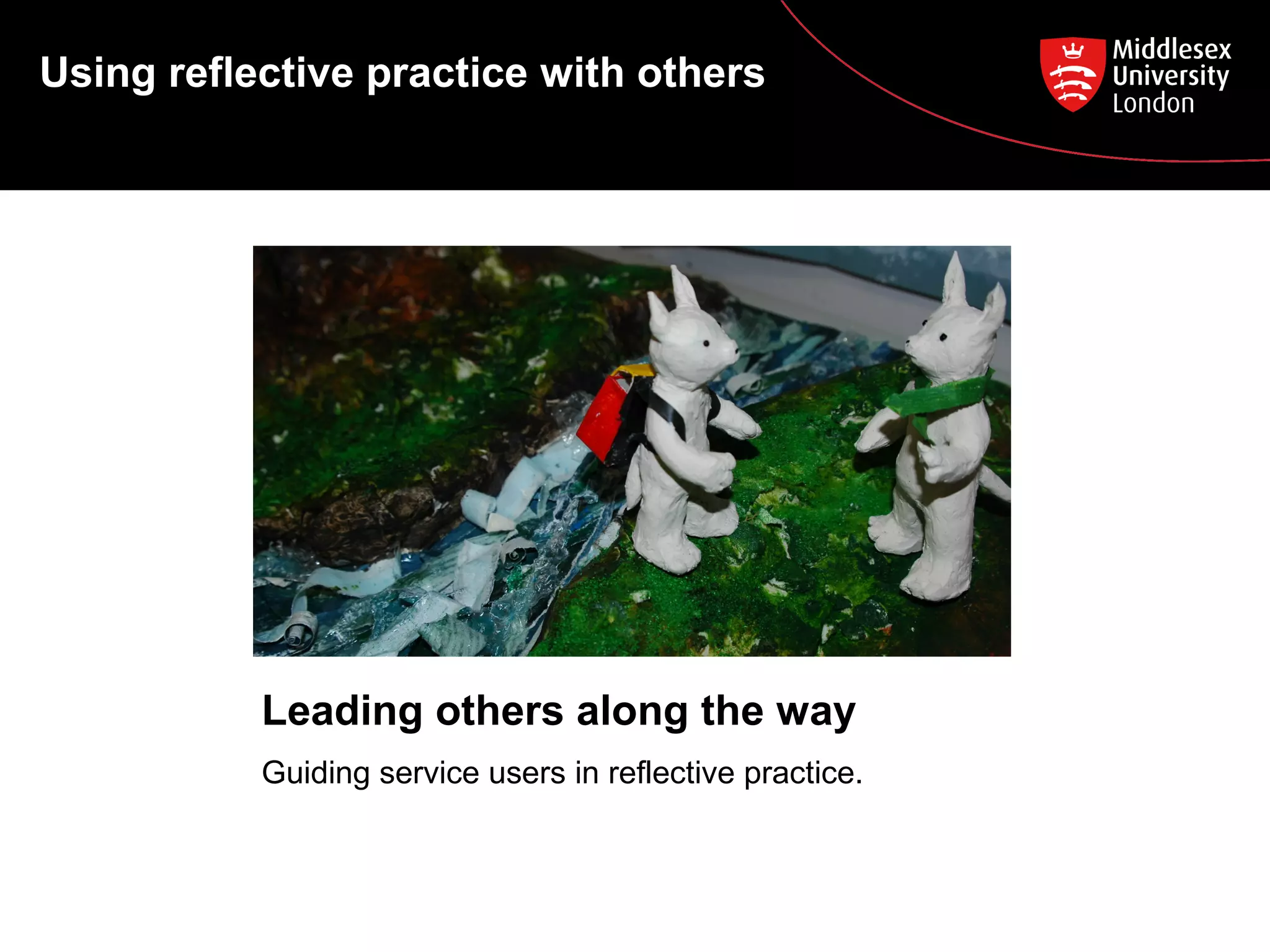
Using reflective practice with others

Leading others along the way
Guiding service users in reflective practice.
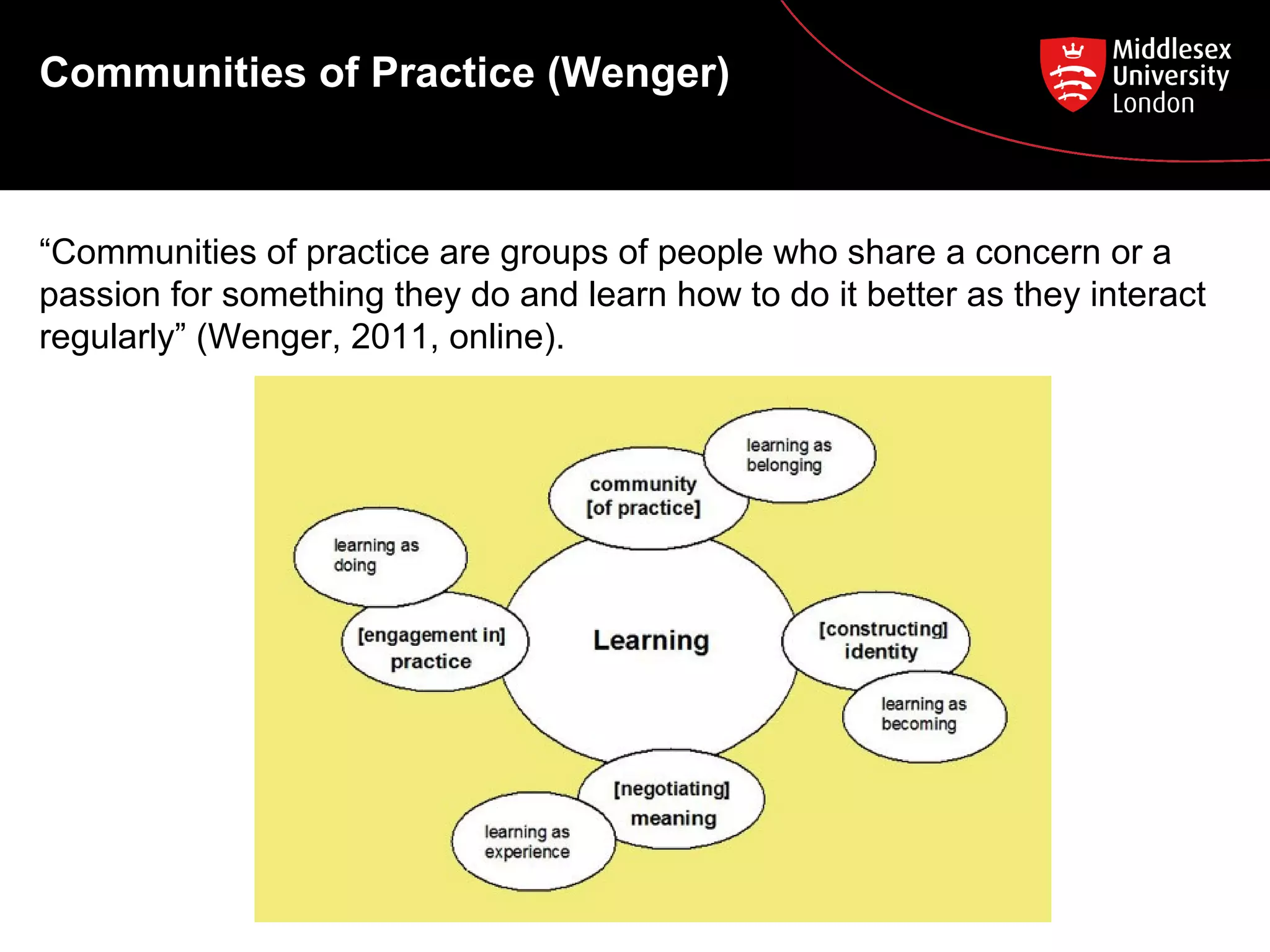
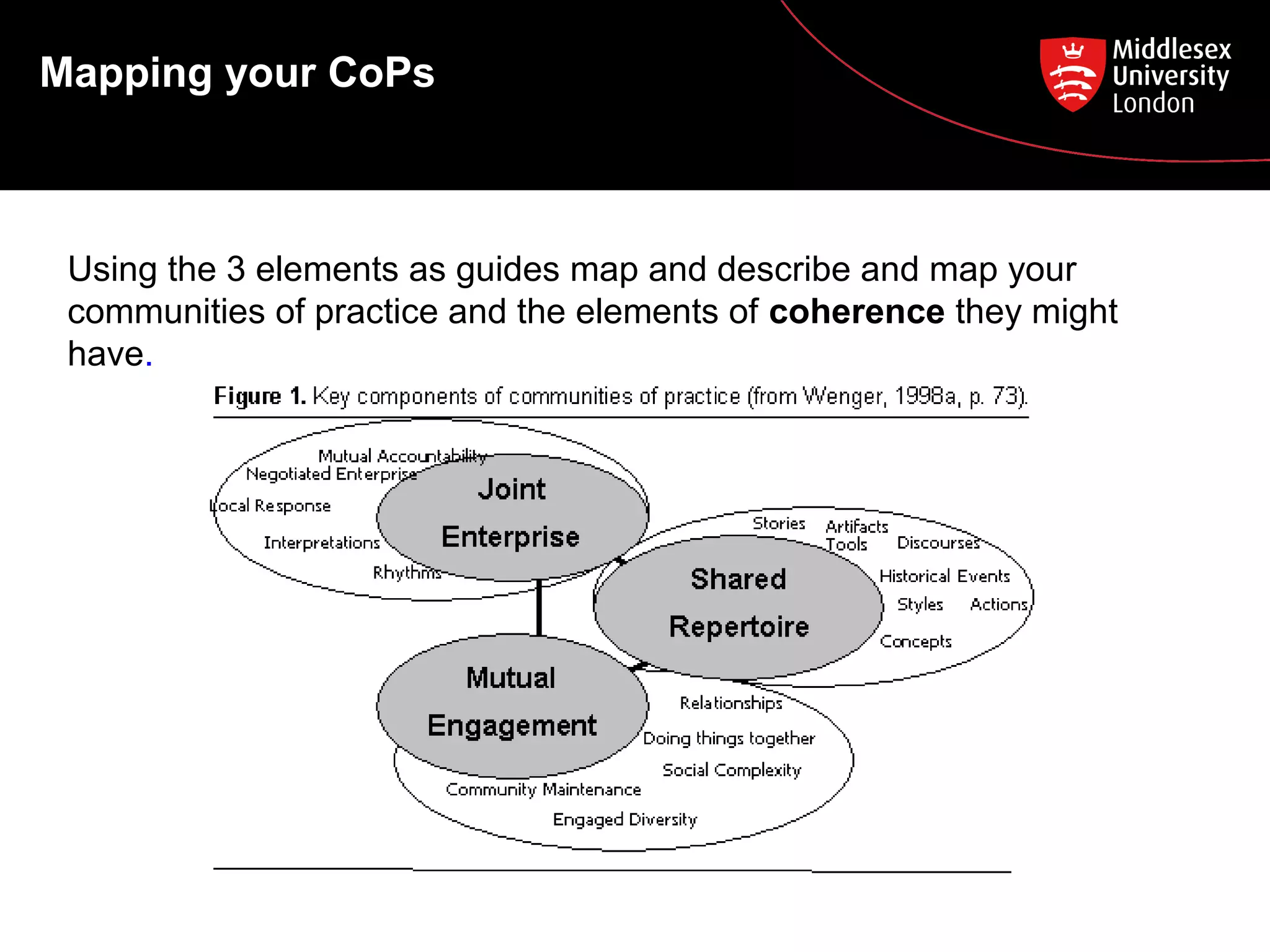
Communities of Practice (Wenger)

“Communities of practice are groups of people who share a concern or a
passion for something they do and learn how to do it better as they interact
regularly” (Wenger, 2011, online).
Mapping your CoPs

Using the 3 elements as guides map and describe and map your
communities of practice and the elements of coherence they might
have.
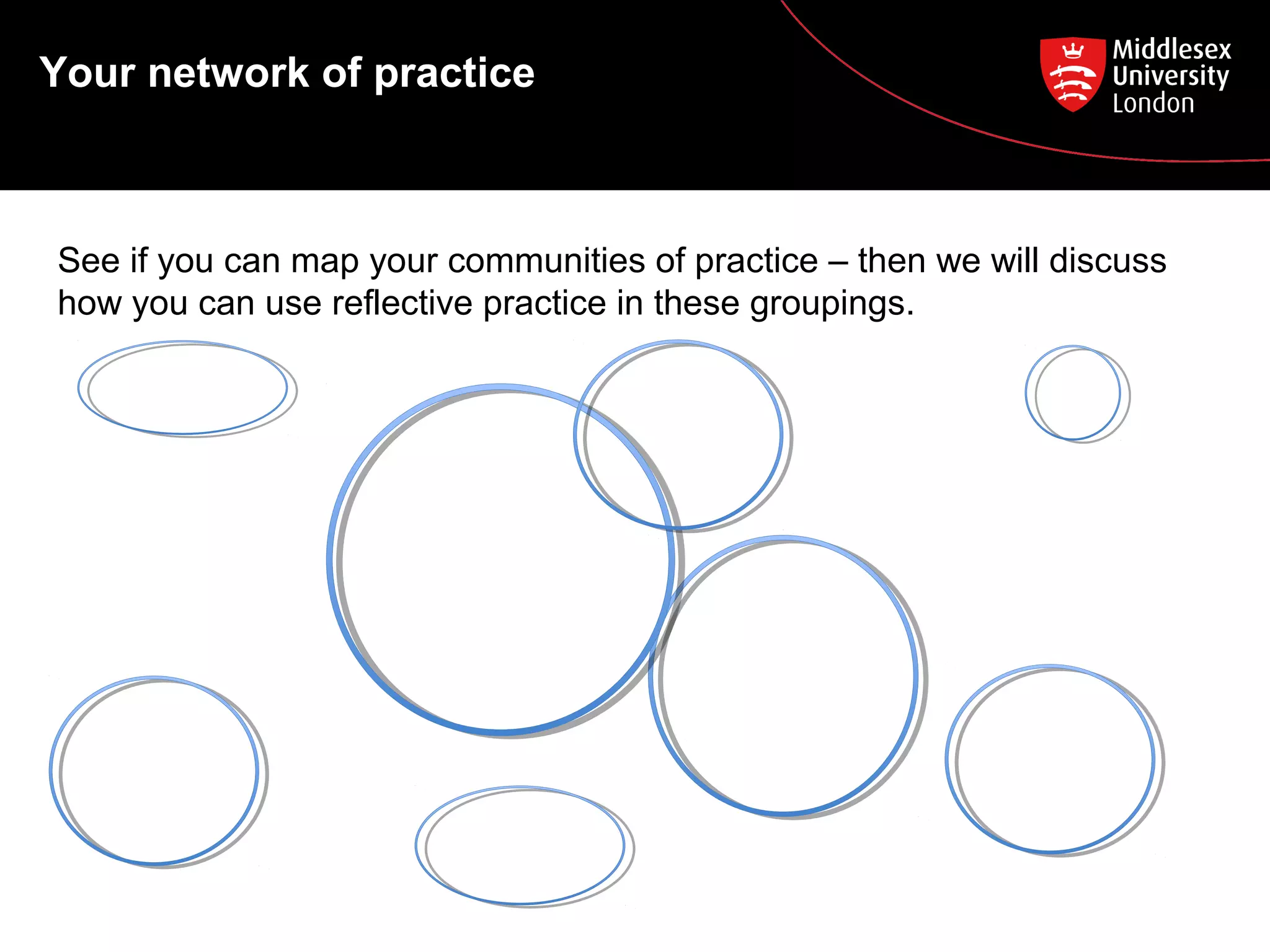
Your network of practice

See if you can map your communities of practice – then we will discuss
how you can use reflective practice in these groupings.
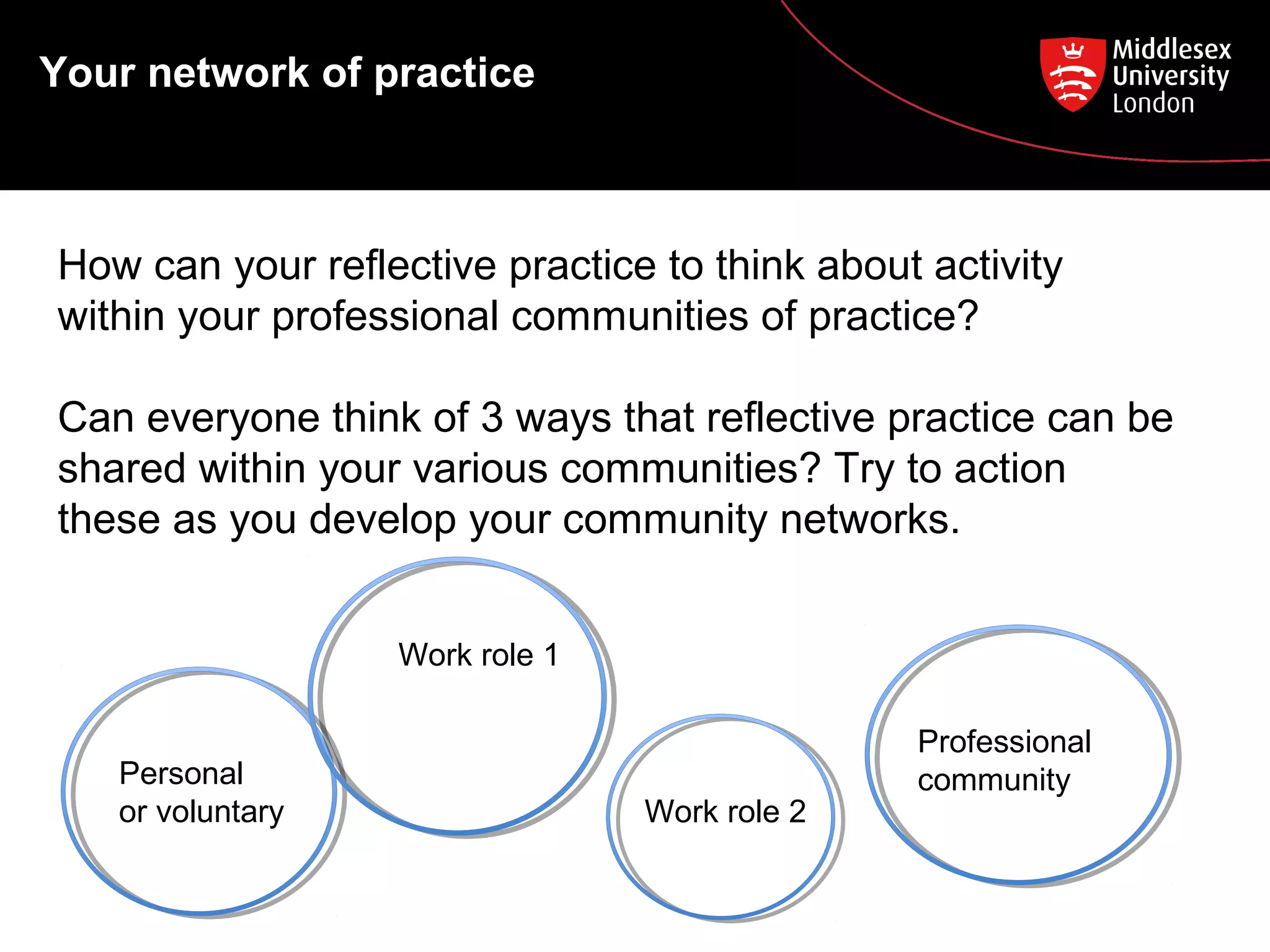
Your network of practice

How can your reflective practice to think about activity
within your professional communities of practice?
Can everyone think of 3 ways that reflective practice can be
shared within your various communities? Try to action
these as you develop your community networks.
Work role 1

Personal
or voluntary

Work role 2

Professional
community
Adding to or making a start
Use today’s exercises to develop a sense of where
you need to apply critical reflection in your practice.
Adding to or making a start
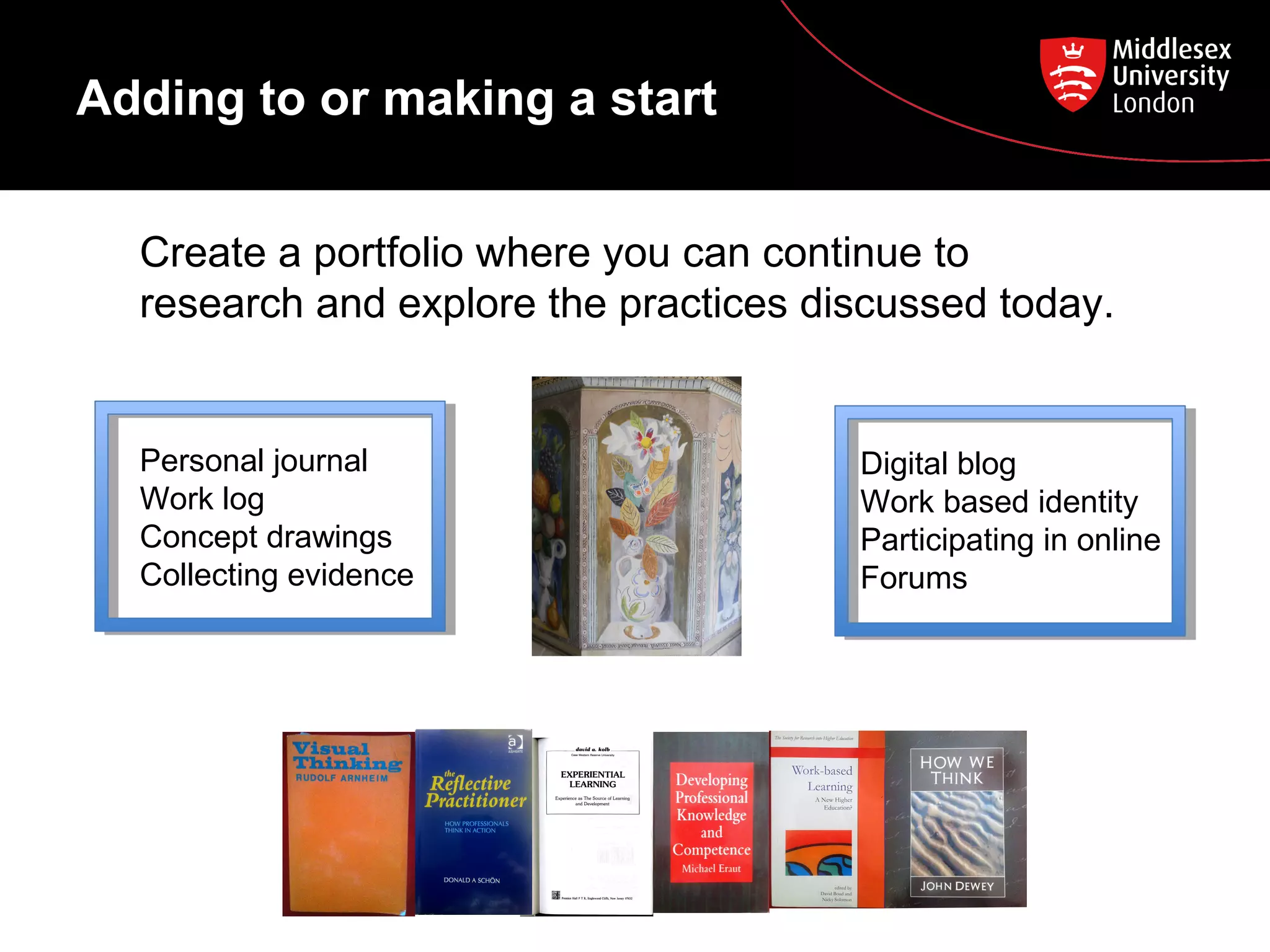
Create a portfolio where you can continue to
research and explore the practices discussed today.

Personal journal
Work log
Concept drawings
Collecting evidence

Digital blog
Work based identity
Participating in online
Forums
Reflective Practice
Indicative Bibliography

Boud, David and Solomon, Nicky (2001) Work-based Learning A New Higher
Education A New Higher Education, SRHE, Buckingham: Taylor and Francis Inc.
Eraut, Michael (1994) Developing Professional Knowledge and Competence,
London: Falmer.
Francis, Russell (2011)The Predicament of the Learner in the New Media Age,
Weblog, Available from: http://predicamentofthelearner.wordpress.com/
Gibbons, Michael, Limoges, Camille, Nowotny, Helga, Schwartzmen, Simon, Scott,
Peter, and Trow, Martin (1994) The New Production of Knowledge, The Dynamics of
Science and Research in Contemporary Societies, London: Sage Publications.
Infed (2013) reflection Infed (2013) (online) reflectionhttp://infed.org/mobi/reflectionlearning-and-education/; ‘david a. kolb on experiential learning’, Available
fromhttp://www.infed.org/biblio/b-explrn.htm; ‘Schon’, Available at:
http://www.infed.org/thinkers/et-schon.htm
International Review of Open and Distance Learning (2011) (illustration of CoP)
(online) Available from: http://www.irrodl.org/index.php/irrodl/article/view/204/286
Indicative Bibliography

Kolb, David A. (1984) Experiential Learning: Experience As The Source Of Learning
And Development, Englewood Cliffs, New Jersey: Prentice-Hall.
Kolb’s Learning Styles (2011) (illustration and text) Available from
http://www.businessballs.com/kolblearningstyles.htm
McAteer, Erica and Marsden, Sally (2004) ‘Networked Learning Conference,
Frameworks for the Representation and Analysis of Networked Learning Activity’,
University of Glasgow (illustration).
Murillo, E. (2011) "Communities of practice in the business and organization studies
literature" Information Research, 16(1) paper 464. [Available at
http://InformationR.net/ir/16-1/paper464.html] (Illustration)
Nottingham, Patience (2013) Illustrations ‘Ain’t no mountain high enough’.
Owen, Deborah and Saries, Patricia (2012)Exit tickets to Understanding, Copyright
of Library Media Connection is the property of ABC-Clio - Library Media Connection.
Saddington, T. (2011) (online) Available from: http://www.icel.org.uk/pdf/el.pdf
Indicative Bibliography

Schön, D. (1983) The Reflective Practitioner: How Professionals Think In Action,
New York, NY: USA: Basic Books.
Schön, D. (1987) Educating the Reflective Practitioner: Towards a New Design for
Teaching and Learning in the Professions, San Francisco: Jossey-Bass Publishers.
University of Leicester (2011) ‘Honey and Mumford’, Available from:
http://www2.le.ac.uk/offices/careers/pgrd/resources/teaching/theories/honeymumford
Wenger, E. (2006) ‘Communities of Practice a Brief Introduction’, available from:
http://www.ewenger.com/theory/communities_of_practice_intro.htm [Accessed
4/12/06]
Wenger, E., White, N. and Smith, J. (2009) Digital Habitas Stewarding Technology
for Communities, Portland, USA: CPSquare.
Wenger, E. (2011) Website (online) Available from
http://www.ewenger.com/theory/index.htm
The End

p.nottingham@mdx.ac.uk

PN Reflective Practice CILIP 2013 slideshare

  • 1.
    CILIP Reflective Practice 28thOctober 2013 Dr. Paula Nottingham
  • 2.
    Reflective Practice Reflective practiceFeedback Postgraduate Courseis a valuable way of understanding how professionals evaluate what they do in order to improve their performance in the workplace.
  • 3.
    Reflective practice THOUGHT/COMMENT Strategies forreflective practice can help save time, but time is sometimes difficult to find in a busy work/life schedule.
  • 4.
  • 5.
    Using Reflection Draw ahead Fill the head with ideas. Discuss these with the group.
  • 6.
    Using Reflection Concept drawingsare devices for visualising ideas inside interior personal exterior professional with others The only rules say not to draw recognised figurative imagery – you can use shapes, lines, arrows, patterns. Three minutes…
  • 7.
    The journey Reaching goalsthrough reflective practice Using critical reflection as a way to engage and challenge. ‘Ain’t no mountain high enough’
  • 8.
    Reflective practice inprofessional life Reflection using contextual and situated knowledge Experience of practice Adult learning and social learning theory based on critical reflection to improve performance
  • 9.
    Work based learning transdisciplinarity Workbased learning (WBL) can be within a disciplinary area or used more generically within a workplace that contains transdisciplinary knowledge (Gibbons et al., 1994). Middlesex model of work based learning (e.g Costley and Armsby, 2007) Looks at learning in the workplace - there is a need to find the space and time to learn and negotiate change for busy professionals performing various roles and functions - often the emphasis is on the service or competencies that are required versus individual or team capabilities. Considers individual and organisational learning.
  • 10.
  • 11.
    The journey Stargazing Allowing criticalreflection to guide present and future action.
  • 12.
    Schön Reflection-in-action practice iswhen practitioners think about practice while they are doing it. Reflection-on-action can happen after the encounter. It is about using tacit knowledge and treating experience as ‘unique’ versus solely using technical rationality. “It is the entire process of reflection-in-action which is central to the ‘art’ by which some practitioners deal well with situations of uncertainty, instability uniqueness, and value conflict” (Schön, 1983, p. 50).
  • 13.
    Argyris and Schön “Whenthey came to explore the nature of organizational learning Chris Argyris and Donald Schon (1978: 2-3) described the process as follows… “Single-loop learning is like a thermostat that learns when it is too hot of too cold and turns the heat on or off. The thermostat can perform this task because it can receive information (the temperature of the room) and take corrective action. Doubleloop learning occurs when error is detected and corrected in ways that involve the modification of an organization’s underlying norms, policies and objectives” (Infed, 2013).
  • 14.
  • 15.
    Experiential models forreflection Kolb and others developed models of experiential learning practice that include developing learning from doing. Learning from experience is a variation of this practice.
  • 16.
    Experiential models forreflection http://www.ldu.leeds.ac.uk/ldu/sddu_multimedia/kolb/kolb_flash.htm
  • 17.
    Honey and Mumford Welearn in different ways – Activist - learning by doing – Reflectors - learning by observing – Theorist - learning by thinking through in a logical manner – Pragmatist - learning through putting ideas into practice and testing them out “Honey and Alan Mumford developed their learning styles system as a variation on the Kolb model…” (Infed, 2013, online).
  • 18.
    What is ReflectivePractice? Boud in ‘Creating a Work-based Curriculum’, Work-based Learning A New Higher Education (Boud and Solomon, 2001) p. 55. “Critical reflection is important… because it is only through deeper critique that work situations can be improved, workplaces transformed and productivity significantly enhanced. It is about noticing and questioning the taken-for-granted assumptions that one holds and that are held by others. While it can be discomforting process, it is necessary in all situations that do not involve perpetuating the status quo.”
  • 19.
    What is ReflectivePractice? Eraut’s (1994) professional knowledge: Propositional knowledge – disciplinary/professional principles Impressions, Personal knowledge and Interpretations of Experience “ people naturally develop some constructs, perspectives and frames of reference which are essentially personal, even if they have been influenced by public concepts and ideas circulating in the community” (p.106). Process knowledge - procedures based in professional practice - skilled behaviour
  • 20.
    Dewey John Dewey introduceda practical way of thinking saying that experience was key to understanding. “Reflective thinking is always more or less troublesome because it involves overcoming the inertia that inclines one to take things at face value ; it involves willingness to endure a condition of mental unrest and disturbance (1910, p.13). “Unconsciousness gives spontaneity and freshness ; consciousness conviction and control” (2010, p.217).
  • 21.
    The journey Seeing therealities of practice. Allowing the process to clarify and articulate needs.
  • 22.
    Using Reflection Personal goals thatcan be played out at work and home to develop a work/life balance and utilise informal learning Where do you think the process of reflection might help you improve or develop more useful practice? Job description What is your role What do you do?
  • 23.
    Learning Log exercise Fillout the sample learning log using a small and focused experience from your workplace. What was the task for the learning? What have I learned about the focus/task? How can I be more effective? What needs to be done and why? e.g. acquiring knowledge, feedback/discussion with peers? What have I discovered about myself? e.g. strengths, points of view, values… Date
  • 24.
    Using Reflection What did youlearn about yourself? Experience of practice What did your learn about your workplace?
  • 25.
    Reviewing an incidentusing Kolb Take an larger significant incident from you own professional working environment and apply the thinking form the Kolb cycle. Discuss this with others. What did you do? Doing… How did it go? Reviewing… What ideas would you keep or do differently? Concluding… Planning/trying out… When we you try out the new version after reflecting on the outcomes?
  • 26.
    Using Reflection Following upon the critical reflection - making a difference to practice… What are your ideas? How can you action your ideas?
  • 27.
  • 28.
    Using reflective practicewith others Leading others along the way Guiding service users in reflective practice.
  • 29.
    Communities of Practice(Wenger) “Communities of practice are groups of people who share a concern or a passion for something they do and learn how to do it better as they interact regularly” (Wenger, 2011, online).
  • 30.
    Mapping your CoPs Usingthe 3 elements as guides map and describe and map your communities of practice and the elements of coherence they might have.
  • 31.
    Your network ofpractice See if you can map your communities of practice – then we will discuss how you can use reflective practice in these groupings.
  • 32.
    Your network ofpractice How can your reflective practice to think about activity within your professional communities of practice? Can everyone think of 3 ways that reflective practice can be shared within your various communities? Try to action these as you develop your community networks. Work role 1 Personal or voluntary Work role 2 Professional community
  • 33.
    Adding to ormaking a start Use today’s exercises to develop a sense of where you need to apply critical reflection in your practice.
  • 34.
    Adding to ormaking a start Create a portfolio where you can continue to research and explore the practices discussed today. Personal journal Work log Concept drawings Collecting evidence Digital blog Work based identity Participating in online Forums
  • 35.
  • 36.
    Indicative Bibliography Boud, Davidand Solomon, Nicky (2001) Work-based Learning A New Higher Education A New Higher Education, SRHE, Buckingham: Taylor and Francis Inc. Eraut, Michael (1994) Developing Professional Knowledge and Competence, London: Falmer. Francis, Russell (2011)The Predicament of the Learner in the New Media Age, Weblog, Available from: http://predicamentofthelearner.wordpress.com/ Gibbons, Michael, Limoges, Camille, Nowotny, Helga, Schwartzmen, Simon, Scott, Peter, and Trow, Martin (1994) The New Production of Knowledge, The Dynamics of Science and Research in Contemporary Societies, London: Sage Publications. Infed (2013) reflection Infed (2013) (online) reflectionhttp://infed.org/mobi/reflectionlearning-and-education/; ‘david a. kolb on experiential learning’, Available fromhttp://www.infed.org/biblio/b-explrn.htm; ‘Schon’, Available at: http://www.infed.org/thinkers/et-schon.htm International Review of Open and Distance Learning (2011) (illustration of CoP) (online) Available from: http://www.irrodl.org/index.php/irrodl/article/view/204/286
  • 37.
    Indicative Bibliography Kolb, DavidA. (1984) Experiential Learning: Experience As The Source Of Learning And Development, Englewood Cliffs, New Jersey: Prentice-Hall. Kolb’s Learning Styles (2011) (illustration and text) Available from http://www.businessballs.com/kolblearningstyles.htm McAteer, Erica and Marsden, Sally (2004) ‘Networked Learning Conference, Frameworks for the Representation and Analysis of Networked Learning Activity’, University of Glasgow (illustration). Murillo, E. (2011) "Communities of practice in the business and organization studies literature" Information Research, 16(1) paper 464. [Available at http://InformationR.net/ir/16-1/paper464.html] (Illustration) Nottingham, Patience (2013) Illustrations ‘Ain’t no mountain high enough’. Owen, Deborah and Saries, Patricia (2012)Exit tickets to Understanding, Copyright of Library Media Connection is the property of ABC-Clio - Library Media Connection. Saddington, T. (2011) (online) Available from: http://www.icel.org.uk/pdf/el.pdf
  • 38.
    Indicative Bibliography Schön, D.(1983) The Reflective Practitioner: How Professionals Think In Action, New York, NY: USA: Basic Books. Schön, D. (1987) Educating the Reflective Practitioner: Towards a New Design for Teaching and Learning in the Professions, San Francisco: Jossey-Bass Publishers. University of Leicester (2011) ‘Honey and Mumford’, Available from: http://www2.le.ac.uk/offices/careers/pgrd/resources/teaching/theories/honeymumford Wenger, E. (2006) ‘Communities of Practice a Brief Introduction’, available from: http://www.ewenger.com/theory/communities_of_practice_intro.htm [Accessed 4/12/06] Wenger, E., White, N. and Smith, J. (2009) Digital Habitas Stewarding Technology for Communities, Portland, USA: CPSquare. Wenger, E. (2011) Website (online) Available from http://www.ewenger.com/theory/index.htm
  • 39.