Laparoscopic
    Herniorrhaphy: TEP

            G. Ferzli, MD, FACS
   Professor of Surgery, SUNY Downstate
Chairman of Surgery Lutheran Medical Center
I- Anatomy of the
preperitoneal space
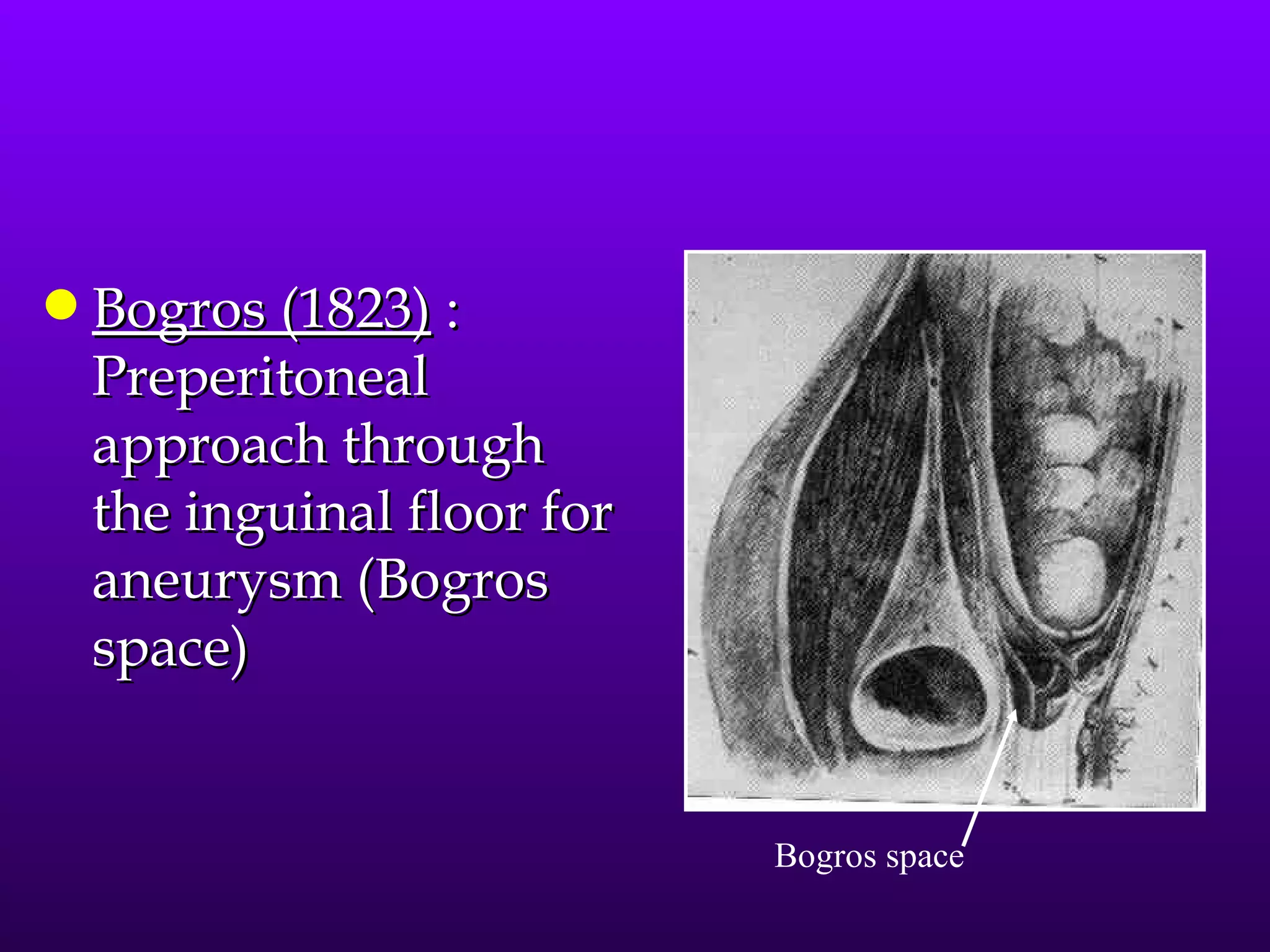
q   Bogros (1823) :
    Preperitoneal
    approach through
    the inguinal floor for
    aneurysm (Bogros
    space)


                             Bogros space
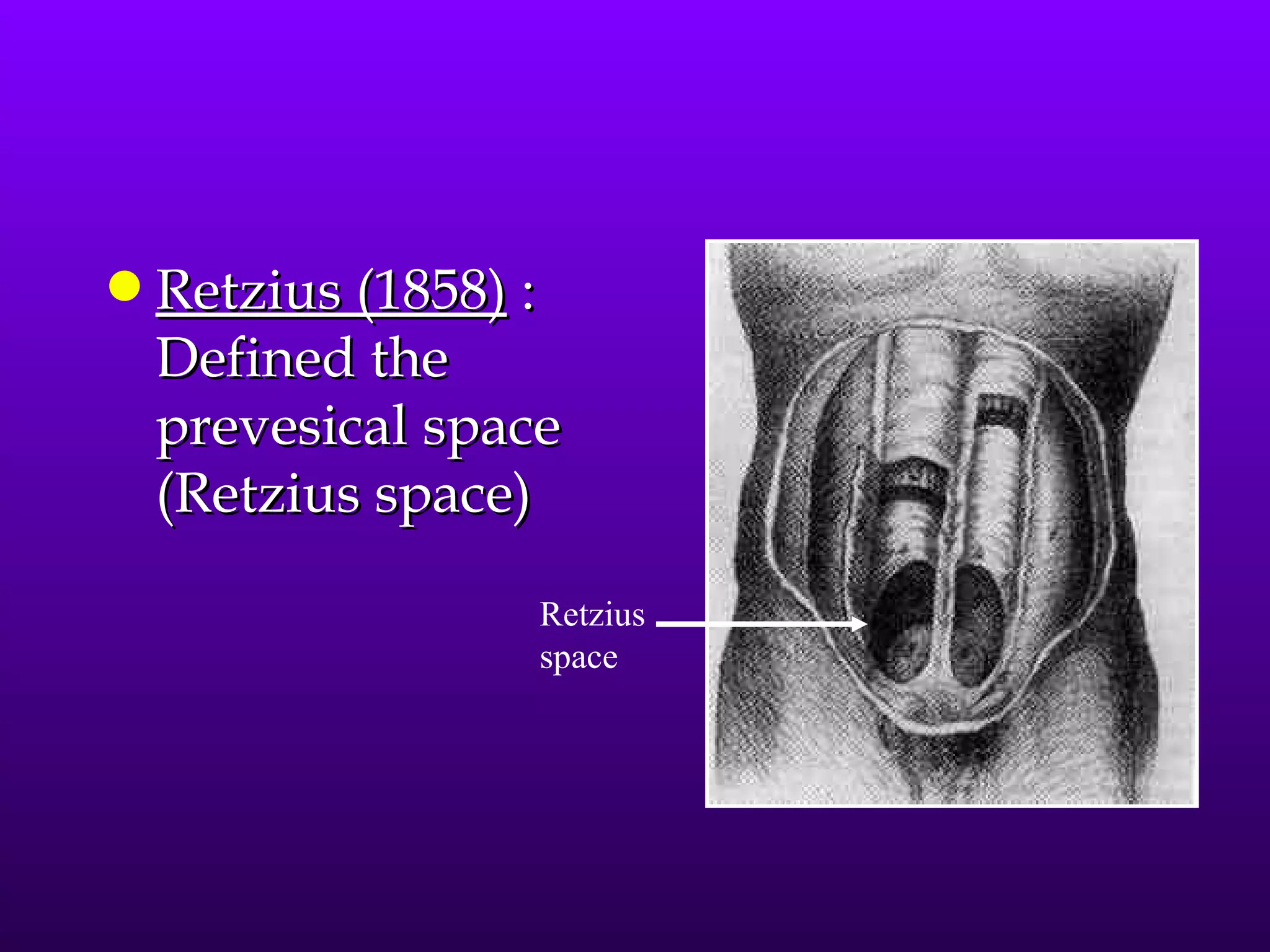
q   Retzius (1858) :
    Defined the
    prevesical space
    (Retzius space)

                   Retzius
                   space
II- Evolution of preperitoneal
        herniorrhaphy
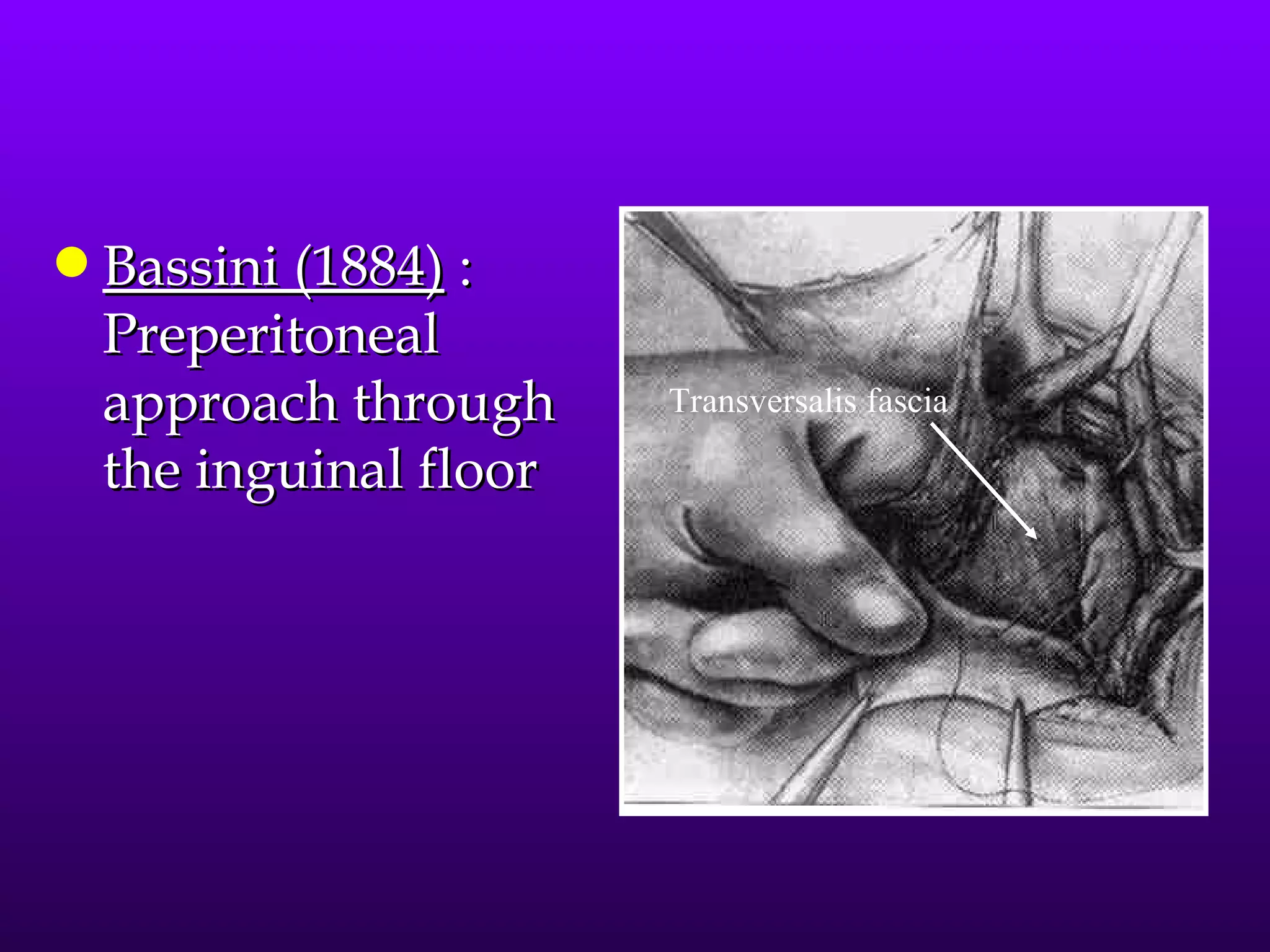
q   Bassini (1884) :
    Preperitoneal
    approach through     Transversalis fascia

    the inguinal floor
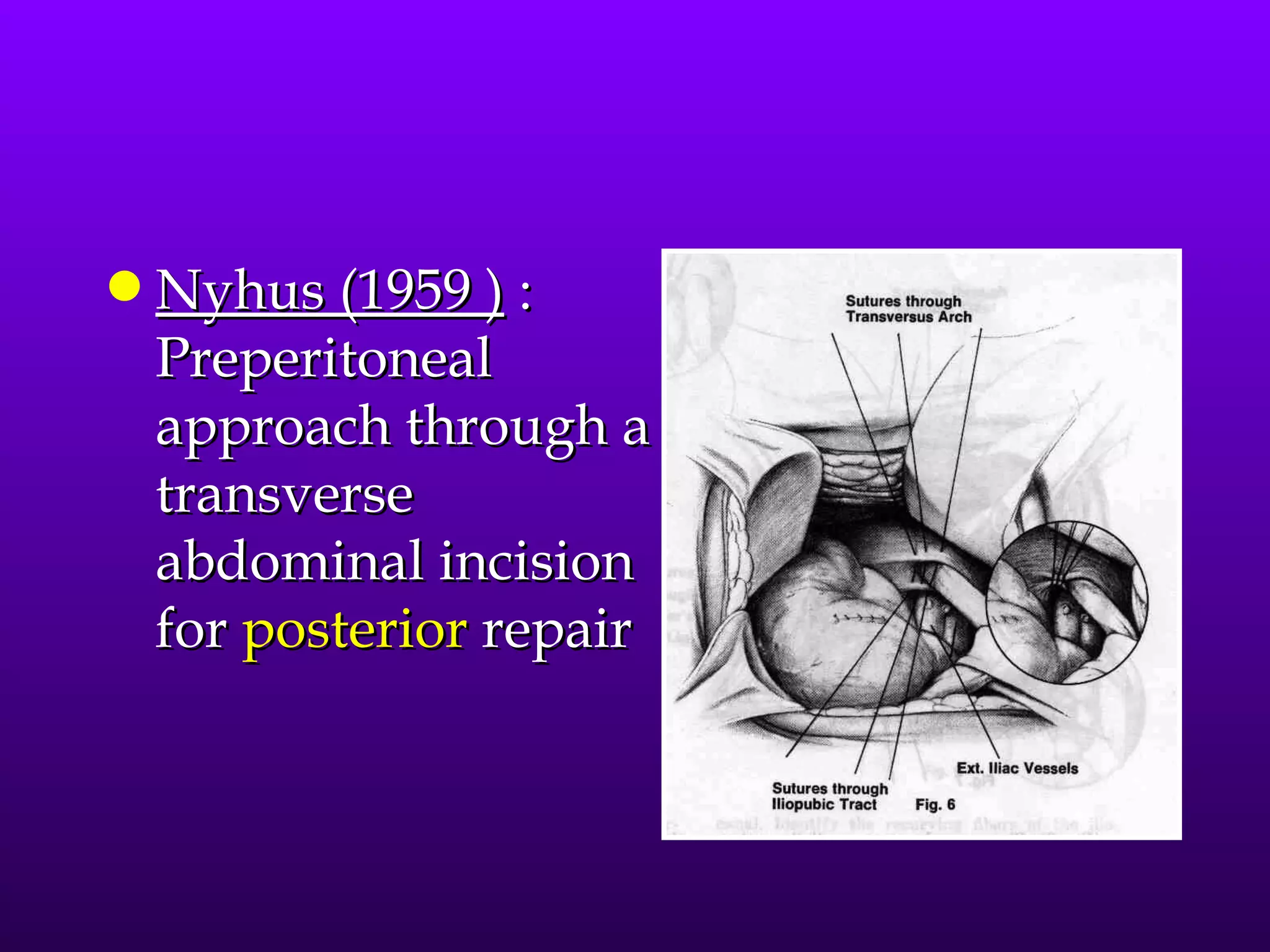
q   Nyhus (1959 ) :
    Preperitoneal
    approach through a
    transverse
    abdominal incision
    for posterior repair
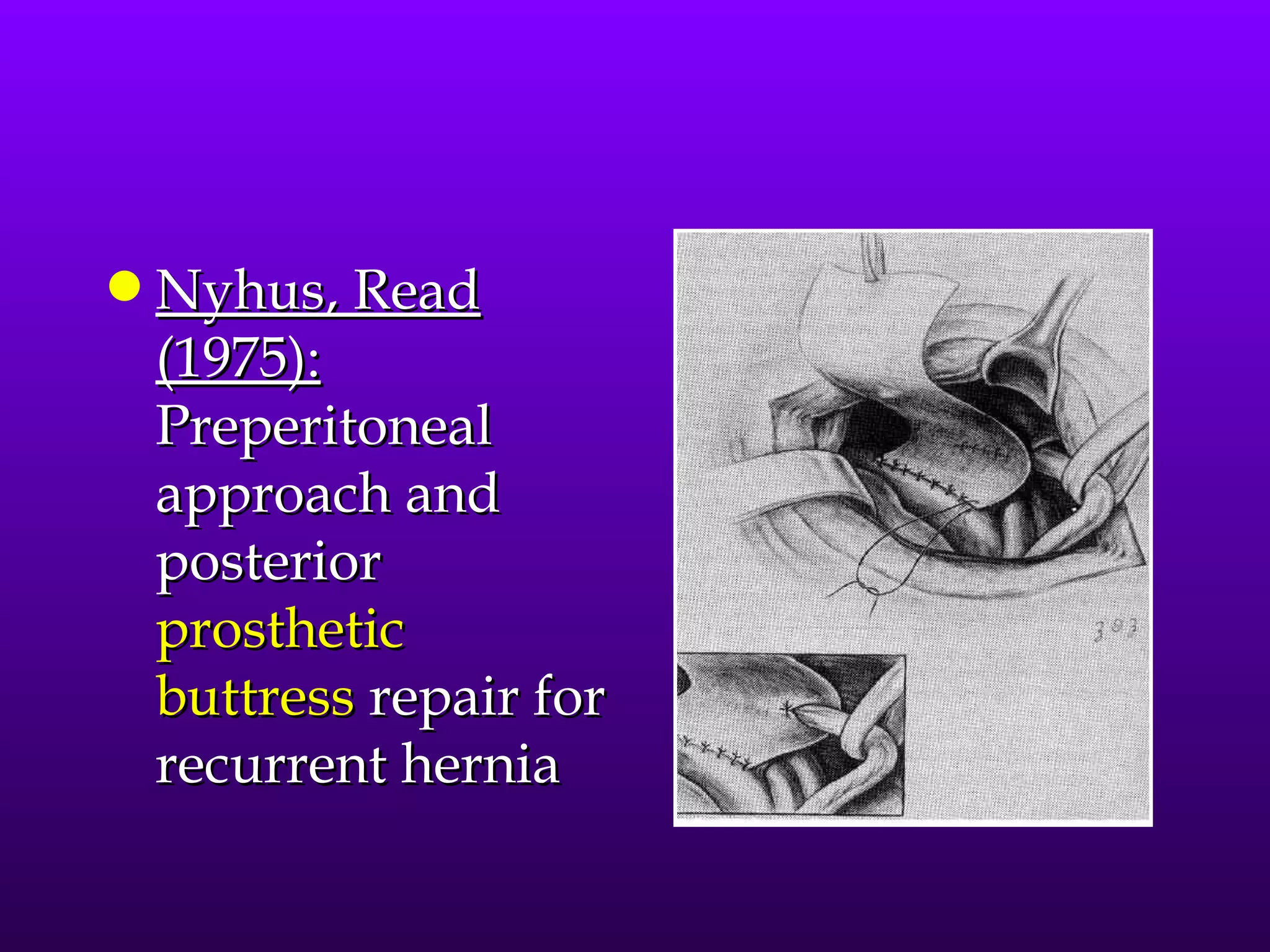
q   Nyhus, Read
    (1975):
    Preperitoneal
    approach and
    posterior
    prosthetic
    buttress repair for
    recurrent hernia
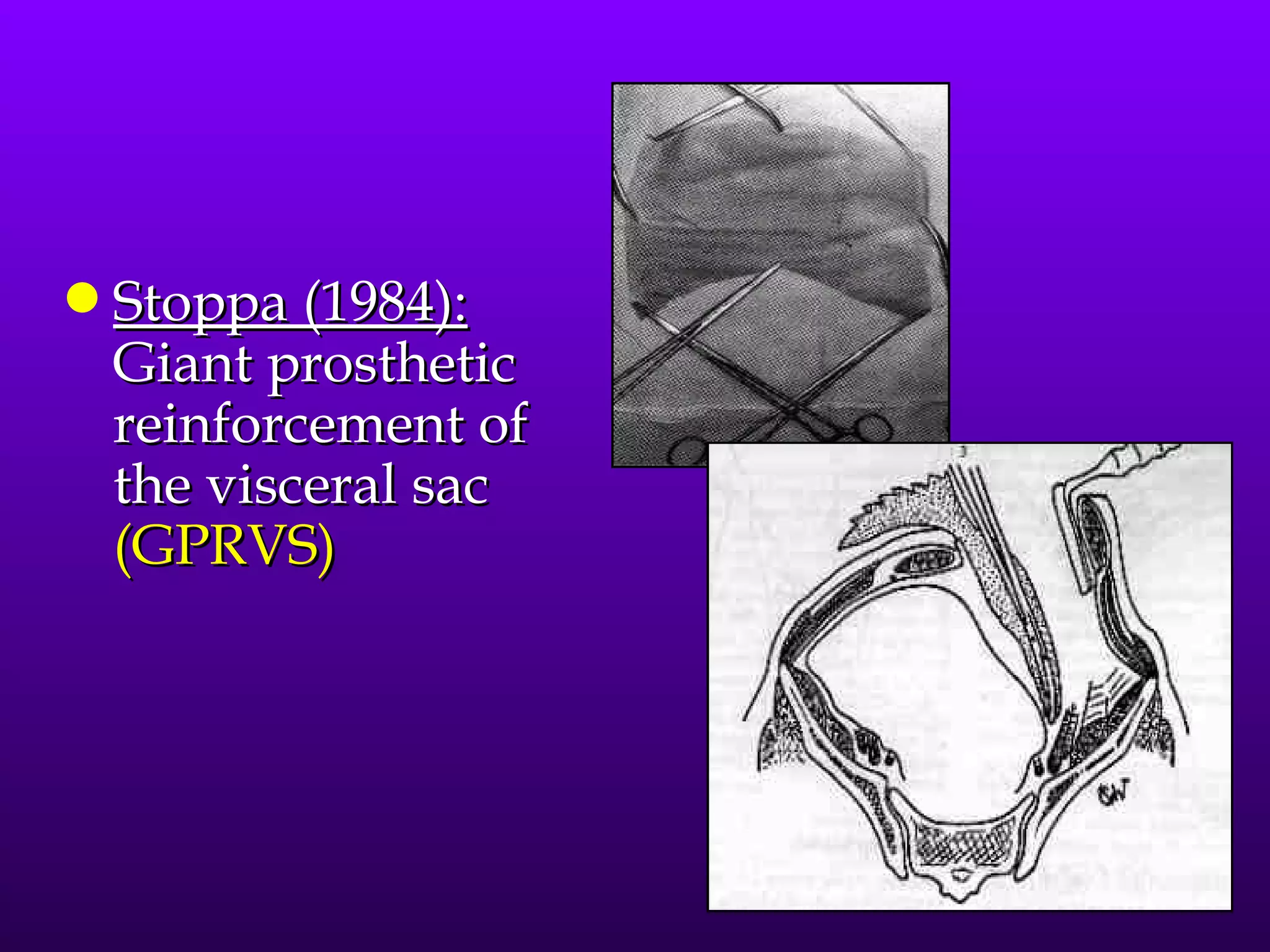
q   Stoppa (1984):
    Giant prosthetic
    reinforcement of
    the visceral sac
    (GPRVS)
Principle of the “Stoppa repair”
1) All hernias of the groin begin in the
myopectineal orifice of Fruchaud (1956)
2) GPRVS replaces the transversalis fascia in
the preperitoneal space by a large prosthesis
that extends far beyond the borders of the
orifice of Fruchaud in all directions
3) The prosthesis is held in place by
intraabdominal pressure and ingrowth of
connective tissue
III- Technique of the TEP*

        It has to reproduce the Stoppa repair
                   Laparoscopically


*Ferzli G., Sayad P.et al Surg Endosc 1998;12:1311-1313
1-Anesthetic choices
   q    General anesthesia
         –   Analgesic
         –   Neuroleptic
         –   Neuromuscular blocking agent
   q    Regional anesthesia
         – Sensory block
   q    Local anesthesia*(with or without
        LMA)
*Ferzli G, Sayad P.(1999) The feasibility of laparoscopic extraperitoneal hernia repair under local
anesthesia. Surg. Endosc. 13, 588
2- Patient preparation
q No NGT
q No Foley ( patient has to empty the
  bladder before entering the operation
  room)
q Slight Trendelenburg
q Flexed table
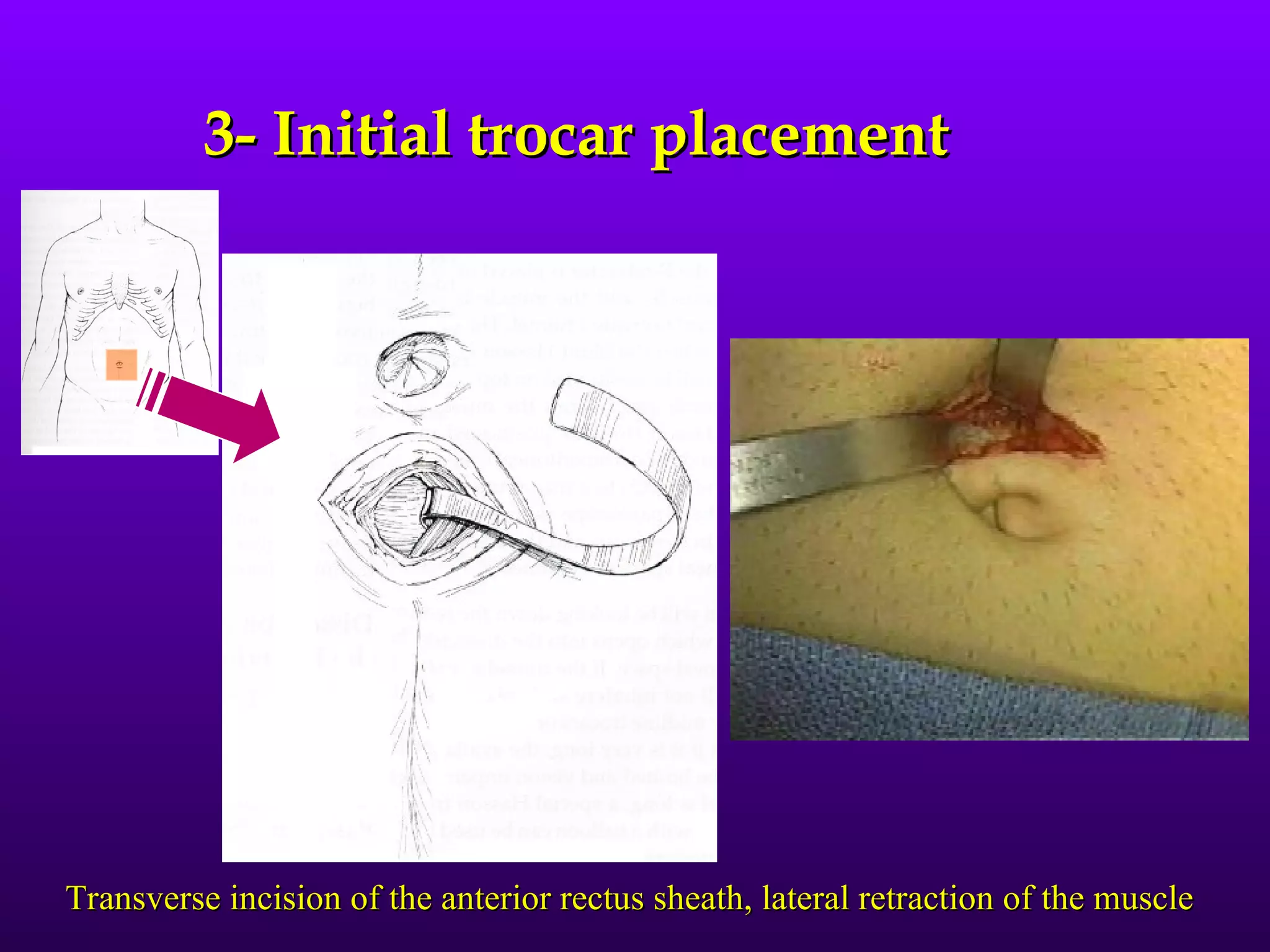
3- Initial trocar placement


Transverse incision of the anterior rectus sheath, lateral retraction of the muscle
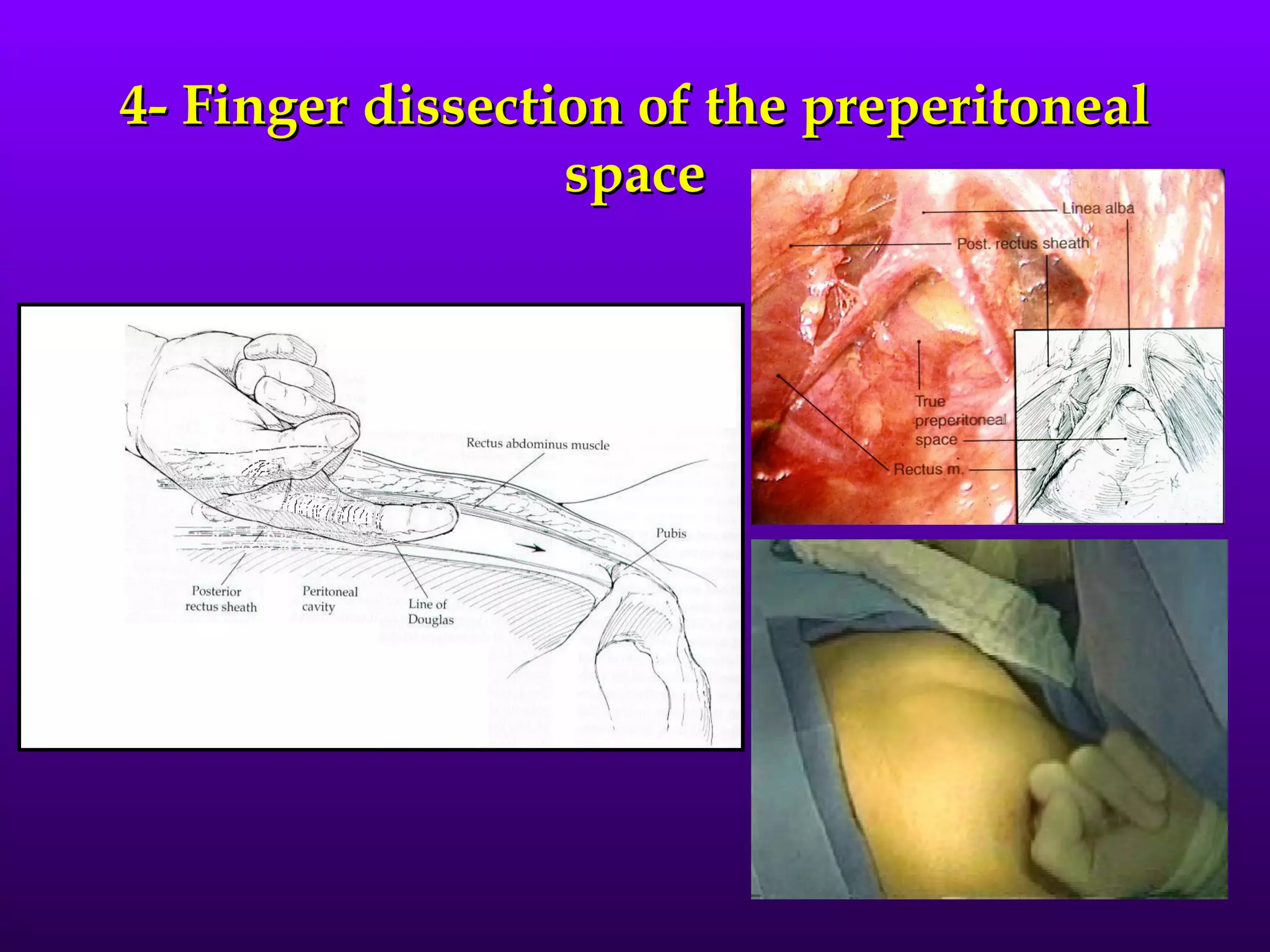
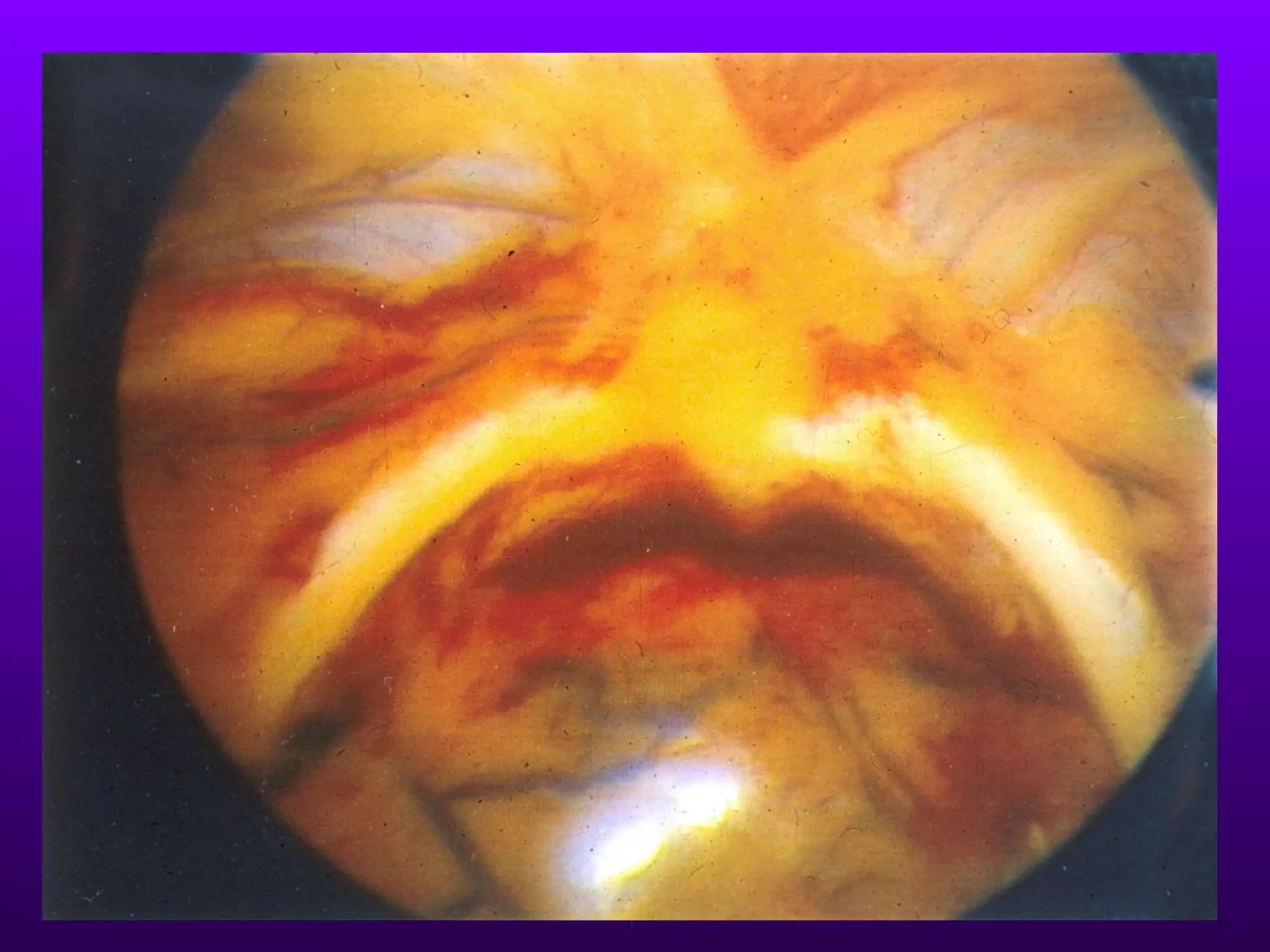
4- Finger dissection of the preperitoneal
                  space
Disadvantages of balloon dissection

q Higher cost
q Longer operative time
q Asymetric dissection
q More traumatic with risk of vascular
  injury (epigastic)
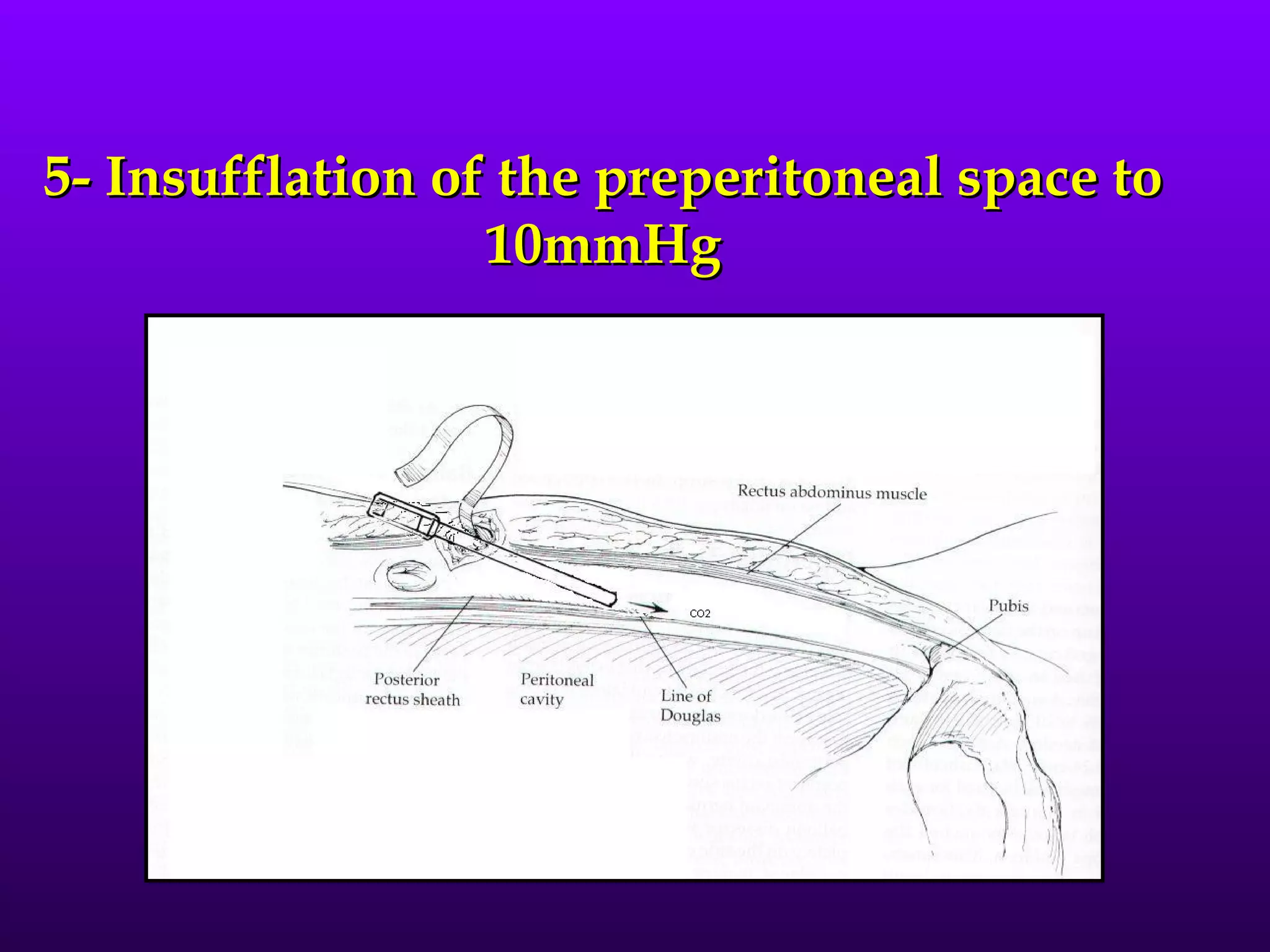
5- Insufflation of the preperitoneal space to
                  10mmHg
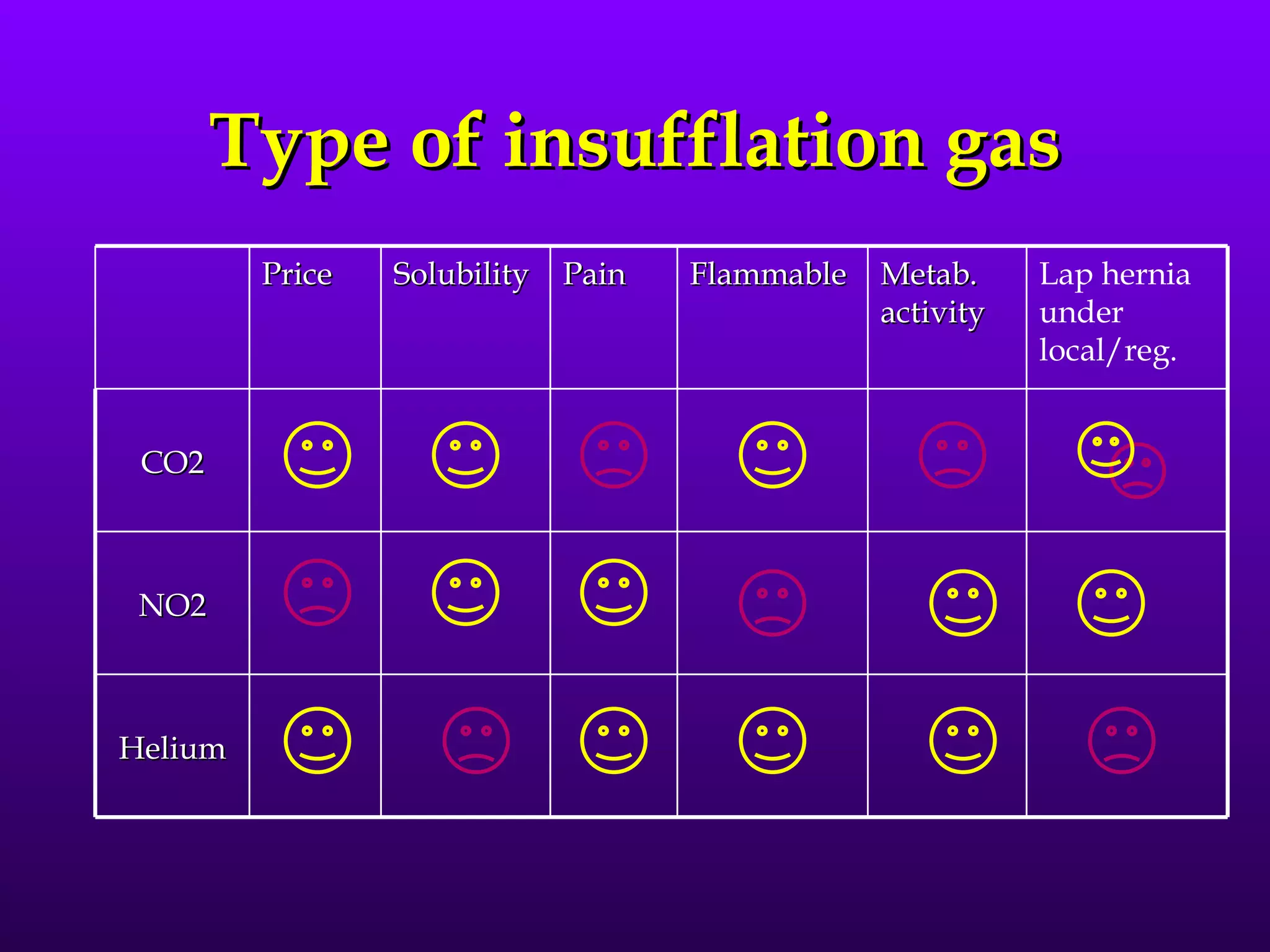
Type of insufflation gas
         Price   Solubility   Pain   Flammable   Metab.     Lap hernia
                                                 activity   under
                                                            local/reg.


 CO2


 NO2


Helium
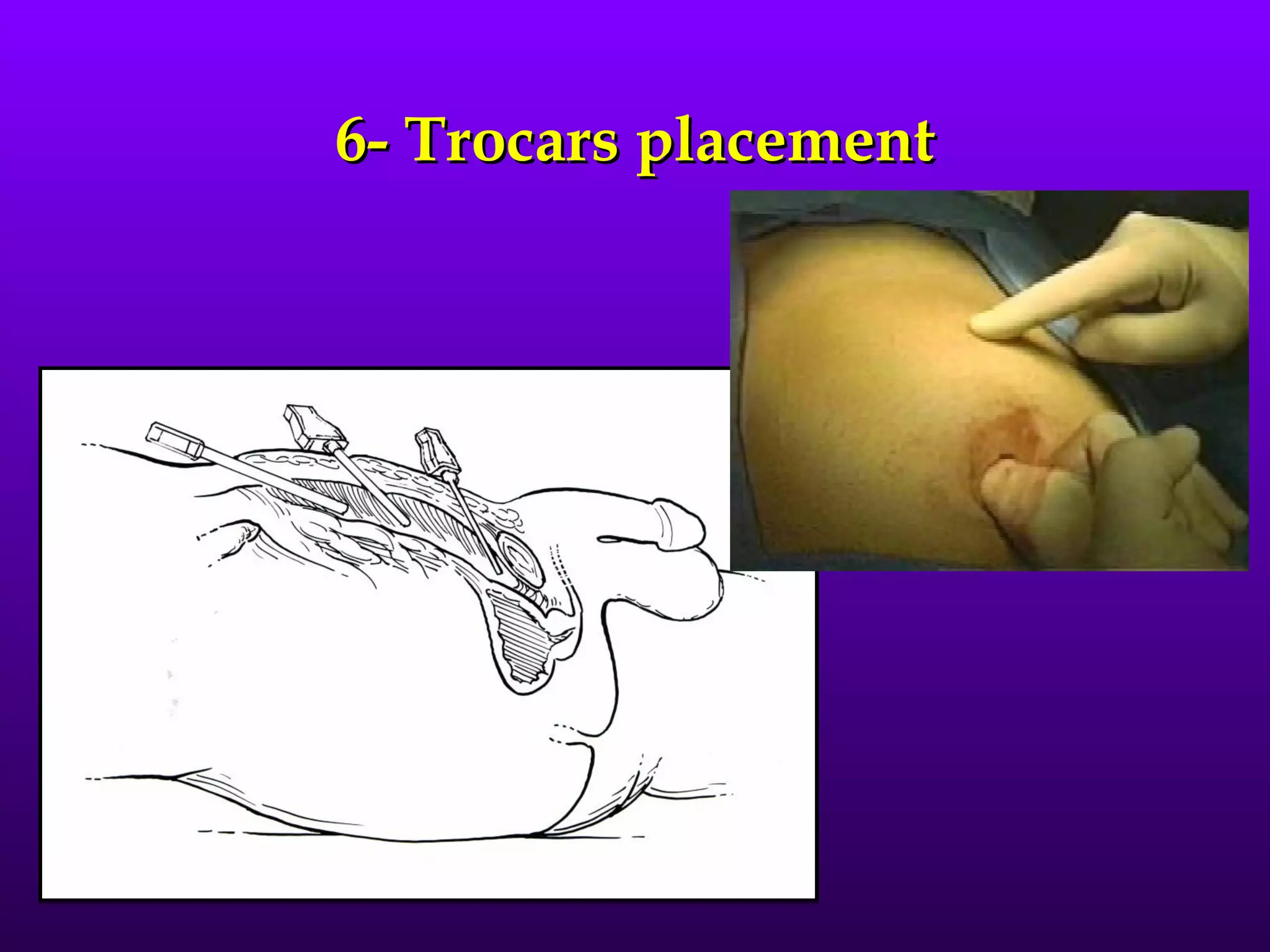
6- Trocars placement
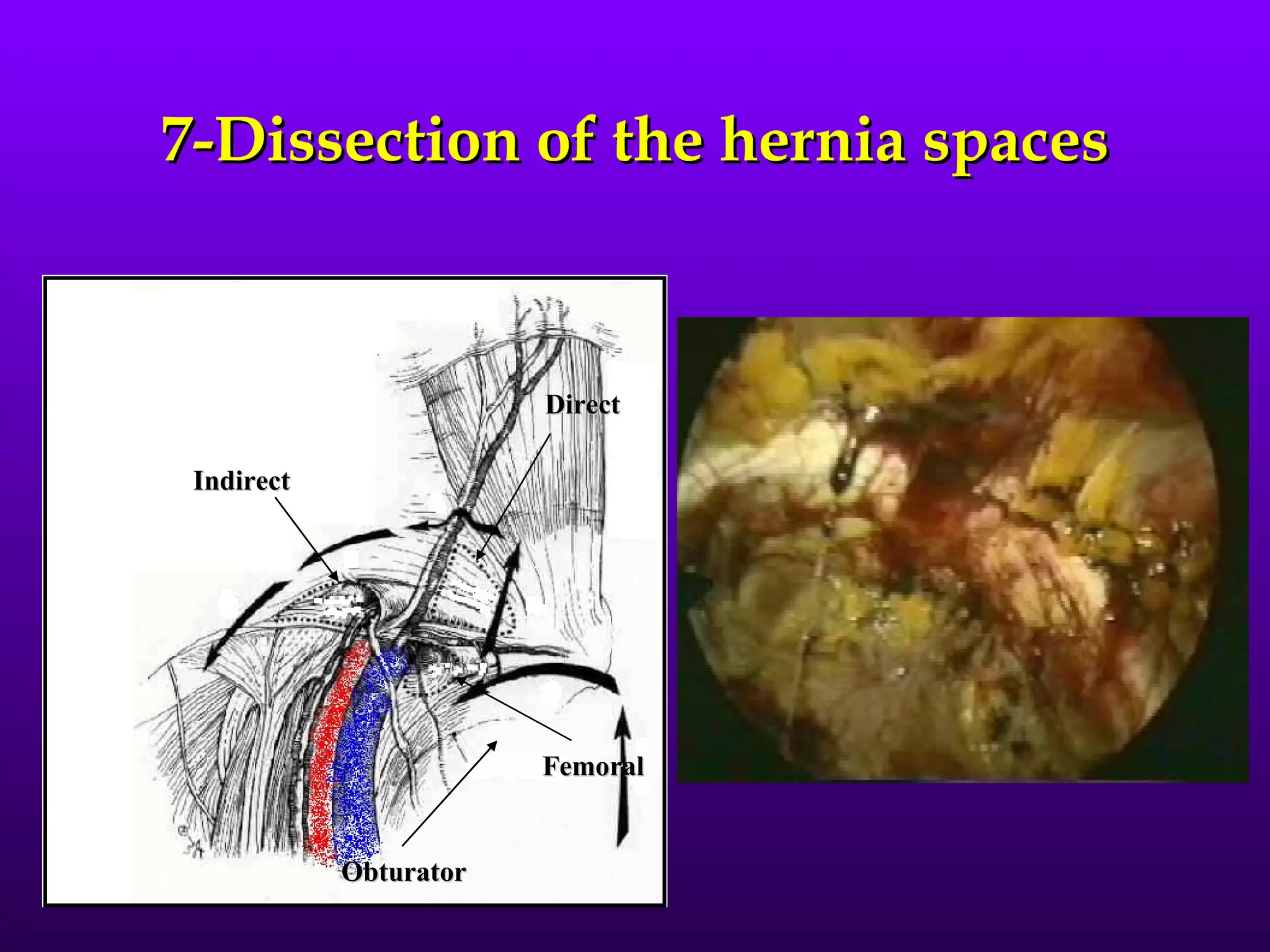
7-Dissection of the hernia spaces


                        Direct

 Indirect


                        Femoral


            Obturator
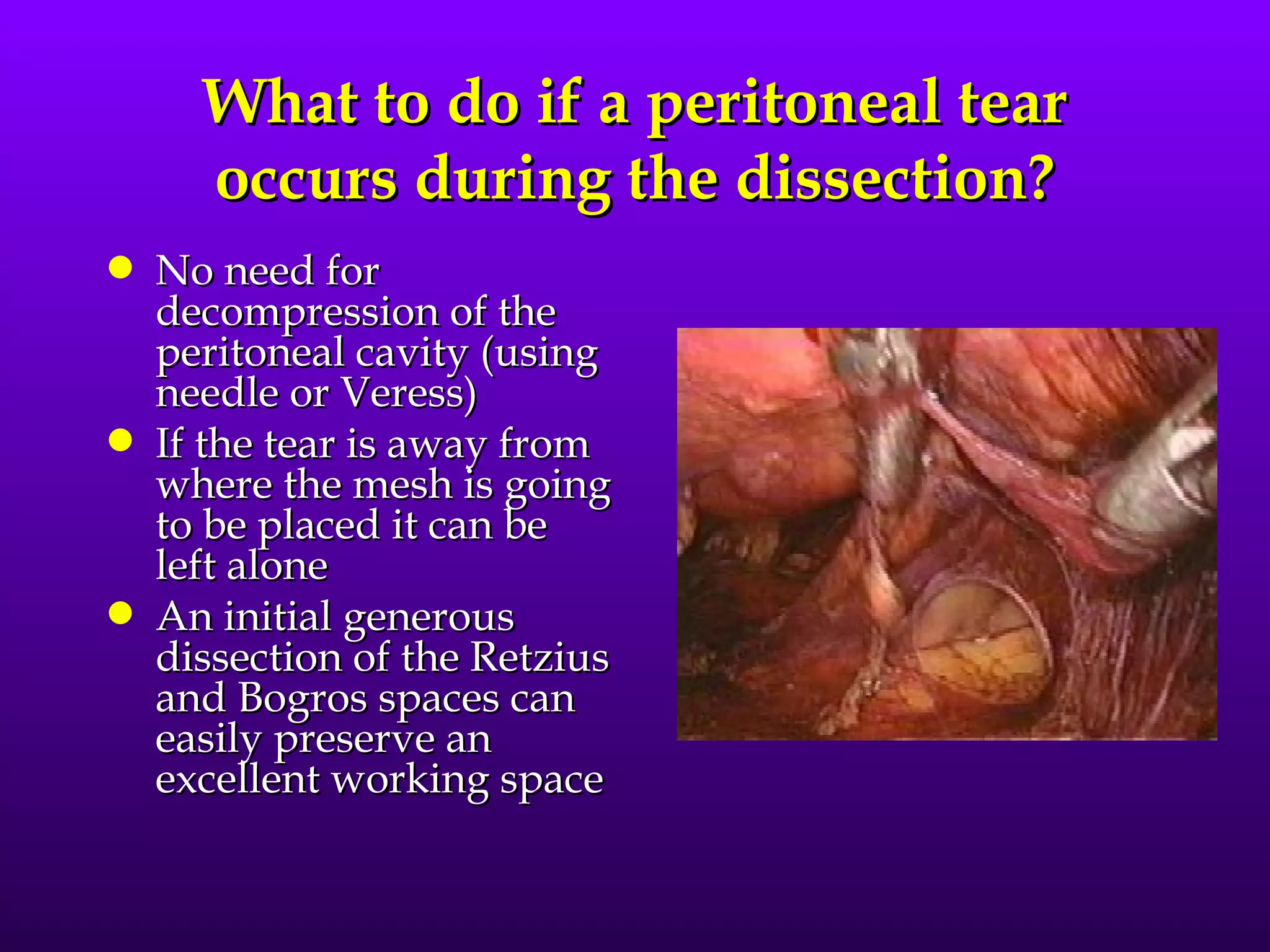
What to do if a peritoneal tear
      occurs during the dissection?
q   No need for
    decompression of the
    peritoneal cavity (using
    needle or Veress)
q   If the tear is away from
    where the mesh is going
    to be placed it can be
    left alone
q   An initial generous
    dissection of the Retzius
    and Bogros spaces can
    easily preserve an
    excellent working space
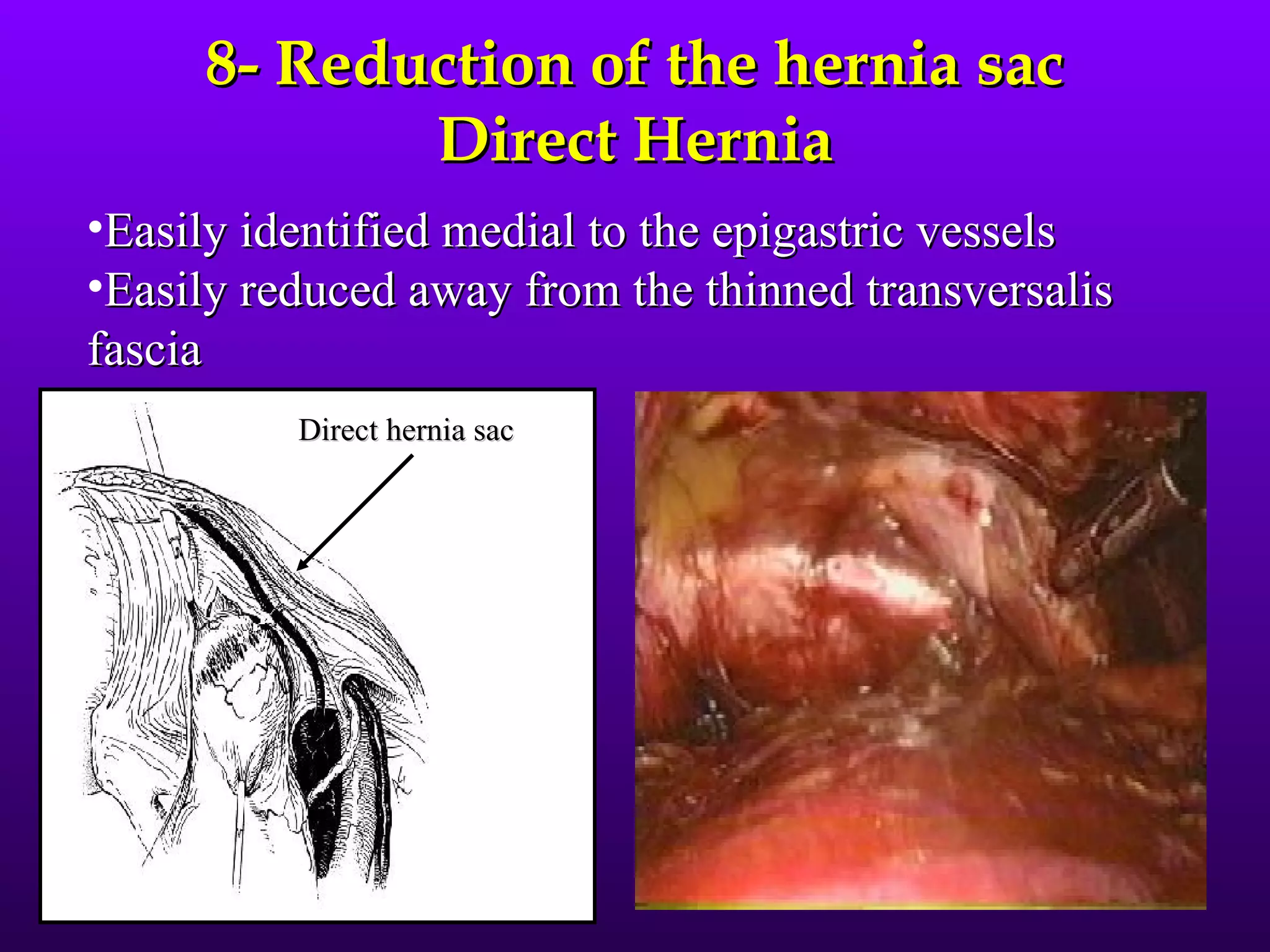
8- Reduction of the hernia sac
            Direct Hernia
•Easily identified medial to the epigastric vessels
•Easily reduced away from the thinned transversalis
fascia
          Direct hernia sac
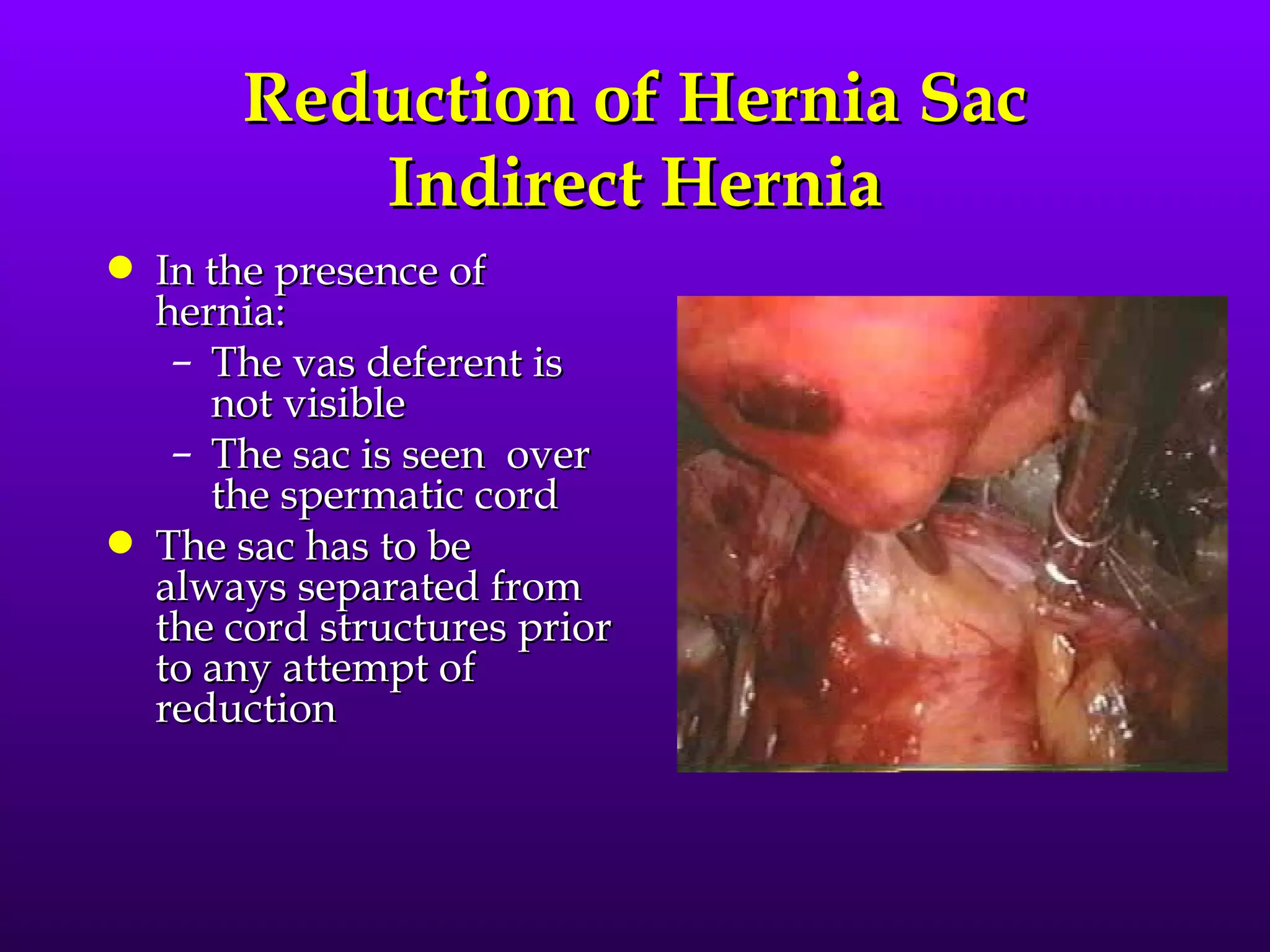
Reduction of Hernia Sac
           Indirect Hernia
q   In the presence of
    hernia:
     – The vas deferent is
       not visible
     – The sac is seen over
       the spermatic cord
q   The sac has to be
    always separated from
    the cord structures prior
    to any attempt of
    reduction
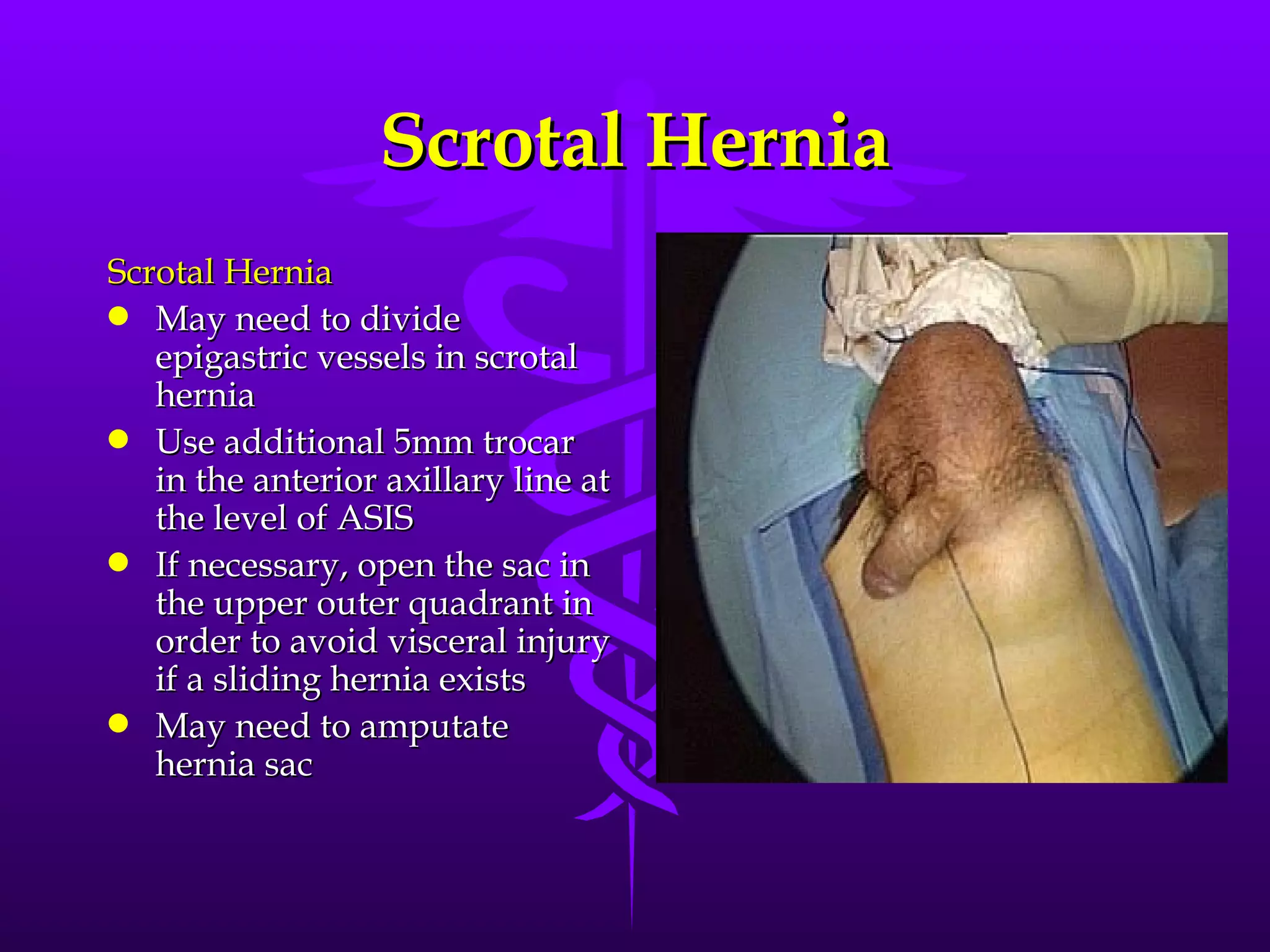
Scrotal Hernia
Scrotal Hernia
q May need to divide
   epigastric vessels in scrotal
   hernia
q Use additional 5mm trocar
   in the anterior axillary line at
   the level of ASIS
q If necessary, open the sac in
   the upper outer quadrant in
   order to avoid visceral injury
   if a sliding hernia exists
q May need to amputate
   hernia sac
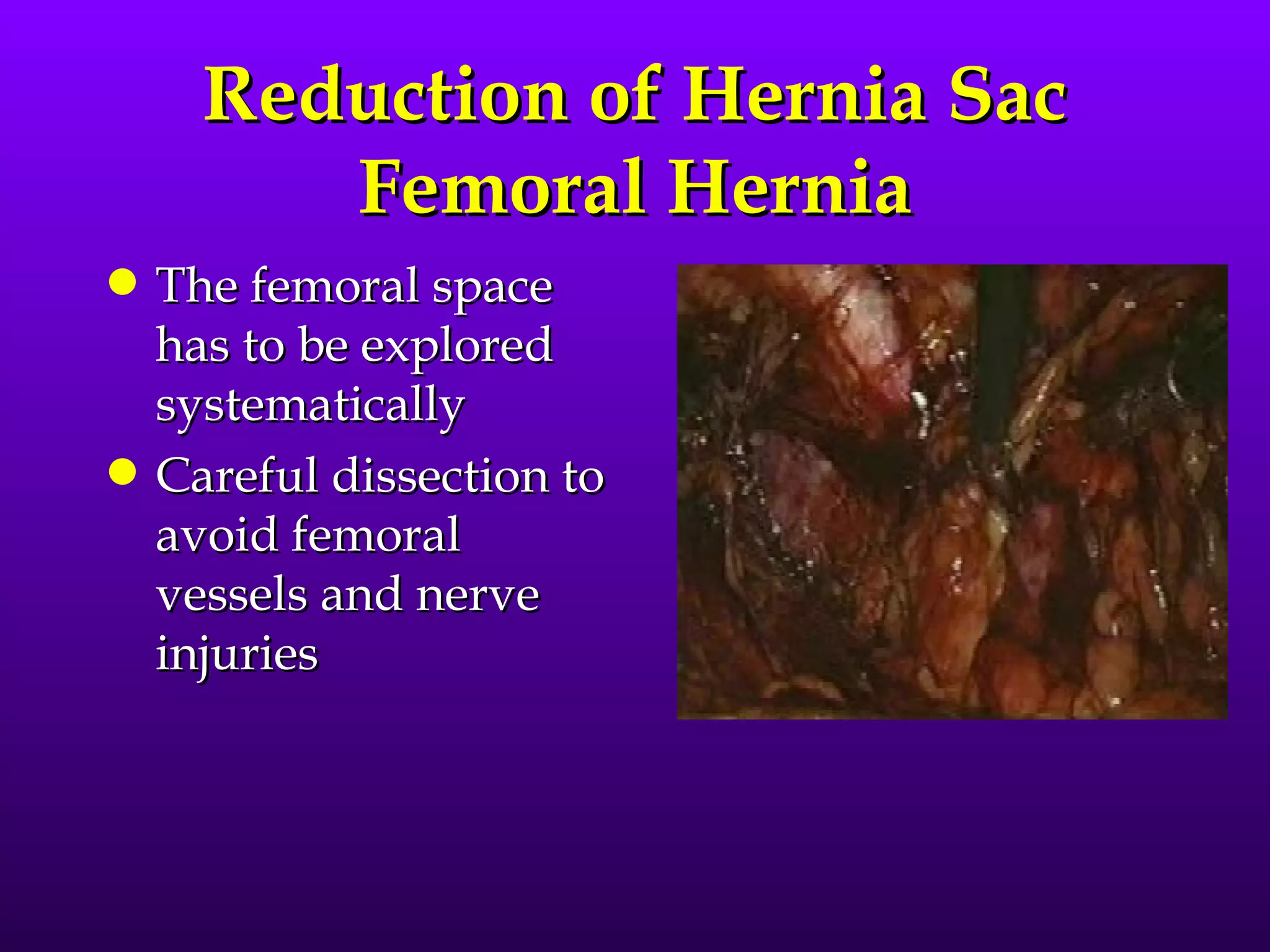
Reduction of Hernia Sac
         Femoral Hernia
q   The femoral space
    has to be explored
    systematically
q   Careful dissection to
    avoid femoral
    vessels and nerve
    injuries
Reduction of Hernia Sac
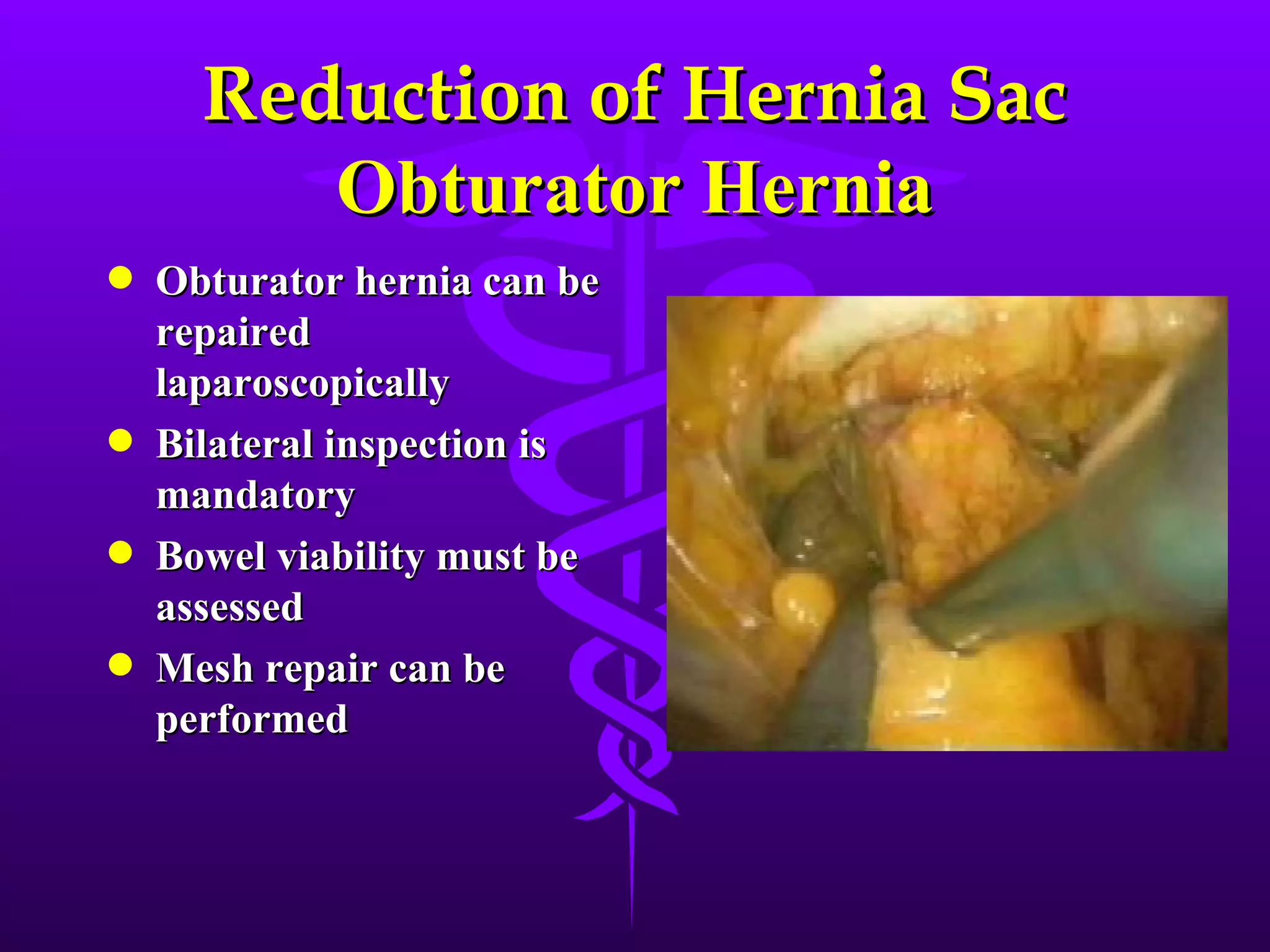
         Obturator Hernia
q   Obturator hernia can be
    repaired
    laparoscopically
q   Bilateral inspection is
    mandatory
q   Bowel viability must be
    assessed
q   Mesh repair can be
    performed
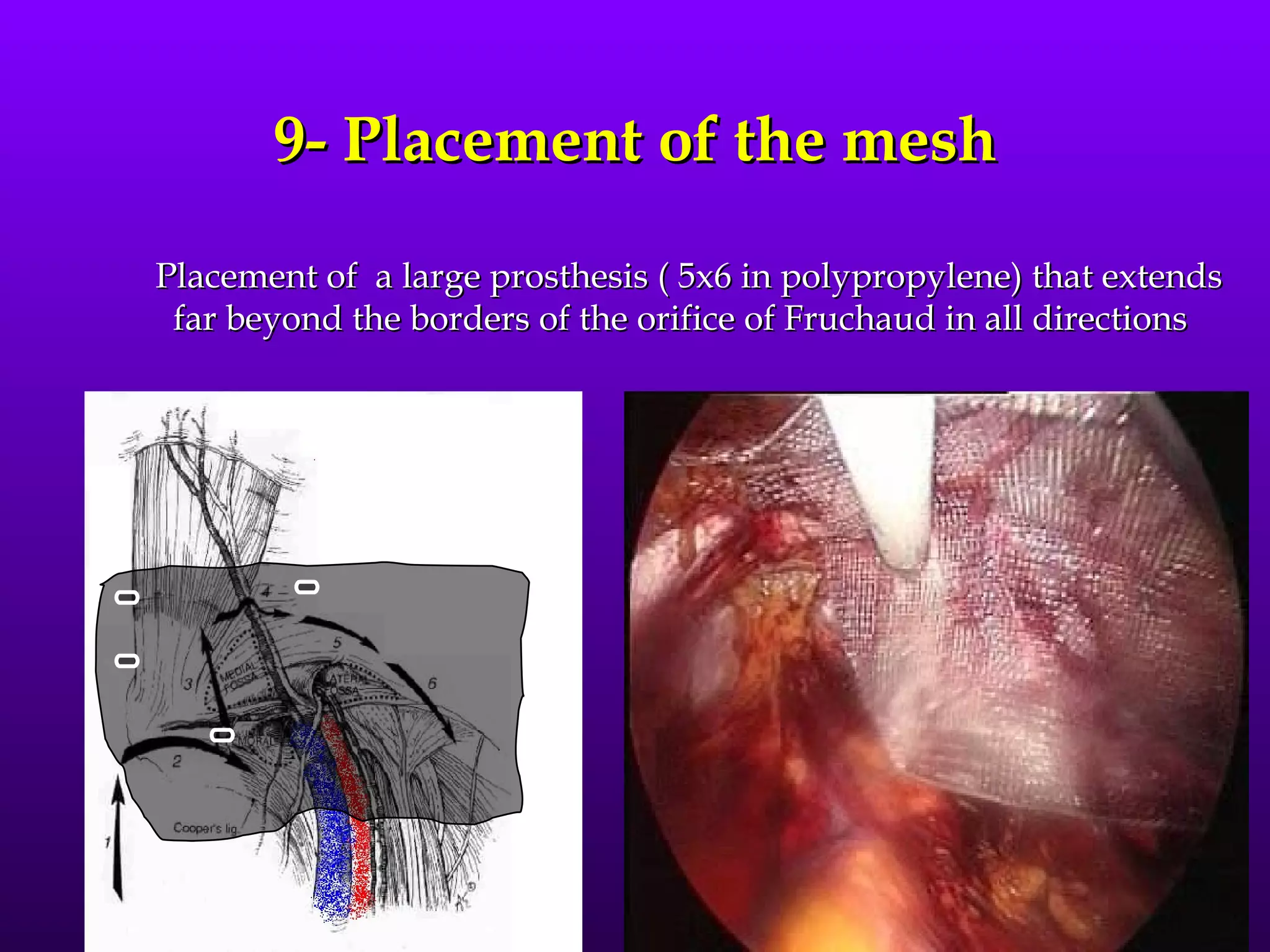
9- Placement of the mesh

Placement of a large prosthesis ( 5x6 in polypropylene) that extends
 far beyond the borders of the orifice of Fruchaud in all directions
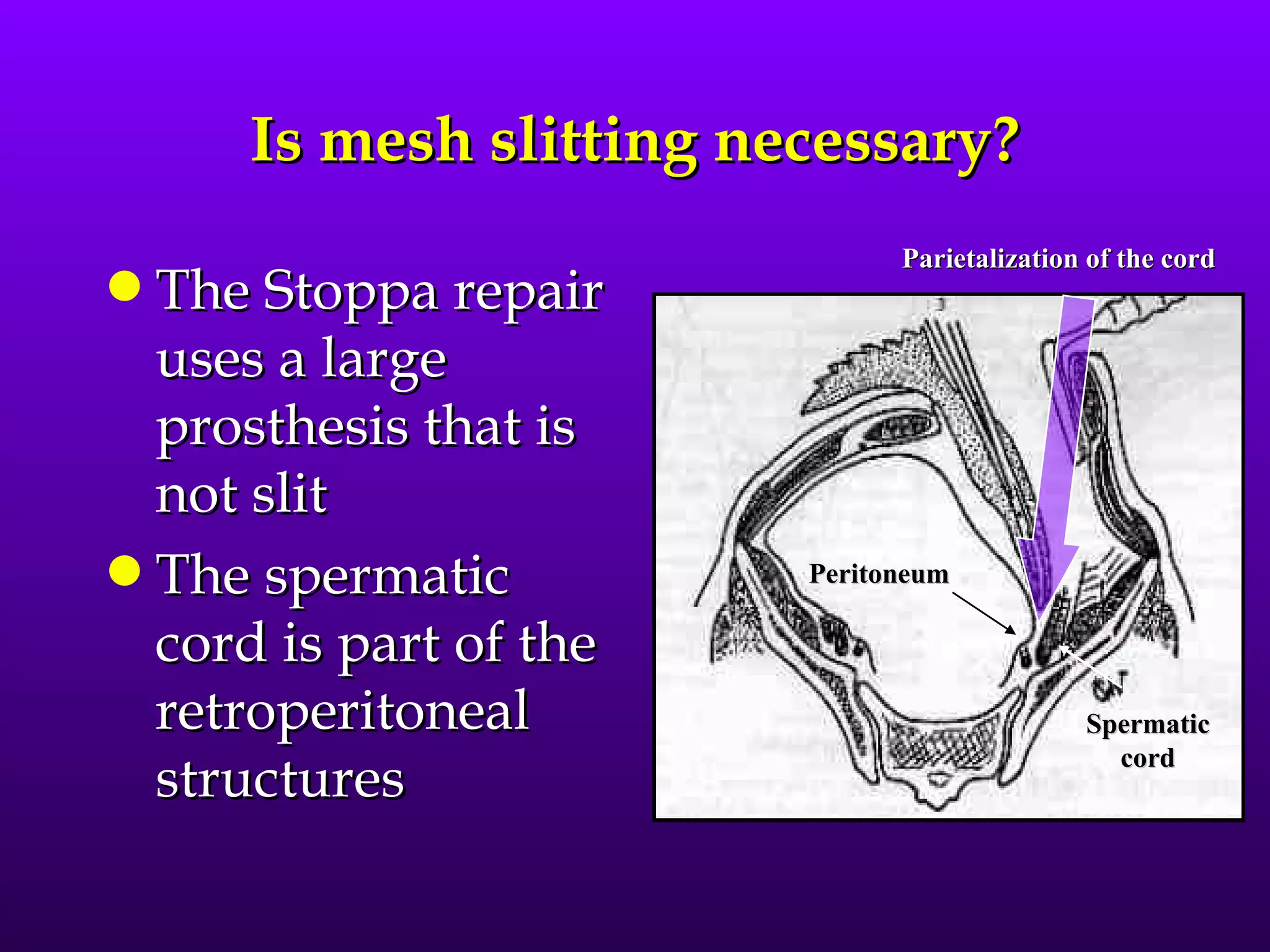
Is mesh slitting necessary?
                              Parietalization of the cord
q The Stoppa repair
  uses a large
  prosthesis that is
  not slit
q The spermatic         Peritoneum

  cord is part of the
  retroperitoneal                            Spermatic
                                               cord
  structures
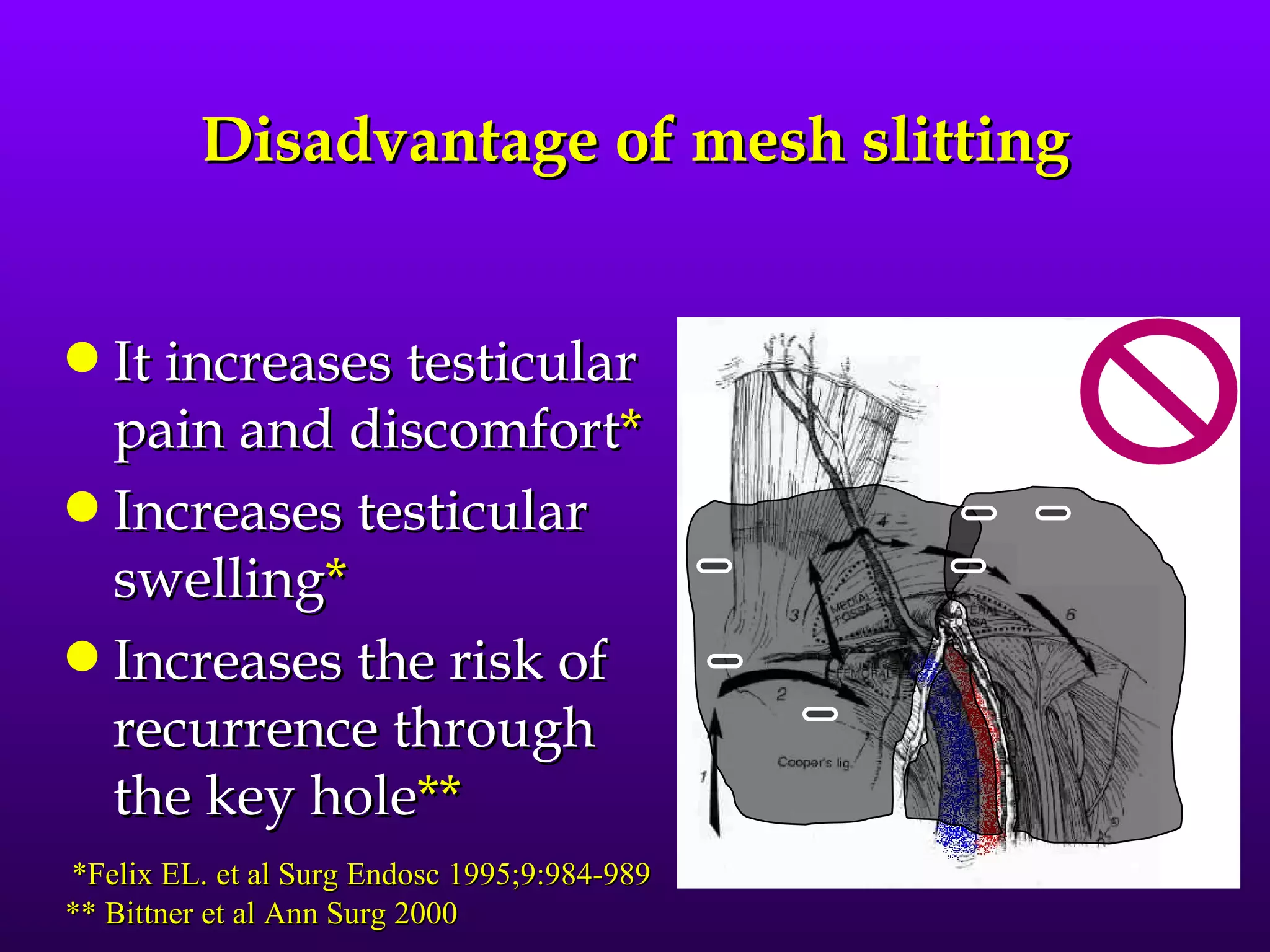
Disadvantage of mesh slitting


q It increases testicular
  pain and discomfort*
q Increases testicular
  swelling*
q Increases the risk of
  recurrence through
  the key hole**
*Felix EL. et al Surg Endosc 1995;9:984-989
** Bittner et al Ann Surg 2000
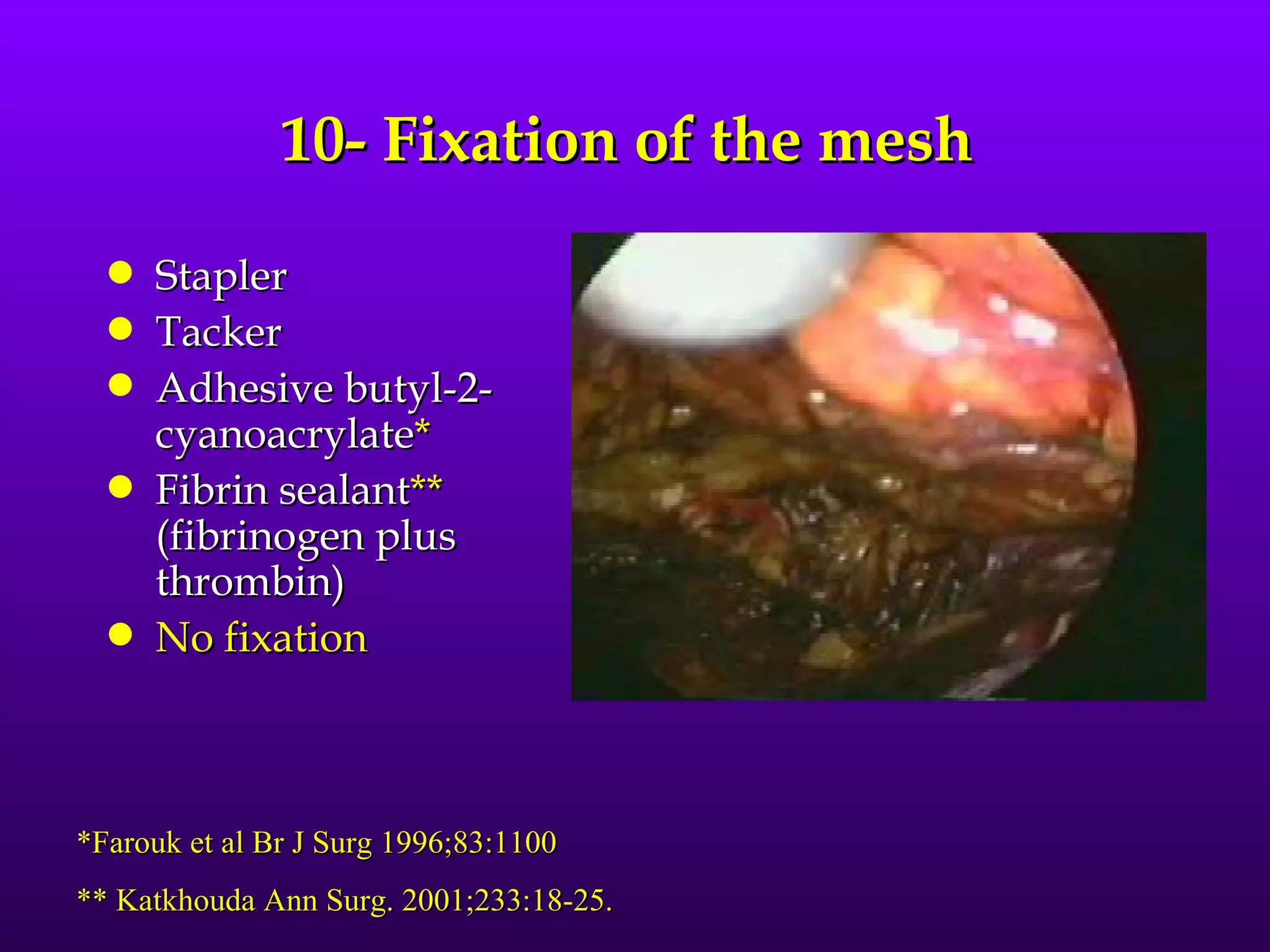
10- Fixation of the mesh
  q   Stapler
  q   Tacker
  q   Adhesive butyl-2-
      cyanoacrylate*
  q   Fibrin sealant**
      (fibrinogen plus
      thrombin)
  q   No fixation


*Farouk et al Br J Surg 1996;83:1100
** Katkhouda Ann Surg. 2001;233:18-25.
Disadvantage of mesh
               fixation
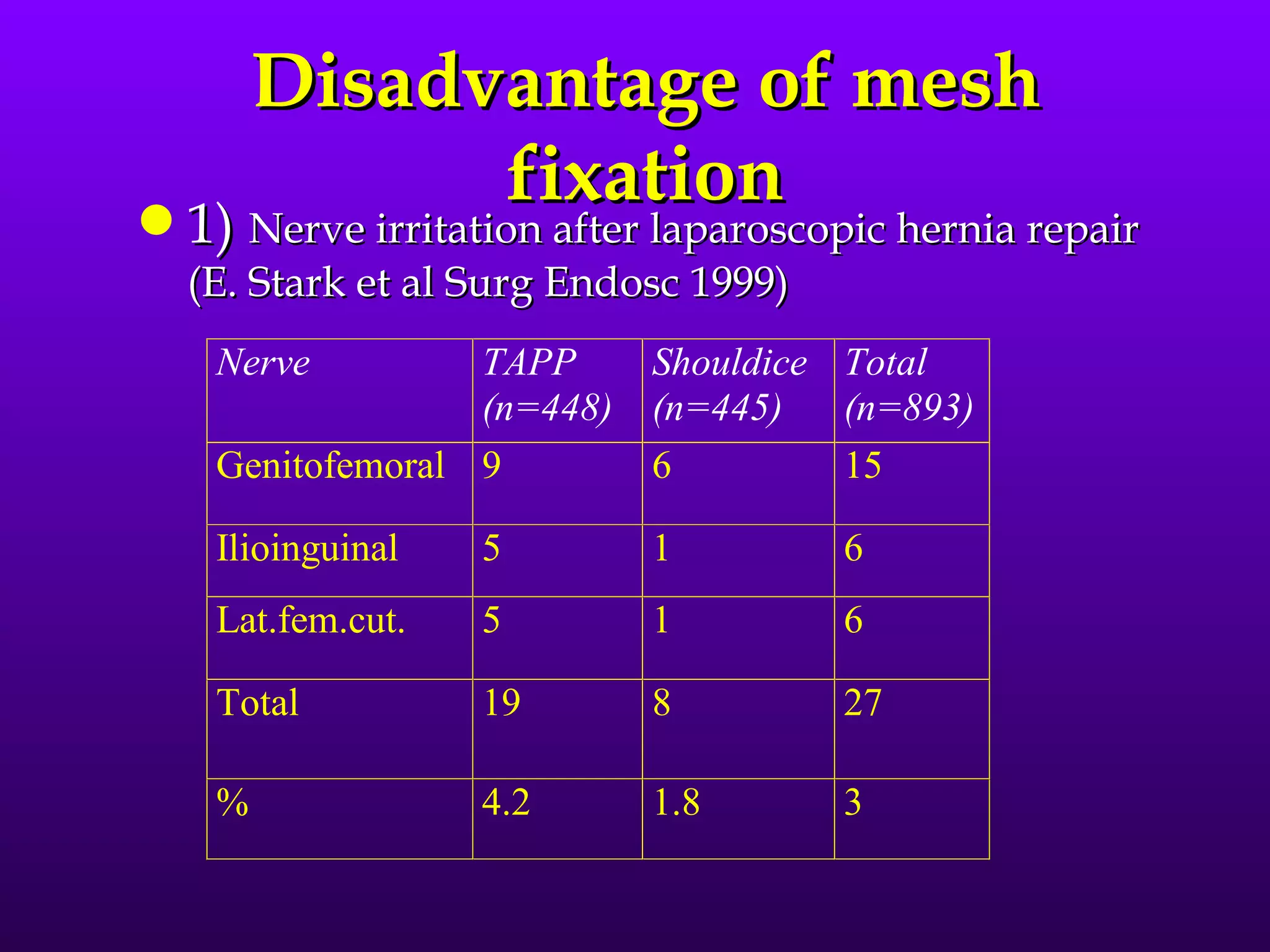
q   1) Nerve irritation after laparoscopic hernia repair
    (E. Stark et al Surg Endosc 1999)
     Nerve         TAPP    Shouldice Total
                   (n=448) (n=445)   (n=893)
     Genitofemoral 9       6         15

     Ilioinguinal   5        1          6
     Lat.fem.cut.   5        1          6

     Total          19       8          27

     %              4.2      1.8        3
Disadvantage of mesh fixation

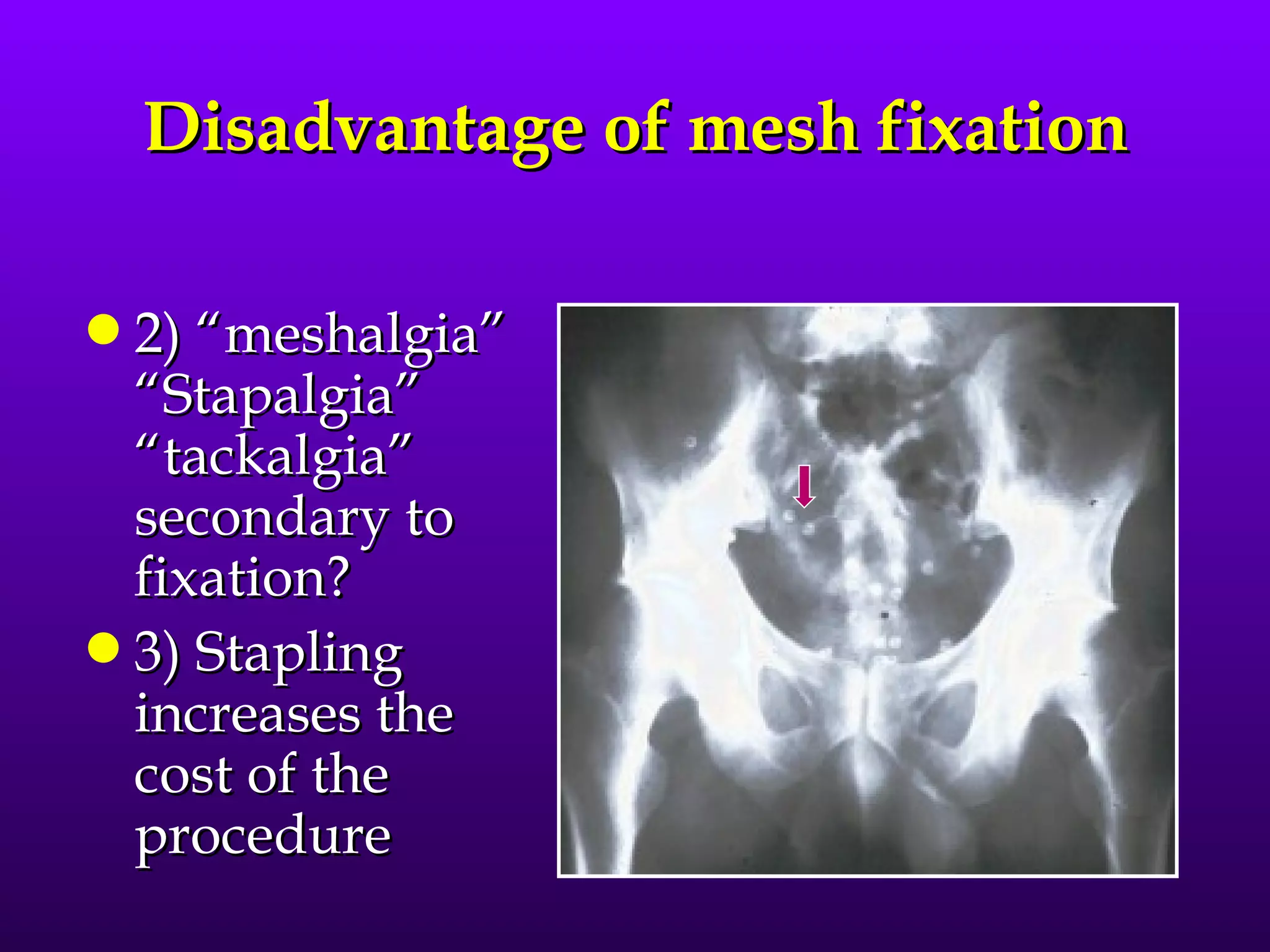
q 2) “meshalgia”
  “Stapalgia”
  “tackalgia”
  secondary to
  fixation?
q 3) Stapling
  increases the
  cost of the
  procedure
11- Systematic contra-lateral
               exploration *
q   No need for complete contra-lateral dissection*
q   Incidence of incipient contra-lateral hernias :
    11.2%* (724 patients)
q   Safe and does not considerably increase the
    operative time (2-5min)*
q   Obviate the need for re-operation, reduces the
    overall costs to the health care system and
    eliminates any further work loss for the patient*


    *Sayad P, Ferzli G. Surg Endosc 1999;13:1168-1169
In conclusion
            Important!
q Generous dissection of the Bogros space
q Complete parietalization of the cord
  structures
q Placement of a large mesh
q Minimal or no placement of staples

Laparoscopic Herniorrhaphy: TEP

  • 1.
    Laparoscopic Herniorrhaphy: TEP G. Ferzli, MD, FACS Professor of Surgery, SUNY Downstate Chairman of Surgery Lutheran Medical Center
  • 2.
    I- Anatomy ofthe preperitoneal space
  • 3.
    q Bogros (1823) : Preperitoneal approach through the inguinal floor for aneurysm (Bogros space) Bogros space
  • 4.
    q Retzius (1858) : Defined the prevesical space (Retzius space) Retzius space
  • 5.
    II- Evolution ofpreperitoneal herniorrhaphy
  • 6.
    q Bassini (1884) : Preperitoneal approach through Transversalis fascia the inguinal floor
  • 7.
    q Nyhus (1959 ) : Preperitoneal approach through a transverse abdominal incision for posterior repair
  • 8.
    q Nyhus, Read (1975): Preperitoneal approach and posterior prosthetic buttress repair for recurrent hernia
  • 9.
    q Stoppa (1984): Giant prosthetic reinforcement of the visceral sac (GPRVS)
  • 10.
    Principle of the“Stoppa repair” 1) All hernias of the groin begin in the myopectineal orifice of Fruchaud (1956) 2) GPRVS replaces the transversalis fascia in the preperitoneal space by a large prosthesis that extends far beyond the borders of the orifice of Fruchaud in all directions 3) The prosthesis is held in place by intraabdominal pressure and ingrowth of connective tissue
  • 11.
    III- Technique ofthe TEP* It has to reproduce the Stoppa repair Laparoscopically *Ferzli G., Sayad P.et al Surg Endosc 1998;12:1311-1313
  • 12.
    1-Anesthetic choices q General anesthesia – Analgesic – Neuroleptic – Neuromuscular blocking agent q Regional anesthesia – Sensory block q Local anesthesia*(with or without LMA) *Ferzli G, Sayad P.(1999) The feasibility of laparoscopic extraperitoneal hernia repair under local anesthesia. Surg. Endosc. 13, 588
  • 13.
    2- Patient preparation qNo NGT q No Foley ( patient has to empty the bladder before entering the operation room) q Slight Trendelenburg q Flexed table
  • 14.
    3- Initial trocarplacement Transverse incision of the anterior rectus sheath, lateral retraction of the muscle
  • 15.
    4- Finger dissectionof the preperitoneal space
  • 17.
    Disadvantages of balloondissection q Higher cost q Longer operative time q Asymetric dissection q More traumatic with risk of vascular injury (epigastic)
  • 18.
    5- Insufflation ofthe preperitoneal space to 10mmHg
  • 19.
    Type of insufflationgas Price Solubility Pain Flammable Metab. Lap hernia activity under local/reg. CO2 NO2 Helium
  • 20.
  • 21.
    7-Dissection of thehernia spaces Direct Indirect Femoral Obturator
  • 22.
    What to doif a peritoneal tear occurs during the dissection? q No need for decompression of the peritoneal cavity (using needle or Veress) q If the tear is away from where the mesh is going to be placed it can be left alone q An initial generous dissection of the Retzius and Bogros spaces can easily preserve an excellent working space
  • 23.
    8- Reduction ofthe hernia sac Direct Hernia •Easily identified medial to the epigastric vessels •Easily reduced away from the thinned transversalis fascia Direct hernia sac
  • 24.
    Reduction of HerniaSac Indirect Hernia q In the presence of hernia: – The vas deferent is not visible – The sac is seen over the spermatic cord q The sac has to be always separated from the cord structures prior to any attempt of reduction
  • 25.
    Scrotal Hernia Scrotal Hernia qMay need to divide epigastric vessels in scrotal hernia q Use additional 5mm trocar in the anterior axillary line at the level of ASIS q If necessary, open the sac in the upper outer quadrant in order to avoid visceral injury if a sliding hernia exists q May need to amputate hernia sac
  • 26.
    Reduction of HerniaSac Femoral Hernia q The femoral space has to be explored systematically q Careful dissection to avoid femoral vessels and nerve injuries
  • 27.
    Reduction of HerniaSac Obturator Hernia q Obturator hernia can be repaired laparoscopically q Bilateral inspection is mandatory q Bowel viability must be assessed q Mesh repair can be performed
  • 28.
    9- Placement ofthe mesh Placement of a large prosthesis ( 5x6 in polypropylene) that extends far beyond the borders of the orifice of Fruchaud in all directions
  • 29.
    Is mesh slittingnecessary? Parietalization of the cord q The Stoppa repair uses a large prosthesis that is not slit q The spermatic Peritoneum cord is part of the retroperitoneal Spermatic cord structures
  • 30.
    Disadvantage of meshslitting q It increases testicular pain and discomfort* q Increases testicular swelling* q Increases the risk of recurrence through the key hole** *Felix EL. et al Surg Endosc 1995;9:984-989 ** Bittner et al Ann Surg 2000
  • 31.
    10- Fixation ofthe mesh q Stapler q Tacker q Adhesive butyl-2- cyanoacrylate* q Fibrin sealant** (fibrinogen plus thrombin) q No fixation *Farouk et al Br J Surg 1996;83:1100 ** Katkhouda Ann Surg. 2001;233:18-25.
  • 32.
    Disadvantage of mesh fixation q 1) Nerve irritation after laparoscopic hernia repair (E. Stark et al Surg Endosc 1999) Nerve TAPP Shouldice Total (n=448) (n=445) (n=893) Genitofemoral 9 6 15 Ilioinguinal 5 1 6 Lat.fem.cut. 5 1 6 Total 19 8 27 % 4.2 1.8 3
  • 33.
    Disadvantage of meshfixation q 2) “meshalgia” “Stapalgia” “tackalgia” secondary to fixation? q 3) Stapling increases the cost of the procedure
  • 34.
    11- Systematic contra-lateral exploration * q No need for complete contra-lateral dissection* q Incidence of incipient contra-lateral hernias : 11.2%* (724 patients) q Safe and does not considerably increase the operative time (2-5min)* q Obviate the need for re-operation, reduces the overall costs to the health care system and eliminates any further work loss for the patient* *Sayad P, Ferzli G. Surg Endosc 1999;13:1168-1169
  • 35.
    In conclusion Important! q Generous dissection of the Bogros space q Complete parietalization of the cord structures q Placement of a large mesh q Minimal or no placement of staples