ANDREW S. WRIGHT MD
DIRECTOR, UW MEDICINE HERNIA
CENTER
TWITTER: @ANDREWSWRIGHT
EMAIL: AWRIGHT2@UW.EDU
Open vs. MIS Inguinal Hernia
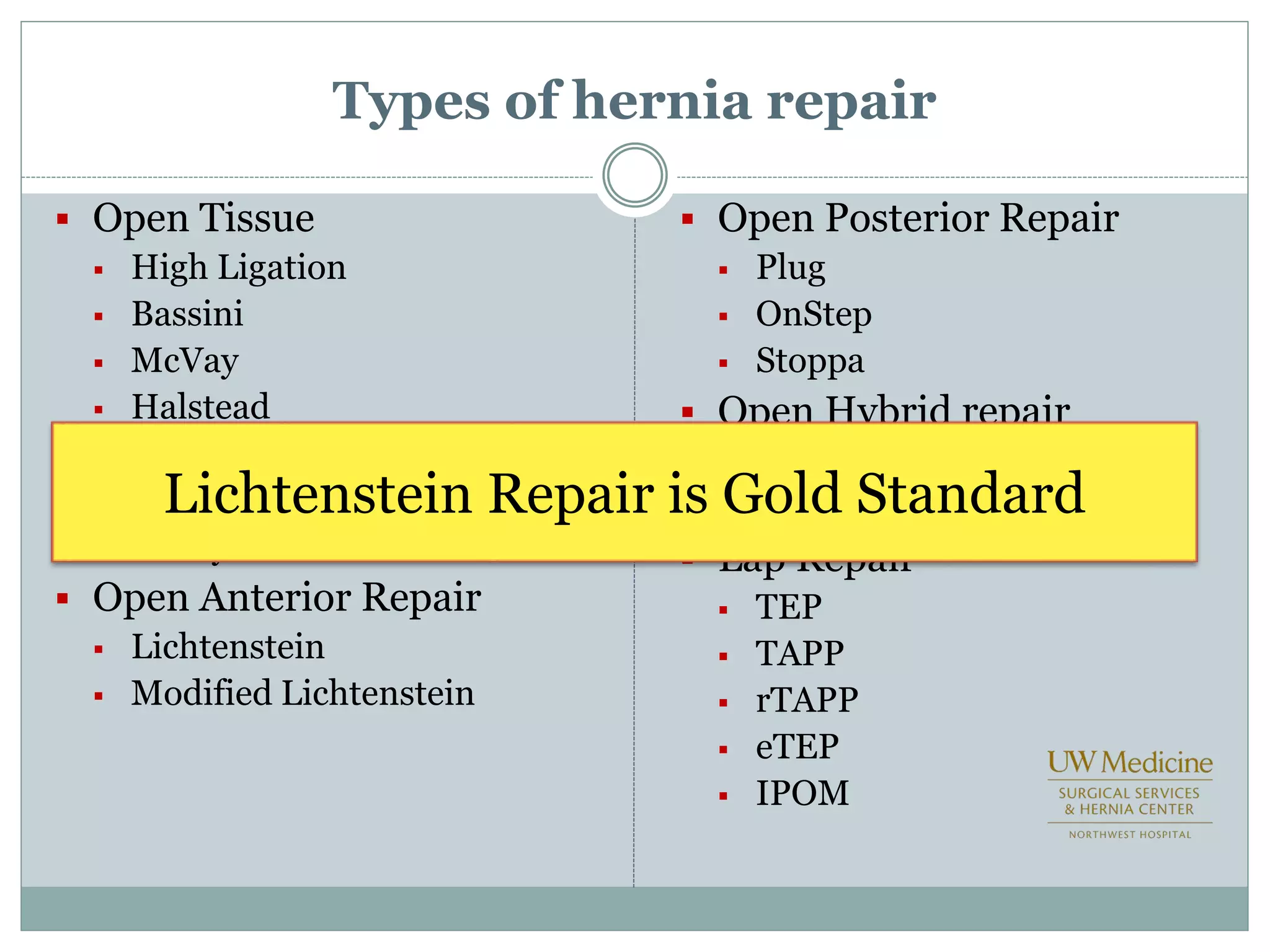
Types of hernia repair
 Open Tissue
 High Ligation
 Bassini
 McVay
 Halstead
 Shouldice
 Desarda
 Marcy
 Open Anterior Repair
 Lichtenstein
 Modified Lichtenstein
 Open Posterior Repair
 Plug
 OnStep
 Stoppa
 Open Hybrid repair
 Plug/patch
 PHS/UHS
 Lap Repair
 TEP
 TAPP
 rTAPP
 eTEP
 IPOM
Types of hernia repair
 Open Tissue
 High Ligation
 Bassini
 McVay
 Halstead
 Shouldice
 Desarda
 Marcy
 Open Anterior Repair
 Lichtenstein
 Modified Lichtenstein
 Open Posterior Repair
 Plug
 OnStep
 Stoppa
 Open Hybrid repair
 Plug/patch
 PHS/UHS
 Lap Repair
 TEP
 TAPP
 rTAPP
 eTEP
 IPOM
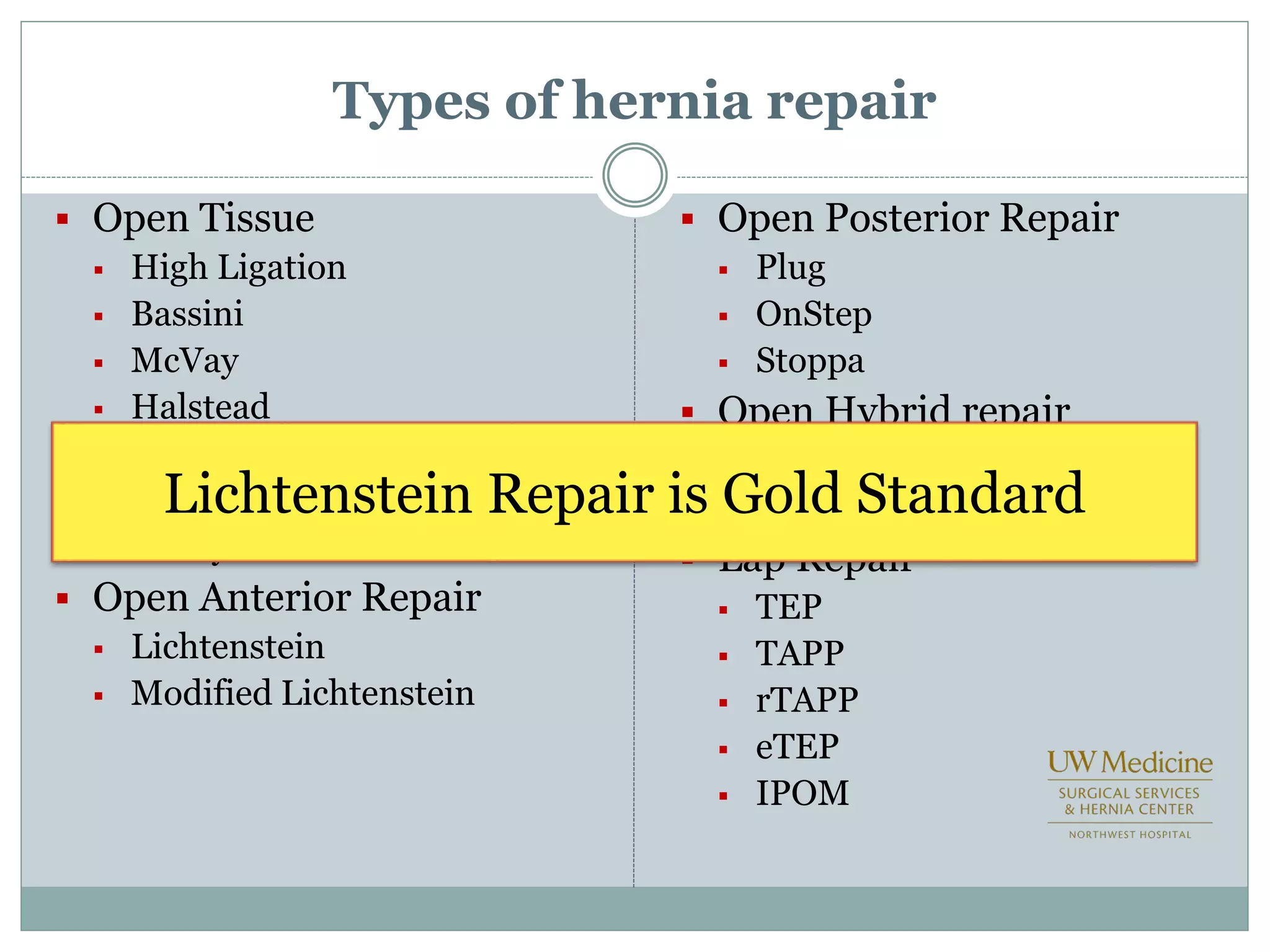
Lichtenstein Repair is Gold Standard
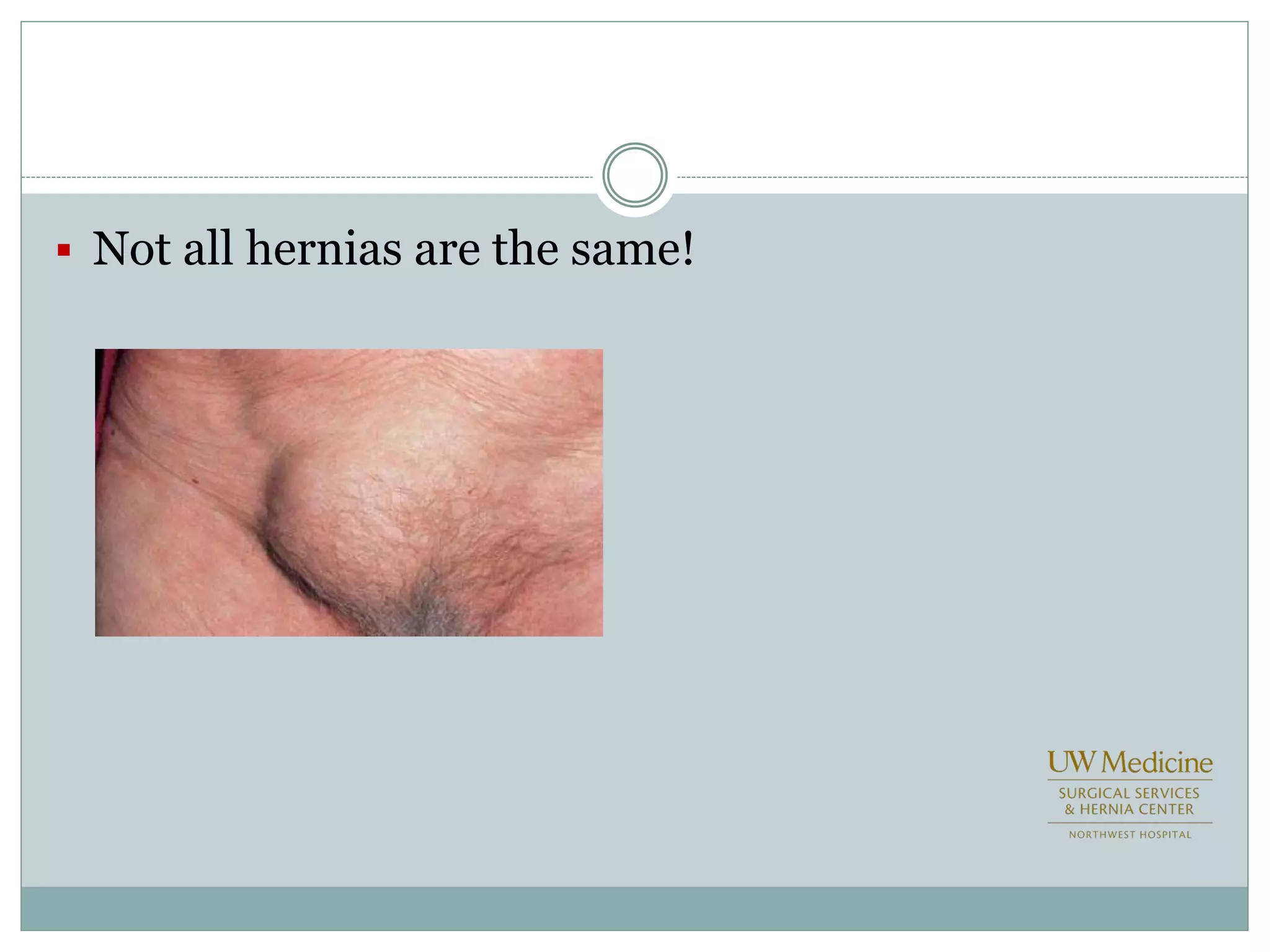
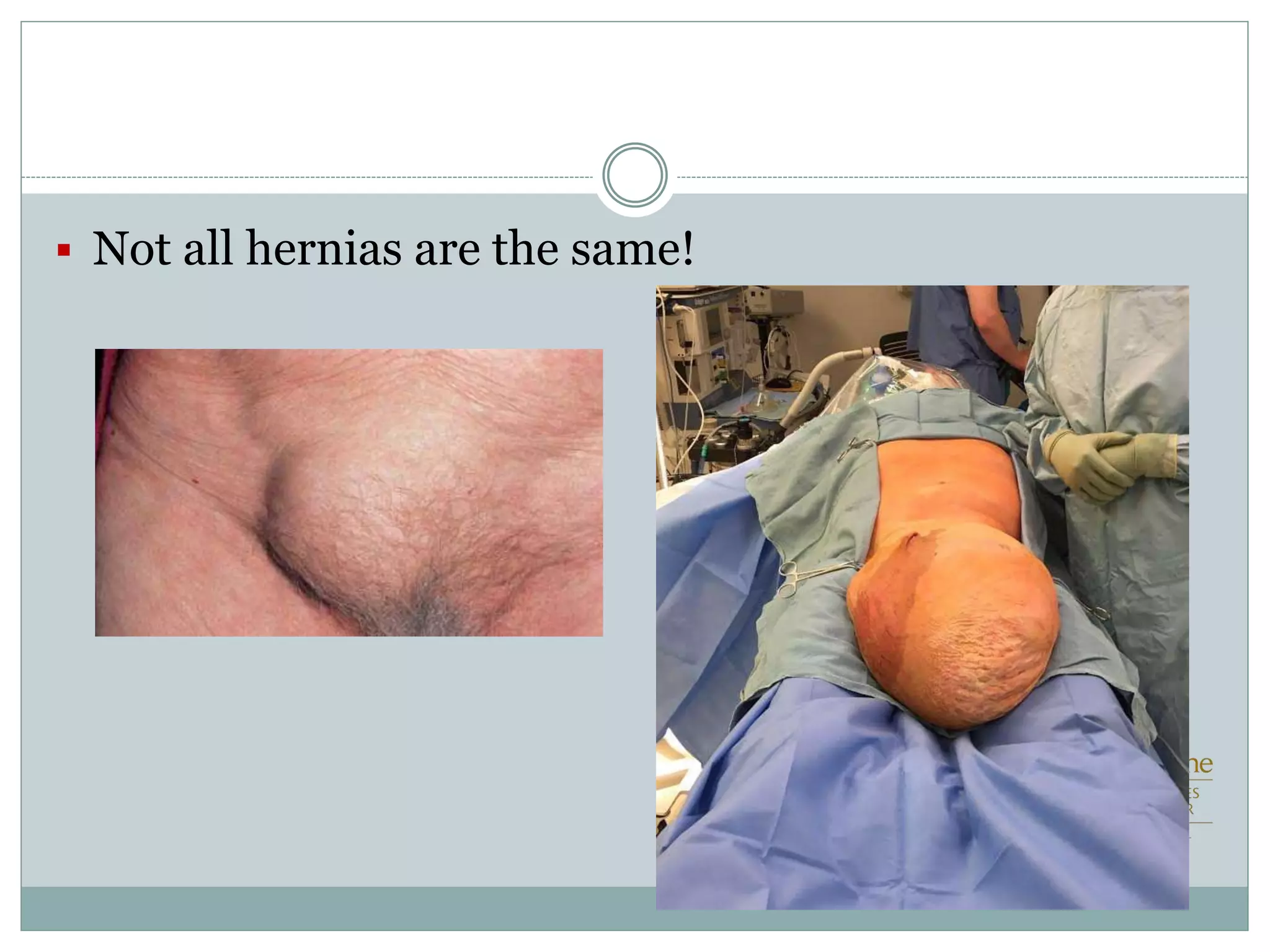
 Not all hernias are the same!
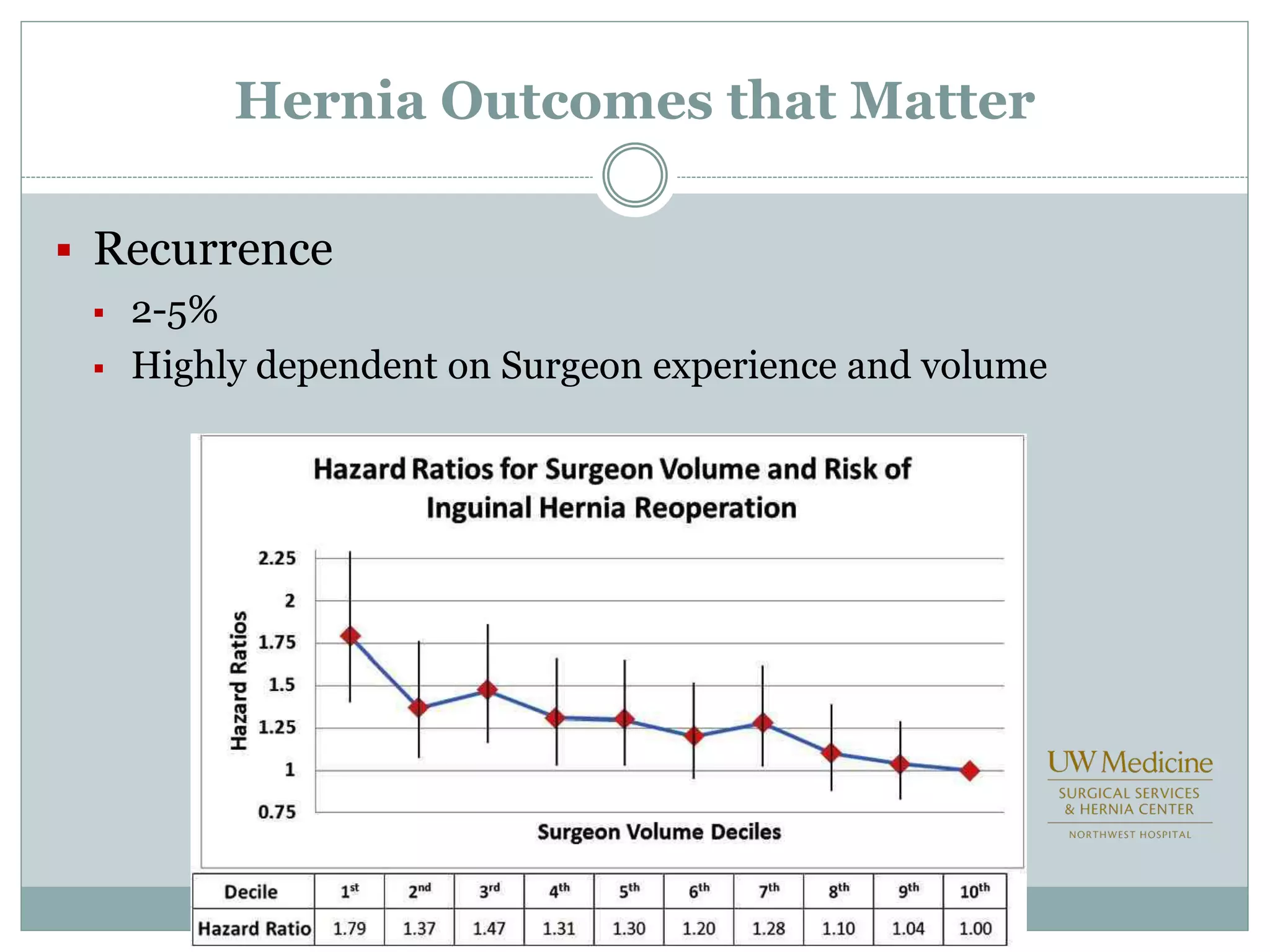
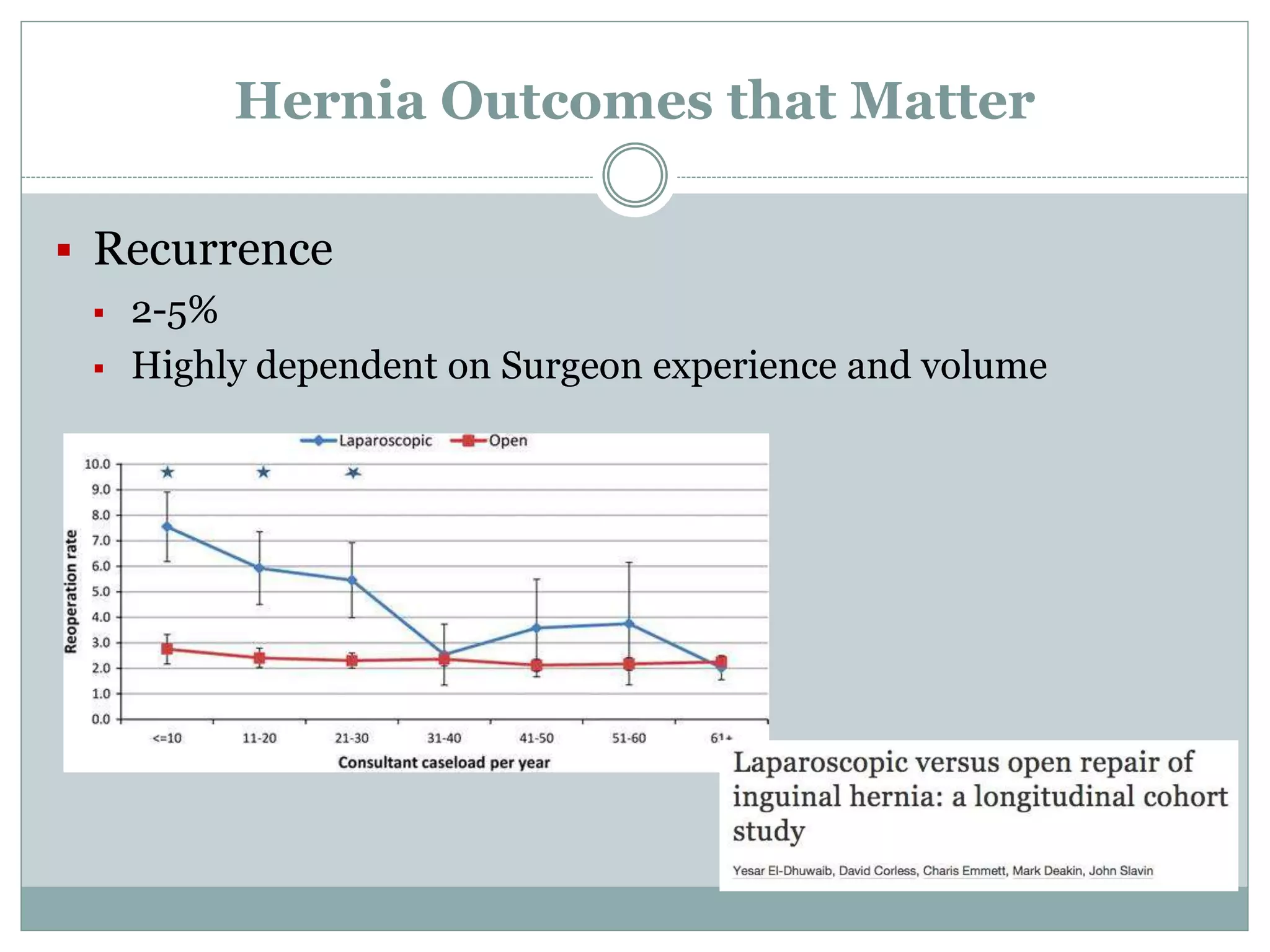
Hernia Outcomes that Matter
 Recurrence
 2-5%
 Highly dependent on Surgeon experience and volume
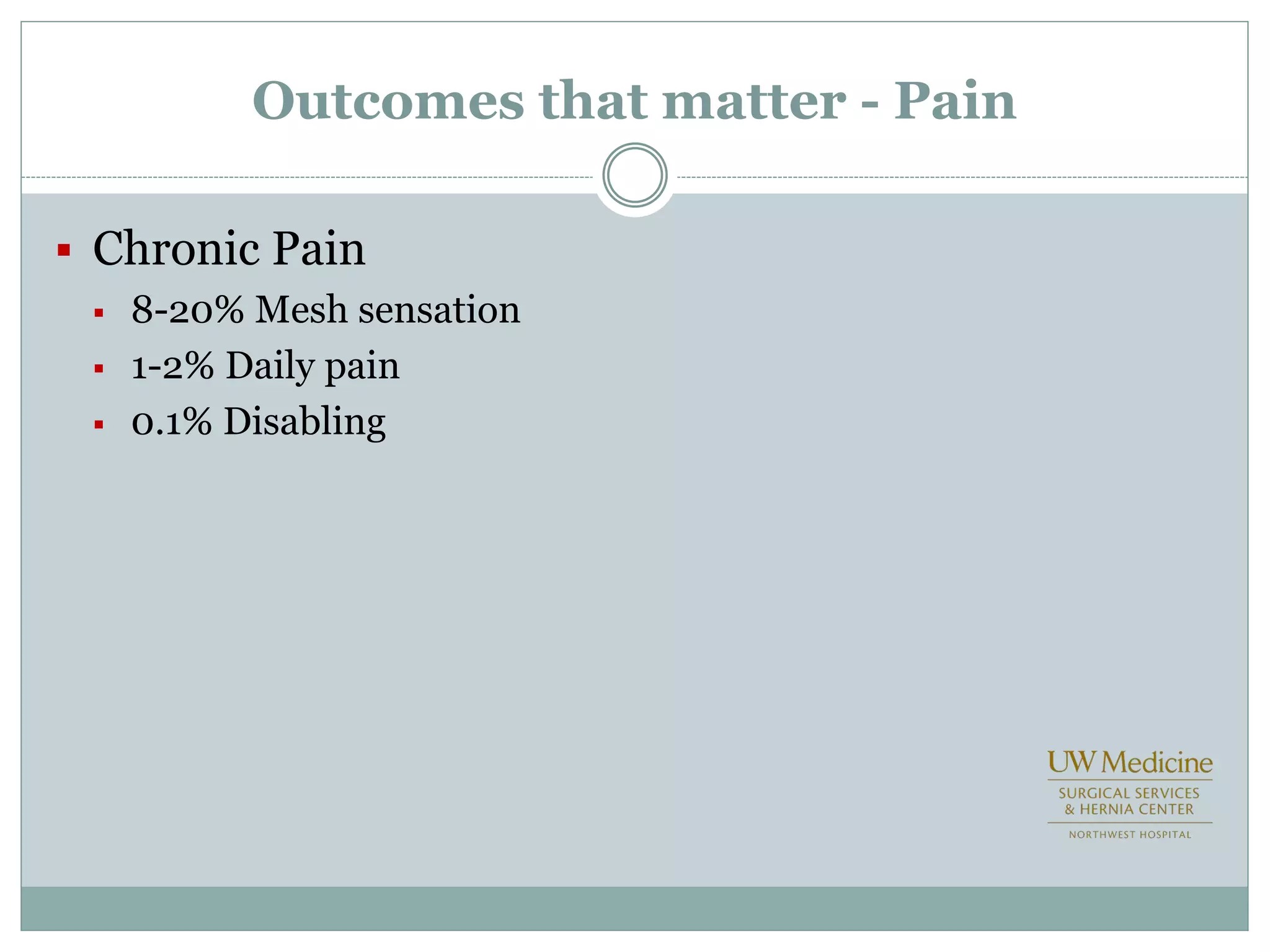
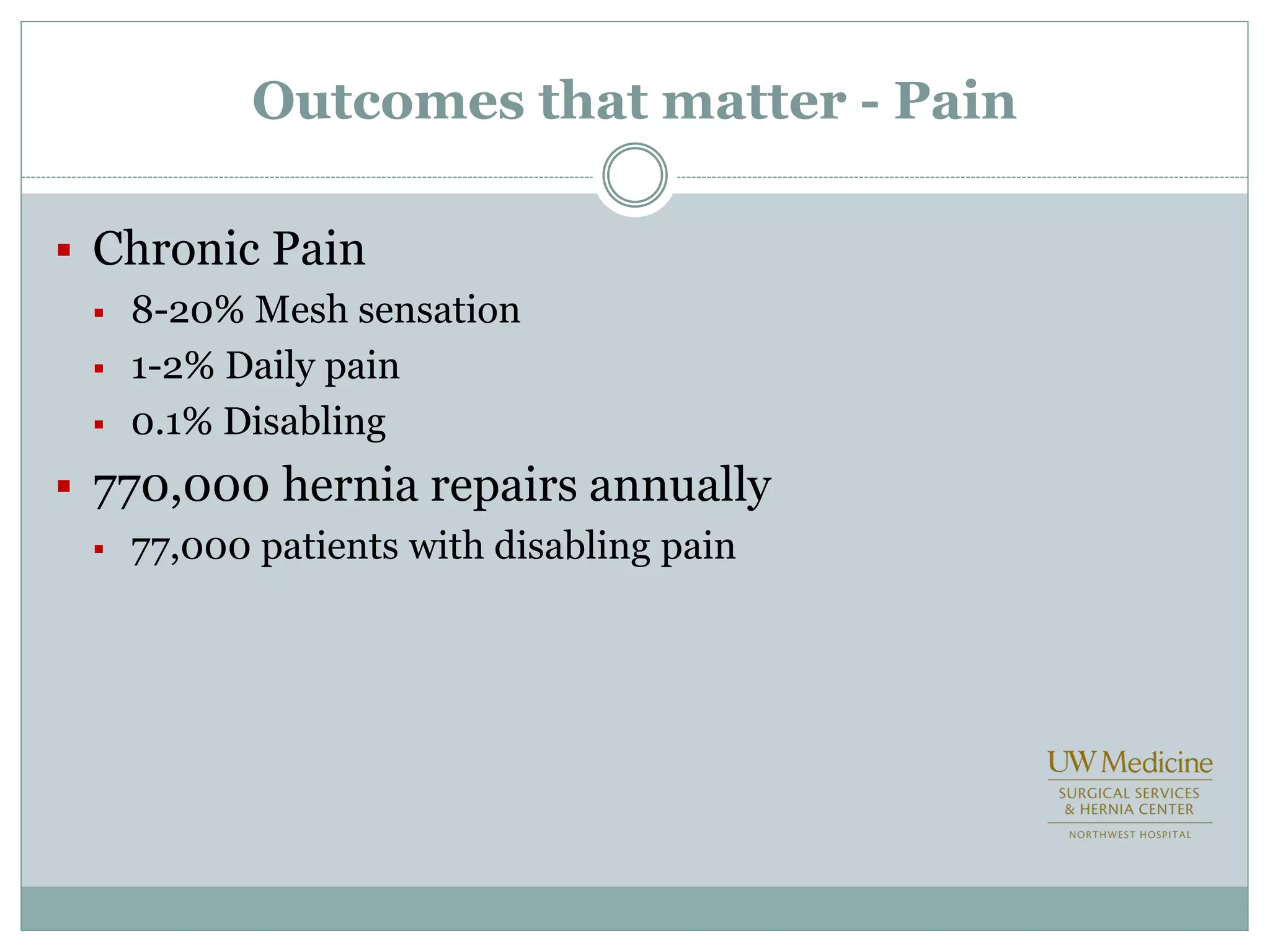
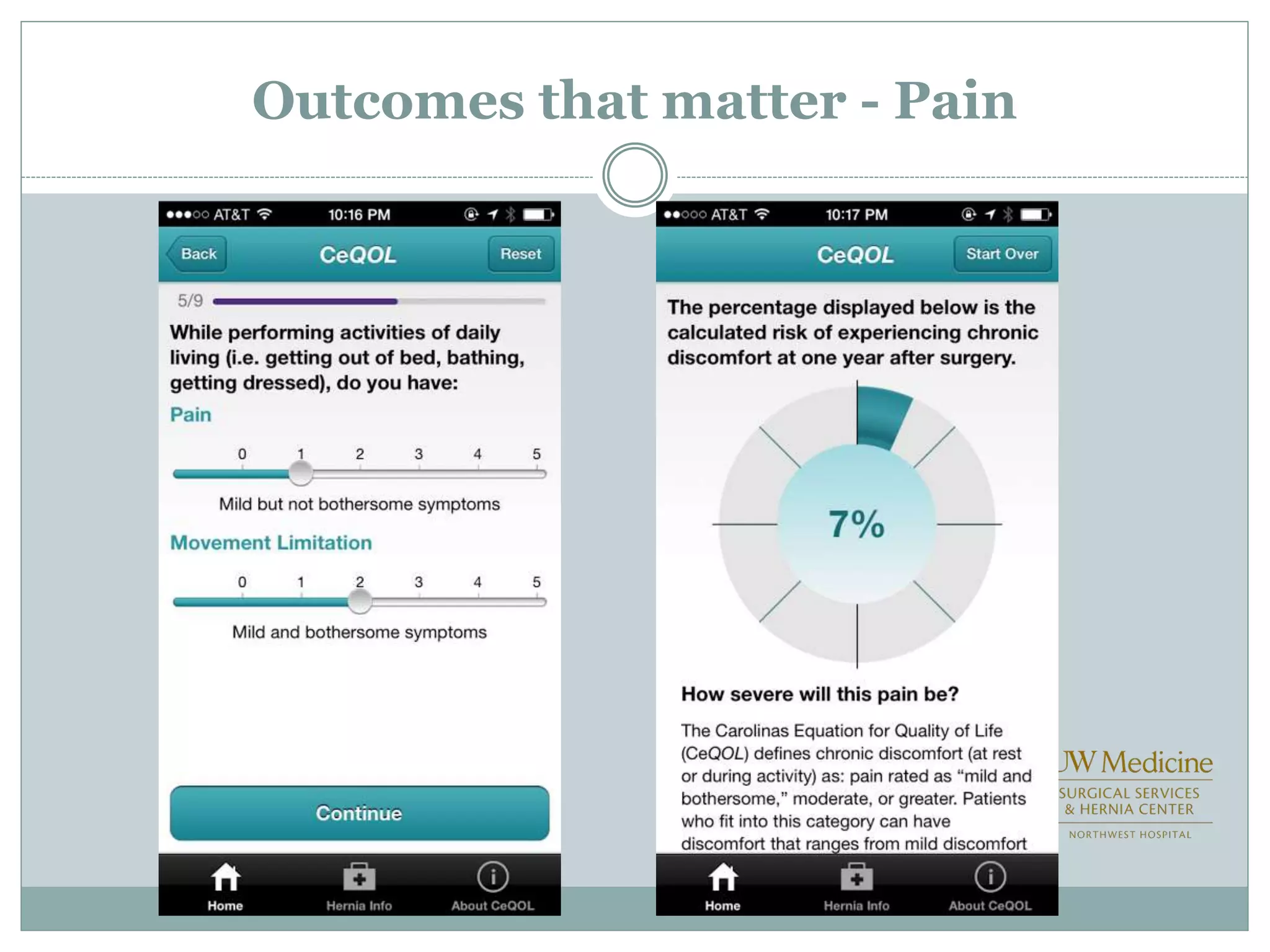
Outcomes that matter - Pain
 Chronic Pain
 8-20% Mesh sensation
 1-2% Daily pain
 0.1% Disabling
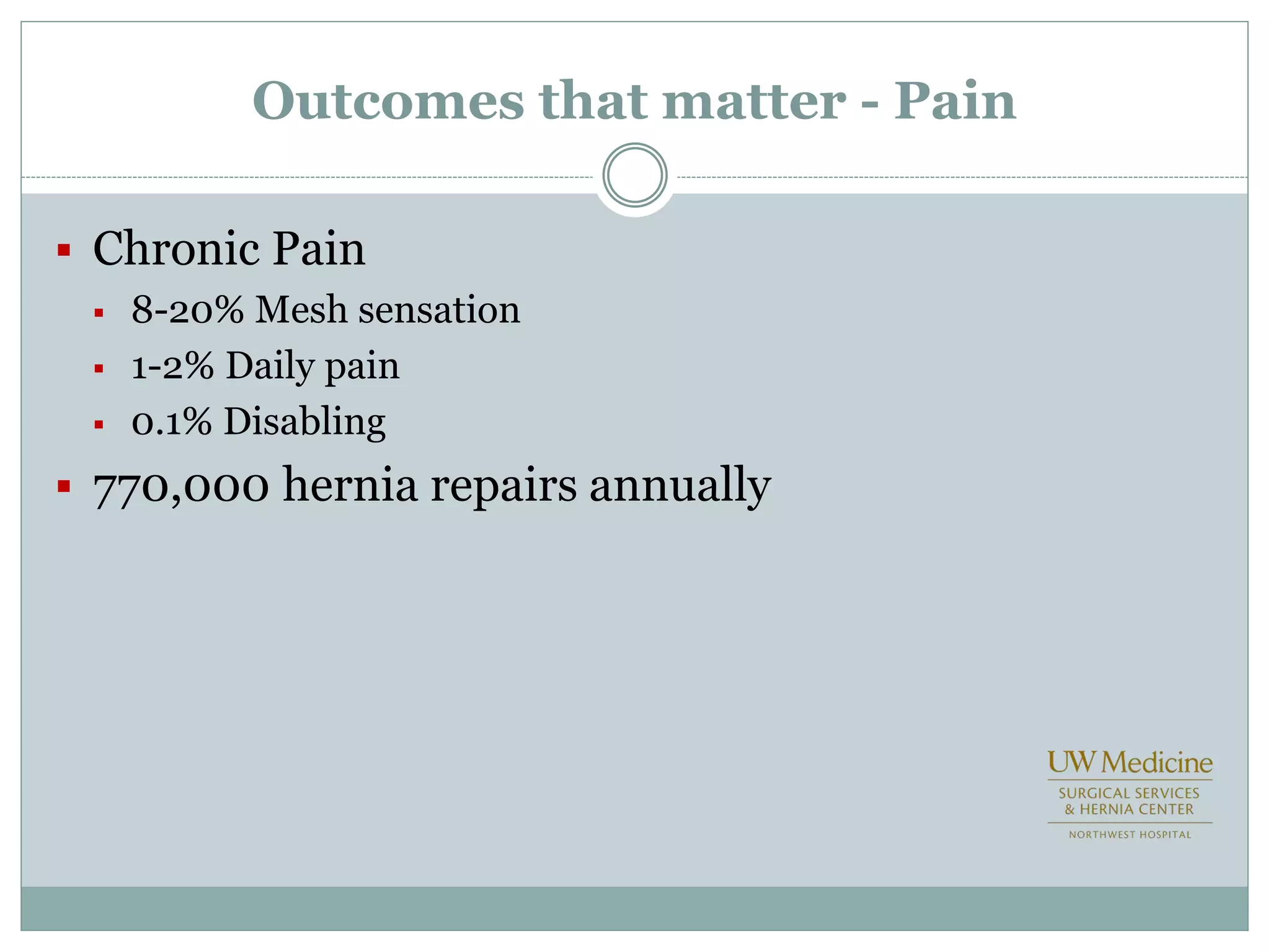
Outcomes that matter - Pain
 Chronic Pain
 8-20% Mesh sensation
 1-2% Daily pain
 0.1% Disabling
 770,000 hernia repairs annually
Outcomes that matter - Pain
 Chronic Pain
 8-20% Mesh sensation
 1-2% Daily pain
 0.1% Disabling
 770,000 hernia repairs annually
 77,000 patients with disabling pain
Outcomes that matter - Pain
Secondary Outcomes
 Cost
 OR time
 Return to work
 Cosmesis
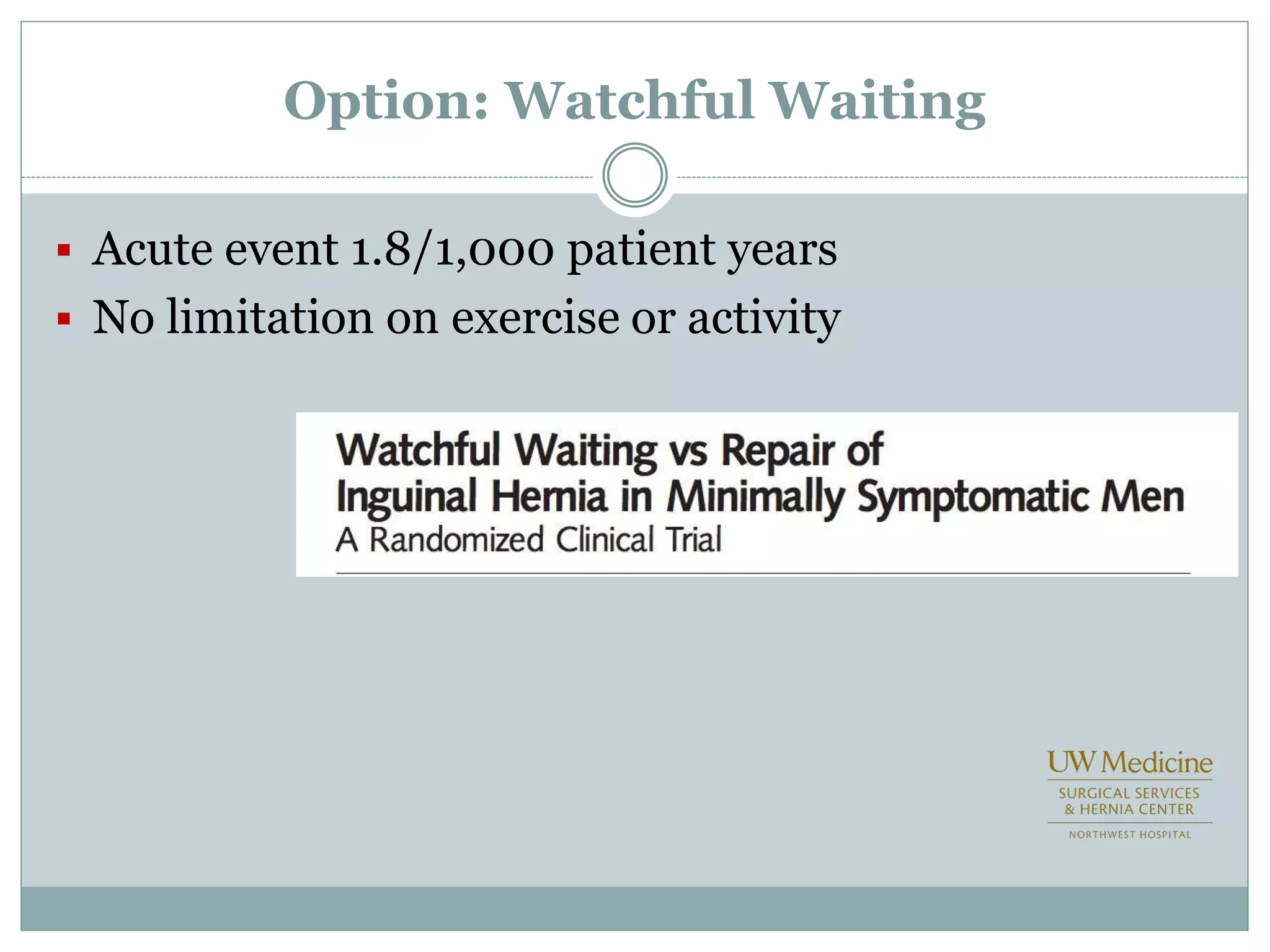
Option: Watchful Waiting
 Acute event 1.8/1,000 patient years
 No limitation on exercise or activity
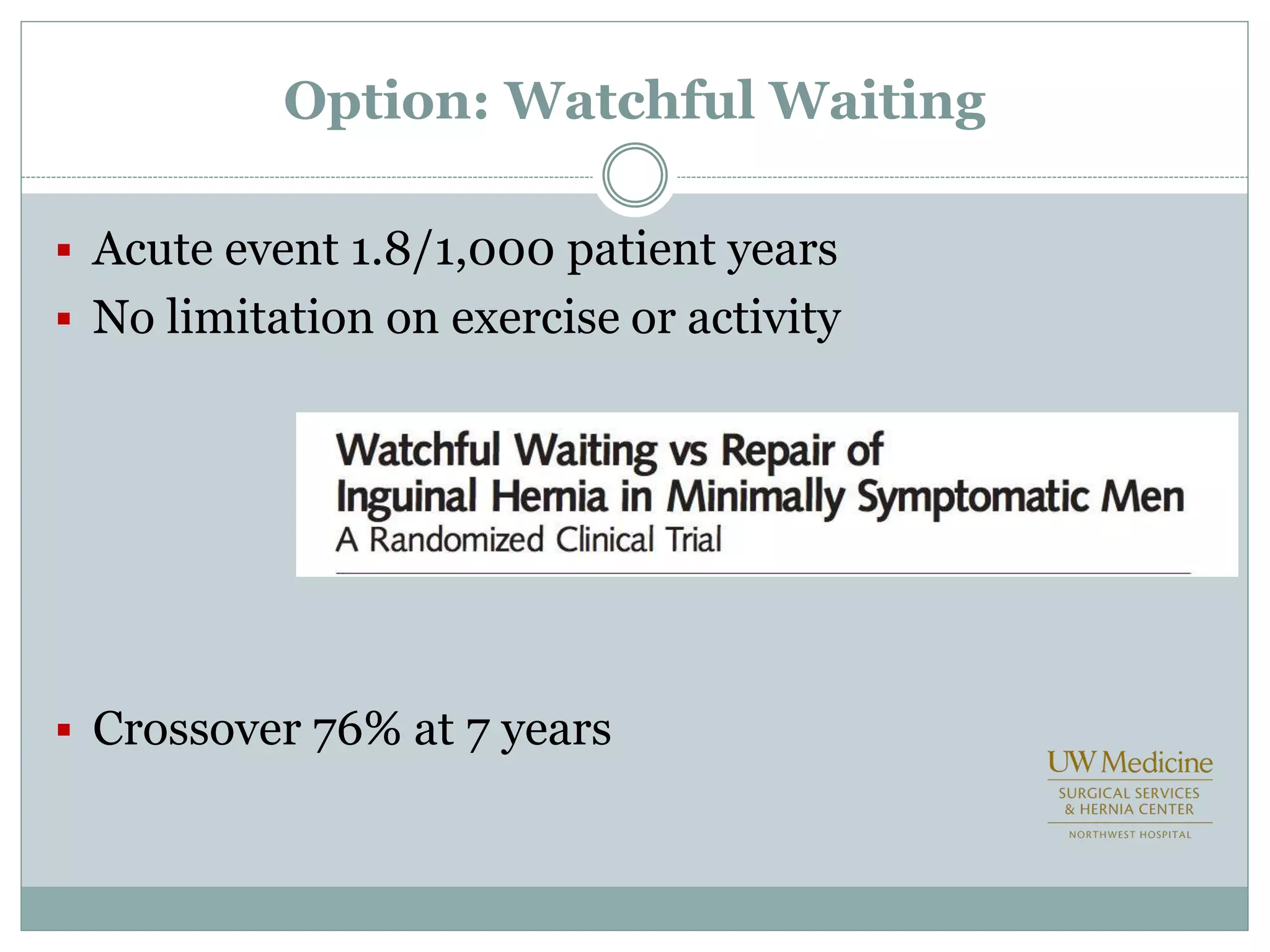
Option: Watchful Waiting
 Acute event 1.8/1,000 patient years
 No limitation on exercise or activity
 Crossover 76% at 7 years
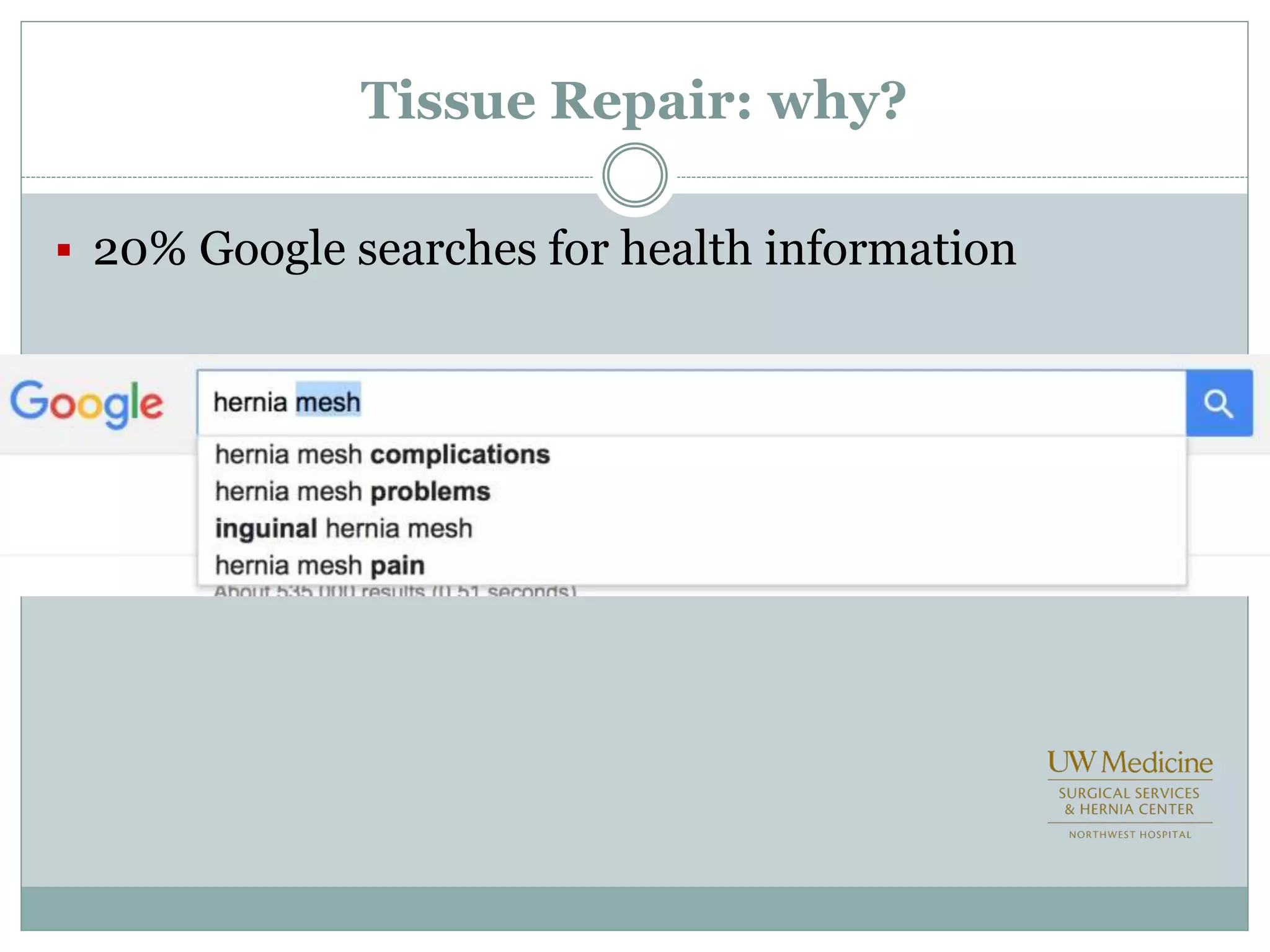
Tissue Repair: why?
 20% Google searches for health information
Tissue Repair: why?
 20% Google searches for health information
Tissue Repair: why?
 20% Google searches for health information
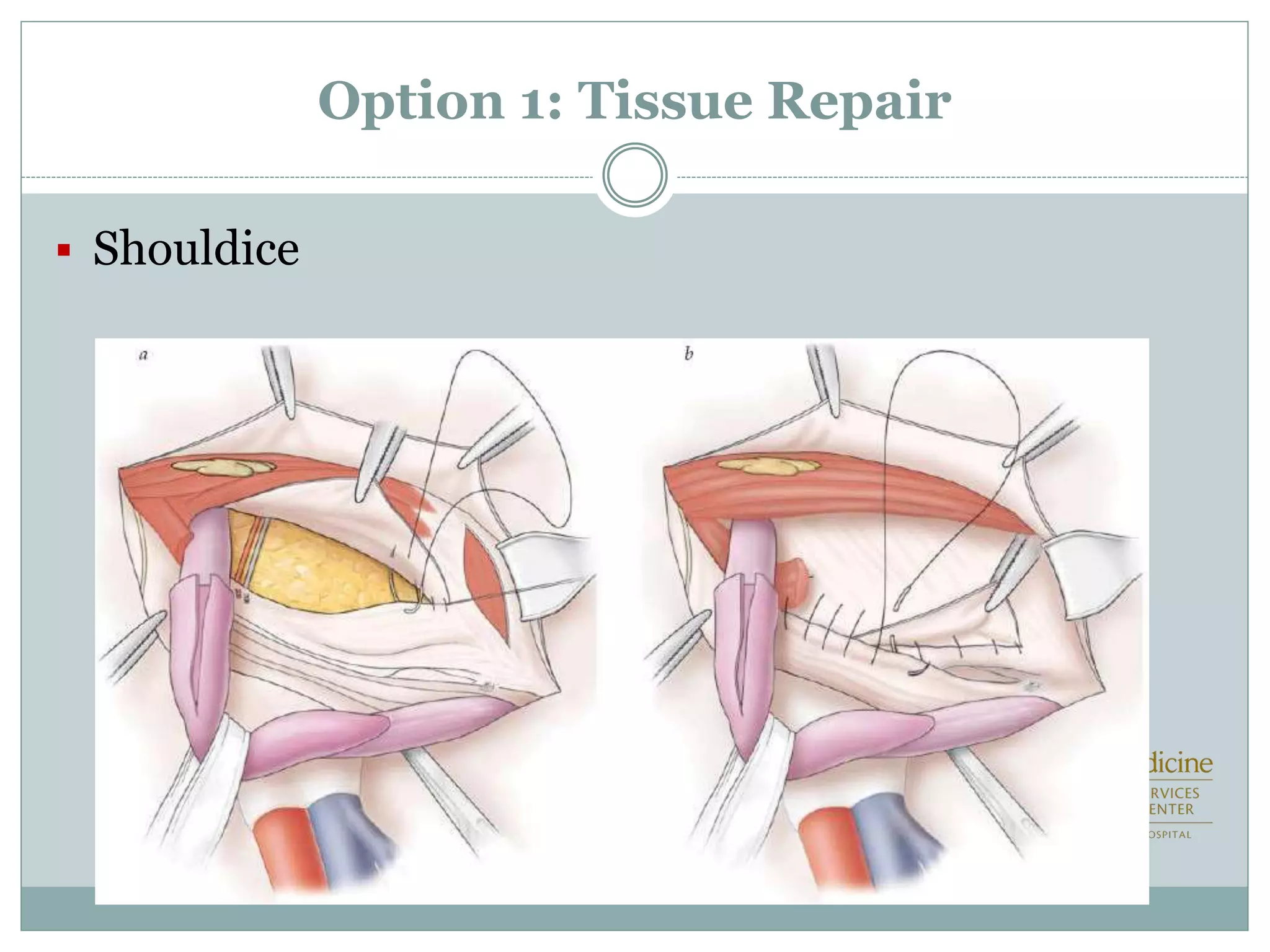
Option 1: Tissue Repair
 Shouldice
 Shouldice
 Highly selected patient
 Technical and operator dependent
 Shouldice
 Cochrane review 2012 Shouldice vs. other open tissue repairs
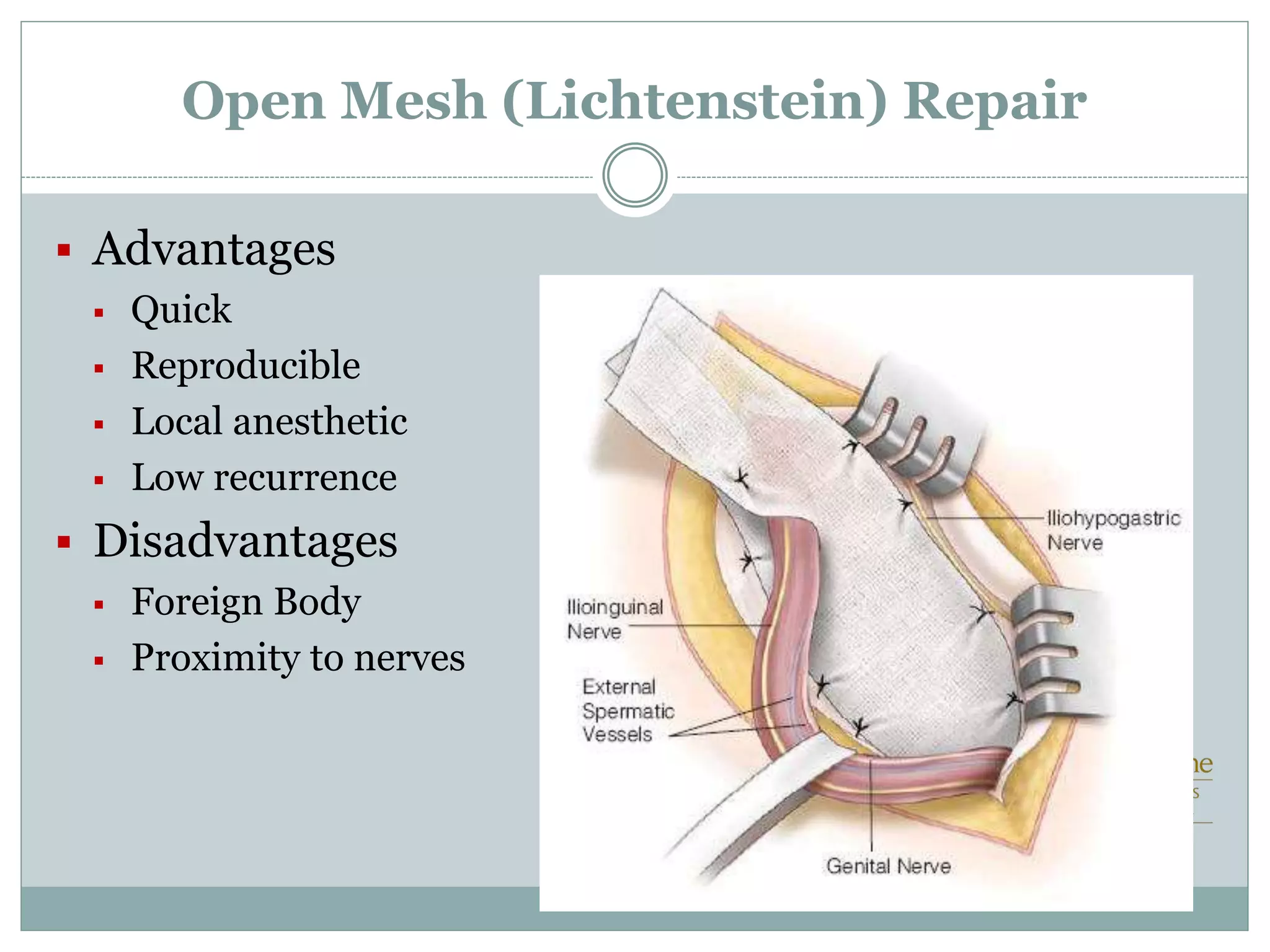
Open Mesh (Lichtenstein) Repair
 Advantages
 Quick
 Reproducible
 Local anesthetic
 Low recurrence
 Disadvantages
 Foreign Body
 Proximity to nerves
 Shouldice
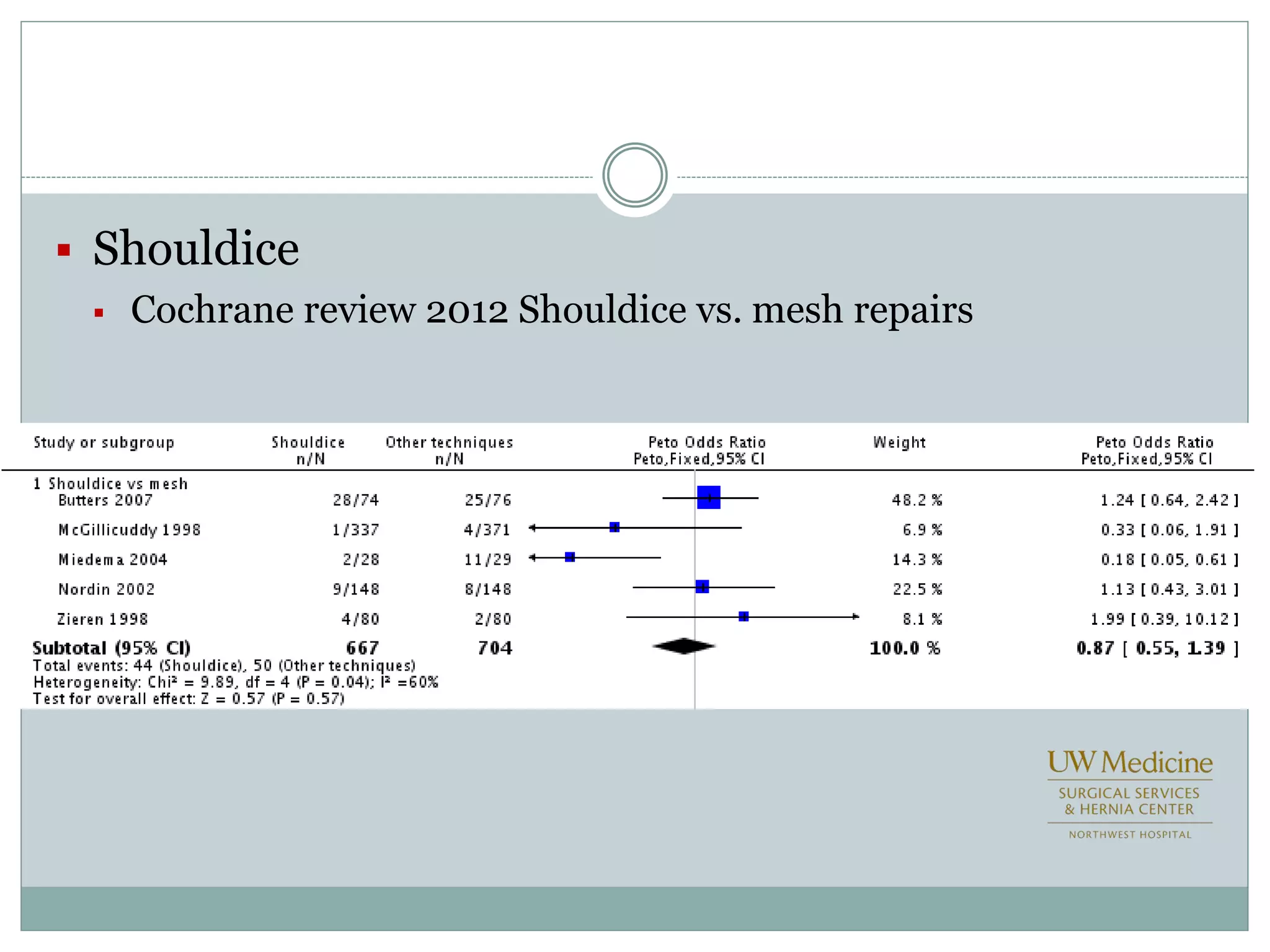
 Cochrane review 2012 Shouldice vs. mesh repairs
 Shouldice
 Cochrane review 2012 Shouldice vs. mesh repairs
No decrease in chronic pain in Shouldice vs.
Lichtenstein
Types of hernia repair
 Open Tissue
 High Ligation
 Bassini
 McVay
 Halstead
 Shouldice
 Desarda
 Marcy
 Open Anterior Repair
 Lichtenstein
 Modified Lichtenstein
 Open Posterior Repair
 Plug
 OnStep
 Stoppa
 Open Hybrid repair
 Plug/patch
 PHS/UHS
 Lap Repair
 TEP
 TAPP
 rTAPP
 eTEP
 IPOM
Lichtenstein Repair is Gold Standard
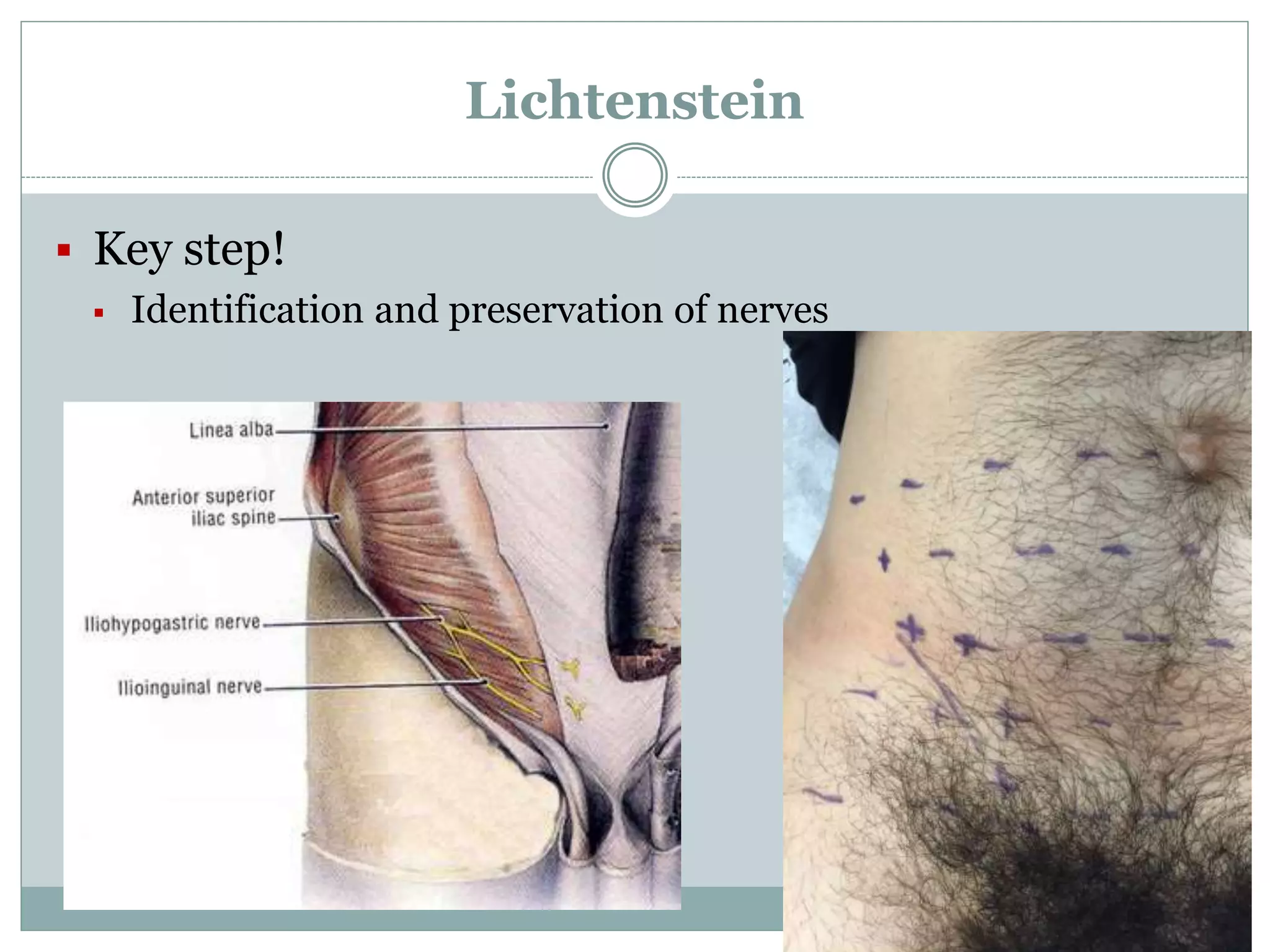
Lichtenstein
 Key step!
 Identification and preservation of nerves
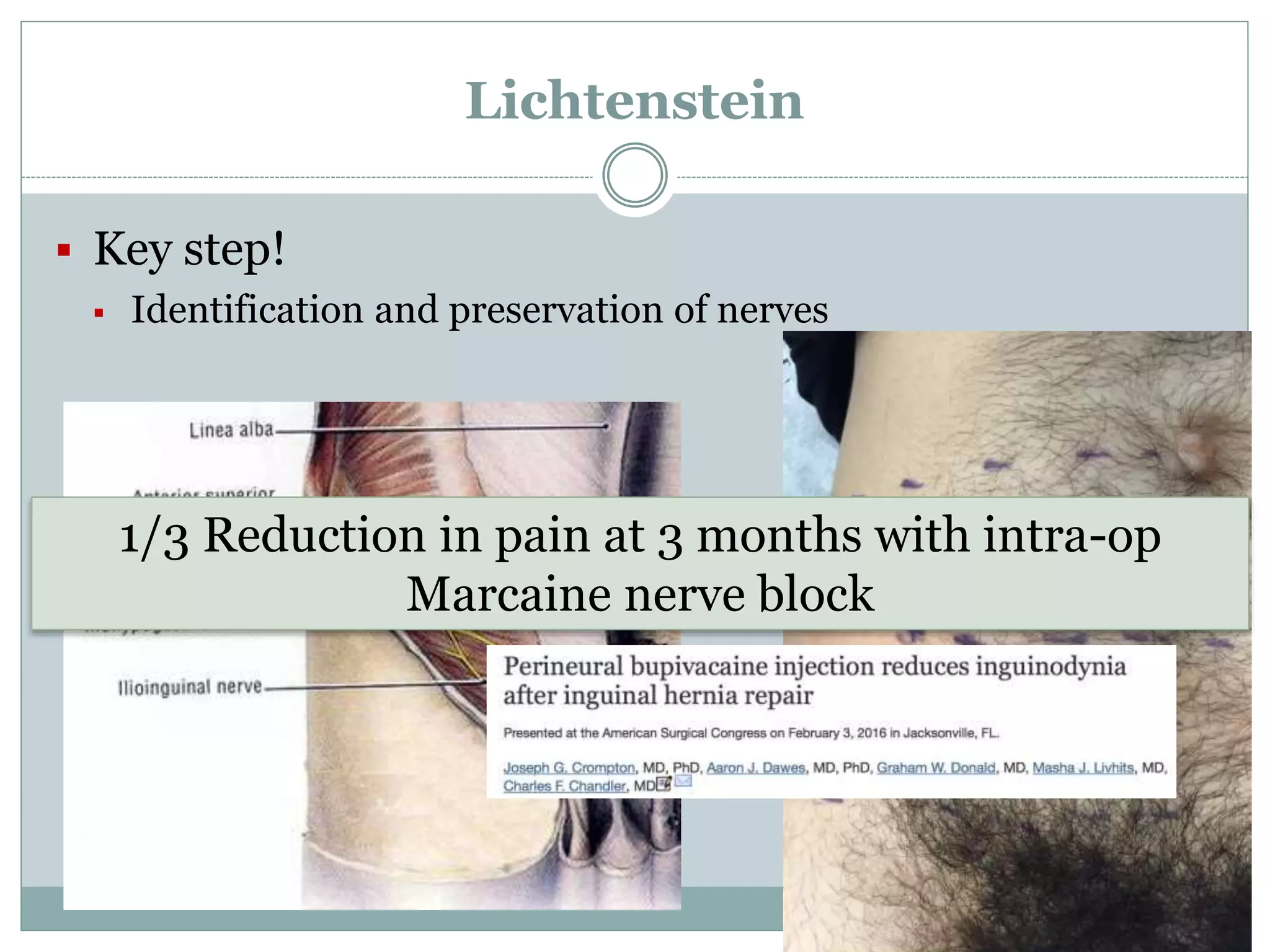
Lichtenstein
 Key step!
 Identification and preservation of nerves
1/3 Reduction in pain at 3 months with intra-op
Marcaine nerve block
Lichtenstein modifications
 no-suture glue technique (TIMELI trial)
 Significant reduction in disabling pain
 No difference in recurrence
ProGrip
ProGrip mesh
Progrip
 Potential benefits
 Reduced risk of nerve injury
 Faster OR time
 Potential disadvantages
 Increased cost
 Increased inflammatory reaction
 Several single center RCTs
 Underpowered
 No difference in chronic pain or recurrence
 Possible increase in foreign body sensation
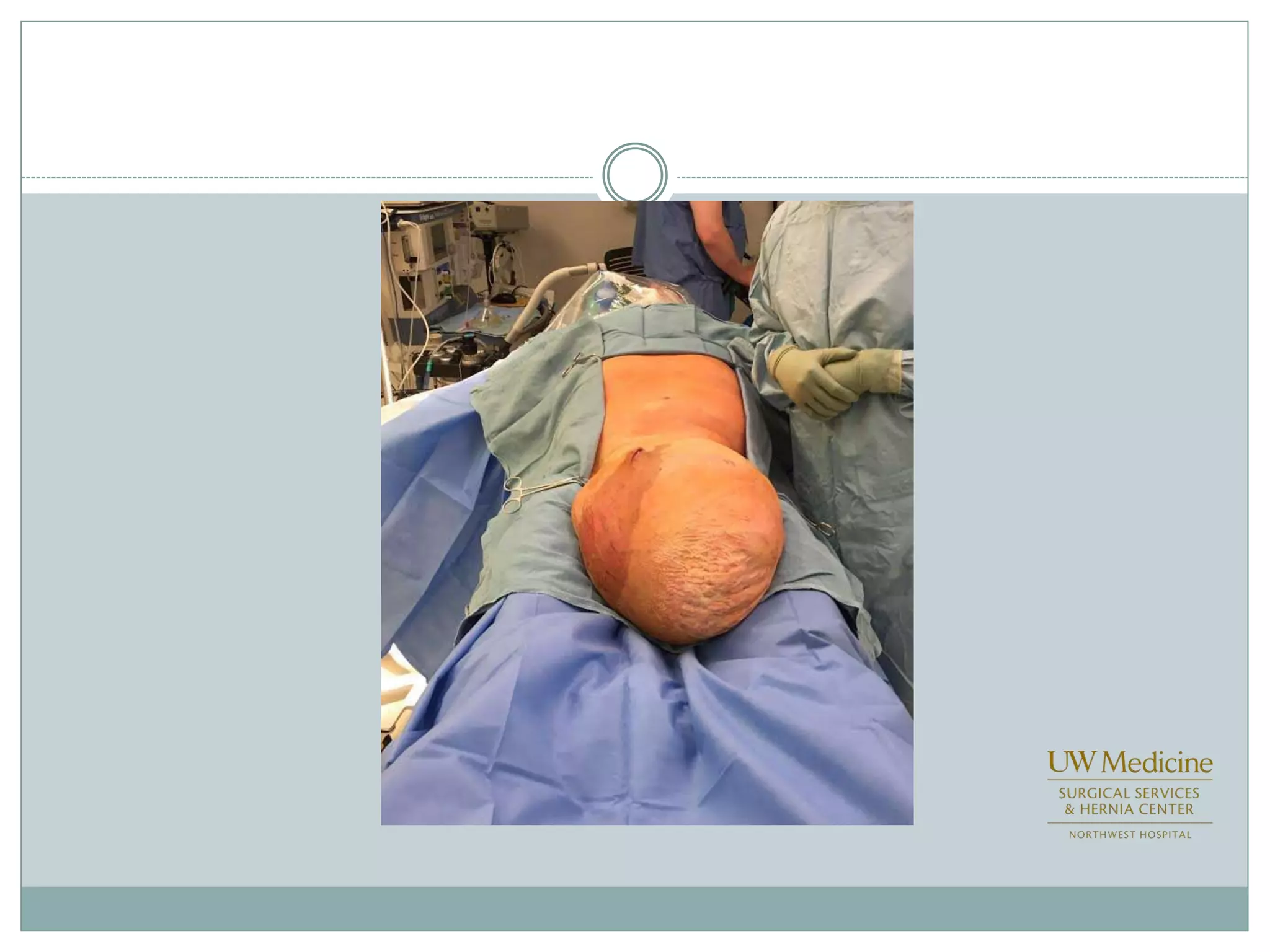
Options: Open Preperitoneal Groin
 Mesh Plug
 PHS – Prolene Hernia System
 UHS
 ONSTEP
 Insightra
 Kugel
 TREPP (transrectus preperitoneal)
Outcomes of open preperitoneal repair
 Most proprietary systems lacking data
 3 year outcomes no different than standard
Lichtenstein
My Recs
 Open preperitoneal repairs burn bridges
 Plug migration
 Meshoma
 No evidence that any proprietary system better than
Lichtenstein
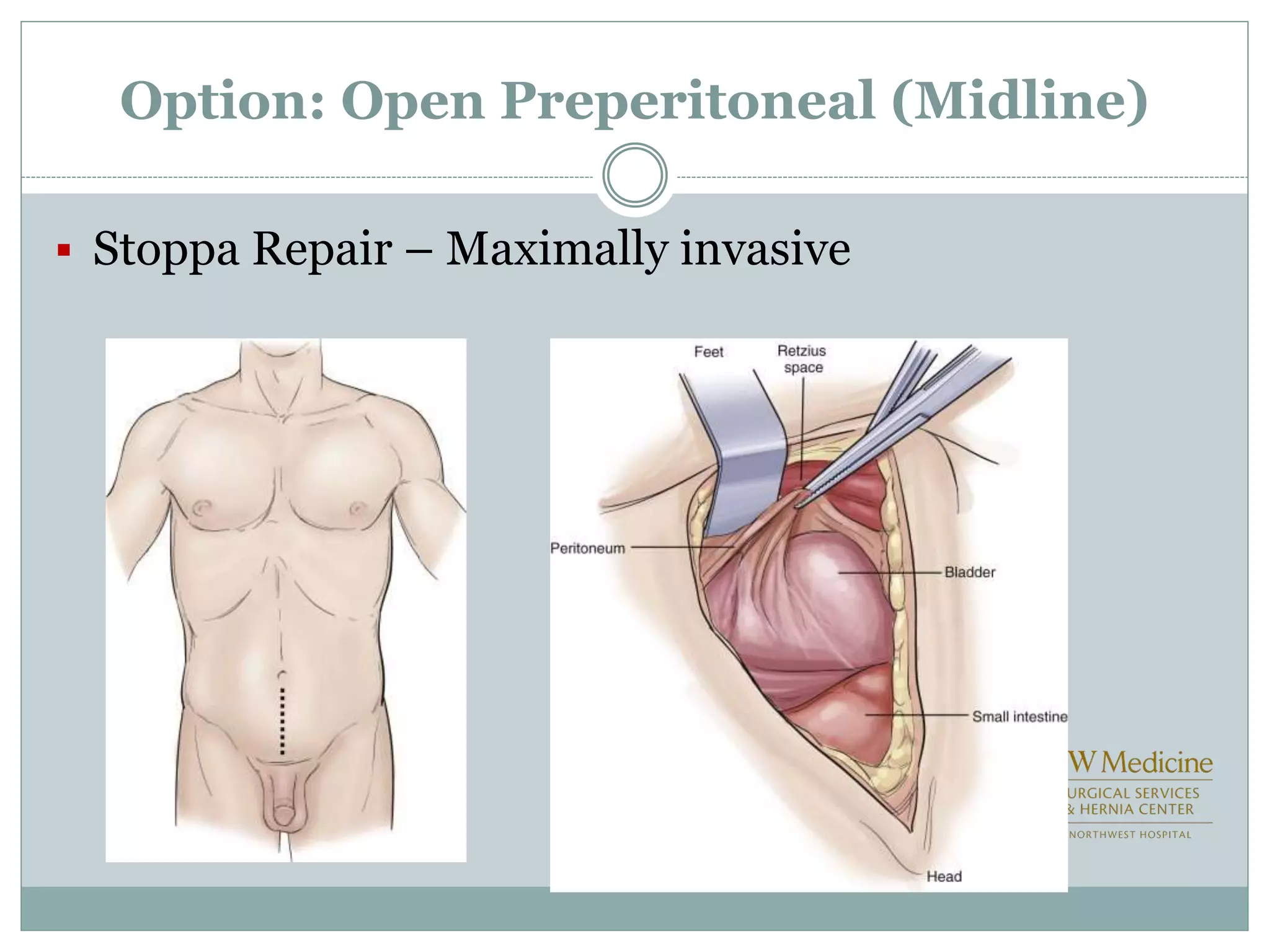
Option: Open Preperitoneal (Midline)
 Stoppa Repair – Maximally invasive
Stoppa Repair
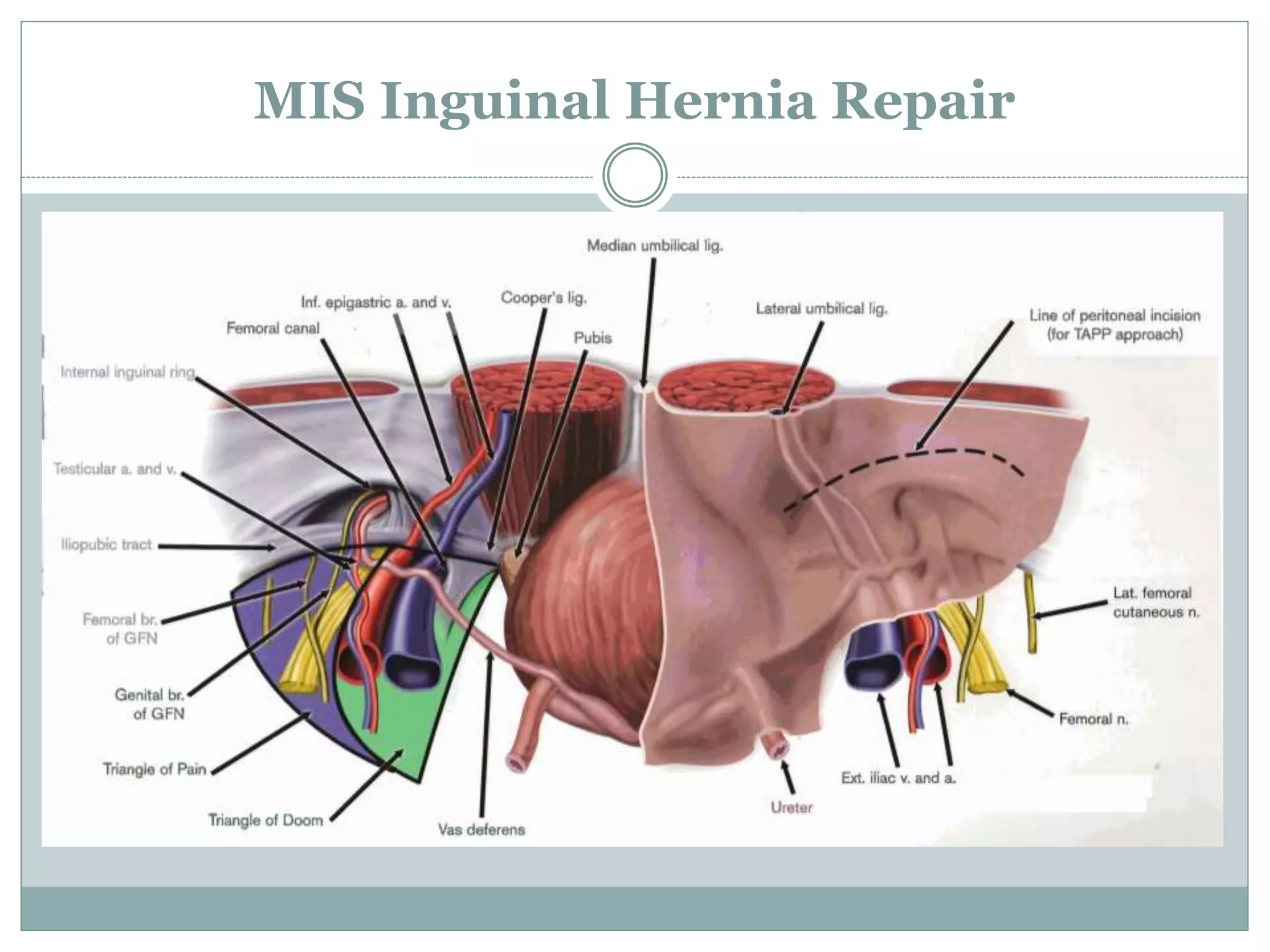
MIS Inguinal Hernia Repair
Laparoscopic Repair
 Advantages
 Less short term and chronic pain, Faster Recovery
 Address bilateral hernias, femoral hernias
 Avoid ilioinguinal and iliohypogastric nerves
Laparoscopic Repair
 Disadvantages
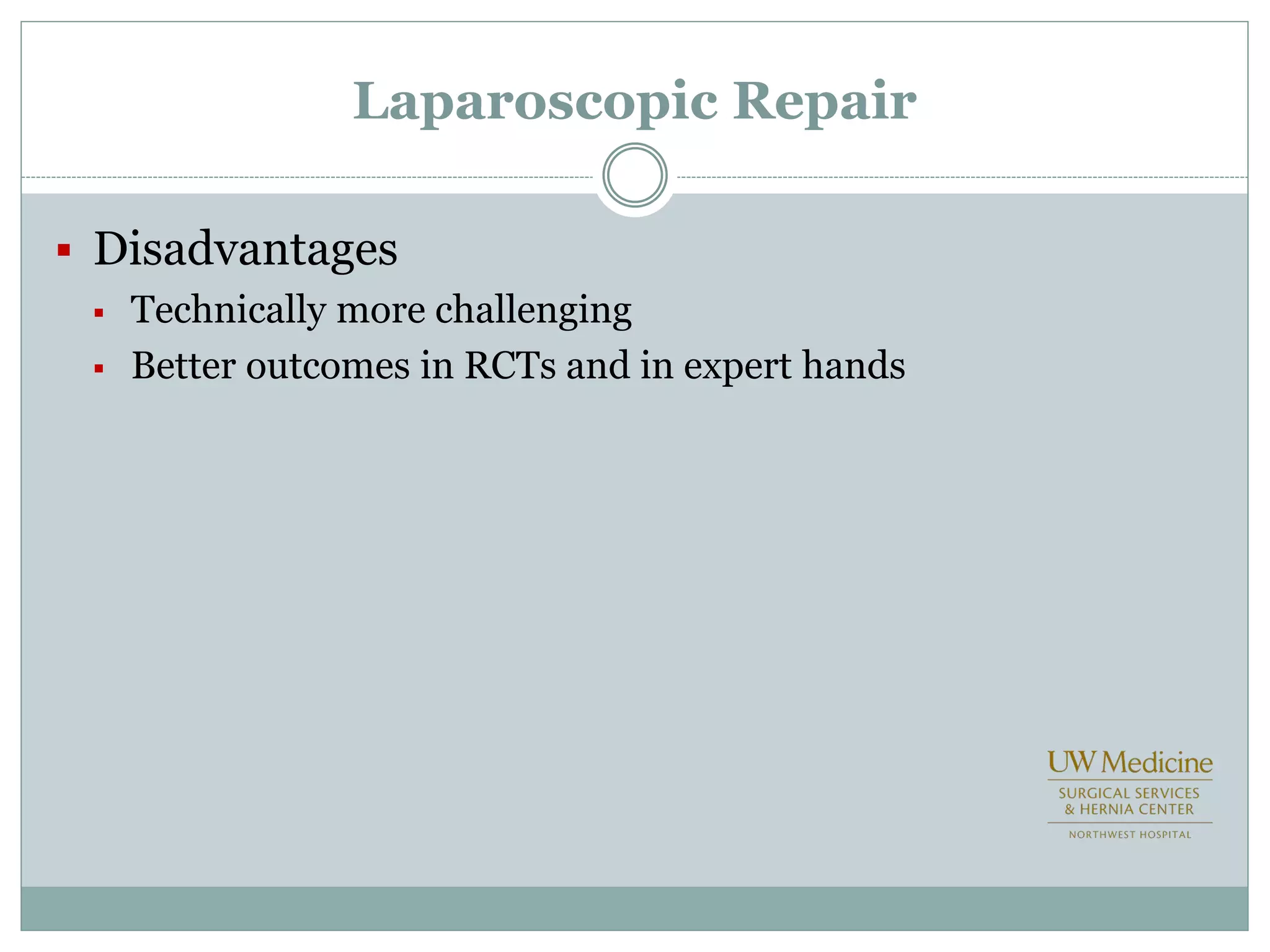
 Technically more challenging
 Better outcomes in RCTs and in expert hands
Lap vs Open: What Does the Data Say?
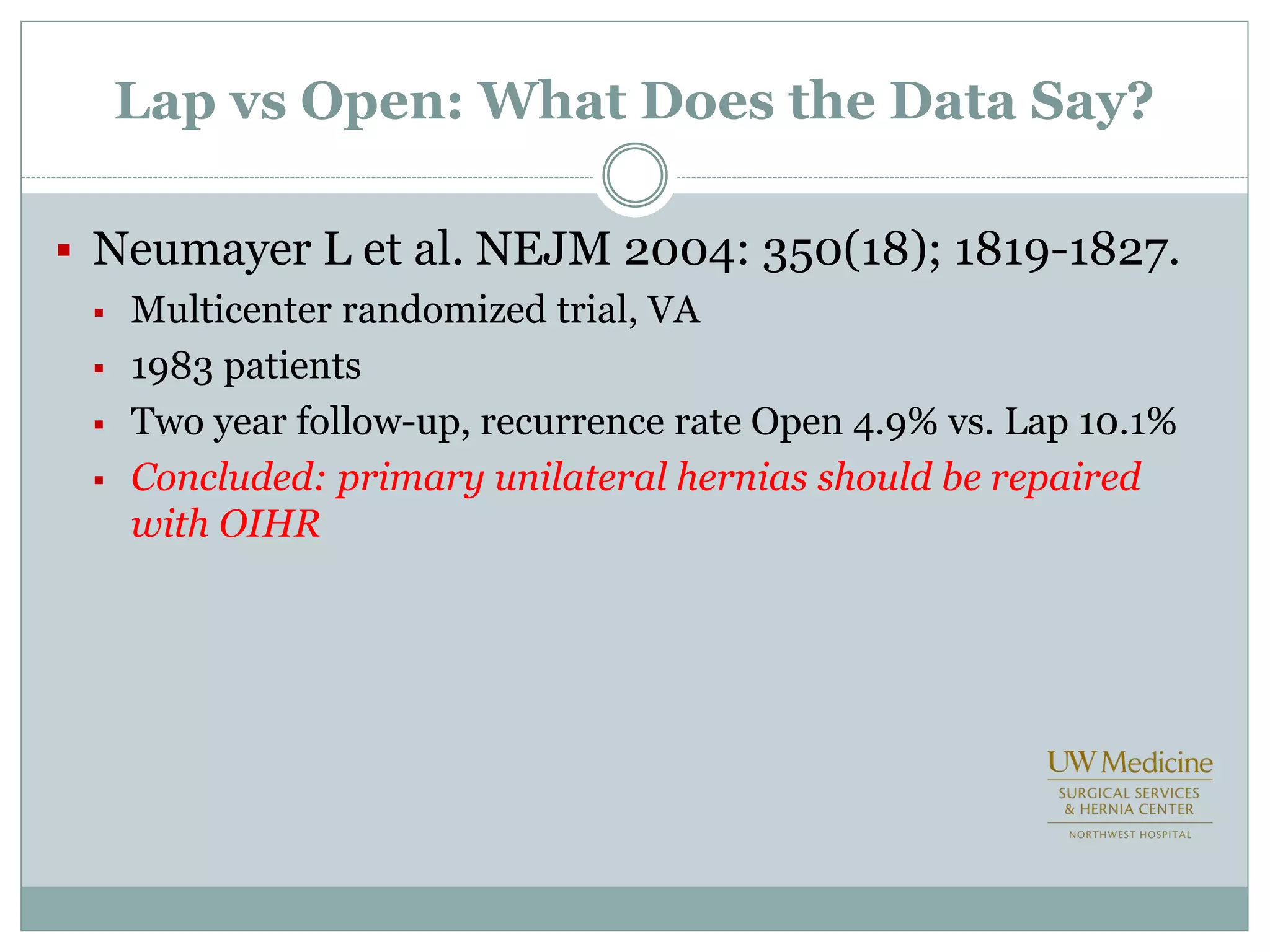
 Neumayer L et al. NEJM 2004: 350(18); 1819-1827.
 Multicenter randomized trial, VA
 1983 patients
 Two year follow-up, recurrence rate Open 4.9% vs. Lap 10.1%
Lap vs Open: What Does the Data Say?
 Neumayer L et al. NEJM 2004: 350(18); 1819-1827.
 Multicenter randomized trial, VA
 1983 patients
 Two year follow-up, recurrence rate Open 4.9% vs. Lap 10.1%
 Concluded: primary unilateral hernias should be repaired
with OIHR
Lap vs Open: What Does the Data Say?
 Neumayer L et al. NEJM 2004: 350(18); 1819-1827.
 Multicenter randomized trial, VA
 1983 patients
 Two year follow-up, recurrence rate Open 4.9% vs. Lap 10.1%
 Concluded: primary unilateral hernias should be repaired
with OIHR
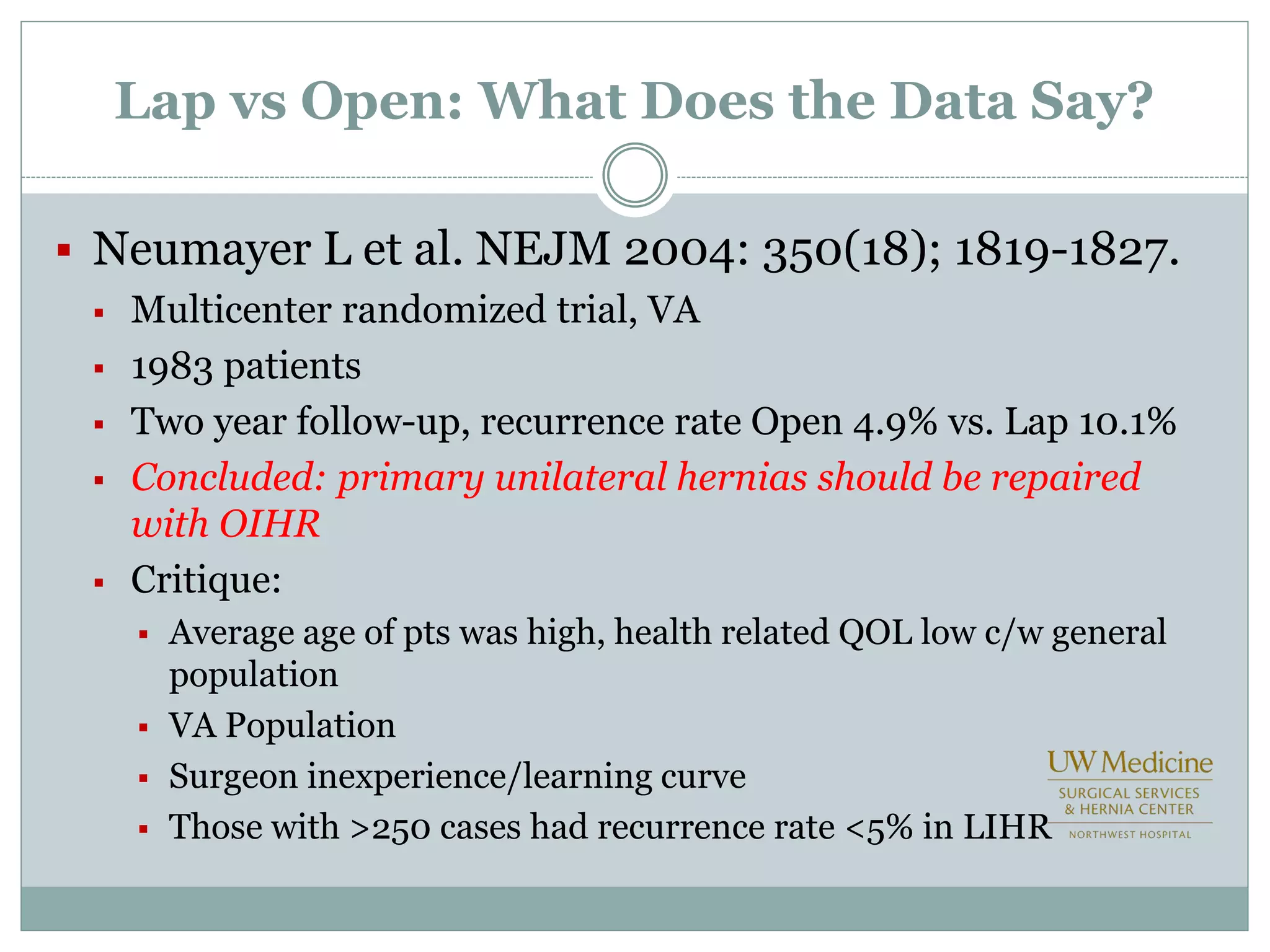
 Critique:
 Average age of pts was high, health related QOL low c/w general
population
 VA Population
 Surgeon inexperience/learning curve
 Those with >250 cases had recurrence rate <5% in LIHR
Lap vs Open Inguinal Hernia
 Kouhia STH et al. Ann Surg 2009; 249(3): 384-387
 90 patients randomized
 6.4% recurrence in OIHR vs. 0% for TEP (ns)
 Higher incidence of chronic pain in OIHR group
 TEP group with less analgesic requirement and shorter return
to work
META-ANALYSIS
RANDOMIZED CLINICAL TRIALS
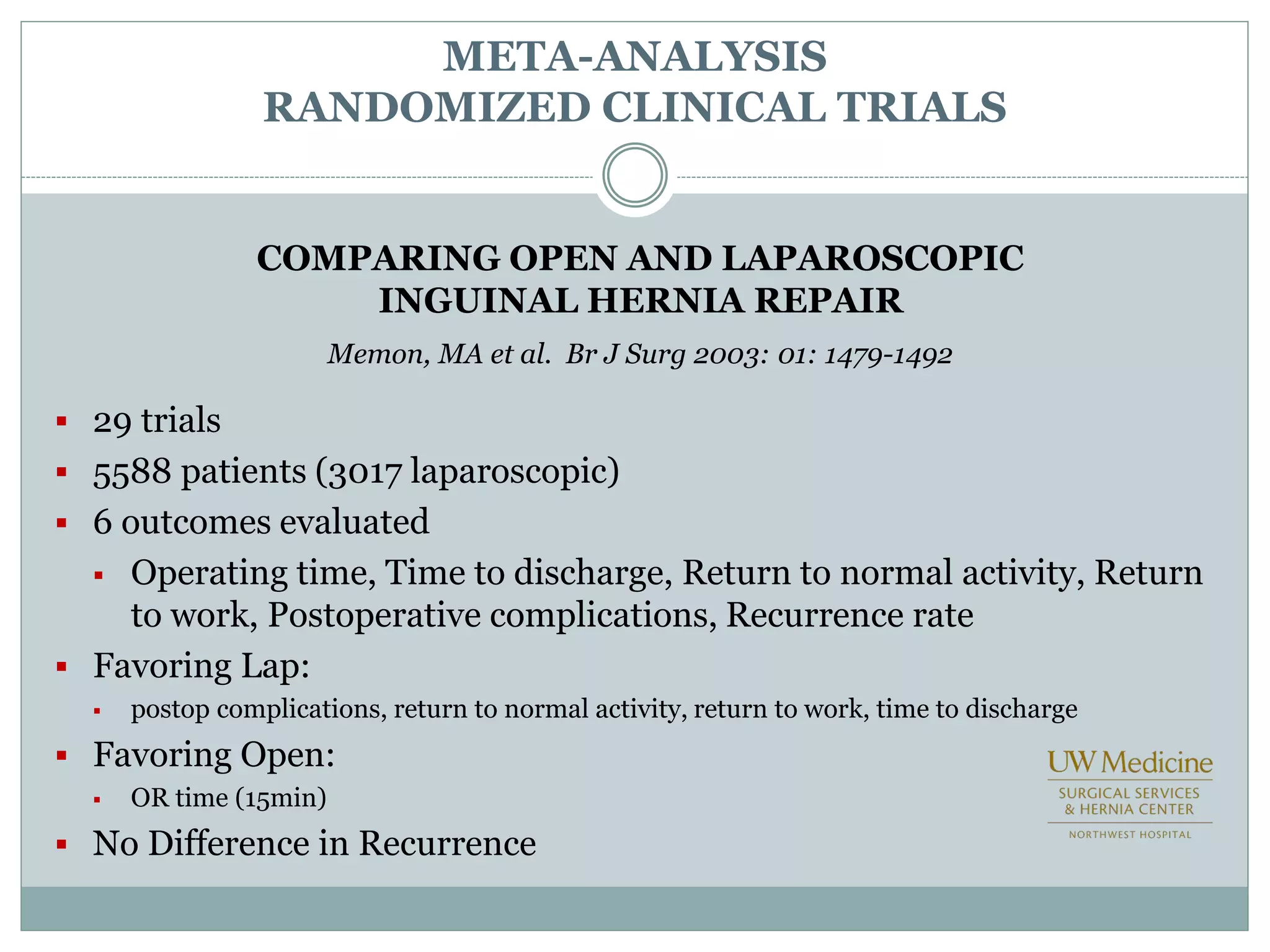
 29 trials
 5588 patients (3017 laparoscopic)
 6 outcomes evaluated
 Operating time, Time to discharge, Return to normal activity, Return
to work, Postoperative complications, Recurrence rate
 Favoring Lap:
 postop complications, return to normal activity, return to work, time to discharge
 Favoring Open:
 OR time (15min)
 No Difference in Recurrence
Memon, MA et al. Br J Surg 2003: 01: 1479-1492
COMPARING OPEN AND LAPAROSCOPIC
INGUINAL HERNIA REPAIR
Hernia Outcomes that Matter
 Recurrence
 2-5%
 Highly dependent on Surgeon experience and volume
Lap vs. Open
Lap
 Less Pain
 Faster Recovery
 Bilateral and Recurrent
 More operator
dependant
Open
 Easier to learn
 Reproducible
 Good results
Make a choice, don’t reserve lap for bilaterals and recurrence or you will never
overcome the learning curve
Questions?
awright2@uw.edu
Twitter: @andrewswright

Laparoscopic vs Open Inguinal Hernia repair

  • 1.
    ANDREW S. WRIGHTMD DIRECTOR, UW MEDICINE HERNIA CENTER TWITTER: @ANDREWSWRIGHT EMAIL: AWRIGHT2@UW.EDU Open vs. MIS Inguinal Hernia
  • 4.
    Types of herniarepair  Open Tissue  High Ligation  Bassini  McVay  Halstead  Shouldice  Desarda  Marcy  Open Anterior Repair  Lichtenstein  Modified Lichtenstein  Open Posterior Repair  Plug  OnStep  Stoppa  Open Hybrid repair  Plug/patch  PHS/UHS  Lap Repair  TEP  TAPP  rTAPP  eTEP  IPOM
  • 5.
    Types of herniarepair  Open Tissue  High Ligation  Bassini  McVay  Halstead  Shouldice  Desarda  Marcy  Open Anterior Repair  Lichtenstein  Modified Lichtenstein  Open Posterior Repair  Plug  OnStep  Stoppa  Open Hybrid repair  Plug/patch  PHS/UHS  Lap Repair  TEP  TAPP  rTAPP  eTEP  IPOM Lichtenstein Repair is Gold Standard
  • 6.
     Not allhernias are the same!
  • 7.
     Not allhernias are the same!
  • 8.
  • 9.
    Hernia Outcomes thatMatter  Recurrence  2-5%  Highly dependent on Surgeon experience and volume
  • 10.
    Outcomes that matter- Pain  Chronic Pain  8-20% Mesh sensation  1-2% Daily pain  0.1% Disabling
  • 11.
    Outcomes that matter- Pain  Chronic Pain  8-20% Mesh sensation  1-2% Daily pain  0.1% Disabling  770,000 hernia repairs annually
  • 12.
    Outcomes that matter- Pain  Chronic Pain  8-20% Mesh sensation  1-2% Daily pain  0.1% Disabling  770,000 hernia repairs annually  77,000 patients with disabling pain
  • 13.
  • 14.
    Secondary Outcomes  Cost OR time  Return to work  Cosmesis
  • 15.
    Option: Watchful Waiting Acute event 1.8/1,000 patient years  No limitation on exercise or activity
  • 16.
    Option: Watchful Waiting Acute event 1.8/1,000 patient years  No limitation on exercise or activity  Crossover 76% at 7 years
  • 17.
    Tissue Repair: why? 20% Google searches for health information
  • 18.
    Tissue Repair: why? 20% Google searches for health information
  • 19.
    Tissue Repair: why? 20% Google searches for health information
  • 20.
    Option 1: TissueRepair  Shouldice
  • 21.
     Shouldice  Highlyselected patient  Technical and operator dependent
  • 22.
     Shouldice  Cochranereview 2012 Shouldice vs. other open tissue repairs
  • 23.
    Open Mesh (Lichtenstein)Repair  Advantages  Quick  Reproducible  Local anesthetic  Low recurrence  Disadvantages  Foreign Body  Proximity to nerves
  • 24.
     Shouldice  Cochranereview 2012 Shouldice vs. mesh repairs
  • 25.
     Shouldice  Cochranereview 2012 Shouldice vs. mesh repairs No decrease in chronic pain in Shouldice vs. Lichtenstein
  • 26.
    Types of herniarepair  Open Tissue  High Ligation  Bassini  McVay  Halstead  Shouldice  Desarda  Marcy  Open Anterior Repair  Lichtenstein  Modified Lichtenstein  Open Posterior Repair  Plug  OnStep  Stoppa  Open Hybrid repair  Plug/patch  PHS/UHS  Lap Repair  TEP  TAPP  rTAPP  eTEP  IPOM Lichtenstein Repair is Gold Standard
  • 27.
    Lichtenstein  Key step! Identification and preservation of nerves
  • 28.
    Lichtenstein  Key step! Identification and preservation of nerves 1/3 Reduction in pain at 3 months with intra-op Marcaine nerve block
  • 29.
    Lichtenstein modifications  no-sutureglue technique (TIMELI trial)  Significant reduction in disabling pain  No difference in recurrence
  • 30.
  • 31.
  • 32.
    Progrip  Potential benefits Reduced risk of nerve injury  Faster OR time  Potential disadvantages  Increased cost  Increased inflammatory reaction  Several single center RCTs  Underpowered  No difference in chronic pain or recurrence  Possible increase in foreign body sensation
  • 33.
    Options: Open PreperitonealGroin  Mesh Plug  PHS – Prolene Hernia System  UHS  ONSTEP  Insightra  Kugel  TREPP (transrectus preperitoneal)
  • 34.
    Outcomes of openpreperitoneal repair  Most proprietary systems lacking data  3 year outcomes no different than standard Lichtenstein
  • 35.
    My Recs  Openpreperitoneal repairs burn bridges  Plug migration  Meshoma  No evidence that any proprietary system better than Lichtenstein
  • 37.
    Option: Open Preperitoneal(Midline)  Stoppa Repair – Maximally invasive
  • 38.
  • 39.
  • 40.
    Laparoscopic Repair  Advantages Less short term and chronic pain, Faster Recovery  Address bilateral hernias, femoral hernias  Avoid ilioinguinal and iliohypogastric nerves
  • 41.
    Laparoscopic Repair  Disadvantages Technically more challenging  Better outcomes in RCTs and in expert hands
  • 42.
    Lap vs Open:What Does the Data Say?  Neumayer L et al. NEJM 2004: 350(18); 1819-1827.  Multicenter randomized trial, VA  1983 patients  Two year follow-up, recurrence rate Open 4.9% vs. Lap 10.1%
  • 43.
    Lap vs Open:What Does the Data Say?  Neumayer L et al. NEJM 2004: 350(18); 1819-1827.  Multicenter randomized trial, VA  1983 patients  Two year follow-up, recurrence rate Open 4.9% vs. Lap 10.1%  Concluded: primary unilateral hernias should be repaired with OIHR
  • 44.
    Lap vs Open:What Does the Data Say?  Neumayer L et al. NEJM 2004: 350(18); 1819-1827.  Multicenter randomized trial, VA  1983 patients  Two year follow-up, recurrence rate Open 4.9% vs. Lap 10.1%  Concluded: primary unilateral hernias should be repaired with OIHR  Critique:  Average age of pts was high, health related QOL low c/w general population  VA Population  Surgeon inexperience/learning curve  Those with >250 cases had recurrence rate <5% in LIHR
  • 45.
    Lap vs OpenInguinal Hernia  Kouhia STH et al. Ann Surg 2009; 249(3): 384-387  90 patients randomized  6.4% recurrence in OIHR vs. 0% for TEP (ns)  Higher incidence of chronic pain in OIHR group  TEP group with less analgesic requirement and shorter return to work
  • 46.
    META-ANALYSIS RANDOMIZED CLINICAL TRIALS 29 trials  5588 patients (3017 laparoscopic)  6 outcomes evaluated  Operating time, Time to discharge, Return to normal activity, Return to work, Postoperative complications, Recurrence rate  Favoring Lap:  postop complications, return to normal activity, return to work, time to discharge  Favoring Open:  OR time (15min)  No Difference in Recurrence Memon, MA et al. Br J Surg 2003: 01: 1479-1492 COMPARING OPEN AND LAPAROSCOPIC INGUINAL HERNIA REPAIR
  • 47.
    Hernia Outcomes thatMatter  Recurrence  2-5%  Highly dependent on Surgeon experience and volume
  • 48.
    Lap vs. Open Lap Less Pain  Faster Recovery  Bilateral and Recurrent  More operator dependant Open  Easier to learn  Reproducible  Good results Make a choice, don’t reserve lap for bilaterals and recurrence or you will never overcome the learning curve
  • 50.