D E P A R T M E N T O F S U R G I C A L G A S T R O E N T E R O L O G Y
K I N G G E O R G E ’ S M E D I C A L U N I V E R S I T Y
L U C K N O W , I N D I A
Current Evidence of D1 - D2
Gastrectomy
OUTLINE
 INTRODUCTION
 NODAL STATIONS
 DEFINITIONS
 CURRENT EVIDENCE
1. D1 GASTRECTOMY
2. D2 GASTRECTOMY
 CONCLUSION
INTRODUCTION
 Gastric cancer is the second leading worldwide cause of cancer death
and the fourth most common cancer .
 The high mortality rate - advanced disease at presentation and
relatively aggressive biology.
 Early lesions - asymptomatic and infrequently detected
 Prognosis has improved, attributable to advances in surgical treatment,
postoperative care, and multimodality therapy.
 In all cases surgery is the standard of care for all resectable tumours:
radical gastrectomy with regional lymphadenectomy
(Surgical treatment of gastric cancer: 15-year follow-up results of the randomised
nationwide Dutch D1D2 trial.Songun I et al Lancet Oncol. 2010 May; 11(5):439-49)
 Nodal involvement - most important prognostic factor.
Hence the importance to lymphadenectomy and its extension.
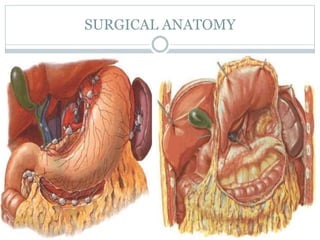
SURGICAL ANATOMY
TIMELINE OF EARLY TRENDS
1950s
 Failure of limited surgery to control disease loco-regionally by Gordon
McNeer.
 >20% cancer recurrence in the non-resected perigastric nodes or the
gastric bed
1960s
 the Japanese Society suggested removal of the appropriate number of
tiers would increase the chance of negative “lymphadenectomy
margins”
INTRODUCTION
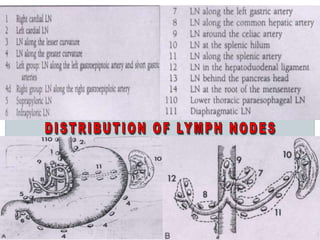
 The lymph node stations - precisely defined by the Japanese Gastric
Cancer Association (JGCA),
formerly known as the Japanese Research Society for Gastric Cancer
 Aim of Japanese classification  a common language for the clinico-
pathological description of gastric cancer.
 Previously the JGCA divided these stations into four levels (N1 through
N4)
DEFINITIONS OF DIFFERENT LEVELS OF LYMPH NODE
DISSECTION
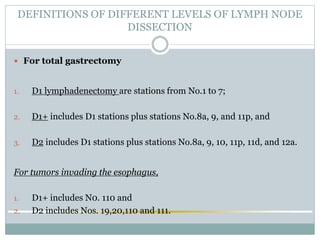
 For total gastrectomy
1. D1 lymphadenectomy are stations from No.1 to 7;
2. D1+ includes D1 stations plus stations No.8a, 9, and 11p, and
3. D2 includes D1 stations plus stations No.8a, 9, 10, 11p, 11d, and 12a.
For tumors invading the esophagus,
1. D1+ includes N0. 110 and
2. D2 includes Nos. 19,20,110 and 111.
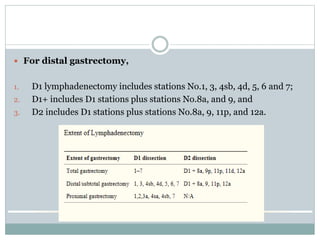
 For distal gastrectomy,
1. D1 lymphadenectomy includes stations No.1, 3, 4sb, 4d, 5, 6 and 7;
2. D1+ includes D1 stations plus stations No.8a, and 9, and
3. D2 includes D1 stations plus stations No.8a, 9, 11p, and 12a.
D1 Gastrectomy
 Early forms not suitable for endoscopic treatment -> a D1 or D1 plus
lymphadenectomy in cases with clinically negative nodes.
(Japanese gastric cancer treatment guidelines 2010 (ver. 3) 2011 Jun; 14(2):113-23)
D1 lymphadenectomy along with
1. proximal gastrectomy and
2. pylorus preserving gastrectomy
only recommended for T1N0 disease.
 When lymph nodes are clinically positive, a D2 dissection
1. removal of stations 12a and 11p in subtotal gastrectomy, and
2. stations 12a, 11d and 10 in total gastrectomy
D2 Gastrectomy
 Systematic (D2) Lymphadenectomy
 Resection of the perigastric lymph nodes and those along the feeding
vessels (N2) with the gastrectomy specimen.
 will vary according to the position of the primary tumour
D2 Gastrectomy
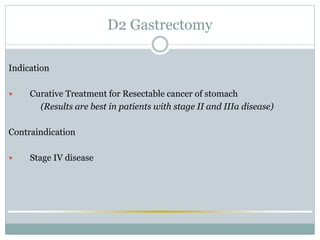
Indication
 Curative Treatment for Resectable cancer of stomach
(Results are best in patients with stage II and IIIa disease)
Contraindication
 Stage IV disease
D2 Lymphadenectomy –
An ACCEPTED STANDARD procedure
for gastric cancer
Why ?
CURRENT EVIDENCE
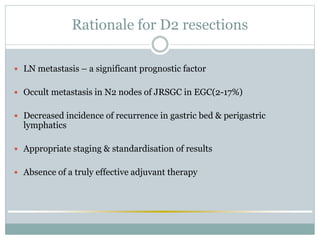
Rationale for D2 resections
 LN metastasis – a significant prognostic factor
 Occult metastasis in N2 nodes of JRSGC in EGC(2-17%)
 Decreased incidence of recurrence in gastric bed & perigastric
lymphatics
 Appropriate staging & standardisation of results
 Absence of a truly effective adjuvant therapy
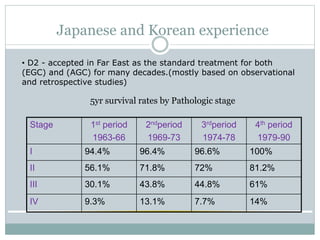
Japanese and Korean experience
5yr survival rates by Pathologic stage
Stage 1st period
1963-66
2ndperiod
1969-73
3rdperiod
1974-78
4th period
1979-90
I 94.4% 96.4% 96.6% 100%
II 56.1% 71.8% 72% 81.2%
III 30.1% 43.8% 44.8% 61%
IV 9.3% 13.1% 7.7% 14%
• D2 - accepted in Far East as the standard treatment for both
(EGC) and (AGC) for many decades.(mostly based on observational
and retrospective studies)
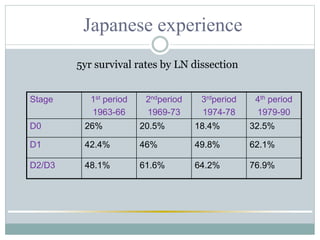
5yr survival rates by LN dissection
Stage 1st period
1963-66
2ndperiod
1969-73
3rdperiod
1974-78
4th period
1979-90
D0 26% 20.5% 18.4% 32.5%
D1 42.4% 46% 49.8% 62.1%
D2/D3 48.1% 61.6% 64.2% 76.9%
Japanese experience
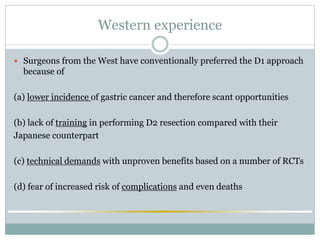
Western experience
 Surgeons from the West have conventionally preferred the D1 approach
because of
(a) lower incidence of gastric cancer and therefore scant opportunities
(b) lack of training in performing D2 resection compared with their
Japanese counterpart
(c) technical demands with unproven benefits based on a number of RCTs
(d) fear of increased risk of complications and even deaths
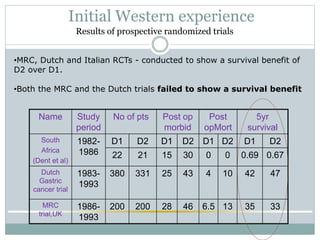
Initial Western experience
Results of prospective randomized trials
Name Study
period
No of pts Post op
morbid
Post
opMort
5yr
survival
South
Africa
(Dent et al)
1982-
1986
D1 D2 D1 D2 D1 D2 D1 D2
22 21 15 30 0 0 0.69 0.67
Dutch
Gastric
cancer trial
1983-
1993
380 331 25 43 4 10 42 47
MRC
trial,UK
1986-
1993
200 200 28 46 6.5 13 35 33
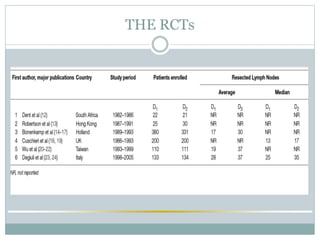
•MRC, Dutch and Italian RCTs - conducted to show a survival benefit of
D2 over D1.
•Both the MRC and the Dutch trials failed to show a survival benefit
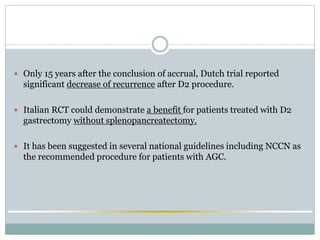
 Only 15 years after the conclusion of accrual, Dutch trial reported
significant decrease of recurrence after D2 procedure.
 Italian RCT could demonstrate a benefit for patients treated with D2
gastrectomy without splenopancreatectomy.
 It has been suggested in several national guidelines including NCCN as
the recommended procedure for patients with AGC.
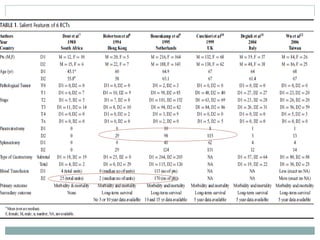
THE RCTs
South African Trial
 Dent et al in South Africa randomized 43patients.
 Major findings were that blood transfusion requirements, operating
time and hospital stay were longer with extended lymphadenectomy.
 At a median follow-up of 3.1 years no benefit regarding survival was
seen.
Hong Kong Trial
 Robetson et al randomized 55 patients in Hong Kong
 Operating time, transfusion requirements and hospital stay, all
increased with extended lymphadenectomy.
 Contrary to the expectations overall survival was significantly worse
and this was attributed to the impact of increased blood transfusion.
UK MRC Trial
 In hospital mortality was high in both groups compared to high volume
Asian centers, and significantly higher in the D2 versus D1 arm (13 vs.
6.5%)
 No significant difference in overall survival at 5 years (D1 35%; D2
33%; P = 0.43).
 Cons
The authors found - additional mortality in the D2 group could be
attributed to the performance of distal pancreatectomy and
splenectomy
Dutch Trial
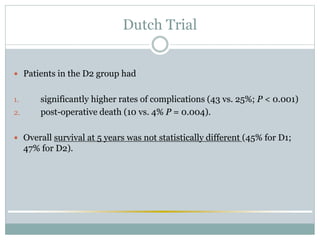
 Patients in the D2 group had
1. significantly higher rates of complications (43 vs. 25%; P < 0.001)
2. post-operative death (10 vs. 4% P = 0.004).
 Overall survival at 5 years was not statistically different (45% for D1;
47% for D2).
 15 year-follow up of the Dutch study
[Surgical treatment of gastric cancer: 15-year follow-up results of the randomised
nationwide Dutch D1D2 trial. Songun et al Lancet Oncol. 2010 May; 11(5):439-49]
1. Loco-regional recurrence rate is significantly lower in patients
treated with D2 lymphadenectomy vs D1.
2. Survival benefit with the enlarged dissection.
 Studies recently demonstrated that even in Europe trained surgeons
could safely perform D2 with spleen and pancreas preservation and
 More favourable recurrence pattern and cancer-related survival,
 D2 seemed to be the recommended treatment for patients
with resectable gastric cancer .
[Extended lymph node dissection without routine spleno-pancreatectomy for treatment
of gastric cancer: low morbidity and mortality rates in a single center series of 250
patients.Biffi R et al J Surg Oncol. 2006 Apr 1; 93(5):394-400]
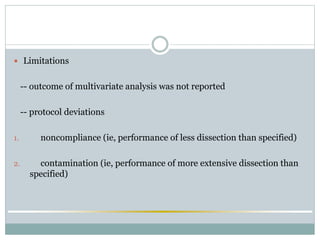
 Limitations
-- outcome of multivariate analysis was not reported
-- protocol deviations
1. noncompliance (ie, performance of less dissection than specified)
2. contamination (ie, performance of more extensive dissection than
specified)
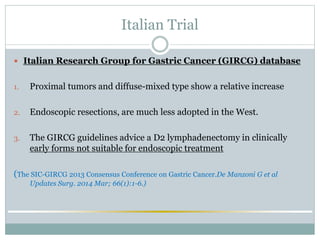
Italian Trial
 Italian Research Group for Gastric Cancer (GIRCG) database
1. Proximal tumors and diffuse-mixed type show a relative increase
2. Endoscopic resections, are much less adopted in the West.
3. The GIRCG guidelines advice a D2 lymphadenectomy in clinically
early forms not suitable for endoscopic treatment
(The SIC-GIRCG 2013 Consensus Conference on Gastric Cancer.De Manzoni G et al
Updates Surg. 2014 Mar; 66(1):1-6.)
 D2 dissection - limited risk of complications and mortality in the West, when
performed in specialized centers and avoiding spleno-pancreatectomy
[RCT comparing survival after D1 or D2 gastrectomy for gastric cancer.Degiuli M et al
Italian Gastric Cancer Study Group. Br J Surg. 2014 Jan; 101(2):23-31].
 Only in selected cases more limited procedures (D1 plus) are adviced by
the GIRCG group.
1. high-risk patients (age > 70 yrs)
2. early forms with favourable pathological characteristics.
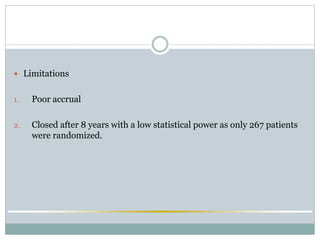
 Limitations
1. Poor accrual
2. Closed after 8 years with a low statistical power as only 267 patients
were randomized.
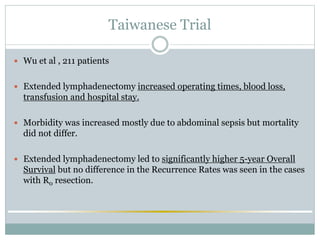
Taiwanese Trial
 Wu et al , 211 patients
 Extended lymphadenectomy increased operating times, blood loss,
transfusion and hospital stay.
 Morbidity was increased mostly due to abdominal sepsis but mortality
did not differ.
 Extended lymphadenectomy led to significantly higher 5-year Overall
Survival but no difference in the Recurrence Rates was seen in the cases
with R0 resection.
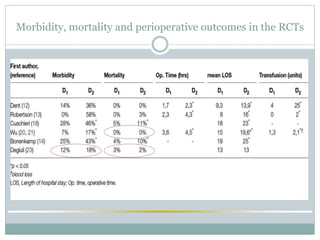
Morbidity, mortality and perioperative outcomes in the RCTs
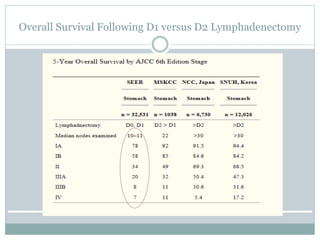
Overall Survival Following D1 versus D2 Lymphadenectomy
Role of Splenectomy and Pancreatectomy
 The overall consensus is that routine splenectomy and distal
pancreatectomy during D2 dissection has no long-term survival benefit
and may even be counter productive.
 However it may be performed for selected patients with
1. T3 tumors or
2. direct invasion or
3. metastasis at the splenopancreatic hilum.
Meta-Analysis of D1 Versus D2 Gastrectomy for Gastric Adenocarcinoma. Annals of
surgery · March 2011 DOI: 10.1097
Concept of Stage Migration
 For stages I–III, stage for stage overall survival is 14–30% lower for
SEER database patients.
 At MSKCC (80% of patients receive a D2 ), stage for stage overall
survival is intermediate between SEER database patients and
NCC/SNUH patients
 Reason
1. Routine D2 lymphadenectomy, greater number of nodes are
examined.
2. Shifted nearly a third of patients from N1 to N2 disease.
Conclusion
 EGC --- D1 /D1+ surgery is only to patients not fitted for less invasive
treatment.
 AGC --- debate on the extent of nodal dissection open for many decades.
 While D2 gastrectomy - standard procedure in eastern countries, mostly based
on observational and retrospective studies,
 Japanese D2 with pancreas preservation – a safe radical treatment for gastric
cancer in selected western patients treated in experienced centers.
West meets the East
 D2 is an accepted minimal standard procedure
 D2 lymphadenectomy with spleen and pancreas preservation can be
performed safely with excellent survival outcomes.
 Significant improvement in overall survival is observed with D2
lymphadenectomy, without increased surgical morbidity and mortality.
 Minimally invasive surgery for gastric cancer including D2 Gastrectomy
is the way of the future.
THANK
YOU

D2 distal gastrectomy final

  • 1.
    D E PA R T M E N T O F S U R G I C A L G A S T R O E N T E R O L O G Y K I N G G E O R G E ’ S M E D I C A L U N I V E R S I T Y L U C K N O W , I N D I A Current Evidence of D1 - D2 Gastrectomy
  • 2.
    OUTLINE  INTRODUCTION  NODALSTATIONS  DEFINITIONS  CURRENT EVIDENCE 1. D1 GASTRECTOMY 2. D2 GASTRECTOMY  CONCLUSION
  • 3.
    INTRODUCTION  Gastric canceris the second leading worldwide cause of cancer death and the fourth most common cancer .  The high mortality rate - advanced disease at presentation and relatively aggressive biology.  Early lesions - asymptomatic and infrequently detected  Prognosis has improved, attributable to advances in surgical treatment, postoperative care, and multimodality therapy.
  • 4.
     In allcases surgery is the standard of care for all resectable tumours: radical gastrectomy with regional lymphadenectomy (Surgical treatment of gastric cancer: 15-year follow-up results of the randomised nationwide Dutch D1D2 trial.Songun I et al Lancet Oncol. 2010 May; 11(5):439-49)  Nodal involvement - most important prognostic factor. Hence the importance to lymphadenectomy and its extension.
  • 5.
  • 6.
    TIMELINE OF EARLYTRENDS 1950s  Failure of limited surgery to control disease loco-regionally by Gordon McNeer.  >20% cancer recurrence in the non-resected perigastric nodes or the gastric bed 1960s  the Japanese Society suggested removal of the appropriate number of tiers would increase the chance of negative “lymphadenectomy margins”
  • 7.
    INTRODUCTION  The lymphnode stations - precisely defined by the Japanese Gastric Cancer Association (JGCA), formerly known as the Japanese Research Society for Gastric Cancer  Aim of Japanese classification  a common language for the clinico- pathological description of gastric cancer.  Previously the JGCA divided these stations into four levels (N1 through N4)
  • 9.
    DEFINITIONS OF DIFFERENTLEVELS OF LYMPH NODE DISSECTION  For total gastrectomy 1. D1 lymphadenectomy are stations from No.1 to 7; 2. D1+ includes D1 stations plus stations No.8a, 9, and 11p, and 3. D2 includes D1 stations plus stations No.8a, 9, 10, 11p, 11d, and 12a. For tumors invading the esophagus, 1. D1+ includes N0. 110 and 2. D2 includes Nos. 19,20,110 and 111.
  • 10.
     For distalgastrectomy, 1. D1 lymphadenectomy includes stations No.1, 3, 4sb, 4d, 5, 6 and 7; 2. D1+ includes D1 stations plus stations No.8a, and 9, and 3. D2 includes D1 stations plus stations No.8a, 9, 11p, and 12a.
  • 11.
    D1 Gastrectomy  Earlyforms not suitable for endoscopic treatment -> a D1 or D1 plus lymphadenectomy in cases with clinically negative nodes. (Japanese gastric cancer treatment guidelines 2010 (ver. 3) 2011 Jun; 14(2):113-23) D1 lymphadenectomy along with 1. proximal gastrectomy and 2. pylorus preserving gastrectomy only recommended for T1N0 disease.  When lymph nodes are clinically positive, a D2 dissection 1. removal of stations 12a and 11p in subtotal gastrectomy, and 2. stations 12a, 11d and 10 in total gastrectomy
  • 12.
    D2 Gastrectomy  Systematic(D2) Lymphadenectomy  Resection of the perigastric lymph nodes and those along the feeding vessels (N2) with the gastrectomy specimen.  will vary according to the position of the primary tumour
  • 13.
    D2 Gastrectomy Indication  CurativeTreatment for Resectable cancer of stomach (Results are best in patients with stage II and IIIa disease) Contraindication  Stage IV disease
  • 14.
    D2 Lymphadenectomy – AnACCEPTED STANDARD procedure for gastric cancer Why ? CURRENT EVIDENCE
  • 15.
    Rationale for D2resections  LN metastasis – a significant prognostic factor  Occult metastasis in N2 nodes of JRSGC in EGC(2-17%)  Decreased incidence of recurrence in gastric bed & perigastric lymphatics  Appropriate staging & standardisation of results  Absence of a truly effective adjuvant therapy
  • 16.
    Japanese and Koreanexperience 5yr survival rates by Pathologic stage Stage 1st period 1963-66 2ndperiod 1969-73 3rdperiod 1974-78 4th period 1979-90 I 94.4% 96.4% 96.6% 100% II 56.1% 71.8% 72% 81.2% III 30.1% 43.8% 44.8% 61% IV 9.3% 13.1% 7.7% 14% • D2 - accepted in Far East as the standard treatment for both (EGC) and (AGC) for many decades.(mostly based on observational and retrospective studies)
  • 17.
    5yr survival ratesby LN dissection Stage 1st period 1963-66 2ndperiod 1969-73 3rdperiod 1974-78 4th period 1979-90 D0 26% 20.5% 18.4% 32.5% D1 42.4% 46% 49.8% 62.1% D2/D3 48.1% 61.6% 64.2% 76.9% Japanese experience
  • 18.
    Western experience  Surgeonsfrom the West have conventionally preferred the D1 approach because of (a) lower incidence of gastric cancer and therefore scant opportunities (b) lack of training in performing D2 resection compared with their Japanese counterpart (c) technical demands with unproven benefits based on a number of RCTs (d) fear of increased risk of complications and even deaths
  • 19.
    Initial Western experience Resultsof prospective randomized trials Name Study period No of pts Post op morbid Post opMort 5yr survival South Africa (Dent et al) 1982- 1986 D1 D2 D1 D2 D1 D2 D1 D2 22 21 15 30 0 0 0.69 0.67 Dutch Gastric cancer trial 1983- 1993 380 331 25 43 4 10 42 47 MRC trial,UK 1986- 1993 200 200 28 46 6.5 13 35 33 •MRC, Dutch and Italian RCTs - conducted to show a survival benefit of D2 over D1. •Both the MRC and the Dutch trials failed to show a survival benefit
  • 20.
     Only 15years after the conclusion of accrual, Dutch trial reported significant decrease of recurrence after D2 procedure.  Italian RCT could demonstrate a benefit for patients treated with D2 gastrectomy without splenopancreatectomy.  It has been suggested in several national guidelines including NCCN as the recommended procedure for patients with AGC.
  • 21.
  • 22.
    South African Trial Dent et al in South Africa randomized 43patients.  Major findings were that blood transfusion requirements, operating time and hospital stay were longer with extended lymphadenectomy.  At a median follow-up of 3.1 years no benefit regarding survival was seen.
  • 23.
    Hong Kong Trial Robetson et al randomized 55 patients in Hong Kong  Operating time, transfusion requirements and hospital stay, all increased with extended lymphadenectomy.  Contrary to the expectations overall survival was significantly worse and this was attributed to the impact of increased blood transfusion.
  • 24.
    UK MRC Trial In hospital mortality was high in both groups compared to high volume Asian centers, and significantly higher in the D2 versus D1 arm (13 vs. 6.5%)  No significant difference in overall survival at 5 years (D1 35%; D2 33%; P = 0.43).  Cons The authors found - additional mortality in the D2 group could be attributed to the performance of distal pancreatectomy and splenectomy
  • 25.
    Dutch Trial  Patientsin the D2 group had 1. significantly higher rates of complications (43 vs. 25%; P < 0.001) 2. post-operative death (10 vs. 4% P = 0.004).  Overall survival at 5 years was not statistically different (45% for D1; 47% for D2).
  • 26.
     15 year-followup of the Dutch study [Surgical treatment of gastric cancer: 15-year follow-up results of the randomised nationwide Dutch D1D2 trial. Songun et al Lancet Oncol. 2010 May; 11(5):439-49] 1. Loco-regional recurrence rate is significantly lower in patients treated with D2 lymphadenectomy vs D1. 2. Survival benefit with the enlarged dissection.
  • 27.
     Studies recentlydemonstrated that even in Europe trained surgeons could safely perform D2 with spleen and pancreas preservation and  More favourable recurrence pattern and cancer-related survival,  D2 seemed to be the recommended treatment for patients with resectable gastric cancer . [Extended lymph node dissection without routine spleno-pancreatectomy for treatment of gastric cancer: low morbidity and mortality rates in a single center series of 250 patients.Biffi R et al J Surg Oncol. 2006 Apr 1; 93(5):394-400]
  • 28.
     Limitations -- outcomeof multivariate analysis was not reported -- protocol deviations 1. noncompliance (ie, performance of less dissection than specified) 2. contamination (ie, performance of more extensive dissection than specified)
  • 29.
    Italian Trial  ItalianResearch Group for Gastric Cancer (GIRCG) database 1. Proximal tumors and diffuse-mixed type show a relative increase 2. Endoscopic resections, are much less adopted in the West. 3. The GIRCG guidelines advice a D2 lymphadenectomy in clinically early forms not suitable for endoscopic treatment (The SIC-GIRCG 2013 Consensus Conference on Gastric Cancer.De Manzoni G et al Updates Surg. 2014 Mar; 66(1):1-6.)
  • 30.
     D2 dissection- limited risk of complications and mortality in the West, when performed in specialized centers and avoiding spleno-pancreatectomy [RCT comparing survival after D1 or D2 gastrectomy for gastric cancer.Degiuli M et al Italian Gastric Cancer Study Group. Br J Surg. 2014 Jan; 101(2):23-31].  Only in selected cases more limited procedures (D1 plus) are adviced by the GIRCG group. 1. high-risk patients (age > 70 yrs) 2. early forms with favourable pathological characteristics.
  • 31.
     Limitations 1. Pooraccrual 2. Closed after 8 years with a low statistical power as only 267 patients were randomized.
  • 32.
    Taiwanese Trial  Wuet al , 211 patients  Extended lymphadenectomy increased operating times, blood loss, transfusion and hospital stay.  Morbidity was increased mostly due to abdominal sepsis but mortality did not differ.  Extended lymphadenectomy led to significantly higher 5-year Overall Survival but no difference in the Recurrence Rates was seen in the cases with R0 resection.
  • 34.
    Morbidity, mortality andperioperative outcomes in the RCTs
  • 35.
    Overall Survival FollowingD1 versus D2 Lymphadenectomy
  • 36.
    Role of Splenectomyand Pancreatectomy  The overall consensus is that routine splenectomy and distal pancreatectomy during D2 dissection has no long-term survival benefit and may even be counter productive.  However it may be performed for selected patients with 1. T3 tumors or 2. direct invasion or 3. metastasis at the splenopancreatic hilum. Meta-Analysis of D1 Versus D2 Gastrectomy for Gastric Adenocarcinoma. Annals of surgery · March 2011 DOI: 10.1097
  • 37.
    Concept of StageMigration  For stages I–III, stage for stage overall survival is 14–30% lower for SEER database patients.  At MSKCC (80% of patients receive a D2 ), stage for stage overall survival is intermediate between SEER database patients and NCC/SNUH patients  Reason 1. Routine D2 lymphadenectomy, greater number of nodes are examined. 2. Shifted nearly a third of patients from N1 to N2 disease.
  • 38.
    Conclusion  EGC ---D1 /D1+ surgery is only to patients not fitted for less invasive treatment.  AGC --- debate on the extent of nodal dissection open for many decades.  While D2 gastrectomy - standard procedure in eastern countries, mostly based on observational and retrospective studies,  Japanese D2 with pancreas preservation – a safe radical treatment for gastric cancer in selected western patients treated in experienced centers. West meets the East
  • 39.
     D2 isan accepted minimal standard procedure  D2 lymphadenectomy with spleen and pancreas preservation can be performed safely with excellent survival outcomes.  Significant improvement in overall survival is observed with D2 lymphadenectomy, without increased surgical morbidity and mortality.  Minimally invasive surgery for gastric cancer including D2 Gastrectomy is the way of the future.
  • 40.