Training Neural Networks
Accelerate innovation by unifying data science, engineering
and business
• Founded by the original creators of Apache Spark
• Contributes 75% of the open source code, 10x more than
any other company
• Trained 100k+ Spark users on the Databricks platform
VISION
WHO WE ARE
Unified Analytics Platform powered by Apache Spark™PRODUCT
Aboutourspeaker
Denny Lee
Technical Product Marketing Manager
Former:
• Senior Director of Data Sciences Engineering at SAP Concur
• Principal Program Manager at Microsoft
• Azure Cosmos DB Engineering Spark and Graph Initiatives
• Isotope Incubation Team (currently known as HDInsight)
• Bing’s Audience Insights Team
• Yahoo!’s 24TB Analysis Services cube
DeepLearningFundamentalsSeries
This is a three-part series:
• Introduction to Neural Networks
• Training Neural Networks
• Applying your Convolutional Neural Network
This series will be make use of Keras (TensorFlow backend) but as it is a
fundamentals series, we are focusing primarily on the concepts.
PreviousSession:IntroductiontoNeuralNetworks
• What is Deep Learning?
• What can Deep Learning do for you?
• What are artificial neural networks?
• Let’s start with a perceptron…
• Understanding the effect of activation functions
CurrentSession:TrainingNeuralNetworks
• Tuning training
• Training Algorithms
• Optimization (including Adam)
• Convolutional Neural Networks
UpcomingSession:ApplyingNeuralNetworks
• Diving further into CNNs
• CNN Architectures
• Convolutions at Work!
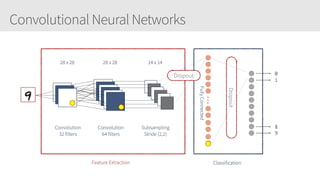
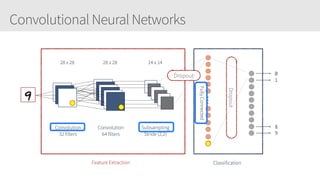
Convolutional Neural Networks
28 x 28 28 x 28 14 x 14
Convolution
32 filters
Convolution
64 filters
Subsampling
Stride (2,2)
Feature Extraction Classification
0
1
8
9
FullyConnected
Dropout
Dropout
Tuning Training
Hyperparameters
• Network
• How many layers?
• How many neurons in each layer?
• What activation functions to use?
• Learning algorithm
• What’s the best value of the learning rate?
• How quickly decay the learning rate? Momentum?
• What type of loss function should I use?
• What batch size?
• How many iterations is enough?
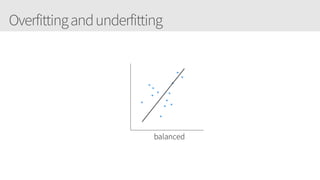
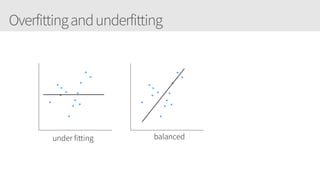
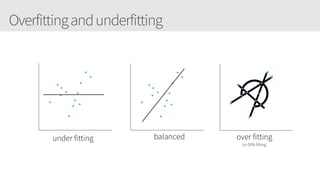
Overfittingandunderfitting
Hyperparameters:Network
Generally, the more layers and the number of units in each layer:
• The greater the capacity of the artificial neural network
• The risk is overfitting when your goal is to build a generalized model.
From a practical perspective, a good starting point is:
• The number of input units equals the dimension of features
• The number of output units equals the number of classes (e.g. in the MNIST dataset, there
are 10 possible values represents digits (0…9) hence there are 10 output units
• Start with one hidden layer that is 2x the number of input units
• A good reference is Andrew Ng’s Coursera Machine Learning course.
Hyperparameters:ActivationFunctions?
• Good starting point: ReLU
• Note many neural networks samples: Keras MNIST,  TensorFlow CIFAR10 Pruning, etc.
• Note that each activation function has its own strengths and weaknesses.  A good quote
on activation functions from CS231N summarizes the choice well:
“What neuron type should I use?” Use the ReLU non-linearity, be careful with your learning rates
and possibly monitor the fraction of “dead” units in a network. If this concerns you, give Leaky
ReLU or Maxout a try. Never use sigmoid. Try tanh, but expect it to work worse than ReLU/
Maxout.
Neurons … Activate!
DEMO
Hyperparameters
Learning algorithm
• What’s the best value of the learning rate?
• How quickly decay the learning rate? Momentum?
• What type of loss function should I use?
• What batch size?
• How many iterations is enough?
Training Algorithms
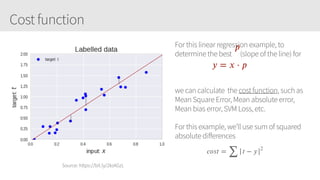
Cost function
Source: https://bit.ly/2IoAGzL
For this linear regression example, to
determine the best (slope of the line) for
we can calculate the cost function, such as
Mean Square Error, Mean absolute error,
Mean bias error, SVM Loss, etc.
For this example, we’ll use sum of squared
absolute differences
𝑦 = 𝑥 ⋅ 𝑝
𝑝
𝑐𝑜𝑠𝑡 =
∑
| 𝑡 − 𝑦|2
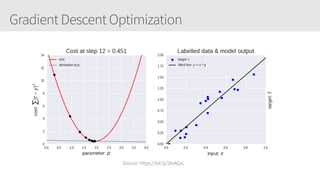
Gradient Descent Optimization
Source: https://bit.ly/2IoAGzL
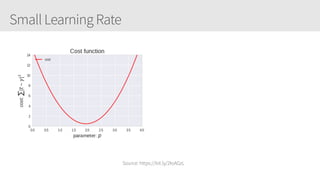
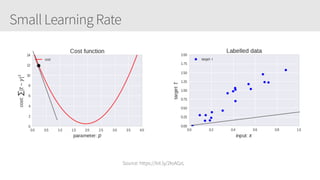
Small Learning Rate
Source: https://bit.ly/2IoAGzL
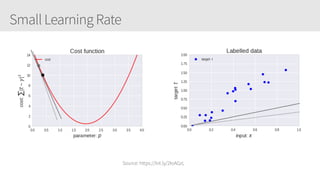
Small Learning Rate
Source: https://bit.ly/2IoAGzL
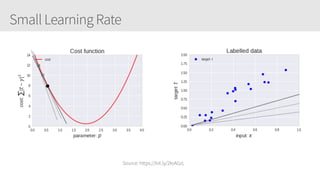
Small Learning Rate
Source: https://bit.ly/2IoAGzL
Small Learning Rate
Source: https://bit.ly/2IoAGzL
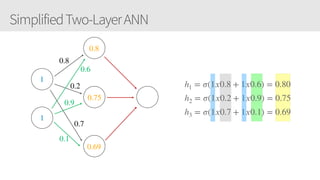
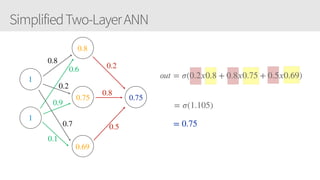
SimplifiedTwo-LayerANN
1
1
0.8
0.2
0.7
0.6
0.9
0.1
0.8
0.75
0.69
h1 = 𝜎(1𝑥0.8 + 1𝑥0.6) = 0.80
h2 = 𝜎(1𝑥0.2 + 1𝑥0.9) = 0.75
h3 = 𝜎(1𝑥0.7 + 1𝑥0.1) = 0.69
SimplifiedTwo-LayerANN
1
1
0.8
0.2
0.7
0.6
0.9
0.1
0.8
0.75
0.69
0.2
0.8
0.5
0.75
𝑜𝑢𝑡 = 𝜎(0.2𝑥0.8 + 0.8𝑥0.75 + 0.5𝑥0.69)
= 𝜎(1.105)
= 0.75
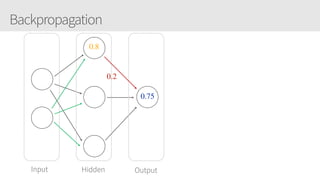
Backpropagation
Input Hidden Output
0.8
0.2
0.75
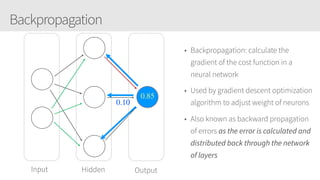
Backpropagation
Input Hidden Output
0.85
• Backpropagation: calculate the
gradient of the cost function in a
neural network
• Used by gradient descent optimization
algorithm to adjust weight of neurons
• Also known as backward propagation
of errors as the error is calculated and
distributed back through the network
of layers
0.10
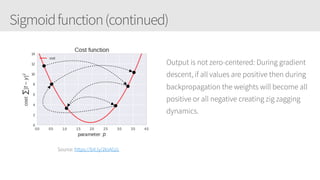
Sigmoidfunction(continued)
Output is not zero-centered: During gradient
descent, if all values are positive then during
backpropagation the weights will become all
positive or all negative creating zig zagging
dynamics.
Source: https://bit.ly/2IoAGzL
LearningRateCallouts
• Too small, it may take too long to get minima
• Too large, it may skip the minima altogether
Optimization
OptimizationOverview
• After backpropagation, the parameters are updated based on the gradients
calculated
• There are several approaches in this area of active research; we will focus on:
• Stochastic Gradient Descent
• Momentum, NAG
• Per-parameter adaptive learning rate methods
StochasticGradientDescent
• (Batch) Gradient Descent is computed on the full dataset (not efficient for large
scale models and datasets).
• Often converges faster because it performs updates more frequently
• But due to frequent updates, this may complicate convergence to the exact
minima
• For more information, refer to:
• Andrew Ng’s 2. Stochastic Gradient (https://goo.gl/bNrJbx)
• Types of Optimization Algorithms used in Neural Networks and Ways to
Optimize Gradient Descent (https://goo.gl/tB2e7S)
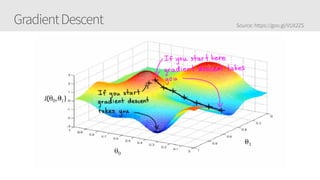
GradientDescent Source: https://goo.gl/VUX2ZS
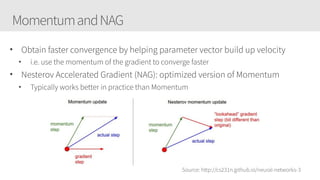
MomentumandNAG
• Obtain faster convergence by helping parameter vector build up velocity
• i.e. use the momentum of the gradient to converge faster
• Nesterov Accelerated Gradient (NAG): optimized version of Momentum
• Typically works better in practice than Momentum
Source: http://cs231n.github.io/neural-networks-3
Annealingthelearningrate
• i.e. slow down the learning rate to prevent it from bouncing around too much
• Referred as the decay parameter (i.e., the learning rate decay over each
update) to reduce kinetic energy
• Note, this is different from rho (i.e. exponentially weighted average or
exponentially weighted decay of past gradients) to smooth the descent path
trajectory
Per-parameteradaptivelearningratemethods
• Adaptively tune learning rates at the parameter level
• Popular methods include:
• Adaptive Gradient Algorithm (AdaGrad) improves performance on problems with sparse
gradients (e.g. natural language and computer vision problems).
• Root Mean Square Propagation (RMSProp) maintains per-parameter learning rates based
on the average of recent magnitudes of the gradients for the weight (e.g. how quickly it is
changing). This means the algorithm does well on online and non-stationary problems
(e.g. noisy).
• AdaDelta: Per dimension learning rate method for gradient descent with minimal
computational overhead, requires no manual tuning, and quite robust
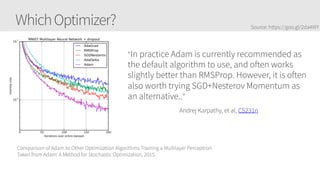
WhichOptimizer?
“In practice Adam is currently recommended as
the default algorithm to use, and often works
slightly better than RMSProp. However, it is often
also worth trying SGD+Nesterov Momentum as
an alternative..”
 Andrej Karpathy, et al, CS231n
Source: https://goo.gl/2da4WY
Comparison of Adam to Other Optimization Algorithms Training a Multilayer Perceptron

Taken from Adam: A Method for Stochastic Optimization, 2015.
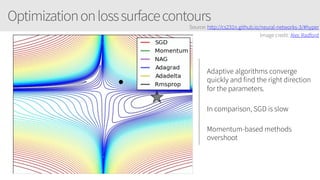
Optimizationonlosssurfacecontours
Adaptive algorithms converge
quickly and find the right direction
for the parameters.
In comparison, SGD is slow
Momentum-based methods
overshoot
Source: http://cs231n.github.io/neural-networks-3/#hyper
Image credit: Alec Radford
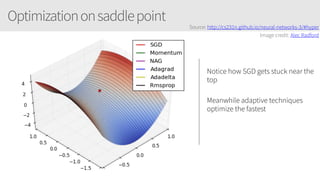
Optimizationonsaddlepoint
Notice how SGD gets stuck near the
top
Meanwhile adaptive techniques
optimize the fastest
Source: http://cs231n.github.io/neural-networks-3/#hyper
Image credit: Alec Radford
GoodReferences
• Suki Lau's Learning Rate Schedules and Adaptive Learning Rate Methods for
Deep Learning
• CS23n Convolutional Neural Networks for Visual Recognition
• Fundamentals of Deep Learning
• ADADELTA: An Adaptive Learning Rate Method
• Gentle Introduction to the Adam Optimization Algorithm for Deep Learning
Convolutional Networks
ConvolutionalNeuralNetworks
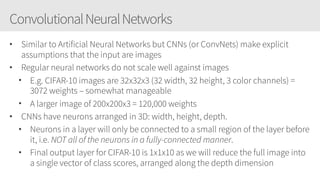
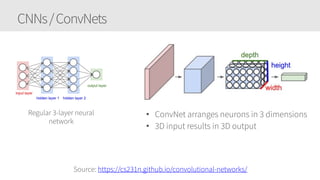
• Similar to Artificial Neural Networks but CNNs (or ConvNets) make explicit
assumptions that the input are images
• Regular neural networks do not scale well against images
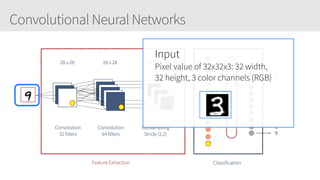
• E.g. CIFAR-10 images are 32x32x3 (32 width, 32 height, 3 color channels) =
3072 weights – somewhat manageable
• A larger image of 200x200x3 = 120,000 weights
• CNNs have neurons arranged in 3D: width, height, depth.
• Neurons in a layer will only be connected to a small region of the layer before
it, i.e. NOT all of the neurons in a fully-connected manner.
• Final output layer for CIFAR-10 is 1x1x10 as we will reduce the full image into
a single vector of class scores, arranged along the depth dimension
CNNs/ConvNets
Regular 3-layer neural
network
• ConvNet arranges neurons in 3 dimensions
• 3D input results in 3D output
Source: https://cs231n.github.io/convolutional-networks/
Convolutional Neural Networks
28 x 28 28 x 28 14 x 14
Convolution
32 filters
Convolution
64 filters
Subsampling
Stride (2,2)
Feature Extraction Classification
0
1
8
9
FullyConnected
Dropout
Dropout
Convolutional Neural Networks
28 x 28 28 x 28 14 x 14
Convolution
32 filters
Convolution
64 filters
Subsampling
Stride (2,2)
Feature Extraction Classification
0
1
8
9
FullyConnected
Dropout
Dropout
Input
Pixel value of 32x32x3: 32 width,
32 height, 3 color channels (RGB)
Convolutional Neural Networks
28 x 28 28 x 28 14 x 14
Convolution
32 filters
Convolution
64 filters
Subsampling
Stride (2,2)
Feature Extraction Classification
0
1
8
9
FullyConnected
Dropout
Dropout
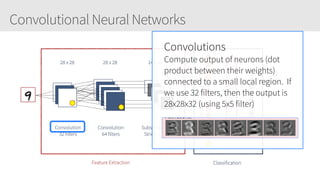
Convolutions
Compute output of neurons (dot
product between their weights)
connected to a small local region. If
we use 32 filters, then the output is
28x28x32 (using 5x5 filter)
Convolutional Neural Networks
28 x 28 28 x 28 14 x 14
Convolution
32 filters
Convolution
64 filters
Subsampling
Stride (2,2)
Feature Extraction Classification
0
1
8
9
FullyConnected
Dropout
Dropout
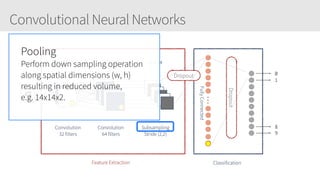
Pooling
Perform down sampling operation
along spatial dimensions (w, h)
resulting in reduced volume,
e.g. 14x14x2.
Convolutional Neural Networks
28 x 28 28 x 28 14 x 14
Convolution
32 filters
Convolution
64 filters
Subsampling
Stride (2,2)
Feature Extraction Classification
0
1
8
9
FullyConnected
Dropout
Dropout
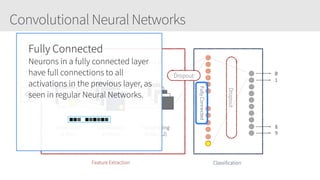
Fully Connected
Neurons in a fully connected layer
have full connections to all
activations in the previous layer, as
seen in regular Neural Networks.
https://cs.stanford.edu/people/karpathy/convnetjs/demo/mnist.html
ConvNetJS MNIST Demo
Neurons … Activate!
DEMO
I’d like to thank…
GreatReferences
• Andrej Karparthy’s ConvNetJS MNIST Demo
• What is back propagation in neural networks?
• CS231n: Convolutional Neural Networks for Visual Recognition
• Syllabus and Slides | Course Notes | YouTube
• With particular focus on CS231n: Lecture 7: Convolution Neural Networks 
• Neural Networks and Deep Learning
• TensorFlow
GreatReferences
• Deep Visualization Toolbox
• Back Propagation with TensorFlow
• TensorFrames: Google TensorFlow with Apache Spark
• Integrating deep learning libraries with Apache Spark
• Build, Scale, and Deploy Deep Learning Pipelines with Ease
Attribution
Tomek Drabas
Brooke Wenig
Timothee Hunter
Cyrielle Simeone
Q&A
What’s next?
Applying your Convolutional Neural Network
October 25, 2018 | 10:00 PDT
https://dbricks.co/2O2c4BZ
State Of The Art Deep Learning On Apache Spark™
October 31, 2018 | 09:00 PDT
https://dbricks.co/2NqogIp

Training Neural Networks

  • 1.
  • 2.
    Accelerate innovation byunifying data science, engineering and business • Founded by the original creators of Apache Spark • Contributes 75% of the open source code, 10x more than any other company • Trained 100k+ Spark users on the Databricks platform VISION WHO WE ARE Unified Analytics Platform powered by Apache Spark™PRODUCT
  • 3.
    Aboutourspeaker Denny Lee Technical ProductMarketing Manager Former: • Senior Director of Data Sciences Engineering at SAP Concur • Principal Program Manager at Microsoft • Azure Cosmos DB Engineering Spark and Graph Initiatives • Isotope Incubation Team (currently known as HDInsight) • Bing’s Audience Insights Team • Yahoo!’s 24TB Analysis Services cube
  • 4.
    DeepLearningFundamentalsSeries This is athree-part series: • Introduction to Neural Networks • Training Neural Networks • Applying your Convolutional Neural Network This series will be make use of Keras (TensorFlow backend) but as it is a fundamentals series, we are focusing primarily on the concepts.
  • 5.
    PreviousSession:IntroductiontoNeuralNetworks • What isDeep Learning? • What can Deep Learning do for you? • What are artificial neural networks? • Let’s start with a perceptron… • Understanding the effect of activation functions
  • 6.
    CurrentSession:TrainingNeuralNetworks • Tuning training •Training Algorithms • Optimization (including Adam) • Convolutional Neural Networks
  • 7.
    UpcomingSession:ApplyingNeuralNetworks • Diving furtherinto CNNs • CNN Architectures • Convolutions at Work!
  • 8.
    Convolutional Neural Networks 28x 28 28 x 28 14 x 14 Convolution 32 filters Convolution 64 filters Subsampling Stride (2,2) Feature Extraction Classification 0 1 8 9 FullyConnected Dropout Dropout
  • 9.
  • 10.
    Hyperparameters • Network • Howmany layers? • How many neurons in each layer? • What activation functions to use? • Learning algorithm • What’s the best value of the learning rate? • How quickly decay the learning rate? Momentum? • What type of loss function should I use? • What batch size? • How many iterations is enough?
  • 11.
  • 12.
  • 13.
  • 14.
    Hyperparameters:Network Generally, the morelayers and the number of units in each layer: • The greater the capacity of the artificial neural network • The risk is overfitting when your goal is to build a generalized model. From a practical perspective, a good starting point is: • The number of input units equals the dimension of features • The number of output units equals the number of classes (e.g. in the MNIST dataset, there are 10 possible values represents digits (0…9) hence there are 10 output units • Start with one hidden layer that is 2x the number of input units • A good reference is Andrew Ng’s Coursera Machine Learning course.
  • 15.
    Hyperparameters:ActivationFunctions? • Good startingpoint: ReLU • Note many neural networks samples: Keras MNIST,  TensorFlow CIFAR10 Pruning, etc. • Note that each activation function has its own strengths and weaknesses.  A good quote on activation functions from CS231N summarizes the choice well: “What neuron type should I use?” Use the ReLU non-linearity, be careful with your learning rates and possibly monitor the fraction of “dead” units in a network. If this concerns you, give Leaky ReLU or Maxout a try. Never use sigmoid. Try tanh, but expect it to work worse than ReLU/ Maxout.
  • 16.
  • 17.
    Hyperparameters Learning algorithm • What’sthe best value of the learning rate? • How quickly decay the learning rate? Momentum? • What type of loss function should I use? • What batch size? • How many iterations is enough?
  • 18.
  • 19.
    Cost function Source: https://bit.ly/2IoAGzL Forthis linear regression example, to determine the best (slope of the line) for we can calculate the cost function, such as Mean Square Error, Mean absolute error, Mean bias error, SVM Loss, etc. For this example, we’ll use sum of squared absolute differences 𝑦 = 𝑥 ⋅ 𝑝 𝑝 𝑐𝑜𝑠𝑡 = ∑ | 𝑡 − 𝑦|2
  • 20.
  • 21.
    Small Learning Rate Source:https://bit.ly/2IoAGzL
  • 22.
    Small Learning Rate Source:https://bit.ly/2IoAGzL
  • 23.
    Small Learning Rate Source:https://bit.ly/2IoAGzL
  • 24.
    Small Learning Rate Source:https://bit.ly/2IoAGzL
  • 25.
    SimplifiedTwo-LayerANN 1 1 0.8 0.2 0.7 0.6 0.9 0.1 0.8 0.75 0.69 h1 = 𝜎(1𝑥0.8+ 1𝑥0.6) = 0.80 h2 = 𝜎(1𝑥0.2 + 1𝑥0.9) = 0.75 h3 = 𝜎(1𝑥0.7 + 1𝑥0.1) = 0.69
  • 26.
  • 27.
  • 28.
    Backpropagation Input Hidden Output 0.85 •Backpropagation: calculate the gradient of the cost function in a neural network • Used by gradient descent optimization algorithm to adjust weight of neurons • Also known as backward propagation of errors as the error is calculated and distributed back through the network of layers 0.10
  • 29.
    Sigmoidfunction(continued) Output is notzero-centered: During gradient descent, if all values are positive then during backpropagation the weights will become all positive or all negative creating zig zagging dynamics. Source: https://bit.ly/2IoAGzL
  • 30.
    LearningRateCallouts • Too small,it may take too long to get minima • Too large, it may skip the minima altogether
  • 31.
  • 32.
    OptimizationOverview • After backpropagation,the parameters are updated based on the gradients calculated • There are several approaches in this area of active research; we will focus on: • Stochastic Gradient Descent • Momentum, NAG • Per-parameter adaptive learning rate methods
  • 33.
    StochasticGradientDescent • (Batch) GradientDescent is computed on the full dataset (not efficient for large scale models and datasets). • Often converges faster because it performs updates more frequently • But due to frequent updates, this may complicate convergence to the exact minima • For more information, refer to: • Andrew Ng’s 2. Stochastic Gradient (https://goo.gl/bNrJbx) • Types of Optimization Algorithms used in Neural Networks and Ways to Optimize Gradient Descent (https://goo.gl/tB2e7S)
  • 34.
  • 35.
    MomentumandNAG • Obtain fasterconvergence by helping parameter vector build up velocity • i.e. use the momentum of the gradient to converge faster • Nesterov Accelerated Gradient (NAG): optimized version of Momentum • Typically works better in practice than Momentum Source: http://cs231n.github.io/neural-networks-3
  • 36.
    Annealingthelearningrate • i.e. slowdown the learning rate to prevent it from bouncing around too much • Referred as the decay parameter (i.e., the learning rate decay over each update) to reduce kinetic energy • Note, this is different from rho (i.e. exponentially weighted average or exponentially weighted decay of past gradients) to smooth the descent path trajectory
  • 37.
    Per-parameteradaptivelearningratemethods • Adaptively tunelearning rates at the parameter level • Popular methods include: • Adaptive Gradient Algorithm (AdaGrad) improves performance on problems with sparse gradients (e.g. natural language and computer vision problems). • Root Mean Square Propagation (RMSProp) maintains per-parameter learning rates based on the average of recent magnitudes of the gradients for the weight (e.g. how quickly it is changing). This means the algorithm does well on online and non-stationary problems (e.g. noisy). • AdaDelta: Per dimension learning rate method for gradient descent with minimal computational overhead, requires no manual tuning, and quite robust
  • 38.
    WhichOptimizer? “In practice Adamis currently recommended as the default algorithm to use, and often works slightly better than RMSProp. However, it is often also worth trying SGD+Nesterov Momentum as an alternative..”  Andrej Karpathy, et al, CS231n Source: https://goo.gl/2da4WY Comparison of Adam to Other Optimization Algorithms Training a Multilayer Perceptron
 Taken from Adam: A Method for Stochastic Optimization, 2015.
  • 39.
    Optimizationonlosssurfacecontours Adaptive algorithms converge quicklyand find the right direction for the parameters. In comparison, SGD is slow Momentum-based methods overshoot Source: http://cs231n.github.io/neural-networks-3/#hyper Image credit: Alec Radford
  • 40.
    Optimizationonsaddlepoint Notice how SGDgets stuck near the top Meanwhile adaptive techniques optimize the fastest Source: http://cs231n.github.io/neural-networks-3/#hyper Image credit: Alec Radford
  • 41.
    GoodReferences • Suki Lau'sLearning Rate Schedules and Adaptive Learning Rate Methods for Deep Learning • CS23n Convolutional Neural Networks for Visual Recognition • Fundamentals of Deep Learning • ADADELTA: An Adaptive Learning Rate Method • Gentle Introduction to the Adam Optimization Algorithm for Deep Learning
  • 42.
  • 43.
    ConvolutionalNeuralNetworks • Similar toArtificial Neural Networks but CNNs (or ConvNets) make explicit assumptions that the input are images • Regular neural networks do not scale well against images • E.g. CIFAR-10 images are 32x32x3 (32 width, 32 height, 3 color channels) = 3072 weights – somewhat manageable • A larger image of 200x200x3 = 120,000 weights • CNNs have neurons arranged in 3D: width, height, depth. • Neurons in a layer will only be connected to a small region of the layer before it, i.e. NOT all of the neurons in a fully-connected manner. • Final output layer for CIFAR-10 is 1x1x10 as we will reduce the full image into a single vector of class scores, arranged along the depth dimension
  • 44.
    CNNs/ConvNets Regular 3-layer neural network •ConvNet arranges neurons in 3 dimensions • 3D input results in 3D output Source: https://cs231n.github.io/convolutional-networks/
  • 45.
    Convolutional Neural Networks 28x 28 28 x 28 14 x 14 Convolution 32 filters Convolution 64 filters Subsampling Stride (2,2) Feature Extraction Classification 0 1 8 9 FullyConnected Dropout Dropout
  • 46.
    Convolutional Neural Networks 28x 28 28 x 28 14 x 14 Convolution 32 filters Convolution 64 filters Subsampling Stride (2,2) Feature Extraction Classification 0 1 8 9 FullyConnected Dropout Dropout Input Pixel value of 32x32x3: 32 width, 32 height, 3 color channels (RGB)
  • 47.
    Convolutional Neural Networks 28x 28 28 x 28 14 x 14 Convolution 32 filters Convolution 64 filters Subsampling Stride (2,2) Feature Extraction Classification 0 1 8 9 FullyConnected Dropout Dropout Convolutions Compute output of neurons (dot product between their weights) connected to a small local region. If we use 32 filters, then the output is 28x28x32 (using 5x5 filter)
  • 48.
    Convolutional Neural Networks 28x 28 28 x 28 14 x 14 Convolution 32 filters Convolution 64 filters Subsampling Stride (2,2) Feature Extraction Classification 0 1 8 9 FullyConnected Dropout Dropout Pooling Perform down sampling operation along spatial dimensions (w, h) resulting in reduced volume, e.g. 14x14x2.
  • 49.
    Convolutional Neural Networks 28x 28 28 x 28 14 x 14 Convolution 32 filters Convolution 64 filters Subsampling Stride (2,2) Feature Extraction Classification 0 1 8 9 FullyConnected Dropout Dropout Fully Connected Neurons in a fully connected layer have full connections to all activations in the previous layer, as seen in regular Neural Networks.
  • 50.
  • 51.
  • 52.
    I’d like tothank…
  • 53.
    GreatReferences • Andrej Karparthy’sConvNetJS MNIST Demo • What is back propagation in neural networks? • CS231n: Convolutional Neural Networks for Visual Recognition • Syllabus and Slides | Course Notes | YouTube • With particular focus on CS231n: Lecture 7: Convolution Neural Networks  • Neural Networks and Deep Learning • TensorFlow
  • 54.
    GreatReferences • Deep VisualizationToolbox • Back Propagation with TensorFlow • TensorFrames: Google TensorFlow with Apache Spark • Integrating deep learning libraries with Apache Spark • Build, Scale, and Deploy Deep Learning Pipelines with Ease
  • 55.
  • 56.
  • 57.
    What’s next? Applying yourConvolutional Neural Network October 25, 2018 | 10:00 PDT https://dbricks.co/2O2c4BZ State Of The Art Deep Learning On Apache Spark™ October 31, 2018 | 09:00 PDT https://dbricks.co/2NqogIp