Download as PDF, PPTX
![2019https://deeplearning.mit.eduFor the full list of references visit:
https://hcai.mit.edu/references
“AI began with an ancient wish to forge the gods.”
- Pamela McCorduck, Machines Who Think, 1979
[286]
Visualized here are 3% of the neurons and 0.0001% of the synapses in the brain.
Thalamocortical system visualization via DigiCortex Engine.
Frankenstein (1818)
Ex Machina (2015)](https://image.slidesharecdn.com/deeplearningbasics-190126142117/75/MIT-Deep-Learning-Basics-Introduction-and-Overview-by-Lex-Fridman-3-2048.jpg)

![2019https://deeplearning.mit.eduFor the full updated list of references visit:
https://selfdrivingcars.mit.edu/references
Deep Learning is Representation Learning
(aka Feature Learning)
[20]
Deep
Learning
Representation
Learning
Machine
Learning
Artificial
Intelligence](https://image.slidesharecdn.com/deeplearningbasics-190126142117/75/MIT-Deep-Learning-Basics-Introduction-and-Overview-by-Lex-Fridman-8-2048.jpg)
![2019https://deeplearning.mit.eduFor the full updated list of references visit:
https://selfdrivingcars.mit.edu/references
Representation Matters
[20]
Task: Draw a line to separate the green triangles and blue circles.](https://image.slidesharecdn.com/deeplearningbasics-190126142117/75/MIT-Deep-Learning-Basics-Introduction-and-Overview-by-Lex-Fridman-9-2048.jpg)
![2019https://deeplearning.mit.eduFor the full updated list of references visit:
https://selfdrivingcars.mit.edu/references
Deep Learning is Representation Learning
(aka Feature Learning)
[146]
Task: Draw a line to separate the blue curve and red curve](https://image.slidesharecdn.com/deeplearningbasics-190126142117/75/MIT-Deep-Learning-Basics-Introduction-and-Overview-by-Lex-Fridman-10-2048.jpg)
![2019https://deeplearning.mit.eduFor the full updated list of references visit:
https://selfdrivingcars.mit.edu/references
Representation Matters
[20]
Sun-Centered Model
(Formalized by Copernicus in 16th century)
Earth-Centered Model
“History of science is the history of compression progress.”
- Jürgen Schmidhuber](https://image.slidesharecdn.com/deeplearningbasics-190126142117/75/MIT-Deep-Learning-Basics-Introduction-and-Overview-by-Lex-Fridman-11-2048.jpg)
![2019https://deeplearning.mit.eduFor the full updated list of references visit:
https://selfdrivingcars.mit.edu/references
Why Deep Learning? Scalable Machine Learning
[283, 284]](https://image.slidesharecdn.com/deeplearningbasics-190126142117/75/MIT-Deep-Learning-Basics-Introduction-and-Overview-by-Lex-Fridman-12-2048.jpg)

![2019https://deeplearning.mit.eduFor the full list of references visit:
https://hcai.mit.edu/references
Why Not Deep Learning? Unintended Consequences
Player gets reward based on:
1. Finishing time
2. Finishing position
3. Picking up “turbos”
[285]
Human AI (Deep RL Agent)](https://image.slidesharecdn.com/deeplearningbasics-190126142117/75/MIT-Deep-Learning-Basics-Introduction-and-Overview-by-Lex-Fridman-15-2048.jpg)
![2019https://deeplearning.mit.eduFor the full list of references visit:
https://hcai.mit.edu/references
Pure Perception is Hard
[66]](https://image.slidesharecdn.com/deeplearningbasics-190126142117/75/MIT-Deep-Learning-Basics-Introduction-and-Overview-by-Lex-Fridman-17-2048.jpg)
![2019https://deeplearning.mit.eduFor the full list of references visit:
https://hcai.mit.edu/references
Visual Understanding is Harder
[211]
Examples of what we can’t do well:
• Mirrors
• Sparse information
• 3D Structure
• Physics
• What’s on
peoples’ minds?
• What happens next?
• Humor](https://image.slidesharecdn.com/deeplearningbasics-190126142117/75/MIT-Deep-Learning-Basics-Introduction-and-Overview-by-Lex-Fridman-18-2048.jpg)
![2019https://deeplearning.mit.eduFor the full list of references visit:
https://hcai.mit.edu/references
Deep Learning:
Our intuition about what’s “hard” is flawed (in complicated ways)
“Encoded in the large, highly evolve sensory and motor portions of the human brain is a billion
years of experience about the nature of the world and how to survive in it.… Abstract thought,
though, is a new trick, perhaps less than 100 thousand years old. We have not yet mastered it. It
is not all that intrinsically difficult; it just seems so when we do it.”
- Hans Moravec, Mind Children (1988)
Visual perception: 540,000,000 years of data
Bipedal movement: 230,000,000 years of data
Abstract thought: 100,000 years of data
Prediction: Dog + Distortion Prediction: Ostrich
[6, 7, 11, 68]](https://image.slidesharecdn.com/deeplearningbasics-190126142117/75/MIT-Deep-Learning-Basics-Introduction-and-Overview-by-Lex-Fridman-19-2048.jpg)
![2019https://deeplearning.mit.eduFor the full list of references visit:
https://hcai.mit.edu/references
Measuring Progress: Einstein vs Savant
[281]
Max Tegmark’s rising sea visualization of
Hans Moravec’s landscape of human competence](https://image.slidesharecdn.com/deeplearningbasics-190126142117/75/MIT-Deep-Learning-Basics-Introduction-and-Overview-by-Lex-Fridman-20-2048.jpg)
![2019https://deeplearning.mit.eduFor the full updated list of references visit:
https://selfdrivingcars.mit.edu/references
Special Purpose Intelligence:
Estimating Apartment Cost
[65]](https://image.slidesharecdn.com/deeplearningbasics-190126142117/75/MIT-Deep-Learning-Basics-Introduction-and-Overview-by-Lex-Fridman-21-2048.jpg)
![2019https://deeplearning.mit.eduFor the full updated list of references visit:
https://selfdrivingcars.mit.edu/references
(Toward) General Purpose Intelligence:
Pong to Pixels
[63]
Andrej Karpathy. “Deep Reinforcement
Learning: Pong from Pixels.” 2016.
• 80x80 image (difference image)
• 2 actions: up or down
• 200,000 Pong games
This is a step towards general purpose
artificial intelligence!
Policy Network:](https://image.slidesharecdn.com/deeplearningbasics-190126142117/75/MIT-Deep-Learning-Basics-Introduction-and-Overview-by-Lex-Fridman-22-2048.jpg)
![2019https://deeplearning.mit.eduFor the full updated list of references visit:
https://selfdrivingcars.mit.edu/references
Data Augmentation
[294]
Flip:
Rotate:Scale:
Crop:
Translation:
Noise:](https://image.slidesharecdn.com/deeplearningbasics-190126142117/75/MIT-Deep-Learning-Basics-Introduction-and-Overview-by-Lex-Fridman-24-2048.jpg)
![2019https://deeplearning.mit.eduFor the full list of references visit:
https://hcai.mit.edu/references
The Challenge of Deep Learning:
Efficient Teaching + Efficient Learning
• Humans can learn from very few examples
• Machines (in most cases) need thousands/millions of examples
[291]](https://image.slidesharecdn.com/deeplearningbasics-190126142117/75/MIT-Deep-Learning-Basics-Introduction-and-Overview-by-Lex-Fridman-25-2048.jpg)
![2019https://deeplearning.mit.eduFor the full list of references visit:
https://hcai.mit.edu/references
Regression vs Classification
[288]](https://image.slidesharecdn.com/deeplearningbasics-190126142117/75/MIT-Deep-Learning-Basics-Introduction-and-Overview-by-Lex-Fridman-28-2048.jpg)
![2019https://deeplearning.mit.eduFor the full list of references visit:
https://hcai.mit.edu/references
Multi-Class vs Multi-Label
[288]](https://image.slidesharecdn.com/deeplearningbasics-190126142117/75/MIT-Deep-Learning-Basics-Introduction-and-Overview-by-Lex-Fridman-29-2048.jpg)
![2019https://deeplearning.mit.eduFor the full updated list of references visit:
https://selfdrivingcars.mit.edu/references
Neuron: Biological Inspiration for Computation
[18, 143]
(Artificial) Neuron: computational building
block for the “neural network”
Neuron: computational building
block for the brain](https://image.slidesharecdn.com/deeplearningbasics-190126142117/75/MIT-Deep-Learning-Basics-Introduction-and-Overview-by-Lex-Fridman-31-2048.jpg)
![2019https://deeplearning.mit.eduFor the full updated list of references visit:
https://selfdrivingcars.mit.edu/references
Biological and Artificial Neural Networks
Human Brain
• Thalamocortical system:
3 million neurons
476 million synapses
• Full brain:
100 billion neurons
1,000 trillion synapses
Artificial Neural Network
• ResNet-152:
60 million synapses
[286]
Human brains have ~10,000,000 times synapses
than artificial neural networks.](https://image.slidesharecdn.com/deeplearningbasics-190126142117/75/MIT-Deep-Learning-Basics-Introduction-and-Overview-by-Lex-Fridman-32-2048.jpg)
![2019https://deeplearning.mit.eduFor the full updated list of references visit:
https://selfdrivingcars.mit.edu/references
Neuron: Biological Inspiration for Computation
• Neuron: computational
building block for the brain
[18, 143]
• (Artificial) Neuron: computational
building block for the “neural network”
Key Difference:
• Parameters: Human brains have
~10,000,000 times synapses than
artificial neural networks.
• Topology: Human brains have no
“layers”. Async: The human brain works
asynchronously, ANNs work
synchronously.
• Learning algorithm: ANNs use gradient
descent for learning. We don’t know
what human brains use
• Power consumption: Biological neural
networks use very little power
compared to artificial networks
• Stages: Biological networks usually
never stop learning. ANNs first train
then test.](https://image.slidesharecdn.com/deeplearningbasics-190126142117/75/MIT-Deep-Learning-Basics-Introduction-and-Overview-by-Lex-Fridman-33-2048.jpg)
![2019https://deeplearning.mit.eduFor the full updated list of references visit:
https://selfdrivingcars.mit.edu/references
Neuron: Forward Pass
[78]](https://image.slidesharecdn.com/deeplearningbasics-190126142117/75/MIT-Deep-Learning-Basics-Introduction-and-Overview-by-Lex-Fridman-34-2048.jpg)
![2019https://deeplearning.mit.eduFor the full updated list of references visit:
https://selfdrivingcars.mit.edu/references
Combing Neurons in Hidden Layers:
The “Emergent” Power to Approximate
[62]
Universality: For any arbitrary function f(x), there exists a neural
network that closely approximate it for any input x](https://image.slidesharecdn.com/deeplearningbasics-190126142117/75/MIT-Deep-Learning-Basics-Introduction-and-Overview-by-Lex-Fridman-35-2048.jpg)
![2019https://deeplearning.mit.eduFor the full list of references visit:
https://hcai.mit.edu/references
Neural Networks are Parallelizable
[273]
Step 1
Step 2
Step 3
Step 4
Step 5
Animated](https://image.slidesharecdn.com/deeplearningbasics-190126142117/75/MIT-Deep-Learning-Basics-Introduction-and-Overview-by-Lex-Fridman-36-2048.jpg)
![2019https://deeplearning.mit.eduFor the full list of references visit:
https://hcai.mit.edu/references
Compute Hardware
• CPU – serial, general purpose, everyone has one
• GPU – parallelizable, still general purpose
• TPU – custom ASIC (Application-Specific Integrated Circuit) by
Google, specialized for machine learning, low precision
[273]](https://image.slidesharecdn.com/deeplearningbasics-190126142117/75/MIT-Deep-Learning-Basics-Introduction-and-Overview-by-Lex-Fridman-37-2048.jpg)
![2019https://deeplearning.mit.eduFor the full list of references visit:
https://hcai.mit.edu/references
Key Concepts:
Activation Functions
Sigmoid
• Vanishing gradients
• Not zero centered
[148]
Tanh
• Vanishing gradients
ReLU
• Not zero centered](https://image.slidesharecdn.com/deeplearningbasics-190126142117/75/MIT-Deep-Learning-Basics-Introduction-and-Overview-by-Lex-Fridman-38-2048.jpg)

![2019https://deeplearning.mit.eduFor the full updated list of references visit:
https://selfdrivingcars.mit.edu/references
Backpropagation
[63, 80, 100]
Task: Update the weights and biases to decrease loss function
Subtasks:
1. Forward pass to compute network output and “error”
2. Backward pass to compute gradients
3. A fraction of the weight’s gradient is subtracted from the weight.
Learning Rate Numerical Method: Automatic Differentiation](https://image.slidesharecdn.com/deeplearningbasics-190126142117/75/MIT-Deep-Learning-Basics-Introduction-and-Overview-by-Lex-Fridman-40-2048.jpg)
![2019https://deeplearning.mit.edu
Learning is an Optimization Problem
Task: Update the weights and biases to decrease loss function
References: [103]
SGD: Stochastic Gradient Descent](https://image.slidesharecdn.com/deeplearningbasics-190126142117/75/MIT-Deep-Learning-Basics-Introduction-and-Overview-by-Lex-Fridman-41-2048.jpg)
![2019https://deeplearning.mit.eduReferences: [102, 104]
Partial derivatives are small = Learning is slow
• If a neuron is initialized poorly, it might not fire for
entire training dataset.
• Large parts of your network could be dead ReLUs!
Vanishing Gradients:Dying ReLUs
Hard to break symmetry Vanilla SGD gets your there, but can be slow](https://image.slidesharecdn.com/deeplearningbasics-190126142117/75/MIT-Deep-Learning-Basics-Introduction-and-Overview-by-Lex-Fridman-42-2048.jpg)
![2019https://deeplearning.mit.eduFor the full list of references visit:
https://hcai.mit.edu/references
Mini-Batch Size
Mini-Batch size: Number of training instances the network
evaluates per weight update step.
• Larger batch size = more computational speed
• Smaller batch size = (empirically) better generalization
“Training with large minibatches is bad for your health. More importantly, it's
bad for your test error. Friends don’t let friends use minibatches larger than 32.”
- Yann LeCun
Revisiting Small Batch Training for Deep Neural Networks (2018)
[329]](https://image.slidesharecdn.com/deeplearningbasics-190126142117/75/MIT-Deep-Learning-Basics-Introduction-and-Overview-by-Lex-Fridman-43-2048.jpg)
![2019https://deeplearning.mit.eduFor the full updated list of references visit:
https://selfdrivingcars.mit.edu/references
Overfitting and Regularization
• Help the network generalize to data it hasn’t seen.
• Big problem for small datasets.
• Overfitting example (a sine curve vs 9-degree polynomial):
[24, 20, 140]](https://image.slidesharecdn.com/deeplearningbasics-190126142117/75/MIT-Deep-Learning-Basics-Introduction-and-Overview-by-Lex-Fridman-44-2048.jpg)
![2019https://deeplearning.mit.eduFor the full updated list of references visit:
https://selfdrivingcars.mit.edu/references
Overfitting and Regularization
• Overfitting: The error decreases in the training set but
increases in the test set.
[24, 20, 140]](https://image.slidesharecdn.com/deeplearningbasics-190126142117/75/MIT-Deep-Learning-Basics-Introduction-and-Overview-by-Lex-Fridman-45-2048.jpg)
![2019https://deeplearning.mit.eduFor the full updated list of references visit:
https://selfdrivingcars.mit.edu/references
Regularization: Early Stoppage
• Create “validation” set (subset of the training set).
• Validation set is assumed to be a representative of the testing set.
• Early stoppage: Stop training (or at least save a checkpoint)
when performance on the validation set decreases
[20, 140]](https://image.slidesharecdn.com/deeplearningbasics-190126142117/75/MIT-Deep-Learning-Basics-Introduction-and-Overview-by-Lex-Fridman-46-2048.jpg)
![2019https://deeplearning.mit.eduFor the full updated list of references visit:
https://selfdrivingcars.mit.edu/references
Regularization: Dropout
• Dropout: Randomly remove some nodes in the network (along
with incoming and outgoing edges)
• Notes:
• Usually p >= 0.5 (p is probability of keeping node)
• Input layers p should be much higher (and use noise instead of dropout)
• Most deep learning frameworks come with a dropout layer
[20, 140]](https://image.slidesharecdn.com/deeplearningbasics-190126142117/75/MIT-Deep-Learning-Basics-Introduction-and-Overview-by-Lex-Fridman-47-2048.jpg)
![2019https://deeplearning.mit.eduFor the full updated list of references visit:
https://selfdrivingcars.mit.edu/references
Regularization: Weight Penalty (aka Weight Decay)
• L2 Penalty: Penalize squared weights. Result:
• Keeps weight small unless error derivative is
very large.
• Prevent from fitting sampling error.
• Smoother model (output changes slower as
the input change).
• If network has two similar inputs, it prefers to
put half the weight on each rather than all the
weight on one.
• L1 Penalty: Penalize absolute weights. Result:
• Allow for a few weights to remain large.
[20, 140, 147]](https://image.slidesharecdn.com/deeplearningbasics-190126142117/75/MIT-Deep-Learning-Basics-Introduction-and-Overview-by-Lex-Fridman-48-2048.jpg)
![2019https://deeplearning.mit.eduFor the full updated list of references visit:
https://selfdrivingcars.mit.edu/references
Normalization
• Network Input Normalization
• Example: Pixel to [0, 1] or [-1, 1] or according to mean and std.
• Batch Normalization (BatchNorm, BN)
• Normalize hidden layer inputs to mini-batch mean & variance
• Reduces impact of earlier layers on later layers
• Batch Renormalization (BatchRenorm, BR)
• Fixes difference b/w training and inference by keeping a moving
average asymptotically approaching a global normalization.
• Other options:
• Layer normalization (LN) – conceived for RNNs
• Instance normalization (IN) – conceived for Style Transfer
• Group normalization (GN) – conceived for CNNs
[289, 290]](https://image.slidesharecdn.com/deeplearningbasics-190126142117/75/MIT-Deep-Learning-Basics-Introduction-and-Overview-by-Lex-Fridman-49-2048.jpg)
![2019https://deeplearning.mit.eduFor the full updated list of references visit:
https://selfdrivingcars.mit.edu/references
Neural Network Playground
http://playground.tensorflow.org
[154]](https://image.slidesharecdn.com/deeplearningbasics-190126142117/75/MIT-Deep-Learning-Basics-Introduction-and-Overview-by-Lex-Fridman-50-2048.jpg)
![2019https://deeplearning.mit.eduFor the full list of references visit:
https://hcai.mit.edu/references
Convolutional Neural Networks:
Image Classification
• Convolutional filters:
take advantage of
spatial invariance
[293]](https://image.slidesharecdn.com/deeplearningbasics-190126142117/75/MIT-Deep-Learning-Basics-Introduction-and-Overview-by-Lex-Fridman-51-2048.jpg)
![2019https://deeplearning.mit.edu
• AlexNet (2012): First CNN (15.4%)
• 8 layers
• 61 million parameters
• ZFNet (2013): 15.4% to 11.2%
• 8 layers
• More filters. Denser stride.
• VGGNet (2014): 11.2% to 7.3%
• Beautifully uniform:
3x3 conv, stride 1, pad 1, 2x2 max pool
• 16 layers
• 138 million parameters
• GoogLeNet (2014): 11.2% to 6.7%
• Inception modules
• 22 layers
• 5 million parameters
(throw away fully connected layers)
• ResNet (2015): 6.7% to 3.57%
• More layers = better performance
• 152 layers
• CUImage (2016): 3.57% to 2.99%
• Ensemble of 6 models
• SENet (2017): 2.99% to 2.251%
• Squeeze and excitation block: network
is allowed to adaptively adjust the
weighting of each feature map in the
convolutional block.
References: [90]
Human error (5.1%)
surpassed in 2015](https://image.slidesharecdn.com/deeplearningbasics-190126142117/75/MIT-Deep-Learning-Basics-Introduction-and-Overview-by-Lex-Fridman-52-2048.jpg)
![2019https://deeplearning.mit.eduFor the full list of references visit:
https://hcai.mit.edu/references
Object Detection / Localization
Region-Based Methods | Shown: Faster R-CNN
[299]](https://image.slidesharecdn.com/deeplearningbasics-190126142117/75/MIT-Deep-Learning-Basics-Introduction-and-Overview-by-Lex-Fridman-53-2048.jpg)
![2019https://deeplearning.mit.eduFor the full list of references visit:
https://hcai.mit.edu/references
Object Detection / Localization
Single-Shot Methods | Shown: SSD
[299]](https://image.slidesharecdn.com/deeplearningbasics-190126142117/75/MIT-Deep-Learning-Basics-Introduction-and-Overview-by-Lex-Fridman-54-2048.jpg)
![2019https://deeplearning.mit.eduFor the full list of references visit:
https://hcai.mit.edu/references
Semantic Segmentation
[175]](https://image.slidesharecdn.com/deeplearningbasics-190126142117/75/MIT-Deep-Learning-Basics-Introduction-and-Overview-by-Lex-Fridman-55-2048.jpg)

![2019https://deeplearning.mit.eduFor the full updated list of references visit:
https://selfdrivingcars.mit.edu/references
Autoencoders
• Unsupervised learning
• Gives embedding
• Typically better embeddings
come from discriminative task
[298]
http://projector.tensorflow.org/](https://image.slidesharecdn.com/deeplearningbasics-190126142117/75/MIT-Deep-Learning-Basics-Introduction-and-Overview-by-Lex-Fridman-57-2048.jpg)
![2019https://deeplearning.mit.eduFor the full updated list of references visit:
https://selfdrivingcars.mit.edu/references
Generative Adversarial Network (GANs)
[302, 303, 304]](https://image.slidesharecdn.com/deeplearningbasics-190126142117/75/MIT-Deep-Learning-Basics-Introduction-and-Overview-by-Lex-Fridman-58-2048.jpg)
![2019https://deeplearning.mit.eduFor the full updated list of references visit:
https://selfdrivingcars.mit.edu/references
Word Embeddings
(Word2Vec)
[297]
Word Vector
Skip Gram Model:](https://image.slidesharecdn.com/deeplearningbasics-190126142117/75/MIT-Deep-Learning-Basics-Introduction-and-Overview-by-Lex-Fridman-59-2048.jpg)
![2019https://deeplearning.mit.eduFor the full list of references visit:
https://hcai.mit.edu/references
Recurrent Neural Networks
• Applications
• Sequence Data
• Text
• Speech
• Audio
• Video
• Generation
[299]](https://image.slidesharecdn.com/deeplearningbasics-190126142117/75/MIT-Deep-Learning-Basics-Introduction-and-Overview-by-Lex-Fridman-60-2048.jpg)
![2019https://deeplearning.mit.eduFor the full list of references visit:
https://hcai.mit.edu/references
Long-Term Dependency
• Short-term dependence:
Bob is eating an apple.
• Long-term dependence:
Bob likes apples. He is hungry and decided to
have a snack. So now he is eating an apple.
[109]
Context
In theory, vanilla RNNs
can handle arbitrarily
long-term dependence.
In practice, it’s difficult.](https://image.slidesharecdn.com/deeplearningbasics-190126142117/75/MIT-Deep-Learning-Basics-Introduction-and-Overview-by-Lex-Fridman-61-2048.jpg)
![2019https://deeplearning.mit.eduFor the full list of references visit:
https://hcai.mit.edu/references
Long Short-Term Memory (LSTM) Networks:
Pick What to Forget and What To Remember
[109]
Conveyer belt for previous state and new data:
1. Decide what to forget (state)
2. Decide what to remember (state)
3. Decide what to output (if anything)](https://image.slidesharecdn.com/deeplearningbasics-190126142117/75/MIT-Deep-Learning-Basics-Introduction-and-Overview-by-Lex-Fridman-62-2048.jpg)
![2019https://deeplearning.mit.eduFor the full list of references visit:
https://hcai.mit.edu/references
Bidirectional RNN
[109]
• Learn representations from both previous time
steps and future time steps](https://image.slidesharecdn.com/deeplearningbasics-190126142117/75/MIT-Deep-Learning-Basics-Introduction-and-Overview-by-Lex-Fridman-63-2048.jpg)
![2019https://deeplearning.mit.eduFor the full list of references visit:
https://hcai.mit.edu/references
Encoder-Decoder Architecture
[295]
Encoder RNN encodes input sequence into a fixed size vector,
and then is passed repeatedly to decoder RNN.](https://image.slidesharecdn.com/deeplearningbasics-190126142117/75/MIT-Deep-Learning-Basics-Introduction-and-Overview-by-Lex-Fridman-64-2048.jpg)
![2019https://deeplearning.mit.eduFor the full list of references visit:
https://hcai.mit.edu/references
Attention
[296]
Attention mechanism allows the network to refer back to the
input sequence, instead of forcing it to encode all information
into one fixed-length vector.](https://image.slidesharecdn.com/deeplearningbasics-190126142117/75/MIT-Deep-Learning-Basics-Introduction-and-Overview-by-Lex-Fridman-65-2048.jpg)
![2019https://deeplearning.mit.eduFor the full updated list of references visit:
https://selfdrivingcars.mit.edu/references
AutoML and Neural Architecture Search (NASNet)
[300, 301]](https://image.slidesharecdn.com/deeplearningbasics-190126142117/75/MIT-Deep-Learning-Basics-Introduction-and-Overview-by-Lex-Fridman-66-2048.jpg)
![2019https://deeplearning.mit.eduFor the full updated list of references visit:
https://selfdrivingcars.mit.edu/references
Deep Reinforcement Learning
[306, 307]](https://image.slidesharecdn.com/deeplearningbasics-190126142117/75/MIT-Deep-Learning-Basics-Introduction-and-Overview-by-Lex-Fridman-67-2048.jpg)
![2019https://deeplearning.mit.eduFor the full list of references visit:
https://hcai.mit.edu/references
Toward Artificial General Intelligence
• Transfer Learning
• Hyperparameter Optimization
• Architecture Search
• Meta Learning
[286, 291]](https://image.slidesharecdn.com/deeplearningbasics-190126142117/75/MIT-Deep-Learning-Basics-Introduction-and-Overview-by-Lex-Fridman-68-2048.jpg)


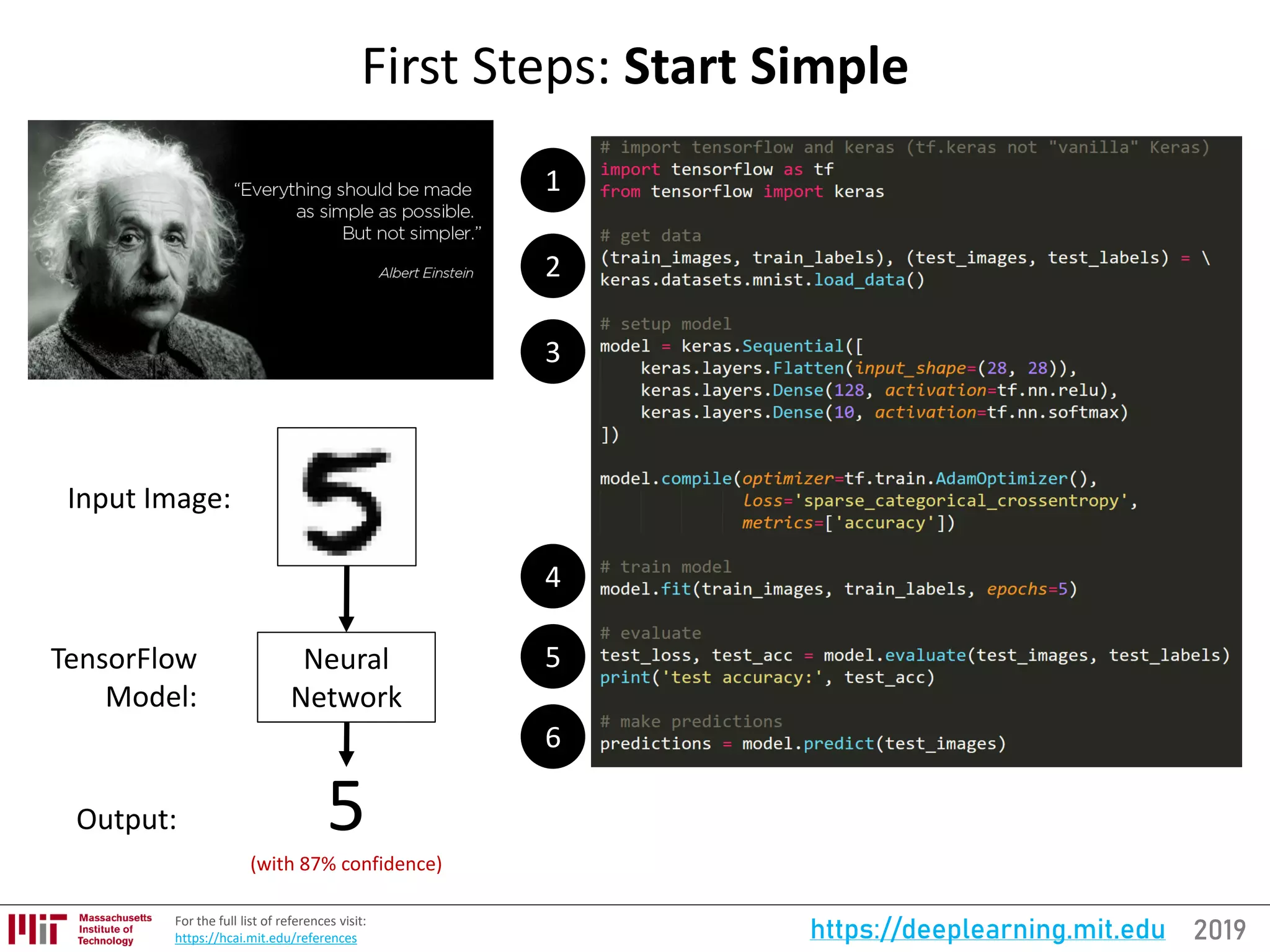
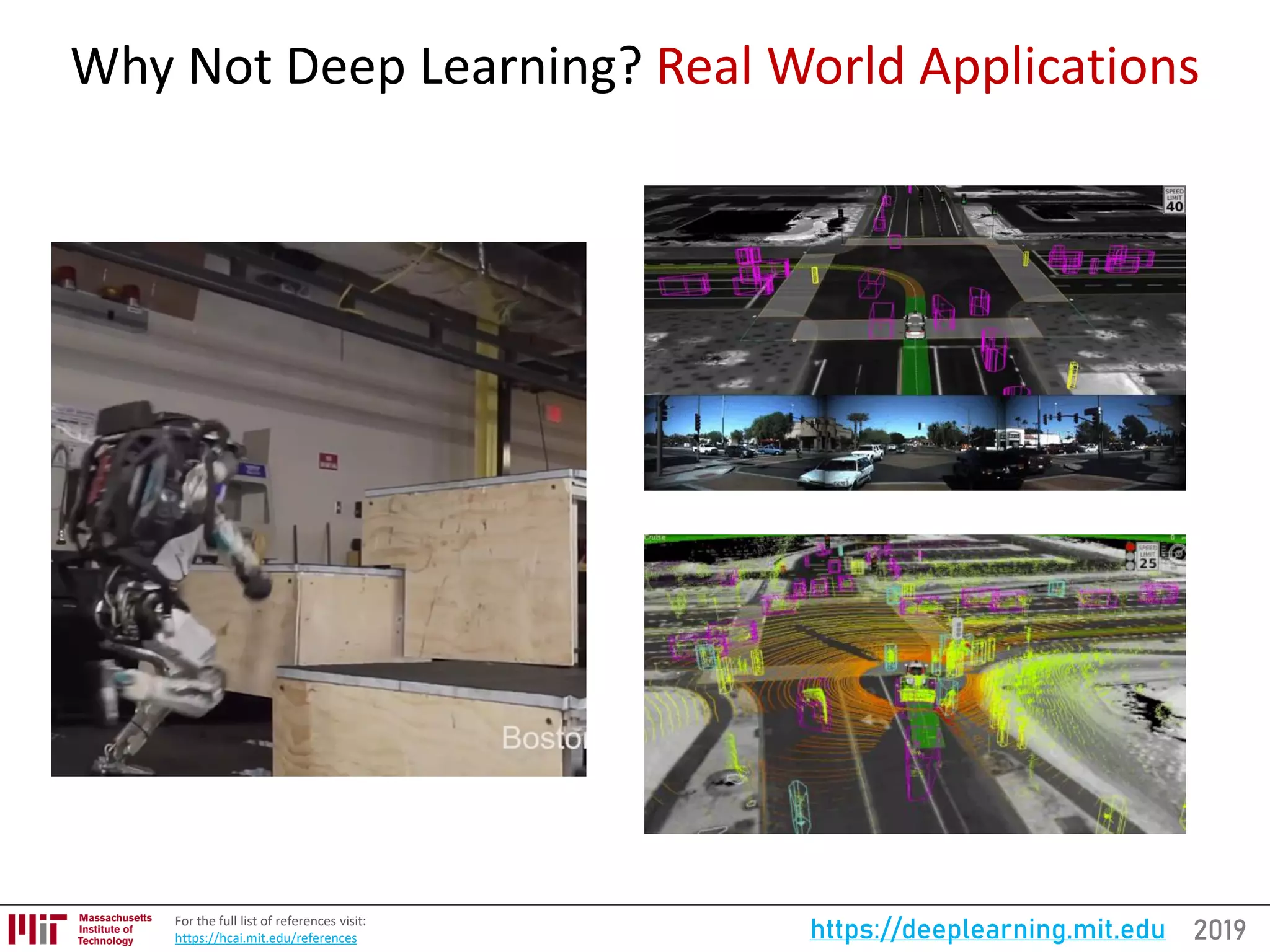
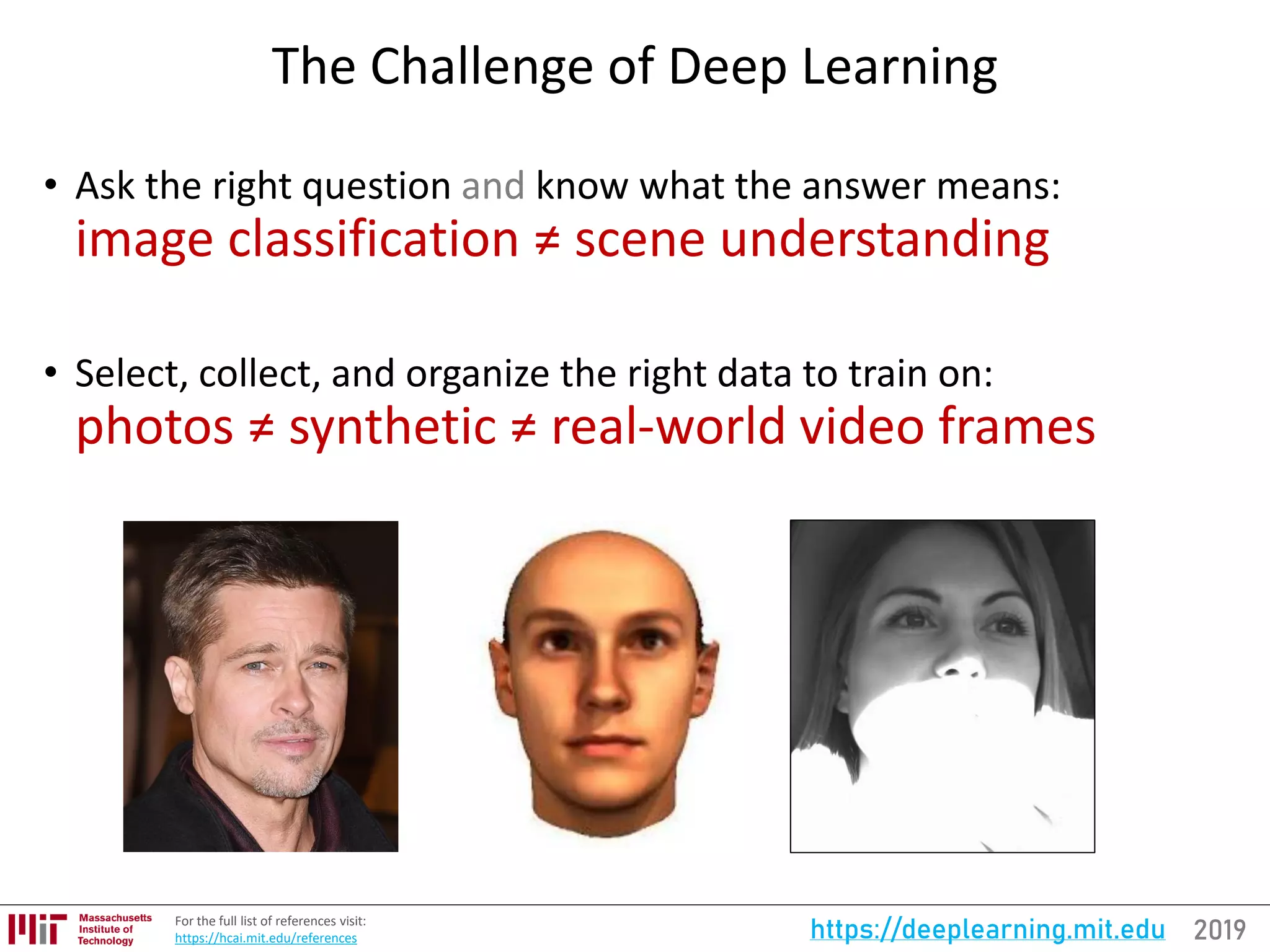
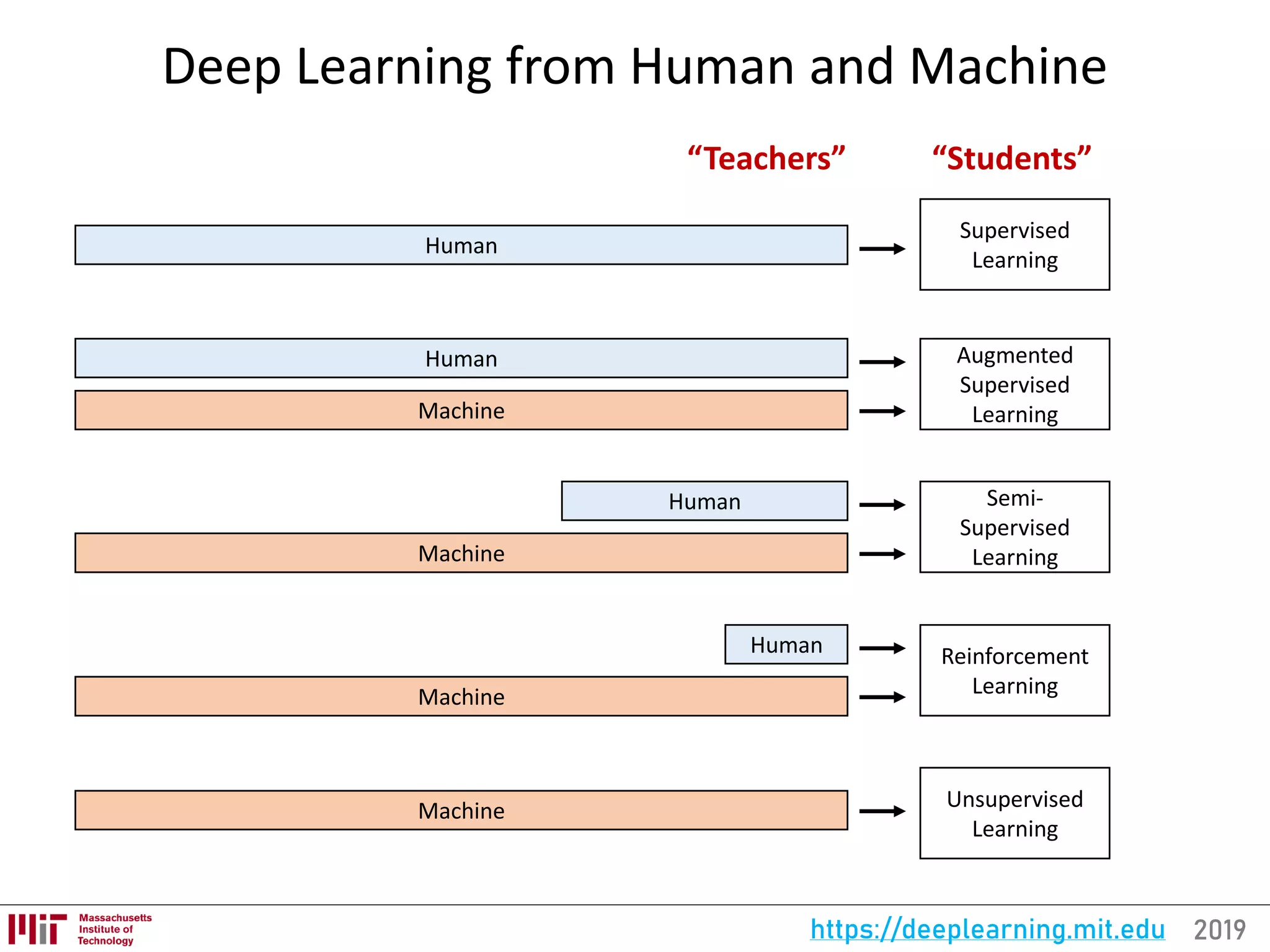
The document provides an overview of deep learning, detailing its basic components, historical milestones, and current applications such as image and speech recognition. It discusses challenges in deep learning, including the need for quality data, understanding complex tasks, and the limitations of neural networks compared to human intelligence. Additionally, it highlights tools like TensorFlow and PyTorch, along with concepts like representation learning, backpropagation, and regularization techniques to improve model performance.


