We are starting at 14:00!
Grab a seat and get ready
#7 Neural Networks
AI Saturdays Kigali
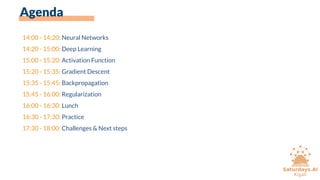
Agenda
14:00 - 14:20: Neural Networks
14:20 - 15:00: Deep Learning
15:00 - 15:20: Activation Function
15:20 - 15:35: Gradient Descent
15:35 - 15:45: Backpropagation
15:45 - 16:00: Regularization
16:00 - 16:30: Lunch
16:30 - 17:30: Practice
17:30 - 18:00: Challenges & Next steps
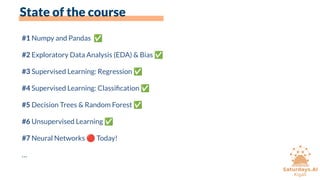
State of the course
#1 Numpy and Pandas ✅
#2 Exploratory Data Analysis (EDA) & Bias ✅
#3 Supervised Learning: Regression ✅
#4 Supervised Learning: Classification ✅
#5 Decision Trees & Random Forest ✅
#6 Unsupervised Learning ✅
#7 Neural Networks 🔴 Today!
…
Neural Networks
Neural Networks (overview)
Many tasks that involve intelligence, pattern recognition, and object detection are extremely difficult to
automate, yet seem to be performed easily and naturally by animals and young children.
Have you ever wondered how your brain recognizes images?
● No matter what or how the image looks, the brain can tell that this is an image of a cat and not a
dog.
● The brain relates to the best possible pattern and concludes the result.
Why Neural Networks?
Neural Networks: Why?
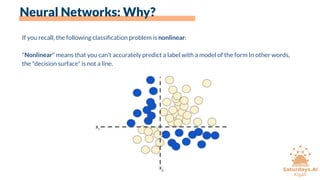
If you recall, the following classification problem is nonlinear:
"Nonlinear" means that you can't accurately predict a label with a model of the form In other words,
the "decision surface" is not a line.
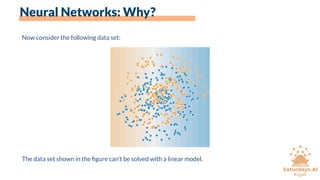
Now consider the following data set:
The data set shown in the figure can't be solved with a linear model.
Neural Networks: Why?
How Neural Networks work
Neural Networks
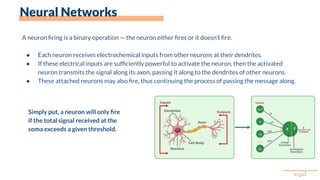
A neuron firing is a binary operation — the neuron either fires or it doesn’t fire.
● Each neuron receives electrochemical inputs from other neurons at their dendrites.
● If these electrical inputs are sufficiently powerful to activate the neuron, then the activated
neuron transmits the signal along its axon, passing it along to the dendrites of other neurons.
● These attached neurons may also fire, thus continuing the process of passing the message along.
Simply put, a neuron will only fire
if the total signal received at the
soma exceeds a given threshold.
Neural Networks
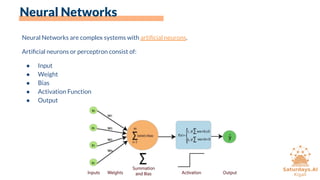
Neural Networks are complex systems with artificial neurons.
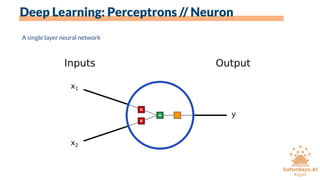
Artificial neurons or perceptron consist of:
● Input
● Weight
● Bias
● Activation Function
● Output
Neural Networks: Topics
● Deep Learning
● Activation functions
● Gradient Descent
● Backpropagation
● Regularization
● PyTorch & Other Tools!
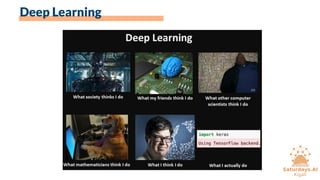
Deep Learning
Deep Learning
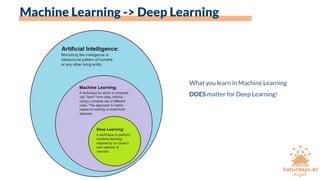
Machine Learning -> Deep Learning
What you learn in Machine Learning
DOES matter for Deep Learning!
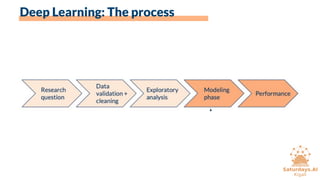
Deep Learning: The process
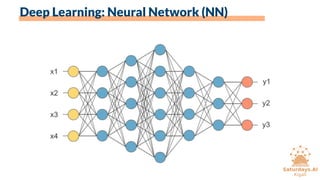
Deep Learning: Neural Network (NN)
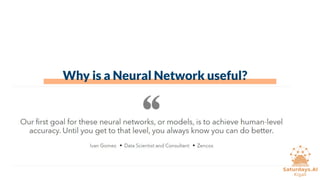
Why is a Neural Network useful?
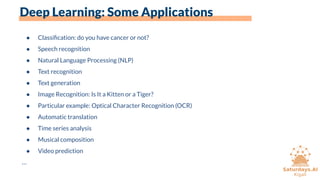
Deep Learning: Some Applications
● Classification: do you have cancer or not?
● Speech recognition
● Natural Language Processing (NLP)
● Text recognition
● Text generation
● Image Recognition: Is It a Kitten or a Tiger?
● Particular example: Optical Character Recognition (OCR)
● Automatic translation
● Time series analysis
● Musical composition
● Video prediction
…
What are the different components of a NN?
Deep Learning: Perceptrons // Neuron
A single layer neural network
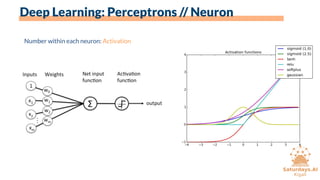
Number within each neuron: Activation
Deep Learning: Perceptrons // Neuron
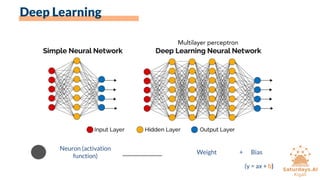
Deep Learning
Neuron (activation
function)
Weight + Bias
(y = ax + b)
Multilayer perceptron
How does it work?
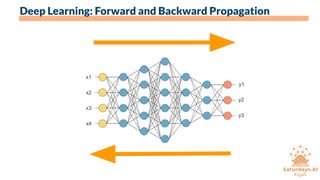
Deep Learning: Forward and Backward Propagation
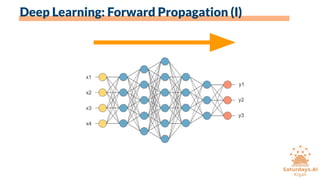
Deep Learning: Forward Propagation (I)
Source: 3Blue1Brown
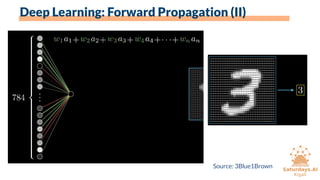
Deep Learning: Forward Propagation (II)
Source: 3Blue1Brown
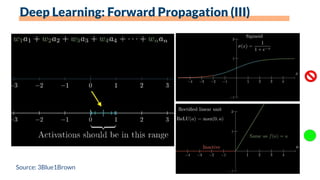
Deep Learning: Forward Propagation (III)
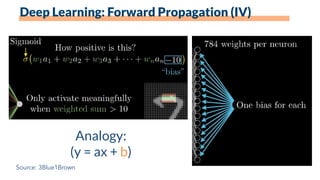
Analogy:
(y = ax + b)
Source: 3Blue1Brown
Deep Learning: Forward Propagation (IV)
Source: 3Blue1Brown
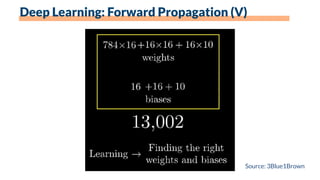
Deep Learning: Forward Propagation (V)
Source: 3Blue1Brown
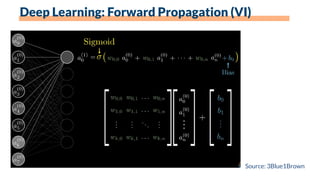
Deep Learning: Forward Propagation (VI)
Source: 3Blue1Brown
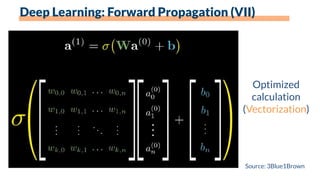
Optimized
calculation
(Vectorization)
Deep Learning: Forward Propagation (VII)
Neural networks: Nodes and hidden layers
Forward Propagation
https://developers.google.com/machine-learning/crash-course/neural-
networks/nodes-hidden-layers
Activation Function
Activation Function
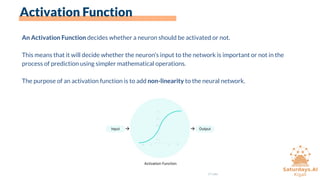
An Activation Function decides whether a neuron should be activated or not.
This means that it will decide whether the neuron’s input to the network is important or not in the
process of prediction using simpler mathematical operations.
The purpose of an activation function is to add non-linearity to the neural network.
Common Activation Function
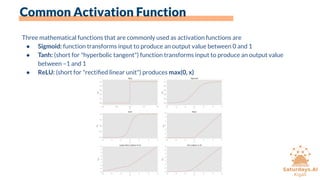
Three mathematical functions that are commonly used as activation functions are
● Sigmoid: function transforms input to produce an output value between 0 and 1
● Tanh: (short for "hyperbolic tangent") function transforms input to produce an output value
between –1 and 1
● ReLU: (short for "rectified linear unit") produces max(0, x)
Neural networks: Activation functions
Forward Propagation
https://developers.google.com/machine-learning/crash-course/neural-
networks/activation-functions
How do we know if the NN will be good or bad?
Gradient Descent
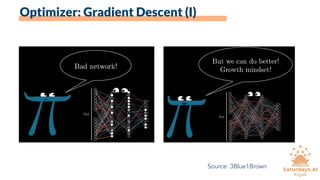
Optimizer: Gradient Descent (I)
Source: 3Blue1Brown
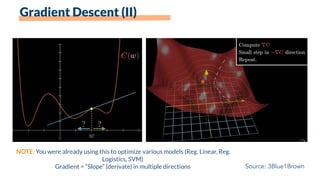
Gradient Descent (II)
NOTE: You were already using this to optimize various models (Reg. Linear, Reg.
Logistics, SVM)
Gradient = “Slope” (derivate) in multiple directions Source: 3Blue1Brown
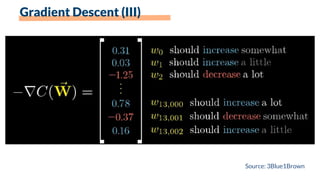
Gradient Descent (III)
Source: 3Blue1Brown
How do we know if the NN will be good or bad?
Backpropagation
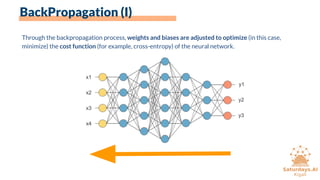
BackPropagation (I)
Through the backpropagation process, weights and biases are adjusted to optimize (in this case,
minimize) the cost function (for example, cross-entropy) of the neural network.
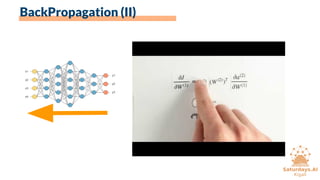
BackPropagation (II)
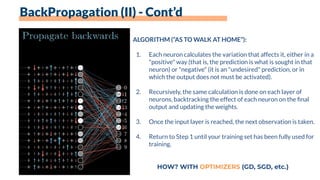
ALGORITHM (“AS TO WALK AT HOME”):
1. Each neuron calculates the variation that affects it, either in a
"positive" way (that is, the prediction is what is sought in that
neuron) or "negative" (it is an "undesired" prediction, or in
which the output does not must be activated).
2. Recursively, the same calculation is done on each layer of
neurons, backtracking the effect of each neuron on the final
output and updating the weights.
3. Once the input layer is reached, the next observation is taken.
4. Return to Step 1 until your training set has been fully used for
training.
HOW? WITH OPTIMIZERS (GD, SGD, etc.)
BackPropagation (II) - Cont’d
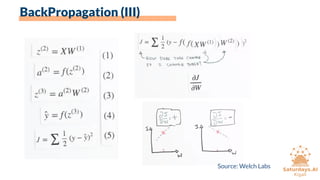
Source: Welch Labs
BackPropagation (III)
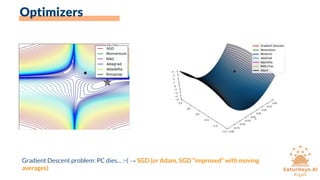
Optimizers
Gradient Descent problem: PC dies… :-( → SGD (or Adam, SGD “improved” with moving
averages)
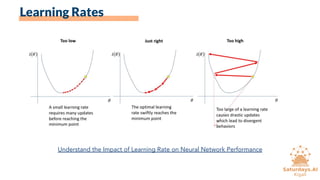
Learning Rates
Understand the Impact of Learning Rate on Neural Network Performance
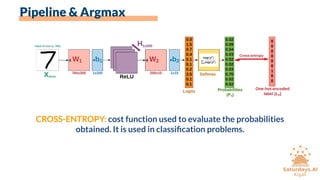
Pipeline & Argmax
CROSS-ENTROPY: cost function used to evaluate the probabilities
obtained. It is used in classification problems.
So if this works like ML, can you overfit an NN?
INDEED !
Regularization
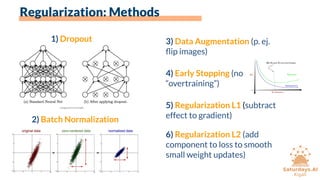
Regularization: Methods
1) Dropout
2) Batch Normalization
3) Data Augmentation (p. ej.
flip images)
4) Early Stopping (no
“overtraining”)
6) Regularization L2 (add
component to loss to smooth
small weight updates)
5) Regularization L1 (subtract
effect to gradient)
What are the tools you can use to create a NN?
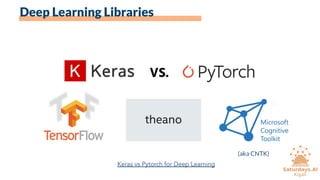
Deep Learning Libraries
Keras vs Pytorch for Deep Learning
(aka CNTK)
Lunch
Practice - NNs
https://developers.google.com/machine-learning/cra
sh-course/neural-networks/interactive-exercises
Challenges & Next
steps!
Any
questions?
THANKS
kigali@saturdays.ai
coming soon
coming soon

#7 Neural Networks Artificial intelligence