Recent Developments in
SparkR for Advanced Analytics
Xiangrui Meng
meng@databricks.com
2016/06/07 - Spark Summit 2016
About Me
• Software Engineer at Databricks
• tech lead of machine learning and data science
• Committer and PMC member of Apache Spark
• Ph.D. from Stanford in computational mathematics
2
Outline
• Introduction to SparkR
• Descriptive analytics in SparkR
• Predictive analytics in SparkR
• Future directions
3
Introduction to SparkR
Bridging the gap between R and Big Data
SparkR
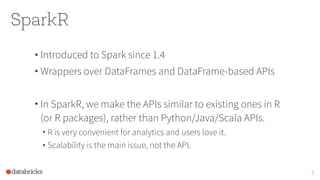
• Introduced to Spark since 1.4
• Wrappers over DataFrames and DataFrame-based APIs
• In SparkR, we make the APIs similar to existing ones in R
(or R packages), rather than Python/Java/Scala APIs.
• R is very convenient for analytics and users love it.
• Scalability is the main issue, not the API.
5
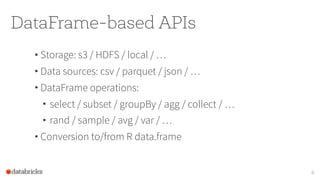
DataFrame-based APIs
• Storage: s3 / HDFS / local / …
• Data sources: csv / parquet / json / …
• DataFrame operations:
• select / subset / groupBy / agg / collect / …
• rand / sample / avg / var / …
• Conversion to/from R data.frame
6
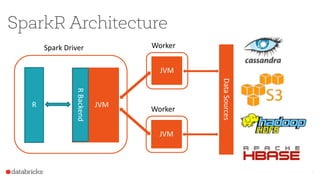
SparkR Architecture
7
Spark Driver
R JVM
RBackend
JVM
Worker
JVM
Worker
DataSources
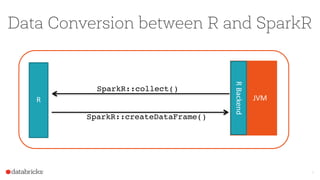
Data Conversion between R and SparkR
8
R JVM
RBackend
SparkR::collect()
SparkR::createDataFrame()
Descriptive Analytics
Big Data at a glimpse in SparkR
Summary Statistics
10
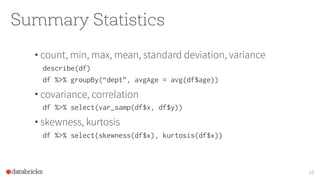
• count, min, max, mean, standard deviation, variance
describe(df)
df %>% groupBy(“dept”, avgAge = avg(df$age))
• covariance, correlation
df %>% select(var_samp(df$x, df$y))
• skewness, kurtosis
df %>% select(skewness(df$x), kurtosis(df$x))
Sampling Algorithms
• Bernoulli sampling (without replacement)

df %>% sample(FALSE, 0.01)
• Poisson sampling (with replacement)

df %>% sample(TRUE, 0.01)
• stratified sampling

df %>% sampleBy(“key”, c(positive = 1.0, negative = 0.1))
11
Approximate Algorithms
• frequent items [Karp03]
df %>% freqItems(c(“title”, “gender”), support = 0.01)
• approximate quantiles [Greenwald01]
df %>% approxQuantile(“value”, c(0.1, 0.5, 0.9), relErr = 0.01)
• single pass with aggregate pattern
• trade-off between accuracy and space
12
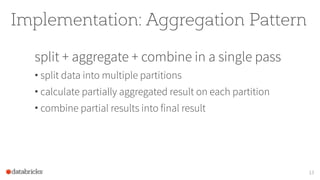
Implementation: Aggregation Pattern
split + aggregate + combine in a single pass
• split data into multiple partitions
• calculate partially aggregated result on each partition
• combine partial results into final result
13
Implementation: High-Performance
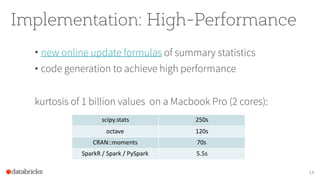
• new online update formulas of summary statistics
• code generation to achieve high performance
kurtosis of 1 billion values on a Macbook Pro (2 cores):
14
scipy.stats 250s
octave 120s
CRAN::moments 70s
SparkR / Spark / PySpark 5.5s
Predictive Analytics
Enabling large-scale machine learning in SparkR
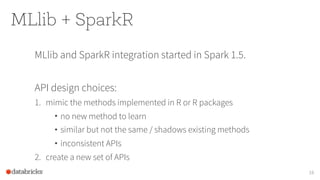
MLlib + SparkR
MLlib and SparkR integration started in Spark 1.5.
API design choices:
1. mimic the methods implemented in R or R packages
• no new method to learn
• similar but not the same / shadows existing methods
• inconsistent APIs
2. create a new set of APIs
16
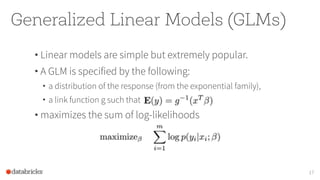
Generalized Linear Models (GLMs)
• Linear models are simple but extremely popular.
• A GLM is specified by the following:
• a distribution of the response (from the exponential family),
• a link function g such that
• maximizes the sum of log-likelihoods
17
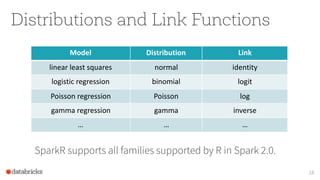
Distributions and Link Functions
SparkR supports all families supported by R in Spark 2.0.
18
Model Distribution Link
linear least squares normal identity
logistic regression binomial logit
Poisson regression Poisson log
gamma regression gamma inverse
… … …
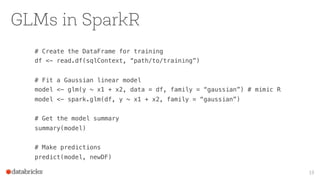
GLMs in SparkR
# Create the DataFrame for training
df <- read.df(sqlContext, “path/to/training”)
# Fit a Gaussian linear model
model <- glm(y ~ x1 + x2, data = df, family = “gaussian”) # mimic R
model <- spark.glm(df, y ~ x1 + x2, family = “gaussian”)
# Get the model summary
summary(model)
# Make predictions
predict(model, newDF)
19
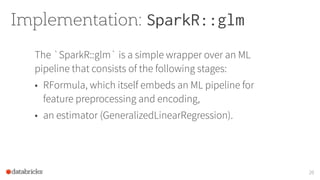
Implementation: SparkR::glm
The `SparkR::glm` is a simple wrapper over an ML
pipeline that consists of the following stages:
• RFormula, which itself embeds an ML pipeline for
feature preprocessing and encoding,
• an estimator (GeneralizedLinearRegression).
20
RWrapper
Implementation: SparkR::glm
21
RFormula
GLM
RWrapper
RFormula
GLM
StringIndexer
VectorAssembler
IndexToString
StringIndexer
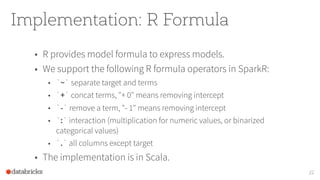
Implementation: R Formula
22
• R provides model formula to express models.
• We support the following R formula operators in SparkR:
• `~` separate target and terms
• `+` concat terms, "+ 0" means removing intercept
• `-` remove a term, "- 1" means removing intercept
• `:` interaction (multiplication for numeric values, or binarized
categorical values)
• `.` all columns except target
• The implementation is in Scala.
Implementation: Test against R
Besides normal tests, we also verify our implementation using R.
/*

df <- as.data.frame(cbind(A, b))

for (formula in c(b ~ . -1, b ~ .)) {

model <- lm(formula, data=df, weights=w)

print(as.vector(coef(model)))

}


[1] -3.727121 3.009983

[1] 18.08 6.08 -0.60

*/
val expected = Seq(Vectors.dense(0.0, -3.727121, 3.009983),

Vectors.dense(18.08, 6.08, -0.60))
23
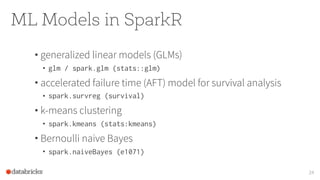
ML Models in SparkR
• generalized linear models (GLMs)
• glm / spark.glm (stats::glm)
• accelerated failure time (AFT) model for survival analysis
• spark.survreg (survival)
• k-means clustering
• spark.kmeans (stats:kmeans)
• Bernoulli naive Bayes
• spark.naiveBayes (e1071)
24
Model Persistence in SparkR
• model persistence supported for all ML models in SparkR
• thin wrappers over pipeline persistence from MLlib
model <- spark.glm(df, x ~ y + z, family = “gaussian”)
write.ml(model, path)
model <- read.ml(path)
summary(model)
• feasible to pass saved models to Scala/Java engineers
25
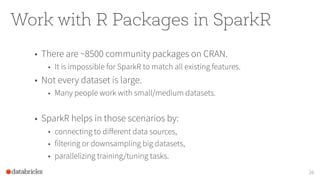
Work with R Packages in SparkR
• There are ~8500 community packages on CRAN.
• It is impossible for SparkR to match all existing features.
• Not every dataset is large.
• Many people work with small/medium datasets.
• SparkR helps in those scenarios by:
• connecting to different data sources,
• filtering or downsampling big datasets,
• parallelizing training/tuning tasks.
26
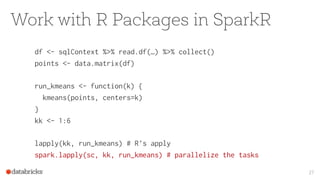
Work with R Packages in SparkR
df <- sqlContext %>% read.df(…) %>% collect()
points <- data.matrix(df)
run_kmeans <- function(k) {
kmeans(points, centers=k)
}
kk <- 1:6
lapply(kk, run_kmeans) # R’s apply
spark.lapply(sc, kk, run_kmeans) # parallelize the tasks
27
summary(this.talk)
• SparkR enables big data analytics on R
• descriptive analytics on top of DataFrames
• predictive analytics from MLlib integration
• SparkR works well with existing R packages
Thanks to the Apache Spark community for developing and
maintaining SparkR: Alteryx, Berkeley AMPLab, Databricks,
Hortonworks, IBM, Intel, etc, and individual contributors!!
28
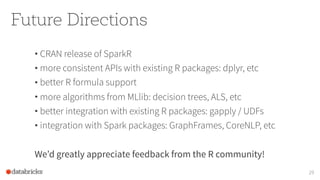
Future Directions
• CRAN release of SparkR
• more consistent APIs with existing R packages: dplyr, etc
• better R formula support
• more algorithms from MLlib: decision trees, ALS, etc
• better integration with existing R packages: gapply / UDFs
• integration with Spark packages: GraphFrames, CoreNLP, etc
We’d greatly appreciate feedback from the R community!
29
Try Apache Spark with Databricks
30
http://databricks.com/try
• Download a companion notebook of this talk at: http://dbricks.co/1rbujoD
• Try latest version of Apache Spark and preview of Spark 2.0
Thank you.
• SparkRuserguideonApacheSparkwebsite
• MLlibroadmapforSpark2.1
• Officehours:
• 2-3:30pmatExpoHallTheater;3:45-6pmatDatabricksbooth
• DatabricksCommunityEditionandblogposts

Recent Developments In SparkR For Advanced Analytics

  • 1.
    Recent Developments in SparkRfor Advanced Analytics Xiangrui Meng meng@databricks.com 2016/06/07 - Spark Summit 2016
  • 2.
    About Me • SoftwareEngineer at Databricks • tech lead of machine learning and data science • Committer and PMC member of Apache Spark • Ph.D. from Stanford in computational mathematics 2
  • 3.
    Outline • Introduction toSparkR • Descriptive analytics in SparkR • Predictive analytics in SparkR • Future directions 3
  • 4.
    Introduction to SparkR Bridgingthe gap between R and Big Data
  • 5.
    SparkR • Introduced toSpark since 1.4 • Wrappers over DataFrames and DataFrame-based APIs • In SparkR, we make the APIs similar to existing ones in R (or R packages), rather than Python/Java/Scala APIs. • R is very convenient for analytics and users love it. • Scalability is the main issue, not the API. 5
  • 6.
    DataFrame-based APIs • Storage:s3 / HDFS / local / … • Data sources: csv / parquet / json / … • DataFrame operations: • select / subset / groupBy / agg / collect / … • rand / sample / avg / var / … • Conversion to/from R data.frame 6
  • 7.
    SparkR Architecture 7 Spark Driver RJVM RBackend JVM Worker JVM Worker DataSources
  • 8.
    Data Conversion betweenR and SparkR 8 R JVM RBackend SparkR::collect() SparkR::createDataFrame()
  • 9.
    Descriptive Analytics Big Dataat a glimpse in SparkR
  • 10.
    Summary Statistics 10 • count,min, max, mean, standard deviation, variance describe(df) df %>% groupBy(“dept”, avgAge = avg(df$age)) • covariance, correlation df %>% select(var_samp(df$x, df$y)) • skewness, kurtosis df %>% select(skewness(df$x), kurtosis(df$x))
  • 11.
    Sampling Algorithms • Bernoullisampling (without replacement)
 df %>% sample(FALSE, 0.01) • Poisson sampling (with replacement)
 df %>% sample(TRUE, 0.01) • stratified sampling
 df %>% sampleBy(“key”, c(positive = 1.0, negative = 0.1)) 11
  • 12.
    Approximate Algorithms • frequentitems [Karp03] df %>% freqItems(c(“title”, “gender”), support = 0.01) • approximate quantiles [Greenwald01] df %>% approxQuantile(“value”, c(0.1, 0.5, 0.9), relErr = 0.01) • single pass with aggregate pattern • trade-off between accuracy and space 12
  • 13.
    Implementation: Aggregation Pattern split+ aggregate + combine in a single pass • split data into multiple partitions • calculate partially aggregated result on each partition • combine partial results into final result 13
  • 14.
    Implementation: High-Performance • newonline update formulas of summary statistics • code generation to achieve high performance kurtosis of 1 billion values on a Macbook Pro (2 cores): 14 scipy.stats 250s octave 120s CRAN::moments 70s SparkR / Spark / PySpark 5.5s
  • 15.
  • 16.
    MLlib + SparkR MLliband SparkR integration started in Spark 1.5. API design choices: 1. mimic the methods implemented in R or R packages • no new method to learn • similar but not the same / shadows existing methods • inconsistent APIs 2. create a new set of APIs 16
  • 17.
    Generalized Linear Models(GLMs) • Linear models are simple but extremely popular. • A GLM is specified by the following: • a distribution of the response (from the exponential family), • a link function g such that • maximizes the sum of log-likelihoods 17
  • 18.
    Distributions and LinkFunctions SparkR supports all families supported by R in Spark 2.0. 18 Model Distribution Link linear least squares normal identity logistic regression binomial logit Poisson regression Poisson log gamma regression gamma inverse … … …
  • 19.
    GLMs in SparkR #Create the DataFrame for training df <- read.df(sqlContext, “path/to/training”) # Fit a Gaussian linear model model <- glm(y ~ x1 + x2, data = df, family = “gaussian”) # mimic R model <- spark.glm(df, y ~ x1 + x2, family = “gaussian”) # Get the model summary summary(model) # Make predictions predict(model, newDF) 19
  • 20.
    Implementation: SparkR::glm The `SparkR::glm`is a simple wrapper over an ML pipeline that consists of the following stages: • RFormula, which itself embeds an ML pipeline for feature preprocessing and encoding, • an estimator (GeneralizedLinearRegression). 20
  • 21.
  • 22.
    Implementation: R Formula 22 •R provides model formula to express models. • We support the following R formula operators in SparkR: • `~` separate target and terms • `+` concat terms, "+ 0" means removing intercept • `-` remove a term, "- 1" means removing intercept • `:` interaction (multiplication for numeric values, or binarized categorical values) • `.` all columns except target • The implementation is in Scala.
  • 23.
    Implementation: Test againstR Besides normal tests, we also verify our implementation using R. /*
 df <- as.data.frame(cbind(A, b))
 for (formula in c(b ~ . -1, b ~ .)) {
 model <- lm(formula, data=df, weights=w)
 print(as.vector(coef(model)))
 }
 
 [1] -3.727121 3.009983
 [1] 18.08 6.08 -0.60
 */ val expected = Seq(Vectors.dense(0.0, -3.727121, 3.009983),
 Vectors.dense(18.08, 6.08, -0.60)) 23
  • 24.
    ML Models inSparkR • generalized linear models (GLMs) • glm / spark.glm (stats::glm) • accelerated failure time (AFT) model for survival analysis • spark.survreg (survival) • k-means clustering • spark.kmeans (stats:kmeans) • Bernoulli naive Bayes • spark.naiveBayes (e1071) 24
  • 25.
    Model Persistence inSparkR • model persistence supported for all ML models in SparkR • thin wrappers over pipeline persistence from MLlib model <- spark.glm(df, x ~ y + z, family = “gaussian”) write.ml(model, path) model <- read.ml(path) summary(model) • feasible to pass saved models to Scala/Java engineers 25
  • 26.
    Work with RPackages in SparkR • There are ~8500 community packages on CRAN. • It is impossible for SparkR to match all existing features. • Not every dataset is large. • Many people work with small/medium datasets. • SparkR helps in those scenarios by: • connecting to different data sources, • filtering or downsampling big datasets, • parallelizing training/tuning tasks. 26
  • 27.
    Work with RPackages in SparkR df <- sqlContext %>% read.df(…) %>% collect() points <- data.matrix(df) run_kmeans <- function(k) { kmeans(points, centers=k) } kk <- 1:6 lapply(kk, run_kmeans) # R’s apply spark.lapply(sc, kk, run_kmeans) # parallelize the tasks 27
  • 28.
    summary(this.talk) • SparkR enablesbig data analytics on R • descriptive analytics on top of DataFrames • predictive analytics from MLlib integration • SparkR works well with existing R packages Thanks to the Apache Spark community for developing and maintaining SparkR: Alteryx, Berkeley AMPLab, Databricks, Hortonworks, IBM, Intel, etc, and individual contributors!! 28
  • 29.
    Future Directions • CRANrelease of SparkR • more consistent APIs with existing R packages: dplyr, etc • better R formula support • more algorithms from MLlib: decision trees, ALS, etc • better integration with existing R packages: gapply / UDFs • integration with Spark packages: GraphFrames, CoreNLP, etc We’d greatly appreciate feedback from the R community! 29
  • 30.
    Try Apache Sparkwith Databricks 30 http://databricks.com/try • Download a companion notebook of this talk at: http://dbricks.co/1rbujoD • Try latest version of Apache Spark and preview of Spark 2.0
  • 31.
    Thank you. • SparkRuserguideonApacheSparkwebsite •MLlibroadmapforSpark2.1 • Officehours: • 2-3:30pmatExpoHallTheater;3:45-6pmatDatabricksbooth • DatabricksCommunityEditionandblogposts