Introduction to Spark Developer Training
Diana Carroll | Senior Curriculum Developer
Agenda
 Cloudera's Learning Path for Developers
 Target Audience and Prerequisites
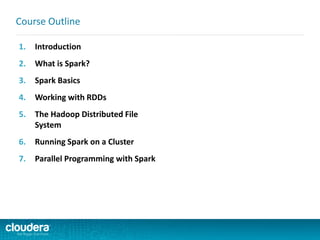
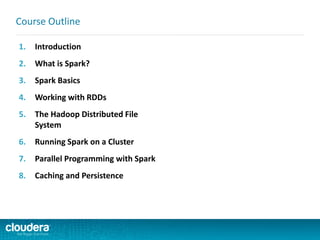
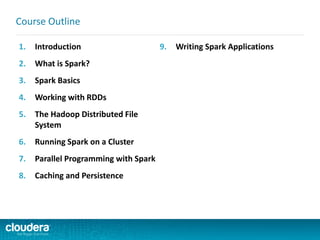
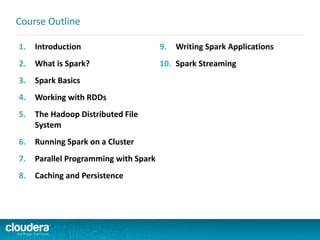
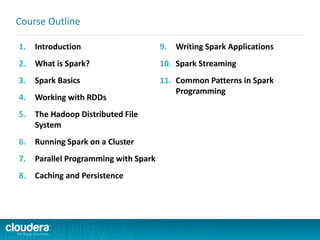
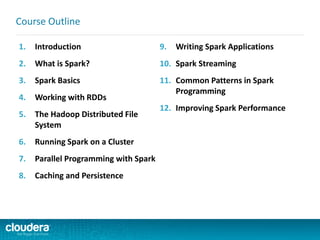
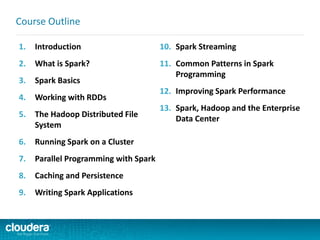
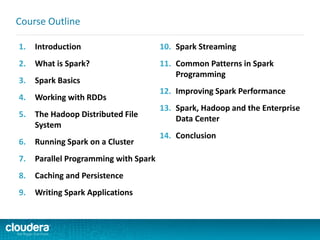
 Course Outline
 Short Presentation Based on Actual Course Material
 Question and Answer Session
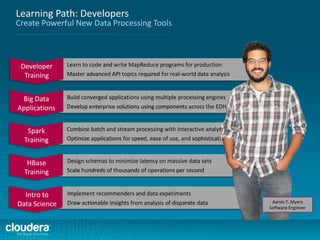
Learning Path: Developers
Create Powerful New Data Processing Tools
Learn to code and write MapReduce programs for production
Master advanced API topics required for real-world data analysis
Design schemas to minimize latency on massive data sets
Scale hundreds of thousands of operations per second
Implement recommenders and data experiments
Draw actionable insights from analysis of disparate data
Build converged applications using multiple processing engines
Develop enterprise solutions using components across the EDH
Combine batch and stream processing with interactive analytics
Optimize applications for speed, ease of use, and sophistication
Spark
Training
Big Data
Applications
HBase
Training
Intro to
Data Science
Developer
Training
Aaron T. Myers
Software Engineer
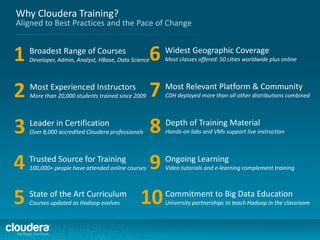
1 Broadest Range of Courses
Developer, Admin, Analyst, HBase, Data Science
2
3
Most Experienced Instructors
More than 20,000 students trained since 2009
6 Widest Geographic Coverage
Most classes offered: 50 cities worldwide plus online
7 Most Relevant Platform & Community
CDH deployed more than all other distributions combined
8 Depth of Training Material
Hands-on labs and VMs support live instruction
Leader in Certification
Over 8,000 accredited Cloudera professionals
4 Trusted Source for Training
100,000+ people have attended online courses 9 Ongoing Learning
Video tutorials and e-learning complement training
Why Cloudera Training?
Aligned to Best Practices and the Pace of Change
5 State of the Art Curriculum
Courses updated as Hadoop evolves 10Commitment to Big Data Education
University partnerships to teach Hadoop in the classroom
Cloudera Developer Training for Apache Spark
About the Course
 Intended for people who write code, such as
–Software Engineers
–Data Engineers
–ETL Developers
Target Audience
 No prior knowledge of Spark, Hadoop or distributed programming
concepts is required
Course Prerequisites
 No prior knowledge of Spark, Hadoop or distributed programming
concepts is required
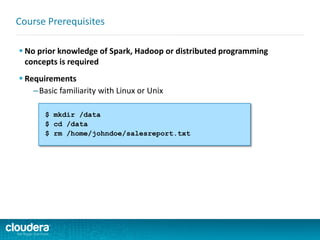
 Requirements
–Basic familiarity with Linux or Unix
Course Prerequisites
$ mkdir /data
$ cd /data
$ rm /home/johndoe/salesreport.txt
 No prior knowledge of Spark, Hadoop or distributed programming
concepts is required
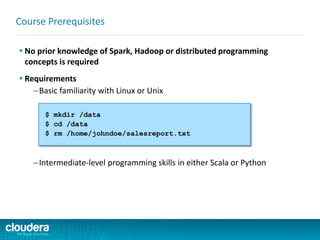
 Requirements
–Basic familiarity with Linux or Unix
–Intermediate-level programming skills in either Scala or Python
Course Prerequisites
$ mkdir /data
$ cd /data
$ rm /home/johndoe/salesreport.txt
Example of Required Scala Skill Level
 Do you understand the following code? Could you write something
similar?
object Maps {
val colors = Map("red" -> 0xFF0000,
"turquoise" -> 0x00FFFF,
"black" -> 0x000000,
"orange" -> 0xFF8040,
"brown" -> 0x804000)
def main(args: Array[String]) {
for (name <- args) println(
colors.get(name) match {
case Some(code) =>
name + " has code: " + code
case None =>
"Unknown color: " + name
}
)
}
}
Example of Required Python Skill Level
 Do you understand the following code? Could you write something
similar?
import sys
def parsePurchases(s):
return s.split(',')
if __name__ == "__main__":
if len(sys.argv) < 2:
print "Usage: SumPrices <products>"
exit(-1)
prices = {'apple': 0.40, 'banana': 0.50, 'orange': 0.10}
total = sum(prices[fruit]
for fruit in parsePurchases(sys.argv[1]))
print 'Total: $%.2f' % total
 Getting started with Scala
–www.scala-lang.org
Practicing Scala or Python
 Getting started with Scala
–www.scala-lang.org
 Getting started with Python
–python.org
–developers.google.com/edu/python
–and many more
Practicing Scala or Python
1. Introduction
Course Outline
1. Introduction
2. What is Spark?
Course Outline
1. Introduction
2. What is Spark?
3. Spark Basics
Course Outline
1. Introduction
2. What is Spark?
3. Spark Basics
4. Working with RDDs
Course Outline
1. Introduction
2. What is Spark?
3. Spark Basics
4. Working with RDDs
5. The Hadoop Distributed File
System
Course Outline
1. Introduction
2. What is Spark?
3. Spark Basics
4. Working with RDDs
5. The Hadoop Distributed File
System
6. Running Spark on a Cluster
Course Outline
1. Introduction
2. What is Spark?
3. Spark Basics
4. Working with RDDs
5. The Hadoop Distributed File
System
6. Running Spark on a Cluster
7. Parallel Programming with Spark
Course Outline
1. Introduction
2. What is Spark?
3. Spark Basics
4. Working with RDDs
5. The Hadoop Distributed File
System
6. Running Spark on a Cluster
7. Parallel Programming with Spark
8. Caching and Persistence
Course Outline
1. Introduction
2. What is Spark?
3. Spark Basics
4. Working with RDDs
5. The Hadoop Distributed File
System
6. Running Spark on a Cluster
7. Parallel Programming with Spark
8. Caching and Persistence
9. Writing Spark Applications
Course Outline
1. Introduction
2. What is Spark?
3. Spark Basics
4. Working with RDDs
5. The Hadoop Distributed File
System
6. Running Spark on a Cluster
7. Parallel Programming with Spark
8. Caching and Persistence
9. Writing Spark Applications
10. Spark Streaming
Course Outline
1. Introduction
2. What is Spark?
3. Spark Basics
4. Working with RDDs
5. The Hadoop Distributed File
System
6. Running Spark on a Cluster
7. Parallel Programming with Spark
8. Caching and Persistence
9. Writing Spark Applications
10. Spark Streaming
11. Common Patterns in Spark
Programming
Course Outline
1. Introduction
2. What is Spark?
3. Spark Basics
4. Working with RDDs
5. The Hadoop Distributed File
System
6. Running Spark on a Cluster
7. Parallel Programming with Spark
8. Caching and Persistence
9. Writing Spark Applications
10. Spark Streaming
11. Common Patterns in Spark
Programming
12. Improving Spark Performance
Course Outline
1. Introduction
2. What is Spark?
3. Spark Basics
4. Working with RDDs
5. The Hadoop Distributed File
System
6. Running Spark on a Cluster
7. Parallel Programming with Spark
8. Caching and Persistence
9. Writing Spark Applications
10. Spark Streaming
11. Common Patterns in Spark
Programming
12. Improving Spark Performance
13. Spark, Hadoop and the Enterprise
Data Center
Course Outline
1. Introduction
2. What is Spark?
3. Spark Basics
4. Working with RDDs
5. The Hadoop Distributed File
System
6. Running Spark on a Cluster
7. Parallel Programming with Spark
8. Caching and Persistence
9. Writing Spark Applications
10. Spark Streaming
11. Common Patterns in Spark
Programming
12. Improving Spark Performance
13. Spark, Hadoop and the Enterprise
Data Center
14. Conclusion
Course Outline
 Based on
–Chapter 3: Spark Basics
–Chapter 4: Working with RDDs
Course Excerpt
 Based on
–Chapter 3: Spark Basics
–Chapter 4: Working with RDDs
 Topics
–What is Spark?
–The components of a distributed data processing system
–Intro to the Spark Shell
–Resilient Distributed Datasets
–RDD operations
–Example: WordCount
Course Excerpt
 Apache Spark is a fast, general engine for large-scale data
processing and analysis
–Open source, developed at UC Berkeley
 Written in Scala
–Functional programming language that runs in a JVM
What is Apache Spark?
 Apache Spark is a fast, general engine for large-scale data
processing and analysis
–Open source, developed at UC Berkeley
 Written in Scala
–Functional programming language that runs in a JVM
 Key Concepts
–Avoid the data bottleneck by distributing data when it is
stored
–Bring the processing to the data
–Data stored in memory
What is Apache Spark?
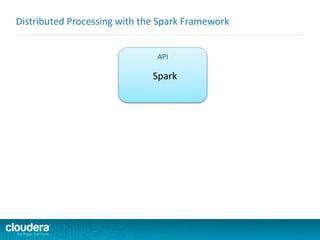
Distributed Processing with the Spark Framework
API
Spark
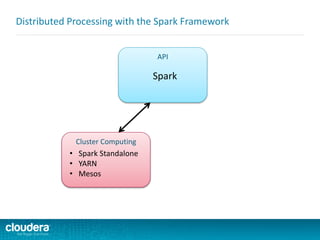
Distributed Processing with the Spark Framework
API
Cluster Computing
Spark
• Spark Standalone
• YARN
• Mesos
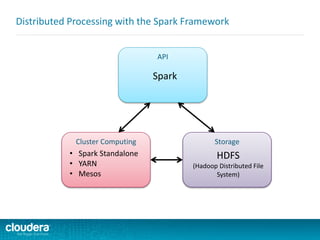
Distributed Processing with the Spark Framework
API
Cluster Computing Storage
Spark
• Spark Standalone
• YARN
• Mesos
HDFS
(Hadoop Distributed File
System)
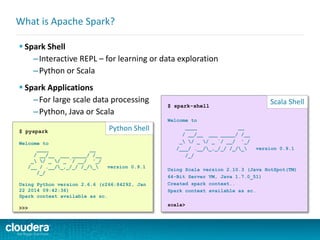
 Spark Shell
–Interactive REPL – for learning or data exploration
–Python or Scala
 Spark Applications
–For large scale data processing
–Python, Java or Scala
What is Apache Spark?
$ pyspark
Welcome to
____ __
/ __/__ ___ _____/ /__
_ / _ / _ `/ __/ '_/
/__ / .__/_,_/_/ /_/_ version 0.9.1
/_/
Using Python version 2.6.6 (r266:84292, Jan
22 2014 09:42:36)
Spark context available as sc.
>>>
$ spark-shell
Welcome to
____ __
/ __/__ ___ _____/ /__
_ / _ / _ `/ __/ '_/
/___/ .__/_,_/_/ /_/_ version 0.9.1
/_/
Using Scala version 2.10.3 (Java HotSpot(TM)
64-Bit Server VM, Java 1.7.0_51)
Created spark context..
Spark context available as sc.
scala>
Scala Shell
Python Shell
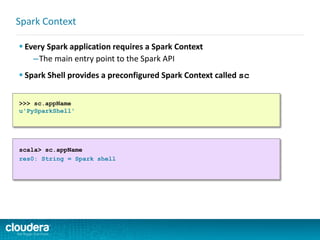
 Every Spark application requires a Spark Context
–The main entry point to the Spark API
 Spark Shell provides a preconfigured Spark Context called sc
Spark Context
>>> sc.appName
u'PySparkShell'
scala> sc.appName
res0: String = Spark shell
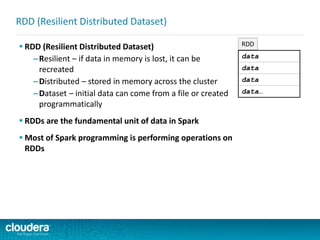
 RDD (Resilient Distributed Dataset)
–Resilient – if data in memory is lost, it can be
recreated
–Distributed – stored in memory across the cluster
–Dataset – initial data can come from a file or created
programmatically
 RDDs are the fundamental unit of data in Spark
 Most of Spark programming is performing operations on
RDDs
RDD (Resilient Distributed Dataset)
data
data
data
data…
RDD
I've never seen a purple cow.
I never hope to see one;
But I can tell you, anyhow,
I'd rather see than be one.
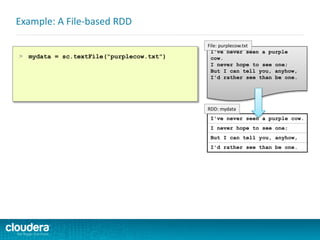
Example: A File-based RDD
I've never seen a purple
cow.
I never hope to see one;
But I can tell you, anyhow,
I'd rather see than be one.
File: purplecow.txt
RDD: mydata
> mydata = sc.textFile("purplecow.txt")
I've never seen a purple cow.
I never hope to see one;
But I can tell you, anyhow,
I'd rather see than be one.
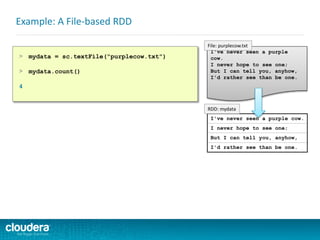
Example: A File-based RDD
I've never seen a purple
cow.
I never hope to see one;
But I can tell you, anyhow,
I'd rather see than be one.
File: purplecow.txt
RDD: mydata
> mydata = sc.textFile("purplecow.txt")
> mydata.count()
4
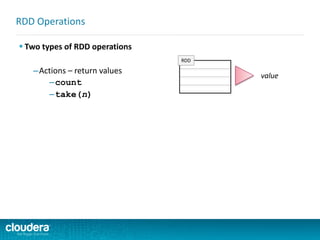
 Two types of RDD operations
–Actions – return values
–count
–take(n)
RDD Operations
value
RDD
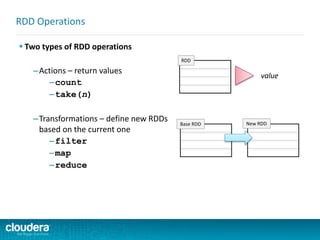
 Two types of RDD operations
–Actions – return values
–count
–take(n)
–Transformations – define new RDDs
based on the current one
–filter
–map
–reduce
RDD Operations
value
RDD
New RDDBase RDD
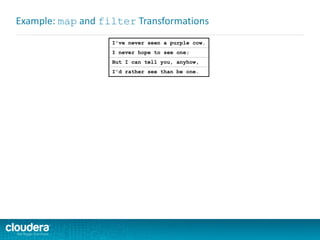
I've never seen a purple cow.
I never hope to see one;
But I can tell you, anyhow,
I'd rather see than be one.
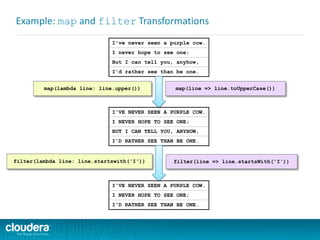
Example: map and filter Transformations
I've never seen a purple cow.
I never hope to see one;
But I can tell you, anyhow,
I'd rather see than be one.
I'VE NEVER SEEN A PURPLE COW.
I NEVER HOPE TO SEE ONE;
BUT I CAN TELL YOU, ANYHOW,
I'D RATHER SEE THAN BE ONE.
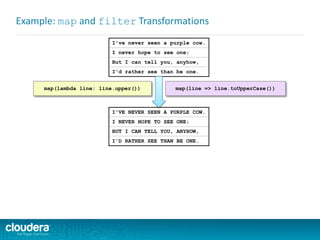
Example: map and filter Transformations
map(lambda line: line.upper()) map(line => line.toUpperCase())
I've never seen a purple cow.
I never hope to see one;
But I can tell you, anyhow,
I'd rather see than be one.
I'VE NEVER SEEN A PURPLE COW.
I NEVER HOPE TO SEE ONE;
BUT I CAN TELL YOU, ANYHOW,
I'D RATHER SEE THAN BE ONE.
Example: map and filter Transformations
I'VE NEVER SEEN A PURPLE COW.
I NEVER HOPE TO SEE ONE;
I'D RATHER SEE THAN BE ONE.
filter(lambda line: line.startswith('I'))
map(lambda line: line.upper()) map(line => line.toUpperCase())
filter(line => line.startsWith('I'))
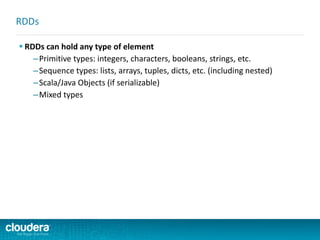
 RDDs can hold any type of element
–Primitive types: integers, characters, booleans, strings, etc.
–Sequence types: lists, arrays, tuples, dicts, etc. (including nested)
–Scala/Java Objects (if serializable)
–Mixed types
RDDs
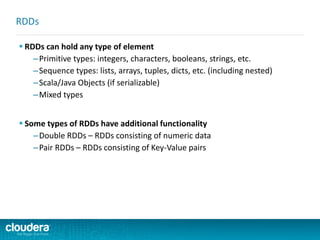
 RDDs can hold any type of element
–Primitive types: integers, characters, booleans, strings, etc.
–Sequence types: lists, arrays, tuples, dicts, etc. (including nested)
–Scala/Java Objects (if serializable)
–Mixed types
 Some types of RDDs have additional functionality
–Double RDDs – RDDs consisting of numeric data
–Pair RDDs – RDDs consisting of Key-Value pairs
RDDs
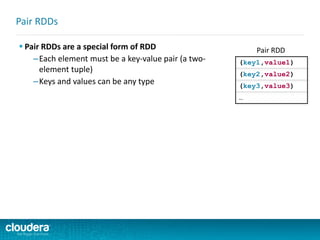
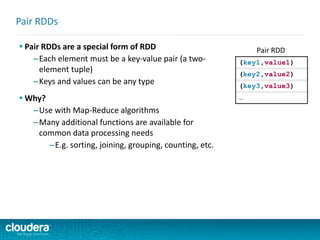
 Pair RDDs are a special form of RDD
–Each element must be a key-value pair (a two-
element tuple)
–Keys and values can be any type
Pair RDDs
(key1,value1)
(key2,value2)
(key3,value3)
…
Pair RDD
 Pair RDDs are a special form of RDD
–Each element must be a key-value pair (a two-
element tuple)
–Keys and values can be any type
 Why?
–Use with Map-Reduce algorithms
–Many additional functions are available for
common data processing needs
–E.g. sorting, joining, grouping, counting, etc.
Pair RDDs
(key1,value1)
(key2,value2)
(key3,value3)
…
Pair RDD
 MapReduce is a common programming model
–Two phases
–Map – process each element in a data set
–Reduce – aggregate or consolidate the data
–Easily applicable to distributed processing of large data sets
MapReduce
 MapReduce is a common programming model
–Two phases
–Map – process each element in a data set
–Reduce – aggregate or consolidate the data
–Easily applicable to distributed processing of large data sets
 Hadoop MapReduce is the major implementation
–Limited
–Each job has one Map phase, one Reduce phase in each
–Job output saved to files
MapReduce
 MapReduce is a common programming model
–Two phases
–Map – process each element in a data set
–Reduce – aggregate or consolidate the data
–Easily applicable to distributed processing of large data sets
 Hadoop MapReduce is the major implementation
–Limited
–Each job has one Map phase, one Reduce phase in each
–Job output saved to files
 Spark implements MapReduce with much greater flexibility
–Map and Reduce functions can be interspersed
–Results stored in memory
–Operations can be chained easily
MapReduce
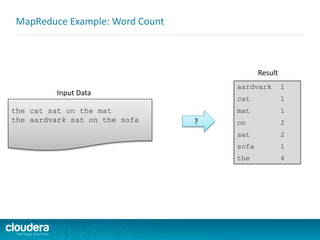
MapReduce Example: Word Count
the cat sat on the mat
the aardvark sat on the sofa
Input Data
Result
aardvark 1
cat 1
mat 1
on 2
sat 2
sofa 1
the 4
?
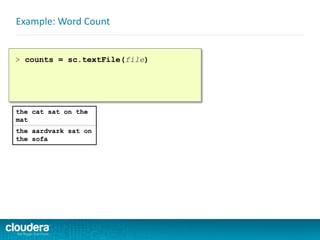
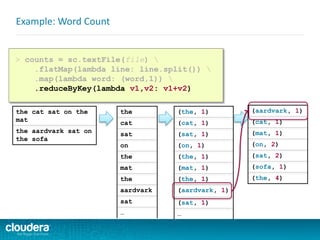
Example: Word Count
> counts = sc.textFile(file)
the cat sat on the
mat
the aardvark sat on
the sofa
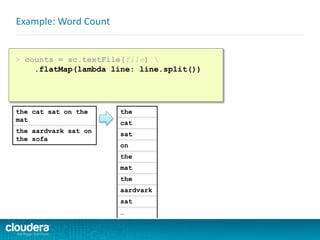
Example: Word Count
> counts = sc.textFile(file) 
.flatMap(lambda line: line.split())
the cat sat on the
mat
the aardvark sat on
the sofa
the
cat
sat
on
the
mat
the
aardvark
sat
…
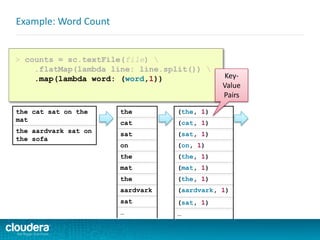
Example: Word Count
> counts = sc.textFile(file) 
.flatMap(lambda line: line.split()) 
.map(lambda word: (word,1))
the cat sat on the
mat
the aardvark sat on
the sofa
(the, 1)
(cat, 1)
(sat, 1)
(on, 1)
(the, 1)
(mat, 1)
(the, 1)
(aardvark, 1)
(sat, 1)
…
the
cat
sat
on
the
mat
the
aardvark
sat
…
Key-
Value
Pairs
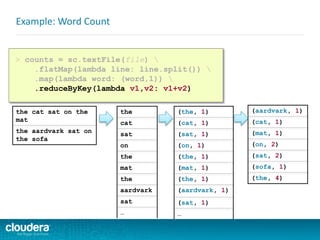
Example: Word Count
> counts = sc.textFile(file) 
.flatMap(lambda line: line.split()) 
.map(lambda word: (word,1)) 
.reduceByKey(lambda v1,v2: v1+v2)
(aardvark, 1)
(cat, 1)
(mat, 1)
(on, 2)
(sat, 2)
(sofa, 1)
(the, 4)
the cat sat on the
mat
the aardvark sat on
the sofa
(the, 1)
(cat, 1)
(sat, 1)
(on, 1)
(the, 1)
(mat, 1)
(the, 1)
(aardvark, 1)
(sat, 1)
…
the
cat
sat
on
the
mat
the
aardvark
sat
…
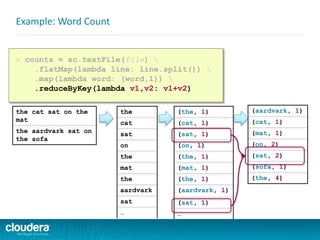
Example: Word Count
> counts = sc.textFile(file) 
.flatMap(lambda line: line.split()) 
.map(lambda word: (word,1)) 
.reduceByKey(lambda v1,v2: v1+v2)
(aardvark, 1)
(cat, 1)
(mat, 1)
(on, 2)
(sat, 2)
(sofa, 1)
(the, 4)
the cat sat on the
mat
the aardvark sat on
the sofa
(the, 1)
(cat, 1)
(sat, 1)
(on, 1)
(the, 1)
(mat, 1)
(the, 1)
(aardvark, 1)
(sat, 1)
…
the
cat
sat
on
the
mat
the
aardvark
sat
…
Example: Word Count
> counts = sc.textFile(file) 
.flatMap(lambda line: line.split()) 
.map(lambda word: (word,1)) 
.reduceByKey(lambda v1,v2: v1+v2)
(aardvark, 1)
(cat, 1)
(mat, 1)
(on, 2)
(sat, 2)
(sofa, 1)
(the, 4)
the cat sat on the
mat
the aardvark sat on
the sofa
(the, 1)
(cat, 1)
(sat, 1)
(on, 1)
(the, 1)
(mat, 1)
(the, 1)
(aardvark, 1)
(sat, 1)
…
the
cat
sat
on
the
mat
the
aardvark
sat
…
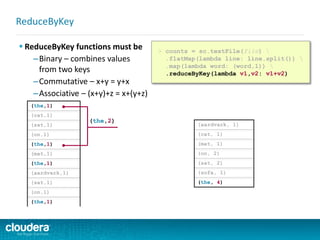
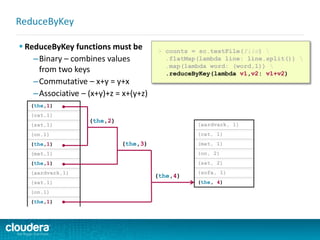
 ReduceByKey functions must be
–Binary – combines values
from two keys
–Commutative – x+y = y+x
–Associative – (x+y)+z = x+(y+z)
ReduceByKey
(the,1)
(cat,1)
(sat,1)
(on,1)
(the,1)
(mat,1)
(the,1)
(aardvark,1)
(sat,1)
(on,1)
(the,1)
> counts = sc.textFile(file) 
.flatMap(lambda line: line.split()) 
.map(lambda word: (word,1)) 
.reduceByKey(lambda v1,v2: v1+v2)
(the,2)
(aardvark, 1)
(cat, 1)
(mat, 1)
(on, 2)
(sat, 2)
(sofa, 1)
(the, 4)
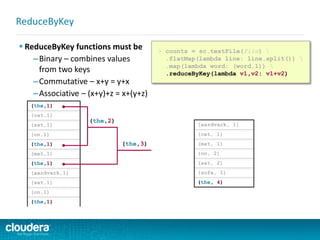
 ReduceByKey functions must be
–Binary – combines values
from two keys
–Commutative – x+y = y+x
–Associative – (x+y)+z = x+(y+z)
ReduceByKey
(the,1)
(cat,1)
(sat,1)
(on,1)
(the,1)
(mat,1)
(the,1)
(aardvark,1)
(sat,1)
(on,1)
(the,1)
> counts = sc.textFile(file) 
.flatMap(lambda line: line.split()) 
.map(lambda word: (word,1)) 
.reduceByKey(lambda v1,v2: v1+v2)
(the,2)
(the,3)
(aardvark, 1)
(cat, 1)
(mat, 1)
(on, 2)
(sat, 2)
(sofa, 1)
(the, 4)
 ReduceByKey functions must be
–Binary – combines values
from two keys
–Commutative – x+y = y+x
–Associative – (x+y)+z = x+(y+z)
ReduceByKey
(the,1)
(cat,1)
(sat,1)
(on,1)
(the,1)
(mat,1)
(the,1)
(aardvark,1)
(sat,1)
(on,1)
(the,1)
> counts = sc.textFile(file) 
.flatMap(lambda line: line.split()) 
.map(lambda word: (word,1)) 
.reduceByKey(lambda v1,v2: v1+v2)
(the,2)
(the,3)
(the,4)
(aardvark, 1)
(cat, 1)
(mat, 1)
(on, 2)
(sat, 2)
(sofa, 1)
(the, 4)
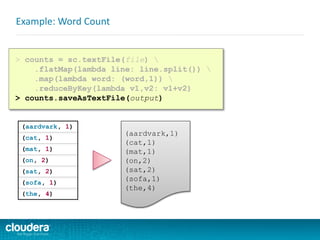
Example: Word Count
> counts = sc.textFile(file) 
.flatMap(lambda line: line.split()) 
.map(lambda word: (word,1)) 
.reduceByKey(lambda v1,v2: v1+v2)
> counts.saveAsTextFile(output)
(aardvark, 1)
(cat, 1)
(mat, 1)
(on, 2)
(sat, 2)
(sofa, 1)
(the, 4)
(aardvark,1)
(cat,1)
(mat,1)
(on,2)
(sat,2)
(sofa,1)
(the,4)
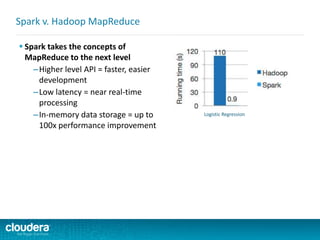
 Spark takes the concepts of
MapReduce to the next level
–Higher level API = faster, easier
development
Spark v. Hadoop MapReduce
 Spark takes the concepts of
MapReduce to the next level
–Higher level API = faster, easier
development
Spark v. Hadoop MapReduce
public class WordCount {
public static void main(String[] args) throws Exception {
Job job = new Job();
job.setJarByClass(WordCount.class);
job.setJobName("Word Count");
FileInputFormat.setInputPaths(job, new Path(args[0]));
FileOutputFormat.setOutputPath(job, new Path(args[1]));
job.setMapperClass(WordMapper.class);
job.setReducerClass(SumReducer.class);
job.setMapOutputKeyClass(Text.class);
job.setMapOutputValueClass(IntWritable.class);
job.setOutputKeyClass(Text.class);
job.setOutputValueClass(IntWritable.class);
boolean success = job.waitForCompletion(true);
System.exit(success ? 0 : 1);
}
}
public class WordMapper extends Mapper<LongWritable, Text, Text,
IntWritable> {
public void map(LongWritable key, Text value,
Context context) throws IOException, InterruptedException {
String line = value.toString();
for (String word : line.split("W+")) {
if (word.length() > 0)
context.write(new Text(word), new IntWritable(1));
}
}
}
}
public class SumReducer extends Reducer<Text, IntWritable, Text,
IntWritable> {
public void reduce(Text key, Iterable<IntWritable>
values, Context context) throws IOException, InterruptedException {
int wordCount = 0;
for (IntWritable value : values) {
wordCount += value.get();
}
context.write(key, new IntWritable(wordCount));
}
}
> counts = sc.textFile(file) 
.flatMap(lambda line: line.split()) 
.map(lambda word: (word,1)) 
.reduceByKey(lambda v1,v2: v1+v2)
> counts.saveAsTextFile(output)
 Spark takes the concepts of
MapReduce to the next level
–Higher level API = faster, easier
development
–Low latency = near real-time
processing
Spark v. Hadoop MapReduce
 Spark takes the concepts of
MapReduce to the next level
–Higher level API = faster, easier
development
–Low latency = near real-time
processing
–In-memory data storage = up to
100x performance improvement
Spark v. Hadoop MapReduce
Logistic Regression
Thank you for attending!
• Submit questions in the Q&A panel
• Follow Cloudera University @ClouderaU
• Follow Diana on GitHub:
https://github.com/dianacarroll
• Follow the Developer learning path:
http://university.cloudera.com/develop
ers
• Learn about the enterprise data hub:
http://tinyurl.com/edh-webinar
• Join the Cloudera user community:
http://community.cloudera.com/
Register now for Cloudera training at
http://university.cloudera.com
Use discount code Spark_10 to save 10%
on new enrollments in Spark Developer
Training classes delivered by Cloudera
until October 3, 2014*
Use discount code 15off2 to save 15% on
enrollments in two or more training
classes delivered by Cloudera until
October 3, 2014*
* Excludes classes sold or delivered by Cloudera partners

Introduction to Apache Spark Developer Training

  • 1.
    Introduction to SparkDeveloper Training Diana Carroll | Senior Curriculum Developer
  • 2.
    Agenda  Cloudera's LearningPath for Developers  Target Audience and Prerequisites  Course Outline  Short Presentation Based on Actual Course Material  Question and Answer Session
  • 3.
    Learning Path: Developers CreatePowerful New Data Processing Tools Learn to code and write MapReduce programs for production Master advanced API topics required for real-world data analysis Design schemas to minimize latency on massive data sets Scale hundreds of thousands of operations per second Implement recommenders and data experiments Draw actionable insights from analysis of disparate data Build converged applications using multiple processing engines Develop enterprise solutions using components across the EDH Combine batch and stream processing with interactive analytics Optimize applications for speed, ease of use, and sophistication Spark Training Big Data Applications HBase Training Intro to Data Science Developer Training Aaron T. Myers Software Engineer
  • 4.
    1 Broadest Rangeof Courses Developer, Admin, Analyst, HBase, Data Science 2 3 Most Experienced Instructors More than 20,000 students trained since 2009 6 Widest Geographic Coverage Most classes offered: 50 cities worldwide plus online 7 Most Relevant Platform & Community CDH deployed more than all other distributions combined 8 Depth of Training Material Hands-on labs and VMs support live instruction Leader in Certification Over 8,000 accredited Cloudera professionals 4 Trusted Source for Training 100,000+ people have attended online courses 9 Ongoing Learning Video tutorials and e-learning complement training Why Cloudera Training? Aligned to Best Practices and the Pace of Change 5 State of the Art Curriculum Courses updated as Hadoop evolves 10Commitment to Big Data Education University partnerships to teach Hadoop in the classroom
  • 5.
    Cloudera Developer Trainingfor Apache Spark About the Course
  • 6.
     Intended forpeople who write code, such as –Software Engineers –Data Engineers –ETL Developers Target Audience
  • 7.
     No priorknowledge of Spark, Hadoop or distributed programming concepts is required Course Prerequisites
  • 8.
     No priorknowledge of Spark, Hadoop or distributed programming concepts is required  Requirements –Basic familiarity with Linux or Unix Course Prerequisites $ mkdir /data $ cd /data $ rm /home/johndoe/salesreport.txt
  • 9.
     No priorknowledge of Spark, Hadoop or distributed programming concepts is required  Requirements –Basic familiarity with Linux or Unix –Intermediate-level programming skills in either Scala or Python Course Prerequisites $ mkdir /data $ cd /data $ rm /home/johndoe/salesreport.txt
  • 10.
    Example of RequiredScala Skill Level  Do you understand the following code? Could you write something similar? object Maps { val colors = Map("red" -> 0xFF0000, "turquoise" -> 0x00FFFF, "black" -> 0x000000, "orange" -> 0xFF8040, "brown" -> 0x804000) def main(args: Array[String]) { for (name <- args) println( colors.get(name) match { case Some(code) => name + " has code: " + code case None => "Unknown color: " + name } ) } }
  • 11.
    Example of RequiredPython Skill Level  Do you understand the following code? Could you write something similar? import sys def parsePurchases(s): return s.split(',') if __name__ == "__main__": if len(sys.argv) < 2: print "Usage: SumPrices <products>" exit(-1) prices = {'apple': 0.40, 'banana': 0.50, 'orange': 0.10} total = sum(prices[fruit] for fruit in parsePurchases(sys.argv[1])) print 'Total: $%.2f' % total
  • 12.
     Getting startedwith Scala –www.scala-lang.org Practicing Scala or Python
  • 13.
     Getting startedwith Scala –www.scala-lang.org  Getting started with Python –python.org –developers.google.com/edu/python –and many more Practicing Scala or Python
  • 14.
  • 15.
    1. Introduction 2. Whatis Spark? Course Outline
  • 16.
    1. Introduction 2. Whatis Spark? 3. Spark Basics Course Outline
  • 17.
    1. Introduction 2. Whatis Spark? 3. Spark Basics 4. Working with RDDs Course Outline
  • 18.
    1. Introduction 2. Whatis Spark? 3. Spark Basics 4. Working with RDDs 5. The Hadoop Distributed File System Course Outline
  • 19.
    1. Introduction 2. Whatis Spark? 3. Spark Basics 4. Working with RDDs 5. The Hadoop Distributed File System 6. Running Spark on a Cluster Course Outline
  • 20.
    1. Introduction 2. Whatis Spark? 3. Spark Basics 4. Working with RDDs 5. The Hadoop Distributed File System 6. Running Spark on a Cluster 7. Parallel Programming with Spark Course Outline
  • 21.
    1. Introduction 2. Whatis Spark? 3. Spark Basics 4. Working with RDDs 5. The Hadoop Distributed File System 6. Running Spark on a Cluster 7. Parallel Programming with Spark 8. Caching and Persistence Course Outline
  • 22.
    1. Introduction 2. Whatis Spark? 3. Spark Basics 4. Working with RDDs 5. The Hadoop Distributed File System 6. Running Spark on a Cluster 7. Parallel Programming with Spark 8. Caching and Persistence 9. Writing Spark Applications Course Outline
  • 23.
    1. Introduction 2. Whatis Spark? 3. Spark Basics 4. Working with RDDs 5. The Hadoop Distributed File System 6. Running Spark on a Cluster 7. Parallel Programming with Spark 8. Caching and Persistence 9. Writing Spark Applications 10. Spark Streaming Course Outline
  • 24.
    1. Introduction 2. Whatis Spark? 3. Spark Basics 4. Working with RDDs 5. The Hadoop Distributed File System 6. Running Spark on a Cluster 7. Parallel Programming with Spark 8. Caching and Persistence 9. Writing Spark Applications 10. Spark Streaming 11. Common Patterns in Spark Programming Course Outline
  • 25.
    1. Introduction 2. Whatis Spark? 3. Spark Basics 4. Working with RDDs 5. The Hadoop Distributed File System 6. Running Spark on a Cluster 7. Parallel Programming with Spark 8. Caching and Persistence 9. Writing Spark Applications 10. Spark Streaming 11. Common Patterns in Spark Programming 12. Improving Spark Performance Course Outline
  • 26.
    1. Introduction 2. Whatis Spark? 3. Spark Basics 4. Working with RDDs 5. The Hadoop Distributed File System 6. Running Spark on a Cluster 7. Parallel Programming with Spark 8. Caching and Persistence 9. Writing Spark Applications 10. Spark Streaming 11. Common Patterns in Spark Programming 12. Improving Spark Performance 13. Spark, Hadoop and the Enterprise Data Center Course Outline
  • 27.
    1. Introduction 2. Whatis Spark? 3. Spark Basics 4. Working with RDDs 5. The Hadoop Distributed File System 6. Running Spark on a Cluster 7. Parallel Programming with Spark 8. Caching and Persistence 9. Writing Spark Applications 10. Spark Streaming 11. Common Patterns in Spark Programming 12. Improving Spark Performance 13. Spark, Hadoop and the Enterprise Data Center 14. Conclusion Course Outline
  • 28.
     Based on –Chapter3: Spark Basics –Chapter 4: Working with RDDs Course Excerpt
  • 29.
     Based on –Chapter3: Spark Basics –Chapter 4: Working with RDDs  Topics –What is Spark? –The components of a distributed data processing system –Intro to the Spark Shell –Resilient Distributed Datasets –RDD operations –Example: WordCount Course Excerpt
  • 30.
     Apache Sparkis a fast, general engine for large-scale data processing and analysis –Open source, developed at UC Berkeley  Written in Scala –Functional programming language that runs in a JVM What is Apache Spark?
  • 31.
     Apache Sparkis a fast, general engine for large-scale data processing and analysis –Open source, developed at UC Berkeley  Written in Scala –Functional programming language that runs in a JVM  Key Concepts –Avoid the data bottleneck by distributing data when it is stored –Bring the processing to the data –Data stored in memory What is Apache Spark?
  • 32.
    Distributed Processing withthe Spark Framework API Spark
  • 33.
    Distributed Processing withthe Spark Framework API Cluster Computing Spark • Spark Standalone • YARN • Mesos
  • 34.
    Distributed Processing withthe Spark Framework API Cluster Computing Storage Spark • Spark Standalone • YARN • Mesos HDFS (Hadoop Distributed File System)
  • 35.
     Spark Shell –InteractiveREPL – for learning or data exploration –Python or Scala  Spark Applications –For large scale data processing –Python, Java or Scala What is Apache Spark? $ pyspark Welcome to ____ __ / __/__ ___ _____/ /__ _ / _ / _ `/ __/ '_/ /__ / .__/_,_/_/ /_/_ version 0.9.1 /_/ Using Python version 2.6.6 (r266:84292, Jan 22 2014 09:42:36) Spark context available as sc. >>> $ spark-shell Welcome to ____ __ / __/__ ___ _____/ /__ _ / _ / _ `/ __/ '_/ /___/ .__/_,_/_/ /_/_ version 0.9.1 /_/ Using Scala version 2.10.3 (Java HotSpot(TM) 64-Bit Server VM, Java 1.7.0_51) Created spark context.. Spark context available as sc. scala> Scala Shell Python Shell
  • 36.
     Every Sparkapplication requires a Spark Context –The main entry point to the Spark API  Spark Shell provides a preconfigured Spark Context called sc Spark Context >>> sc.appName u'PySparkShell' scala> sc.appName res0: String = Spark shell
  • 37.
     RDD (ResilientDistributed Dataset) –Resilient – if data in memory is lost, it can be recreated –Distributed – stored in memory across the cluster –Dataset – initial data can come from a file or created programmatically  RDDs are the fundamental unit of data in Spark  Most of Spark programming is performing operations on RDDs RDD (Resilient Distributed Dataset) data data data data… RDD
  • 38.
    I've never seena purple cow. I never hope to see one; But I can tell you, anyhow, I'd rather see than be one. Example: A File-based RDD I've never seen a purple cow. I never hope to see one; But I can tell you, anyhow, I'd rather see than be one. File: purplecow.txt RDD: mydata > mydata = sc.textFile("purplecow.txt")
  • 39.
    I've never seena purple cow. I never hope to see one; But I can tell you, anyhow, I'd rather see than be one. Example: A File-based RDD I've never seen a purple cow. I never hope to see one; But I can tell you, anyhow, I'd rather see than be one. File: purplecow.txt RDD: mydata > mydata = sc.textFile("purplecow.txt") > mydata.count() 4
  • 40.
     Two typesof RDD operations –Actions – return values –count –take(n) RDD Operations value RDD
  • 41.
     Two typesof RDD operations –Actions – return values –count –take(n) –Transformations – define new RDDs based on the current one –filter –map –reduce RDD Operations value RDD New RDDBase RDD
  • 42.
    I've never seena purple cow. I never hope to see one; But I can tell you, anyhow, I'd rather see than be one. Example: map and filter Transformations
  • 43.
    I've never seena purple cow. I never hope to see one; But I can tell you, anyhow, I'd rather see than be one. I'VE NEVER SEEN A PURPLE COW. I NEVER HOPE TO SEE ONE; BUT I CAN TELL YOU, ANYHOW, I'D RATHER SEE THAN BE ONE. Example: map and filter Transformations map(lambda line: line.upper()) map(line => line.toUpperCase())
  • 44.
    I've never seena purple cow. I never hope to see one; But I can tell you, anyhow, I'd rather see than be one. I'VE NEVER SEEN A PURPLE COW. I NEVER HOPE TO SEE ONE; BUT I CAN TELL YOU, ANYHOW, I'D RATHER SEE THAN BE ONE. Example: map and filter Transformations I'VE NEVER SEEN A PURPLE COW. I NEVER HOPE TO SEE ONE; I'D RATHER SEE THAN BE ONE. filter(lambda line: line.startswith('I')) map(lambda line: line.upper()) map(line => line.toUpperCase()) filter(line => line.startsWith('I'))
  • 45.
     RDDs canhold any type of element –Primitive types: integers, characters, booleans, strings, etc. –Sequence types: lists, arrays, tuples, dicts, etc. (including nested) –Scala/Java Objects (if serializable) –Mixed types RDDs
  • 46.
     RDDs canhold any type of element –Primitive types: integers, characters, booleans, strings, etc. –Sequence types: lists, arrays, tuples, dicts, etc. (including nested) –Scala/Java Objects (if serializable) –Mixed types  Some types of RDDs have additional functionality –Double RDDs – RDDs consisting of numeric data –Pair RDDs – RDDs consisting of Key-Value pairs RDDs
  • 47.
     Pair RDDsare a special form of RDD –Each element must be a key-value pair (a two- element tuple) –Keys and values can be any type Pair RDDs (key1,value1) (key2,value2) (key3,value3) … Pair RDD
  • 48.
     Pair RDDsare a special form of RDD –Each element must be a key-value pair (a two- element tuple) –Keys and values can be any type  Why? –Use with Map-Reduce algorithms –Many additional functions are available for common data processing needs –E.g. sorting, joining, grouping, counting, etc. Pair RDDs (key1,value1) (key2,value2) (key3,value3) … Pair RDD
  • 49.
     MapReduce isa common programming model –Two phases –Map – process each element in a data set –Reduce – aggregate or consolidate the data –Easily applicable to distributed processing of large data sets MapReduce
  • 50.
     MapReduce isa common programming model –Two phases –Map – process each element in a data set –Reduce – aggregate or consolidate the data –Easily applicable to distributed processing of large data sets  Hadoop MapReduce is the major implementation –Limited –Each job has one Map phase, one Reduce phase in each –Job output saved to files MapReduce
  • 51.
     MapReduce isa common programming model –Two phases –Map – process each element in a data set –Reduce – aggregate or consolidate the data –Easily applicable to distributed processing of large data sets  Hadoop MapReduce is the major implementation –Limited –Each job has one Map phase, one Reduce phase in each –Job output saved to files  Spark implements MapReduce with much greater flexibility –Map and Reduce functions can be interspersed –Results stored in memory –Operations can be chained easily MapReduce
  • 52.
    MapReduce Example: WordCount the cat sat on the mat the aardvark sat on the sofa Input Data Result aardvark 1 cat 1 mat 1 on 2 sat 2 sofa 1 the 4 ?
  • 53.
    Example: Word Count >counts = sc.textFile(file) the cat sat on the mat the aardvark sat on the sofa
  • 54.
    Example: Word Count >counts = sc.textFile(file) .flatMap(lambda line: line.split()) the cat sat on the mat the aardvark sat on the sofa the cat sat on the mat the aardvark sat …
  • 55.
    Example: Word Count >counts = sc.textFile(file) .flatMap(lambda line: line.split()) .map(lambda word: (word,1)) the cat sat on the mat the aardvark sat on the sofa (the, 1) (cat, 1) (sat, 1) (on, 1) (the, 1) (mat, 1) (the, 1) (aardvark, 1) (sat, 1) … the cat sat on the mat the aardvark sat … Key- Value Pairs
  • 56.
    Example: Word Count >counts = sc.textFile(file) .flatMap(lambda line: line.split()) .map(lambda word: (word,1)) .reduceByKey(lambda v1,v2: v1+v2) (aardvark, 1) (cat, 1) (mat, 1) (on, 2) (sat, 2) (sofa, 1) (the, 4) the cat sat on the mat the aardvark sat on the sofa (the, 1) (cat, 1) (sat, 1) (on, 1) (the, 1) (mat, 1) (the, 1) (aardvark, 1) (sat, 1) … the cat sat on the mat the aardvark sat …
  • 57.
    Example: Word Count >counts = sc.textFile(file) .flatMap(lambda line: line.split()) .map(lambda word: (word,1)) .reduceByKey(lambda v1,v2: v1+v2) (aardvark, 1) (cat, 1) (mat, 1) (on, 2) (sat, 2) (sofa, 1) (the, 4) the cat sat on the mat the aardvark sat on the sofa (the, 1) (cat, 1) (sat, 1) (on, 1) (the, 1) (mat, 1) (the, 1) (aardvark, 1) (sat, 1) … the cat sat on the mat the aardvark sat …
  • 58.
    Example: Word Count >counts = sc.textFile(file) .flatMap(lambda line: line.split()) .map(lambda word: (word,1)) .reduceByKey(lambda v1,v2: v1+v2) (aardvark, 1) (cat, 1) (mat, 1) (on, 2) (sat, 2) (sofa, 1) (the, 4) the cat sat on the mat the aardvark sat on the sofa (the, 1) (cat, 1) (sat, 1) (on, 1) (the, 1) (mat, 1) (the, 1) (aardvark, 1) (sat, 1) … the cat sat on the mat the aardvark sat …
  • 59.
     ReduceByKey functionsmust be –Binary – combines values from two keys –Commutative – x+y = y+x –Associative – (x+y)+z = x+(y+z) ReduceByKey (the,1) (cat,1) (sat,1) (on,1) (the,1) (mat,1) (the,1) (aardvark,1) (sat,1) (on,1) (the,1) > counts = sc.textFile(file) .flatMap(lambda line: line.split()) .map(lambda word: (word,1)) .reduceByKey(lambda v1,v2: v1+v2) (the,2) (aardvark, 1) (cat, 1) (mat, 1) (on, 2) (sat, 2) (sofa, 1) (the, 4)
  • 60.
     ReduceByKey functionsmust be –Binary – combines values from two keys –Commutative – x+y = y+x –Associative – (x+y)+z = x+(y+z) ReduceByKey (the,1) (cat,1) (sat,1) (on,1) (the,1) (mat,1) (the,1) (aardvark,1) (sat,1) (on,1) (the,1) > counts = sc.textFile(file) .flatMap(lambda line: line.split()) .map(lambda word: (word,1)) .reduceByKey(lambda v1,v2: v1+v2) (the,2) (the,3) (aardvark, 1) (cat, 1) (mat, 1) (on, 2) (sat, 2) (sofa, 1) (the, 4)
  • 61.
     ReduceByKey functionsmust be –Binary – combines values from two keys –Commutative – x+y = y+x –Associative – (x+y)+z = x+(y+z) ReduceByKey (the,1) (cat,1) (sat,1) (on,1) (the,1) (mat,1) (the,1) (aardvark,1) (sat,1) (on,1) (the,1) > counts = sc.textFile(file) .flatMap(lambda line: line.split()) .map(lambda word: (word,1)) .reduceByKey(lambda v1,v2: v1+v2) (the,2) (the,3) (the,4) (aardvark, 1) (cat, 1) (mat, 1) (on, 2) (sat, 2) (sofa, 1) (the, 4)
  • 62.
    Example: Word Count >counts = sc.textFile(file) .flatMap(lambda line: line.split()) .map(lambda word: (word,1)) .reduceByKey(lambda v1,v2: v1+v2) > counts.saveAsTextFile(output) (aardvark, 1) (cat, 1) (mat, 1) (on, 2) (sat, 2) (sofa, 1) (the, 4) (aardvark,1) (cat,1) (mat,1) (on,2) (sat,2) (sofa,1) (the,4)
  • 63.
     Spark takesthe concepts of MapReduce to the next level –Higher level API = faster, easier development Spark v. Hadoop MapReduce
  • 64.
     Spark takesthe concepts of MapReduce to the next level –Higher level API = faster, easier development Spark v. Hadoop MapReduce public class WordCount { public static void main(String[] args) throws Exception { Job job = new Job(); job.setJarByClass(WordCount.class); job.setJobName("Word Count"); FileInputFormat.setInputPaths(job, new Path(args[0])); FileOutputFormat.setOutputPath(job, new Path(args[1])); job.setMapperClass(WordMapper.class); job.setReducerClass(SumReducer.class); job.setMapOutputKeyClass(Text.class); job.setMapOutputValueClass(IntWritable.class); job.setOutputKeyClass(Text.class); job.setOutputValueClass(IntWritable.class); boolean success = job.waitForCompletion(true); System.exit(success ? 0 : 1); } } public class WordMapper extends Mapper<LongWritable, Text, Text, IntWritable> { public void map(LongWritable key, Text value, Context context) throws IOException, InterruptedException { String line = value.toString(); for (String word : line.split("W+")) { if (word.length() > 0) context.write(new Text(word), new IntWritable(1)); } } } } public class SumReducer extends Reducer<Text, IntWritable, Text, IntWritable> { public void reduce(Text key, Iterable<IntWritable> values, Context context) throws IOException, InterruptedException { int wordCount = 0; for (IntWritable value : values) { wordCount += value.get(); } context.write(key, new IntWritable(wordCount)); } } > counts = sc.textFile(file) .flatMap(lambda line: line.split()) .map(lambda word: (word,1)) .reduceByKey(lambda v1,v2: v1+v2) > counts.saveAsTextFile(output)
  • 65.
     Spark takesthe concepts of MapReduce to the next level –Higher level API = faster, easier development –Low latency = near real-time processing Spark v. Hadoop MapReduce
  • 66.
     Spark takesthe concepts of MapReduce to the next level –Higher level API = faster, easier development –Low latency = near real-time processing –In-memory data storage = up to 100x performance improvement Spark v. Hadoop MapReduce Logistic Regression
  • 68.
    Thank you forattending! • Submit questions in the Q&A panel • Follow Cloudera University @ClouderaU • Follow Diana on GitHub: https://github.com/dianacarroll • Follow the Developer learning path: http://university.cloudera.com/develop ers • Learn about the enterprise data hub: http://tinyurl.com/edh-webinar • Join the Cloudera user community: http://community.cloudera.com/ Register now for Cloudera training at http://university.cloudera.com Use discount code Spark_10 to save 10% on new enrollments in Spark Developer Training classes delivered by Cloudera until October 3, 2014* Use discount code 15off2 to save 15% on enrollments in two or more training classes delivered by Cloudera until October 3, 2014* * Excludes classes sold or delivered by Cloudera partners

Editor's Notes

  • #12 As I said, Python is another option. Take a look at this simple program, which takes a list of products purchased from the command line, and calculates the total cost of the purchase. Again, if this syntax doesn’t make sense to you, you will need to get more familiar with Python before you take the course. In the course, you need to be comfortable with defining functions, working with lists and arrays, parsing strings and so on.
  • #13 If you don’t yet have the programming skills to take this course, a good place to start learning Scala is at the official Scala site: scala-lang.org, which includes lots of documentation including overviews and a series of tutorials geared toward Java developers. The site also has pointers to other resources, such as a Coursera course and several good books.
  • #14 There’s an even richer set of resources for learning Python, including tutorials at python.org, and well as many other tutorial sites and online classes. One particularly useful resource for experienced programmers is Google’s Python class for developers. And of course, there are many Python books available from O’Reilly and other respected publishers. Note that Spark uses Python 2.6 or 2.7, so if you are new to Python, focus your learning on Python 2 instead of 3.
  • #15 Now let’s turn our attention to what you will actually learn in the class. [CLICK] After a brief introduction
  • #16 Now let’s turn our attention to what you will actually learn in the class. [CLICK] After a brief introduction, [CLICK] Chapter 2 is “What is Spark?” As I said, no experience with Spark or distributed processing is required, so we start at the beginning: what is Spark and why would you want to use it? What problems does it solve and what kind of use cases might you want to use it for? [CLICK] Then in Chapter 3 we move on to actually using Spark. We introduce the concept of Resilient Distributed Datasets, or RDDs, which is the core concept in Spark development, and briefly cover the principles of Functional Programming as used in Spark. In the hands-on exercises, you’ll learn how to start the Spark interactive shell and load data from a file into an RDD. [CLICK] In Chapter 4 we look more deeply at RDDs: how to perform operations to transform them and extract data from them. You will learn about Map-Reduce, a programming model for parallel processing of large data sets, and compare Spark’s MapReduce implementation with Hadoop’s. In the exercises, you will work with a set of Apache web server logs files: loading them into an RDD, parsing and filtering the data, and aggregating, joining and reporting on the data. [CLICK] In Chapter 5, we introduce the Hadoop Distributed File System, or HDFS, which provides the distribute storage layer Spark uses to read and save data in a cluster. The course virtual machines include a running HDFS cluster, so in the exercises you will have a chance to import and export data using both the command line and a Spark application. [CLICK] Chapter 6 gives an overview of how a Spark application distributes processing on a cluster using a supported clustering platform, such as YARN, Mesos, or the Spark Standalone framework included with Spark. You will learn about different deployment options for a Spark application, and in the exercises you will start a Spark Standalone cluster on your virtual machine, start the Spark Shell on the cluster, and use the Spark Standalone web UI to explore the cluster. [CLICK] The next chapter goes deeper into clustered computing. We will cover how Spark partitions RDDs by storing data in memory on multiple nodes in the cluster…and how it distributes parallel tasks to process that data on the node where it is stored. In the exercises you will explore data partitioning, and use the Spark Application UI to better understand how Spark executes tasks in a cluster. [CLICK] In Chapter 8, we cover one of Spark’s unique features – the ability to cache distributed data locally, either in memory or on disk, for great improvements in performance. You will also learn about what makes RDDs “resilient”: how Spark uses “lineage” to recreate the data as needed in case of losing a node. [CLICK] In Chapter 9 teaches how to write and configure a Spark application from scratch. In the exercises, you will build a Spark application in either Scala or Python, configure different application properties, and submit the application to run on the cluster. [CLICK] Chapter 10 introduces one of the most exciting parts of the Spark ecosystem, Spark Streaming, which allows you to use Spark to process streaming data in near real-time, from sources such as application logs and social media feeds. In the exercises, you will write a Spark Streaming application to process data from a stream of web server logs. [CLICK] In the next chapter we discuss common patterns in Spark Programming, with a particular focus on implementing iterative algorithms in Spark, which is one of Spark’s special strong points. We will explore page ranking as a common iterative tasks, as well as briefly introduce Spark’s machine learning and graphing add-ons: MLLib and GraphX. In the labs, you will use Spark to implement an iterative calculation of k-means on location data. [CLICK] In Chapter 12, you will learn how to diagnose and fix common performance issues in Spark applications using techniques such as shared variables, serialization and data partitioning. you will practice using broadcast variables to avoid expensive join operations. [CLICK] Finally, in Chapter 13 you will learn how to use Spark in the context of a production data center. We will discuss how Spark complements existing Hadoop MapReduce applications, and explore how Spark applications work with other components of the Hadoop ecosystem such as Sqoop, Flume, HBase and Impala. In the final exercises before the course conclusion, [CLICK] you’ll practice extracting data from a relational database using Sqoop and using that data in Spark.
  • #17 Now let’s turn our attention to what you will actually learn in the class. [CLICK] After a brief introduction, [CLICK] Chapter 2 is “What is Spark?” As I said, no experience with Spark or distributed processing is required, so we start at the beginning: what is Spark and why would you want to use it? What problems does it solve and what kind of use cases might you want to use it for? [CLICK] Then in Chapter 3 we move on to actually using Spark. We introduce the concept of Resilient Distributed Datasets, or RDDs, which is the core concept in Spark development, and briefly cover the principles of Functional Programming as used in Spark. In the hands-on exercises, you’ll learn how to start the Spark interactive shell and load data from a file into an RDD. [CLICK] In Chapter 4 we look more deeply at RDDs: how to perform operations to transform them and extract data from them. You will learn about Map-Reduce, a programming model for parallel processing of large data sets, and compare Spark’s MapReduce implementation with Hadoop’s. In the exercises, you will work with a set of Apache web server logs files: loading them into an RDD, parsing and filtering the data, and aggregating, joining and reporting on the data. [CLICK] In Chapter 5, we introduce the Hadoop Distributed File System, or HDFS, which provides the distribute storage layer Spark uses to read and save data in a cluster. The course virtual machines include a running HDFS cluster, so in the exercises you will have a chance to import and export data using both the command line and a Spark application. [CLICK] Chapter 6 gives an overview of how a Spark application distributes processing on a cluster using a supported clustering platform, such as YARN, Mesos, or the Spark Standalone framework included with Spark. You will learn about different deployment options for a Spark application, and in the exercises you will start a Spark Standalone cluster on your virtual machine, start the Spark Shell on the cluster, and use the Spark Standalone web UI to explore the cluster. [CLICK] The next chapter goes deeper into clustered computing. We will cover how Spark partitions RDDs by storing data in memory on multiple nodes in the cluster…and how it distributes parallel tasks to process that data on the node where it is stored. In the exercises you will explore data partitioning, and use the Spark Application UI to better understand how Spark executes tasks in a cluster. [CLICK] In Chapter 8, we cover one of Spark’s unique features – the ability to cache distributed data locally, either in memory or on disk, for great improvements in performance. You will also learn about what makes RDDs “resilient”: how Spark uses “lineage” to recreate the data as needed in case of losing a node. [CLICK] In Chapter 9 teaches how to write and configure a Spark application from scratch. In the exercises, you will build a Spark application in either Scala or Python, configure different application properties, and submit the application to run on the cluster. [CLICK] Chapter 10 introduces one of the most exciting parts of the Spark ecosystem, Spark Streaming, which allows you to use Spark to process streaming data in near real-time, from sources such as application logs and social media feeds. In the exercises, you will write a Spark Streaming application to process data from a stream of web server logs. [CLICK] In the next chapter we discuss common patterns in Spark Programming, with a particular focus on implementing iterative algorithms in Spark, which is one of Spark’s special strong points. We will explore page ranking as a common iterative tasks, as well as briefly introduce Spark’s machine learning and graphing add-ons: MLLib and GraphX. In the labs, you will use Spark to implement an iterative calculation of k-means on location data. [CLICK] In Chapter 12, you will learn how to diagnose and fix common performance issues in Spark applications using techniques such as shared variables, serialization and data partitioning. you will practice using broadcast variables to avoid expensive join operations. [CLICK] Finally, in Chapter 13 you will learn how to use Spark in the context of a production data center. We will discuss how Spark complements existing Hadoop MapReduce applications, and explore how Spark applications work with other components of the Hadoop ecosystem such as Sqoop, Flume, HBase and Impala. In the final exercises before the course conclusion, [CLICK] you’ll practice extracting data from a relational database using Sqoop and using that data in Spark.
  • #18 Now let’s turn our attention to what you will actually learn in the class. [CLICK] After a brief introduction, [CLICK] Chapter 2 is “What is Spark?” As I said, no experience with Spark or distributed processing is required, so we start at the beginning: what is Spark and why would you want to use it? What problems does it solve and what kind of use cases might you want to use it for? [CLICK] Then in Chapter 3 we move on to actually using Spark. We introduce the concept of Resilient Distributed Datasets, or RDDs, which is the core concept in Spark development, and briefly cover the principles of Functional Programming as used in Spark. In the hands-on exercises, you’ll learn how to start the Spark interactive shell and load data from a file into an RDD. [CLICK] In Chapter 4 we look more deeply at RDDs: how to perform operations to transform them and extract data from them. You will learn about Map-Reduce, a programming model for parallel processing of large data sets, and compare Spark’s MapReduce implementation with Hadoop’s. In the exercises, you will work with a set of Apache web server logs files: loading them into an RDD, parsing and filtering the data, and aggregating, joining and reporting on the data. [CLICK] In Chapter 5, we introduce the Hadoop Distributed File System, or HDFS, which provides the distribute storage layer Spark uses to read and save data in a cluster. The course virtual machines include a running HDFS cluster, so in the exercises you will have a chance to import and export data using both the command line and a Spark application. [CLICK] Chapter 6 gives an overview of how a Spark application distributes processing on a cluster using a supported clustering platform, such as YARN, Mesos, or the Spark Standalone framework included with Spark. You will learn about different deployment options for a Spark application, and in the exercises you will start a Spark Standalone cluster on your virtual machine, start the Spark Shell on the cluster, and use the Spark Standalone web UI to explore the cluster. [CLICK] The next chapter goes deeper into clustered computing. We will cover how Spark partitions RDDs by storing data in memory on multiple nodes in the cluster…and how it distributes parallel tasks to process that data on the node where it is stored. In the exercises you will explore data partitioning, and use the Spark Application UI to better understand how Spark executes tasks in a cluster. [CLICK] In Chapter 8, we cover one of Spark’s unique features – the ability to cache distributed data locally, either in memory or on disk, for great improvements in performance. You will also learn about what makes RDDs “resilient”: how Spark uses “lineage” to recreate the data as needed in case of losing a node. [CLICK] In Chapter 9 teaches how to write and configure a Spark application from scratch. In the exercises, you will build a Spark application in either Scala or Python, configure different application properties, and submit the application to run on the cluster. [CLICK] Chapter 10 introduces one of the most exciting parts of the Spark ecosystem, Spark Streaming, which allows you to use Spark to process streaming data in near real-time, from sources such as application logs and social media feeds. In the exercises, you will write a Spark Streaming application to process data from a stream of web server logs. [CLICK] In the next chapter we discuss common patterns in Spark Programming, with a particular focus on implementing iterative algorithms in Spark, which is one of Spark’s special strong points. We will explore page ranking as a common iterative tasks, as well as briefly introduce Spark’s machine learning and graphing add-ons: MLLib and GraphX. In the labs, you will use Spark to implement an iterative calculation of k-means on location data. [CLICK] In Chapter 12, you will learn how to diagnose and fix common performance issues in Spark applications using techniques such as shared variables, serialization and data partitioning. you will practice using broadcast variables to avoid expensive join operations. [CLICK] Finally, in Chapter 13 you will learn how to use Spark in the context of a production data center. We will discuss how Spark complements existing Hadoop MapReduce applications, and explore how Spark applications work with other components of the Hadoop ecosystem such as Sqoop, Flume, HBase and Impala. In the final exercises before the course conclusion, [CLICK] you’ll practice extracting data from a relational database using Sqoop and using that data in Spark.
  • #19 Now let’s turn our attention to what you will actually learn in the class. [CLICK] After a brief introduction, [CLICK] Chapter 2 is “What is Spark?” As I said, no experience with Spark or distributed processing is required, so we start at the beginning: what is Spark and why would you want to use it? What problems does it solve and what kind of use cases might you want to use it for? [CLICK] Then in Chapter 3 we move on to actually using Spark. We introduce the concept of Resilient Distributed Datasets, or RDDs, which is the core concept in Spark development, and briefly cover the principles of Functional Programming as used in Spark. In the hands-on exercises, you’ll learn how to start the Spark interactive shell and load data from a file into an RDD. [CLICK] In Chapter 4 we look more deeply at RDDs: how to perform operations to transform them and extract data from them. You will learn about Map-Reduce, a programming model for parallel processing of large data sets, and compare Spark’s MapReduce implementation with Hadoop’s. In the exercises, you will work with a set of Apache web server logs files: loading them into an RDD, parsing and filtering the data, and aggregating, joining and reporting on the data. [CLICK] In Chapter 5, we introduce the Hadoop Distributed File System, or HDFS, which provides the distribute storage layer Spark uses to read and save data in a cluster. The course virtual machines include a running HDFS cluster, so in the exercises you will have a chance to import and export data using both the command line and a Spark application. [CLICK] Chapter 6 gives an overview of how a Spark application distributes processing on a cluster using a supported clustering platform, such as YARN, Mesos, or the Spark Standalone framework included with Spark. You will learn about different deployment options for a Spark application, and in the exercises you will start a Spark Standalone cluster on your virtual machine, start the Spark Shell on the cluster, and use the Spark Standalone web UI to explore the cluster. [CLICK] The next chapter goes deeper into clustered computing. We will cover how Spark partitions RDDs by storing data in memory on multiple nodes in the cluster…and how it distributes parallel tasks to process that data on the node where it is stored. In the exercises you will explore data partitioning, and use the Spark Application UI to better understand how Spark executes tasks in a cluster. [CLICK] In Chapter 8, we cover one of Spark’s unique features – the ability to cache distributed data locally, either in memory or on disk, for great improvements in performance. You will also learn about what makes RDDs “resilient”: how Spark uses “lineage” to recreate the data as needed in case of losing a node. [CLICK] In Chapter 9 teaches how to write and configure a Spark application from scratch. In the exercises, you will build a Spark application in either Scala or Python, configure different application properties, and submit the application to run on the cluster. [CLICK] Chapter 10 introduces one of the most exciting parts of the Spark ecosystem, Spark Streaming, which allows you to use Spark to process streaming data in near real-time, from sources such as application logs and social media feeds. In the exercises, you will write a Spark Streaming application to process data from a stream of web server logs. [CLICK] In the next chapter we discuss common patterns in Spark Programming, with a particular focus on implementing iterative algorithms in Spark, which is one of Spark’s special strong points. We will explore page ranking as a common iterative tasks, as well as briefly introduce Spark’s machine learning and graphing add-ons: MLLib and GraphX. In the labs, you will use Spark to implement an iterative calculation of k-means on location data. [CLICK] In Chapter 12, you will learn how to diagnose and fix common performance issues in Spark applications using techniques such as shared variables, serialization and data partitioning. you will practice using broadcast variables to avoid expensive join operations. [CLICK] Finally, in Chapter 13 you will learn how to use Spark in the context of a production data center. We will discuss how Spark complements existing Hadoop MapReduce applications, and explore how Spark applications work with other components of the Hadoop ecosystem such as Sqoop, Flume, HBase and Impala. In the final exercises before the course conclusion, [CLICK] you’ll practice extracting data from a relational database using Sqoop and using that data in Spark.
  • #20 Now let’s turn our attention to what you will actually learn in the class. [CLICK] After a brief introduction, [CLICK] Chapter 2 is “What is Spark?” As I said, no experience with Spark or distributed processing is required, so we start at the beginning: what is Spark and why would you want to use it? What problems does it solve and what kind of use cases might you want to use it for? [CLICK] Then in Chapter 3 we move on to actually using Spark. We introduce the concept of Resilient Distributed Datasets, or RDDs, which is the core concept in Spark development, and briefly cover the principles of Functional Programming as used in Spark. In the hands-on exercises, you’ll learn how to start the Spark interactive shell and load data from a file into an RDD. [CLICK] In Chapter 4 we look more deeply at RDDs: how to perform operations to transform them and extract data from them. You will learn about Map-Reduce, a programming model for parallel processing of large data sets, and compare Spark’s MapReduce implementation with Hadoop’s. In the exercises, you will work with a set of Apache web server logs files: loading them into an RDD, parsing and filtering the data, and aggregating, joining and reporting on the data. [CLICK] In Chapter 5, we introduce the Hadoop Distributed File System, or HDFS, which provides the distribute storage layer Spark uses to read and save data in a cluster. The course virtual machines include a running HDFS cluster, so in the exercises you will have a chance to import and export data using both the command line and a Spark application. [CLICK] Chapter 6 gives an overview of how a Spark application distributes processing on a cluster using a supported clustering platform, such as YARN, Mesos, or the Spark Standalone framework included with Spark. You will learn about different deployment options for a Spark application, and in the exercises you will start a Spark Standalone cluster on your virtual machine, start the Spark Shell on the cluster, and use the Spark Standalone web UI to explore the cluster. [CLICK] The next chapter goes deeper into clustered computing. We will cover how Spark partitions RDDs by storing data in memory on multiple nodes in the cluster…and how it distributes parallel tasks to process that data on the node where it is stored. In the exercises you will explore data partitioning, and use the Spark Application UI to better understand how Spark executes tasks in a cluster. [CLICK] In Chapter 8, we cover one of Spark’s unique features – the ability to cache distributed data locally, either in memory or on disk, for great improvements in performance. You will also learn about what makes RDDs “resilient”: how Spark uses “lineage” to recreate the data as needed in case of losing a node. [CLICK] In Chapter 9 teaches how to write and configure a Spark application from scratch. In the exercises, you will build a Spark application in either Scala or Python, configure different application properties, and submit the application to run on the cluster. [CLICK] Chapter 10 introduces one of the most exciting parts of the Spark ecosystem, Spark Streaming, which allows you to use Spark to process streaming data in near real-time, from sources such as application logs and social media feeds. In the exercises, you will write a Spark Streaming application to process data from a stream of web server logs. [CLICK] In the next chapter we discuss common patterns in Spark Programming, with a particular focus on implementing iterative algorithms in Spark, which is one of Spark’s special strong points. We will explore page ranking as a common iterative tasks, as well as briefly introduce Spark’s machine learning and graphing add-ons: MLLib and GraphX. In the labs, you will use Spark to implement an iterative calculation of k-means on location data. [CLICK] In Chapter 12, you will learn how to diagnose and fix common performance issues in Spark applications using techniques such as shared variables, serialization and data partitioning. you will practice using broadcast variables to avoid expensive join operations. [CLICK] Finally, in Chapter 13 you will learn how to use Spark in the context of a production data center. We will discuss how Spark complements existing Hadoop MapReduce applications, and explore how Spark applications work with other components of the Hadoop ecosystem such as Sqoop, Flume, HBase and Impala. In the final exercises before the course conclusion, [CLICK] you’ll practice extracting data from a relational database using Sqoop and using that data in Spark.