Mays Yousuf Ismail ©

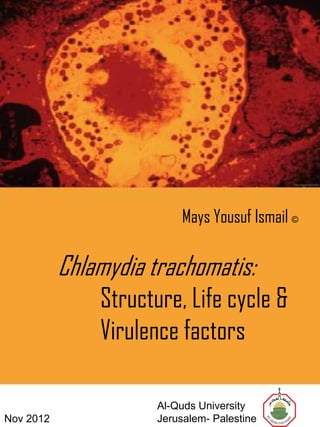
           Chlamydia trachomatis:
               Structure, Life cycle &
               Virulence factors

                      Al-Quds University
Nov 2012              Jerusalem- Palestine
It’s Challenging !!


PID:4-5 POVERTY
      US$10
Million/year
billion/year


                      > 500
                   >6 Million
                     %90 pop.
                    Million @
 ECONOMY          LIMITEDPOVERTY TO
                          ACCSESS
                    are Blind
                    infected
                    high risk
                        WATER


    PERSONAL HYGIENE
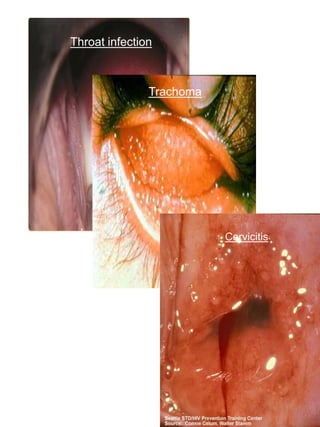
Throat infection


               Trachoma


                          Cervicitis
What we already know
  about Chlamydia
   trachomatis !!

Aerobic, obligate intracellular
parasite of eukaryotic cells
Questions raised from this
        cryptic fact!!
1. Why does it live only intracellularly?

2. Is it really a bacteria? Or a virus?

3. What are its morphology? And its Metabolism
    pathways?

4. How does it cause disease?

5. What are its weak points?

6. Can we prevent its infection? Can we make a
    vaccine?
What makes Chlamydia trachomatis
 UNIQUE; What makes it CLEVER !!

   Scientists discovered that Chlamydia
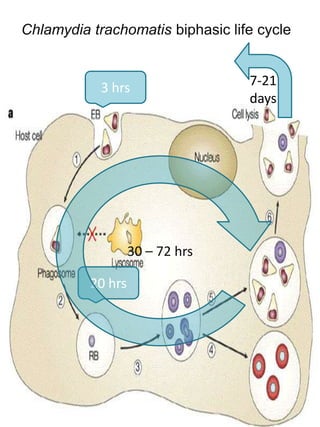
    trachomatis has a biphasic life cycle


    Infectious                 Non-infectious,
   extracellular                intracellular
elementary bodies             reticulate bodies
Chlamydia trachomatis biphasic life cycle


            3 hrs                 7-21
                                  days


                   30 – 72 hrs

          20 hrs
But what makes EB infectious??
     why isn’t it found intracellularly?

and What makes RB survive intracellularly?
     why isn’t it found extracellularly?
Hmmmm.. Let’s see …!!
     Elementary Body                   Reticulate Body

      Extracellular form           Intra-cytoplasmatic form

 Infectious particle, released   Non-infectious particle, never
 when infected cells rupture.              released.

                                 With iodine stain, appears as
    Analogous to a spore
                                      cellular inclusions

 0.25 to 0.3 μm in diameter           0.6 μm in diameter.

                                    No rigid cell wall; still,
  Presence of rigid cell wall
                                      membrane-bound

Preserves genome, plasmids,
      RNA polymerase,             All structures are retained
       and ribosomes.

                                 Replication by binary fission,
       No Replication
                                 rate of 2-3 hrs per generation

    Metabolically inactive           Metabolically active

Can induce Exo-, and Endo-       Can’t induce Exo-, and Endo-
           cytosis                          cytosis
So, now we know we’re not dealing with
         only one Bacterium it’s
             TWO in ONE !!

   And this maybe makes it easier ?!
**The fact that the Elementary body is found extracellularly, and

   has a cell wall.

** Chlamydia has a unique cell wall; outer LPS membrane but NO

     peptidoglycan.

  Made it possible to use Gram Stain to figure out the bacteria’s
                            Morphology !!

Chlamydia trachomatis is a Gram-negative coccobacilli bacteria.


**The fact that the Reticulate body is found intracellularly as

   inclusions.

   Made it possible to use Giemsa to detect it intracellularly !!

Chlamydia trachomatis is as small or smaller than many viruses;

                           0.25 to 1.5 μm.
Why does it live only
  intracellularly?
Although Chlamydia trachomatis has a Glycolytic pathway,

      a linked tricarboxylic acid cycle and an electron

     transport system to produce energy, also Glycogen

                     synthesis pathway.


               Still, it’s an Energy Parasite;

i.e. can’t synthesize sufficient ATP and is host-dependent.

                        (EB  RB)
What makes a bacteria this clever to live
               inside a cell?
 Will this protect it from the immune
                 system?
Those who wanna compete should work
             harder !!
         Polymorphic membrane
                                                   Chlamydial Anomaly
              transporter
                                   unique
                                    cell
                                    wall
              cryptic
                                                    genome
             plasmid


 Compete
  host for                                                     LPS
   lipids                       Chlamydia
   Type III secretion          trachomatis          Sialic acid of mucous
      apparatus                                          membranes


 Pathogenicity                                  15
                           %75                           Adhesion
    Islands
                                             serotypes


                         sub-               Antigenic
                        clinical            variation
Virulence Factors
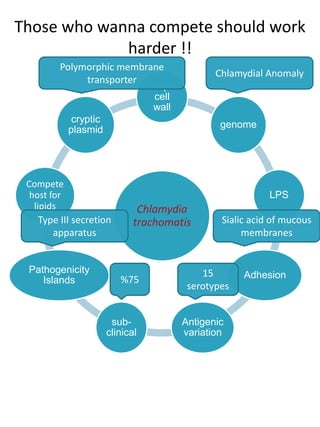
1.   Chlamydia has a unique cell wall; outer LPS membrane but NO peptidoglycan.
     It contains Cystine-rich proteins functionally equivalent to peptidoglycan. This
     inhibits phagolysosome fusion.

2.   Chlamydia genome encodes for peptidoglycan biosynthesis enzymes but PGs
     aren’t synthesized; Hence, resistance to beta-lactam drugs. Chlamydial
     anomaly.

3.   LPS that causes septic shock.

4.   Adhesion to sialic acid receptors on mucous membranes; presence at sites
     inaccessible to phagocytes, T-cells & B-cells.

5.   Antigenic variation resulting in15 known serotypes.

6.   75% of the infections are sub-clinical still infectious though.

7.   Pathogenicity Islands coding for needle-like projection type III secretion
     apparatus that inject proteins directly from the bacteria into the cell cytoplasm
     and avoid lysosomes.

8.   Chlamydia-infested vacuole divert lipids to itself rather than to another
     compartment of the host cell.

9.   Proteins and regulatory factors produced by the cryptic plasmid. Polymorphic
     outer membrane auto-transporter family of proteins, the putative large
     cytotoxin, and stress response proteins.
Scientists: What if the immune system
                 attacks?
Chlamydia trachomatis: I’ll get dormant !!


       This raised the concept of :
        Chlamydial persistence
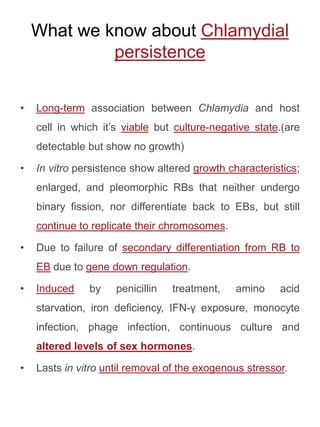
What we know about Chlamydial
             persistence


•   Long-term association between Chlamydia and host
    cell in which it’s viable but culture-negative state.(are
    detectable but show no growth)

•   In vitro persistence show altered growth characteristics;
    enlarged, and pleomorphic RBs that neither undergo
    binary fission, nor differentiate back to EBs, but still
    continue to replicate their chromosomes.

•   Due to failure of secondary differentiation from RB to
    EB due to gene down regulation.

•   Induced    by    penicillin   treatment,   amino     acid
    starvation, iron deficiency, IFN-γ exposure, monocyte
    infection, phage infection, continuous culture and
    altered levels of sex hormones.

•   Lasts in vitro until removal of the exogenous stressor.
Aren’t there any gaps ??


1. Penicillin arrests Bacterial Cytokinesis

2. Tetracycline, Erythromycin block Protein Synthesis

3. Although there’s no immunogenic surface proteins;

    still, LPS can be used, but they are weak !! (vaccine).
Be Aware !!


       Chlamydia trachomatis is present as

asymptomatic state within specific hosts providing a

                 natural reservoir.
ECOLOGY
References

1.http://en.wikipedia.org/wiki/Chlamydia_(bacterium)

2.http://www.ncbi.nlm.nih.gov/pubmed/10411734

3.http://microbewiki.kenyon.edu/index.php/Chlamydia_trachomatis

4. http://www.biomedcentral.com/1471-2180/11/150

5.http://www.sunysccc.edu/academic/mst/microbes/32ctrac.htm

6.http://www.plosone.org/article/info%3Adoi%2F10.1371%2Fjournal.pone.0007
    723

7.http://web.uconn.edu/mcbstaff/graf/Student%20presentations/Chlamydia/Chla
    mydia%20trachomatis.html

8.http://www.tjclarkdirect.com/bacterial_diseases/chlamydia_trachomatis.htm

9. http://www.austincc.edu/microbio/2421a/ct.htm

10. http://www.ncbi.nlm.nih.gov/pubmed/20470049

11. http://jid.oxfordjournals.org/content/201/Supplement_2/S126.full

12. http://www.hindawi.com/journals/idog/2011/525182/fig2/

Chlamydia trachomatis

  • 1.
    Mays Yousuf Ismail© Chlamydia trachomatis: Structure, Life cycle & Virulence factors Al-Quds University Nov 2012 Jerusalem- Palestine
  • 2.
    It’s Challenging !! PID:4-5POVERTY US$10 Million/year billion/year > 500 >6 Million %90 pop. Million @ ECONOMY LIMITEDPOVERTY TO ACCSESS are Blind infected high risk WATER PERSONAL HYGIENE
  • 3.
    Throat infection Trachoma Cervicitis
  • 4.
    What we alreadyknow about Chlamydia trachomatis !! Aerobic, obligate intracellular parasite of eukaryotic cells
  • 5.
    Questions raised fromthis cryptic fact!! 1. Why does it live only intracellularly? 2. Is it really a bacteria? Or a virus? 3. What are its morphology? And its Metabolism pathways? 4. How does it cause disease? 5. What are its weak points? 6. Can we prevent its infection? Can we make a vaccine?
  • 6.
    What makes Chlamydiatrachomatis UNIQUE; What makes it CLEVER !! Scientists discovered that Chlamydia trachomatis has a biphasic life cycle Infectious Non-infectious, extracellular intracellular elementary bodies reticulate bodies
  • 7.
    Chlamydia trachomatis biphasiclife cycle 3 hrs 7-21 days 30 – 72 hrs 20 hrs
  • 8.
    But what makesEB infectious?? why isn’t it found intracellularly? and What makes RB survive intracellularly? why isn’t it found extracellularly?
  • 9.
    Hmmmm.. Let’s see…!! Elementary Body Reticulate Body Extracellular form Intra-cytoplasmatic form Infectious particle, released Non-infectious particle, never when infected cells rupture. released. With iodine stain, appears as Analogous to a spore cellular inclusions 0.25 to 0.3 μm in diameter 0.6 μm in diameter. No rigid cell wall; still, Presence of rigid cell wall membrane-bound Preserves genome, plasmids, RNA polymerase, All structures are retained and ribosomes. Replication by binary fission, No Replication rate of 2-3 hrs per generation Metabolically inactive Metabolically active Can induce Exo-, and Endo- Can’t induce Exo-, and Endo- cytosis cytosis
  • 10.
    So, now weknow we’re not dealing with only one Bacterium it’s TWO in ONE !! And this maybe makes it easier ?!
  • 11.
    **The fact thatthe Elementary body is found extracellularly, and has a cell wall. ** Chlamydia has a unique cell wall; outer LPS membrane but NO peptidoglycan. Made it possible to use Gram Stain to figure out the bacteria’s Morphology !! Chlamydia trachomatis is a Gram-negative coccobacilli bacteria. **The fact that the Reticulate body is found intracellularly as inclusions. Made it possible to use Giemsa to detect it intracellularly !! Chlamydia trachomatis is as small or smaller than many viruses; 0.25 to 1.5 μm.
  • 13.
    Why does itlive only intracellularly?
  • 14.
    Although Chlamydia trachomatishas a Glycolytic pathway, a linked tricarboxylic acid cycle and an electron transport system to produce energy, also Glycogen synthesis pathway. Still, it’s an Energy Parasite; i.e. can’t synthesize sufficient ATP and is host-dependent. (EB  RB)
  • 15.
    What makes abacteria this clever to live inside a cell? Will this protect it from the immune system?
  • 16.
    Those who wannacompete should work harder !! Polymorphic membrane Chlamydial Anomaly transporter unique cell wall cryptic genome plasmid Compete host for LPS lipids Chlamydia Type III secretion trachomatis Sialic acid of mucous apparatus membranes Pathogenicity 15 %75 Adhesion Islands serotypes sub- Antigenic clinical variation
  • 17.
    Virulence Factors 1. Chlamydia has a unique cell wall; outer LPS membrane but NO peptidoglycan. It contains Cystine-rich proteins functionally equivalent to peptidoglycan. This inhibits phagolysosome fusion. 2. Chlamydia genome encodes for peptidoglycan biosynthesis enzymes but PGs aren’t synthesized; Hence, resistance to beta-lactam drugs. Chlamydial anomaly. 3. LPS that causes septic shock. 4. Adhesion to sialic acid receptors on mucous membranes; presence at sites inaccessible to phagocytes, T-cells & B-cells. 5. Antigenic variation resulting in15 known serotypes. 6. 75% of the infections are sub-clinical still infectious though. 7. Pathogenicity Islands coding for needle-like projection type III secretion apparatus that inject proteins directly from the bacteria into the cell cytoplasm and avoid lysosomes. 8. Chlamydia-infested vacuole divert lipids to itself rather than to another compartment of the host cell. 9. Proteins and regulatory factors produced by the cryptic plasmid. Polymorphic outer membrane auto-transporter family of proteins, the putative large cytotoxin, and stress response proteins.
  • 18.
    Scientists: What ifthe immune system attacks? Chlamydia trachomatis: I’ll get dormant !! This raised the concept of : Chlamydial persistence
  • 19.
    What we knowabout Chlamydial persistence • Long-term association between Chlamydia and host cell in which it’s viable but culture-negative state.(are detectable but show no growth) • In vitro persistence show altered growth characteristics; enlarged, and pleomorphic RBs that neither undergo binary fission, nor differentiate back to EBs, but still continue to replicate their chromosomes. • Due to failure of secondary differentiation from RB to EB due to gene down regulation. • Induced by penicillin treatment, amino acid starvation, iron deficiency, IFN-γ exposure, monocyte infection, phage infection, continuous culture and altered levels of sex hormones. • Lasts in vitro until removal of the exogenous stressor.
  • 20.
    Aren’t there anygaps ?? 1. Penicillin arrests Bacterial Cytokinesis 2. Tetracycline, Erythromycin block Protein Synthesis 3. Although there’s no immunogenic surface proteins; still, LPS can be used, but they are weak !! (vaccine).
  • 21.
    Be Aware !! Chlamydia trachomatis is present as asymptomatic state within specific hosts providing a natural reservoir.
  • 22.
  • 23.
    References 1.http://en.wikipedia.org/wiki/Chlamydia_(bacterium) 2.http://www.ncbi.nlm.nih.gov/pubmed/10411734 3.http://microbewiki.kenyon.edu/index.php/Chlamydia_trachomatis 4. http://www.biomedcentral.com/1471-2180/11/150 5.http://www.sunysccc.edu/academic/mst/microbes/32ctrac.htm 6.http://www.plosone.org/article/info%3Adoi%2F10.1371%2Fjournal.pone.0007 723 7.http://web.uconn.edu/mcbstaff/graf/Student%20presentations/Chlamydia/Chla mydia%20trachomatis.html 8.http://www.tjclarkdirect.com/bacterial_diseases/chlamydia_trachomatis.htm 9. http://www.austincc.edu/microbio/2421a/ct.htm 10. http://www.ncbi.nlm.nih.gov/pubmed/20470049 11. http://jid.oxfordjournals.org/content/201/Supplement_2/S126.full 12. http://www.hindawi.com/journals/idog/2011/525182/fig2/