Alcaligenes
By- Sanju Sah
St. Xavier’s college, Maitighar, Kathmandu
Department of Microbiology
CLASSIFICATION
Kingdom: Bacteria
Phylum: Proteobacteria
Class: Betaproteobacteria
Order: Burkholderiales
Family: Alcaligenaceae
Genus: Alcaligenes
Species: faecalis
INTRODUCTION
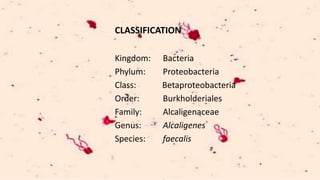
• Alcaligenes is a genus of Gram-negative, rod-
shaped bacteria.
• They are obligately aerobic, but some can undergo
anaerobic respiration if nitrate is present.
• The species are motile with peritrichous flagella
and rarely non motile.
• They have a distinct cell wall.
• It is a genus of non fermenting bacteria.
• Strains of Alcaligenes (such as A. faecalis) are found
mostly in the intestinal tracts of vertebrates,
decaying materials, dairy products, water, and soil;
they can be isolated from human respiratory and
gastrointestinal tracts and wounds in hospitalized
patients with compromised immune systems.
• It is a pathogenic, opportunistic bacteria.
• Samples from blood, urine, feces, discharge from ears, spinal fluid, and wounds
have produced this type of bacteria.
• Alcaligenes species have been increasingly recovered over the past decade from
patients with cystic fibrosis (CF).
• Some species of Alcaligenes are potential causes of chronic pulmonary disease in
patients with cystic fibrosis.
• Alcaligenes generate energy in a number of ways, including arsenite oxidation.
A. faecalis
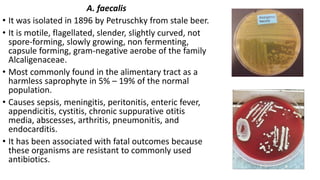
• It was isolated in 1896 by Petruschky from stale beer.
• It is motile, flagellated, slender, slightly curved, not
spore-forming, slowly growing, non fermenting,
capsule forming, gram-negative aerobe of the family
Alcaligenaceae.
• Most commonly found in the alimentary tract as a
harmless saprophyte in 5% – 19% of the normal
population.
• Causes sepsis, meningitis, peritonitis, enteric fever,
appendicitis, cystitis, chronic suppurative otitis
media, abscesses, arthritis, pneumonitis, and
endocarditis.
• It has been associated with fatal outcomes because
these organisms are resistant to commonly used
antibiotics.
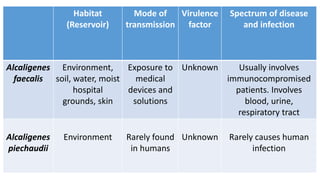
Habitat
(Reservoir)
Mode of
transmission
Virulence
factor
Spectrum of disease
and infection
Alcaligenes
faecalis
Environment,
soil, water, moist
hospital
grounds, skin
Exposure to
medical
devices and
solutions
Unknown Usually involves
immunocompromised
patients. Involves
blood, urine,
respiratory tract
Alcaligenes
piechaudii
Environment Rarely found
in humans
Unknown Rarely causes human
infection
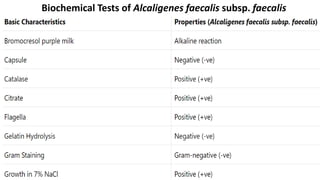
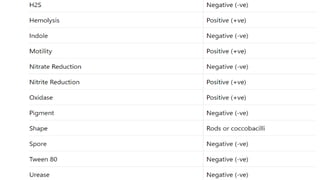
Biochemical Tests of Alcaligenes faecalis subsp. faecalis
• PATHOLOGY OF A. faecalis
• Many infections caused by the microbe are a result
of contamination of medical devices.
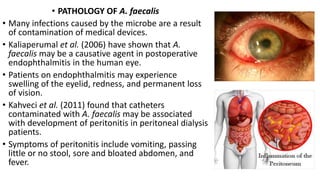
• Kaliaperumal et al. (2006) have shown that A.
faecalis may be a causative agent in postoperative
endophthalmitis in the human eye.
• Patients on endophthalmitis may experience
swelling of the eyelid, redness, and permanent loss
of vision.
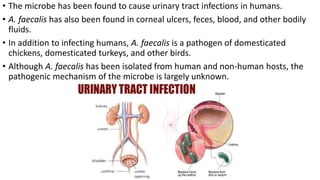
• Kahveci et al. (2011) found that catheters
contaminated with A. faecalis may be associated
with development of peritonitis in peritoneal dialysis
patients.
• Symptoms of peritonitis include vomiting, passing
little or no stool, sore and bloated abdomen, and
fever.
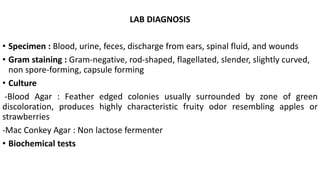
• The microbe has been found to cause urinary tract infections in humans.
• A. faecalis has also been found in corneal ulcers, feces, blood, and other bodily
fluids.
• In addition to infecting humans, A. faecalis is a pathogen of domesticated
chickens, domesticated turkeys, and other birds.
• Although A. faecalis has been isolated from human and non-human hosts, the
pathogenic mechanism of the microbe is largely unknown.
LAB DIAGNOSIS
• Specimen : Blood, urine, feces, discharge from ears, spinal fluid, and wounds
• Gram staining : Gram-negative, rod-shaped, flagellated, slender, slightly curved,
non spore-forming, capsule forming
• Culture
-Blood Agar : Feather edged colonies usually surrounded by zone of green
discoloration, produces highly characteristic fruity odor resembling apples or
strawberries
-Mac Conkey Agar : Non lactose fermenter
• Biochemical tests
TREATMENT
• Currently, carbapenems, antipseudomonal penicillins, and trimethoprim/sul-
famethoxazole are considered the agents of choice for the treatment of
A. faecalis infections
REFERENCES
• https://www.jstage.jst.go.jp/article/yoken/68/2/68_JJID.2014.164/_pdf
• Bailey and Scott (2007). Diagnostic Microbiology 12th edition Elsevier pp 363-369
• https://microbewiki.kenyon.edu/index.php/Alcaligenes_faecalis_NEUF2011
• https://www.sciencedirect.com/topics/biochemistry-genetics-and-molecular-
biology/alcaligenes-faecalis
THANK
YOU

Alcaligens (1)

  • 1.
    Alcaligenes By- Sanju Sah St.Xavier’s college, Maitighar, Kathmandu Department of Microbiology
  • 2.
    CLASSIFICATION Kingdom: Bacteria Phylum: Proteobacteria Class:Betaproteobacteria Order: Burkholderiales Family: Alcaligenaceae Genus: Alcaligenes Species: faecalis
  • 3.
    INTRODUCTION • Alcaligenes isa genus of Gram-negative, rod- shaped bacteria. • They are obligately aerobic, but some can undergo anaerobic respiration if nitrate is present. • The species are motile with peritrichous flagella and rarely non motile. • They have a distinct cell wall. • It is a genus of non fermenting bacteria. • Strains of Alcaligenes (such as A. faecalis) are found mostly in the intestinal tracts of vertebrates, decaying materials, dairy products, water, and soil; they can be isolated from human respiratory and gastrointestinal tracts and wounds in hospitalized patients with compromised immune systems.
  • 4.
    • It isa pathogenic, opportunistic bacteria. • Samples from blood, urine, feces, discharge from ears, spinal fluid, and wounds have produced this type of bacteria. • Alcaligenes species have been increasingly recovered over the past decade from patients with cystic fibrosis (CF). • Some species of Alcaligenes are potential causes of chronic pulmonary disease in patients with cystic fibrosis. • Alcaligenes generate energy in a number of ways, including arsenite oxidation.
  • 5.
    A. faecalis • Itwas isolated in 1896 by Petruschky from stale beer. • It is motile, flagellated, slender, slightly curved, not spore-forming, slowly growing, non fermenting, capsule forming, gram-negative aerobe of the family Alcaligenaceae. • Most commonly found in the alimentary tract as a harmless saprophyte in 5% – 19% of the normal population. • Causes sepsis, meningitis, peritonitis, enteric fever, appendicitis, cystitis, chronic suppurative otitis media, abscesses, arthritis, pneumonitis, and endocarditis. • It has been associated with fatal outcomes because these organisms are resistant to commonly used antibiotics.
  • 6.
    Habitat (Reservoir) Mode of transmission Virulence factor Spectrum ofdisease and infection Alcaligenes faecalis Environment, soil, water, moist hospital grounds, skin Exposure to medical devices and solutions Unknown Usually involves immunocompromised patients. Involves blood, urine, respiratory tract Alcaligenes piechaudii Environment Rarely found in humans Unknown Rarely causes human infection
  • 7.
    Biochemical Tests ofAlcaligenes faecalis subsp. faecalis
  • 9.
    • PATHOLOGY OFA. faecalis • Many infections caused by the microbe are a result of contamination of medical devices. • Kaliaperumal et al. (2006) have shown that A. faecalis may be a causative agent in postoperative endophthalmitis in the human eye. • Patients on endophthalmitis may experience swelling of the eyelid, redness, and permanent loss of vision. • Kahveci et al. (2011) found that catheters contaminated with A. faecalis may be associated with development of peritonitis in peritoneal dialysis patients. • Symptoms of peritonitis include vomiting, passing little or no stool, sore and bloated abdomen, and fever.
  • 10.
    • The microbehas been found to cause urinary tract infections in humans. • A. faecalis has also been found in corneal ulcers, feces, blood, and other bodily fluids. • In addition to infecting humans, A. faecalis is a pathogen of domesticated chickens, domesticated turkeys, and other birds. • Although A. faecalis has been isolated from human and non-human hosts, the pathogenic mechanism of the microbe is largely unknown.
  • 11.
    LAB DIAGNOSIS • Specimen: Blood, urine, feces, discharge from ears, spinal fluid, and wounds • Gram staining : Gram-negative, rod-shaped, flagellated, slender, slightly curved, non spore-forming, capsule forming • Culture -Blood Agar : Feather edged colonies usually surrounded by zone of green discoloration, produces highly characteristic fruity odor resembling apples or strawberries -Mac Conkey Agar : Non lactose fermenter • Biochemical tests
  • 12.
    TREATMENT • Currently, carbapenems,antipseudomonal penicillins, and trimethoprim/sul- famethoxazole are considered the agents of choice for the treatment of A. faecalis infections
  • 13.
    REFERENCES • https://www.jstage.jst.go.jp/article/yoken/68/2/68_JJID.2014.164/_pdf • Baileyand Scott (2007). Diagnostic Microbiology 12th edition Elsevier pp 363-369 • https://microbewiki.kenyon.edu/index.php/Alcaligenes_faecalis_NEUF2011 • https://www.sciencedirect.com/topics/biochemistry-genetics-and-molecular- biology/alcaligenes-faecalis
  • 14.