Module 2:
Matter Around Us
Chapter 6 Water, Solutions And Suspensions
1© Copyright Star Publishing Pte Ltd
Chapter 6 Water, Solutions
And Suspensions
6.1 What are Solutions and
Suspensions?
6.2 Why is water a universal solvent?
6.3 What are the factors that affect the
solubility of a solute in a solvent?
6.4 What are the factors that affect the
rate of dissolving?
6.5 What are Acids and Alkalis?
2© Copyright Star Publishing Pte Ltd
Objectives
 Explain what is meant by the terms
solute, solvent and solution
 Give examples of uses of solvents and
solutions at home, in industries and in
medicine
 Deduce the nature of solutions and
suspension by simple laboratory tests
(e.g. passing a beam of light, filtering
using filter paper)
3© Copyright Star Publishing Pte Ltd
What is a solution?
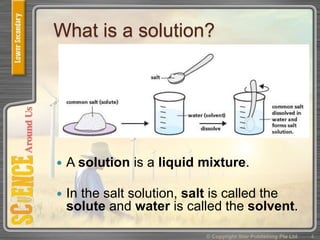
 A solution is a liquid mixture.
 In the salt solution, salt is called the
solute and water is called the solvent.
© Copyright Star Publishing Pte Ltd 4
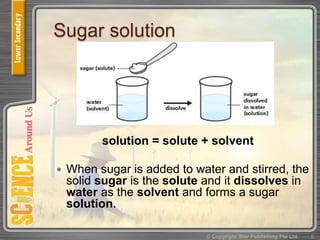
Sugar solution
solution = solute + solvent
 When sugar is added to water and stirred, the
solid sugar is the solute and it dissolves in
water as the solvent and forms a sugar
solution.
© Copyright Star Publishing Pte Ltd 5
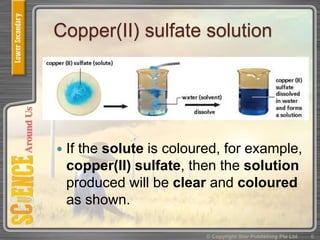
Copper(II) sulfate solution
 If the solute is coloured, for example,
copper(II) sulfate, then the solution
produced will be clear and coloured
as shown.
© Copyright Star Publishing Pte Ltd 6
Properties of solutions
 Solutions are homogeneous. This
means that the colour, physical and
chemical properties are the same
throughout the solution.
 Solutions will not separate back into
the solute and solvent even if they are
left to stand.
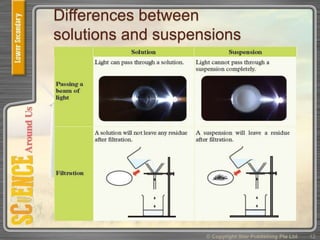
 When filtered, the solution will pass
through the filter paper completely.
© Copyright Star Publishing Pte Ltd 7
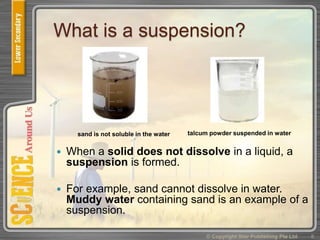
What is a suspension?
 When a solid does not dissolve in a liquid, a
suspension is formed.
 For example, sand cannot dissolve in water.
Muddy water containing sand is an example of a
suspension.
© Copyright Star Publishing Pte Ltd 8
talcum powder suspended in watersand is not soluble in the water
Properties of suspensions
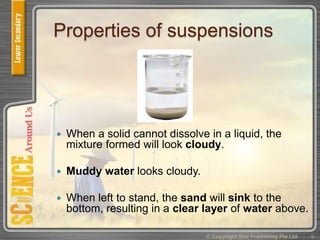
 When a solid cannot dissolve in a liquid, the
mixture formed will look cloudy.
 Muddy water looks cloudy.
 When left to stand, the sand will sink to the
bottom, resulting in a clear layer of water above.
© Copyright Star Publishing Pte Ltd 9
Properties of suspensions
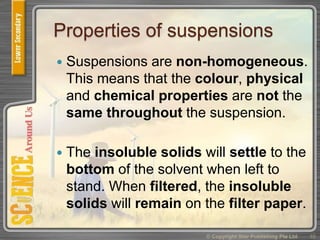
 Suspensions are non-homogeneous.
This means that the colour, physical
and chemical properties are not the
same throughout the suspension.
 The insoluble solids will settle to the
bottom of the solvent when left to
stand. When filtered, the insoluble
solids will remain on the filter paper.
© Copyright Star Publishing Pte Ltd 10
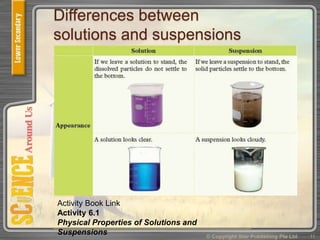
Differences between
solutions and suspensions
© Copyright Star Publishing Pte Ltd 11
Activity Book Link
Activity 6.1
Physical Properties of Solutions and
Suspensions
Differences between
solutions and suspensions
© Copyright Star Publishing Pte Ltd 12
Chapter 6 Water, Solutions
And Suspensions
6.1 What are Solutions and
Suspensions?
6.2 Why is water a universal solvent?
6.3 What are the factors that affect the
solubility of a solute in a solvent?
6.4 What are the factors that affect the
rate of dissolving?
6.5 What are Acids and Alkalis?
13© Copyright Star Publishing Pte Ltd
Objectives
 Recognise that water dissolves many
substances
14© Copyright Star Publishing Pte Ltd
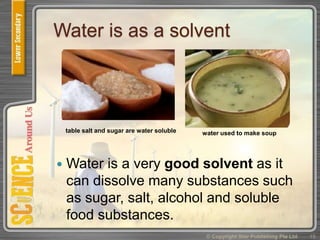
Water is as a solvent
 Water is a very good solvent as it
can dissolve many substances such
as sugar, salt, alcohol and soluble
food substances.
© Copyright Star Publishing Pte Ltd 15
water used to make souptable salt and sugar are water soluble
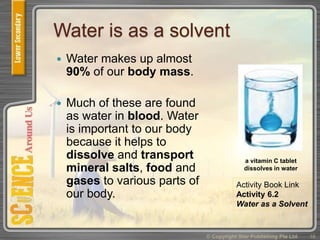
Water is as a solvent
 Water makes up almost
90% of our body mass.
 Much of these are found
as water in blood. Water
is important to our body
because it helps to
dissolve and transport
mineral salts, food and
gases to various parts of
our body.
© Copyright Star Publishing Pte Ltd 16
a vitamin C tablet
dissolves in water
Activity Book Link
Activity 6.2
Water as a Solvent
Use of Solvents and Solutions
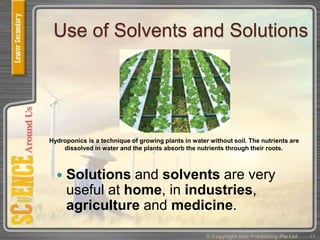
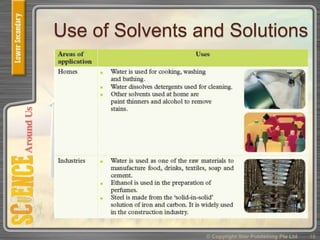
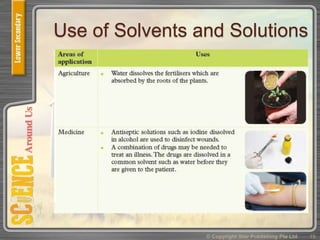
 Solutions and solvents are very
useful at home, in industries,
agriculture and medicine.
© Copyright Star Publishing Pte Ltd 17
Hydroponics is a technique of growing plants in water without soil. The nutrients are
dissolved in water and the plants absorb the nutrients through their roots.
Use of Solvents and Solutions
© Copyright Star Publishing Pte Ltd 18
Use of Solvents and Solutions
© Copyright Star Publishing Pte Ltd 19
Chapter 6 Water, Solutions
And Suspensions
6.1 What are Solutions and
Suspensions?
6.2 Why is water a universal solvent?
6.3 What are the factors that affect
the solubility of a solute in a
solvent?
6.4 What are the factors that affect the
rate of dissolving?
6.5 What are Acids and Alkalis?
20© Copyright Star Publishing Pte Ltd
Objectives
 Investigate the factors that affect the
solubility of materials (e.g. type of
solute/solvent, temperature).
21© Copyright Star Publishing Pte Ltd
Solubility of a substance
 The solubility of a substance is the
maximum amount of the substance
that can dissolve in a given amount
of solvent (e.g. 100 cm3 of water) at a
given temperature (e.g. 25°C).
 Different types of solids will have
different solubilities in a solvent.
© Copyright Star Publishing Pte Ltd 22
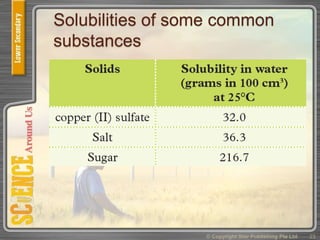
Solubilities of some common
substances
© Copyright Star Publishing Pte Ltd 23
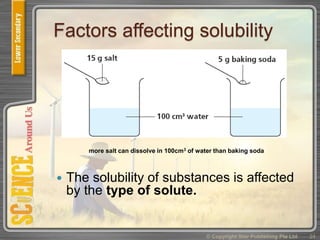
Factors affecting solubility
 The solubility of substances is affected
by the type of solute.
© Copyright Star Publishing Pte Ltd 24
more salt can dissolve in 100cm3 of water than baking soda
Factors affecting solubility
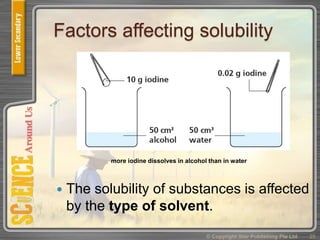
 The solubility of substances is affected
by the type of solvent.
© Copyright Star Publishing Pte Ltd 25
more iodine dissolves in alcohol than in water
Factors affecting solubility
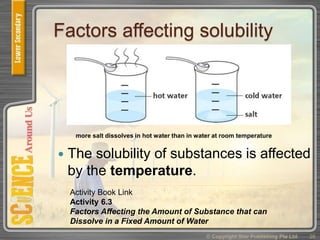
 The solubility of substances is affected
by the temperature.
© Copyright Star Publishing Pte Ltd 26
more salt dissolves in hot water than in water at room temperature
Activity Book Link
Activity 6.3
Factors Affecting the Amount of Substance that can
Dissolve in a Fixed Amount of Water
Chapter 6 Water, Solutions
And Suspensions
6.1 What are Solutions and
Suspensions?
6.2 Why is water a universal solvent?
6.3 What are the factors that affect the
solubility of a solute in a solvent?
6.4 What are the factors that affect
the rate of dissolving?
6.5 What are Acids and Alkalis?
27© Copyright Star Publishing Pte Ltd
Objectives
 Investigate the factors that affect the
rate of dissolving (e.g. temperature,
surface area, stirring).
28© Copyright Star Publishing Pte Ltd
Factors Affecting the Rate of Dissolving
of Substances
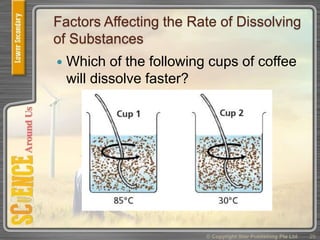
 Which of the following cups of coffee
will dissolve faster?
© Copyright Star Publishing Pte Ltd 29
Factors Affecting the Rate of Dissolving
of Substances
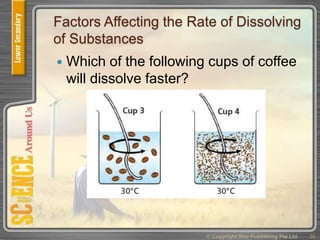
 Which of the following cups of coffee
will dissolve faster?
© Copyright Star Publishing Pte Ltd 30
Factors Affecting the Rate of Dissolving
of Substances
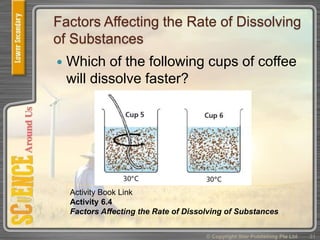
 Which of the following cups of coffee
will dissolve faster?
© Copyright Star Publishing Pte Ltd 31
Activity Book Link
Activity 6.4
Factors Affecting the Rate of Dissolving of Substances
What is the rate of dissolving
?
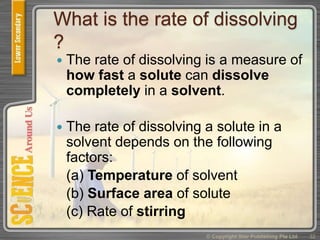
 The rate of dissolving is a measure of
how fast a solute can dissolve
completely in a solvent.
 The rate of dissolving a solute in a
solvent depends on the following
factors:
(a) Temperature of solvent
(b) Surface area of solute
(c) Rate of stirring
© Copyright Star Publishing Pte Ltd 32
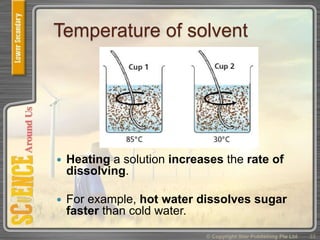
Temperature of solvent
 Heating a solution increases the rate of
dissolving.
 For example, hot water dissolves sugar
faster than cold water.
© Copyright Star Publishing Pte Ltd 33
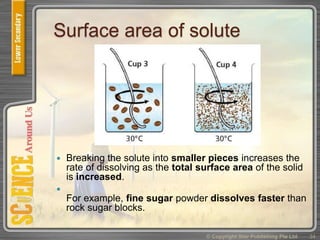
Surface area of solute
 Breaking the solute into smaller pieces increases the
rate of dissolving as the total surface area of the solid
is increased.

For example, fine sugar powder dissolves faster than
rock sugar blocks.
© Copyright Star Publishing Pte Ltd 34
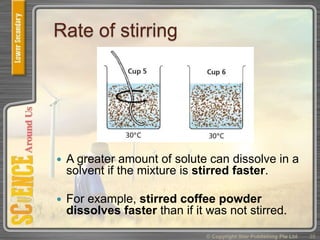
Rate of stirring
 A greater amount of solute can dissolve in a
solvent if the mixture is stirred faster.
 For example, stirred coffee powder
dissolves faster than if it was not stirred.
© Copyright Star Publishing Pte Ltd 35
Chapter 6 Water, Solutions
And Suspensions
6.1 What are Solutions and
Suspensions?
6.2 Why is water a universal solvent?
6.3 What are the factors that affect the
solubility of a solute in a solvent?
6.4 What are the factors that affect the
rate of dissolving?
6.5 What are Acids and Alkalis?
36© Copyright Star Publishing Pte Ltd
Objectives
 Describe acidity, neutrality and
alkalinity in terms of the pH scale
(whole numbers only)
 Show an understanding that indicators
are substances that change colour
when an acid or alkali is added to
them
 Investigate the effect of acidic, alkaline
and neutral solutions on indicators
(Universal and litmus indicators)
37© Copyright Star Publishing Pte Ltd
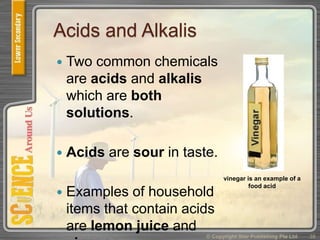
Acids and Alkalis
 Two common chemicals
are acids and alkalis
which are both
solutions.
 Acids are sour in taste.
 Examples of household
items that contain acids
are lemon juice and
© Copyright Star Publishing Pte Ltd 38
vinegar is an example of a
food acid
Alkalis
 Alkalis are bitter in
taste.
 Alkalis belong to a larger
group of chemicals
known as bases. Alkalis
are bases that are
soluble in water.
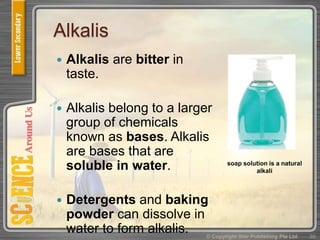
 Detergents and baking
powder can dissolve in
water to form alkalis. © Copyright Star Publishing Pte Ltd 39
soap solution is a natural
alkali
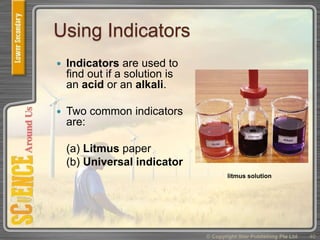
Using Indicators
 Indicators are used to
find out if a solution is
an acid or an alkali.
 Two common indicators
are:
(a) Litmus paper
(b) Universal indicator
© Copyright Star Publishing Pte Ltd 40
litmus solution
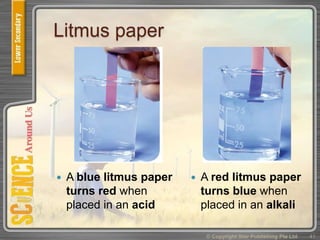
Litmus paper
 A blue litmus paper
turns red when
placed in an acid
 A red litmus paper
turns blue when
placed in an alkali
© Copyright Star Publishing Pte Ltd 41
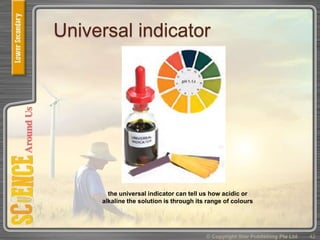
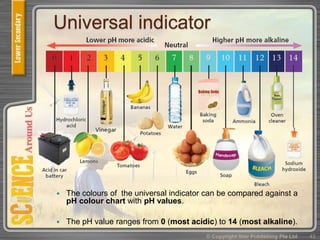
Universal indicator
© Copyright Star Publishing Pte Ltd 42
the universal indicator can tell us how acidic or
alkaline the solution is through its range of colours
Universal indicator
 The colours of the universal indicator can be compared against a
pH colour chart with pH values.
 The pH value ranges from 0 (most acidic) to 14 (most alkaline).
© Copyright Star Publishing Pte Ltd 43
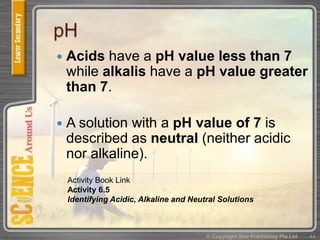
pH
 Acids have a pH value less than 7
while alkalis have a pH value greater
than 7.
 A solution with a pH value of 7 is
described as neutral (neither acidic
nor alkaline).
© Copyright Star Publishing Pte Ltd 44
Activity Book Link
Activity 6.5
Identifying Acidic, Alkaline and Neutral Solutions
© Copyright Star Publishing Pte Ltd 45

Lss module 2 chpt 6 water, solution, suspension

  • 1.
    Module 2: Matter AroundUs Chapter 6 Water, Solutions And Suspensions 1© Copyright Star Publishing Pte Ltd
  • 2.
    Chapter 6 Water,Solutions And Suspensions 6.1 What are Solutions and Suspensions? 6.2 Why is water a universal solvent? 6.3 What are the factors that affect the solubility of a solute in a solvent? 6.4 What are the factors that affect the rate of dissolving? 6.5 What are Acids and Alkalis? 2© Copyright Star Publishing Pte Ltd
  • 3.
    Objectives  Explain whatis meant by the terms solute, solvent and solution  Give examples of uses of solvents and solutions at home, in industries and in medicine  Deduce the nature of solutions and suspension by simple laboratory tests (e.g. passing a beam of light, filtering using filter paper) 3© Copyright Star Publishing Pte Ltd
  • 4.
    What is asolution?  A solution is a liquid mixture.  In the salt solution, salt is called the solute and water is called the solvent. © Copyright Star Publishing Pte Ltd 4
  • 5.
    Sugar solution solution =solute + solvent  When sugar is added to water and stirred, the solid sugar is the solute and it dissolves in water as the solvent and forms a sugar solution. © Copyright Star Publishing Pte Ltd 5
  • 6.
    Copper(II) sulfate solution If the solute is coloured, for example, copper(II) sulfate, then the solution produced will be clear and coloured as shown. © Copyright Star Publishing Pte Ltd 6
  • 7.
    Properties of solutions Solutions are homogeneous. This means that the colour, physical and chemical properties are the same throughout the solution.  Solutions will not separate back into the solute and solvent even if they are left to stand.  When filtered, the solution will pass through the filter paper completely. © Copyright Star Publishing Pte Ltd 7
  • 8.
    What is asuspension?  When a solid does not dissolve in a liquid, a suspension is formed.  For example, sand cannot dissolve in water. Muddy water containing sand is an example of a suspension. © Copyright Star Publishing Pte Ltd 8 talcum powder suspended in watersand is not soluble in the water
  • 9.
    Properties of suspensions When a solid cannot dissolve in a liquid, the mixture formed will look cloudy.  Muddy water looks cloudy.  When left to stand, the sand will sink to the bottom, resulting in a clear layer of water above. © Copyright Star Publishing Pte Ltd 9
  • 10.
    Properties of suspensions Suspensions are non-homogeneous. This means that the colour, physical and chemical properties are not the same throughout the suspension.  The insoluble solids will settle to the bottom of the solvent when left to stand. When filtered, the insoluble solids will remain on the filter paper. © Copyright Star Publishing Pte Ltd 10
  • 11.
    Differences between solutions andsuspensions © Copyright Star Publishing Pte Ltd 11 Activity Book Link Activity 6.1 Physical Properties of Solutions and Suspensions
  • 12.
    Differences between solutions andsuspensions © Copyright Star Publishing Pte Ltd 12
  • 13.
    Chapter 6 Water,Solutions And Suspensions 6.1 What are Solutions and Suspensions? 6.2 Why is water a universal solvent? 6.3 What are the factors that affect the solubility of a solute in a solvent? 6.4 What are the factors that affect the rate of dissolving? 6.5 What are Acids and Alkalis? 13© Copyright Star Publishing Pte Ltd
  • 14.
    Objectives  Recognise thatwater dissolves many substances 14© Copyright Star Publishing Pte Ltd
  • 15.
    Water is asa solvent  Water is a very good solvent as it can dissolve many substances such as sugar, salt, alcohol and soluble food substances. © Copyright Star Publishing Pte Ltd 15 water used to make souptable salt and sugar are water soluble
  • 16.
    Water is asa solvent  Water makes up almost 90% of our body mass.  Much of these are found as water in blood. Water is important to our body because it helps to dissolve and transport mineral salts, food and gases to various parts of our body. © Copyright Star Publishing Pte Ltd 16 a vitamin C tablet dissolves in water Activity Book Link Activity 6.2 Water as a Solvent
  • 17.
    Use of Solventsand Solutions  Solutions and solvents are very useful at home, in industries, agriculture and medicine. © Copyright Star Publishing Pte Ltd 17 Hydroponics is a technique of growing plants in water without soil. The nutrients are dissolved in water and the plants absorb the nutrients through their roots.
  • 18.
    Use of Solventsand Solutions © Copyright Star Publishing Pte Ltd 18
  • 19.
    Use of Solventsand Solutions © Copyright Star Publishing Pte Ltd 19
  • 20.
    Chapter 6 Water,Solutions And Suspensions 6.1 What are Solutions and Suspensions? 6.2 Why is water a universal solvent? 6.3 What are the factors that affect the solubility of a solute in a solvent? 6.4 What are the factors that affect the rate of dissolving? 6.5 What are Acids and Alkalis? 20© Copyright Star Publishing Pte Ltd
  • 21.
    Objectives  Investigate thefactors that affect the solubility of materials (e.g. type of solute/solvent, temperature). 21© Copyright Star Publishing Pte Ltd
  • 22.
    Solubility of asubstance  The solubility of a substance is the maximum amount of the substance that can dissolve in a given amount of solvent (e.g. 100 cm3 of water) at a given temperature (e.g. 25°C).  Different types of solids will have different solubilities in a solvent. © Copyright Star Publishing Pte Ltd 22
  • 23.
    Solubilities of somecommon substances © Copyright Star Publishing Pte Ltd 23
  • 24.
    Factors affecting solubility The solubility of substances is affected by the type of solute. © Copyright Star Publishing Pte Ltd 24 more salt can dissolve in 100cm3 of water than baking soda
  • 25.
    Factors affecting solubility The solubility of substances is affected by the type of solvent. © Copyright Star Publishing Pte Ltd 25 more iodine dissolves in alcohol than in water
  • 26.
    Factors affecting solubility The solubility of substances is affected by the temperature. © Copyright Star Publishing Pte Ltd 26 more salt dissolves in hot water than in water at room temperature Activity Book Link Activity 6.3 Factors Affecting the Amount of Substance that can Dissolve in a Fixed Amount of Water
  • 27.
    Chapter 6 Water,Solutions And Suspensions 6.1 What are Solutions and Suspensions? 6.2 Why is water a universal solvent? 6.3 What are the factors that affect the solubility of a solute in a solvent? 6.4 What are the factors that affect the rate of dissolving? 6.5 What are Acids and Alkalis? 27© Copyright Star Publishing Pte Ltd
  • 28.
    Objectives  Investigate thefactors that affect the rate of dissolving (e.g. temperature, surface area, stirring). 28© Copyright Star Publishing Pte Ltd
  • 29.
    Factors Affecting theRate of Dissolving of Substances  Which of the following cups of coffee will dissolve faster? © Copyright Star Publishing Pte Ltd 29
  • 30.
    Factors Affecting theRate of Dissolving of Substances  Which of the following cups of coffee will dissolve faster? © Copyright Star Publishing Pte Ltd 30
  • 31.
    Factors Affecting theRate of Dissolving of Substances  Which of the following cups of coffee will dissolve faster? © Copyright Star Publishing Pte Ltd 31 Activity Book Link Activity 6.4 Factors Affecting the Rate of Dissolving of Substances
  • 32.
    What is therate of dissolving ?  The rate of dissolving is a measure of how fast a solute can dissolve completely in a solvent.  The rate of dissolving a solute in a solvent depends on the following factors: (a) Temperature of solvent (b) Surface area of solute (c) Rate of stirring © Copyright Star Publishing Pte Ltd 32
  • 33.
    Temperature of solvent Heating a solution increases the rate of dissolving.  For example, hot water dissolves sugar faster than cold water. © Copyright Star Publishing Pte Ltd 33
  • 34.
    Surface area ofsolute  Breaking the solute into smaller pieces increases the rate of dissolving as the total surface area of the solid is increased.  For example, fine sugar powder dissolves faster than rock sugar blocks. © Copyright Star Publishing Pte Ltd 34
  • 35.
    Rate of stirring A greater amount of solute can dissolve in a solvent if the mixture is stirred faster.  For example, stirred coffee powder dissolves faster than if it was not stirred. © Copyright Star Publishing Pte Ltd 35
  • 36.
    Chapter 6 Water,Solutions And Suspensions 6.1 What are Solutions and Suspensions? 6.2 Why is water a universal solvent? 6.3 What are the factors that affect the solubility of a solute in a solvent? 6.4 What are the factors that affect the rate of dissolving? 6.5 What are Acids and Alkalis? 36© Copyright Star Publishing Pte Ltd
  • 37.
    Objectives  Describe acidity,neutrality and alkalinity in terms of the pH scale (whole numbers only)  Show an understanding that indicators are substances that change colour when an acid or alkali is added to them  Investigate the effect of acidic, alkaline and neutral solutions on indicators (Universal and litmus indicators) 37© Copyright Star Publishing Pte Ltd
  • 38.
    Acids and Alkalis Two common chemicals are acids and alkalis which are both solutions.  Acids are sour in taste.  Examples of household items that contain acids are lemon juice and © Copyright Star Publishing Pte Ltd 38 vinegar is an example of a food acid
  • 39.
    Alkalis  Alkalis arebitter in taste.  Alkalis belong to a larger group of chemicals known as bases. Alkalis are bases that are soluble in water.  Detergents and baking powder can dissolve in water to form alkalis. © Copyright Star Publishing Pte Ltd 39 soap solution is a natural alkali
  • 40.
    Using Indicators  Indicatorsare used to find out if a solution is an acid or an alkali.  Two common indicators are: (a) Litmus paper (b) Universal indicator © Copyright Star Publishing Pte Ltd 40 litmus solution
  • 41.
    Litmus paper  Ablue litmus paper turns red when placed in an acid  A red litmus paper turns blue when placed in an alkali © Copyright Star Publishing Pte Ltd 41
  • 42.
    Universal indicator © CopyrightStar Publishing Pte Ltd 42 the universal indicator can tell us how acidic or alkaline the solution is through its range of colours
  • 43.
    Universal indicator  Thecolours of the universal indicator can be compared against a pH colour chart with pH values.  The pH value ranges from 0 (most acidic) to 14 (most alkaline). © Copyright Star Publishing Pte Ltd 43
  • 44.
    pH  Acids havea pH value less than 7 while alkalis have a pH value greater than 7.  A solution with a pH value of 7 is described as neutral (neither acidic nor alkaline). © Copyright Star Publishing Pte Ltd 44 Activity Book Link Activity 6.5 Identifying Acidic, Alkaline and Neutral Solutions
  • 45.
    © Copyright StarPublishing Pte Ltd 45