MILLER/SPOOLMAN
LIVING IN THE ENVIRONMENT           17TH


                  Chapter 13
                  Water Resources
Case Study: The Colorado River Basin— An
        Overtapped Resource (1)
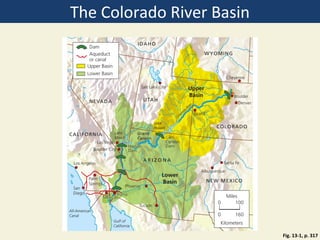
 • 2,300 km through 7 U.S. states

 • 14 Dams and reservoirs

 • Located in a desert area within the rain shadow of
   the Rocky Mountains

 • Water supplied mostly from snowmelt of the Rocky
   Mountains
Case Study: The Colorado River Basin— An
        Overtapped Resource (2)
 • Supplies water and electricity for about 30 million
   people
    • Las Vegas, Los Angeles, San Diego

 • Irrigation of crops that help feed America

 • Very little water reaches the Gulf of California

 • Southwest experiencing recent droughts
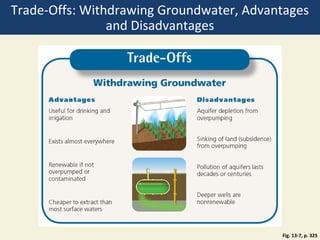
The Colorado River Basin


                           Fig. 13-1, p. 317
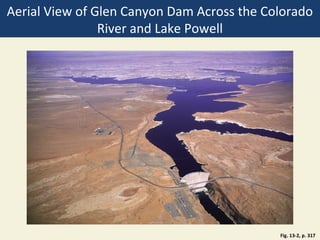
Aerial View of Glen Canyon Dam Across the Colorado
                River and Lake Powell


                                            Fig. 13-2, p. 317
Freshwater Is an Irreplaceable Resource That
       We Are Managing Poorly (1)
• Why is water so important?

• Earth as a watery world: 71% of surface

• Poorly managed resource

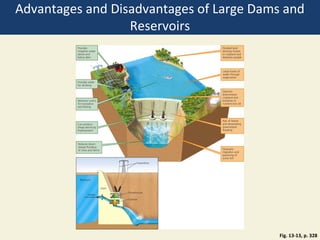
• Water waste

• Water pollution
Freshwater Is an Irreplaceable Resource That
       We Are Managing Poorly (2)
• Access to water is
   •   A global health issue
   •   An economic issue
   •   A women’s and children’s issue
   •   A national and global security issue
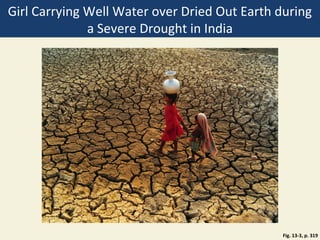
Girl Carrying Well Water over Dried Out Earth during
              a Severe Drought in India


                                               Fig. 13-3, p. 319
Most of the Earth’s Freshwater Is Not
            Available to Us
• Freshwater availability: 0.024%
   • Groundwater, lakes, rivers, streams


• Hydrologic cycle
   • Movement of water in the seas, land, and air
   • Driven by solar energy and gravity


• People divided into
   • Water haves
   • Water have-nots
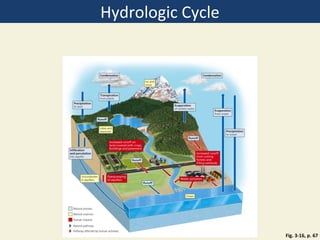
Hydrologic Cycle


                   Fig. 3-16, p. 67
Groundwater and Surface Water Are
       Critical Resources (1)
• Zone of saturation
  • Spaces in soil are filled with water
• Water table
  • Top of zone of saturation
• Aquifers
  • Natural recharge
  • Lateral recharge
• Surface Water
  • Surface runoff
  • Watershed (drainage) basin
We Use Much of the World’s Reliable
              Runoff
• 2/3 of the surface runoff: lost by seasonal floods

• 1/3 is reliable runoff = usable

• World-wide averages
   • Domestic: 10%
   • Agriculture: 70%
   • Industrial use: 20%
Science Focus: Water Footprints and
          Virtual Water (1)
• Water footprint
   • Volume of water we directly and indirectly

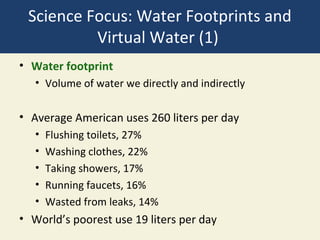
• Average American uses 260 liters per day
   •   Flushing toilets, 27%
   •   Washing clothes, 22%
   •   Taking showers, 17%
   •   Running faucets, 16%
   •   Wasted from leaks, 14%
• World’s poorest use 19 liters per day
Case Study: Freshwater Resources in
          the United States
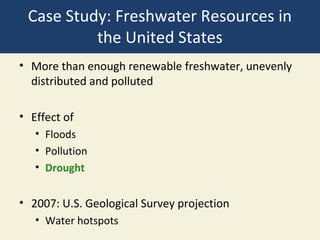
• More than enough renewable freshwater, unevenly
  distributed and polluted

• Effect of
   • Floods
   • Pollution
   • Drought


• 2007: U.S. Geological Survey projection
   • Water hotspots
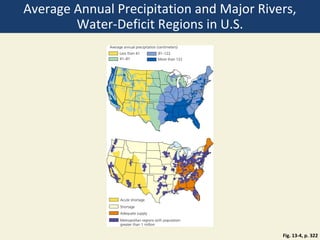
Average Annual Precipitation and Major Rivers,
        Water-Deficit Regions in U.S.


                                           Fig. 13-4, p. 322
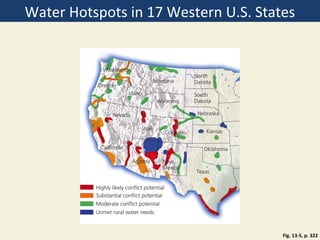
Water Hotspots in 17 Western U.S. States


                                      Fig. 13-5, p. 322
Water Shortages Will Grow (1)
• Dry climates

• Drought

• Too many people using a normal supply of water

• Wasteful use of water
Water Shortages Will Grow (2)
• China and urbanization

• 30% earth’s land area experiences severe drought
   • Will rise to 45% by 2059 from climate change

• Potential conflicts/wars over water
   • Refugees from arid lands
   • Increased mortality
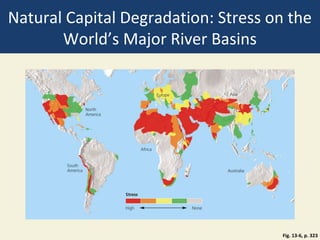
Natural Capital Degradation: Stress on the
       World’s Major River Basins


                                     Fig. 13-6, p. 323
Groundwater is Being Withdrawn
    Faster Than It Is Replenished (1)
• Most aquifers are renewable

• Aquifers provide drinking water for half the world

• Water tables are falling in many parts of the world,
  primarily from crop irrigation
Trade-Offs: Withdrawing Groundwater, Advantages
                and Disadvantages


                                          Fig. 13-7, p. 325
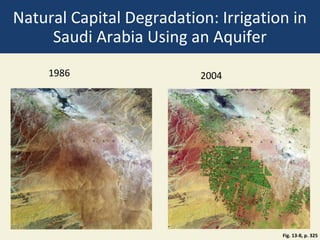
Natural Capital Degradation: Irrigation in
     Saudi Arabia Using an Aquifer
     1986                 2004


                                      Fig. 13-8, p. 325
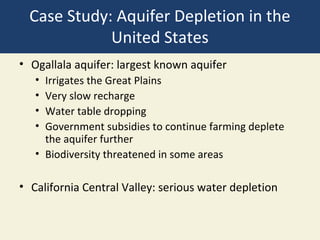
Case Study: Aquifer Depletion in the
             United States
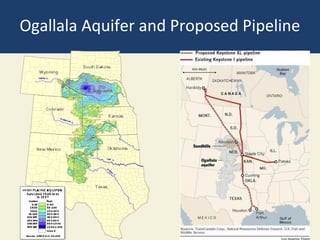
• Ogallala aquifer: largest known aquifer
   • Irrigates the Great Plains
   • Very slow recharge
   • Water table dropping
   • Government subsidies to continue farming deplete
     the aquifer further
   • Biodiversity threatened in some areas

• California Central Valley: serious water depletion
Ogallala Aquifer and Proposed Pipeline
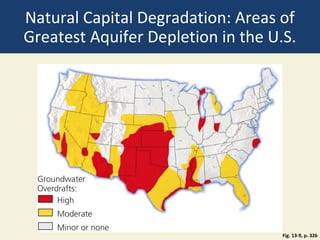
Natural Capital Degradation: Areas of
Greatest Aquifer Depletion in the U.S.


                                    Fig. 13-9, p. 326
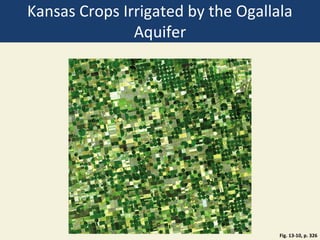
Kansas Crops Irrigated by the Ogallala
               Aquifer


                                    Fig. 13-10, p. 326
Overpumping Aquifers Has Several
          Harmful Effects
• Limits future food production

• Bigger gap between the rich and the poor

• Land subsidence (sinking)
   • Mexico City
   • San Joaquin Valley in California


• Groundwater overdrafts near coastal regions
   • Contamination of groundwater with saltwater
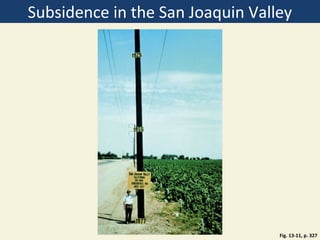
Subsidence in the San Joaquin Valley


                                  Fig. 13-11, p. 327
Deep Aquifers Might Be Tapped

• May contain enough water to provide for billions of
  people for centuries

• Major concerns
   1.                                           Nonre
                                                newab
                                                le
   2.                                           Little is
                                                known
                                                about
                                                the
                                                geolog
Large Dams and Reservoirs Have
   Advantages and Disadvantages (1)
• Main goal of a dam and reservoir system
  • Capture and store runoff


  • Release runoff as needed to control:
     •   Floods
     •   Generate electricity
     •   Supply irrigation water
     •   Recreation (reservoirs)
Large Dams and Reservoirs Have
  Advantages and Disadvantages (2)
• Advantages
  • Increase the reliable runoff available
  • Reduce flooding
  • Grow crops in arid regions
Large Dams and Reservoirs Have
   Advantages and Disadvantages (3)
• Disadvantages
  •   Displaces people
  •   Flooded regions
  •   Impaired ecological services of rivers
  •   Loss of plant and animal species
  •   Fill up with sediment
  •   Can cause other streams and lakes to dry up
Advantages and Disadvantages of Large Dams and
                  Reservoirs


                                          Fig. 13-13, p. 328
A Closer Look at the Overtapped
        Colorado River Basin (1)
• Only small amount of Colorado River water reaches
  Gulf of California
   • Threatens aquatic species in river and species that live
     in the estuary


• Current rate of river withdrawal is not sustainable

• Much water used for agriculture that is inefficient with
  water use: cotton, alfalfa, rice
   • Water use subsidized by government
A Closer Look at the Overtapped
          Colorado River Basin (2)
• Reservoirs
  •   Leak water into ground below
  •   Lose much water through evaporation
  •   Fill up with silt load of river, depriving delta
  •   Could eventually lose ability to store water and create
      electricity
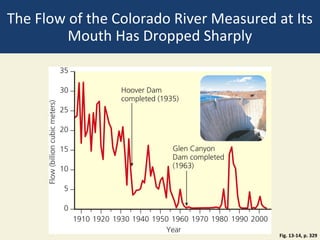
The Flow of the Colorado River Measured at Its
         Mouth Has Dropped Sharply


                                         Fig. 13-14, p. 329
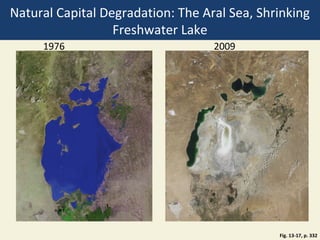
Case Study: The Aral Sea Disaster (1)

• Large-scale water transfers in dry central Asia

• Salinity

• Wetland destruction and wildlife

• Fish extinctions and fishing declines
Case Study: The Aral Sea Disaster (2)

• Wind-blown salt

• Water pollution

• Restoration efforts
   • Cooperation of neighboring countries
   • More efficient irrigation
   • Dike built to raise lake level
Natural Capital Degradation: The Aral Sea, Shrinking
                  Freshwater Lake
     1976                          2009


                                              Fig. 13-17, p. 332
Removing Salt from Seawater Is Costly, Kills
 Organisms, Creates Briny Wastewater (1)
• Desalination
  • Removing dissolved salts
  • Distillation: evaporate water, leaving salts behind
  • Reverse osmosis, microfiltration: use high pressure to
    remove salts
Removing Salt from Seawater Is Costly, Kills
 Organisms, Creates Briny Wastewater (2)
• Problems
  1. High cost and energy footprint
  2. Keeps down algal growth and kills many marine
     organisms
  3. Large quantity of brine wastes
Science Focus: The Search for
   Improved Desalination Technology
• Desalination on offshore ships
   • Solar or wind energy

• Use ocean waves for power

• Build desalination plants near electric power plants
Reducing Water Waste Has Many
              Benefits
• One-half to two-thirds of water is wasted

• Subsidies mask the true cost of water

• Water conservation
   • Improves irrigation efficiency
   • Improves collection efficiency
   • Uses less in homes and businesses
We Can Cut Water Waste in Irrigation

• Flood irrigation
   • Wasteful


• Center pivot, low pressure sprinkler

• Low-energy, precision application sprinklers

• Drip or trickle irrigation, microirrigation
   • Costly; less water waste
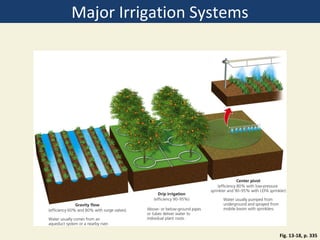
Major Irrigation Systems


                           Fig. 13-18, p. 335
Less-Developed Countries Use Low-
      Tech Methods for Irrigation
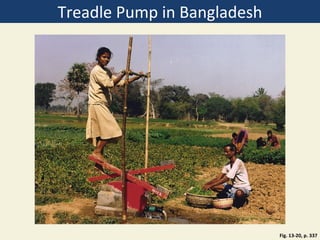
• Human-powered treadle pumps

• Harvest and store rainwater

• Create a polyculture canopy over crops: reduces
  evaporation
Treadle Pump in Bangladesh


                             Fig. 13-20, p. 337
We Can Cut Water Waste in Industry
            and Homes
• Recycle water in industry

• Fix leaks in the plumbing systems

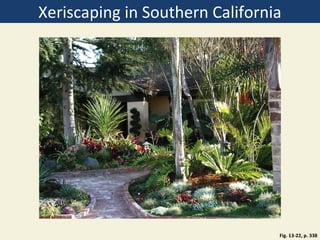
• Use water-thrifty landscaping: xeriscaping

• Use gray water

• Pay-as-you-go water use
Xeriscaping in Southern California


                                 Fig. 13-22, p. 338
We Can Use Less Water to
            Remove Wastes
• Can we mimic how nature deals with waste?

• Use human sewage to create nutrient-rich sludge to
  apply to croplands

• Waterless composting toilets
Some Areas Get Too Much Water from
            Flooding (1)
• Flood plains
   •   Highly productive wetlands
   •   Provide natural flood and erosion control
   •   Maintain high water quality
   •   Recharge groundwater

• Benefits of floodplains
   • Fertile soils
   • Nearby rivers for use and recreation
   • Flatlands for urbanization and farming
Some Areas Get Too Much Water from
            Flooding (2)
• Human activities make floods worse
  •   Levees can break or be overtopped
  •   Paving and development increase runoff
  •   Removal of water-absorbing vegetation
  •   Draining wetlands and building on them
  •   Rising sea levels from global warming means more
      coastal flooding
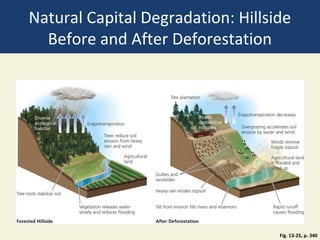
Natural Capital Degradation: Hillside
  Before and After Deforestation


                                   Fig. 13-25, p. 340
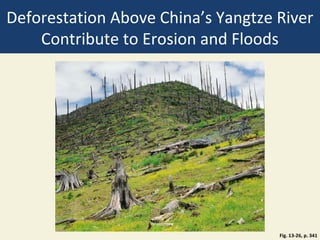
Deforestation Above China’s Yangtze River
    Contribute to Erosion and Floods


                                    Fig. 13-26, p. 341
Case Study: Living Dangerously on
      Floodplains in Bangladesh
• Dense population on coastal floodplain

• Moderate floods maintain fertile soil

• Increased frequency of large floods

• Effects of development in the Himalayan foothills

• Destruction of coastal wetlands: mangrove forests
We Can Reduce Flood Risks

• Rely more on nature’s systems
   • Wetlands
   • Natural vegetation in watersheds


• Rely less on engineering devices
   • Dams
   • Levees
   • Channelized streams
Three Big Ideas

1. One of the world’s major environmental problems
   is the growing shortage of freshwater in many parts
   of the world.
2. We can increase water supplies in water-short
   areas in a number of ways, but the most important
   way is to reduce overall water use and waste by
   using water more sustainably.
3. We can use water more sustainably by cutting
   water waste, raising water prices, slowing
   population growth, and protecting aquifers, forests,
   and other ecosystems that store and release water.

Bio 105 Chapter 13

  • 1.
    MILLER/SPOOLMAN LIVING IN THEENVIRONMENT 17TH Chapter 13 Water Resources
  • 2.
    Case Study: TheColorado River Basin— An Overtapped Resource (1) • 2,300 km through 7 U.S. states • 14 Dams and reservoirs • Located in a desert area within the rain shadow of the Rocky Mountains • Water supplied mostly from snowmelt of the Rocky Mountains
  • 3.
    Case Study: TheColorado River Basin— An Overtapped Resource (2) • Supplies water and electricity for about 30 million people • Las Vegas, Los Angeles, San Diego • Irrigation of crops that help feed America • Very little water reaches the Gulf of California • Southwest experiencing recent droughts
  • 4.
    The Colorado RiverBasin Fig. 13-1, p. 317
  • 5.
    Aerial View ofGlen Canyon Dam Across the Colorado River and Lake Powell Fig. 13-2, p. 317
  • 6.
    Freshwater Is anIrreplaceable Resource That We Are Managing Poorly (1) • Why is water so important? • Earth as a watery world: 71% of surface • Poorly managed resource • Water waste • Water pollution
  • 7.
    Freshwater Is anIrreplaceable Resource That We Are Managing Poorly (2) • Access to water is • A global health issue • An economic issue • A women’s and children’s issue • A national and global security issue
  • 8.
    Girl Carrying WellWater over Dried Out Earth during a Severe Drought in India Fig. 13-3, p. 319
  • 9.
    Most of theEarth’s Freshwater Is Not Available to Us • Freshwater availability: 0.024% • Groundwater, lakes, rivers, streams • Hydrologic cycle • Movement of water in the seas, land, and air • Driven by solar energy and gravity • People divided into • Water haves • Water have-nots
  • 10.
    Hydrologic Cycle Fig. 3-16, p. 67
  • 11.
    Groundwater and SurfaceWater Are Critical Resources (1) • Zone of saturation • Spaces in soil are filled with water • Water table • Top of zone of saturation • Aquifers • Natural recharge • Lateral recharge • Surface Water • Surface runoff • Watershed (drainage) basin
  • 12.
    We Use Muchof the World’s Reliable Runoff • 2/3 of the surface runoff: lost by seasonal floods • 1/3 is reliable runoff = usable • World-wide averages • Domestic: 10% • Agriculture: 70% • Industrial use: 20%
  • 13.
    Science Focus: WaterFootprints and Virtual Water (1) • Water footprint • Volume of water we directly and indirectly • Average American uses 260 liters per day • Flushing toilets, 27% • Washing clothes, 22% • Taking showers, 17% • Running faucets, 16% • Wasted from leaks, 14% • World’s poorest use 19 liters per day
  • 14.
    Case Study: FreshwaterResources in the United States • More than enough renewable freshwater, unevenly distributed and polluted • Effect of • Floods • Pollution • Drought • 2007: U.S. Geological Survey projection • Water hotspots
  • 15.
    Average Annual Precipitationand Major Rivers, Water-Deficit Regions in U.S. Fig. 13-4, p. 322
  • 16.
    Water Hotspots in17 Western U.S. States Fig. 13-5, p. 322
  • 17.
    Water Shortages WillGrow (1) • Dry climates • Drought • Too many people using a normal supply of water • Wasteful use of water
  • 18.
    Water Shortages WillGrow (2) • China and urbanization • 30% earth’s land area experiences severe drought • Will rise to 45% by 2059 from climate change • Potential conflicts/wars over water • Refugees from arid lands • Increased mortality
  • 19.
    Natural Capital Degradation:Stress on the World’s Major River Basins Fig. 13-6, p. 323
  • 20.
    Groundwater is BeingWithdrawn Faster Than It Is Replenished (1) • Most aquifers are renewable • Aquifers provide drinking water for half the world • Water tables are falling in many parts of the world, primarily from crop irrigation
  • 21.
    Trade-Offs: Withdrawing Groundwater,Advantages and Disadvantages Fig. 13-7, p. 325
  • 22.
    Natural Capital Degradation:Irrigation in Saudi Arabia Using an Aquifer 1986 2004 Fig. 13-8, p. 325
  • 23.
    Case Study: AquiferDepletion in the United States • Ogallala aquifer: largest known aquifer • Irrigates the Great Plains • Very slow recharge • Water table dropping • Government subsidies to continue farming deplete the aquifer further • Biodiversity threatened in some areas • California Central Valley: serious water depletion
  • 24.
    Ogallala Aquifer andProposed Pipeline
  • 25.
    Natural Capital Degradation:Areas of Greatest Aquifer Depletion in the U.S. Fig. 13-9, p. 326
  • 26.
    Kansas Crops Irrigatedby the Ogallala Aquifer Fig. 13-10, p. 326
  • 27.
    Overpumping Aquifers HasSeveral Harmful Effects • Limits future food production • Bigger gap between the rich and the poor • Land subsidence (sinking) • Mexico City • San Joaquin Valley in California • Groundwater overdrafts near coastal regions • Contamination of groundwater with saltwater
  • 28.
    Subsidence in theSan Joaquin Valley Fig. 13-11, p. 327
  • 29.
    Deep Aquifers MightBe Tapped • May contain enough water to provide for billions of people for centuries • Major concerns 1. Nonre newab le 2. Little is known about the geolog
  • 30.
    Large Dams andReservoirs Have Advantages and Disadvantages (1) • Main goal of a dam and reservoir system • Capture and store runoff • Release runoff as needed to control: • Floods • Generate electricity • Supply irrigation water • Recreation (reservoirs)
  • 31.
    Large Dams andReservoirs Have Advantages and Disadvantages (2) • Advantages • Increase the reliable runoff available • Reduce flooding • Grow crops in arid regions
  • 32.
    Large Dams andReservoirs Have Advantages and Disadvantages (3) • Disadvantages • Displaces people • Flooded regions • Impaired ecological services of rivers • Loss of plant and animal species • Fill up with sediment • Can cause other streams and lakes to dry up
  • 33.
    Advantages and Disadvantagesof Large Dams and Reservoirs Fig. 13-13, p. 328
  • 34.
    A Closer Lookat the Overtapped Colorado River Basin (1) • Only small amount of Colorado River water reaches Gulf of California • Threatens aquatic species in river and species that live in the estuary • Current rate of river withdrawal is not sustainable • Much water used for agriculture that is inefficient with water use: cotton, alfalfa, rice • Water use subsidized by government
  • 35.
    A Closer Lookat the Overtapped Colorado River Basin (2) • Reservoirs • Leak water into ground below • Lose much water through evaporation • Fill up with silt load of river, depriving delta • Could eventually lose ability to store water and create electricity
  • 36.
    The Flow ofthe Colorado River Measured at Its Mouth Has Dropped Sharply Fig. 13-14, p. 329
  • 37.
    Case Study: TheAral Sea Disaster (1) • Large-scale water transfers in dry central Asia • Salinity • Wetland destruction and wildlife • Fish extinctions and fishing declines
  • 38.
    Case Study: TheAral Sea Disaster (2) • Wind-blown salt • Water pollution • Restoration efforts • Cooperation of neighboring countries • More efficient irrigation • Dike built to raise lake level
  • 39.
    Natural Capital Degradation:The Aral Sea, Shrinking Freshwater Lake 1976 2009 Fig. 13-17, p. 332
  • 40.
    Removing Salt fromSeawater Is Costly, Kills Organisms, Creates Briny Wastewater (1) • Desalination • Removing dissolved salts • Distillation: evaporate water, leaving salts behind • Reverse osmosis, microfiltration: use high pressure to remove salts
  • 41.
    Removing Salt fromSeawater Is Costly, Kills Organisms, Creates Briny Wastewater (2) • Problems 1. High cost and energy footprint 2. Keeps down algal growth and kills many marine organisms 3. Large quantity of brine wastes
  • 42.
    Science Focus: TheSearch for Improved Desalination Technology • Desalination on offshore ships • Solar or wind energy • Use ocean waves for power • Build desalination plants near electric power plants
  • 43.
    Reducing Water WasteHas Many Benefits • One-half to two-thirds of water is wasted • Subsidies mask the true cost of water • Water conservation • Improves irrigation efficiency • Improves collection efficiency • Uses less in homes and businesses
  • 44.
    We Can CutWater Waste in Irrigation • Flood irrigation • Wasteful • Center pivot, low pressure sprinkler • Low-energy, precision application sprinklers • Drip or trickle irrigation, microirrigation • Costly; less water waste
  • 45.
    Major Irrigation Systems Fig. 13-18, p. 335
  • 46.
    Less-Developed Countries UseLow- Tech Methods for Irrigation • Human-powered treadle pumps • Harvest and store rainwater • Create a polyculture canopy over crops: reduces evaporation
  • 47.
    Treadle Pump inBangladesh Fig. 13-20, p. 337
  • 48.
    We Can CutWater Waste in Industry and Homes • Recycle water in industry • Fix leaks in the plumbing systems • Use water-thrifty landscaping: xeriscaping • Use gray water • Pay-as-you-go water use
  • 49.
    Xeriscaping in SouthernCalifornia Fig. 13-22, p. 338
  • 50.
    We Can UseLess Water to Remove Wastes • Can we mimic how nature deals with waste? • Use human sewage to create nutrient-rich sludge to apply to croplands • Waterless composting toilets
  • 51.
    Some Areas GetToo Much Water from Flooding (1) • Flood plains • Highly productive wetlands • Provide natural flood and erosion control • Maintain high water quality • Recharge groundwater • Benefits of floodplains • Fertile soils • Nearby rivers for use and recreation • Flatlands for urbanization and farming
  • 52.
    Some Areas GetToo Much Water from Flooding (2) • Human activities make floods worse • Levees can break or be overtopped • Paving and development increase runoff • Removal of water-absorbing vegetation • Draining wetlands and building on them • Rising sea levels from global warming means more coastal flooding
  • 53.
    Natural Capital Degradation:Hillside Before and After Deforestation Fig. 13-25, p. 340
  • 54.
    Deforestation Above China’sYangtze River Contribute to Erosion and Floods Fig. 13-26, p. 341
  • 55.
    Case Study: LivingDangerously on Floodplains in Bangladesh • Dense population on coastal floodplain • Moderate floods maintain fertile soil • Increased frequency of large floods • Effects of development in the Himalayan foothills • Destruction of coastal wetlands: mangrove forests
  • 56.
    We Can ReduceFlood Risks • Rely more on nature’s systems • Wetlands • Natural vegetation in watersheds • Rely less on engineering devices • Dams • Levees • Channelized streams
  • 57.
    Three Big Ideas 1.One of the world’s major environmental problems is the growing shortage of freshwater in many parts of the world. 2. We can increase water supplies in water-short areas in a number of ways, but the most important way is to reduce overall water use and waste by using water more sustainably. 3. We can use water more sustainably by cutting water waste, raising water prices, slowing population growth, and protecting aquifers, forests, and other ecosystems that store and release water.

Editor's Notes

  • #5 Figure 13.1: The Colorado River basin : The area drained by this basin is equal to more than one-twelfth of the land area of the lower 48 states. Two large reservoirs—Lake Mead behind the Hoover Dam and Lake Powell behind the Glen Canyon Dam—store about 80% of the water in this basin.
  • #6 Figure 13.2: The Glen Canyon Dam across the Colorado River was completed in 1963. Lake Powell behind the dam is the second largest reservoir in the United States.
  • #9 Figure 13.3: Many areas of the world suffer from severe and long-lasting shortages of freshwater. This has a major impact on the poor in some areas of India, especially women and children such as this young girl carrying water to her home in a very dry area. According to the United Nations, over 1.2 billion people—about 4 times the entire U.S. population—do not have access to clean water where they live. Each day girls and women in this group typically walk an average of almost 6 kilometers (4 miles) and spend an average of 3 hours collecting water from distant sources .
  • #11 Figure 3.16: Natural capital. This diagram is a simplified model of the water cycle , or hydrologic cycle , in which water circulates in various physical forms within the biosphere. Major harmful impacts of human activities are shown by the red arrows and boxes. Question: What are three ways in which your lifestyle directly or indirectly affects the hydrologic cycle?
  • #16 Figure 13.4: The top map shows the average annual precipitation and major rivers in the continental United States. The bottom map shows water-deficit regions in the continental United States and their proximity to metropolitan areas having populations greater than 1 million (shaded areas). Question: Why do you think some areas with moderate precipitation still suffer from water shortages? (Data from U.S. Water Resources Council and U.S. Geological Surve y)
  • #17 Figure 13.5: This map shows water scarcity hotspots in 17 western states that, by 2025, could face intense conflicts over scarce water needed for urban growth, irrigation, recreation, and wildlife. Some analysts suggest that this is a map of places not to live in the foreseeable future. Question: Which, if any, of these areas are found in the Colorado River basin (Figure 13-1)? (Data from U.S. Department of the Interior )
  • #20 Figure 13.6: N atural capital degradation. The world’s major river basins differ in their degree of water scarcity stress, the measurement of which is based on a comparison of the amount of water available with the amount used by humans ( Concept 13-1B ). Questions: If you live in a water-stressed area, what signs of stress have you noticed? In what ways, if any, has it affected your life? (Data from World Commission on Water Use in the 21st Century)
  • #22 Figure 13.7: Withdrawing groundwater from aquifers has advantages and disadvantages. Questions: Which two advantages and which two disadvantages do you think are the most important? Why?
  • #23 Figure 13.8: N atural capital degradation. These satellite photos show farmland irrigated by groundwater pumped from an ancient and nonrenewable aquifer in a vast desert region of Saudi Arabia between 1986 (left) and 2004 (right). Irrigated areas appear as green dots (each representing a circular spray system) and brown dots show areas where wells have gone dry and the land has returned to desert. Hydrologists estimate that because of aquifer depletion, most irrigated agriculture in Saudi Arabia will disappear within the next 5 to 10 years.
  • #26 Figure 13.9: N atural capital degradation. This map shows areas of greatest aquifer depletion from groundwater overdraft in the continental United States. Aquifer depletion is also high in Hawaii and Puerto Rico (not shown on map). See an animation based on this figure at CengageNOW. Questions: Do you depend on any of these overdrawn aquifers for your drinking water? If so, what is the level of severity of overdraft where you live? (Data from U.S. Water Resources Council and U.S. Geological Surve y)
  • #27 Figure 13.10: These crop fields in the state of Kansas are irrigated by groundwater pumped from the Ogallala. Green circles show irrigated areas and brown, gray, and white circles represent fields that have been recently harvested and plowed under or that have not been planted for a year.
  • #29 Figure 13.11: This pole shows subsidence from overpumping of an aquifer for irrigation in California’s San Joaquin Central Valley between 1925 and 1977. In 1925, the land surface in this area was near the top of this pole. Since 1977 this problem has gotten worse.
  • #34 Figure 13.13: Trade-offs. Large dams and reservoirs have advantages (green) and disadvantages (orange) ( Concept 13-3 ). The world’s 45,000 large dams (15 meters (49 feet) or higher) capture and store about 14% of the world’s surface runoff, provide water for almost half of all irrigated cropland, and supply more than half the electricity used in 65 countries. The United States has more than 70,000 large and small dams, capable of capturing and storing half of the country’s entire river flow. Question: Which single advantage and which single disadvantage do you think are the most important?
  • #37 Figure 13.14: The measured flow of the Colorado River at its mouth has dropped sharply since 1905 as a result of multiple dams, water withdrawals for agriculture and urban water supplies, and prolonged drought. Historical records and tree-ring analysis show that about once every century, the southwestern United States suffers from a mega-drought—a decades-long dry period. (Data from U.S. Geological Survey )
  • #40 Figure 13.17: N atural capital degradation. The Aral Sea was one of the world’s largest saline lakes. Since 1960, it has been shrinking and getting saltier because most of the water from the two rivers that replenish it has been diverted to grow cotton and food crops. These satellite photos show the sea in 1976 and in 2009. As the Southern Aral Sea shrank, it split into two lakes and left behind a salty desert, economic ruin, increasing health problems, and severe ecological disruption. By late 2009, the larger eastern part of the once huge Southern Aral Sea was gone (bottom-right part of each photo). The smaller Northern Aral Sea (top of each photo) has also shrunk, but not nearly as much as the Southern Aral Sea has. Question: What are three things that you think should be done to help prevent further shrinkage of the Aral Sea?
  • #46 Figure 13.18: Several different systems are used to irrigate crops. The two most efficient systems are the low - energy, precision application (LEPA) center-pivot system and the drip irrigation system. Because of high initial costs, they are not widely used. The development of new, low-cost, drip-irrigation systems may change this situation.
  • #48 Figure 13.20: S olutions. In areas of Bangladesh and India, where water tables are high, many small-scale farmers use treadle pumps to supply irrigation water to their fields.
  • #50 Figure 13.22: This yard in Encinitas, a city in a dry area of southern California (USA), uses a diversity of plants that are native to the arid environment and require little watering.
  • #54 Figure 13.25: N atural capital degradation. These diagrams show a hillside before and after deforestation. Once a hillside has been deforested for timber, fuelwood, livestock grazing, or unsustainable farming, water from precipitation rushes down the denuded slopes, erodes precious topsoil, and can increase flooding and pollution in local streams. Such deforestation can also increase landslides and mudflows. A 3,000-year-old Chinese proverb says, “To protect your rivers, protect your mountains.” See an animation based on this figure at CengageNOW. Question: How might a drought in this area make these effects even worse?
  • #55 Figure 13.26: Deforestation of hills and mountains in China’s Yangtze River Basin contributed to increased flooding, topsoil erosion, and the flow of eroded sediment into the Yangtze River. Because of these harmful effects, China stopped the deforestation and established a massive tree-planting program to reforest the degraded land.