Learning Objectives
By theend of this lesson, students will be able to:
1. Identify and explain the roles of solute and
solvent in a solution using everyday examples.
2. Give examples of common solutes and
solvents.
3. Describe how solutes and solvents interact to
form a solution.
Guide Questions
Does thesugar disappear?
Where does it go?
Can you get the sugar back?
What might affect how fast it dissolves?
5.
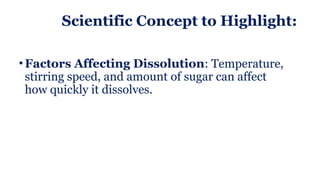
Scientific Concept toHighlight:
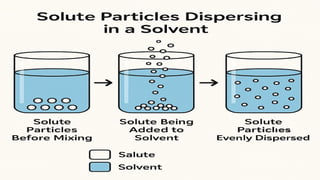
• Dissolving: Sugar dissolves in water, forming a
solution. The sugar molecules spread out evenly
among the water molecules.
6.
Scientific Concept toHighlight:
• Physical Change: This is a physical change, not
a chemical one—the sugar is still sugar, just in a
different form.
7.
Scientific Concept toHighlight:
• Factors Affecting Dissolution: Temperature,
stirring speed, and amount of sugar can affect
how quickly it dissolves.
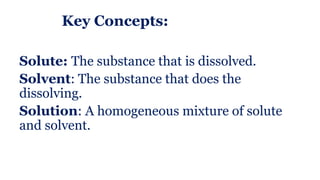
Key Concepts:
Solute: Thesubstance that is dissolved.
Solvent: The substance that does the
dissolving.
Solution: A homogeneous mixture of solute
and solvent.
Simple Experiment: Dissolving
Saltin Water
Materials Needed
- Clear glass or beaker
- Tap water
- Table salt
- Spoon or stirrer
- Optional: food coloring (to make it more
visual)
13.
Simple Experiment: Dissolving
Saltin Water
Procedure
1. Fill the glass halfway with water.
2. Add a teaspoon of salt to the water.
3. Observe what happens before stirring.
4. Stir the mixture gently with a spoon.
5. Watch as the salt disappears and the water
becomes clear again.
14.
Simple Experiment: Dissolving
Saltin Water
Observation
- Before stirring, salt settles at the bottom.
- After stirring, salt dissolves and disperses evenly in
the water.
- The water looks clear, but now contains dissolved salt
— a solution.
15.
Simple Experiment: Dissolving
Saltin Water
Explanation
- Salt = Solute (substance being dissolved)
- Water = Solvent (substance doing the dissolving)
- The salt particles break apart and spread throughout
the water, forming a homogeneous mixture.
factors affecting solubility
1.Temperature
- When water is heated, its molecules
move faster, allowing them to break
apart solute particles more easily.
Summary
Factor Effect onSolubility
Temperature Increases solubility of solids in liquids
Stirring Speeds up the rate of dissolving (not the amount
dissolved)
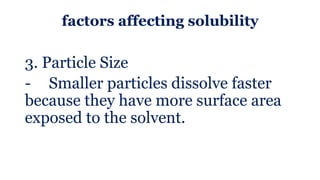
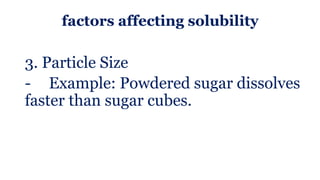
Particle Size Smaller particles dissolve faster due to greater
surface area
27.
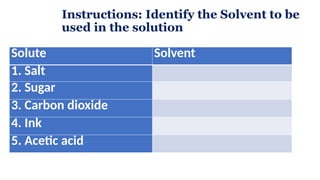
Instructions: Identify theSolvent to be
used in the solution
Solute Solvent
1. Salt
2. Sugar
3. Carbon dioxide
4. Ink
5. Acetic acid
Editor's Notes
#3 Share – Invite pairs to share their ideas with the class. You can write their responses on the board and group similar ideas together.
#4 Let them discuss in pairs and share with the class.