Changes in Matter
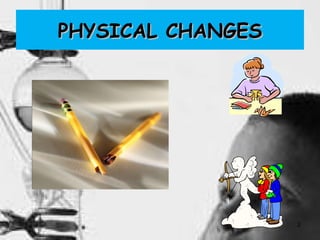
PHYSICAL CHANGES
_______  ______ occurs when the substance changes state but does not change its chemical composition.  For example:  water freezing into ice, cutting a piece of wood into smaller pieces, etc. The form or appearance has changed, but the properties of that substance are the same  (i.e. it has the same melting point, boiling point, chemical composition, etc.)
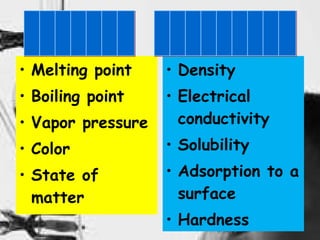
Melting point Boiling point Vapor pressure Color State of matter Density  Electrical conductivity Solubility Adsorption to a surface Hardness _______  _________
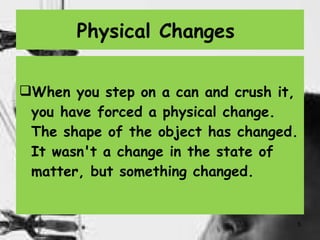
Physical Changes  When you step on a can and crush it, you have forced a physical change. The shape of the object has changed. It wasn't a change in the state of matter, but something changed.
CHEMICAL CHANGES
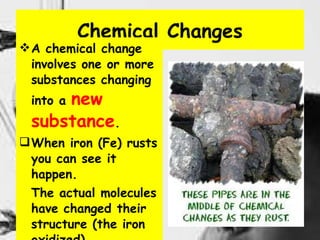
Chemical Changes A chemical change involves one or more substances changing into a  new substance . When iron (Fe) rusts you can see it happen.  The actual molecules have changed their structure (the iron oxidized).
What are chemical changes? occurs when a substance changes into something new.  This occurs due to heating, chemical reaction, etc.  You can tell a chemical change has occurred if the density, melting point or freezing point of the original substance changes.  Many common signs of a chemical change can be seen (bubbles forming, mass changed, etc).
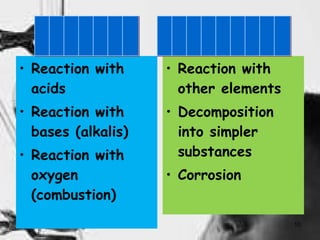
Reaction with acids Reaction with bases (alkalis) Reaction with oxygen (combustion) Reaction with other elements Decomposition into simpler substances Corrosion _______  _________
Chemical Changes The ability of a substance to undergo a specific chemical change is called a  chemical property . iron plus oxygen forms rust, so the ability to rust is a chemical property of iron During a chemical change (also called chemical reaction), the composition of matter always changes.
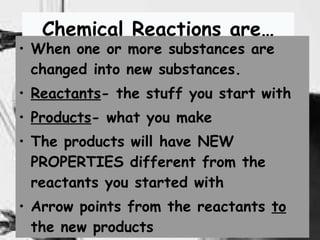
Chemical Reactions are… When one or more substances are changed into new substances. Reactants - the stuff you start with Products - what you make The products will have NEW PROPERTIES different from the reactants you started with Arrow points from the reactants  to  the new products
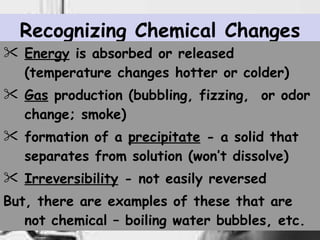
Recognizing Chemical Changes Energy  is absorbed or released (temperature changes hotter or colder) Gas  production (bubbling, fizzing,  or odor change; smoke) formation of a   precipitate   - a solid that separates from solution (won’t dissolve) Irreversibility   - not easily reversed But, there are examples of these that are not chemical – boiling water bubbles, etc.
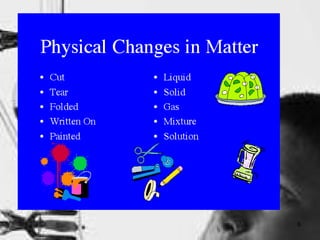
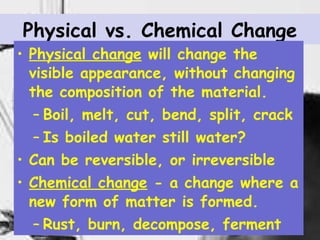
Physical vs. Chemical Change Physical change  will change the visible appearance, without changing the composition of the material. Boil, melt, cut, bend, split, crack Is boiled water still water? Can be reversible, or irreversible Chemical change  - a change where a new form of matter is formed. Rust, burn, decompose, ferment
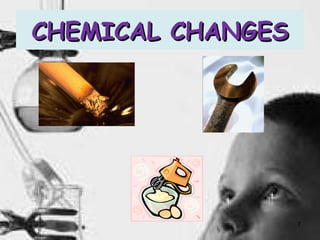
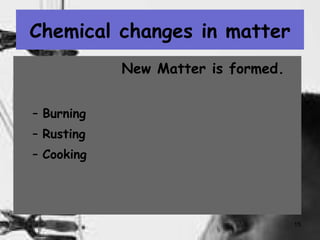
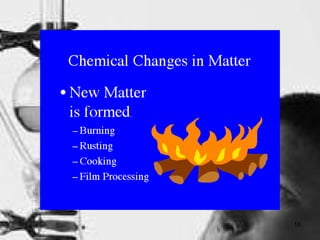
Chemical changes in matter New Matter is formed.  Burning  Rusting  Cooking
Changes of matter

Changes of matter

  • 1.
  • 2.
  • 3.
    _______ ______occurs when the substance changes state but does not change its chemical composition. For example: water freezing into ice, cutting a piece of wood into smaller pieces, etc. The form or appearance has changed, but the properties of that substance are the same (i.e. it has the same melting point, boiling point, chemical composition, etc.)
  • 4.
    Melting point Boilingpoint Vapor pressure Color State of matter Density Electrical conductivity Solubility Adsorption to a surface Hardness _______ _________
  • 5.
    Physical Changes When you step on a can and crush it, you have forced a physical change. The shape of the object has changed. It wasn't a change in the state of matter, but something changed.
  • 7.
  • 8.
    Chemical Changes Achemical change involves one or more substances changing into a new substance . When iron (Fe) rusts you can see it happen. The actual molecules have changed their structure (the iron oxidized).
  • 9.
    What are chemicalchanges? occurs when a substance changes into something new. This occurs due to heating, chemical reaction, etc. You can tell a chemical change has occurred if the density, melting point or freezing point of the original substance changes. Many common signs of a chemical change can be seen (bubbles forming, mass changed, etc).
  • 10.
    Reaction with acidsReaction with bases (alkalis) Reaction with oxygen (combustion) Reaction with other elements Decomposition into simpler substances Corrosion _______ _________
  • 11.
    Chemical Changes Theability of a substance to undergo a specific chemical change is called a chemical property . iron plus oxygen forms rust, so the ability to rust is a chemical property of iron During a chemical change (also called chemical reaction), the composition of matter always changes.
  • 12.
    Chemical Reactions are…When one or more substances are changed into new substances. Reactants - the stuff you start with Products - what you make The products will have NEW PROPERTIES different from the reactants you started with Arrow points from the reactants to the new products
  • 13.
    Recognizing Chemical ChangesEnergy is absorbed or released (temperature changes hotter or colder) Gas production (bubbling, fizzing, or odor change; smoke) formation of a precipitate - a solid that separates from solution (won’t dissolve) Irreversibility - not easily reversed But, there are examples of these that are not chemical – boiling water bubbles, etc.
  • 14.
    Physical vs. ChemicalChange Physical change will change the visible appearance, without changing the composition of the material. Boil, melt, cut, bend, split, crack Is boiled water still water? Can be reversible, or irreversible Chemical change - a change where a new form of matter is formed. Rust, burn, decompose, ferment
  • 15.
    Chemical changes inmatter New Matter is formed. Burning Rusting Cooking

Editor's Notes

  • #4 2010_2gp_wk10_1104m_Properties and changes of Matter_macky kara 01/11/12 Definition of physical changes.
  • #5 2010_2gp_wk10_1104m_Properties and changes of Matter_macky kara 01/11/12 Physical changes are characterized by the following:
  • #10 2010_2gp_wk10_1104m_Properties and changes of Matter_macky kara 01/11/12 Definition of chemical change.
  • #11 2010_2gp_wk10_1104m_Properties and changes of Matter_macky kara 01/11/12 Chemical Changes are characterized by the following:
  • #12 2010_2gp_wk10_1104m_Properties and changes of Matter_macky kara 01/11/12
  • #13 2010_2gp_wk10_1104m_Properties and changes of Matter_macky kara 01/11/12
  • #14 2010_2gp_wk10_1104m_Properties and changes of Matter_macky kara 01/11/12
  • #15 2010_2gp_wk10_1104m_Properties and changes of Matter_macky kara 01/11/12