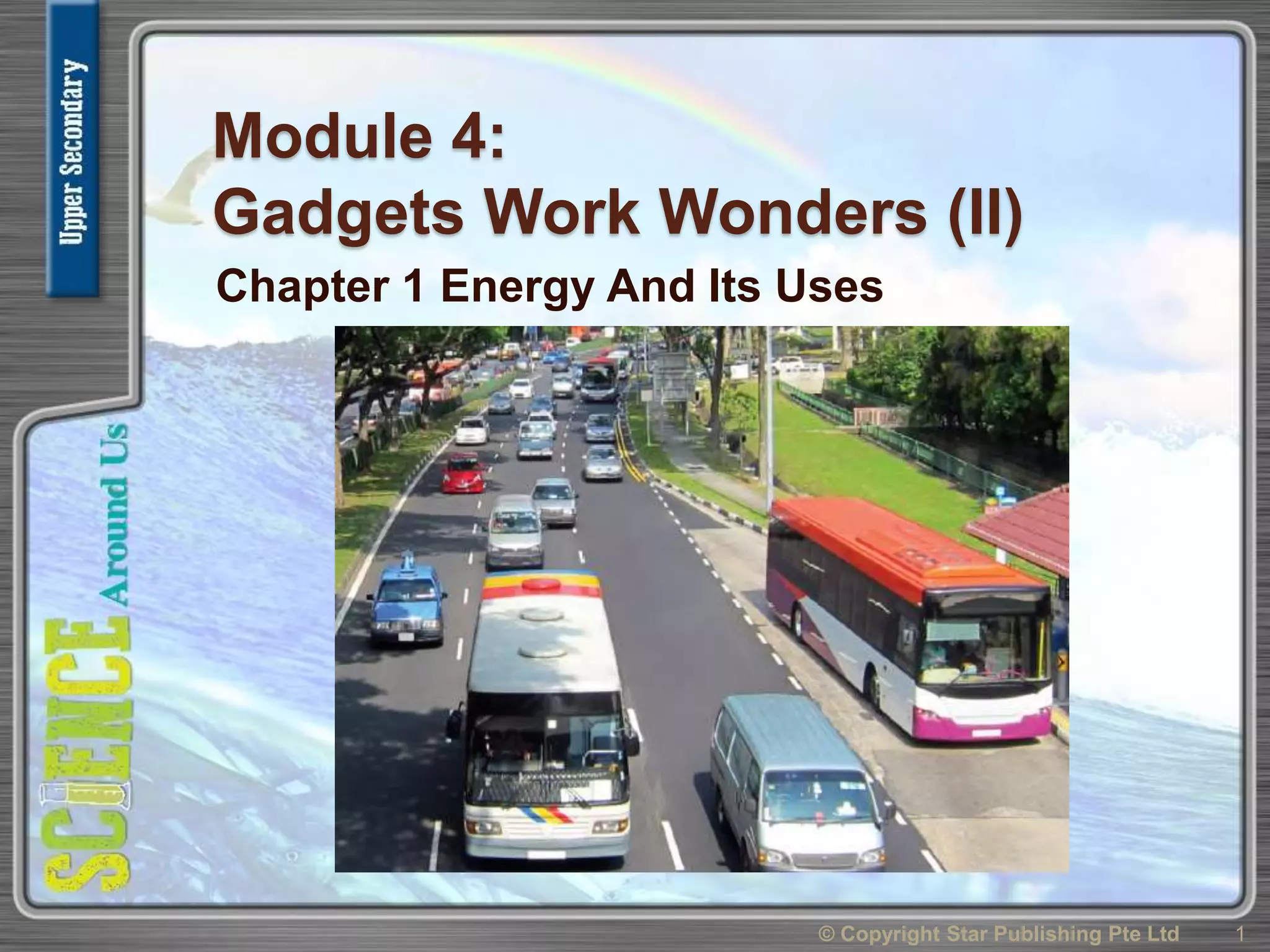
Module 4:
Gadgets Work Wonders (II)
Chapter 1 Energy And Its Uses
1© Copyright Star Publishing Pte Ltd
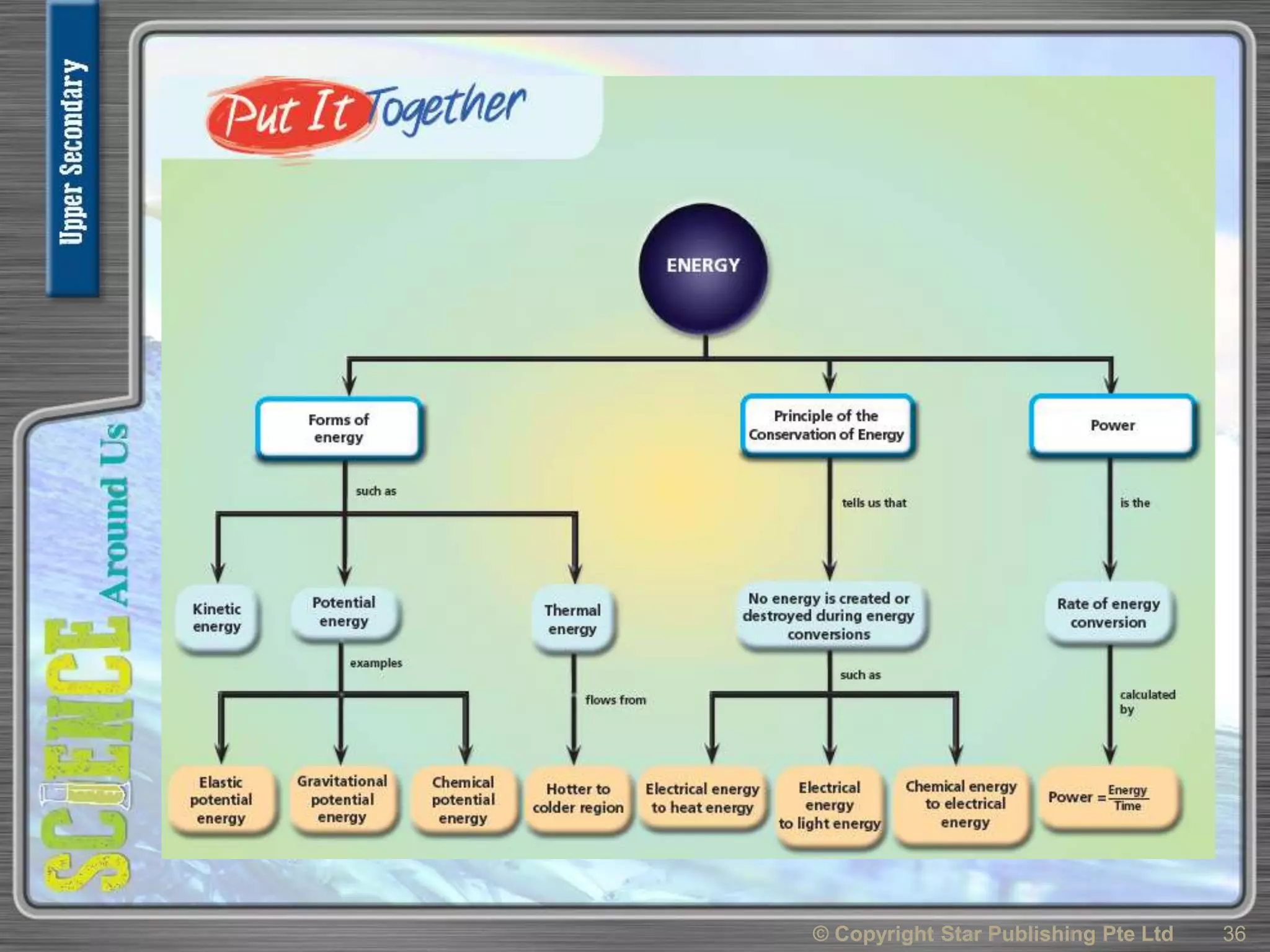
Chapter 1 Energy And Its Uses
1.1 What are some common forms of
energy?
1.2 What is the Principle of the
Conversation of Energy?
1.3 What is power and how is it
calculated?
2© Copyright Star Publishing Pte Ltd
Objectives
 Show understanding that kinetic
energy, elastic potential energy,
gravitational potential energy,
chemical potential energy and thermal
energy are examples of different forms
of energy
 Show understanding that thermal
energy is transferred from a region of
higher temperature to a region of
lower temperature
3© Copyright Star Publishing Pte Ltd
What is Energy?
 Energy is the capacity to do work.
 There are many different forms of
energy. Three forms of energy that we
encounter in our daily lives are kinetic
energy, potential energy and thermal
energy.
© Copyright Star Publishing Pte Ltd 4
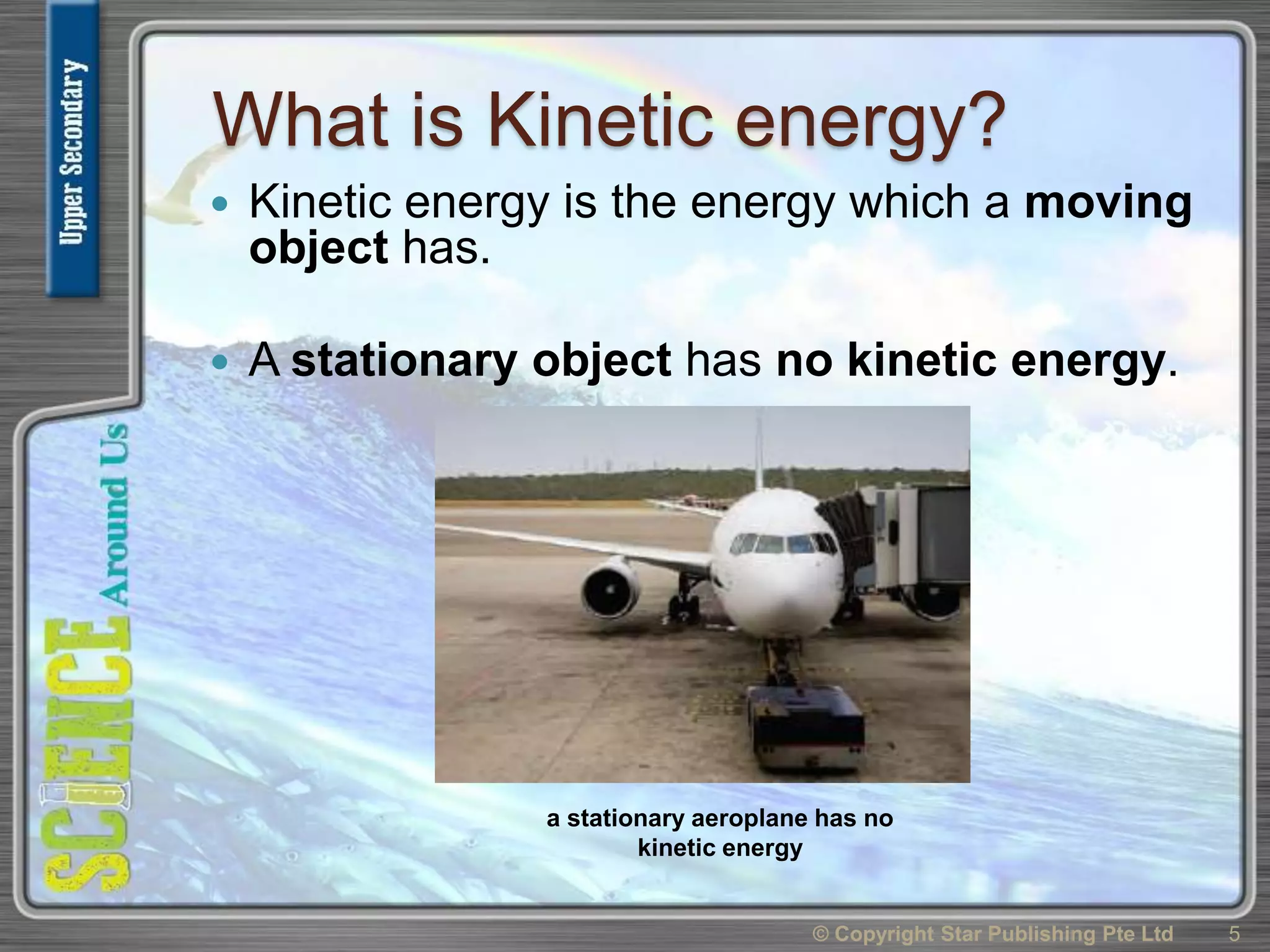
What is Kinetic energy?
 Kinetic energy is the energy which a moving
object has.
 A stationary object has no kinetic energy.
© Copyright Star Publishing Pte Ltd 5
a stationary aeroplane has no
kinetic energy
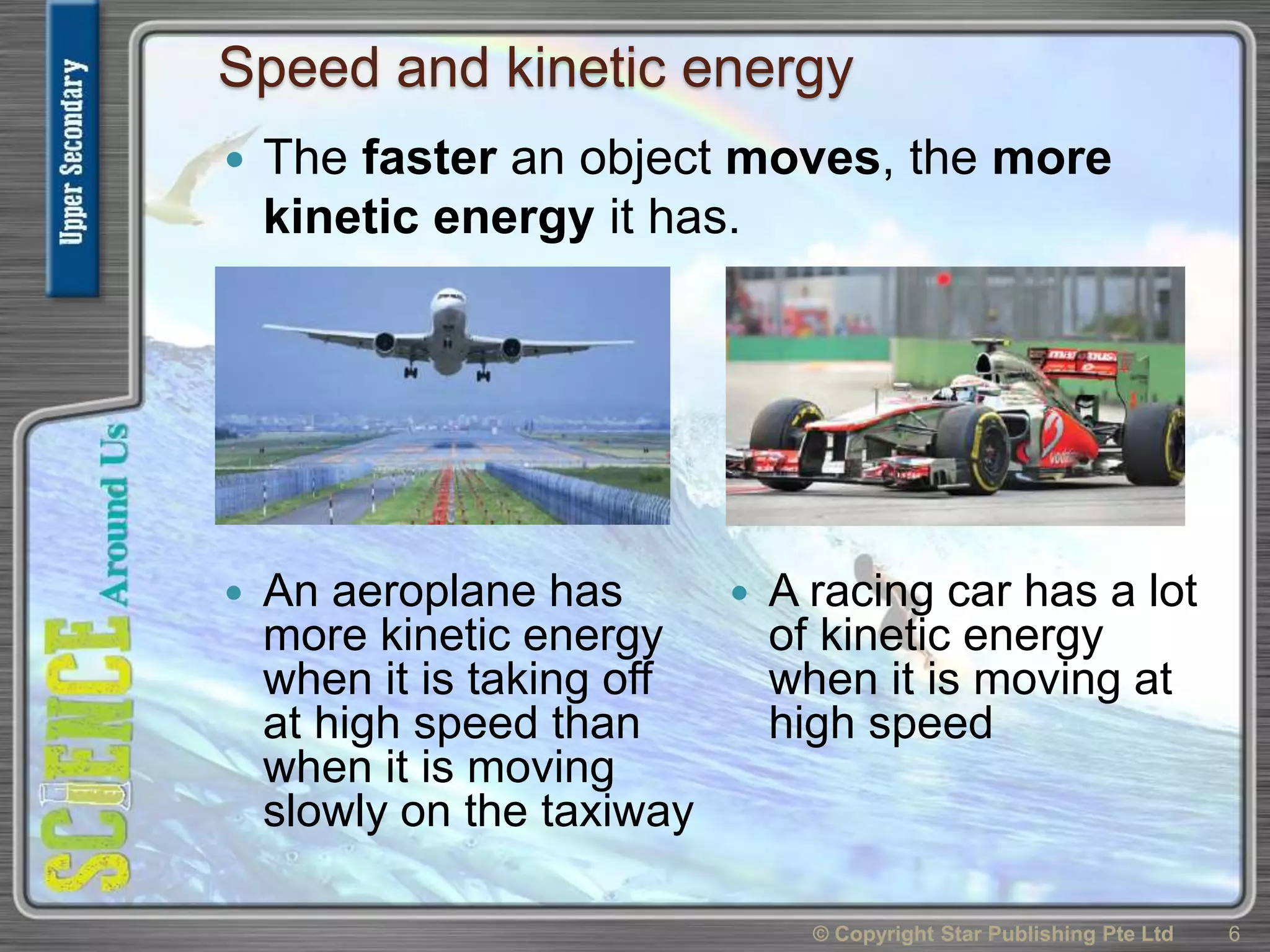
Speed and kinetic energy
 An aeroplane has
more kinetic energy
when it is taking off
at high speed than
when it is moving
slowly on the taxiway
 A racing car has a lot
of kinetic energy
when it is moving at
high speed
© Copyright Star Publishing Pte Ltd 6
 The faster an object moves, the more
kinetic energy it has.
What is Potential energy?
 Potential energy is stored energy.
 Three common forms of potential
energy are: elastic potential energy,
chemical potential energy and
gravitational potential energy.
© Copyright Star Publishing Pte Ltd 7
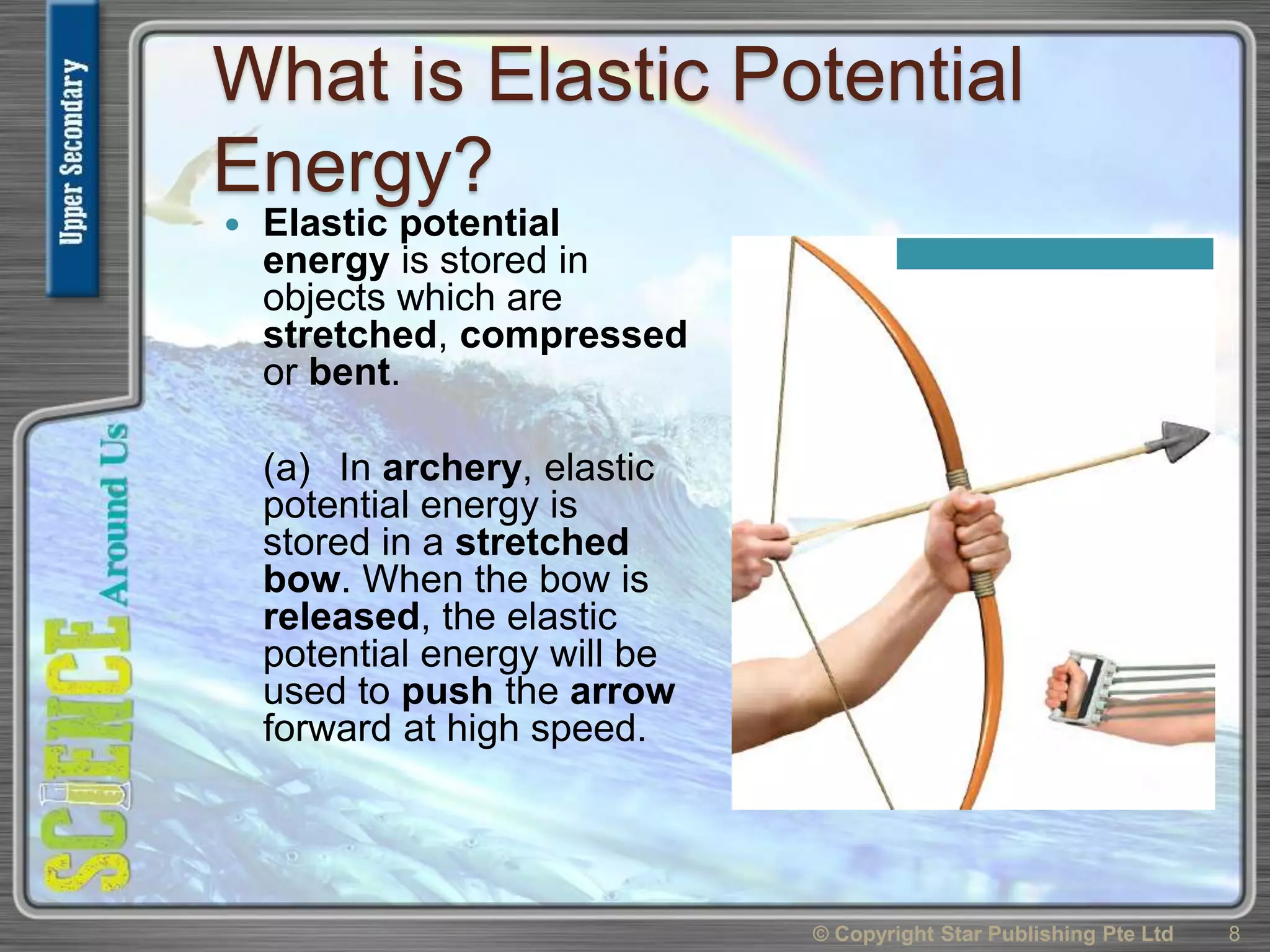
What is Elastic Potential
Energy?
 Elastic potential
energy is stored in
objects which are
stretched, compressed
or bent.
(a) In archery, elastic
potential energy is
stored in a stretched
bow. When the bow is
released, the elastic
potential energy will be
used to push the arrow
forward at high speed.
© Copyright Star Publishing Pte Ltd 8
What is Elastic Potential
Energy?
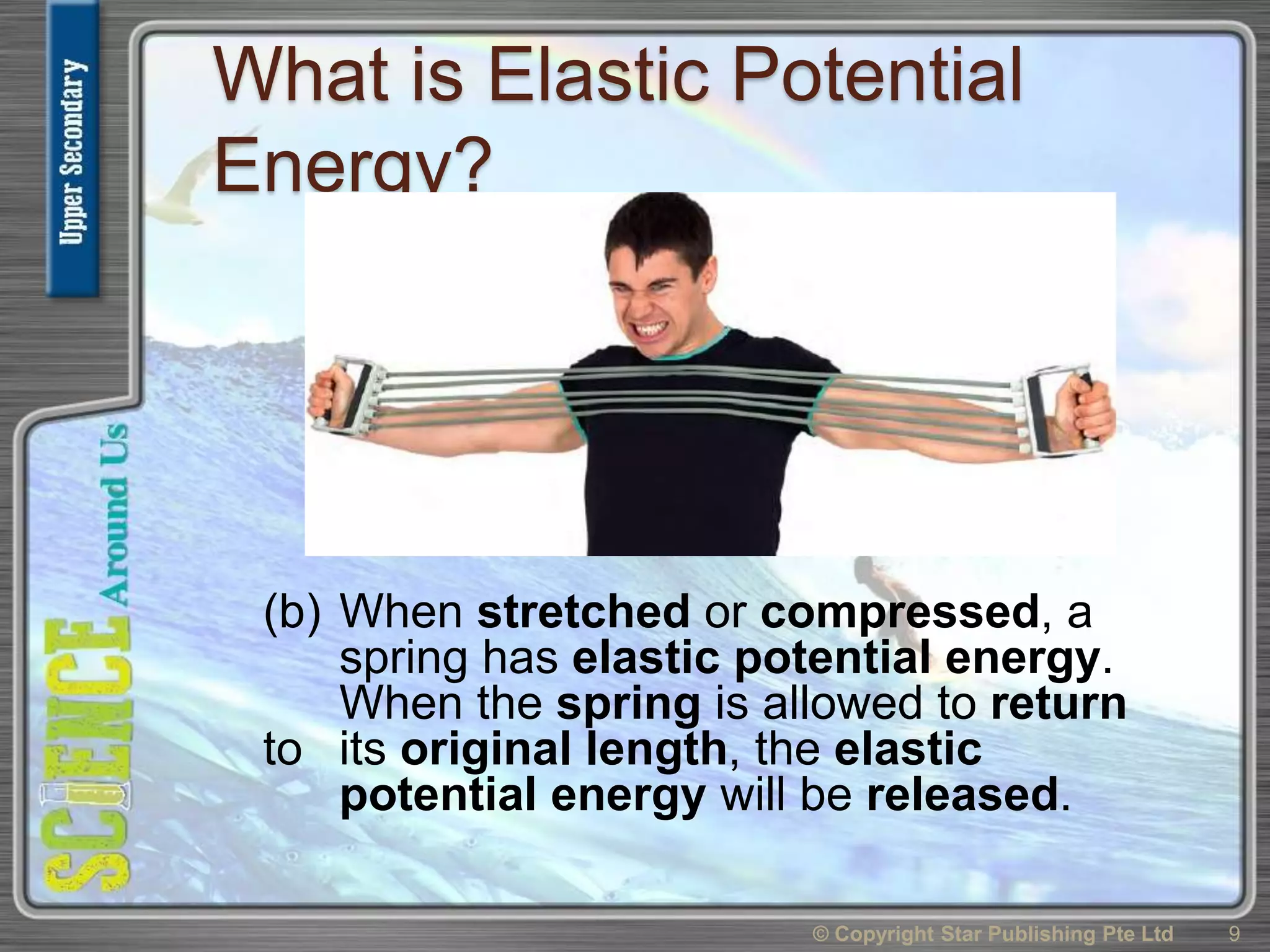
(b) When stretched or compressed, a
spring has elastic potential energy.
When the spring is allowed to return
to its original length, the elastic
potential energy will be released.
© Copyright Star Publishing Pte Ltd 9
What is Elastic Potential
Energy?
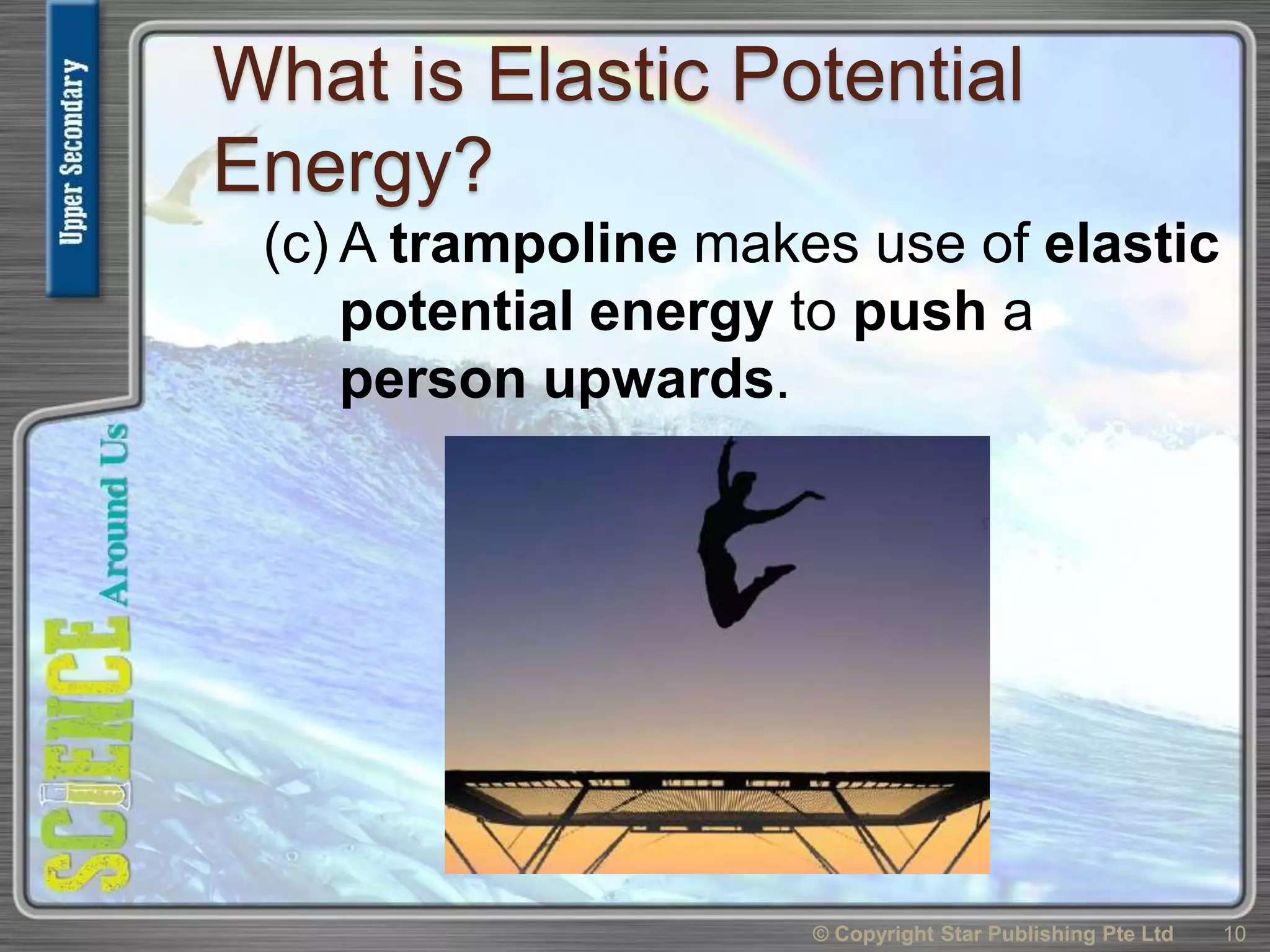
(c) A trampoline makes use of elastic
potential energy to push a
person upwards.
© Copyright Star Publishing Pte Ltd 10
What is Gravitational Potential Energy?
 Gravitational potential energy is the
energy that an object has because of its
position.
 The higher the position of an object, the
more gravitational potential energy it has.
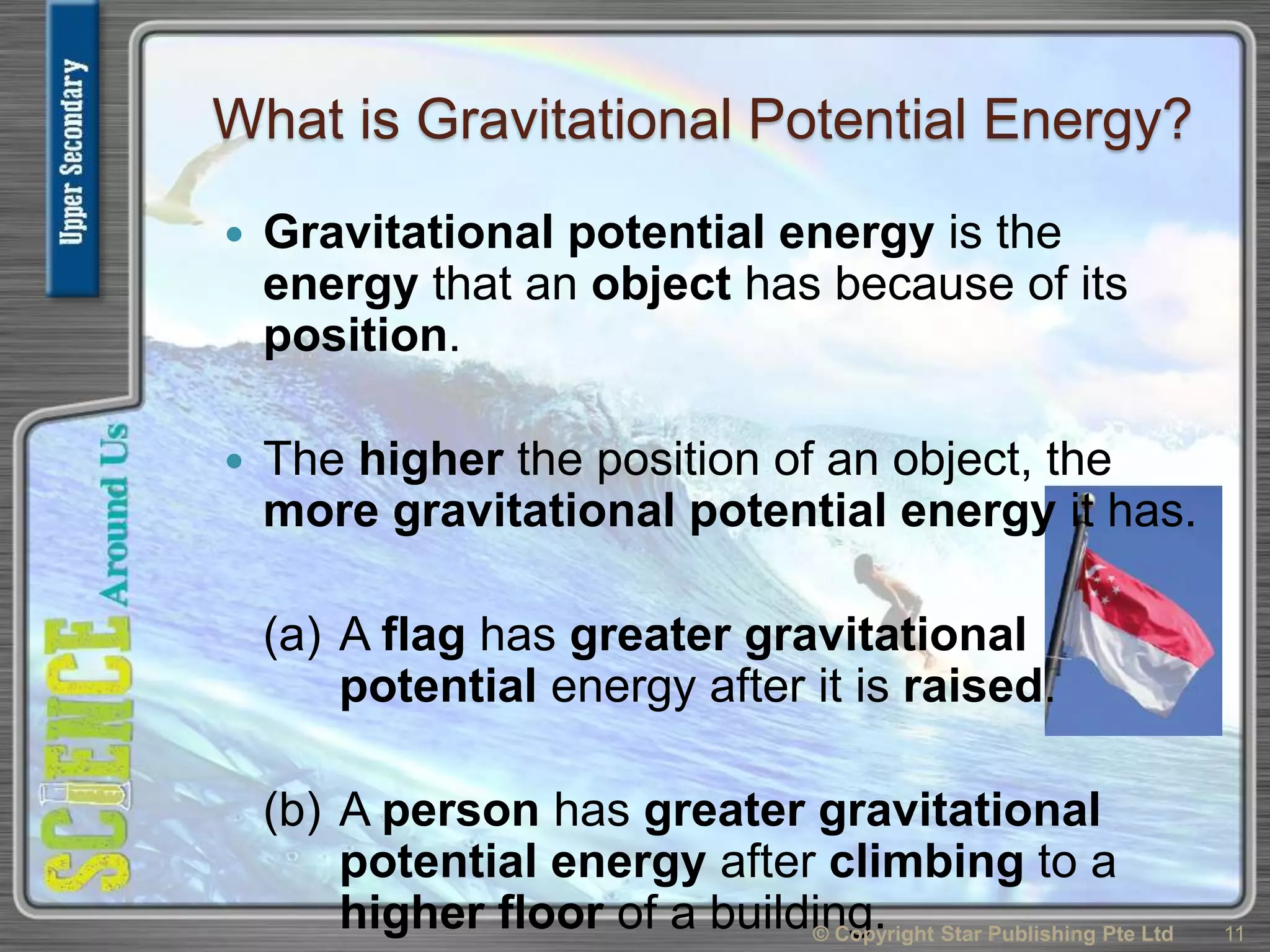
(a) A flag has greater gravitational
potential energy after it is raised.
(b) A person has greater gravitational
potential energy after climbing to a
higher floor of a building.© Copyright Star Publishing Pte Ltd 11
What is chemical Potential Energy?
 Chemical potential energy is the energy
stored in substances such as fuels and
food.
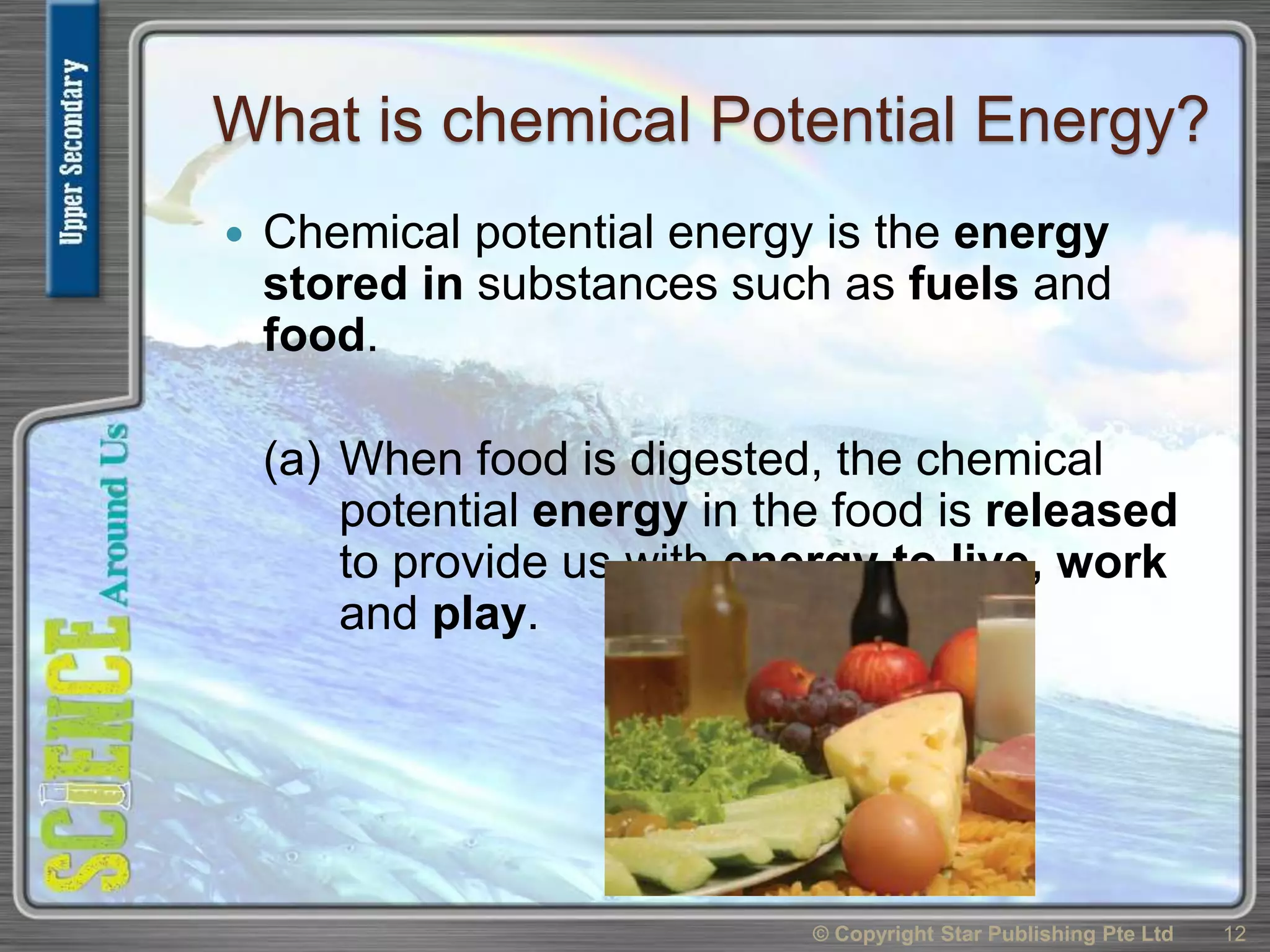
(a) When food is digested, the chemical
potential energy in the food is released
to provide us with energy to live, work
and play.
© Copyright Star Publishing Pte Ltd 12
Chemical Potential Energy
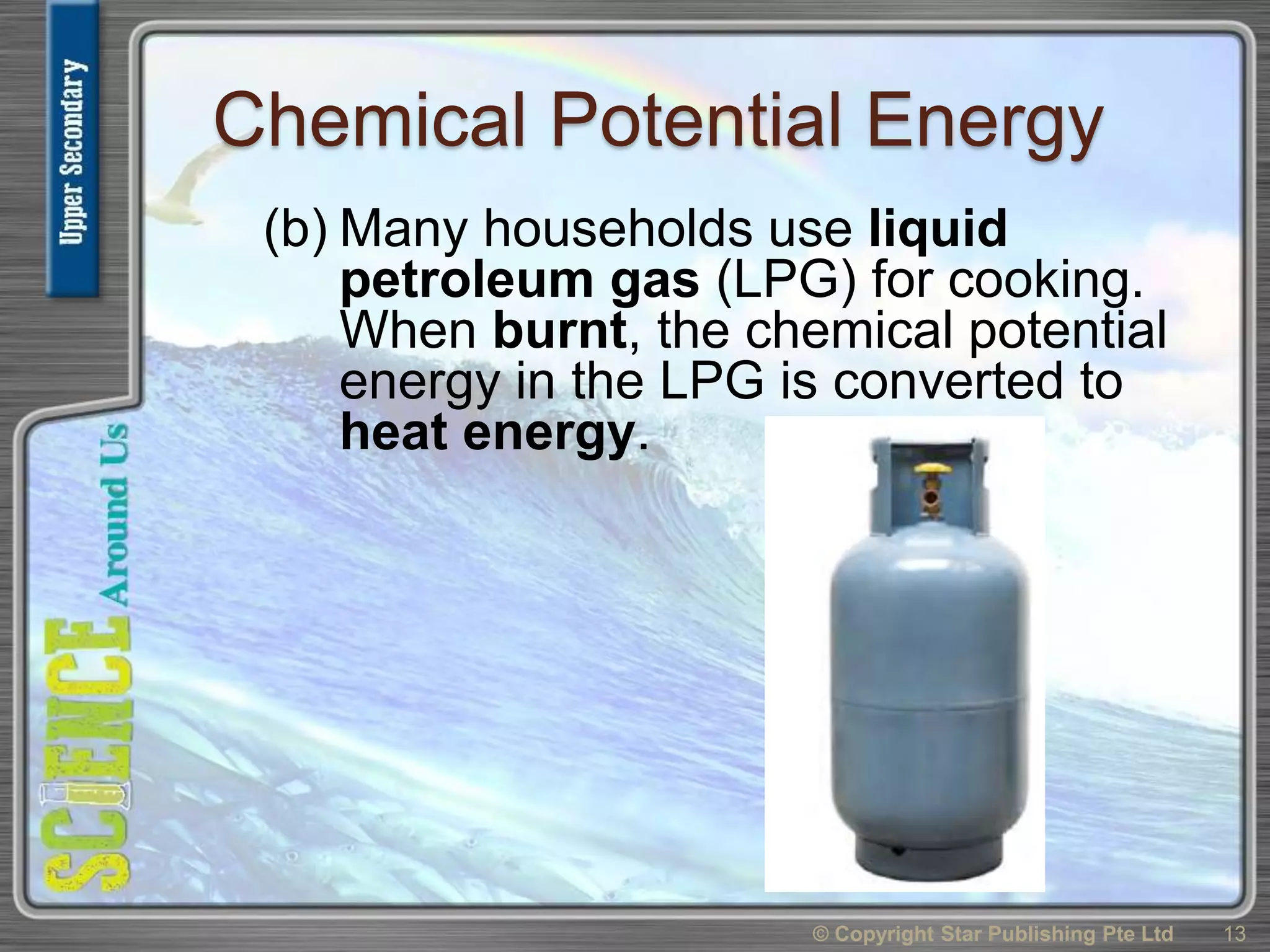
(b) Many households use liquid
petroleum gas (LPG) for cooking.
When burnt, the chemical potential
energy in the LPG is converted to
heat energy.
© Copyright Star Publishing Pte Ltd 13
What is Thermal energy?
 Thermal energy is the energy an object has
because of its temperature.
 The hotter an object, the more thermal
energy it has.
 Our most important source of thermal energy
is the Sun.
 We obtain thermal energy for cooking and
keeping warm by burning fuels or using
electricity.
© Copyright Star Publishing Pte Ltd 14
What is Thermal energy?
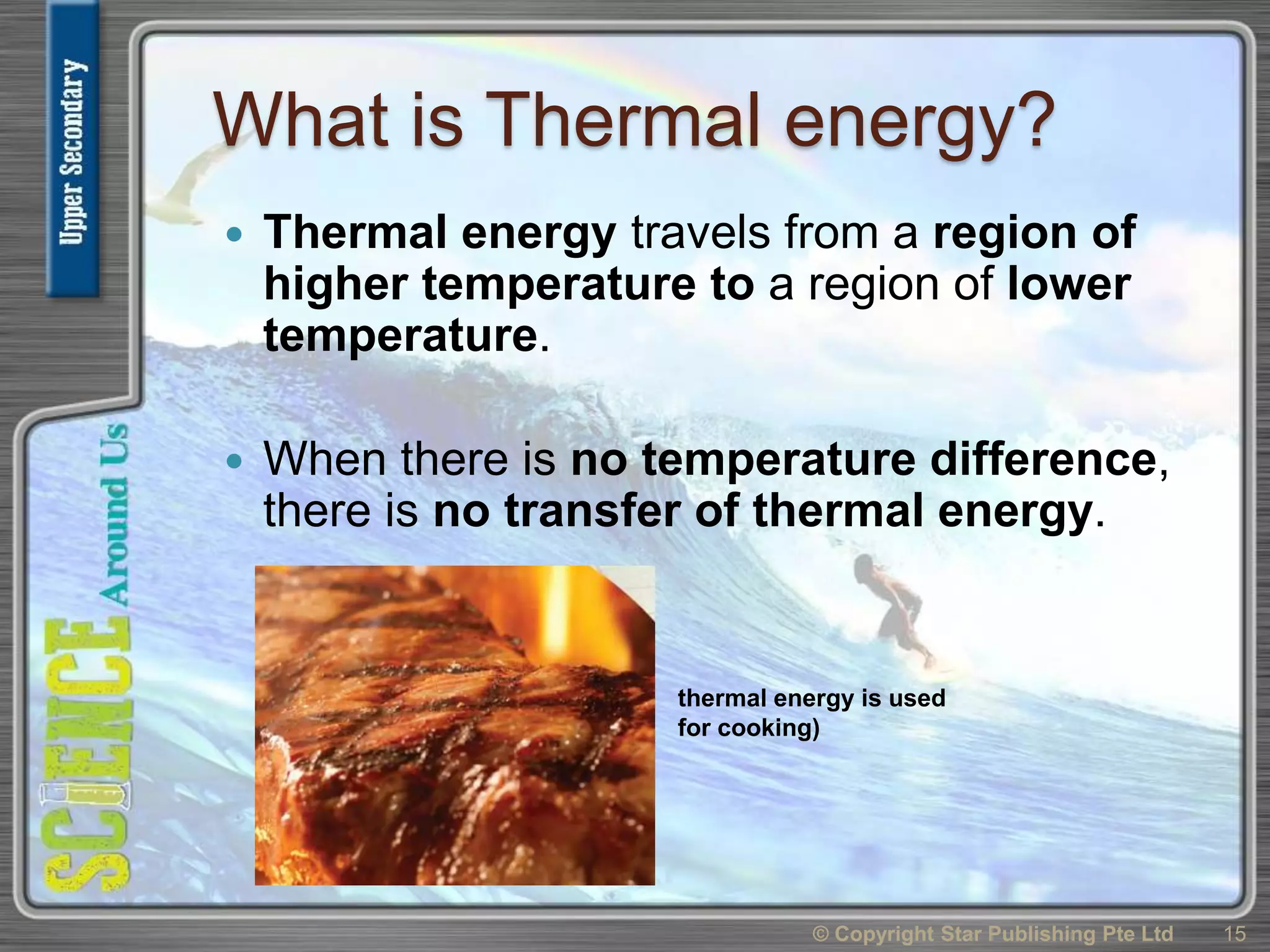
 Thermal energy travels from a region of
higher temperature to a region of lower
temperature.
 When there is no temperature difference,
there is no transfer of thermal energy.
© Copyright Star Publishing Pte Ltd 15
thermal energy is used
for cooking)
What is Thermal energy?
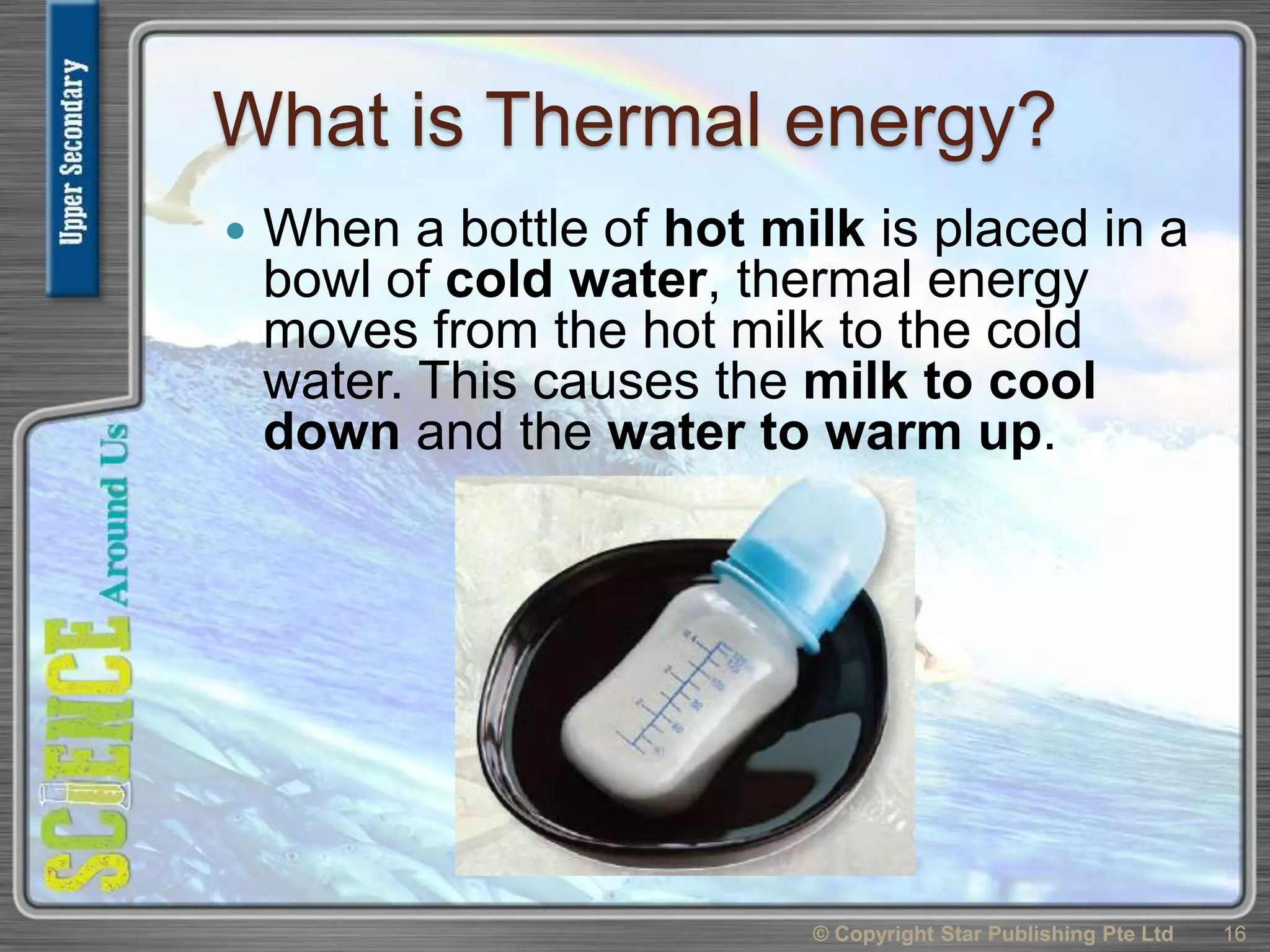
 When a bottle of hot milk is placed in a
bowl of cold water, thermal energy
moves from the hot milk to the cold
water. This causes the milk to cool
down and the water to warm up.
© Copyright Star Publishing Pte Ltd 16
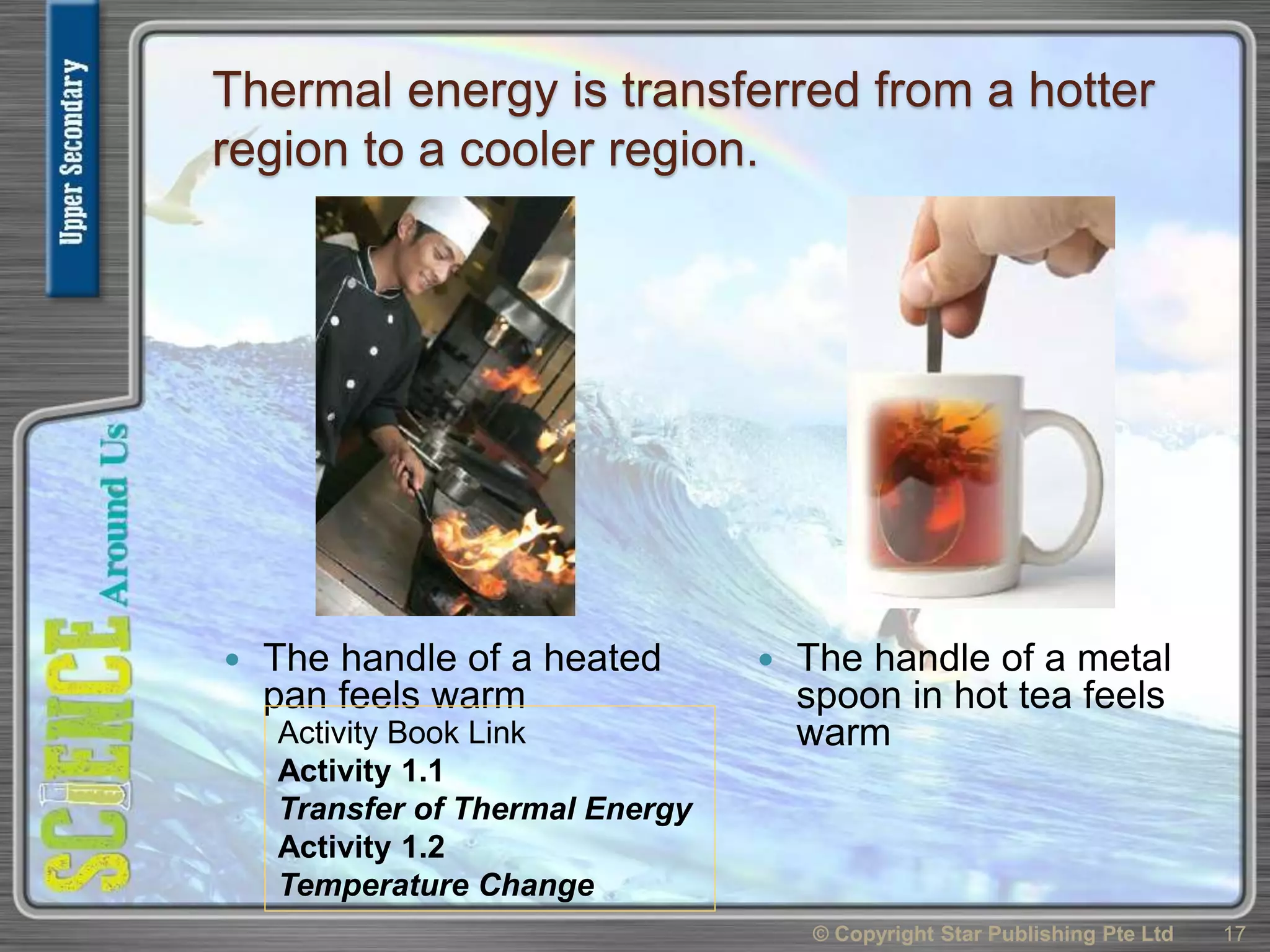
Thermal energy is transferred from a hotter
region to a cooler region.
 The handle of a heated
pan feels warm
 The handle of a metal
spoon in hot tea feels
warm
© Copyright Star Publishing Pte Ltd 17
Activity Book Link
Activity 1.1
Transfer of Thermal Energy
Activity 1.2
Temperature Change
Chapter 1 Energy And Its Uses
1.1 What are some common forms of
energy?
1.2 What is the Principle of the
Conversation of Energy?
1.3 What is power and how is it
calculated?
18© Copyright Star Publishing Pte Ltd
Objectives
 Show understanding that kinetic
energy, elastic potential energy,
gravitational potential energy,
chemical potential energy and thermal
energy are examples of different forms
of energy
 Show understanding that thermal
energy is transferred from a region of
higher temperature to a region of
lower temperature
19© Copyright Star Publishing Pte Ltd
The Principle of the Conservation of
Energy
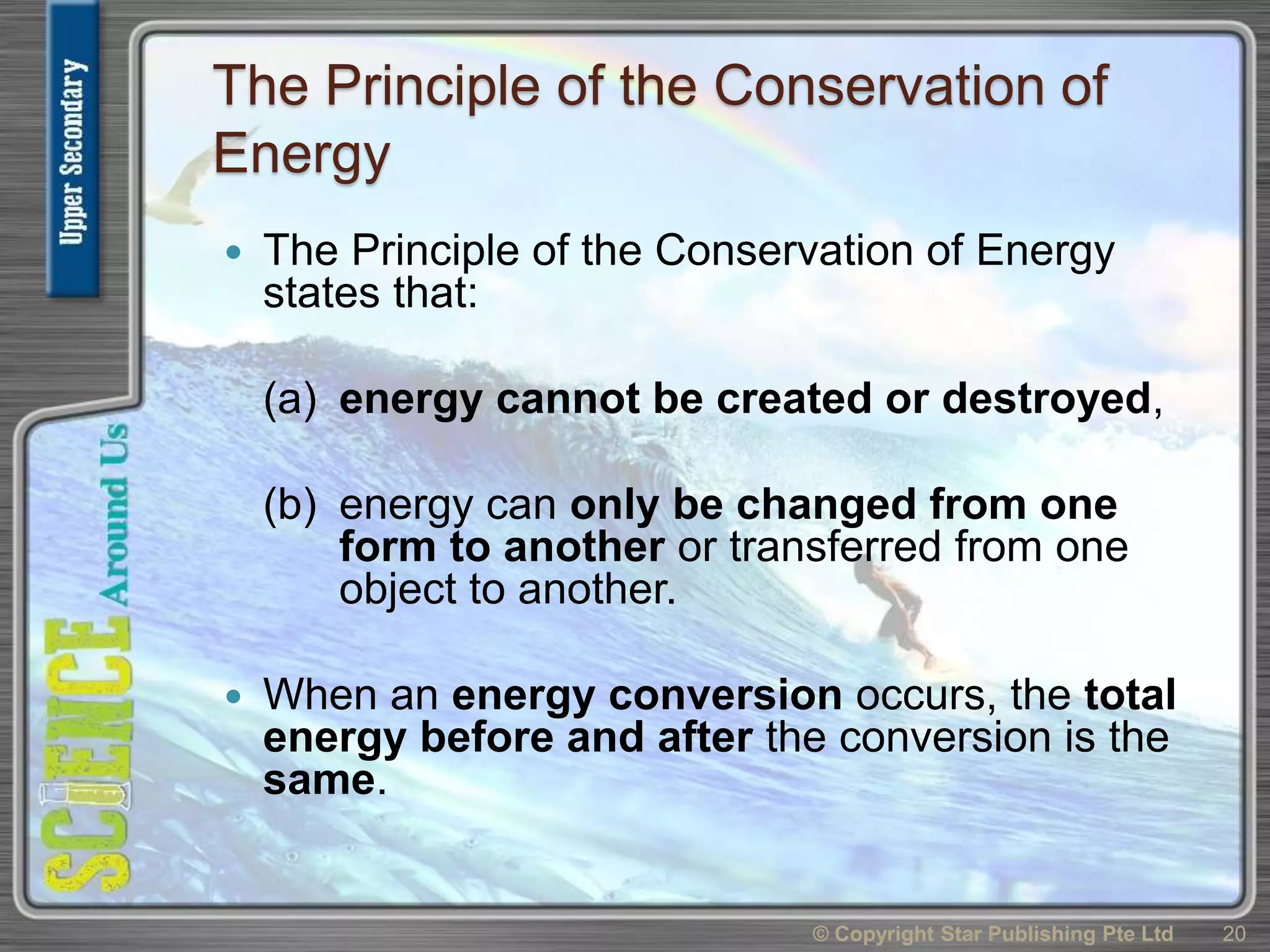
 The Principle of the Conservation of Energy
states that:
(a) energy cannot be created or destroyed,
(b) energy can only be changed from one
form to another or transferred from one
object to another.
 When an energy conversion occurs, the total
energy before and after the conversion is the
same.
© Copyright Star Publishing Pte Ltd 20
Examples of energy
conversion
 Some examples of energy conversion
are:
(a) Throwing a ball vertically upwards
(b) Shooting an arrow with a bow
(c) Lighting a bulb with a battery
© Copyright Star Publishing Pte Ltd 21
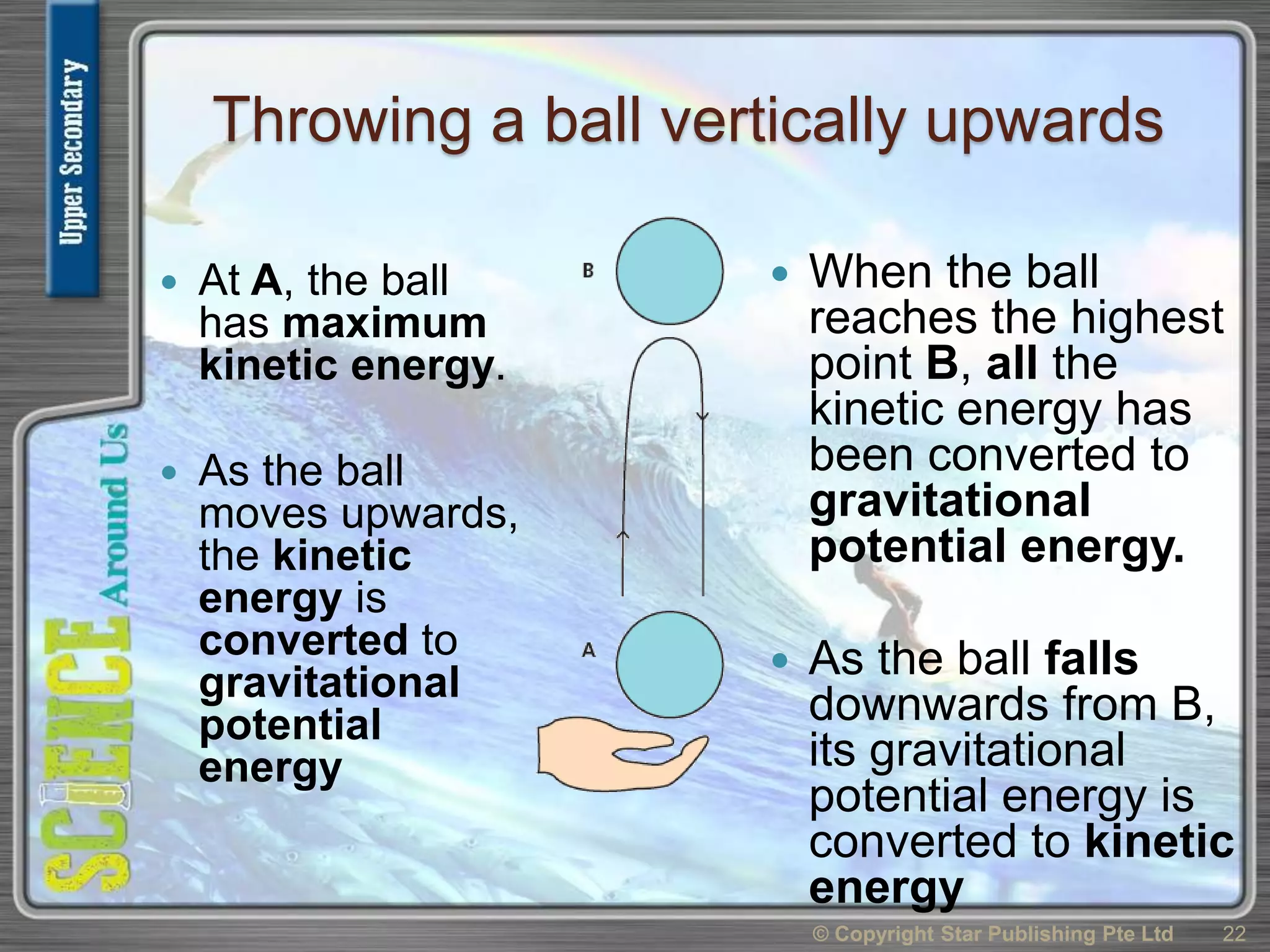
Throwing a ball vertically upwards
 At A, the ball
has maximum
kinetic energy.
 As the ball
moves upwards,
the kinetic
energy is
converted to
gravitational
potential
energy
© Copyright Star Publishing Pte Ltd 22
 When the ball
reaches the highest
point B, all the
kinetic energy has
been converted to
gravitational
potential energy.
 As the ball falls
downwards from B,
its gravitational
potential energy is
converted to kinetic
energy
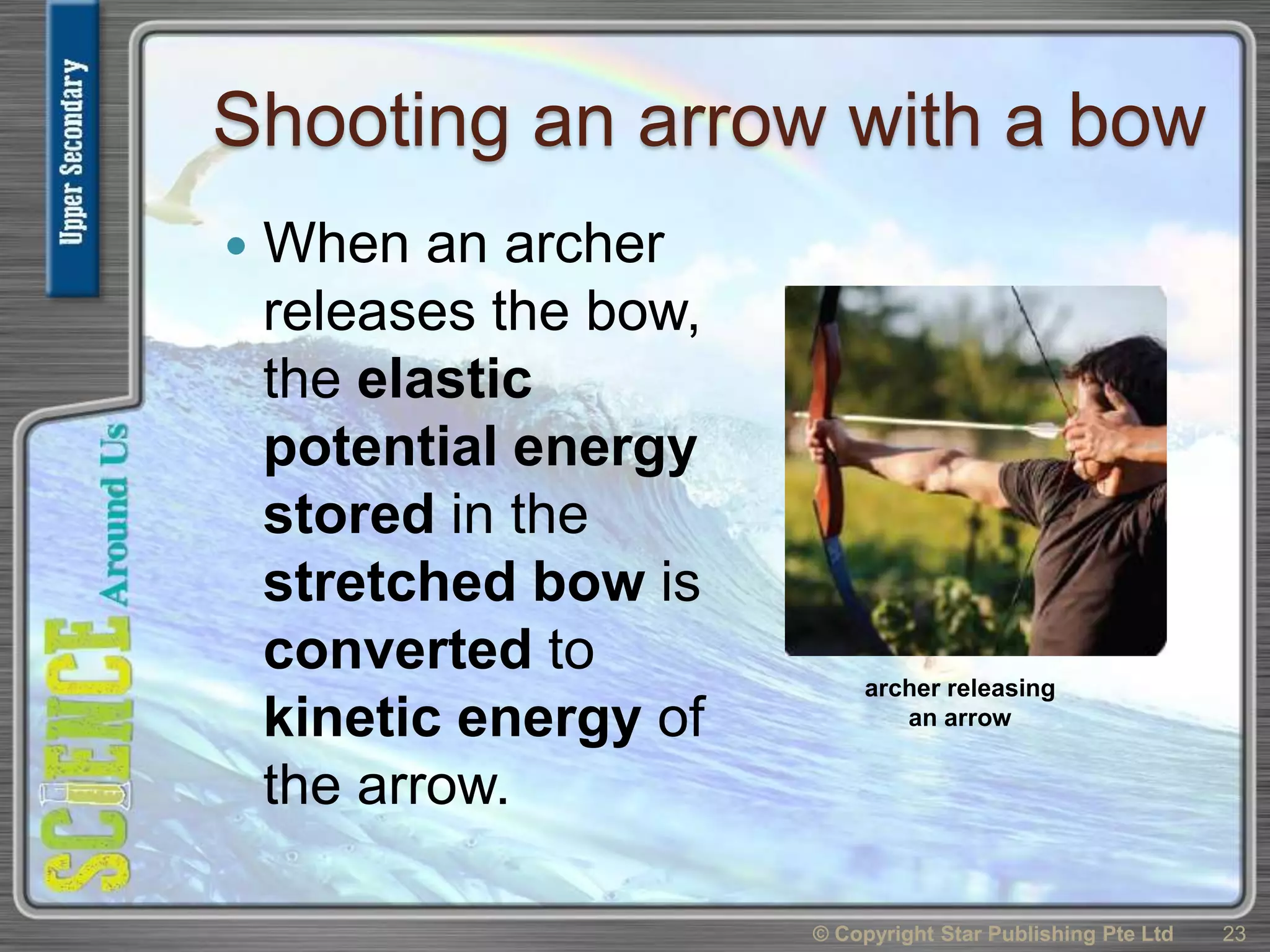
Shooting an arrow with a bow
 When an archer
releases the bow,
the elastic
potential energy
stored in the
stretched bow is
converted to
kinetic energy of
the arrow.
© Copyright Star Publishing Pte Ltd 23
archer releasing
an arrow
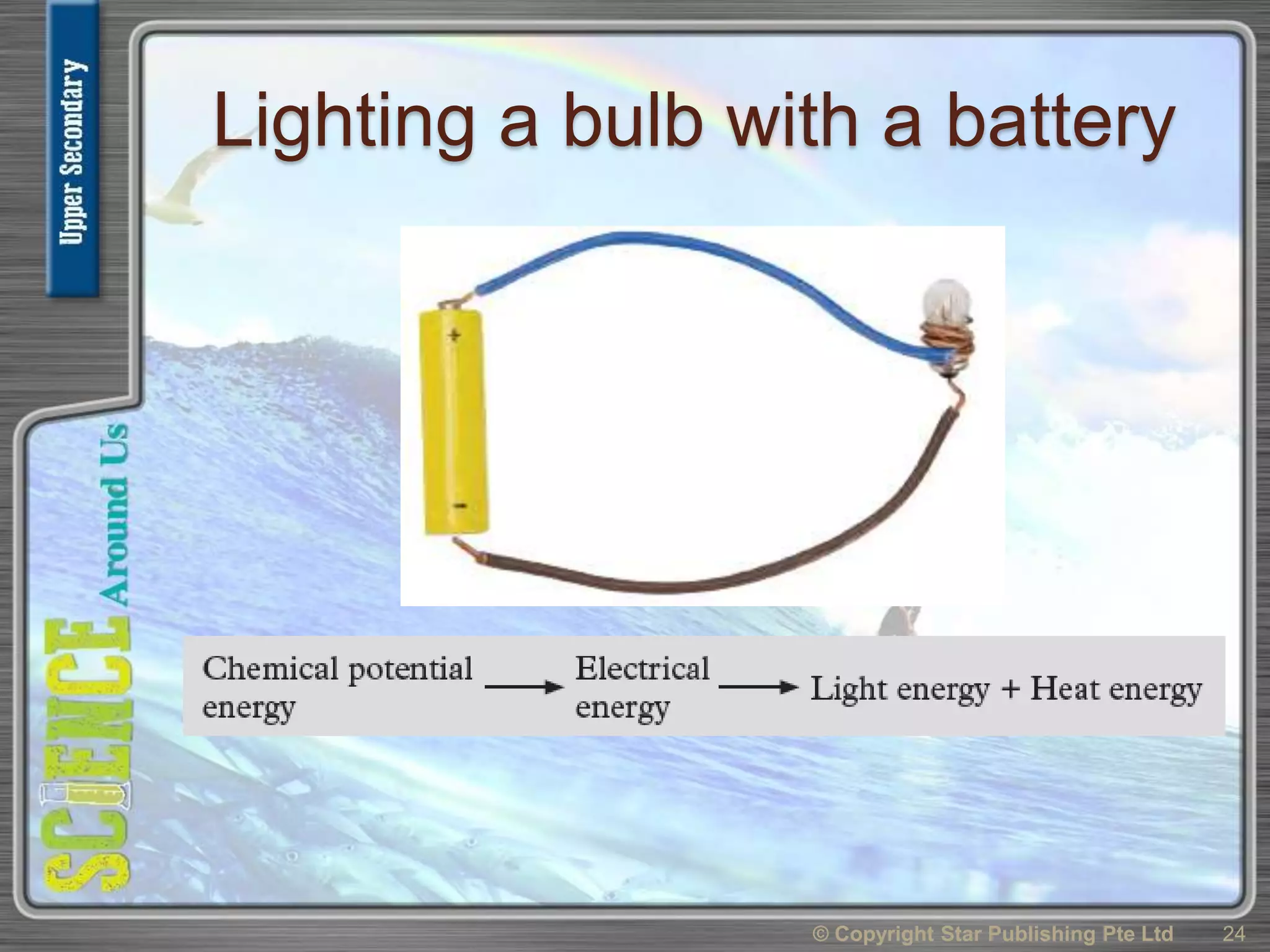
Lighting a bulb with a battery
© Copyright Star Publishing Pte Ltd 24
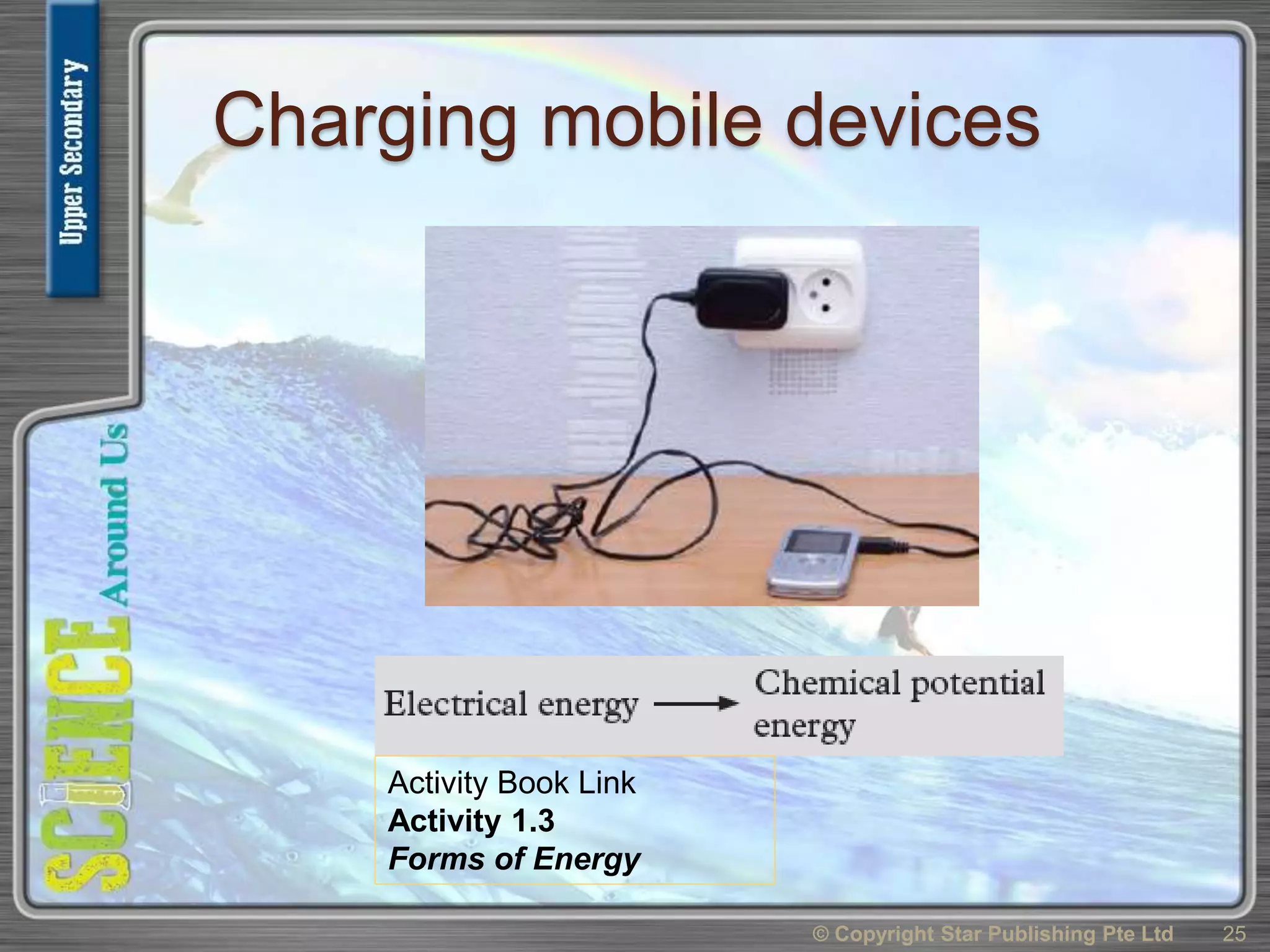
Charging mobile devices
© Copyright Star Publishing Pte Ltd 25
Activity Book Link
Activity 1.3
Forms of Energy
Importance of Conserving Energy
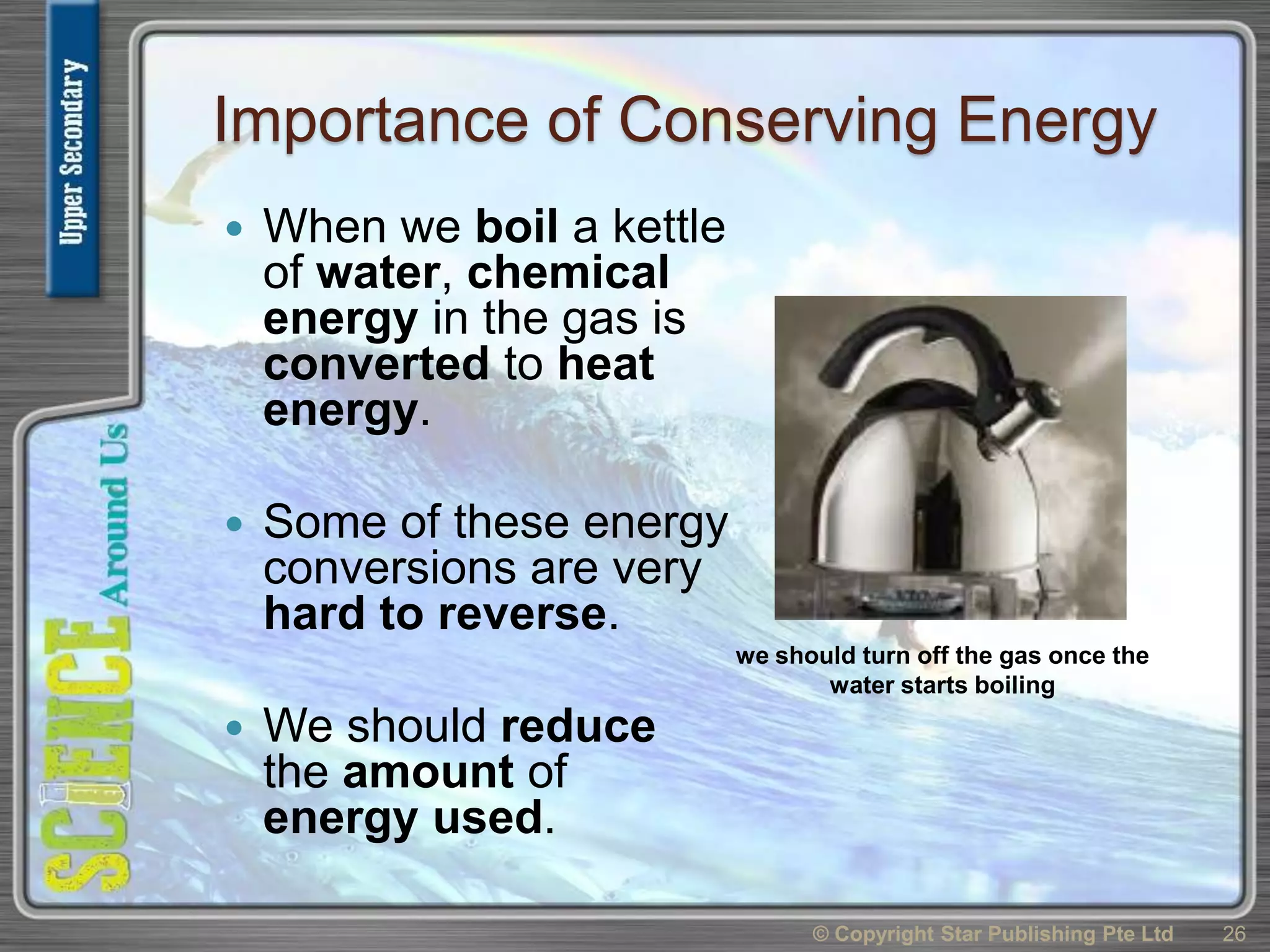
 When we boil a kettle
of water, chemical
energy in the gas is
converted to heat
energy.
 Some of these energy
conversions are very
hard to reverse.
 We should reduce
the amount of
energy used.
© Copyright Star Publishing Pte Ltd 26
we should turn off the gas once the
water starts boiling
Importance of Conserving Energy
 We depend
heavily on
electrical energy in
our modern living.
 We reduce the
amount of fossil
fuels used when
we reduce the
use of electrical
energy.
© Copyright Star Publishing Pte Ltd 27
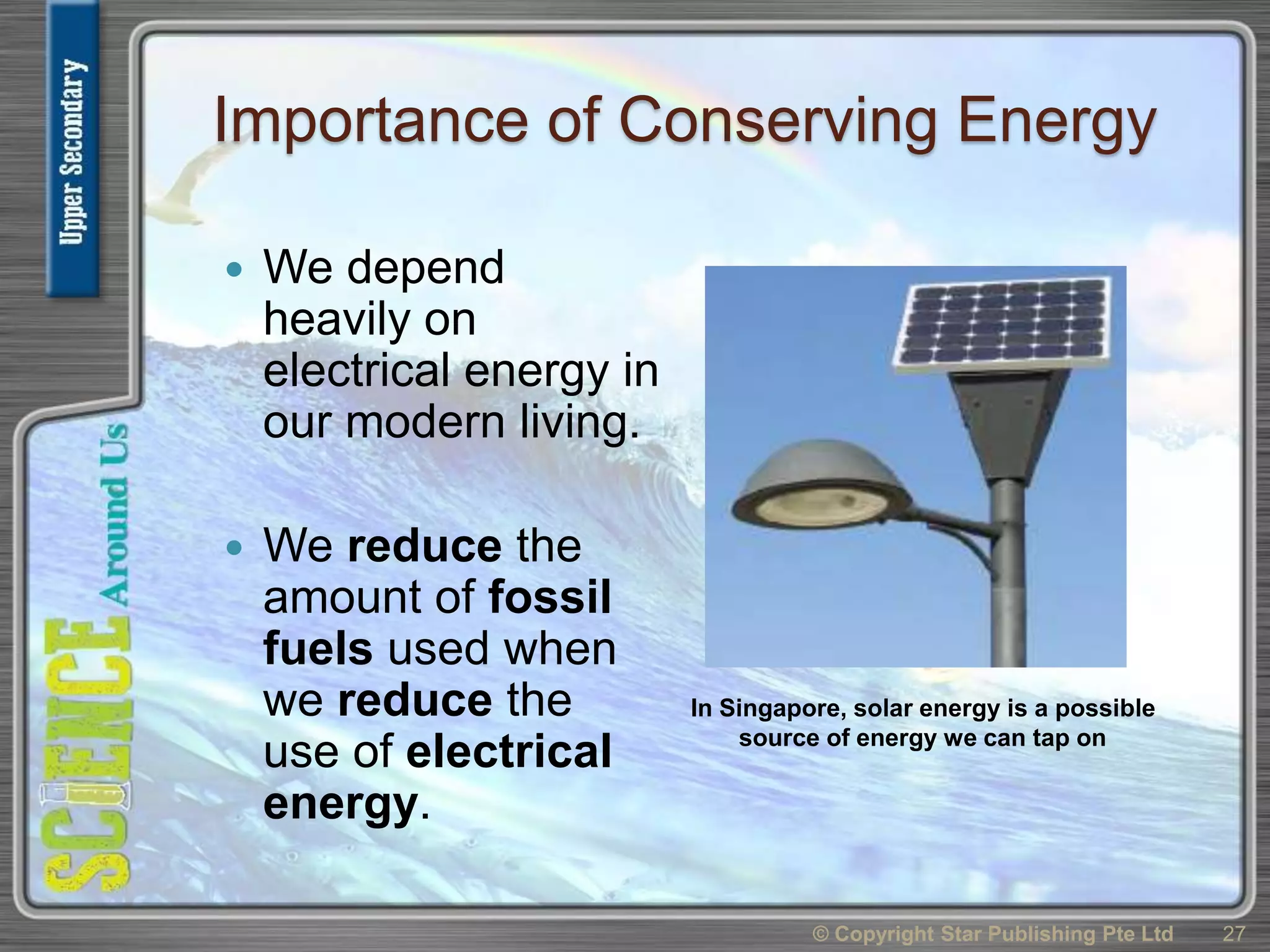
In Singapore, solar energy is a possible
source of energy we can tap on
How can we conserve energy?
 We can reduce
the amount of
fuels used by
taking public
transport.
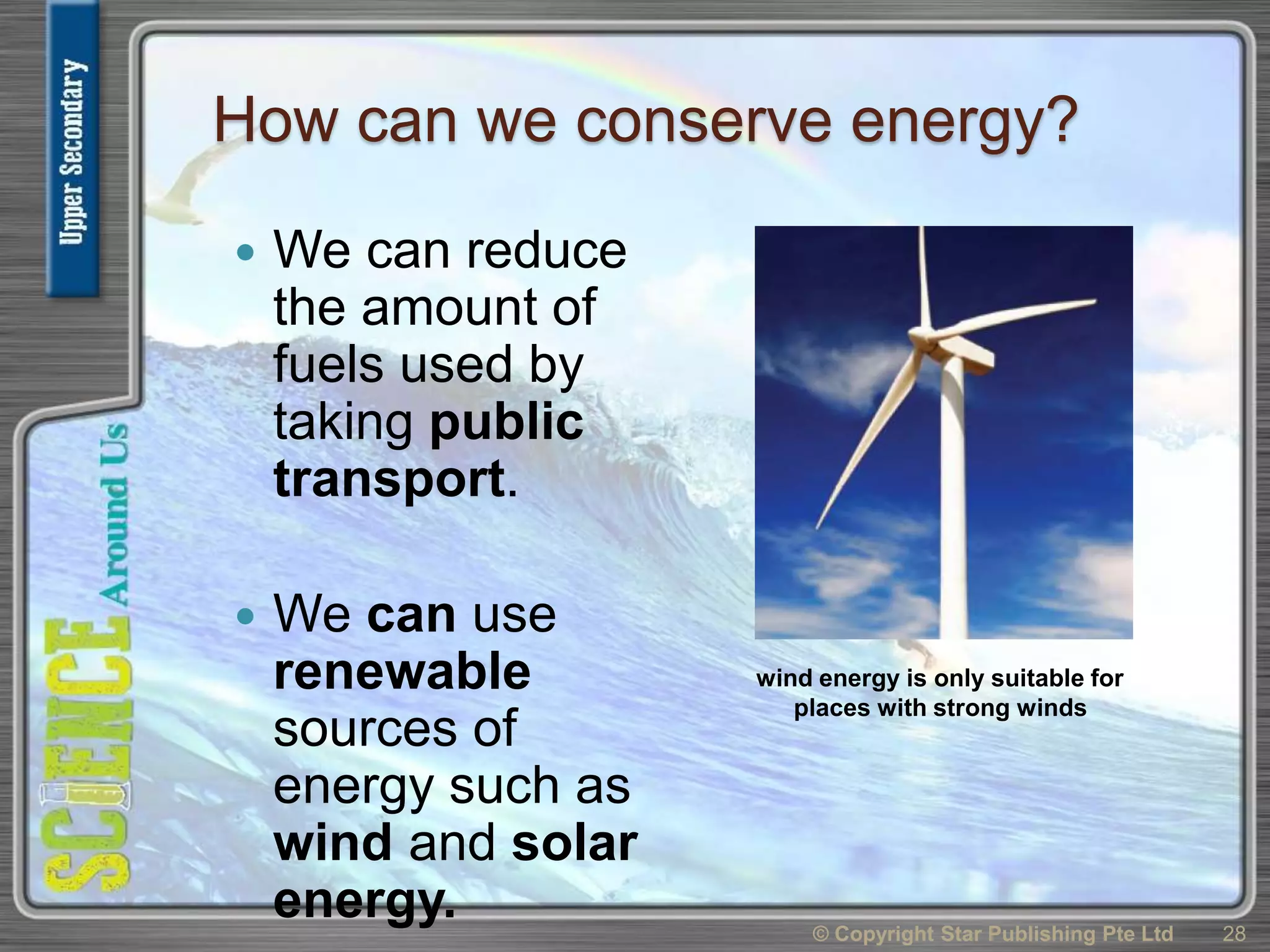
 We can use
renewable
sources of
energy such as
wind and solar
energy. © Copyright Star Publishing Pte Ltd 28
wind energy is only suitable for
places with strong winds
How can we conserve
energy?
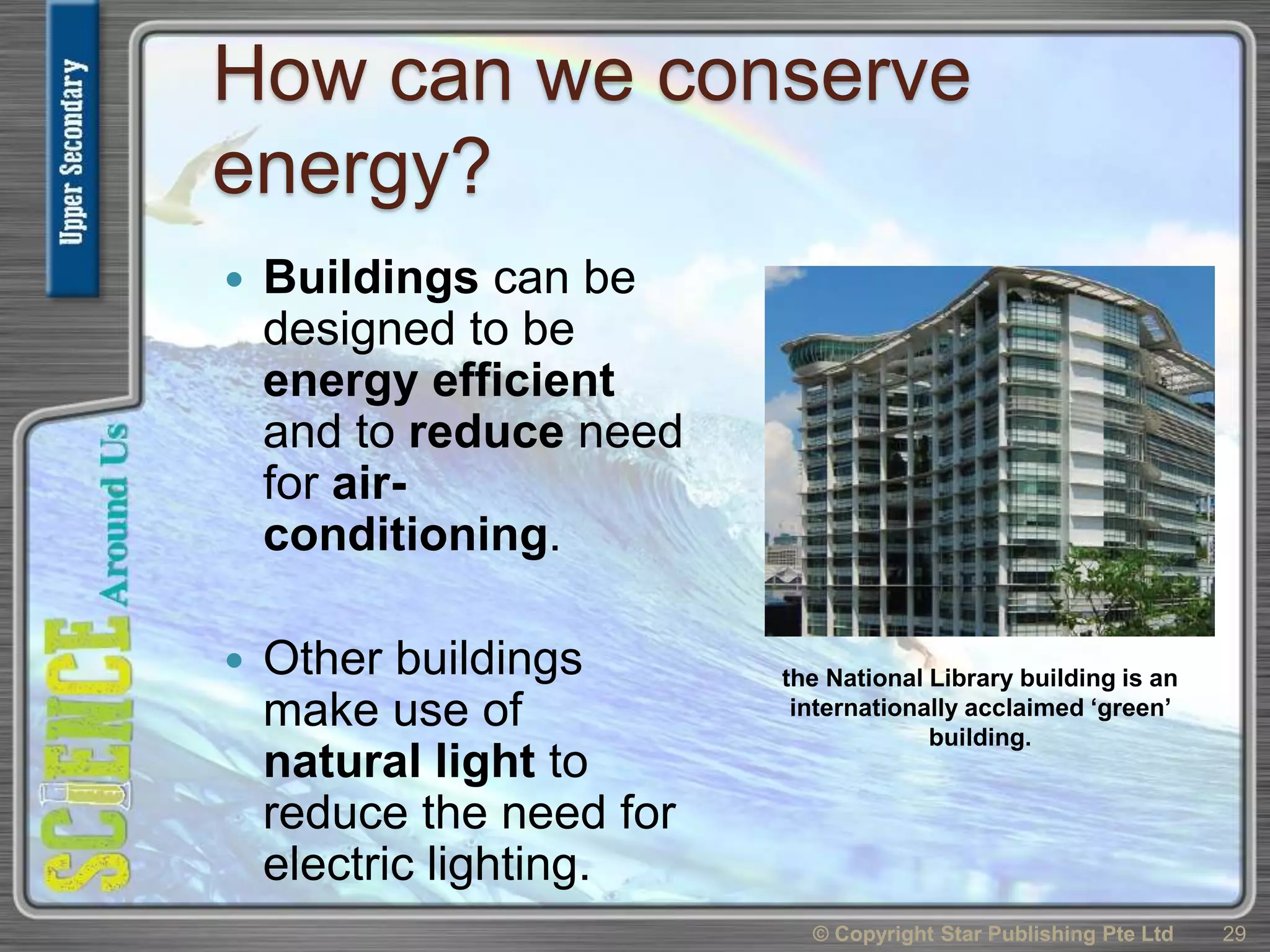
 Buildings can be
designed to be
energy efficient
and to reduce need
for air-
conditioning.
 Other buildings
make use of
natural light to
reduce the need for
electric lighting.
© Copyright Star Publishing Pte Ltd 29
the National Library building is an
internationally acclaimed ‘green’
building.
Chapter 1 Energy And Its Uses
1.1 What are some common forms of
energy?
1.2 What is the Principle of the
Conversation of Energy?
1.3 What is power and how is it
calculated?
30© Copyright Star Publishing Pte Ltd
Objectives
 Relate power to energy transferred
and time taken, using appropriate
examples and the equation
power = in simple systems
31© Copyright Star Publishing Pte Ltd
time
energy
What is Power?
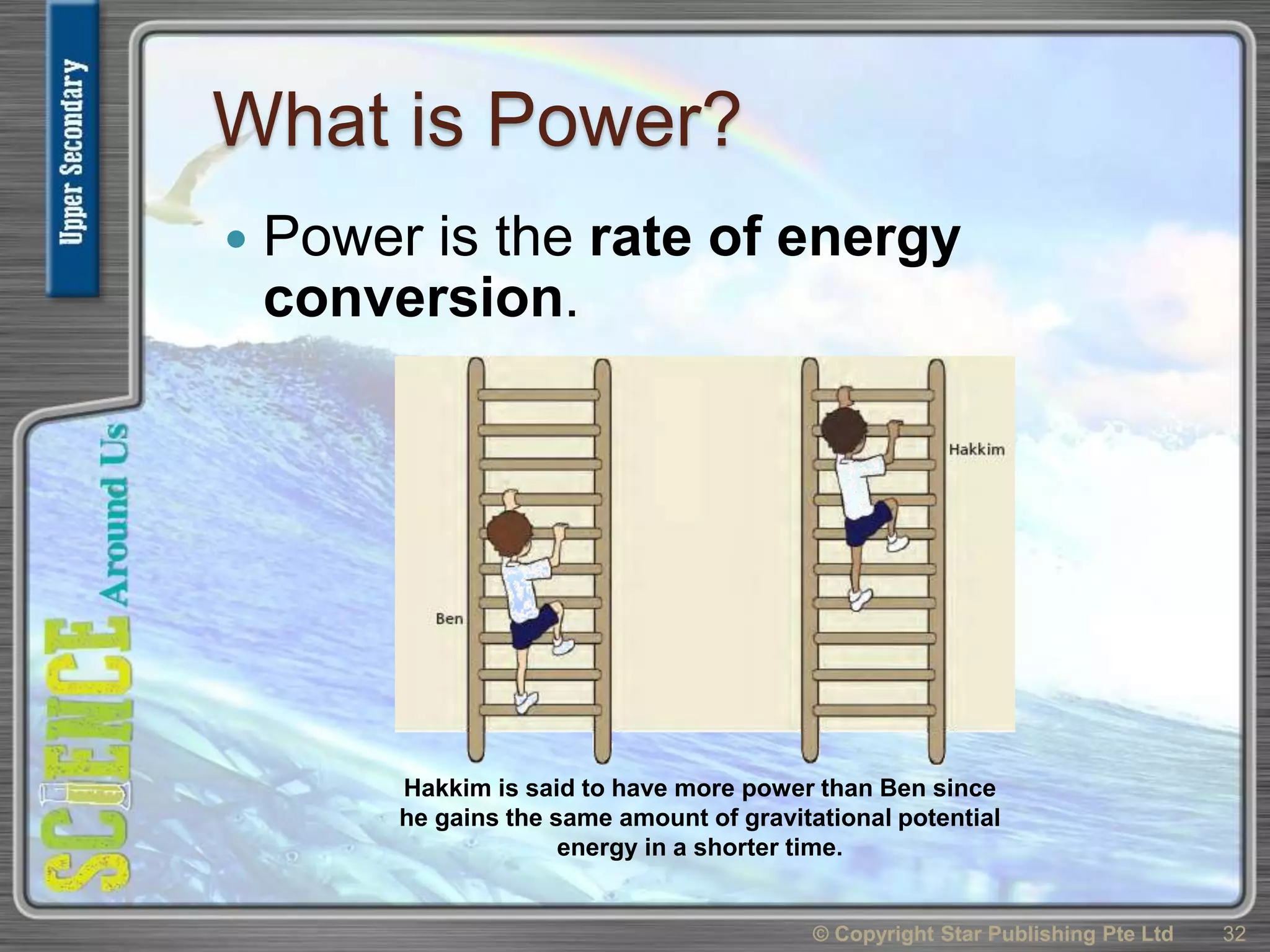
 Power is the rate of energy
conversion.
© Copyright Star Publishing Pte Ltd 32
Hakkim is said to have more power than Ben since
he gains the same amount of gravitational potential
energy in a shorter time.
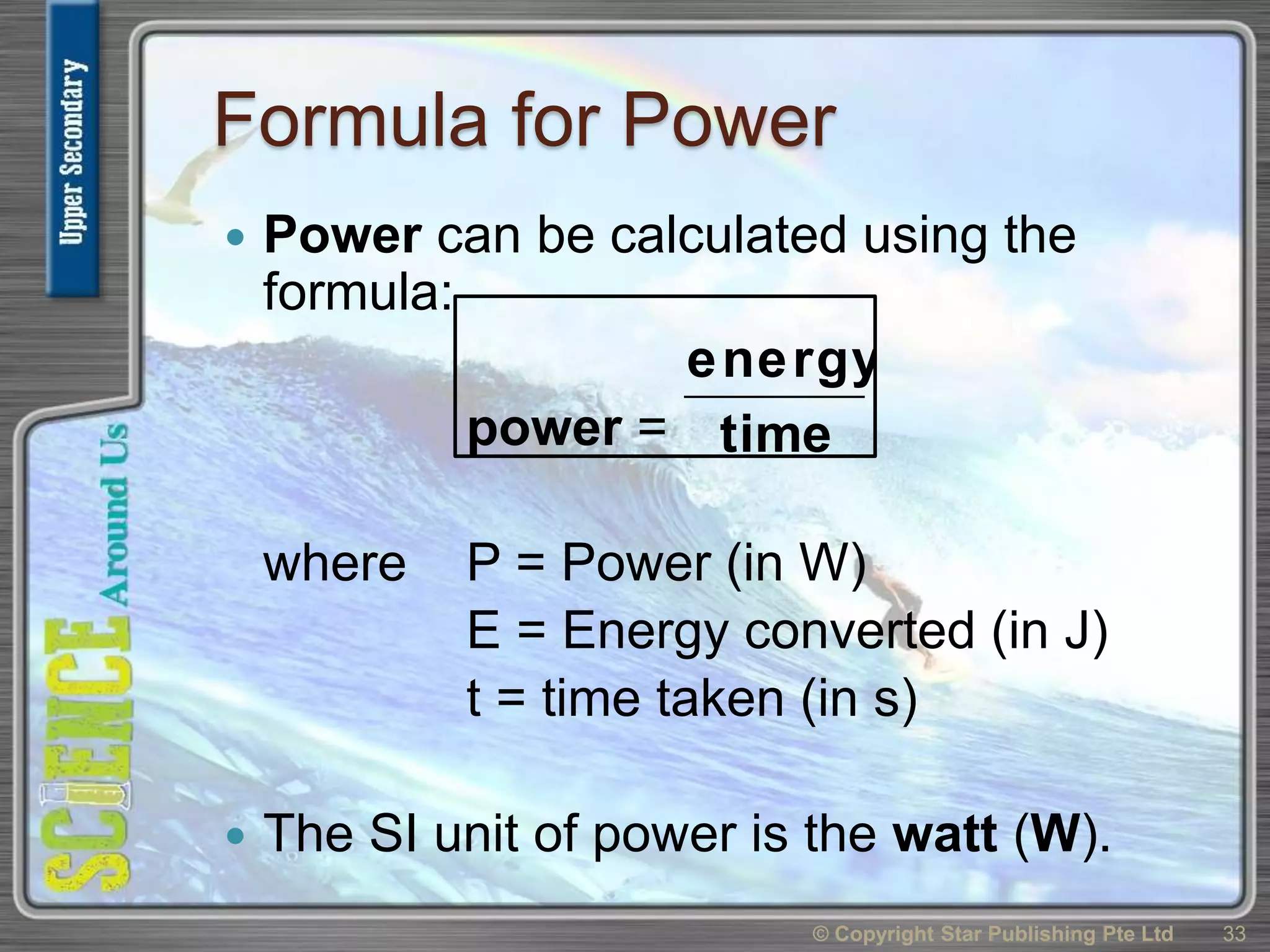
Formula for Power
 Power can be calculated using the
formula:
power =
where P = Power (in W)
E = Energy converted (in J)
t = time taken (in s)
 The SI unit of power is the watt (W).
© Copyright Star Publishing Pte Ltd 33
time
energy
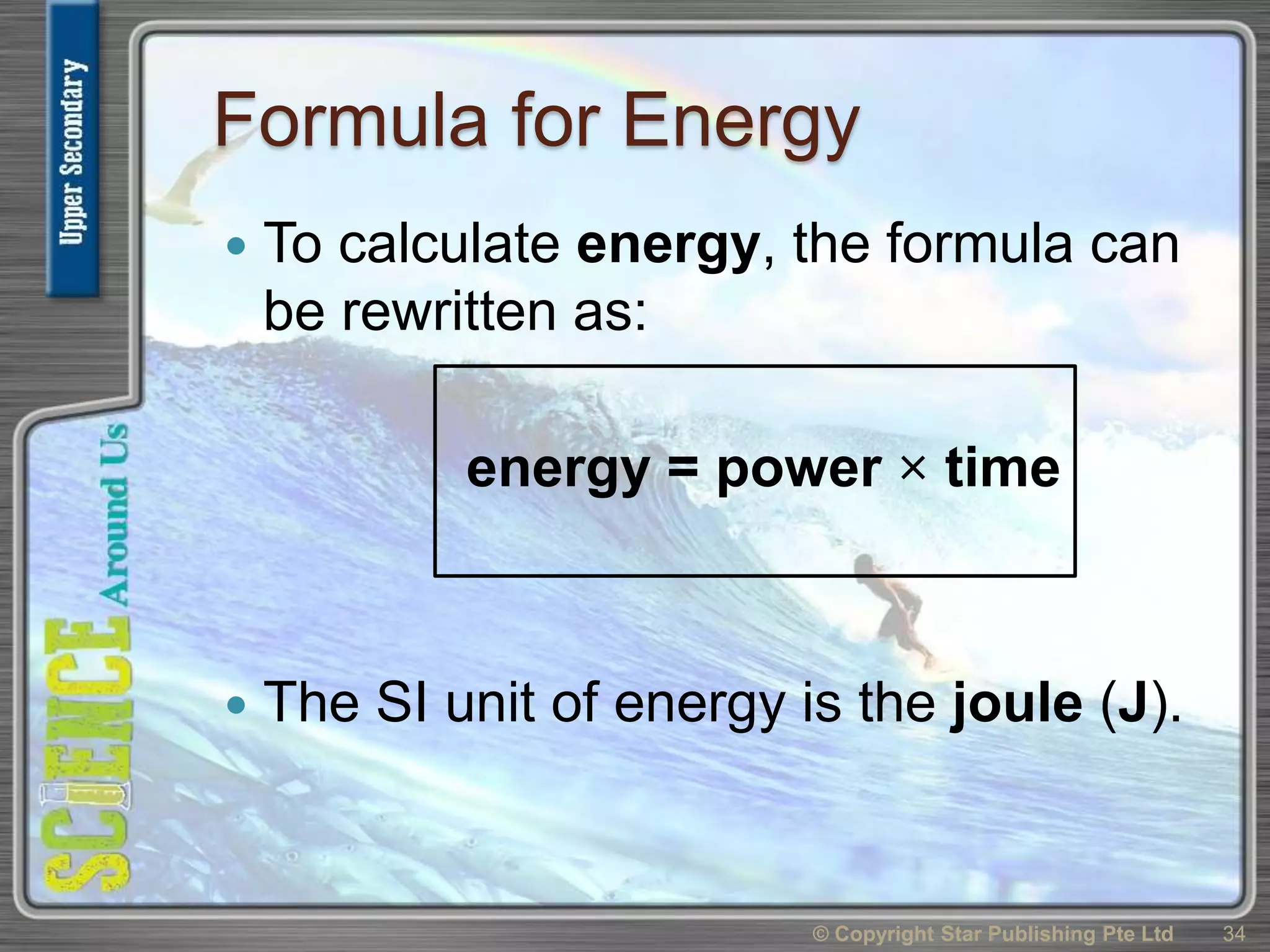
Formula for Energy
 To calculate energy, the formula can
be rewritten as:
energy = power × time
 The SI unit of energy is the joule (J).
© Copyright Star Publishing Pte Ltd 34
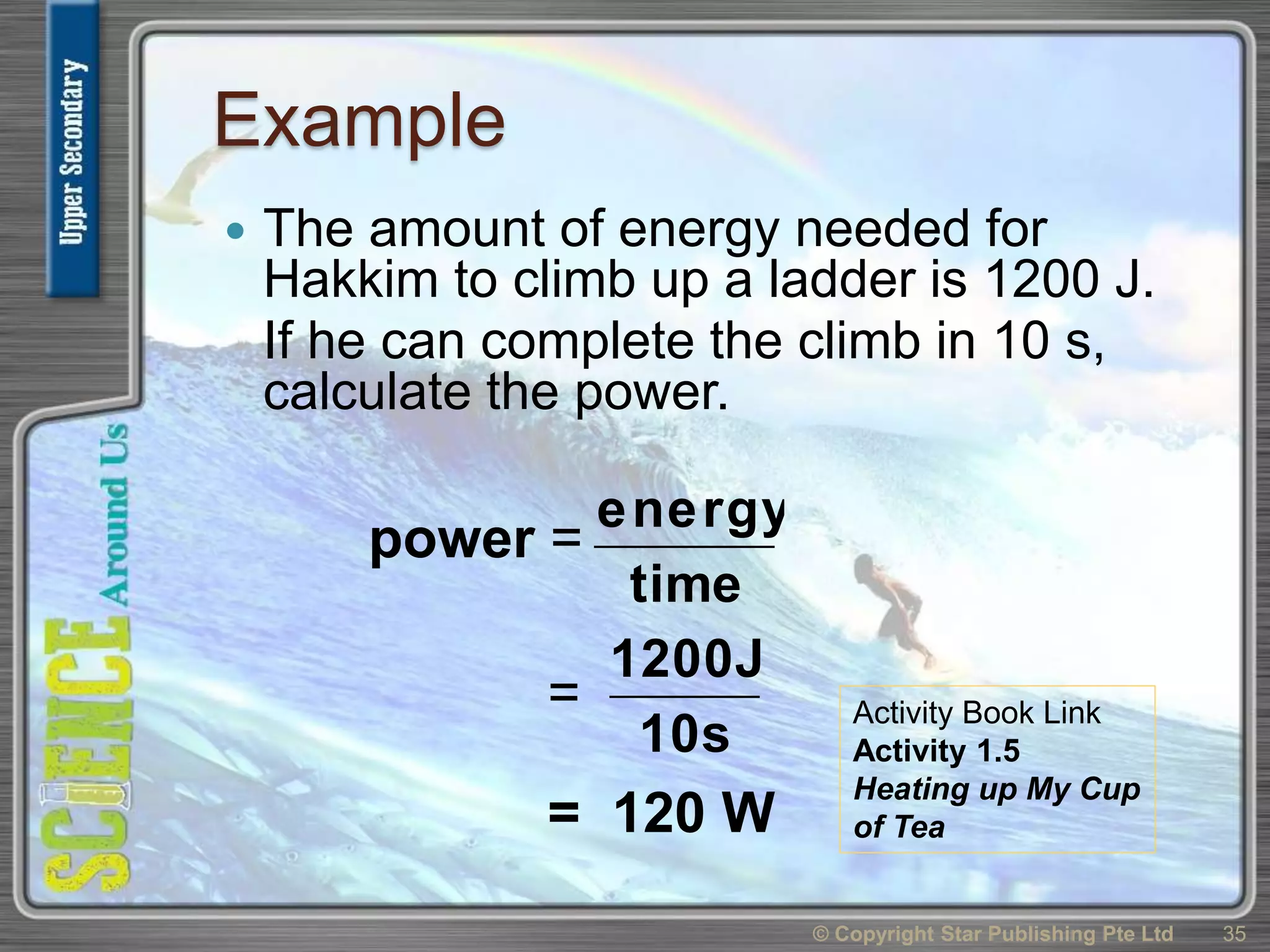
Example
 The amount of energy needed for
Hakkim to climb up a ladder is 1200 J.
If he can complete the climb in 10 s,
calculate the power.
© Copyright Star Publishing Pte Ltd 35
power =
time
energy
=
10s
1200J
= 120 W
Activity Book Link
Activity 1.5
Heating up My Cup
of Tea
© Copyright Star Publishing Pte Ltd 36

module 4 chpt 1 Energy and Its Uses

  • 1.
    Module 4: Gadgets WorkWonders (II) Chapter 1 Energy And Its Uses 1© Copyright Star Publishing Pte Ltd
  • 2.
    Chapter 1 EnergyAnd Its Uses 1.1 What are some common forms of energy? 1.2 What is the Principle of the Conversation of Energy? 1.3 What is power and how is it calculated? 2© Copyright Star Publishing Pte Ltd
  • 3.
    Objectives  Show understandingthat kinetic energy, elastic potential energy, gravitational potential energy, chemical potential energy and thermal energy are examples of different forms of energy  Show understanding that thermal energy is transferred from a region of higher temperature to a region of lower temperature 3© Copyright Star Publishing Pte Ltd
  • 4.
    What is Energy? Energy is the capacity to do work.  There are many different forms of energy. Three forms of energy that we encounter in our daily lives are kinetic energy, potential energy and thermal energy. © Copyright Star Publishing Pte Ltd 4
  • 5.
    What is Kineticenergy?  Kinetic energy is the energy which a moving object has.  A stationary object has no kinetic energy. © Copyright Star Publishing Pte Ltd 5 a stationary aeroplane has no kinetic energy
  • 6.
    Speed and kineticenergy  An aeroplane has more kinetic energy when it is taking off at high speed than when it is moving slowly on the taxiway  A racing car has a lot of kinetic energy when it is moving at high speed © Copyright Star Publishing Pte Ltd 6  The faster an object moves, the more kinetic energy it has.
  • 7.
    What is Potentialenergy?  Potential energy is stored energy.  Three common forms of potential energy are: elastic potential energy, chemical potential energy and gravitational potential energy. © Copyright Star Publishing Pte Ltd 7
  • 8.
    What is ElasticPotential Energy?  Elastic potential energy is stored in objects which are stretched, compressed or bent. (a) In archery, elastic potential energy is stored in a stretched bow. When the bow is released, the elastic potential energy will be used to push the arrow forward at high speed. © Copyright Star Publishing Pte Ltd 8
  • 9.
    What is ElasticPotential Energy? (b) When stretched or compressed, a spring has elastic potential energy. When the spring is allowed to return to its original length, the elastic potential energy will be released. © Copyright Star Publishing Pte Ltd 9
  • 10.
    What is ElasticPotential Energy? (c) A trampoline makes use of elastic potential energy to push a person upwards. © Copyright Star Publishing Pte Ltd 10
  • 11.
    What is GravitationalPotential Energy?  Gravitational potential energy is the energy that an object has because of its position.  The higher the position of an object, the more gravitational potential energy it has. (a) A flag has greater gravitational potential energy after it is raised. (b) A person has greater gravitational potential energy after climbing to a higher floor of a building.© Copyright Star Publishing Pte Ltd 11
  • 12.
    What is chemicalPotential Energy?  Chemical potential energy is the energy stored in substances such as fuels and food. (a) When food is digested, the chemical potential energy in the food is released to provide us with energy to live, work and play. © Copyright Star Publishing Pte Ltd 12
  • 13.
    Chemical Potential Energy (b)Many households use liquid petroleum gas (LPG) for cooking. When burnt, the chemical potential energy in the LPG is converted to heat energy. © Copyright Star Publishing Pte Ltd 13
  • 14.
    What is Thermalenergy?  Thermal energy is the energy an object has because of its temperature.  The hotter an object, the more thermal energy it has.  Our most important source of thermal energy is the Sun.  We obtain thermal energy for cooking and keeping warm by burning fuels or using electricity. © Copyright Star Publishing Pte Ltd 14
  • 15.
    What is Thermalenergy?  Thermal energy travels from a region of higher temperature to a region of lower temperature.  When there is no temperature difference, there is no transfer of thermal energy. © Copyright Star Publishing Pte Ltd 15 thermal energy is used for cooking)
  • 16.
    What is Thermalenergy?  When a bottle of hot milk is placed in a bowl of cold water, thermal energy moves from the hot milk to the cold water. This causes the milk to cool down and the water to warm up. © Copyright Star Publishing Pte Ltd 16
  • 17.
    Thermal energy istransferred from a hotter region to a cooler region.  The handle of a heated pan feels warm  The handle of a metal spoon in hot tea feels warm © Copyright Star Publishing Pte Ltd 17 Activity Book Link Activity 1.1 Transfer of Thermal Energy Activity 1.2 Temperature Change
  • 18.
    Chapter 1 EnergyAnd Its Uses 1.1 What are some common forms of energy? 1.2 What is the Principle of the Conversation of Energy? 1.3 What is power and how is it calculated? 18© Copyright Star Publishing Pte Ltd
  • 19.
    Objectives  Show understandingthat kinetic energy, elastic potential energy, gravitational potential energy, chemical potential energy and thermal energy are examples of different forms of energy  Show understanding that thermal energy is transferred from a region of higher temperature to a region of lower temperature 19© Copyright Star Publishing Pte Ltd
  • 20.
    The Principle ofthe Conservation of Energy  The Principle of the Conservation of Energy states that: (a) energy cannot be created or destroyed, (b) energy can only be changed from one form to another or transferred from one object to another.  When an energy conversion occurs, the total energy before and after the conversion is the same. © Copyright Star Publishing Pte Ltd 20
  • 21.
    Examples of energy conversion Some examples of energy conversion are: (a) Throwing a ball vertically upwards (b) Shooting an arrow with a bow (c) Lighting a bulb with a battery © Copyright Star Publishing Pte Ltd 21
  • 22.
    Throwing a ballvertically upwards  At A, the ball has maximum kinetic energy.  As the ball moves upwards, the kinetic energy is converted to gravitational potential energy © Copyright Star Publishing Pte Ltd 22  When the ball reaches the highest point B, all the kinetic energy has been converted to gravitational potential energy.  As the ball falls downwards from B, its gravitational potential energy is converted to kinetic energy
  • 23.
    Shooting an arrowwith a bow  When an archer releases the bow, the elastic potential energy stored in the stretched bow is converted to kinetic energy of the arrow. © Copyright Star Publishing Pte Ltd 23 archer releasing an arrow
  • 24.
    Lighting a bulbwith a battery © Copyright Star Publishing Pte Ltd 24
  • 25.
    Charging mobile devices ©Copyright Star Publishing Pte Ltd 25 Activity Book Link Activity 1.3 Forms of Energy
  • 26.
    Importance of ConservingEnergy  When we boil a kettle of water, chemical energy in the gas is converted to heat energy.  Some of these energy conversions are very hard to reverse.  We should reduce the amount of energy used. © Copyright Star Publishing Pte Ltd 26 we should turn off the gas once the water starts boiling
  • 27.
    Importance of ConservingEnergy  We depend heavily on electrical energy in our modern living.  We reduce the amount of fossil fuels used when we reduce the use of electrical energy. © Copyright Star Publishing Pte Ltd 27 In Singapore, solar energy is a possible source of energy we can tap on
  • 28.
    How can weconserve energy?  We can reduce the amount of fuels used by taking public transport.  We can use renewable sources of energy such as wind and solar energy. © Copyright Star Publishing Pte Ltd 28 wind energy is only suitable for places with strong winds
  • 29.
    How can weconserve energy?  Buildings can be designed to be energy efficient and to reduce need for air- conditioning.  Other buildings make use of natural light to reduce the need for electric lighting. © Copyright Star Publishing Pte Ltd 29 the National Library building is an internationally acclaimed ‘green’ building.
  • 30.
    Chapter 1 EnergyAnd Its Uses 1.1 What are some common forms of energy? 1.2 What is the Principle of the Conversation of Energy? 1.3 What is power and how is it calculated? 30© Copyright Star Publishing Pte Ltd
  • 31.
    Objectives  Relate powerto energy transferred and time taken, using appropriate examples and the equation power = in simple systems 31© Copyright Star Publishing Pte Ltd time energy
  • 32.
    What is Power? Power is the rate of energy conversion. © Copyright Star Publishing Pte Ltd 32 Hakkim is said to have more power than Ben since he gains the same amount of gravitational potential energy in a shorter time.
  • 33.
    Formula for Power Power can be calculated using the formula: power = where P = Power (in W) E = Energy converted (in J) t = time taken (in s)  The SI unit of power is the watt (W). © Copyright Star Publishing Pte Ltd 33 time energy
  • 34.
    Formula for Energy To calculate energy, the formula can be rewritten as: energy = power × time  The SI unit of energy is the joule (J). © Copyright Star Publishing Pte Ltd 34
  • 35.
    Example  The amountof energy needed for Hakkim to climb up a ladder is 1200 J. If he can complete the climb in 10 s, calculate the power. © Copyright Star Publishing Pte Ltd 35 power = time energy = 10s 1200J = 120 W Activity Book Link Activity 1.5 Heating up My Cup of Tea
  • 36.
    © Copyright StarPublishing Pte Ltd 36