CRISPR-CAS: AN
ADVANCED AND
EFFICIENT TOOL FOR
GENOME MODIFICATION
by
Avinash Tiwari
M. Tech 1st year, 2nd sem.
201710209010002
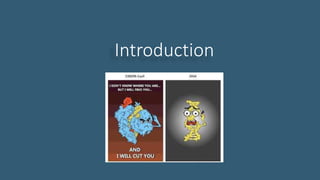
Introduction
• Every bacterium has their own resistance mechanism against the
exposure of foreign genetic material
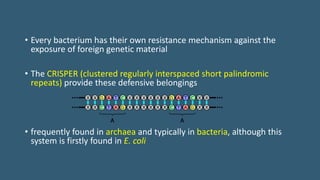
• The CRISPER (clustered regularly interspaced short palindromic
repeats) provide these defensive belongings
• frequently found in archaea and typically in bacteria, although this
system is firstly found in E. coli
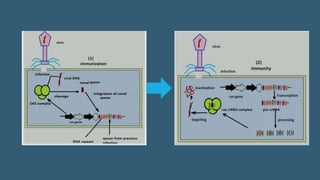
• virus attack on the bacteria the insert their DNA in the bacteria and
hijack the bacterial machinery and make their copy and spread
• CRISPER is like cut and paste is ligated in bacterial genome in a
specific area
• incorporated DNA segment of virus transcribed in to RNA which is
associated with a cas nucleases enzymes which snip the virus DNA
and make the disable
Mechanism
How it work
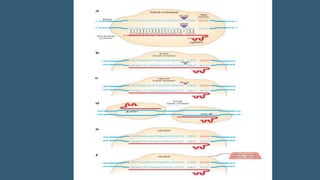
• CRISPR system incorporates sequences from invading DNA between
CRISPR repeat sequences encoded as arrays within the host genome
• Transcripts from the CRISPR repeat arrays are processed into CRISPR
RNAs (crRNAs) having a variable sequence transcribed from the invading
DNA, known as the “protospacer” sequence, as well as part of the
CRISPR repeat
• The protospacer encoded portion of the crRNA directs cas9 to cleave
complementary target DNA sequences. CRISPR system from
Streptococcus pyogenes has been adapted for inducing sequence-
specific DSBs and targeted genome editing
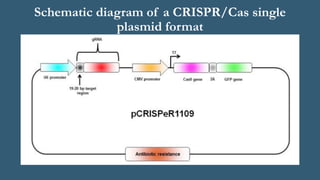
• Two components must be introduced and/or expressed in cells or an
organism to perform genome editing:
1. the cas9 nuclease
2. a ‘guide RNA’ (gRNA),
• consisting of a fusion of a crRNA and a constant tracrRNA.20
nucleotides at the 5′ end of the gRNA direct cas9 to a specific target
DNA site using standard RNA-DNA complementarity base pairing rules
• Thus, with this system, cas9 nuclease activity can be directed to any
DNA sequence of the form N20 -NGG simply by altering the first 20
nucleotide of the gRNA to correspond to the target DNA sequence
Schematic diagram of a CRISPR/Cas single
plasmid format
Application
• genome editing
• completely change the genome of any eukaryotic organism
• endogenous gene expression •
• endogenous transcript and encoding a bacterial lipoprotein (BLP)
• gene regulation in the pathogenesis
• transformed genome editing and biomedicine
• applied as genetic recorders
• molecular barcoding and cellular lineage tracing
• provides a cellular memory of biological activity
Future Aspects
• Pharmaceutical companies may develop the CRISPR based drug for
treat the Heart disease, blood disorders and blindness
• It will be possible in couple of decades , it may be possible to treat
cancer , AIDS through a pill or injections
• CRISPR-cas may be used for boosting human immune intelligence
1. Aklujkar M, Lovley DR. Interference with histidyl-tRNA synthetase by a CRISPR spacer sequence as a factor in the evolution of
Pelobacter carbinolicus, 2010
2. Barrangou R, Marraffini LA. CRISPR-cas systems: Prokaryotes upgrade to adaptive immunity. Mol Cell. 2014
3. Jeffry D. Sander and J. Keith Joung, CRISPR-cas systems for genome editing,regulation andtargeting,2014
4. Timothy R. Sampson and David S. Weiss CRISPR-C systems: new players in gene regulation and bacterial physiology
5. Khaoula Belhaj, Angela Chaparro-Garcia, Sophien Kamoun and Vladimir Nekrasov, Plant genome editing made easy: targeted
mutagenesis in model and crop plants using the CRISPR/Cas system,2013
6. Melissa M. Harrison,Brian V. Jenkins, Kate M. O’ConnorGiles and Jill Wildonger, A CRISPR view of development,2015
7. Thomas Gaj,Charles A. Gersbach and Carlos F. Barbas, ZFN, TALEN and CRISPR/Cas-based methods for genome
engineering,2013
8. Eric S. Lander, The Heroes of CRISPR, 2015
9. Qiupeng Zheng1, Xiaohong Cai2, Meng How Tan, Steven Schaffert2, Christopher P. Arnold, Xue Gong, Chang-Zheng Chen and
Shenglin, Huang1, Precise gene deletion and replacement using the CRISPR/Cas9 system in human cells, 2014
10. Patrick D. Hsu, Eric S. Lander,and Feng, Zhang Development and Applications of CRISPR-Cas9 for Genome Engineering, 2014
11. Jeffry D Sander1,2 & J Keith Joung,CriSPr-Cas systems for editing, regulating and targeting genomes, 2014
12. Thomas Gaj1,2,3, Charles A. Gersbach4,5, and Carlos F. Barbas, ZFN, TALEN, and CRISPR/Cas-based methods for genome
engineering, 2013
REFERENCES
Crispr cas:an advance and efficient tool for genome modification

Crispr cas:an advance and efficient tool for genome modification

  • 1.
    CRISPR-CAS: AN ADVANCED AND EFFICIENTTOOL FOR GENOME MODIFICATION by Avinash Tiwari M. Tech 1st year, 2nd sem. 201710209010002
  • 2.
  • 3.
    • Every bacteriumhas their own resistance mechanism against the exposure of foreign genetic material • The CRISPER (clustered regularly interspaced short palindromic repeats) provide these defensive belongings • frequently found in archaea and typically in bacteria, although this system is firstly found in E. coli
  • 4.
    • virus attackon the bacteria the insert their DNA in the bacteria and hijack the bacterial machinery and make their copy and spread • CRISPER is like cut and paste is ligated in bacterial genome in a specific area • incorporated DNA segment of virus transcribed in to RNA which is associated with a cas nucleases enzymes which snip the virus DNA and make the disable
  • 5.
  • 7.
  • 8.
    • CRISPR systemincorporates sequences from invading DNA between CRISPR repeat sequences encoded as arrays within the host genome • Transcripts from the CRISPR repeat arrays are processed into CRISPR RNAs (crRNAs) having a variable sequence transcribed from the invading DNA, known as the “protospacer” sequence, as well as part of the CRISPR repeat • The protospacer encoded portion of the crRNA directs cas9 to cleave complementary target DNA sequences. CRISPR system from Streptococcus pyogenes has been adapted for inducing sequence- specific DSBs and targeted genome editing
  • 9.
    • Two componentsmust be introduced and/or expressed in cells or an organism to perform genome editing: 1. the cas9 nuclease 2. a ‘guide RNA’ (gRNA), • consisting of a fusion of a crRNA and a constant tracrRNA.20 nucleotides at the 5′ end of the gRNA direct cas9 to a specific target DNA site using standard RNA-DNA complementarity base pairing rules • Thus, with this system, cas9 nuclease activity can be directed to any DNA sequence of the form N20 -NGG simply by altering the first 20 nucleotide of the gRNA to correspond to the target DNA sequence
  • 11.
    Schematic diagram ofa CRISPR/Cas single plasmid format
  • 12.
  • 13.
    • genome editing •completely change the genome of any eukaryotic organism • endogenous gene expression • • endogenous transcript and encoding a bacterial lipoprotein (BLP) • gene regulation in the pathogenesis • transformed genome editing and biomedicine • applied as genetic recorders • molecular barcoding and cellular lineage tracing • provides a cellular memory of biological activity
  • 14.
  • 15.
    • Pharmaceutical companiesmay develop the CRISPR based drug for treat the Heart disease, blood disorders and blindness • It will be possible in couple of decades , it may be possible to treat cancer , AIDS through a pill or injections • CRISPR-cas may be used for boosting human immune intelligence
  • 16.
    1. Aklujkar M,Lovley DR. Interference with histidyl-tRNA synthetase by a CRISPR spacer sequence as a factor in the evolution of Pelobacter carbinolicus, 2010 2. Barrangou R, Marraffini LA. CRISPR-cas systems: Prokaryotes upgrade to adaptive immunity. Mol Cell. 2014 3. Jeffry D. Sander and J. Keith Joung, CRISPR-cas systems for genome editing,regulation andtargeting,2014 4. Timothy R. Sampson and David S. Weiss CRISPR-C systems: new players in gene regulation and bacterial physiology 5. Khaoula Belhaj, Angela Chaparro-Garcia, Sophien Kamoun and Vladimir Nekrasov, Plant genome editing made easy: targeted mutagenesis in model and crop plants using the CRISPR/Cas system,2013 6. Melissa M. Harrison,Brian V. Jenkins, Kate M. O’ConnorGiles and Jill Wildonger, A CRISPR view of development,2015 7. Thomas Gaj,Charles A. Gersbach and Carlos F. Barbas, ZFN, TALEN and CRISPR/Cas-based methods for genome engineering,2013 8. Eric S. Lander, The Heroes of CRISPR, 2015 9. Qiupeng Zheng1, Xiaohong Cai2, Meng How Tan, Steven Schaffert2, Christopher P. Arnold, Xue Gong, Chang-Zheng Chen and Shenglin, Huang1, Precise gene deletion and replacement using the CRISPR/Cas9 system in human cells, 2014 10. Patrick D. Hsu, Eric S. Lander,and Feng, Zhang Development and Applications of CRISPR-Cas9 for Genome Engineering, 2014 11. Jeffry D Sander1,2 & J Keith Joung,CriSPr-Cas systems for editing, regulating and targeting genomes, 2014 12. Thomas Gaj1,2,3, Charles A. Gersbach4,5, and Carlos F. Barbas, ZFN, TALEN, and CRISPR/Cas-based methods for genome engineering, 2013 REFERENCES