The Earth’s Interior
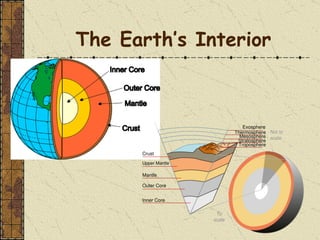
The Earth’s Interior Four Layers (see page 10 of Ref Tables) Inner Core : solid, dense, 6,000 º C, Iron and Nickel Outer Core : Liquid, dense, 3,700º-5,500ºC (increases with depth), Iron and Nickel Mantle : Solid, minerals rich in Fe, Si, Ma, 1,500º - 3,200º C Crust : upper layer, rigid, lighter rock, <1,000ºC
The Earth’s Interior Some terms to know: Asthenosphere :  Upper layer of the mantle, may act in a semi-fluid (plastic) manner Moho  (Mohorovicic Discontinuity): The boundary between the mantle and the crust Lithosphere : Consists of the crust and the rigid upper mantle
The Earth’s Interior Where is the crust thickest? Mountain Ranges. Where is the crust thinnest? The Ocean Floor.
The Earth’s Interior Why is the core so hot? Still retains heat from original formation. Radioactive materials releasing energy as they decay. Increased pressure from above.
 
The Earth’s Interior What happens to rock density, going from the crust to the core? It increases. What happens to temperature, going from the crust to the core? It increases. What happens to pressure, going from the crust to the core? It increases.
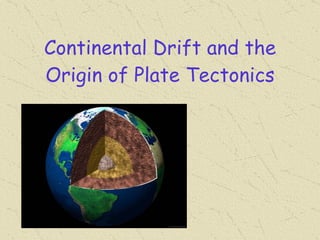
Continental Drift and the Origin of Plate Tectonics
 
Wegener’s Map showing the breakup of Pangea See  Reference Table Page 9
Note how they fit together
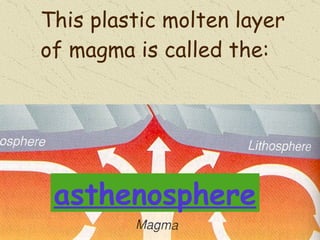
I.The Theory of  Plate Tectonics : The Earth’s lithosphere is made of a number of solid pieces, called __________ which  move in relation to each other. plates
These plates are “riding”on a more “plastic molten”  layer below These plates are “riding”on a more “plastic molten”  layer below
This plastic molten layer of magma is called the:  asthenosphere
 
1.  Theory of Continental Drift Proposed by _______  ________ in 1915. It stated that the earth’s continents separated and collided as they have moved over the surface of the Earth for millions of years. Alfred Wegener
Alfred Wegener (1880-1930) Geographer and Polar Explorer
B. Wegener’s evidence for his his theory: 1. When you line up __________ and _________ they fit like a puzzle. S.America Africa
 
2. __________ species have been found on widely separated parts of the earth. Fossil
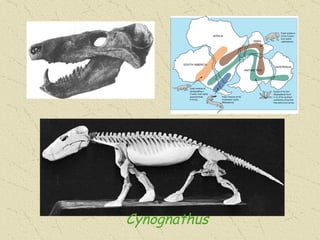
3. Permian fossils are very similar in widely separated continents
Cynognathus
Lystrosaurus
Mt. Sirus Antarctica Lystrosaurus beds
Mesosaurus
3. _____________ and ______________ have a good match of ancient continental rocks and tectonic _________ and _________ structures. S. America Africa fault fold
4. Some mountain chains appear to be continuous from ____________ to______________ continent continent
5. Evidence of _________ climates different from present. ancient Ex . Finding coal beds which indicate tropical climates
Technology developed during WWII Sonar - image the deep ocean using reflected sound. Magnetometer - detect faint magnetic fields. Developed to search for U-boats
World War II Submarine warfare
 
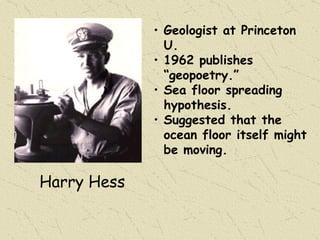
Harry Hess Geologist at Princeton U. 1962 publishes “geopoetry.” Sea floor spreading hypothesis. Suggested that the ocean floor itself might be moving.
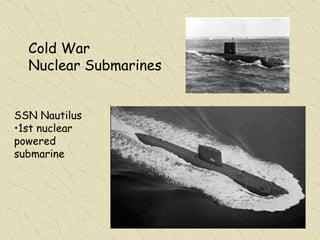
Cold War Nuclear Submarines SSN Nautilus 1st nuclear powered submarine
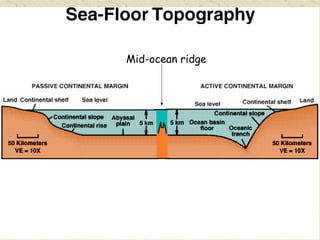
Mid-ocean ridge
 
6 .  Rocks of the ocean basins are _________ than  continental rocks. younger
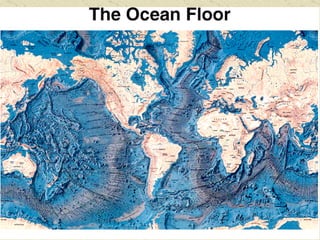
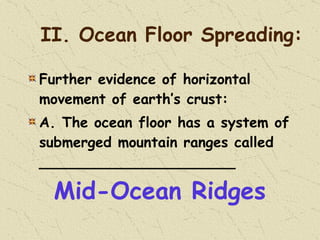
II. Ocean Floor Spreading: Further evidence of horizontal movement of earth’s crust: A. The ocean floor has a system of submerged mountain ranges called ______________________ Mid-Ocean Ridges
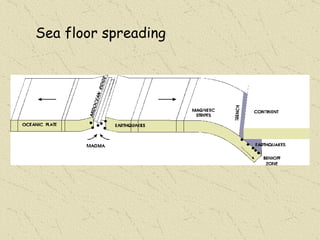
Material from deep within the earth comes to the surface at the ___________________  where it spreads apart to make ________________. Ocean ridges New ocean crust
 
Sea floor spreading
B. The two major pieces of evidence are:   Age of igneous  ocean material 1. 2.  Reversal of magnetic polarity
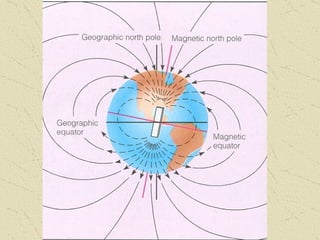
When rock hardened it kept the alignment forming a permanent record of the ___________________  of the earth at that time. Magnetic field
 
N S
N S
 
N S Magnetic polarity reversal
 
Rocks found farther from the ridges have a _____________  magnetic polarity. Parallel stripes of ________________ on either side of these ridges preserve the record of many ____________ of the earth’s magnetic field. reversed magnetism reversals
Measuring the Age of the Ocean Floor 1968, establishment of the Deep Sea Drilling Project (DSDP). Specially outfitted ship for drilling into the ocean floor and retrieving rock samples. Sediment layers and igneous rock dated to reveal the age of the ocean floor in different places.
Deep Sea Drilling Project ship - Glomar Challenger
C. The _______ _________ (basaltic) igneous rocks of the crust near the ocean ridges are covered with a thin layer of ____________. dark dense sediment
This is evidence that the earth’s crust is very ___________ near the ridges. young
 
 
The oldest parts of the ocean crust are found far from the ___________ ridges and near the _______________ ocean continents
 
Acceptance of Sea Floor Spreading (Plate Tectonics) 1970’s - rapid confirmation of remaining predictions and acceptance of the basic theory by most geologists. 1980’s - Plate Tectonics becomes the dominant paradigm in geology. 1990’s - Development of a detailed plate tectonic history of the last 700 million years.
Lesson 2
Lithospheric Plates ___________ in size  and are made up of a  combination of ___________ crust and ______________ crust vary oceanic continental
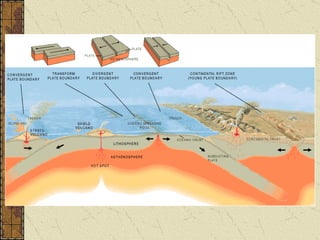
Three kinds of plate motion occur at plate boundaries: 1. _____________________ 2. _____________________ 3. _____________________ convergent divergent transform


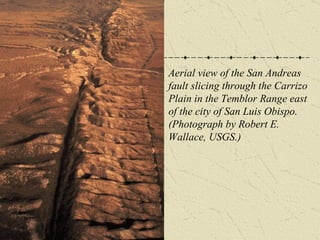
Aerial view of the San Andreas fault slicing through the Carrizo Plain in the Temblor Range east of the city of San Luis Obispo. (Photograph by Robert E. Wallace, USGS.)
 
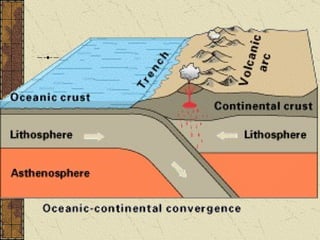
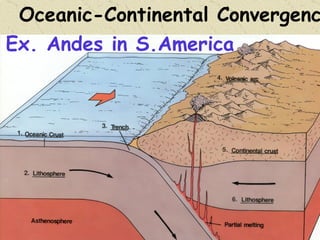
1a.When ocean collides with continent the_________ ocean plate dives down under or ____________ into the mantle forming a  ___________________  denser subducts Subduction zone
Oceanic-Continental Convergence Ex. Andes in S.America
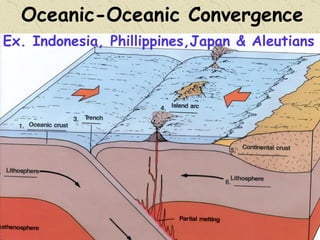
1b.When two ocean plates converge the _______ ___________ocean plate will __________ forming an  ____________  ________ older subduct island arc denser
Oceanic-Oceanic Convergence Ex. Indonesia, Phillippines,Japan & Aleutians
Called SUBDUCTION Continent-Oceanic Crust Collision
1c.When two continental plates converge the  edges of _______ are crumpled up forming _________ ________________ both mountains folded
Continental-Continental Convergence Ex. Himalayas
Himalayas
2.At ____________ plate boundaries, the plates move ___________ and ________ flows up forming parallel ridges made of _______ __________ __________ divergent magma new igneous apart rock
Divergent Plate Boundary Ex. Mid-Atlantic Ridge
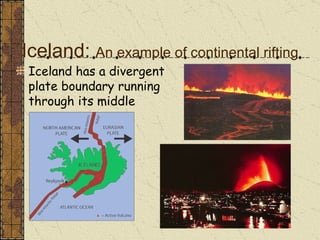
Iceland has a divergent plate boundary running through its middle Iceland:  An example of continental rifting
3. At ____________  plate boundaries, the plates move  ________ each other causing shallow _____________ _______________ transform earth past quakes
Transform  Plate Boundary Ex. San Andreas Fault of California
core III.  MANTLE CONVECTION CELLS:
These plates are “riding”on a more “plastic molten”  layer below III. MANTLE CONVECTION CELLS:
The evidence shows that approximately _______ million years ago, the major continents were _______________ 200 connected
And since that time they have been __ _________ separating
A convection cell is  a stream of  heated material that is moving because of _________   DENSITY DIFFERENCES
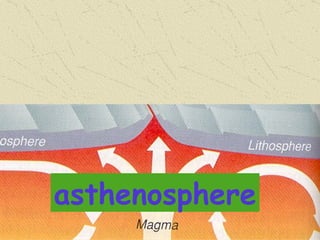
These convection cells exist in part of the mantle called the  _______________ ASTHENOSPHERE
asthenosphere
The two sources of this heat are: 1. 2. Residual (leftover) heat  from the formation of  the Earth Heat generated from radioactive decay from the core of the earth
Hot Spots: Places on the Earth’s surface where plumes of __________ are rising up from the mantle  not  located along ________  _________  ________ magma active Plate  boundaries
 
As a plate passes over   a hot spot, a _______________ _______________ forms CHAIN OF  VOLCANIC MOUNTAINS
 
The tectonic plate moves over a fixed hotspot forming a chain of volcanoes. The volcanoes get younger from one end to the other.
 
The only mountain that _______  ________ is the mountain located directly over the _____  ______ remains active hot spot

Dynamic Earth

  • 1.
  • 2.
    The Earth’s InteriorFour Layers (see page 10 of Ref Tables) Inner Core : solid, dense, 6,000 º C, Iron and Nickel Outer Core : Liquid, dense, 3,700º-5,500ºC (increases with depth), Iron and Nickel Mantle : Solid, minerals rich in Fe, Si, Ma, 1,500º - 3,200º C Crust : upper layer, rigid, lighter rock, <1,000ºC
  • 3.
    The Earth’s InteriorSome terms to know: Asthenosphere : Upper layer of the mantle, may act in a semi-fluid (plastic) manner Moho (Mohorovicic Discontinuity): The boundary between the mantle and the crust Lithosphere : Consists of the crust and the rigid upper mantle
  • 4.
    The Earth’s InteriorWhere is the crust thickest? Mountain Ranges. Where is the crust thinnest? The Ocean Floor.
  • 5.
    The Earth’s InteriorWhy is the core so hot? Still retains heat from original formation. Radioactive materials releasing energy as they decay. Increased pressure from above.
  • 6.
  • 7.
    The Earth’s InteriorWhat happens to rock density, going from the crust to the core? It increases. What happens to temperature, going from the crust to the core? It increases. What happens to pressure, going from the crust to the core? It increases.
  • 8.
    Continental Drift andthe Origin of Plate Tectonics
  • 9.
  • 10.
    Wegener’s Map showingthe breakup of Pangea See Reference Table Page 9
  • 11.
    Note how theyfit together
  • 12.
    I.The Theory of Plate Tectonics : The Earth’s lithosphere is made of a number of solid pieces, called __________ which move in relation to each other. plates
  • 13.
    These plates are“riding”on a more “plastic molten” layer below These plates are “riding”on a more “plastic molten” layer below
  • 14.
    This plastic moltenlayer of magma is called the: asthenosphere
  • 15.
  • 16.
    1. Theoryof Continental Drift Proposed by _______ ________ in 1915. It stated that the earth’s continents separated and collided as they have moved over the surface of the Earth for millions of years. Alfred Wegener
  • 17.
    Alfred Wegener (1880-1930)Geographer and Polar Explorer
  • 18.
    B. Wegener’s evidencefor his his theory: 1. When you line up __________ and _________ they fit like a puzzle. S.America Africa
  • 19.
  • 20.
    2. __________ specieshave been found on widely separated parts of the earth. Fossil
  • 21.
    3. Permian fossilsare very similar in widely separated continents
  • 22.
  • 23.
  • 24.
    Mt. Sirus AntarcticaLystrosaurus beds
  • 25.
  • 26.
    3. _____________ and______________ have a good match of ancient continental rocks and tectonic _________ and _________ structures. S. America Africa fault fold
  • 27.
    4. Some mountainchains appear to be continuous from ____________ to______________ continent continent
  • 28.
    5. Evidence of_________ climates different from present. ancient Ex . Finding coal beds which indicate tropical climates
  • 29.
    Technology developed duringWWII Sonar - image the deep ocean using reflected sound. Magnetometer - detect faint magnetic fields. Developed to search for U-boats
  • 30.
    World War IISubmarine warfare
  • 31.
  • 32.
    Harry Hess Geologistat Princeton U. 1962 publishes “geopoetry.” Sea floor spreading hypothesis. Suggested that the ocean floor itself might be moving.
  • 33.
    Cold War NuclearSubmarines SSN Nautilus 1st nuclear powered submarine
  • 34.
  • 35.
  • 36.
    6 . Rocks of the ocean basins are _________ than continental rocks. younger
  • 37.
    II. Ocean FloorSpreading: Further evidence of horizontal movement of earth’s crust: A. The ocean floor has a system of submerged mountain ranges called ______________________ Mid-Ocean Ridges
  • 38.
    Material from deepwithin the earth comes to the surface at the ___________________ where it spreads apart to make ________________. Ocean ridges New ocean crust
  • 39.
  • 40.
  • 41.
    B. The twomajor pieces of evidence are: Age of igneous ocean material 1. 2. Reversal of magnetic polarity
  • 42.
    When rock hardenedit kept the alignment forming a permanent record of the ___________________ of the earth at that time. Magnetic field
  • 43.
  • 44.
  • 45.
  • 46.
  • 47.
    N S Magneticpolarity reversal
  • 48.
  • 49.
    Rocks found fartherfrom the ridges have a _____________ magnetic polarity. Parallel stripes of ________________ on either side of these ridges preserve the record of many ____________ of the earth’s magnetic field. reversed magnetism reversals
  • 50.
    Measuring the Ageof the Ocean Floor 1968, establishment of the Deep Sea Drilling Project (DSDP). Specially outfitted ship for drilling into the ocean floor and retrieving rock samples. Sediment layers and igneous rock dated to reveal the age of the ocean floor in different places.
  • 51.
    Deep Sea DrillingProject ship - Glomar Challenger
  • 52.
    C. The ________________ (basaltic) igneous rocks of the crust near the ocean ridges are covered with a thin layer of ____________. dark dense sediment
  • 53.
    This is evidencethat the earth’s crust is very ___________ near the ridges. young
  • 54.
  • 55.
  • 56.
    The oldest partsof the ocean crust are found far from the ___________ ridges and near the _______________ ocean continents
  • 57.
  • 58.
    Acceptance of SeaFloor Spreading (Plate Tectonics) 1970’s - rapid confirmation of remaining predictions and acceptance of the basic theory by most geologists. 1980’s - Plate Tectonics becomes the dominant paradigm in geology. 1990’s - Development of a detailed plate tectonic history of the last 700 million years.
  • 59.
  • 60.
    Lithospheric Plates ___________in size and are made up of a combination of ___________ crust and ______________ crust vary oceanic continental
  • 61.
    Three kinds ofplate motion occur at plate boundaries: 1. _____________________ 2. _____________________ 3. _____________________ convergent divergent transform
  • 62.
  • 63.
  • 64.
  • 65.
  • 66.
    Aerial view ofthe San Andreas fault slicing through the Carrizo Plain in the Temblor Range east of the city of San Luis Obispo. (Photograph by Robert E. Wallace, USGS.)
  • 67.
  • 68.
    1a.When ocean collideswith continent the_________ ocean plate dives down under or ____________ into the mantle forming a ___________________ denser subducts Subduction zone
  • 69.
  • 70.
    1b.When two oceanplates converge the _______ ___________ocean plate will __________ forming an ____________ ________ older subduct island arc denser
  • 71.
    Oceanic-Oceanic Convergence Ex.Indonesia, Phillippines,Japan & Aleutians
  • 72.
  • 73.
    1c.When two continentalplates converge the edges of _______ are crumpled up forming _________ ________________ both mountains folded
  • 74.
  • 75.
  • 76.
    2.At ____________ plateboundaries, the plates move ___________ and ________ flows up forming parallel ridges made of _______ __________ __________ divergent magma new igneous apart rock
  • 77.
    Divergent Plate BoundaryEx. Mid-Atlantic Ridge
  • 78.
    Iceland has adivergent plate boundary running through its middle Iceland: An example of continental rifting
  • 79.
    3. At ____________ plate boundaries, the plates move ________ each other causing shallow _____________ _______________ transform earth past quakes
  • 80.
    Transform PlateBoundary Ex. San Andreas Fault of California
  • 81.
    core III. MANTLE CONVECTION CELLS:
  • 82.
    These plates are“riding”on a more “plastic molten” layer below III. MANTLE CONVECTION CELLS:
  • 83.
    The evidence showsthat approximately _______ million years ago, the major continents were _______________ 200 connected
  • 84.
    And since thattime they have been __ _________ separating
  • 85.
    A convection cellis a stream of heated material that is moving because of _________ DENSITY DIFFERENCES
  • 86.
    These convection cellsexist in part of the mantle called the _______________ ASTHENOSPHERE
  • 87.
  • 88.
    The two sourcesof this heat are: 1. 2. Residual (leftover) heat from the formation of the Earth Heat generated from radioactive decay from the core of the earth
  • 89.
    Hot Spots: Placeson the Earth’s surface where plumes of __________ are rising up from the mantle not located along ________ _________ ________ magma active Plate boundaries
  • 90.
  • 91.
    As a platepasses over a hot spot, a _______________ _______________ forms CHAIN OF VOLCANIC MOUNTAINS
  • 92.
  • 93.
    The tectonic platemoves over a fixed hotspot forming a chain of volcanoes. The volcanoes get younger from one end to the other.
  • 94.
  • 95.
    The only mountainthat _______ ________ is the mountain located directly over the _____ ______ remains active hot spot