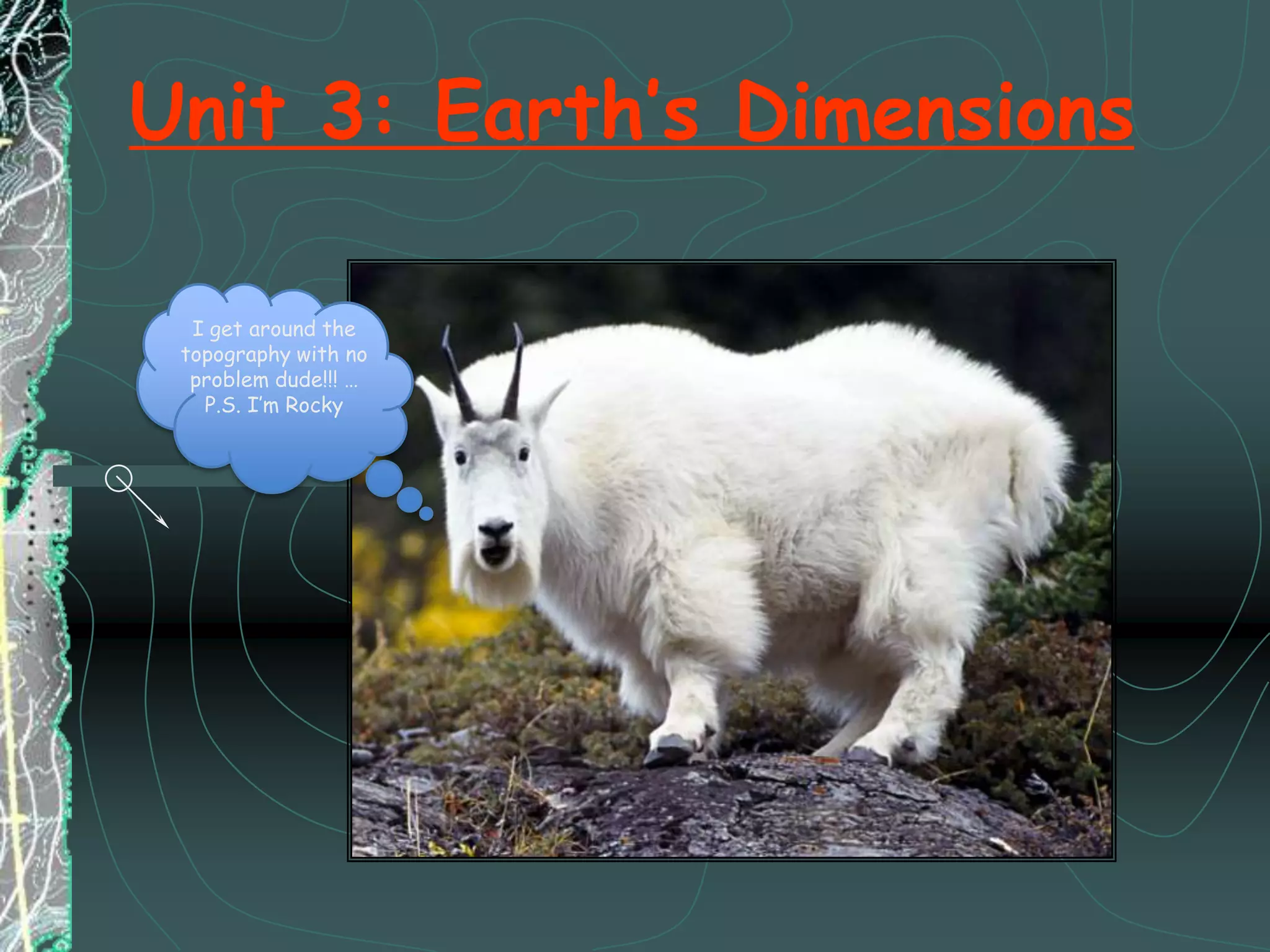
I get around the topography with no problem dude!!! …P.S. I’m RockyUnit 3: Earth’s Dimensions
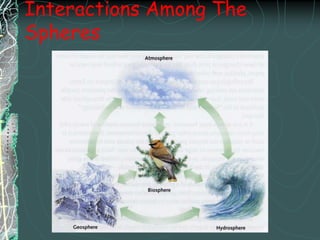
The Earth’s Four SpheresGeosphereAtmosphereHydrosphereBiosphere
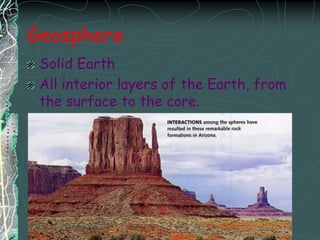
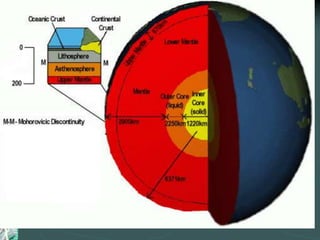
GeosphereSolid EarthAll interior layers of the Earth, from the surface to the core.
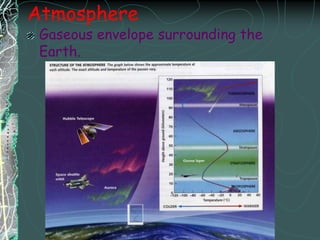
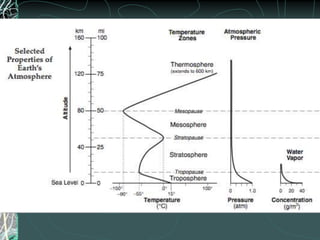
AtmosphereGaseous envelope surrounding the Earth.
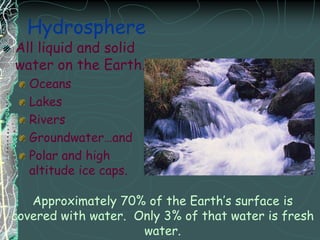
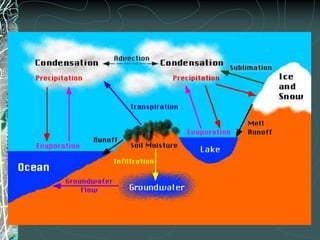
HydrosphereAll liquid and solid water on the Earth.OceansLakes RiversGroundwater…and Polar and high altitude ice caps.Approximately 70% of the Earth’s surface is covered with water.  Only 3% of that water is fresh water.
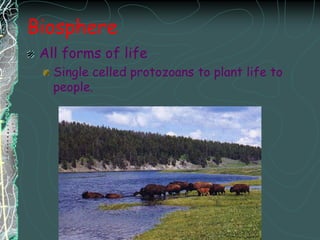
BiosphereAll forms of lifeSingle celled protozoans to plant life to people.
Interactions Among The Spheres
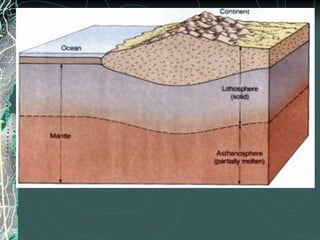
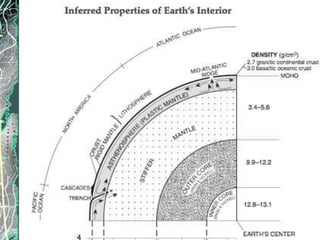
The Spheres of Earth!Put these in order of increasing density:AsthenosphereHydrosphereLithosphereGeosphere
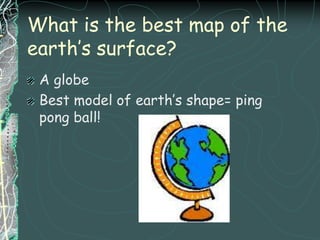
What is the best map of the earth’s surface? A globeBest model of earth’s shape= ping pong ball!
Latitude and Longitude
How do we communicate an exact location on earth’s surface to another person?What information do you need to locate a point on the earth’s surface?You need a coordinate system!
Coordinate SystemA system or group of defined imaginary lines forming a grid used for the determination or location of a point on the surface of an object.Two intersecting lines are needed to locate a point on a 2d surface.latitude/longitude system used to determine exact locations on the surface of the Earth
Latitude and LongitudeHow can positions on a sphere be located?
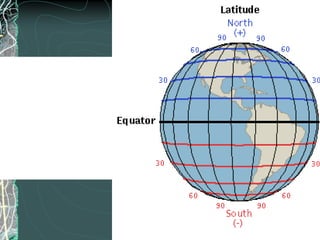
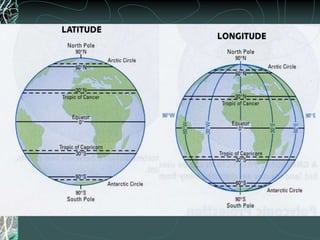
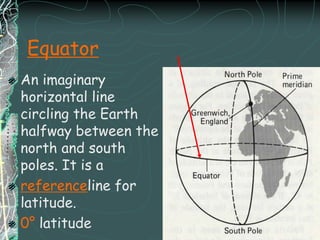
LatitudeAngular distance north or south of the equator, measured from the center of the earth [the core].They are Horizontal Lines running east-west, but, measure north-south.Measured in degrees, minutes, and second.
LatitudeLike climbing a ladder, N is up the ladder S is downThe equator is 0 degrees and the poles are at 90 degrees.Latitude
rungs of a ladder
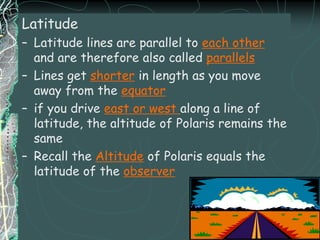
LatitudeLatitude lines are parallel to each other and are therefore also called parallels
Lines get shorter in length as you move away from the equator
if you drive east or west along a line of latitude, the altitude of Polaris remains the same
Recall the Altitude of Polaris equals the latitude of the observer                                                                                                                                                   
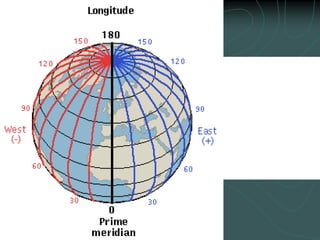
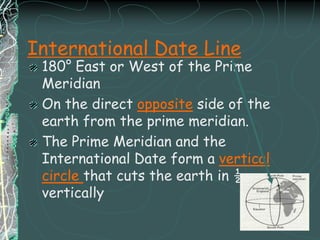
LongitudeAngular distance east or west of the prime meridian, measured from the center of the earth [the core].Vertical Lines running  north-south through the poles, but, measure east-west.180° east or west or the prime meridian is the largest longitude there isThe prime meridian is 0 degrees and the International Date Line is 180 degrees.
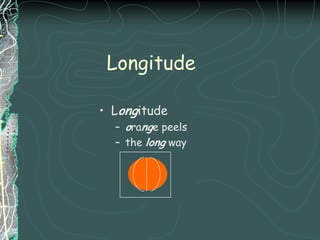
LongitudeLongitude
orange peels
the long way
LongitudeLines of Longitude (Meridian)
lines are not parallel
lines meet at the poles
Also called meridians
Lines are all of equal length
As you travel N & S along a Meridian your time stays the same
Each degree is divided into 60 equal parts called minutes.
Each minute of a degree is divided into 60 equal parts called seconds.
                                                                                                                                                   
EquatorAn imaginary horizontal line circling the Earth halfway between the north and south poles. It is areferenceline for latitude.0° latitude
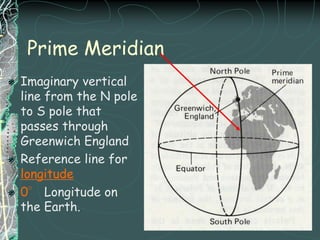
Prime MeridianImaginary vertical line from the N pole to S pole that passes through Greenwich EnglandReference line for longitude0° Longitude on the Earth.
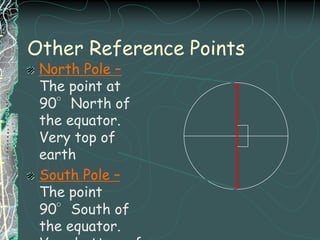
Other Reference PointsNorth Pole – The point at 90°North of the equator. Very top of earthSouth Pole – The point 90°South of the equator. Very bottom of earth
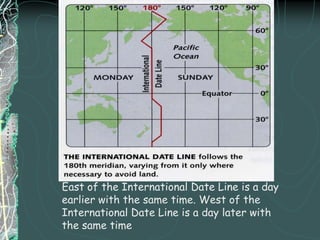
International Date Line180° East or West of the Prime MeridianOn the direct opposite side of the earth from the prime meridian.The Prime Meridian and the International Date form a vertical circle that cuts the earth in ½ vertically
East of the International Date Line is a day earlier with the same time. West of the International Date Line is a day later with the same time
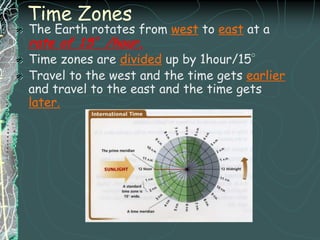
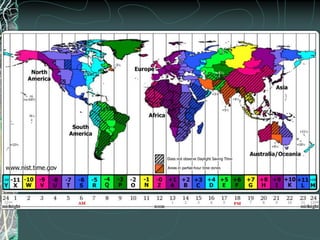
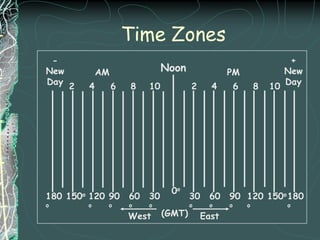
Time ZonesThe Earth rotates from west to east at a rate of 15°/hour.Time zones are divided up by 1hour/15°Travel to the west and the time gets earlier and travel to the east and the time gets later.
Time Zones+ New Day- New DayNoonAMPM1024682468100o30o60o90o180o150o120o30o60o90o180o150o120o(GMT)EastWest
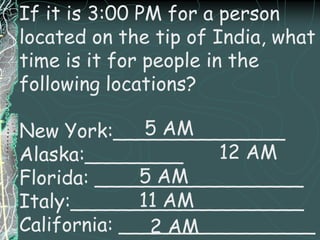
If it is 3:00 PM for a person located on the tip of India, what time is it for people in the following locations?New York:______________Alaska:________Florida: _________________Italy:___________________California: ________________5 AM12 AM5 AM11 AM2 AM
Topographic Maps!
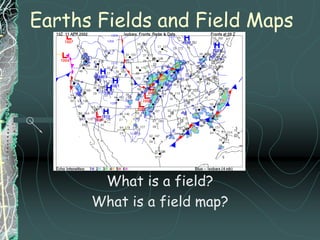
Earths Fields and Field MapsWhat is a field?What is a field map?
Describing Earth’s FieldsField – a region which contains measurable quantities at every location. (i.e. elevation, temperature, pressure…)Field Value – the value of what is being measured.  (i.e. temperature, elevation, pollution concentrations…)Magnitude – Value for a point on a field.
Field Values (cont.)Scalar Field – A field described in terms of magnitude alone (i.e. temp., pressure, humidity)Vector Field – A field described with both magnitude and direction (i.e. wind velocity, gravity, magnetic fields)
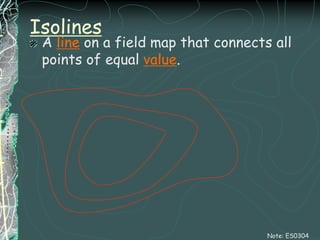
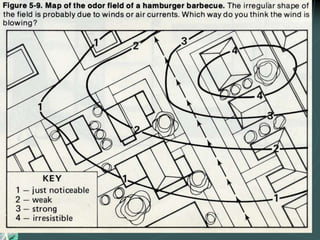
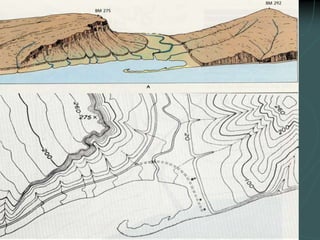
IsolinesA line on a field map that connects all points of equal value.Note: ES0304
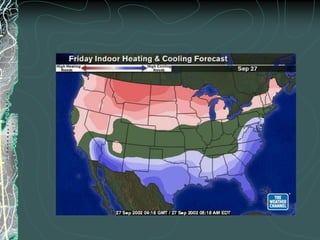
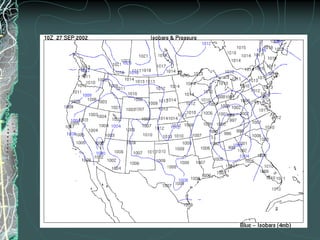
Types of IsolinesContour Line – Isoline that connects points of equal elevations on a contour map.Isotherm - Isoline that connects points of equal temperature on a field map.Isobar – Isoline that connects points of equal pressure on a field map.
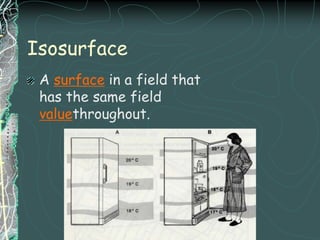
IsosurfaceA surface in a field that has the same field valuethroughout.
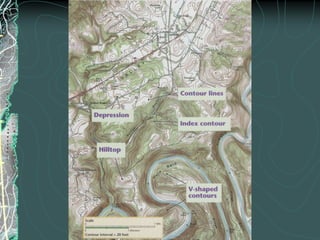
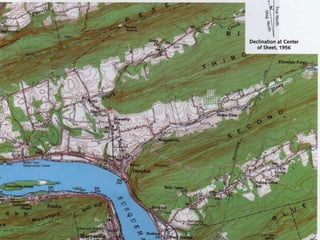
Important Field Map TermsTopographic map/Contour map – A map that uses contour lines to show elevation and landforms.Elevation– Height above mean(average) sea level.Contour interval – Vertical distance, or change in elevation, between adjacent or consecutive contour lines.
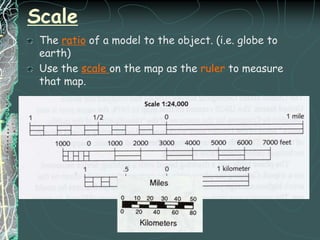
ScaleThe ratio of a model to the object. (i.e. globe to earth)Use the scale on the map as the ruler to measure that map.
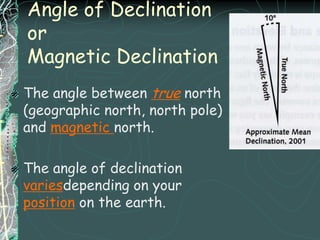
Angle of Declinationor Magnetic DeclinationThe angle between true north (geographic north, north pole) and magnetic north.The angle of declination variesdepending on your position on the earth.
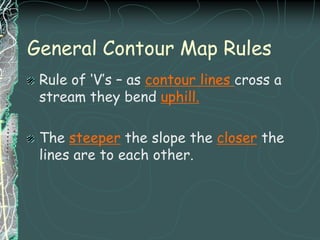
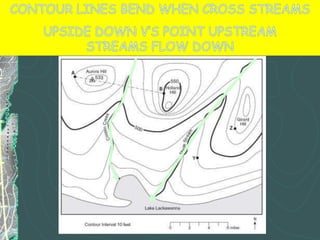
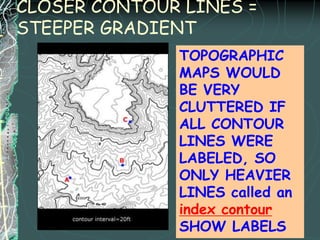
General Contour Map RulesRule of ‘V’s – as contour lines cross a stream they bend uphill.The steeper the slope the closer the lines are to each other.
CONTOUR LINES BEND WHEN CROSS STREAMSUPSIDE DOWN V’S POINT UPSTREAM             STREAMS FLOW DOWN
CLOSER CONTOUR LINES = STEEPER GRADIENTTOPOGRAPHIC MAPS WOULD BE VERY CLUTTERED IF ALL CONTOUR LINES WERE LABELED, SO ONLY HEAVIER LINES called an index contour SHOW LABELS
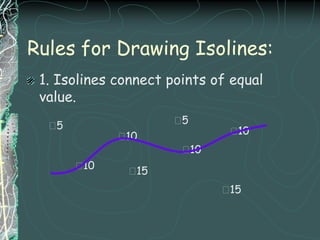
Rules for Drawing Isolines:1. Isolines connect points of equal value.55101010101515
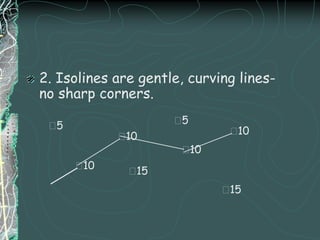
2. Isolines are gentle, curving lines- no sharp corners.55101010101515
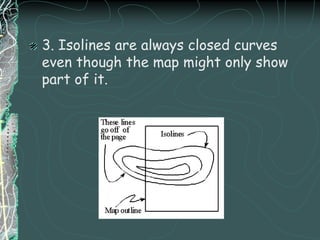
3. Isolines are always closed curves even though the map might only show part of it.
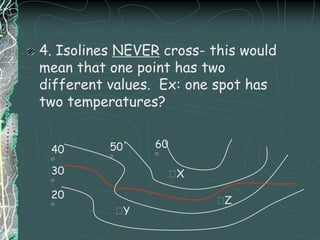
4. Isolines NEVER cross- this would mean that one point has two different values.  Ex: one spot has two temperatures?60 °50 °40 °30 °X20°ZY
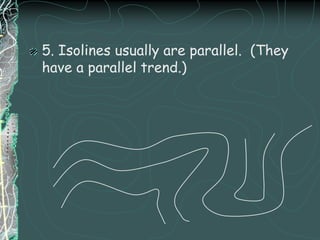
5. Isolines usually are parallel.  (They have a parallel trend.)
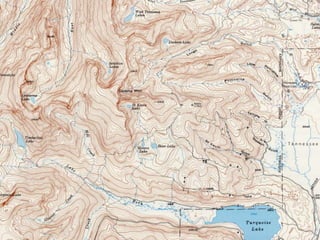
Visualizations of contour lineshttp://geology.asu.edu/~sreynolds/topo_gallery/topo_gallery.htm
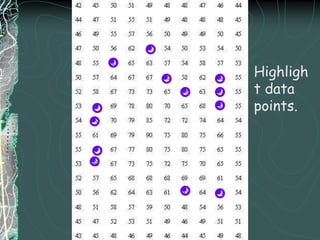
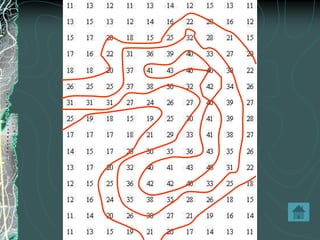
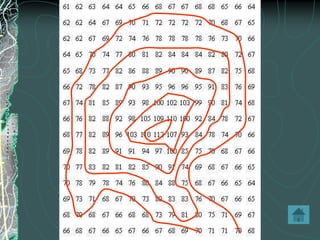
Tips on Drawing Contour LinesAlways draw a contour line so that elevation reading is higher on one side of the contour line and lower on the other side.
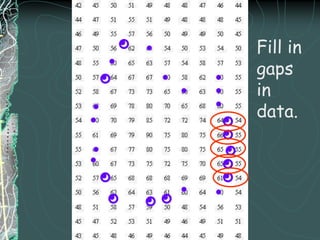
Assume a steady elevation change between neighboring readings when positioning contour lines.
Adjacent contour lines tend to look alike.
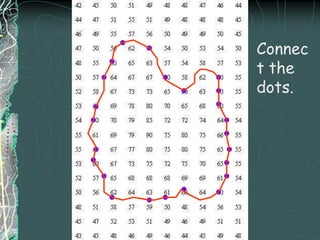
Continue drawing a contour line until it reaches the boundary of plotted data or “closes” to form a loop by making its way to its starting point.
Contour lines never stop or end within a data field, and they never fork, touch or cross one another.
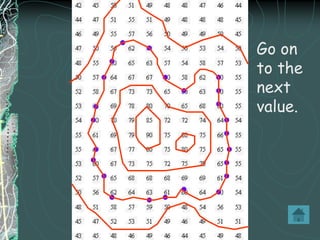
Contour lines cannot skip values and must always appear in sequence.
Only draw contour lines that fall within the range of data reported on the map.
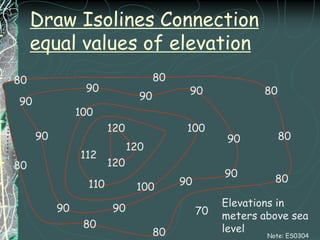
Always label all contour lines.8080909080909010012010080909012011212080908090110100Elevations in meters above sea level9090708080Draw Isolines Connection equal values of elevationNote: ES0304
Highlight data points.
Fill in gaps in data.
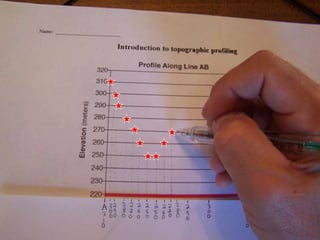
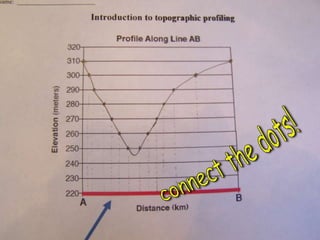
Connect the dots.
Go on to the next value.
Making a Contour Map II
Drawing Contour Maps III
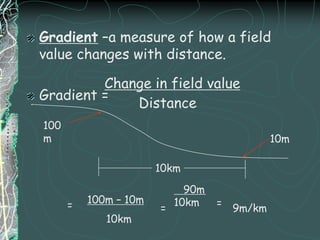
100m   90m	  10km=9m/km10m100m – 10m      10km==10kmGradient –a measure of how a field value changes with distance.Gradient = Change in field value        Distance
GradientGradient shows how quickly the value changes from one point to another.
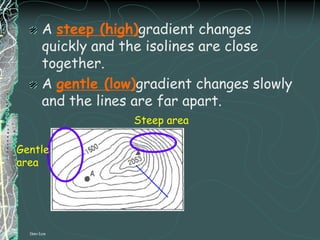
A steep (high)gradient changes quickly and the isolines are close together.A gentle (low)gradient changes slowly and the lines are far apart.Steep areaGentle area1km=1cm
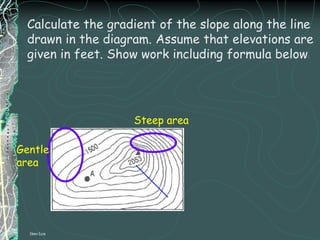
Calculate the gradient of the slope along the line drawn in the diagram. Assume that elevations are given in feet. Show work including formula below:Steep areaGentle area1km=1cm
Making Contours worksheetsWorksheets can be printed from:http://www.rcmurphy.net/Medina%202005/documents/Contours123.doc
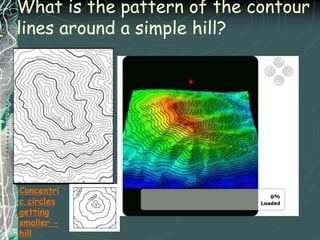
What is the pattern of the contour lines around a simple hill?    Concentric circles getting smaller - hill
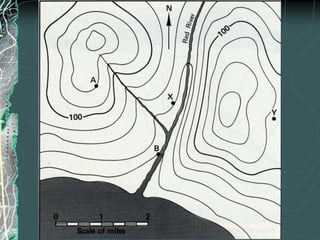
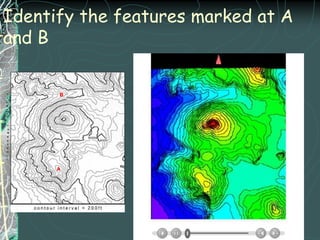
Identify the features marked at A and B
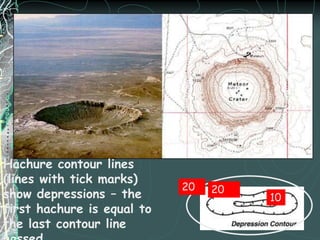
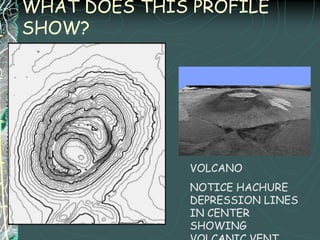
Hachure contour lines (lines with tick marks) show depressions – the first hachure is equal to the last contour line passed202010
WHAT DOES THIS PROFILE SHOW?VOLCANONOTICE HACHURE DEPRESSION LINES IN CENTER SHOWING VOLCANIC VENT
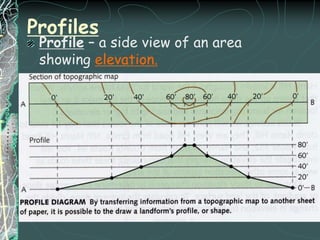
ProfilesProfile – a side view of an area showing elevation.
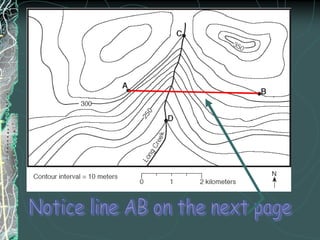
TOPOGRAPHIC PROFILESTOPOGRAPHIC MAPS SHOW THE ELEVATION OR VERTICAL DISTANCE ABOVE SEA LEVEL OF THE SURFACE OF THE EARTHTOPOGRAPHIC PROFILE IS A SIDE VIEW OF AN AREA CUT ALONG A PARTICULAR LINE.
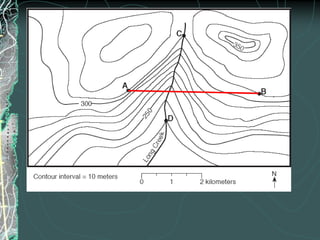
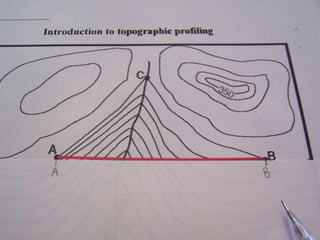
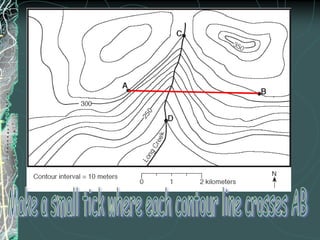
Notice line AB on the next page
So, if we were to look at a profile view of line AB on our topographic map, what might we expect to see? Predictions?Time to FIND OUT!Step 2
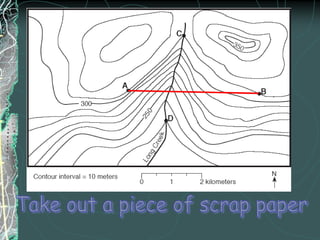
Take out a piece of scrap paper
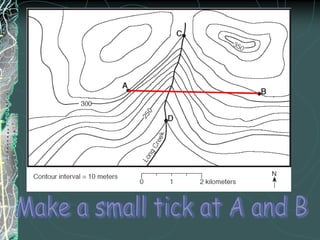
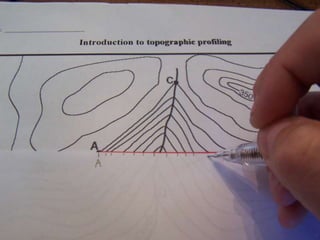
Make a small tick at A and B
Make a small tick where each contour line crosses AB
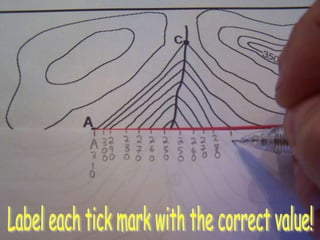
Label each tick mark with the correct value!
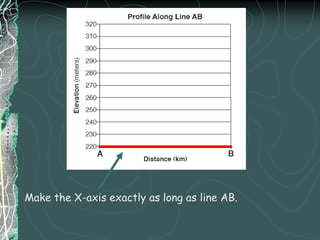
Make the X-axis exactly as long as line AB.

Earths dimension sci 8 ppt np1

  • 1.
    I get aroundthe topography with no problem dude!!! …P.S. I’m RockyUnit 3: Earth’s Dimensions
  • 2.
    The Earth’s FourSpheresGeosphereAtmosphereHydrosphereBiosphere
  • 3.
    GeosphereSolid EarthAll interiorlayers of the Earth, from the surface to the core.
  • 7.
  • 9.
    HydrosphereAll liquid andsolid water on the Earth.OceansLakes RiversGroundwater…and Polar and high altitude ice caps.Approximately 70% of the Earth’s surface is covered with water. Only 3% of that water is fresh water.
  • 12.
    BiosphereAll forms oflifeSingle celled protozoans to plant life to people.
  • 13.
  • 14.
    The Spheres ofEarth!Put these in order of increasing density:AsthenosphereHydrosphereLithosphereGeosphere
  • 15.
    What is thebest map of the earth’s surface? A globeBest model of earth’s shape= ping pong ball!
  • 16.
  • 17.
    How do wecommunicate an exact location on earth’s surface to another person?What information do you need to locate a point on the earth’s surface?You need a coordinate system!
  • 18.
    Coordinate SystemA systemor group of defined imaginary lines forming a grid used for the determination or location of a point on the surface of an object.Two intersecting lines are needed to locate a point on a 2d surface.latitude/longitude system used to determine exact locations on the surface of the Earth
  • 19.
    Latitude and LongitudeHowcan positions on a sphere be located?
  • 20.
    LatitudeAngular distance northor south of the equator, measured from the center of the earth [the core].They are Horizontal Lines running east-west, but, measure north-south.Measured in degrees, minutes, and second.
  • 21.
    LatitudeLike climbing aladder, N is up the ladder S is downThe equator is 0 degrees and the poles are at 90 degrees.Latitude
  • 22.
  • 23.
    LatitudeLatitude lines areparallel to each other and are therefore also called parallels
  • 24.
    Lines get shorterin length as you move away from the equator
  • 25.
    if you driveeast or west along a line of latitude, the altitude of Polaris remains the same
  • 26.
    Recall the Altitudeof Polaris equals the latitude of the observer                                                                                                                                                   
  • 27.
    LongitudeAngular distance eastor west of the prime meridian, measured from the center of the earth [the core].Vertical Lines running north-south through the poles, but, measure east-west.180° east or west or the prime meridian is the largest longitude there isThe prime meridian is 0 degrees and the International Date Line is 180 degrees.
  • 28.
  • 29.
  • 30.
  • 31.
  • 32.
  • 33.
    lines meet atthe poles
  • 34.
  • 35.
    Lines are allof equal length
  • 36.
    As you travelN & S along a Meridian your time stays the same
  • 37.
    Each degree isdivided into 60 equal parts called minutes.
  • 38.
    Each minute ofa degree is divided into 60 equal parts called seconds.
  • 40.
  • 41.
    EquatorAn imaginary horizontalline circling the Earth halfway between the north and south poles. It is areferenceline for latitude.0° latitude
  • 42.
    Prime MeridianImaginary verticalline from the N pole to S pole that passes through Greenwich EnglandReference line for longitude0° Longitude on the Earth.
  • 43.
    Other Reference PointsNorthPole – The point at 90°North of the equator. Very top of earthSouth Pole – The point 90°South of the equator. Very bottom of earth
  • 44.
    International Date Line180°East or West of the Prime MeridianOn the direct opposite side of the earth from the prime meridian.The Prime Meridian and the International Date form a vertical circle that cuts the earth in ½ vertically
  • 45.
    East of theInternational Date Line is a day earlier with the same time. West of the International Date Line is a day later with the same time
  • 46.
    Time ZonesThe Earthrotates from west to east at a rate of 15°/hour.Time zones are divided up by 1hour/15°Travel to the west and the time gets earlier and travel to the east and the time gets later.
  • 48.
    Time Zones+ NewDay- New DayNoonAMPM1024682468100o30o60o90o180o150o120o30o60o90o180o150o120o(GMT)EastWest
  • 49.
    If it is3:00 PM for a person located on the tip of India, what time is it for people in the following locations?New York:______________Alaska:________Florida: _________________Italy:___________________California: ________________5 AM12 AM5 AM11 AM2 AM
  • 50.
  • 51.
    Earths Fields andField MapsWhat is a field?What is a field map?
  • 52.
    Describing Earth’s FieldsField– a region which contains measurable quantities at every location. (i.e. elevation, temperature, pressure…)Field Value – the value of what is being measured. (i.e. temperature, elevation, pollution concentrations…)Magnitude – Value for a point on a field.
  • 53.
    Field Values (cont.)ScalarField – A field described in terms of magnitude alone (i.e. temp., pressure, humidity)Vector Field – A field described with both magnitude and direction (i.e. wind velocity, gravity, magnetic fields)
  • 54.
    IsolinesA line ona field map that connects all points of equal value.Note: ES0304
  • 56.
    Types of IsolinesContourLine – Isoline that connects points of equal elevations on a contour map.Isotherm - Isoline that connects points of equal temperature on a field map.Isobar – Isoline that connects points of equal pressure on a field map.
  • 61.
    IsosurfaceA surface ina field that has the same field valuethroughout.
  • 63.
    Important Field MapTermsTopographic map/Contour map – A map that uses contour lines to show elevation and landforms.Elevation– Height above mean(average) sea level.Contour interval – Vertical distance, or change in elevation, between adjacent or consecutive contour lines.
  • 65.
    ScaleThe ratio ofa model to the object. (i.e. globe to earth)Use the scale on the map as the ruler to measure that map.
  • 66.
    Angle of DeclinationorMagnetic DeclinationThe angle between true north (geographic north, north pole) and magnetic north.The angle of declination variesdepending on your position on the earth.
  • 67.
    General Contour MapRulesRule of ‘V’s – as contour lines cross a stream they bend uphill.The steeper the slope the closer the lines are to each other.
  • 68.
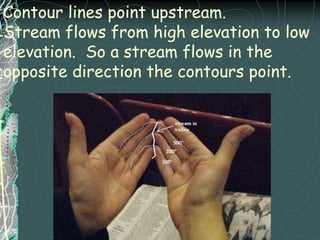
    CONTOUR LINES BENDWHEN CROSS STREAMSUPSIDE DOWN V’S POINT UPSTREAM STREAMS FLOW DOWN
  • 69.
    CLOSER CONTOUR LINES= STEEPER GRADIENTTOPOGRAPHIC MAPS WOULD BE VERY CLUTTERED IF ALL CONTOUR LINES WERE LABELED, SO ONLY HEAVIER LINES called an index contour SHOW LABELS
  • 73.
    Rules for DrawingIsolines:1. Isolines connect points of equal value.55101010101515
  • 74.
    2. Isolines aregentle, curving lines- no sharp corners.55101010101515
  • 75.
    3. Isolines arealways closed curves even though the map might only show part of it.
  • 76.
    4. Isolines NEVERcross- this would mean that one point has two different values. Ex: one spot has two temperatures?60 °50 °40 °30 °X20°ZY
  • 77.
    5. Isolines usuallyare parallel. (They have a parallel trend.)
  • 78.
    Visualizations of contourlineshttp://geology.asu.edu/~sreynolds/topo_gallery/topo_gallery.htm
  • 79.
    Tips on DrawingContour LinesAlways draw a contour line so that elevation reading is higher on one side of the contour line and lower on the other side.
  • 80.
    Assume a steadyelevation change between neighboring readings when positioning contour lines.
  • 81.
    Adjacent contour linestend to look alike.
  • 82.
    Continue drawing acontour line until it reaches the boundary of plotted data or “closes” to form a loop by making its way to its starting point.
  • 83.
    Contour lines neverstop or end within a data field, and they never fork, touch or cross one another.
  • 84.
    Contour lines cannotskip values and must always appear in sequence.
  • 85.
    Only draw contourlines that fall within the range of data reported on the map.
  • 86.
    Always label allcontour lines.8080909080909010012010080909012011212080908090110100Elevations in meters above sea level9090708080Draw Isolines Connection equal values of elevationNote: ES0304
  • 87.
  • 88.
    Fill in gapsin data.
  • 89.
  • 90.
    Go on tothe next value.
  • 91.
  • 93.
  • 95.
    100m 90m 10km=9m/km10m100m – 10m 10km==10kmGradient –a measure of how a field value changes with distance.Gradient = Change in field value Distance
  • 96.
    GradientGradient shows howquickly the value changes from one point to another.
  • 97.
    A steep (high)gradientchanges quickly and the isolines are close together.A gentle (low)gradient changes slowly and the lines are far apart.Steep areaGentle area1km=1cm
  • 98.
    Calculate the gradientof the slope along the line drawn in the diagram. Assume that elevations are given in feet. Show work including formula below:Steep areaGentle area1km=1cm
  • 99.
    Making Contours worksheetsWorksheetscan be printed from:http://www.rcmurphy.net/Medina%202005/documents/Contours123.doc
  • 100.
    What is thepattern of the contour lines around a simple hill? Concentric circles getting smaller - hill
  • 101.
    Identify the featuresmarked at A and B
  • 102.
    Hachure contour lines(lines with tick marks) show depressions – the first hachure is equal to the last contour line passed202010
  • 103.
    WHAT DOES THISPROFILE SHOW?VOLCANONOTICE HACHURE DEPRESSION LINES IN CENTER SHOWING VOLCANIC VENT
  • 104.
    ProfilesProfile – aside view of an area showing elevation.
  • 105.
    TOPOGRAPHIC PROFILESTOPOGRAPHIC MAPSSHOW THE ELEVATION OR VERTICAL DISTANCE ABOVE SEA LEVEL OF THE SURFACE OF THE EARTHTOPOGRAPHIC PROFILE IS A SIDE VIEW OF AN AREA CUT ALONG A PARTICULAR LINE.
  • 107.
    Notice line ABon the next page
  • 108.
    So, if wewere to look at a profile view of line AB on our topographic map, what might we expect to see? Predictions?Time to FIND OUT!Step 2
  • 109.
    Take out apiece of scrap paper
  • 110.
    Make a smalltick at A and B
  • 112.
    Make a smalltick where each contour line crosses AB
  • 114.
    Label each tickmark with the correct value!
  • 115.
    Make the X-axisexactly as long as line AB.
  • 116.
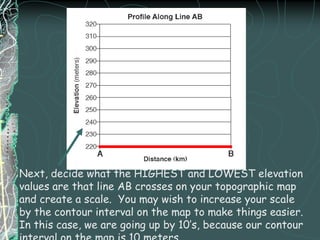
    Next, decide whatthe HIGHEST and LOWEST elevation values are that line AB crosses on your topographic map and create a scale. You may wish to increase your scale by the contour interval on the map to make things easier. In this case, we are going up by 10’s, because our contour interval on the map is 10 meters.
  • 117.
  • 118.
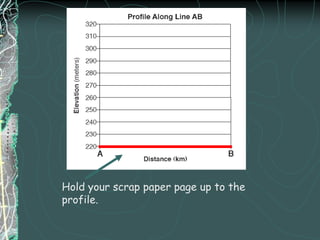
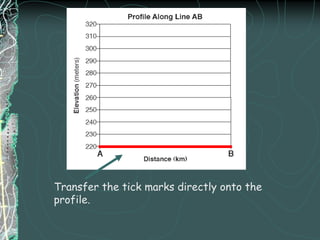
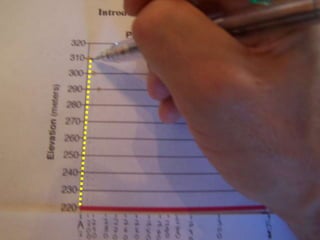
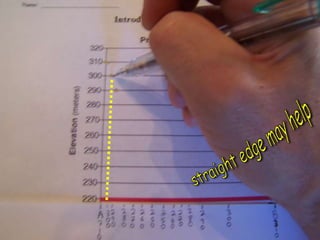
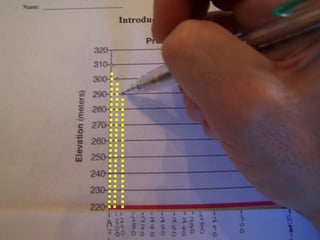
    Hold your scrappaper page up to the profile.
  • 119.
    Transfer the tickmarks directly onto the profile.
  • 121.
  • 124.
  • 125.
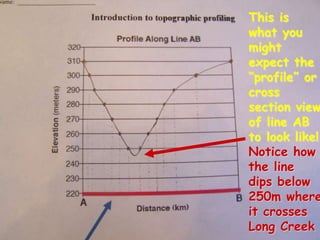
    This is whatyou might expect the “profile” or cross section view of line AB to look like! Notice how the line dips below 250m where it crosses Long Creek
  • 126.
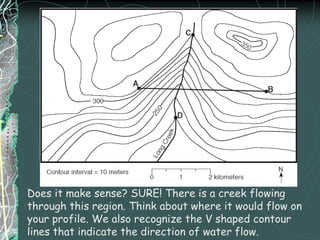
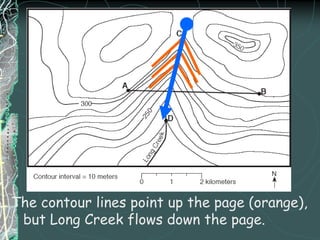
    Does it makesense? SURE! There is a creek flowing through this region. Think about where it would flow on your profile. We also recognize the V shaped contour lines that indicate the direction of water flow.
  • 127.
    The contour linespoint up the page (orange), but Long Creek flows down the page.
  • 128.
    Contour lines pointupstream. Stream flows from high elevation to low elevation. So a stream flows in the opposite direction the contours point.
  • 129.
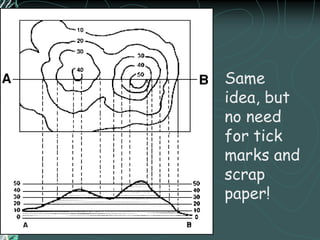
    Or… if youare lucky enough to be able to do your profile on the same page as the topographic map…You can use the: “Drop down a dotted line” method!Example
  • 130.
    Same idea, butno need for tick marks and scrap paper!