Quiz #1
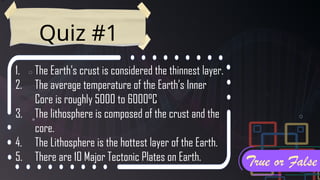
1. The Earth’s crust is considered the thinnest layer.
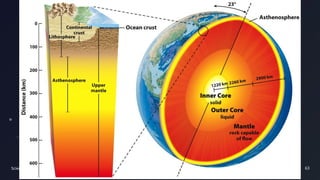
2. The average temperature of the Earth’s Inner
Core is roughly 5000 to 6000°C
3. The lithosphere is composed of the crust and the
core.
4. The Lithosphere is the hottest layer of the Earth.
5. There are 10 Major Tectonic Plates on Earth. True or False
Quiz #1
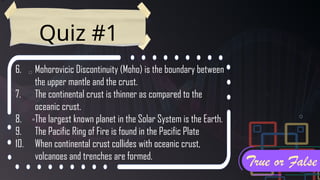
6. Mohorovicic Discontinuity (Moho) is the boundary between
the upper mantle and the crust.
7. The continental crust is thinner as compared to the
oceanic crust.
8. The largest known planet in the Solar System is the Earth.
9. The Pacific Ring of Fire is found in the Pacific Plate
10. When continental crust collides with oceanic crust,
volcanoes and trenches are formed.
True or False
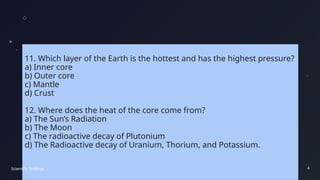
11. Which layer of the Earth is the hottest and has the highest pressure?
a) Inner core
b) Outer core
c) Mantle
d) Crust
12. Where does the heat of the core come from?
a) The Sun’s Radiation
b) The Moon
c) The radioactive decay of Plutonium
d) The Radioactive decay of Uranium, Thorium, and Potassium.
Scientific findings 4
5
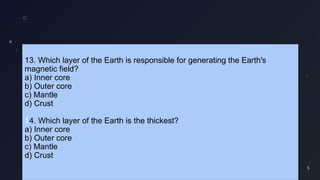
13. Which layer of the Earth is responsible for generating the Earth's
magnetic field?
a) Inner core
b) Outer core
c) Mantle
d) Crust
14. Which layer of the Earth is the thickest?
a) Inner core
b) Outer core
c) Mantle
d) Crust
Scientific findings 6
15. Which layer of the Earth is composed of solid rock and is divided into
tectonic plates?
a) Inner core
b) Outer core
c) Mantle
d) Crust
16. Which type of crust is denser?
a) Continental Crust
b) Oceanic Crust
c) Mantle
d) Tectonic Crust
Scientific findings 7
17. Which layer of the Earth does the diamond formed?
a) Inner core
b) Outer core
c) Mantle
d) Crust
18. Which layer of the Earth is the thinnest?
a) Inner core
b) Outer core
c) Mantle
d) Crust
Scientific findings 8
19. The Lithosphere comes from the Greek words lithos and sphaira which
means.
a) Rock and Sphere
b) Solid and Round
c) Rock and Globe
d) Rock and Earth
20. Which layer of the Earth is located between the crust and the core?
a) Inner core
b) Outer core
c) Mantle
d) Crust
Scientific findings 9
21. It is a precious material found in the mantle.
22. Basalt can be found in which type of Crust?
23. It protects the Earth from the harmful solar radiation.
24. It is the boundary between the crust and the mantle.
25. The deepest part of the Earth.
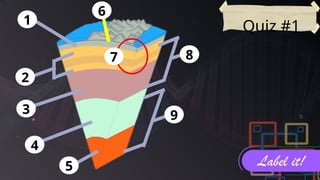
Quiz #1
1
2
3
4
5
6
7 8
9
Label it!
IVAN C H R IST I AN B. B AN AS TAO, L PT
P L A T E B O U N D A R I E S
T Y P E S A N D D E F I N I T I O N
13
LEARNING
OBJECTIVES
At the end of classroom discussion, the students are able to:
 Identify the different types of plate boundaries;
 Differentiate the formations that may be formed per plate
boundaries;
 Use the PhET Simulation to demonstrate Plate Boundaries;
 Give importance to setting boundaries in real-life situations.
15
Plate Motions
16
Plate Motions
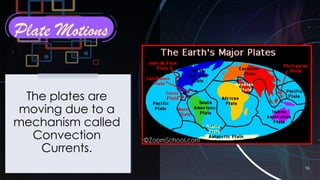
The plates are
moving due to a
mechanism called
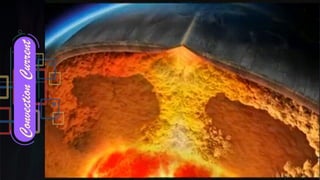
Convection
Currents.
17
Convection Current
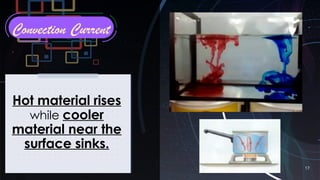
Hot material rises
while cooler
material near the
surface sinks.
18
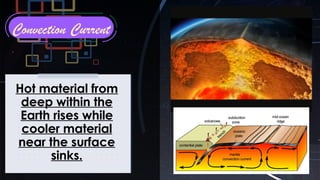
Hot material from
deep within the
Earth rises while
cooler material
near the surface
sinks.
Convection Current
19
Convection
Current
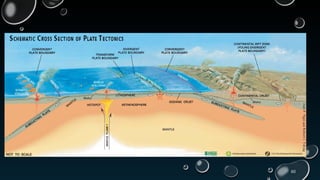
Plate Tectonics
Theory
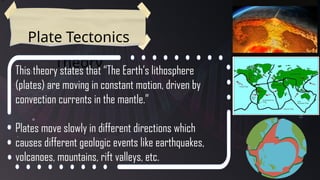
This theory states that “The Earth’s lithosphere
(plates) are moving in constant motion, driven by
convection currents in the mantle.”
Plates move slowly in different directions which
causes different geologic events like earthquakes,
volcanoes, mountains, rift valleys, etc.
Plate Tectonics
Theory
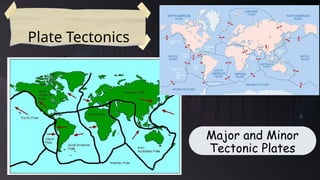
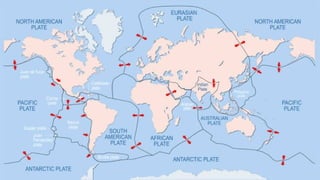
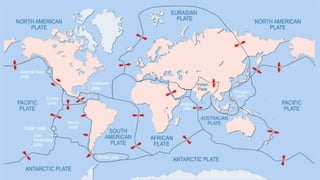
Major and Minor
Tectonic Plates
23
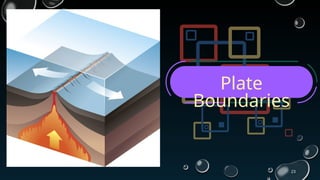
Plate
Boundaries
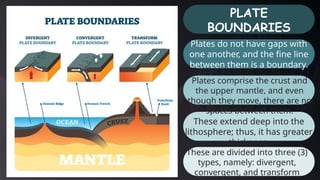
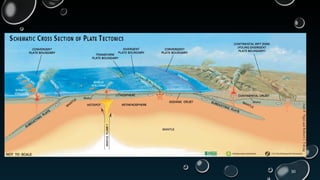
PLATE
BOUNDARIES
Plates do not have gaps with
one another, and the fine line
between them is a boundary.
Plates comprise the crust and
the upper mantle, and even
though they move, there are no
spaces between them.
These extend deep into the
lithosphere; thus, it has greater
thickness.
These are divided into three (3)
types, namely: divergent,
convergent, and transform
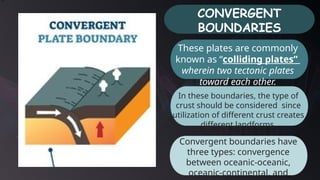
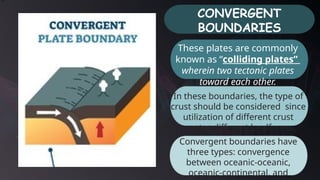
CONVERGENT
BOUNDARIES
In these boundaries, the type of
crust should be considered since
utilization of different crust creates
different landforms.
Convergent boundaries have
three types: convergence
between oceanic-oceanic,
oceanic-continental, and
These plates are commonly
known as “colliding plates”
wherein two tectonic plates
toward each other.
26
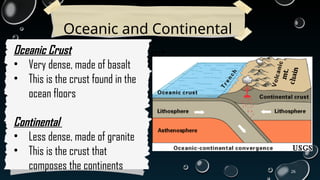
Oceanic and Continental
Crust
Oceanic Crust
• Very dense, made of basalt
• This is the crust found in the
ocean floors
Continental
• Less dense, made of granite
• This is the crust that
composes the continents
CONVERGENT
BOUNDARIES
In these boundaries, the type of
crust should be considered since
utilization of different crust
creates different landforms.
Convergent boundaries have
three types: convergence
between oceanic-oceanic,
oceanic-continental, and
These plates are commonly
known as “colliding plates”
wherein two tectonic plates
toward each other.
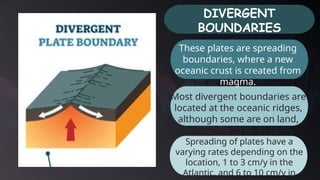
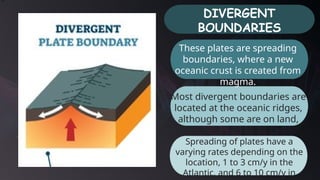
DIVERGENT
BOUNDARIES
Most divergent boundaries are
located at the oceanic ridges,
although some are on land,
Spreading of plates have a
varying rates depending on the
location, 1 to 3 cm/y in the
Atlantic, and 6 to 10 cm/y in
These plates are spreading
boundaries, where a new
oceanic crust is created from
magma.
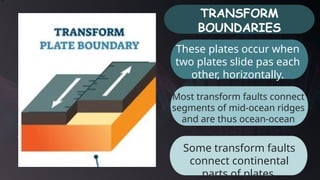
TRANSFORM
BOUNDARIES
Most transform faults connect
segments of mid-ocean ridges
and are thus ocean-ocean
plates.
Some transform faults
connect continental
parts of plates.
These plates occur when
two plates slide pas each
other, horizontally.
30
31
ACTIVITY TO
PERFORM
32
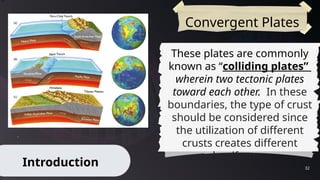
Convergent Plates
Introduction
These plates are commonly
known as “colliding plates”
wherein two tectonic plates
toward each other. In these
boundaries, the type of crust
should be considered since
the utilization of different
crusts creates different
landforms.
33
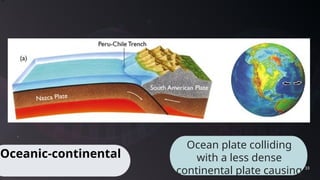
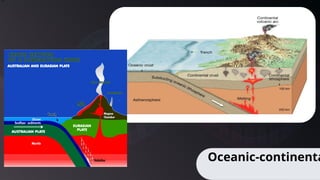
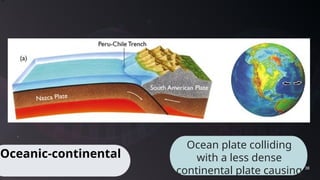
Oceanic-continental
Ocean plate colliding
with a less dense
continental plate causing
34
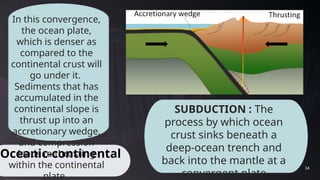
Oceanic-continental
SUBDUCTION : The
process by which ocean
crust sinks beneath a
deep-ocean trench and
back into the mantle at a
convergent plate
In this convergence,
the ocean plate,
which is denser as
compared to the
continental crust will
go under it.
Sediments that has
accumulated in the
continental slope is
thrust up into an
accretionary wedge,
and compression
leads to thrusting
within the continental
plate.
35
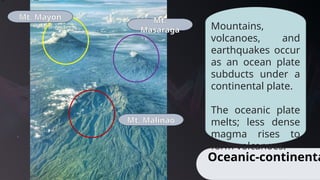
Oceanic-continenta
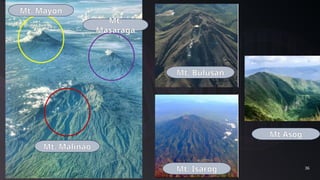
Mountains,
volcanoes, and
earthquakes occur
as an ocean plate
subducts under a
continental plate.
The oceanic plate
melts; less dense
magma rises to
form volcanoes.
Mt. Malinao
Mt.
Masaraga
Mt. Mayon
36
Mt. Malinao
Mt.
Masaraga
Mt. Mayon
Mt. Bulusan
Mt. Isarog
Mt Asog
37
Oceanic-continenta
38
Oceanic-continental
Ocean plate colliding
with a less dense
continental plate causing
39
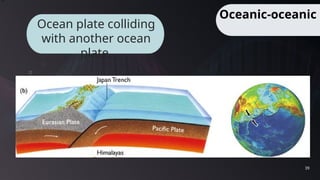
Oceanic-oceanic
Ocean plate colliding
with another ocean
plate.
40
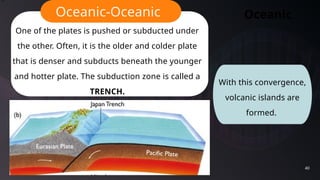
Oceanic
Oceanic-Oceanic
One of the plates is pushed or subducted under
the other. Often, it is the older and colder plate
that is denser and subducts beneath the younger
and hotter plate. The subduction zone is called a
TRENCH.
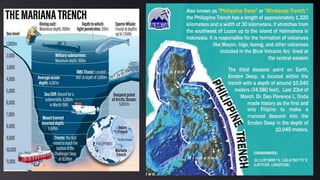
With this convergence,
volcanic islands are
formed.
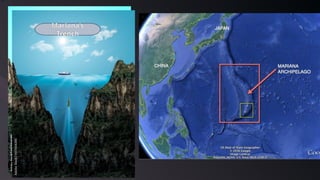
Mariana’s
Trench
43
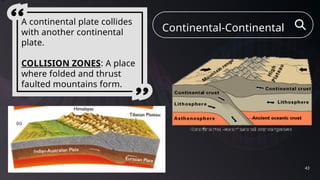
Continental-Continental
A continental plate collides
with another continental
plate.
COLLISION ZONES: A place
where folded and thrust
faulted mountains form.
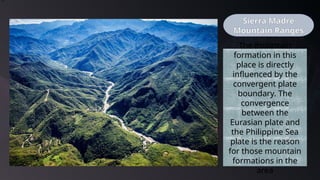
Sierra Madre
Mountain Ranges
The mountain
formation in this
place is directly
influenced by the
convergent plate
boundary. The
convergence
between the
Eurasian plate and
the Philippine Sea
plate is the reason
for those mountain
formations in the
area
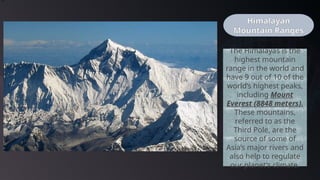
Himalayan
Mountain Ranges
The Himalayas is the
highest mountain
range in the world and
have 9 out of 10 of the
world’s highest peaks,
including Mount
Everest (8848 meters).
These mountains,
referred to as the
Third Pole, are the
source of some of
Asia’s major rivers and
also help to regulate
our planet’s climate.
DIVERGENT
BOUNDARIES
Most divergent boundaries are
located at the oceanic ridges,
although some are on land,
Spreading of plates have a
varying rates depending on the
location, 1 to 3 cm/y in the
Atlantic, and 6 to 10 cm/y in
These plates are spreading
boundaries, where a new
oceanic crust is created from
magma.
48
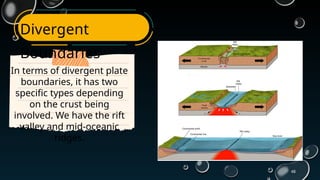
Divergent
Boundaries
In terms of divergent plate
boundaries, it has two
specific types depending
on the crust being
involved. We have the rift
valley and mid-oceanic
ridges.
49
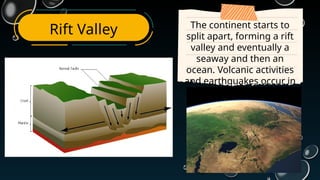
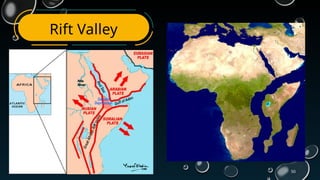
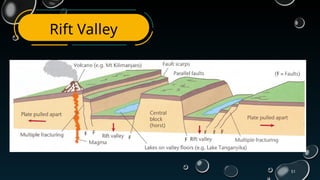
Rift Valley The continent starts to
split apart, forming a rift
valley and eventually a
seaway and then an
ocean. Volcanic activities
and earthquakes occur in
these areas.
50
Rift Valley
51
Rift Valley
52
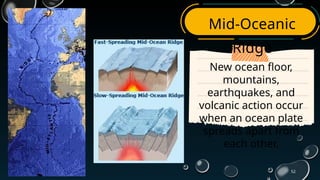
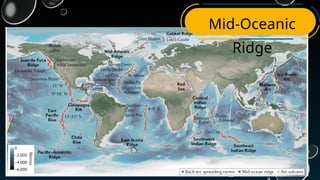
Mid-Oceanic
Ridge
New ocean floor,
mountains,
earthquakes, and
volcanic action occur
when an ocean plate
spreads apart from
each other.
53
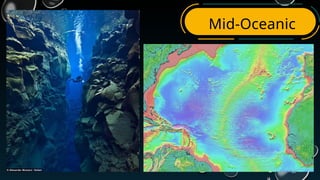
Mid-Oceanic
Ridge
54
Mid-Oceanic
Ridge
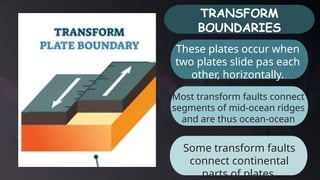
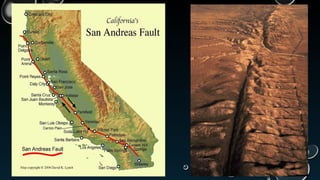
TRANSFORM
BOUNDARIES
Most transform faults connect
segments of mid-ocean ridges
and are thus ocean-ocean
plates.
Some transform faults
connect continental
parts of plates.
These plates occur when
two plates slide pas each
other, horizontally.
56
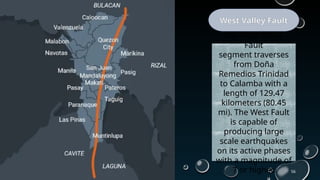
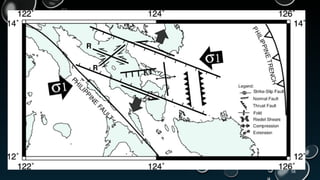
West Valley Fault
The West Valley
Fault
segment traverses
from Doña
Remedios Trinidad
to Calamba with a
length of 129.47
kilometers (80.45
mi). The West Fault
is capable of
producing large
scale earthquakes
on its active phases
with a magnitude of
7 or higher.
57
58
59
60
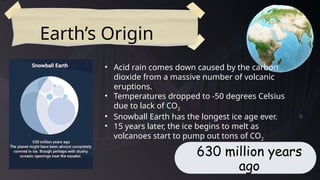
Earth’s Origin
630 million years
ago
• Acid rain comes down caused by the carbon
dioxide from a massive number of volcanic
eruptions.
• Temperatures dropped to -50 degrees Celsius
due to lack of CO2
• Snowball Earth has the longest ice age ever.
• 15 years later, the ice begins to melt as
volcanoes start to pump out tons of CO2
Earth’s Origin
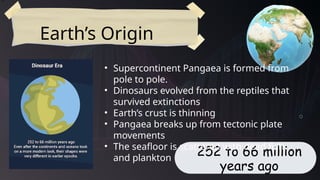
252 to 66 million
years ago
• Supercontinent Pangaea is formed from
pole to pole.
• Dinosaurs evolved from the reptiles that
survived extinctions
• Earth’s crust is thinning
• Pangaea breaks up from tectonic plate
movements
• The seafloor is scattered with dead fish
and plankton
Scientific findings 63
64
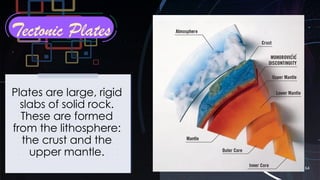
Tectonic Plates
Plates are large, rigid
slabs of solid rock.
These are formed
from the lithosphere:
the crust and the
upper mantle.
65
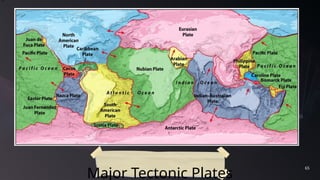
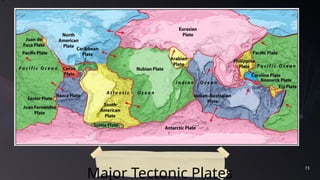
Major Tectonic Plates
66
Major Tectonic Plates
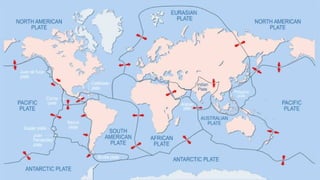
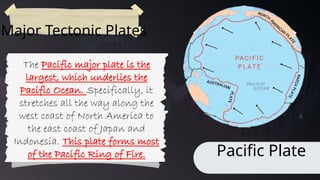
Pacific Plate
The Pacific major plate is the
largest, which underlies the
Pacific Ocean. Specifically, it
stretches all the way along the
west coast of North America to
the east coast of Japan and
Indonesia. This plate forms most
of the Pacific Ring of Fire.
67
Major Tectonic Plates
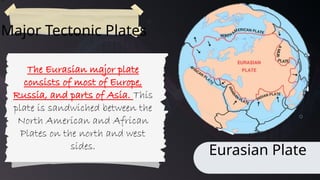
Eurasian Plate
The Eurasian major plate
consists of most of Europe,
Russia, and parts of Asia. This
plate is sandwiched between the
North American and African
Plates on the north and west
sides.
68
Major Tectonic Plates
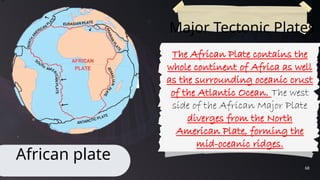
African plate
The African Plate contains the
whole continent of Africa as well
as the surrounding oceanic crust
of the Atlantic Ocean. The west
side of the African Major Plate
diverges from the North
American Plate, forming the
mid-oceanic ridges.
69
Major Tectonic Plates
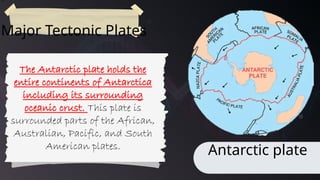
Antarctic plate
The Antarctic plate holds the
entire continents of Antarctica
including its surrounding
oceanic crust. This plate is
surrounded parts of the African,
Australian, Pacific, and South
American plates.
70
Major Tectonic Plates
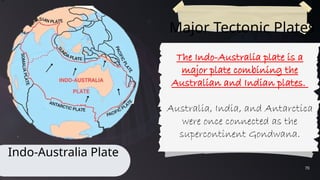
Indo-Australia Plate
The Indo-Australia plate is a
major plate combining the
Australian and Indian plates.
Australia, India, and Antarctica
were once connected as the
supercontinent Gondwana.
71
Major Tectonic Plates
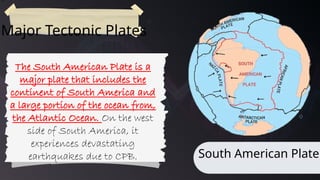
South American Plate
The South American Plate is a
major plate that includes the
continent of South America and
a large portion of the ocean from,
the Atlantic Ocean. On the west
side of South America, it
experiences devastating
earthquakes due to CPB.
72
Major Tectonic Plates
es
of
the
major
tectonic
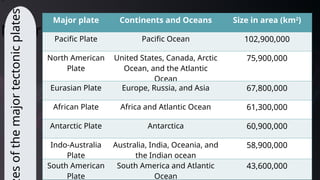
plates Major plate Continents and Oceans Size in area (km2
)
Pacific Plate Pacific Ocean 102,900,000
North American
Plate
United States, Canada, Arctic
Ocean, and the Atlantic
Ocean
75,900,000
Eurasian Plate Europe, Russia, and Asia 67,800,000
African Plate Africa and Atlantic Ocean 61,300,000
Antarctic Plate Antarctica 60,900,000
Indo-Australia
Plate
Australia, India, Oceania, and
the Indian ocean
58,900,000
South American
Plate
South America and Atlantic
Ocean
43,600,000
73
Major Tectonic Plates

Tectonic Plate Boundaries.pptx Convergent, divergent, transform

  • 2.
    Quiz #1 1. TheEarth’s crust is considered the thinnest layer. 2. The average temperature of the Earth’s Inner Core is roughly 5000 to 6000°C 3. The lithosphere is composed of the crust and the core. 4. The Lithosphere is the hottest layer of the Earth. 5. There are 10 Major Tectonic Plates on Earth. True or False
  • 3.
    Quiz #1 6. MohorovicicDiscontinuity (Moho) is the boundary between the upper mantle and the crust. 7. The continental crust is thinner as compared to the oceanic crust. 8. The largest known planet in the Solar System is the Earth. 9. The Pacific Ring of Fire is found in the Pacific Plate 10. When continental crust collides with oceanic crust, volcanoes and trenches are formed. True or False
  • 4.
    11. Which layerof the Earth is the hottest and has the highest pressure? a) Inner core b) Outer core c) Mantle d) Crust 12. Where does the heat of the core come from? a) The Sun’s Radiation b) The Moon c) The radioactive decay of Plutonium d) The Radioactive decay of Uranium, Thorium, and Potassium. Scientific findings 4
  • 5.
    5 13. Which layerof the Earth is responsible for generating the Earth's magnetic field? a) Inner core b) Outer core c) Mantle d) Crust 14. Which layer of the Earth is the thickest? a) Inner core b) Outer core c) Mantle d) Crust
  • 6.
    Scientific findings 6 15.Which layer of the Earth is composed of solid rock and is divided into tectonic plates? a) Inner core b) Outer core c) Mantle d) Crust 16. Which type of crust is denser? a) Continental Crust b) Oceanic Crust c) Mantle d) Tectonic Crust
  • 7.
    Scientific findings 7 17.Which layer of the Earth does the diamond formed? a) Inner core b) Outer core c) Mantle d) Crust 18. Which layer of the Earth is the thinnest? a) Inner core b) Outer core c) Mantle d) Crust
  • 8.
    Scientific findings 8 19.The Lithosphere comes from the Greek words lithos and sphaira which means. a) Rock and Sphere b) Solid and Round c) Rock and Globe d) Rock and Earth 20. Which layer of the Earth is located between the crust and the core? a) Inner core b) Outer core c) Mantle d) Crust
  • 9.
    Scientific findings 9 21.It is a precious material found in the mantle. 22. Basalt can be found in which type of Crust? 23. It protects the Earth from the harmful solar radiation. 24. It is the boundary between the crust and the mantle. 25. The deepest part of the Earth.
  • 10.
  • 11.
    IVAN C HR IST I AN B. B AN AS TAO, L PT
  • 12.
    P L AT E B O U N D A R I E S T Y P E S A N D D E F I N I T I O N
  • 13.
    13 LEARNING OBJECTIVES At the endof classroom discussion, the students are able to:  Identify the different types of plate boundaries;  Differentiate the formations that may be formed per plate boundaries;  Use the PhET Simulation to demonstrate Plate Boundaries;  Give importance to setting boundaries in real-life situations.
  • 15.
  • 16.
    16 Plate Motions The platesare moving due to a mechanism called Convection Currents.
  • 17.
    17 Convection Current Hot materialrises while cooler material near the surface sinks.
  • 18.
    18 Hot material from deepwithin the Earth rises while cooler material near the surface sinks. Convection Current
  • 19.
  • 20.
    Plate Tectonics Theory This theorystates that “The Earth’s lithosphere (plates) are moving in constant motion, driven by convection currents in the mantle.” Plates move slowly in different directions which causes different geologic events like earthquakes, volcanoes, mountains, rift valleys, etc.
  • 21.
    Plate Tectonics Theory Major andMinor Tectonic Plates
  • 23.
  • 24.
    PLATE BOUNDARIES Plates do nothave gaps with one another, and the fine line between them is a boundary. Plates comprise the crust and the upper mantle, and even though they move, there are no spaces between them. These extend deep into the lithosphere; thus, it has greater thickness. These are divided into three (3) types, namely: divergent, convergent, and transform
  • 25.
    CONVERGENT BOUNDARIES In these boundaries,the type of crust should be considered since utilization of different crust creates different landforms. Convergent boundaries have three types: convergence between oceanic-oceanic, oceanic-continental, and These plates are commonly known as “colliding plates” wherein two tectonic plates toward each other.
  • 26.
    26 Oceanic and Continental Crust OceanicCrust • Very dense, made of basalt • This is the crust found in the ocean floors Continental • Less dense, made of granite • This is the crust that composes the continents
  • 27.
    CONVERGENT BOUNDARIES In these boundaries,the type of crust should be considered since utilization of different crust creates different landforms. Convergent boundaries have three types: convergence between oceanic-oceanic, oceanic-continental, and These plates are commonly known as “colliding plates” wherein two tectonic plates toward each other.
  • 28.
    DIVERGENT BOUNDARIES Most divergent boundariesare located at the oceanic ridges, although some are on land, Spreading of plates have a varying rates depending on the location, 1 to 3 cm/y in the Atlantic, and 6 to 10 cm/y in These plates are spreading boundaries, where a new oceanic crust is created from magma.
  • 29.
    TRANSFORM BOUNDARIES Most transform faultsconnect segments of mid-ocean ridges and are thus ocean-ocean plates. Some transform faults connect continental parts of plates. These plates occur when two plates slide pas each other, horizontally.
  • 30.
  • 31.
  • 32.
    32 Convergent Plates Introduction These platesare commonly known as “colliding plates” wherein two tectonic plates toward each other. In these boundaries, the type of crust should be considered since the utilization of different crusts creates different landforms.
  • 33.
    33 Oceanic-continental Ocean plate colliding witha less dense continental plate causing
  • 34.
    34 Oceanic-continental SUBDUCTION : The processby which ocean crust sinks beneath a deep-ocean trench and back into the mantle at a convergent plate In this convergence, the ocean plate, which is denser as compared to the continental crust will go under it. Sediments that has accumulated in the continental slope is thrust up into an accretionary wedge, and compression leads to thrusting within the continental plate.
  • 35.
    35 Oceanic-continenta Mountains, volcanoes, and earthquakes occur asan ocean plate subducts under a continental plate. The oceanic plate melts; less dense magma rises to form volcanoes. Mt. Malinao Mt. Masaraga Mt. Mayon
  • 36.
  • 37.
  • 38.
    38 Oceanic-continental Ocean plate colliding witha less dense continental plate causing
  • 39.
  • 40.
    40 Oceanic Oceanic-Oceanic One of theplates is pushed or subducted under the other. Often, it is the older and colder plate that is denser and subducts beneath the younger and hotter plate. The subduction zone is called a TRENCH. With this convergence, volcanic islands are formed.
  • 41.
  • 43.
    43 Continental-Continental A continental platecollides with another continental plate. COLLISION ZONES: A place where folded and thrust faulted mountains form.
  • 44.
    Sierra Madre Mountain Ranges Themountain formation in this place is directly influenced by the convergent plate boundary. The convergence between the Eurasian plate and the Philippine Sea plate is the reason for those mountain formations in the area
  • 45.
    Himalayan Mountain Ranges The Himalayasis the highest mountain range in the world and have 9 out of 10 of the world’s highest peaks, including Mount Everest (8848 meters). These mountains, referred to as the Third Pole, are the source of some of Asia’s major rivers and also help to regulate our planet’s climate.
  • 47.
    DIVERGENT BOUNDARIES Most divergent boundariesare located at the oceanic ridges, although some are on land, Spreading of plates have a varying rates depending on the location, 1 to 3 cm/y in the Atlantic, and 6 to 10 cm/y in These plates are spreading boundaries, where a new oceanic crust is created from magma.
  • 48.
    48 Divergent Boundaries In terms ofdivergent plate boundaries, it has two specific types depending on the crust being involved. We have the rift valley and mid-oceanic ridges.
  • 49.
    49 Rift Valley Thecontinent starts to split apart, forming a rift valley and eventually a seaway and then an ocean. Volcanic activities and earthquakes occur in these areas.
  • 50.
  • 51.
  • 52.
    52 Mid-Oceanic Ridge New ocean floor, mountains, earthquakes,and volcanic action occur when an ocean plate spreads apart from each other.
  • 53.
  • 54.
  • 55.
    TRANSFORM BOUNDARIES Most transform faultsconnect segments of mid-ocean ridges and are thus ocean-ocean plates. Some transform faults connect continental parts of plates. These plates occur when two plates slide pas each other, horizontally.
  • 56.
    56 West Valley Fault TheWest Valley Fault segment traverses from Doña Remedios Trinidad to Calamba with a length of 129.47 kilometers (80.45 mi). The West Fault is capable of producing large scale earthquakes on its active phases with a magnitude of 7 or higher.
  • 57.
  • 58.
  • 59.
  • 60.
  • 61.
    Earth’s Origin 630 millionyears ago • Acid rain comes down caused by the carbon dioxide from a massive number of volcanic eruptions. • Temperatures dropped to -50 degrees Celsius due to lack of CO2 • Snowball Earth has the longest ice age ever. • 15 years later, the ice begins to melt as volcanoes start to pump out tons of CO2
  • 62.
    Earth’s Origin 252 to66 million years ago • Supercontinent Pangaea is formed from pole to pole. • Dinosaurs evolved from the reptiles that survived extinctions • Earth’s crust is thinning • Pangaea breaks up from tectonic plate movements • The seafloor is scattered with dead fish and plankton
  • 63.
  • 64.
    64 Tectonic Plates Plates arelarge, rigid slabs of solid rock. These are formed from the lithosphere: the crust and the upper mantle.
  • 65.
  • 66.
    66 Major Tectonic Plates PacificPlate The Pacific major plate is the largest, which underlies the Pacific Ocean. Specifically, it stretches all the way along the west coast of North America to the east coast of Japan and Indonesia. This plate forms most of the Pacific Ring of Fire.
  • 67.
    67 Major Tectonic Plates EurasianPlate The Eurasian major plate consists of most of Europe, Russia, and parts of Asia. This plate is sandwiched between the North American and African Plates on the north and west sides.
  • 68.
    68 Major Tectonic Plates Africanplate The African Plate contains the whole continent of Africa as well as the surrounding oceanic crust of the Atlantic Ocean. The west side of the African Major Plate diverges from the North American Plate, forming the mid-oceanic ridges.
  • 69.
    69 Major Tectonic Plates Antarcticplate The Antarctic plate holds the entire continents of Antarctica including its surrounding oceanic crust. This plate is surrounded parts of the African, Australian, Pacific, and South American plates.
  • 70.
    70 Major Tectonic Plates Indo-AustraliaPlate The Indo-Australia plate is a major plate combining the Australian and Indian plates. Australia, India, and Antarctica were once connected as the supercontinent Gondwana.
  • 71.
    71 Major Tectonic Plates SouthAmerican Plate The South American Plate is a major plate that includes the continent of South America and a large portion of the ocean from, the Atlantic Ocean. On the west side of South America, it experiences devastating earthquakes due to CPB.
  • 72.
    72 Major Tectonic Plates es of the major tectonic platesMajor plate Continents and Oceans Size in area (km2 ) Pacific Plate Pacific Ocean 102,900,000 North American Plate United States, Canada, Arctic Ocean, and the Atlantic Ocean 75,900,000 Eurasian Plate Europe, Russia, and Asia 67,800,000 African Plate Africa and Atlantic Ocean 61,300,000 Antarctic Plate Antarctica 60,900,000 Indo-Australia Plate Australia, India, Oceania, and the Indian ocean 58,900,000 South American Plate South America and Atlantic Ocean 43,600,000
  • 73.