Plate Tectonics

  Ag Earth Science
    Ms. Prescott
Continental Drift
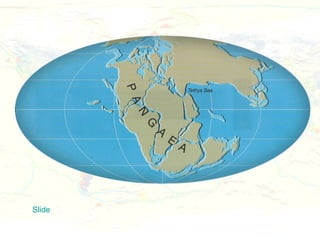
• In 1912 a German scientist named Alfred
  Wegener proposed a hypothesis called
  Continental Drift.

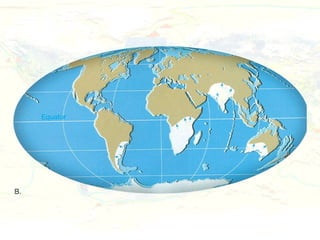
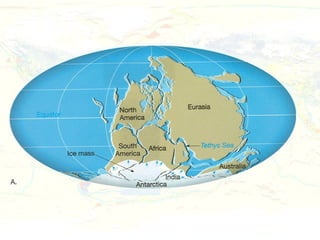
• He hypothesized that the continents once
  formed of a single landmass.

• He called it Pangaea, meaning “all land”
Slide
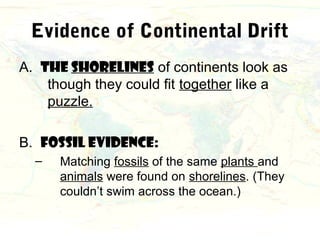
Evidence of Continental Drift
A. The shorelines of continents look as
    though they could fit together like a
    puzzle.

B. Fossil Evidence:
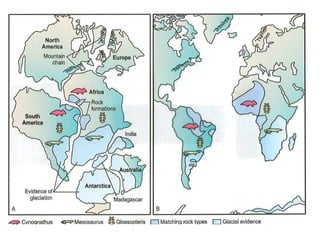
  –   Matching fossils of the same plants and
      animals were found on shorelines. (They
      couldn’t swim across the ocean.)
Evidence of Continental Drift
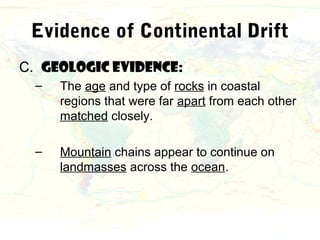
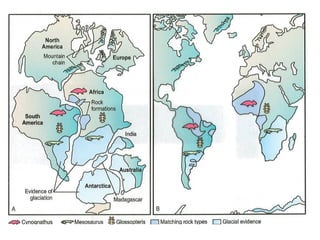
C. Geologic evidence:
  –   The age and type of rocks in coastal
      regions that were far apart from each other
      matched closely.

  –   Mountain chains appear to continue on
      landmasses across the ocean.
Evidence of Continental Drift
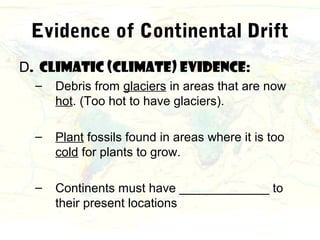
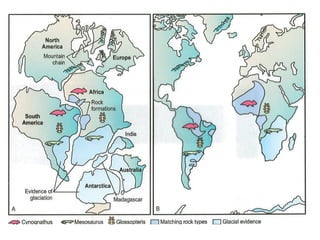
D. Climatic (climate) evidence:
  –   Debris from glaciers in areas that are now
      hot. (Too hot to have glaciers).

  –   Plant fossils found in areas where it is too
      cold for plants to grow.

  –   Continents must have _____________ to
      their present locations
Seafloor Spreading
Mid-Atlantic Ridge
•       Mapped in 1947
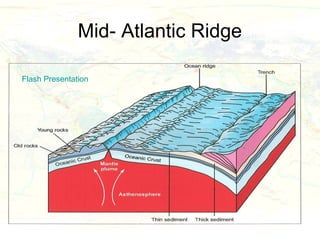
•       An undersea mountain range with a
        steep, narrow valley running down the
        center
•       Ocean floor was young compared to the
        age of continental rocks
    –     Oceanic rocks: younger than 175 million
          years old
    –     Continental rocks: about 4 billion years old
Mid- Atlantic Ridge

Flash Presentation
The Renewal of the Ocean Floor
 a. Developed by Hess
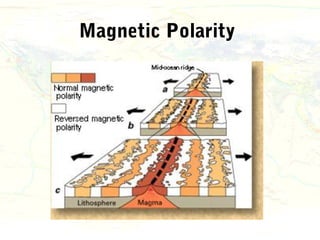
 b. The idea that the valley along the top of the
    Mid-Atlantic Ridge was actually a break in the
    earth’s crust where magma welled up through
 c. This happened because the ocean floor was
    moving away from both sides of the break
    (ridge)
 d. The open area was replaced by the magma
    that cooled and solidified into new rock
 e. Thus, the continents might also be moving
Paleomagnetism of the Ocean
            Floor
• The earth acts like a giant magnet, with
  both north and south pole.
• When rock harden, the magnetic
  orientation of the minerals becomes
  permanent and points to the north.
• Scientist have been finding rocks with a
  magnetic orientation that points south.
Paleomagnetism of the Ocean
           Floor
• Scientist concluded that the earth’s
  magnetic field has reversed.
• They found that all rocks with a south
  magnetic field fell into similar time periods.
• Scientist have discovered that throughout
  history, the earths magnetic pole have
  reversed.
Magnetic Polarity
4.2 The Theory of Plate
             Tectonics
• Is a theory of why and how the continents
  move.

• The earth consist of two types of crust.
  – Oceanic Crust
     • Material on the ocean floor
  – Continental Crust
     • Crust that makes up land masses
The Theory of Plate Tectonics
• The oceanic and continental crust make
  up the lithosphere.
  – Thin outer shell of the earth


• Below the lithosphere lies the
  asthenosphere, a layer of plastic rock, that
  is solid, solid rock that flows (like putty)
  under pressure.
The Theory of Plate Tectonics
• According to the theory, the lithosphere is
  broken into plates that ride on the denser
  asthenosphere.
  – Like blocks of wood floating on water.


• Most plates are composed of both
  continental and oceanic crust.
The Theory of Plate Tectonics
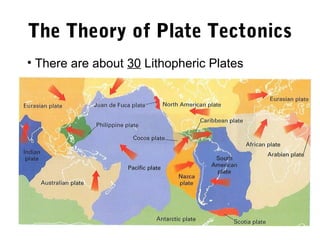
• There are about 30 Lithopheric Plates
Lithospheric Plate Boundaries
• Some plates move toward each other
  others are moving apart.

• This constant movement is what has
  created our earth’s major surface.
  – Mountain Ranges
  – Deep-ocean Trenches
Divergent Boundaries
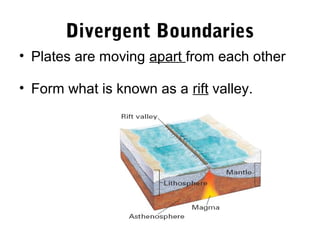
• Plates are moving apart from each other

• Form what is known as a rift valley.
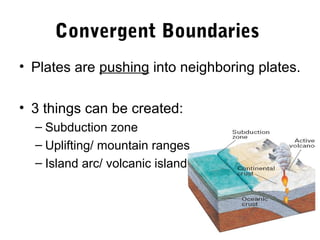
Convergent Boundaries
• Plates are pushing into neighboring plates.

• 3 things can be created:
  – Subduction zone
  – Uplifting/ mountain ranges
  – Island arc/ volcanic island
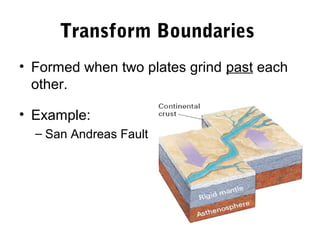
Transform Boundaries
• Formed when two plates grind past each
  other.

• Example:
  – San Andreas Fault
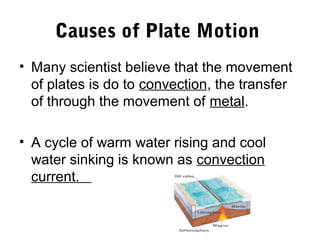
Causes of Plate Motion
• Many scientist believe that the movement
  of plates is do to convection, the transfer
  of through the movement of metal.

• A cycle of warm water rising and cool
  water sinking is known as convection
  current.
Microplate Terrains Theory
• Alfred Wegener’s hypothesized on how
  the plates ended up where they are today.

• His theory is the continents are actually
  like patchworks of terrains.
  – Each terrain has 3 characteristics
     • Rocks and fossils unique to it’s terrain
     • Major fault at every boundary
     • Different magnetic properties

Plate tectonics unit

  • 1.
    Plate Tectonics Ag Earth Science Ms. Prescott
  • 2.
    Continental Drift • In1912 a German scientist named Alfred Wegener proposed a hypothesis called Continental Drift. • He hypothesized that the continents once formed of a single landmass. • He called it Pangaea, meaning “all land”
  • 4.
  • 6.
    Evidence of ContinentalDrift A. The shorelines of continents look as though they could fit together like a puzzle. B. Fossil Evidence: – Matching fossils of the same plants and animals were found on shorelines. (They couldn’t swim across the ocean.)
  • 8.
    Evidence of ContinentalDrift C. Geologic evidence: – The age and type of rocks in coastal regions that were far apart from each other matched closely. – Mountain chains appear to continue on landmasses across the ocean.
  • 10.
    Evidence of ContinentalDrift D. Climatic (climate) evidence: – Debris from glaciers in areas that are now hot. (Too hot to have glaciers). – Plant fossils found in areas where it is too cold for plants to grow. – Continents must have _____________ to their present locations
  • 12.
    Seafloor Spreading Mid-Atlantic Ridge • Mapped in 1947 • An undersea mountain range with a steep, narrow valley running down the center • Ocean floor was young compared to the age of continental rocks – Oceanic rocks: younger than 175 million years old – Continental rocks: about 4 billion years old
  • 13.
  • 14.
    The Renewal ofthe Ocean Floor a. Developed by Hess b. The idea that the valley along the top of the Mid-Atlantic Ridge was actually a break in the earth’s crust where magma welled up through c. This happened because the ocean floor was moving away from both sides of the break (ridge) d. The open area was replaced by the magma that cooled and solidified into new rock e. Thus, the continents might also be moving
  • 15.
    Paleomagnetism of theOcean Floor • The earth acts like a giant magnet, with both north and south pole. • When rock harden, the magnetic orientation of the minerals becomes permanent and points to the north. • Scientist have been finding rocks with a magnetic orientation that points south.
  • 16.
    Paleomagnetism of theOcean Floor • Scientist concluded that the earth’s magnetic field has reversed. • They found that all rocks with a south magnetic field fell into similar time periods. • Scientist have discovered that throughout history, the earths magnetic pole have reversed.
  • 17.
  • 18.
    4.2 The Theoryof Plate Tectonics • Is a theory of why and how the continents move. • The earth consist of two types of crust. – Oceanic Crust • Material on the ocean floor – Continental Crust • Crust that makes up land masses
  • 19.
    The Theory ofPlate Tectonics • The oceanic and continental crust make up the lithosphere. – Thin outer shell of the earth • Below the lithosphere lies the asthenosphere, a layer of plastic rock, that is solid, solid rock that flows (like putty) under pressure.
  • 20.
    The Theory ofPlate Tectonics • According to the theory, the lithosphere is broken into plates that ride on the denser asthenosphere. – Like blocks of wood floating on water. • Most plates are composed of both continental and oceanic crust.
  • 21.
    The Theory ofPlate Tectonics • There are about 30 Lithopheric Plates
  • 22.
    Lithospheric Plate Boundaries •Some plates move toward each other others are moving apart. • This constant movement is what has created our earth’s major surface. – Mountain Ranges – Deep-ocean Trenches
  • 23.
    Divergent Boundaries • Platesare moving apart from each other • Form what is known as a rift valley.
  • 24.
    Convergent Boundaries • Platesare pushing into neighboring plates. • 3 things can be created: – Subduction zone – Uplifting/ mountain ranges – Island arc/ volcanic island
  • 25.
    Transform Boundaries • Formedwhen two plates grind past each other. • Example: – San Andreas Fault
  • 26.
    Causes of PlateMotion • Many scientist believe that the movement of plates is do to convection, the transfer of through the movement of metal. • A cycle of warm water rising and cool water sinking is known as convection current.
  • 27.
    Microplate Terrains Theory •Alfred Wegener’s hypothesized on how the plates ended up where they are today. • His theory is the continents are actually like patchworks of terrains. – Each terrain has 3 characteristics • Rocks and fossils unique to it’s terrain • Major fault at every boundary • Different magnetic properties