UNIT II
CIRCUIT DESIGN
PROCESSES
INTRODUCTION
• Objectives:
–
–
–
–

To know MOS layers
To understand the stick diagrams
To learn design rules
To understand layout and symbolic diagrams

• Outcome:
– At the end of this, will be able draw the stick
diagram, layout and symbolic diagram for simple
MOS circuits
UNIT – II CIRCUIT DESIGN PROCESSES
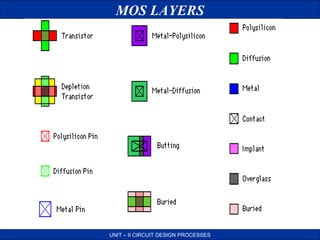
MOS LAYERS

UNIT – II CIRCUIT DESIGN PROCESSES
STICK DIAGRAMS
• Objectives:
– To know what is meant by stick diagram.
– To understand the capabilities and limitations of
stick diagram.
– To learn how to draw stick diagrams for a given
MOS circuit.

• Outcome:
– At the end of this module the students will be able
draw the stick diagram for simple MOS circuits.
UNIT – II CIRCUIT DESIGN PROCESSES
STICK DIAGRAMS
• VLSI design aims to translate circuit concepts
onto silicon.
• Stick diagrams are a means of capturing
topography and layer information using simple
diagrams.
• Stick diagrams convey layer information
through color codes (or monochrome
encoding).
• Acts as an interface between symbolic circuit
and the actual layout.
UNIT – II CIRCUIT DESIGN PROCESSES
STICK DIAGRAMS
• Does show all components/vias.
– Via is used to connect higher level metals from metal connection

• It shows relative placement of components.
• Goes one step closer to the layout
• Helps plan the layout and routing
A stick diagram is a cartoon of a layout.

UNIT – II CIRCUIT DESIGN PROCESSES
STICK DIAGRAMS

• Does not show
– Exact placement of components
– Transistor sizes
– Wire lengths, wire widths, tub boundaries
– Any other low level details such as
parasitics

UNIT – II CIRCUIT DESIGN PROCESSES
STICK DIAGRAMS

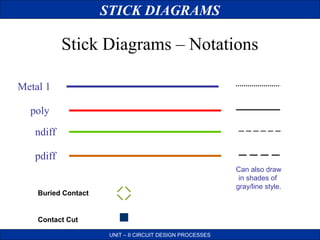
Stick Diagrams – Notations
Metal 1
poly
ndiff
pdiff
Can also draw
in shades of
gray/line style.

Buried Contact

Contact Cut
UNIT – II CIRCUIT DESIGN PROCESSES
STICK DIAGRAMS

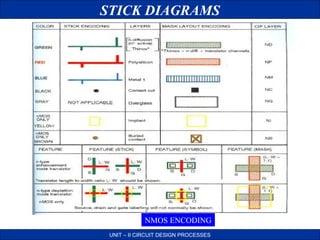
NMOS ENCODING
UNIT – II CIRCUIT DESIGN PROCESSES
STICK DIAGRAMS

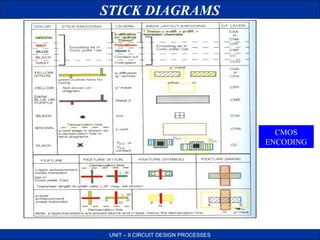
CMOS
ENCODING

UNIT – II CIRCUIT DESIGN PROCESSES
STICK DIAGRAMS

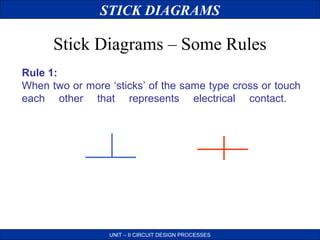
Stick Diagrams – Some Rules
Rule 1:
When two or more ‘sticks’ of the same type cross or touch
each other that represents electrical contact.

UNIT – II CIRCUIT DESIGN PROCESSES
STICK DIAGRAMS

Stick Diagrams – Some Rules
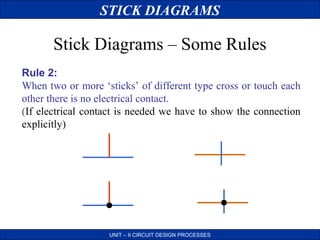
Rule 2:
When two or more ‘sticks’ of different type cross or touch each
other there is no electrical contact.
(If electrical contact is needed we have to show the connection
explicitly)
UNIT – II CIRCUIT DESIGN PROCESSES
STICK DIAGRAMS

Stick Diagrams – Some Rules
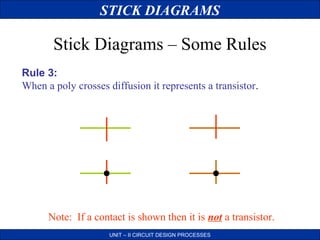
Rule 3:
When a poly crosses diffusion it represents a transistor.

Note: If a contact is shown then it is not a transistor.
UNIT – II CIRCUIT DESIGN PROCESSES
STICK DIAGRAMS

Stick Diagrams – Some Rules
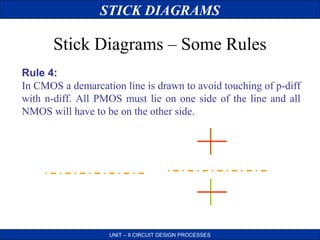
Rule 4:
In CMOS a demarcation line is drawn to avoid touching of p-diff
with n-diff. All PMOS must lie on one side of the line and all
NMOS will have to be on the other side.

UNIT – II CIRCUIT DESIGN PROCESSES
STICK DIAGRAMS

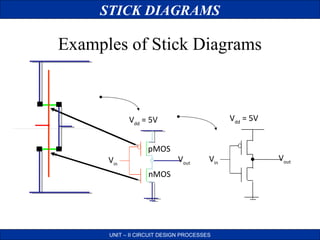
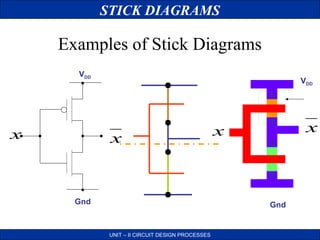
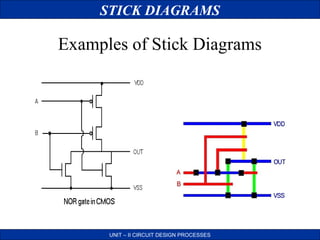
Examples of Stick Diagrams

Vdd = 5V

Vdd = 5V
pMOS
Vin

Vout

Vin

nMOS

UNIT – II CIRCUIT DESIGN PROCESSES

Vout
STICK DIAGRAMS

Examples of Stick Diagrams
VDD

VDD
X

x

x

x

X
X

X
Gnd

Gnd

UNIT – II CIRCUIT DESIGN PROCESSES

x
STICK DIAGRAMS

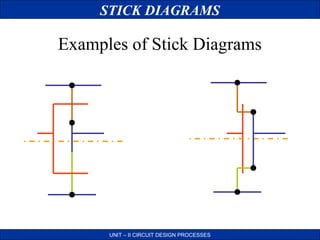
Examples of Stick Diagrams

UNIT – II CIRCUIT DESIGN PROCESSES
STICK DIAGRAMS

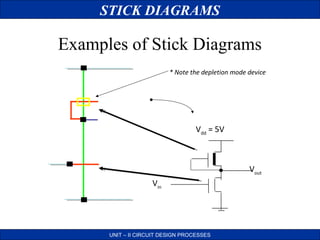
Examples of Stick Diagrams
* Note the depletion mode device

Vdd = 5V

Vout
Vin

UNIT – II CIRCUIT DESIGN PROCESSES
STICK DIAGRAMS

Examples of Stick Diagrams

UNIT – II CIRCUIT DESIGN PROCESSES
STICK DIAGRAMS

Examples of Stick Diagrams

UNIT – II CIRCUIT DESIGN PROCESSES
STICK DIAGRAMS

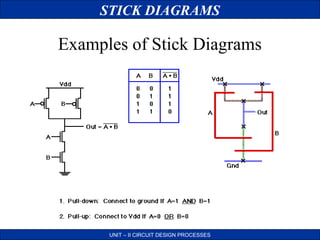
Examples of Stick Diagrams

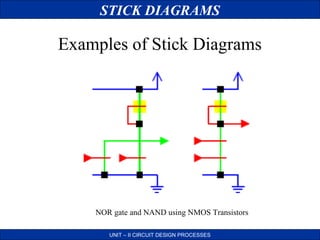
NOR gate and NAND using NMOS Transistors
UNIT – II CIRCUIT DESIGN PROCESSES
STICK DIAGRAMS

Examples of Stick Diagrams

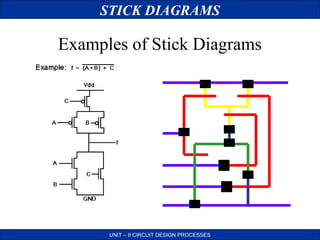
f= [(xy) +z]’ using NMOS Transistors
UNIT – II CIRCUIT DESIGN PROCESSES
STICK DIAGRAMS

Examples of Stick Diagrams

UNIT – II CIRCUIT DESIGN PROCESSES
DESIGN RULES
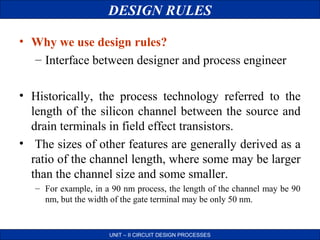
• Why we use design rules?
– Interface between designer and process engineer
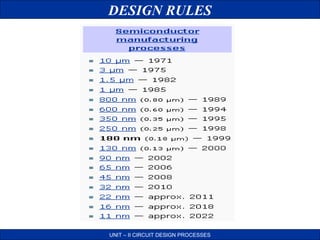
• Historically, the process technology referred to the
length of the silicon channel between the source and
drain terminals in field effect transistors.
• The sizes of other features are generally derived as a
ratio of the channel length, where some may be larger
than the channel size and some smaller.
– For example, in a 90 nm process, the length of the channel may be 90
nm, but the width of the gate terminal may be only 50 nm.

UNIT – II CIRCUIT DESIGN PROCESSES
DESIGN RULES

UNIT – II CIRCUIT DESIGN PROCESSES
DESIGN RULES
• Allow translation of circuits (usually in stick
diagram or symbolic form) into actual
geometry in silicon
• Interface between circuit designer and
fabrication engineer
• Compromise
– designer - tighter, smaller
– fabricator - controllable, reproducible

UNIT – II CIRCUIT DESIGN PROCESSES
DESIGN RULES
• Design rules define ranges for features
– Examples:
• min. wire widths to avoid breaks
• min. spacing to avoid shorts
• minimum overlaps to ensure complete overlaps

– Measured in microns
– Required for resolution/tolerances of masks

• Fabrication processes defined by minimum channel
width
– Also minimum width of poly traces
– Defines “how fast” a fabrication process is

UNIT – II CIRCUIT DESIGN PROCESSES
DESIGN RULES
• Two major approaches:
– “Micron” rules: stated at micron resolution.
– λ rules: simplified micron rules with limited
scaling attributes.
• Design rules represents a tolerance which insures
very high probability of correct fabrication
– scalable design rules: lambda parameter
– absolute dimensions (micron rules)

UNIT – II CIRCUIT DESIGN PROCESSES
DESIGN RULES
“Micron” rules
• All minimum sizes and spacing specified in
microns.
• Rules don't have to be multiples of λ.
• Can result in 50% reduction in area over λ
based rules
• Standard in industry.

UNIT – II CIRCUIT DESIGN PROCESSES
DESIGN RULES
Lambda-based Design Rules
• Lambda-based (scalable CMOS) design rules define
scalable rules based on λ (which is half of the
minimum channel length)
– classes of MOSIS SCMOS rules: SUBMICRON, DEEPSUBMICRON

• Stick diagram is a draft of real layout, it serves as an
abstract view between the schematic and layout.

UNIT – II CIRCUIT DESIGN PROCESSES
DESIGN RULES
Lambda-based Design Rules
• Circuit designer in general want tighter, smaller layouts
for improved performance and decreased silicon area.
• On the other hand, the process engineer wants design
rules that result in a controllable and reproducible
process.
• Generally we find there has to be a compromise for a
competitive circuit to be produced at a reasonable cost.
• All widths, spacing, and distances are written in the
form
• λ = 0.5 X minimum drawn transistor length
UNIT – II CIRCUIT DESIGN PROCESSES
DESIGN RULES
Lambda-based Design Rules
•
•
•
•
•
•
•
•

Design rules based on single parameter, λ
Simple for the designer
Wide acceptance
Provide feature size independent way of setting out
mask
If design rules are obeyed, masks will produce working
circuits
Minimum feature size is defined as 2 λ
Used to preserve topological features on a chip
Prevents shorting, opens, contacts from slipping out of
area to be contacted
UNIT – II CIRCUIT DESIGN PROCESSES
DESIGN RULES
Design Rules – Reality
• Manufacturing processes have inherent limitations in
accuracy and repeatability
• Design rules specify geometry of masks that provide
reasonable yield
• Design rules are determined by experience

UNIT – II CIRCUIT DESIGN PROCESSES
DESIGN RULES
Problems in Manufacturing
•
•
•
•
•
•
•

Photoresist shrinking / tearing
Variations in material deposition
Variations in temperature
Variations in oxide thickness
Impurities
Variations between lots
Variations across the wafer

UNIT – II CIRCUIT DESIGN PROCESSES
DESIGN RULES
Problems in Manufacturing
• Variations in threshold voltage
– oxide thickness
– ion implantation
– poly variations
• Diffusion - changes in doping (variation in R, C)
• Poly, metal variations in height and width
• Shorts and opens
• Via may not be cut all the way through
• Undersize via has too much resistance
• Oversize via may short
UNIT – II CIRCUIT DESIGN PROCESSES
DESIGN RULES
Advantages of Generalized Design Rules
• Ease of learning because they are scalable, portable,
durable
• Long-levity of designs that are simple, abstract and
minimal clutter
• Increased designer efficiency
• Automatic translation to final layout
UNIT – II CIRCUIT DESIGN PROCESSES
DESIGN RULES
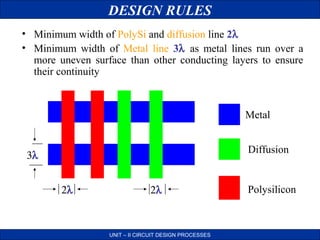
• Minimum width of PolySi and diffusion line 2λ
• Minimum width of Metal line 3λ as metal lines run over a
more uneven surface than other conducting layers to ensure
their continuity

Metal
Diffusion

3λ
2λ

2λ

UNIT – II CIRCUIT DESIGN PROCESSES

Polysilicon
DESIGN RULES
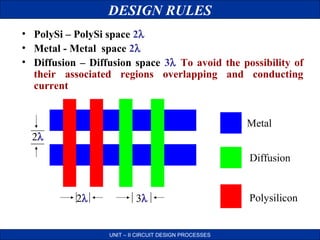
• PolySi – PolySi space 2λ
• Metal - Metal space 2λ
• Diffusion – Diffusion space 3λ To avoid the possibility of
their associated regions overlapping and conducting
current
Metal
2λ
Diffusion

2λ

3λ

UNIT – II CIRCUIT DESIGN PROCESSES

Polysilicon
DESIGN RULES
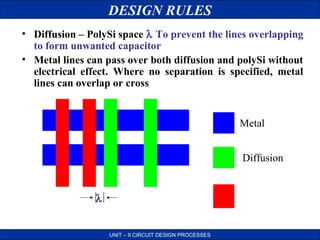
• Diffusion – PolySi space λ To prevent the lines overlapping
to form unwanted capacitor
• Metal lines can pass over both diffusion and polySi without
electrical effect. Where no separation is specified, metal
lines can overlap or cross

Metal
Diffusion

λ

UNIT – II CIRCUIT DESIGN PROCESSES
DESIGN RULES
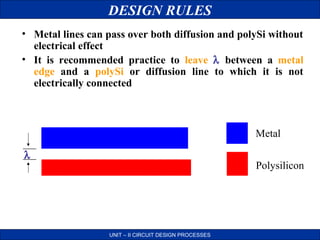
• Metal lines can pass over both diffusion and polySi without
electrical effect
• It is recommended practice to leave λ between a metal
edge and a polySi or diffusion line to which it is not
electrically connected

Metal
λ

Polysilicon

UNIT – II CIRCUIT DESIGN PROCESSES
DESIGN RULES
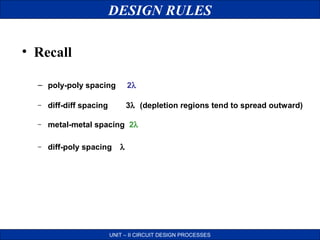
• Recall
– poly-poly spacing

2λ

–

diff-diff spacing

3λ (depletion regions tend to spread outward)

–

metal-metal spacing 2λ

–

diff-poly spacing

λ

UNIT – II CIRCUIT DESIGN PROCESSES
DESIGN RULES
Butting Contact
The gate and source of a depletion device can be connected by a
method known as butting contact. Here metal makes contact to
both the diffusion forming the source of the depletion transistor
and to the polySi forming this device’s gate.

Advantage:
No buried contact mask required and avoids associated processing.

UNIT – II CIRCUIT DESIGN PROCESSES
DESIGN RULES
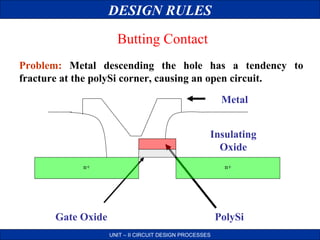
Butting Contact
Problem: Metal descending the hole has a tendency to
fracture at the polySi corner, causing an open circuit.
Metal
Insulating
Oxide
n+

n+

Gate Oxide

PolySi
UNIT – II CIRCUIT DESIGN PROCESSES
DESIGN RULES
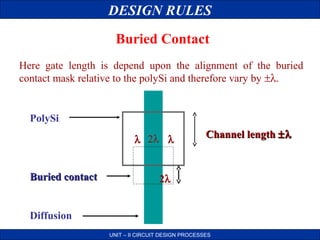
Buried Contact
Here gate length is depend upon the alignment of the buried
contact mask relative to the polySi and therefore vary by ±λ.

PolySi
λ 2λ λ
Buried contact

Channel length ±λ

2λ

Diffusion
UNIT – II CIRCUIT DESIGN PROCESSES
DESIGN RULES
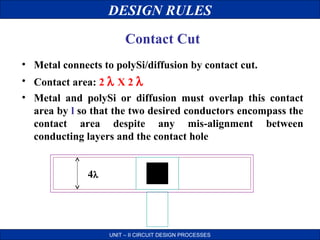
Contact Cut
• Metal connects to polySi/diffusion by contact cut.
• Contact area: 2 λ X 2 λ
• Metal and polySi or diffusion must overlap this contact
area by l so that the two desired conductors encompass the
contact area despite any mis-alignment between
conducting layers and the contact hole
4λ

UNIT – II CIRCUIT DESIGN PROCESSES
DESIGN RULES
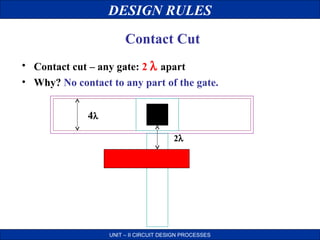
Contact Cut
• Contact cut – any gate: 2 λ apart
• Why? No contact to any part of the gate.
4λ
2λ

UNIT – II CIRCUIT DESIGN PROCESSES
DESIGN RULES
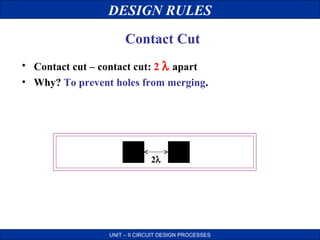
Contact Cut
• Contact cut – contact cut: 2 λ apart
• Why? To prevent holes from merging.

2λ

UNIT – II CIRCUIT DESIGN PROCESSES
DESIGN RULES

UNIT – II CIRCUIT DESIGN PROCESSES
DESIGN RULES
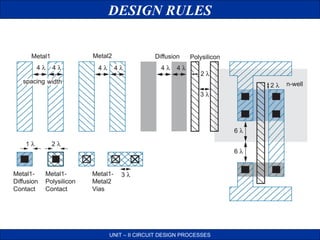
3λ
6λ
6λ

2λ

2λ

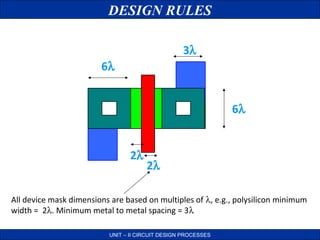
All device mask dimensions are based on multiples of λ, e.g., polysilicon minimum
width = 2λ. Minimum metal to metal spacing = 3λ
UNIT – II CIRCUIT DESIGN PROCESSES
DESIGN RULES
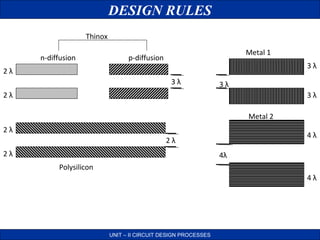
Thinox
n-diffusion

Metal 1

p-diffusion

3λ

2λ
3λ

3λ

2λ

3λ
Metal 2

2λ

4λ

2λ
2λ

4λ
Polysilicon
4λ

UNIT – II CIRCUIT DESIGN PROCESSES
DESIGN RULES
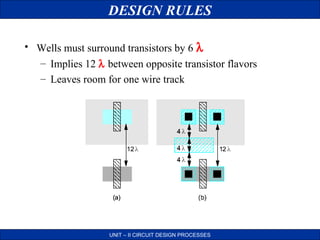
• Wells must surround transistors by 6 λ
– Implies 12 λ between opposite transistor flavors
– Leaves room for one wire track

UNIT – II CIRCUIT DESIGN PROCESSES
DESIGN RULES
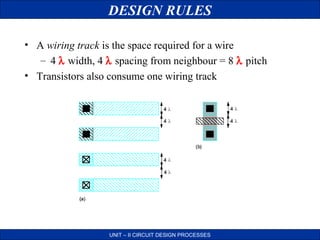
• A wiring track is the space required for a wire
– 4 λ width, 4 λ spacing from neighbour = 8 λ pitch
• Transistors also consume one wiring track

UNIT – II CIRCUIT DESIGN PROCESSES
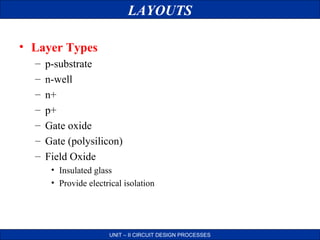
LAYOUTS
• Layer Types
–
–
–
–
–
–
–

p-substrate
n-well
n+
p+
Gate oxide
Gate (polysilicon)
Field Oxide
• Insulated glass
• Provide electrical isolation

UNIT – II CIRCUIT DESIGN PROCESSES
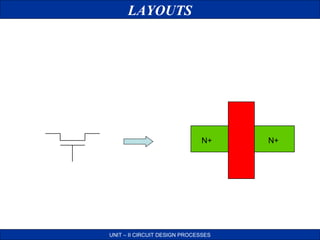
LAYOUTS

N+

UNIT – II CIRCUIT DESIGN PROCESSES

N+
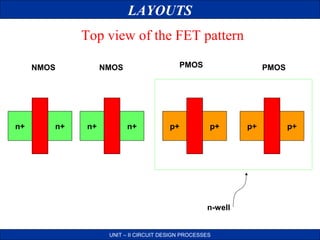
LAYOUTS
Top view of the FET pattern
NMOS

n+

n+

PMOS

NMOS

n+

n+

p+

PMOS

p+

n-well

UNIT – II CIRCUIT DESIGN PROCESSES

p+

p+
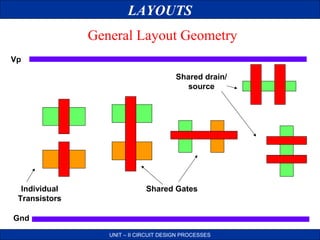
LAYOUTS
General Layout Geometry
Vp
Shared drain/
source

Individual
Transistors

Shared Gates

Gnd
UNIT – II CIRCUIT DESIGN PROCESSES
LAYOUTS
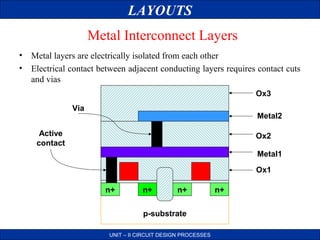
Metal Interconnect Layers
•
•

Metal layers are electrically isolated from each other
Electrical contact between adjacent conducting layers requires contact cuts
and vias
Ox3
Via

Metal2

Active
contact

Ox2
Metal1
Ox1
n+

n+

n+

p-substrate
UNIT – II CIRCUIT DESIGN PROCESSES

n+
LAYOUTS
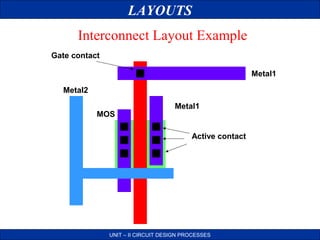
Interconnect Layout Example
Gate contact
Metal1
Metal2
MOS

Metal1

Active contact

UNIT – II CIRCUIT DESIGN PROCESSES
LAYOUTS
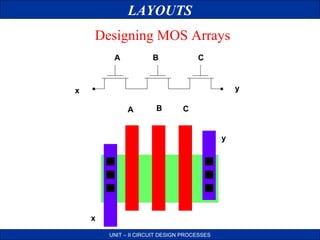
Designing MOS Arrays
A

B

C

y

x
A

B

C

y

x
UNIT – II CIRCUIT DESIGN PROCESSES
LAYOUTS
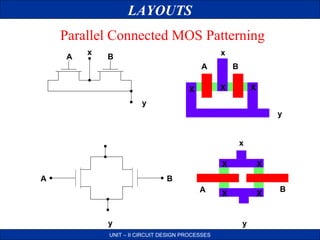
Parallel Connected MOS Patterning
A

x

x

B
A

B
X

X

X

y
y

x
X
A

X

X

X

B
A

y
UNIT – II CIRCUIT DESIGN PROCESSES

y

B
LAYOUTS
Basic Gate Design
• Both the power supply and ground are routed using the Metal
layer
• n+ and p+ regions are denoted using the same fill pattern. The
only difference is the n-well
• Contacts are needed from Metal to n+ or p+

UNIT – II CIRCUIT DESIGN PROCESSES
LAYOUTS
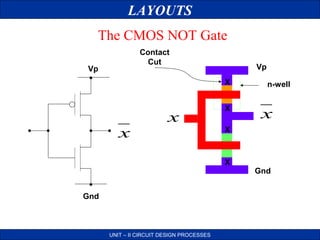
The CMOS NOT Gate
Contact
Cut

Vp

Vp
X

x

x

X

UNIT – II CIRCUIT DESIGN PROCESSES

x

X

X

Gnd

n-well

Gnd
LAYOUTS
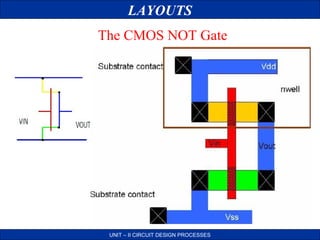
The CMOS NOT Gate

UNIT – II CIRCUIT DESIGN PROCESSES
LAYOUTS
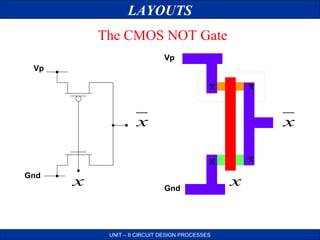
The CMOS NOT Gate
Vp
Vp
X

X

x

x
X

X
Gnd

x

Gnd

UNIT – II CIRCUIT DESIGN PROCESSES

x
LAYOUTS
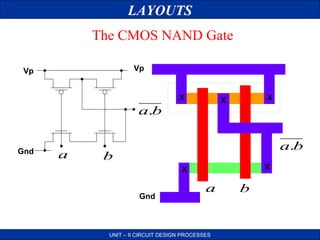
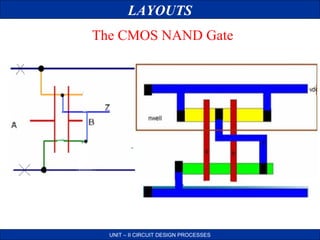
The CMOS NAND Gate
Vp

Vp

X

a.b

Gnd

a

X

X

a.b

b
X

X
Gnd

a

UNIT – II CIRCUIT DESIGN PROCESSES

b
LAYOUTS
The CMOS NAND Gate

UNIT – II CIRCUIT DESIGN PROCESSES
LAYOUTS
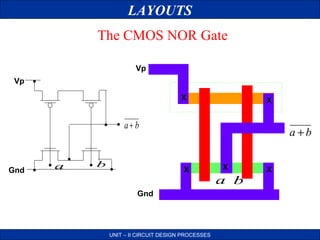
The CMOS NOR Gate
Vp
Vp
X

X

a+ b

Gnd

a

b

a +b
X

Gnd

UNIT – II CIRCUIT DESIGN PROCESSES

X

a b

X
LAYOUTS
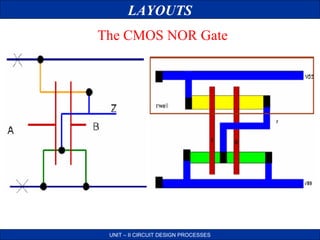
The CMOS NOR Gate

UNIT – II CIRCUIT DESIGN PROCESSES
LAYOUTS
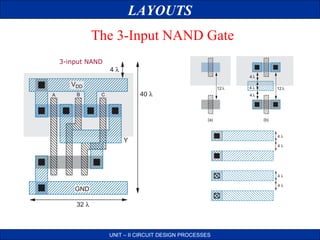
The 3-Input NAND Gate
3-input NAND

UNIT – II CIRCUIT DESIGN PROCESSES
LAYOUTS
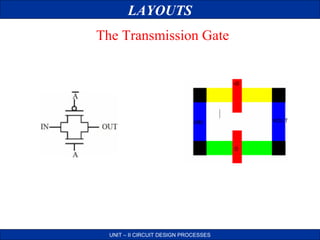
The Transmission Gate

UNIT – II CIRCUIT DESIGN PROCESSES
LAYOUTS
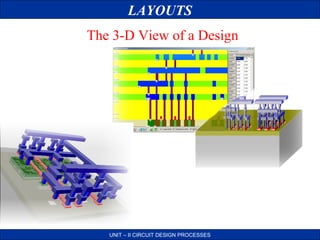
The 3-D View of a Design

UNIT – II CIRCUIT DESIGN PROCESSES
LAYOUTS
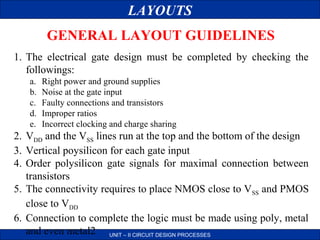
GENERAL LAYOUT GUIDELINES
1. The electrical gate design must be completed by checking the
followings:
a.
b.
c.
d.
e.

Right power and ground supplies
Noise at the gate input
Faulty connections and transistors
Improper ratios
Incorrect clocking and charge sharing

2. VDD and the VSS lines run at the top and the bottom of the design
3. Vertical poysilicon for each gate input
4. Order polysilicon gate signals for maximal connection between
transistors
5. The connectivity requires to place NMOS close to VSS and PMOS
close to VDD
6. Connection to complete the logic must be made using poly, metal
and even metal2 UNIT – II CIRCUIT DESIGN PROCESSES
LAYOUTS
GENERAL LAYOUT GUIDELINES
The factors for density improvement are (optimization):
• Efficient routing space usage. They can be placed over the cells
or even in multiple layers.
• Source drain connections must be merged better.
• White (blank) spaces must be minimum.
• The devices must be of optimum sizes.
• Transparent routing can be provided for cell
interconnection, this reduces global wiring problems
UNIT – II CIRCUIT DESIGN PROCESSES

to

cell
LAYOUTS
LAYOUT OPTIMIZATION FOR PERFORMANCE
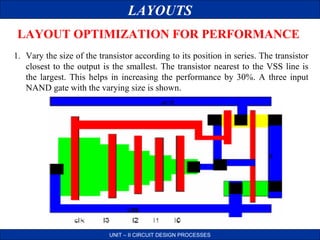
1. Vary the size of the transistor according to its position in series. The transistor
closest to the output is the smallest. The transistor nearest to the VSS line is
the largest. This helps in increasing the performance by 30%. A three input
NAND gate with the varying size is shown.

UNIT – II CIRCUIT DESIGN PROCESSES
LAYOUTS
LAYOUT OPTIMIZATION FOR PERFORMANCE
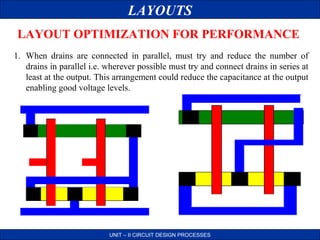
1. When drains are connected in parallel, must try and reduce the number of
drains in parallel i.e. wherever possible must try and connect drains in series at
least at the output. This arrangement could reduce the capacitance at the output
enabling good voltage levels.

UNIT – II CIRCUIT DESIGN PROCESSES
BASIC PHYSICAL DESIGN
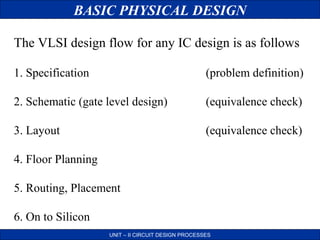
The VLSI design flow for any IC design is as follows
1. Specification

(problem definition)

2. Schematic (gate level design)

(equivalence check)

3. Layout

(equivalence check)

4. Floor Planning
5. Routing, Placement
6. On to Silicon
UNIT – II CIRCUIT DESIGN PROCESSES
ANY Qs?

VLSI circuit design process

  • 1.
  • 2.
    INTRODUCTION • Objectives: – – – – To knowMOS layers To understand the stick diagrams To learn design rules To understand layout and symbolic diagrams • Outcome: – At the end of this, will be able draw the stick diagram, layout and symbolic diagram for simple MOS circuits UNIT – II CIRCUIT DESIGN PROCESSES
  • 3.
    MOS LAYERS UNIT –II CIRCUIT DESIGN PROCESSES
  • 4.
    STICK DIAGRAMS • Objectives: –To know what is meant by stick diagram. – To understand the capabilities and limitations of stick diagram. – To learn how to draw stick diagrams for a given MOS circuit. • Outcome: – At the end of this module the students will be able draw the stick diagram for simple MOS circuits. UNIT – II CIRCUIT DESIGN PROCESSES
  • 5.
    STICK DIAGRAMS • VLSIdesign aims to translate circuit concepts onto silicon. • Stick diagrams are a means of capturing topography and layer information using simple diagrams. • Stick diagrams convey layer information through color codes (or monochrome encoding). • Acts as an interface between symbolic circuit and the actual layout. UNIT – II CIRCUIT DESIGN PROCESSES
  • 6.
    STICK DIAGRAMS • Doesshow all components/vias. – Via is used to connect higher level metals from metal connection • It shows relative placement of components. • Goes one step closer to the layout • Helps plan the layout and routing A stick diagram is a cartoon of a layout. UNIT – II CIRCUIT DESIGN PROCESSES
  • 7.
    STICK DIAGRAMS • Doesnot show – Exact placement of components – Transistor sizes – Wire lengths, wire widths, tub boundaries – Any other low level details such as parasitics UNIT – II CIRCUIT DESIGN PROCESSES
  • 8.
    STICK DIAGRAMS Stick Diagrams– Notations Metal 1 poly ndiff pdiff Can also draw in shades of gray/line style. Buried Contact Contact Cut UNIT – II CIRCUIT DESIGN PROCESSES
  • 9.
    STICK DIAGRAMS NMOS ENCODING UNIT– II CIRCUIT DESIGN PROCESSES
  • 10.
    STICK DIAGRAMS CMOS ENCODING UNIT –II CIRCUIT DESIGN PROCESSES
  • 11.
    STICK DIAGRAMS Stick Diagrams– Some Rules Rule 1: When two or more ‘sticks’ of the same type cross or touch each other that represents electrical contact. UNIT – II CIRCUIT DESIGN PROCESSES
  • 12.
    STICK DIAGRAMS Stick Diagrams– Some Rules Rule 2: When two or more ‘sticks’ of different type cross or touch each other there is no electrical contact. (If electrical contact is needed we have to show the connection explicitly) UNIT – II CIRCUIT DESIGN PROCESSES
  • 13.
    STICK DIAGRAMS Stick Diagrams– Some Rules Rule 3: When a poly crosses diffusion it represents a transistor. Note: If a contact is shown then it is not a transistor. UNIT – II CIRCUIT DESIGN PROCESSES
  • 14.
    STICK DIAGRAMS Stick Diagrams– Some Rules Rule 4: In CMOS a demarcation line is drawn to avoid touching of p-diff with n-diff. All PMOS must lie on one side of the line and all NMOS will have to be on the other side. UNIT – II CIRCUIT DESIGN PROCESSES
  • 15.
    STICK DIAGRAMS Examples ofStick Diagrams Vdd = 5V Vdd = 5V pMOS Vin Vout Vin nMOS UNIT – II CIRCUIT DESIGN PROCESSES Vout
  • 16.
    STICK DIAGRAMS Examples ofStick Diagrams VDD VDD X x x x X X X Gnd Gnd UNIT – II CIRCUIT DESIGN PROCESSES x
  • 17.
    STICK DIAGRAMS Examples ofStick Diagrams UNIT – II CIRCUIT DESIGN PROCESSES
  • 18.
    STICK DIAGRAMS Examples ofStick Diagrams * Note the depletion mode device Vdd = 5V Vout Vin UNIT – II CIRCUIT DESIGN PROCESSES
  • 19.
    STICK DIAGRAMS Examples ofStick Diagrams UNIT – II CIRCUIT DESIGN PROCESSES
  • 20.
    STICK DIAGRAMS Examples ofStick Diagrams UNIT – II CIRCUIT DESIGN PROCESSES
  • 21.
    STICK DIAGRAMS Examples ofStick Diagrams NOR gate and NAND using NMOS Transistors UNIT – II CIRCUIT DESIGN PROCESSES
  • 22.
    STICK DIAGRAMS Examples ofStick Diagrams f= [(xy) +z]’ using NMOS Transistors UNIT – II CIRCUIT DESIGN PROCESSES
  • 23.
    STICK DIAGRAMS Examples ofStick Diagrams UNIT – II CIRCUIT DESIGN PROCESSES
  • 24.
    DESIGN RULES • Whywe use design rules? – Interface between designer and process engineer • Historically, the process technology referred to the length of the silicon channel between the source and drain terminals in field effect transistors. • The sizes of other features are generally derived as a ratio of the channel length, where some may be larger than the channel size and some smaller. – For example, in a 90 nm process, the length of the channel may be 90 nm, but the width of the gate terminal may be only 50 nm. UNIT – II CIRCUIT DESIGN PROCESSES
  • 25.
    DESIGN RULES UNIT –II CIRCUIT DESIGN PROCESSES
  • 26.
    DESIGN RULES • Allowtranslation of circuits (usually in stick diagram or symbolic form) into actual geometry in silicon • Interface between circuit designer and fabrication engineer • Compromise – designer - tighter, smaller – fabricator - controllable, reproducible UNIT – II CIRCUIT DESIGN PROCESSES
  • 27.
    DESIGN RULES • Designrules define ranges for features – Examples: • min. wire widths to avoid breaks • min. spacing to avoid shorts • minimum overlaps to ensure complete overlaps – Measured in microns – Required for resolution/tolerances of masks • Fabrication processes defined by minimum channel width – Also minimum width of poly traces – Defines “how fast” a fabrication process is UNIT – II CIRCUIT DESIGN PROCESSES
  • 28.
    DESIGN RULES • Twomajor approaches: – “Micron” rules: stated at micron resolution. – λ rules: simplified micron rules with limited scaling attributes. • Design rules represents a tolerance which insures very high probability of correct fabrication – scalable design rules: lambda parameter – absolute dimensions (micron rules) UNIT – II CIRCUIT DESIGN PROCESSES
  • 29.
    DESIGN RULES “Micron” rules •All minimum sizes and spacing specified in microns. • Rules don't have to be multiples of λ. • Can result in 50% reduction in area over λ based rules • Standard in industry. UNIT – II CIRCUIT DESIGN PROCESSES
  • 30.
    DESIGN RULES Lambda-based DesignRules • Lambda-based (scalable CMOS) design rules define scalable rules based on λ (which is half of the minimum channel length) – classes of MOSIS SCMOS rules: SUBMICRON, DEEPSUBMICRON • Stick diagram is a draft of real layout, it serves as an abstract view between the schematic and layout. UNIT – II CIRCUIT DESIGN PROCESSES
  • 31.
    DESIGN RULES Lambda-based DesignRules • Circuit designer in general want tighter, smaller layouts for improved performance and decreased silicon area. • On the other hand, the process engineer wants design rules that result in a controllable and reproducible process. • Generally we find there has to be a compromise for a competitive circuit to be produced at a reasonable cost. • All widths, spacing, and distances are written in the form • λ = 0.5 X minimum drawn transistor length UNIT – II CIRCUIT DESIGN PROCESSES
  • 32.
    DESIGN RULES Lambda-based DesignRules • • • • • • • • Design rules based on single parameter, λ Simple for the designer Wide acceptance Provide feature size independent way of setting out mask If design rules are obeyed, masks will produce working circuits Minimum feature size is defined as 2 λ Used to preserve topological features on a chip Prevents shorting, opens, contacts from slipping out of area to be contacted UNIT – II CIRCUIT DESIGN PROCESSES
  • 33.
    DESIGN RULES Design Rules– Reality • Manufacturing processes have inherent limitations in accuracy and repeatability • Design rules specify geometry of masks that provide reasonable yield • Design rules are determined by experience UNIT – II CIRCUIT DESIGN PROCESSES
  • 34.
    DESIGN RULES Problems inManufacturing • • • • • • • Photoresist shrinking / tearing Variations in material deposition Variations in temperature Variations in oxide thickness Impurities Variations between lots Variations across the wafer UNIT – II CIRCUIT DESIGN PROCESSES
  • 35.
    DESIGN RULES Problems inManufacturing • Variations in threshold voltage – oxide thickness – ion implantation – poly variations • Diffusion - changes in doping (variation in R, C) • Poly, metal variations in height and width • Shorts and opens • Via may not be cut all the way through • Undersize via has too much resistance • Oversize via may short UNIT – II CIRCUIT DESIGN PROCESSES
  • 36.
    DESIGN RULES Advantages ofGeneralized Design Rules • Ease of learning because they are scalable, portable, durable • Long-levity of designs that are simple, abstract and minimal clutter • Increased designer efficiency • Automatic translation to final layout UNIT – II CIRCUIT DESIGN PROCESSES
  • 37.
    DESIGN RULES • Minimumwidth of PolySi and diffusion line 2λ • Minimum width of Metal line 3λ as metal lines run over a more uneven surface than other conducting layers to ensure their continuity Metal Diffusion 3λ 2λ 2λ UNIT – II CIRCUIT DESIGN PROCESSES Polysilicon
  • 38.
    DESIGN RULES • PolySi– PolySi space 2λ • Metal - Metal space 2λ • Diffusion – Diffusion space 3λ To avoid the possibility of their associated regions overlapping and conducting current Metal 2λ Diffusion 2λ 3λ UNIT – II CIRCUIT DESIGN PROCESSES Polysilicon
  • 39.
    DESIGN RULES • Diffusion– PolySi space λ To prevent the lines overlapping to form unwanted capacitor • Metal lines can pass over both diffusion and polySi without electrical effect. Where no separation is specified, metal lines can overlap or cross Metal Diffusion λ UNIT – II CIRCUIT DESIGN PROCESSES
  • 40.
    DESIGN RULES • Metallines can pass over both diffusion and polySi without electrical effect • It is recommended practice to leave λ between a metal edge and a polySi or diffusion line to which it is not electrically connected Metal λ Polysilicon UNIT – II CIRCUIT DESIGN PROCESSES
  • 41.
    DESIGN RULES • Recall –poly-poly spacing 2λ – diff-diff spacing 3λ (depletion regions tend to spread outward) – metal-metal spacing 2λ – diff-poly spacing λ UNIT – II CIRCUIT DESIGN PROCESSES
  • 42.
    DESIGN RULES Butting Contact Thegate and source of a depletion device can be connected by a method known as butting contact. Here metal makes contact to both the diffusion forming the source of the depletion transistor and to the polySi forming this device’s gate. Advantage: No buried contact mask required and avoids associated processing. UNIT – II CIRCUIT DESIGN PROCESSES
  • 43.
    DESIGN RULES Butting Contact Problem:Metal descending the hole has a tendency to fracture at the polySi corner, causing an open circuit. Metal Insulating Oxide n+ n+ Gate Oxide PolySi UNIT – II CIRCUIT DESIGN PROCESSES
  • 44.
    DESIGN RULES Buried Contact Heregate length is depend upon the alignment of the buried contact mask relative to the polySi and therefore vary by ±λ. PolySi λ 2λ λ Buried contact Channel length ±λ 2λ Diffusion UNIT – II CIRCUIT DESIGN PROCESSES
  • 45.
    DESIGN RULES Contact Cut •Metal connects to polySi/diffusion by contact cut. • Contact area: 2 λ X 2 λ • Metal and polySi or diffusion must overlap this contact area by l so that the two desired conductors encompass the contact area despite any mis-alignment between conducting layers and the contact hole 4λ UNIT – II CIRCUIT DESIGN PROCESSES
  • 46.
    DESIGN RULES Contact Cut •Contact cut – any gate: 2 λ apart • Why? No contact to any part of the gate. 4λ 2λ UNIT – II CIRCUIT DESIGN PROCESSES
  • 47.
    DESIGN RULES Contact Cut •Contact cut – contact cut: 2 λ apart • Why? To prevent holes from merging. 2λ UNIT – II CIRCUIT DESIGN PROCESSES
  • 48.
    DESIGN RULES UNIT –II CIRCUIT DESIGN PROCESSES
  • 49.
    DESIGN RULES 3λ 6λ 6λ 2λ 2λ All devicemask dimensions are based on multiples of λ, e.g., polysilicon minimum width = 2λ. Minimum metal to metal spacing = 3λ UNIT – II CIRCUIT DESIGN PROCESSES
  • 50.
    DESIGN RULES Thinox n-diffusion Metal 1 p-diffusion 3λ 2λ 3λ 3λ 2λ 3λ Metal2 2λ 4λ 2λ 2λ 4λ Polysilicon 4λ UNIT – II CIRCUIT DESIGN PROCESSES
  • 51.
    DESIGN RULES • Wellsmust surround transistors by 6 λ – Implies 12 λ between opposite transistor flavors – Leaves room for one wire track UNIT – II CIRCUIT DESIGN PROCESSES
  • 52.
    DESIGN RULES • Awiring track is the space required for a wire – 4 λ width, 4 λ spacing from neighbour = 8 λ pitch • Transistors also consume one wiring track UNIT – II CIRCUIT DESIGN PROCESSES
  • 53.
    LAYOUTS • Layer Types – – – – – – – p-substrate n-well n+ p+ Gateoxide Gate (polysilicon) Field Oxide • Insulated glass • Provide electrical isolation UNIT – II CIRCUIT DESIGN PROCESSES
  • 54.
    LAYOUTS N+ UNIT – IICIRCUIT DESIGN PROCESSES N+
  • 55.
    LAYOUTS Top view ofthe FET pattern NMOS n+ n+ PMOS NMOS n+ n+ p+ PMOS p+ n-well UNIT – II CIRCUIT DESIGN PROCESSES p+ p+
  • 56.
    LAYOUTS General Layout Geometry Vp Shareddrain/ source Individual Transistors Shared Gates Gnd UNIT – II CIRCUIT DESIGN PROCESSES
  • 57.
    LAYOUTS Metal Interconnect Layers • • Metallayers are electrically isolated from each other Electrical contact between adjacent conducting layers requires contact cuts and vias Ox3 Via Metal2 Active contact Ox2 Metal1 Ox1 n+ n+ n+ p-substrate UNIT – II CIRCUIT DESIGN PROCESSES n+
  • 58.
    LAYOUTS Interconnect Layout Example Gatecontact Metal1 Metal2 MOS Metal1 Active contact UNIT – II CIRCUIT DESIGN PROCESSES
  • 59.
  • 60.
    LAYOUTS Parallel Connected MOSPatterning A x x B A B X X X y y x X A X X X B A y UNIT – II CIRCUIT DESIGN PROCESSES y B
  • 61.
    LAYOUTS Basic Gate Design •Both the power supply and ground are routed using the Metal layer • n+ and p+ regions are denoted using the same fill pattern. The only difference is the n-well • Contacts are needed from Metal to n+ or p+ UNIT – II CIRCUIT DESIGN PROCESSES
  • 62.
    LAYOUTS The CMOS NOTGate Contact Cut Vp Vp X x x X UNIT – II CIRCUIT DESIGN PROCESSES x X X Gnd n-well Gnd
  • 63.
    LAYOUTS The CMOS NOTGate UNIT – II CIRCUIT DESIGN PROCESSES
  • 64.
    LAYOUTS The CMOS NOTGate Vp Vp X X x x X X Gnd x Gnd UNIT – II CIRCUIT DESIGN PROCESSES x
  • 65.
    LAYOUTS The CMOS NANDGate Vp Vp X a.b Gnd a X X a.b b X X Gnd a UNIT – II CIRCUIT DESIGN PROCESSES b
  • 66.
    LAYOUTS The CMOS NANDGate UNIT – II CIRCUIT DESIGN PROCESSES
  • 67.
    LAYOUTS The CMOS NORGate Vp Vp X X a+ b Gnd a b a +b X Gnd UNIT – II CIRCUIT DESIGN PROCESSES X a b X
  • 68.
    LAYOUTS The CMOS NORGate UNIT – II CIRCUIT DESIGN PROCESSES
  • 69.
    LAYOUTS The 3-Input NANDGate 3-input NAND UNIT – II CIRCUIT DESIGN PROCESSES
  • 70.
    LAYOUTS The Transmission Gate UNIT– II CIRCUIT DESIGN PROCESSES
  • 71.
    LAYOUTS The 3-D Viewof a Design UNIT – II CIRCUIT DESIGN PROCESSES
  • 72.
    LAYOUTS GENERAL LAYOUT GUIDELINES 1.The electrical gate design must be completed by checking the followings: a. b. c. d. e. Right power and ground supplies Noise at the gate input Faulty connections and transistors Improper ratios Incorrect clocking and charge sharing 2. VDD and the VSS lines run at the top and the bottom of the design 3. Vertical poysilicon for each gate input 4. Order polysilicon gate signals for maximal connection between transistors 5. The connectivity requires to place NMOS close to VSS and PMOS close to VDD 6. Connection to complete the logic must be made using poly, metal and even metal2 UNIT – II CIRCUIT DESIGN PROCESSES
  • 73.
    LAYOUTS GENERAL LAYOUT GUIDELINES Thefactors for density improvement are (optimization): • Efficient routing space usage. They can be placed over the cells or even in multiple layers. • Source drain connections must be merged better. • White (blank) spaces must be minimum. • The devices must be of optimum sizes. • Transparent routing can be provided for cell interconnection, this reduces global wiring problems UNIT – II CIRCUIT DESIGN PROCESSES to cell
  • 74.
    LAYOUTS LAYOUT OPTIMIZATION FORPERFORMANCE 1. Vary the size of the transistor according to its position in series. The transistor closest to the output is the smallest. The transistor nearest to the VSS line is the largest. This helps in increasing the performance by 30%. A three input NAND gate with the varying size is shown. UNIT – II CIRCUIT DESIGN PROCESSES
  • 75.
    LAYOUTS LAYOUT OPTIMIZATION FORPERFORMANCE 1. When drains are connected in parallel, must try and reduce the number of drains in parallel i.e. wherever possible must try and connect drains in series at least at the output. This arrangement could reduce the capacitance at the output enabling good voltage levels. UNIT – II CIRCUIT DESIGN PROCESSES
  • 76.
    BASIC PHYSICAL DESIGN TheVLSI design flow for any IC design is as follows 1. Specification (problem definition) 2. Schematic (gate level design) (equivalence check) 3. Layout (equivalence check) 4. Floor Planning 5. Routing, Placement 6. On to Silicon UNIT – II CIRCUIT DESIGN PROCESSES
  • 77.