STICK DIAGRAMS
MODULE 3
VLSI DESIGN
17EC63/15EC63
Dr.H.B.B
ACSCE
Bangalore
DR.HBB notes VLSI DESIGN 1
Introduction
• A popular method of symbolic design ---- stick layout.
• Designer draw a free hand sketch of a Layout, using coloured
lines to represent various process layers such as Diffusion ( p
or n) , Metal and Poly-silicon where
Polysilicon layer crosses diffusion ------- Transistor are created.
Metal wires join Diffusion or poly ------- contacts are formed.
• Design rules are communication link b/w the designer
specifying requirements and fabricator who materializes them.
VLSI design aims to translate circuit concepts onto silicon.
• First set of Design rules were introduced by Lambda based.
DR.HBB notes VLSI DESIGN 2
• Mask design is aimed at turning a specification into masks for
processing silicon to meet the specification.
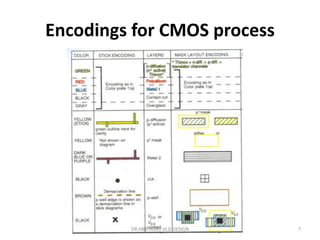
• Stick Diagrams may be used to convey the layer information
through the use of colour code.
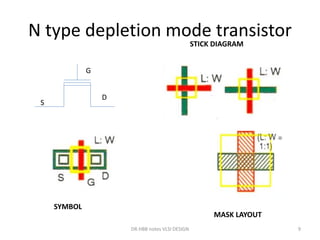
• Note: For Depletion mode transistor, Implant within the thin
oxide is a must.
• Stick diagram and mask layout is one and the same ,but in
mask layout ,aspect ratio (L:W) & distance between any
dimensions has to be shown.
• Nwell CMOS inverter:
In CMOS ,we have both pmos and nmos on same substrate, so
we take P-substrate and create n-well.
Apply VDD to all well in mask layout.
DR.HBB notes VLSI DESIGN 3
• N-well CMOS circuit are superior to p-well because of lower
substrate bias effects on transistor threshold and inherently low
parasitic capacitances associated with source and drain regions.
• For students ,some of the hints are:
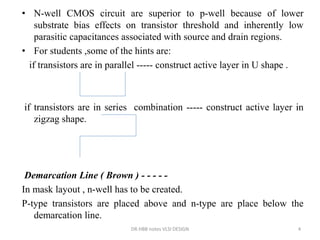
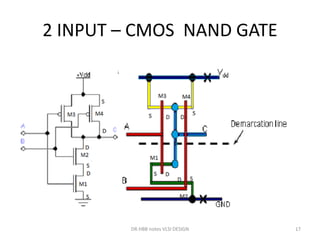
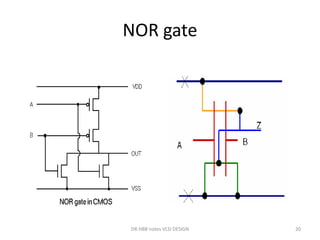
if transistors are in parallel ----- construct active layer in U shape .
if transistors are in series combination ----- construct active layer in
zigzag shape.
Demarcation Line ( Brown ) - - - - -
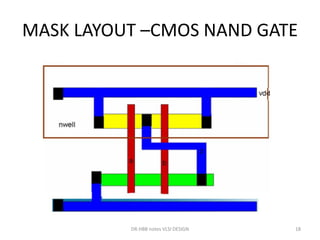
In mask layout , n-well has to be created.
P-type transistors are placed above and n-type are place below the
demarcation line.
DR.HBB notes VLSI DESIGN 4
• In cmos ,no depletion tr is used.
• In cmos ,Diffusion path must not cross demarcation line.
• n Diffusion and Diffusion wires must not join. ‘n’ and ‘p’ features
are normally joined by metal where a connection is needed.
• We should not forget to place a cross on Vdd and Vss rails to
represent the substrate and p well respectively.
• Metal and poly-silicon can cross demarcation line.
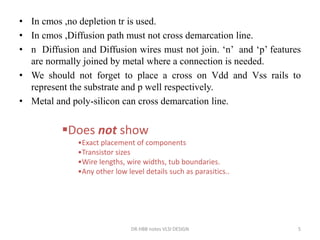
▪Does not show
•Exact placement of components
•Transistor sizes
•Wire lengths, wire widths, tub boundaries.
•Any other low level details such as parasitics..
DR.HBB notes VLSI DESIGN 5
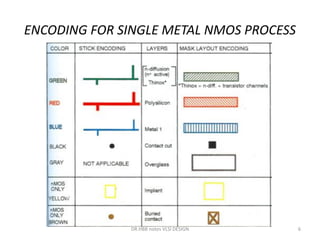
ENCODING FOR SINGLE METAL NMOS PROCESS
DR.HBB notes VLSI DESIGN 6
Encodings for CMOS process
DR.HBB notes VLSI DESIGN 7
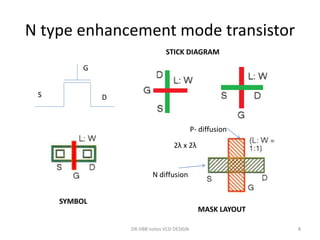
N type enhancement mode transistor
G
S D
STICK DIAGRAM
MASK LAYOUT
SYMBOL
2λ x 2λ
N diffusion
P- diffusion
DR.HBB notes VLSI DESIGN 8
N type depletion mode transistor
STICK DIAGRAM
SYMBOL
MASK LAYOUT
S
D
G
DR.HBB notes VLSI DESIGN 9
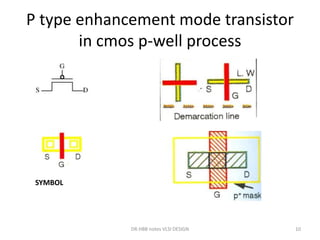
P type enhancement mode transistor
in cmos p-well process
SYMBOL
DR.HBB notes VLSI DESIGN 10
N type enhancement mode transistor
in cmos p-well process
SYMBOL
G
S D
DR.HBB notes VLSI DESIGN 11
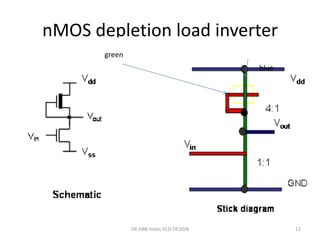
nMOS depletion load inverter
green
blue
DR.HBB notes VLSI DESIGN 12
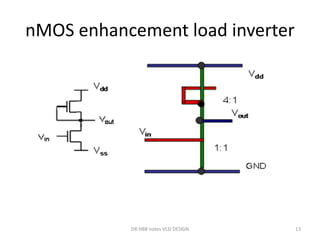
nMOS enhancement load inverter
DR.HBB notes VLSI DESIGN 13
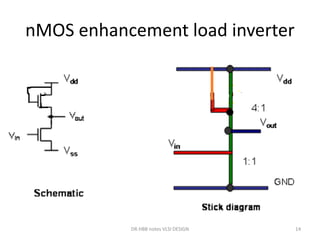
nMOS enhancement load inverter
DR.HBB notes VLSI DESIGN 14
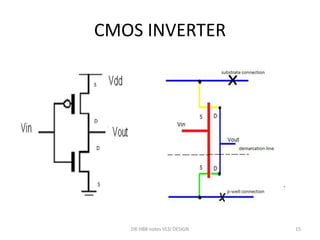
CMOS INVERTER
DR.HBB notes VLSI DESIGN 15
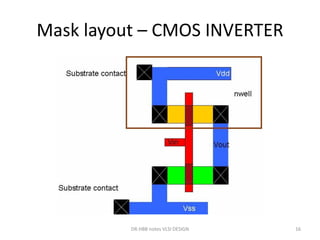
Mask layout – CMOS INVERTER
DR.HBB notes VLSI DESIGN 16
2 INPUT – CMOS NAND GATE
DR.HBB notes VLSI DESIGN 17
MASK LAYOUT –CMOS NAND GATE
DR.HBB notes VLSI DESIGN 18
Two input - Nmos NAND GATE
DR.HBB notes VLSI DESIGN 19
NOR gate
DR.HBB notes VLSI DESIGN 20
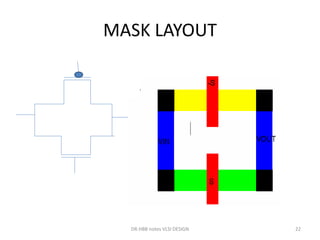
MASK LAYOUT –CMOS NOR GATE
DR.HBB notes VLSI DESIGN 21
MASK LAYOUT
DR.HBB notes VLSI DESIGN 22
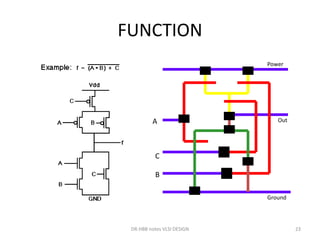
FUNCTION
Power
Ground
Out
A
C
B
DR.HBB notes VLSI DESIGN 23
stick diagram nMOS implementation
of the function f’ = [(x.y)+z]
DR.HBB notes VLSI DESIGN 24
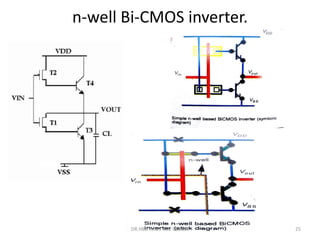
n-well Bi-CMOS inverter.
DR.HBB notes VLSI DESIGN 25
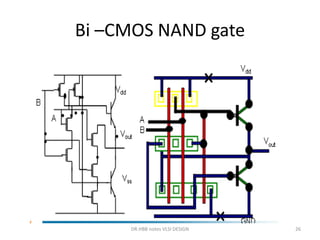
Bi –CMOS NAND gate
DR.HBB notes VLSI DESIGN 26
I bit cmos shift register
• Refer module -5 for stick diagram
DR.HBB notes VLSI DESIGN 27
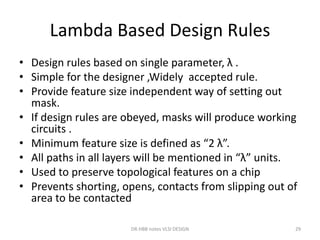
Design Rules
• Allow translation of circuits (usually in stick diagram
or symbolic form) into actual geometry in silicon
• Interface between circuit designer and fabrication
engineer
• Compromise
– Circuit designer wants tighter, smaller layouts or
improved performance.
– Process engineer wants design rules that result in
a controllable, reproducible process.
• Lambda based design rules – work of Mead and
Conway – used widely.
DR.HBB notes VLSI DESIGN 28
Lambda Based Design Rules
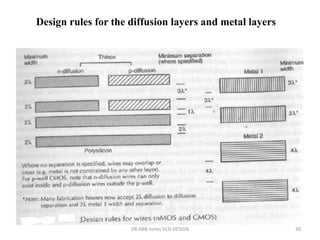
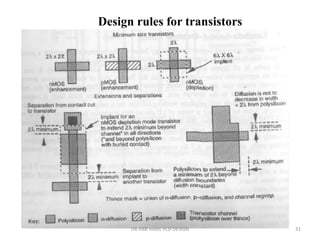
• Design rules based on single parameter, λ .
• Simple for the designer ,Widely accepted rule.
• Provide feature size independent way of setting out
mask.
• If design rules are obeyed, masks will produce working
circuits .
• Minimum feature size is defined as “2 λ”.
• All paths in all layers will be mentioned in “λ” units.
• Used to preserve topological features on a chip
• Prevents shorting, opens, contacts from slipping out of
area to be contacted
DR.HBB notes VLSI DESIGN 29
Design rules for the diffusion layers and metal layers
DR.HBB notes VLSI DESIGN 30
Design rules for transistors
DR.HBB notes VLSI DESIGN 31
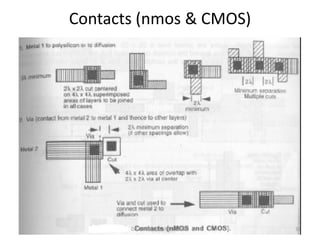
Contacts (nmos & CMOS)
DR.HBB notes VLSI DESIGN 32
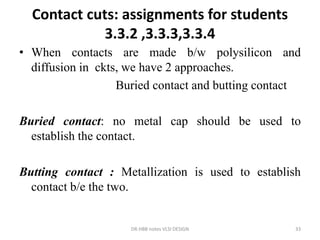
Contact cuts: assignments for students
3.3.2 ,3.3.3,3.3.4
• When contacts are made b/w polysilicon and
diffusion in ckts, we have 2 approaches.
Buried contact and butting contact
Buried contact: no metal cap should be used to
establish the contact.
Butting contact : Metallization is used to establish
contact b/e the two.
DR.HBB notes VLSI DESIGN 33
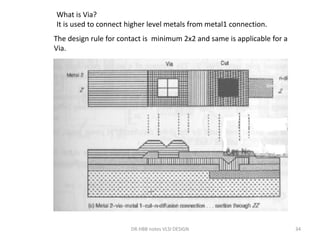
What is Via?
It is used to connect higher level metals from metal1 connection.
The design rule for contact is minimum 2x2 and same is applicable for a
Via.
DR.HBB notes VLSI DESIGN 34

VLSI-Module-3.pdf

  • 1.
    STICK DIAGRAMS MODULE 3 VLSIDESIGN 17EC63/15EC63 Dr.H.B.B ACSCE Bangalore DR.HBB notes VLSI DESIGN 1
  • 2.
    Introduction • A popularmethod of symbolic design ---- stick layout. • Designer draw a free hand sketch of a Layout, using coloured lines to represent various process layers such as Diffusion ( p or n) , Metal and Poly-silicon where Polysilicon layer crosses diffusion ------- Transistor are created. Metal wires join Diffusion or poly ------- contacts are formed. • Design rules are communication link b/w the designer specifying requirements and fabricator who materializes them. VLSI design aims to translate circuit concepts onto silicon. • First set of Design rules were introduced by Lambda based. DR.HBB notes VLSI DESIGN 2
  • 3.
    • Mask designis aimed at turning a specification into masks for processing silicon to meet the specification. • Stick Diagrams may be used to convey the layer information through the use of colour code. • Note: For Depletion mode transistor, Implant within the thin oxide is a must. • Stick diagram and mask layout is one and the same ,but in mask layout ,aspect ratio (L:W) & distance between any dimensions has to be shown. • Nwell CMOS inverter: In CMOS ,we have both pmos and nmos on same substrate, so we take P-substrate and create n-well. Apply VDD to all well in mask layout. DR.HBB notes VLSI DESIGN 3
  • 4.
    • N-well CMOScircuit are superior to p-well because of lower substrate bias effects on transistor threshold and inherently low parasitic capacitances associated with source and drain regions. • For students ,some of the hints are: if transistors are in parallel ----- construct active layer in U shape . if transistors are in series combination ----- construct active layer in zigzag shape. Demarcation Line ( Brown ) - - - - - In mask layout , n-well has to be created. P-type transistors are placed above and n-type are place below the demarcation line. DR.HBB notes VLSI DESIGN 4
  • 5.
    • In cmos,no depletion tr is used. • In cmos ,Diffusion path must not cross demarcation line. • n Diffusion and Diffusion wires must not join. ‘n’ and ‘p’ features are normally joined by metal where a connection is needed. • We should not forget to place a cross on Vdd and Vss rails to represent the substrate and p well respectively. • Metal and poly-silicon can cross demarcation line. ▪Does not show •Exact placement of components •Transistor sizes •Wire lengths, wire widths, tub boundaries. •Any other low level details such as parasitics.. DR.HBB notes VLSI DESIGN 5
  • 6.
    ENCODING FOR SINGLEMETAL NMOS PROCESS DR.HBB notes VLSI DESIGN 6
  • 7.
    Encodings for CMOSprocess DR.HBB notes VLSI DESIGN 7
  • 8.
    N type enhancementmode transistor G S D STICK DIAGRAM MASK LAYOUT SYMBOL 2λ x 2λ N diffusion P- diffusion DR.HBB notes VLSI DESIGN 8
  • 9.
    N type depletionmode transistor STICK DIAGRAM SYMBOL MASK LAYOUT S D G DR.HBB notes VLSI DESIGN 9
  • 10.
    P type enhancementmode transistor in cmos p-well process SYMBOL DR.HBB notes VLSI DESIGN 10
  • 11.
    N type enhancementmode transistor in cmos p-well process SYMBOL G S D DR.HBB notes VLSI DESIGN 11
  • 12.
    nMOS depletion loadinverter green blue DR.HBB notes VLSI DESIGN 12
  • 13.
    nMOS enhancement loadinverter DR.HBB notes VLSI DESIGN 13
  • 14.
    nMOS enhancement loadinverter DR.HBB notes VLSI DESIGN 14
  • 15.
  • 16.
    Mask layout –CMOS INVERTER DR.HBB notes VLSI DESIGN 16
  • 17.
    2 INPUT –CMOS NAND GATE DR.HBB notes VLSI DESIGN 17
  • 18.
    MASK LAYOUT –CMOSNAND GATE DR.HBB notes VLSI DESIGN 18
  • 19.
    Two input -Nmos NAND GATE DR.HBB notes VLSI DESIGN 19
  • 20.
    NOR gate DR.HBB notesVLSI DESIGN 20
  • 21.
    MASK LAYOUT –CMOSNOR GATE DR.HBB notes VLSI DESIGN 21
  • 22.
  • 23.
  • 24.
    stick diagram nMOSimplementation of the function f’ = [(x.y)+z] DR.HBB notes VLSI DESIGN 24
  • 25.
    n-well Bi-CMOS inverter. DR.HBBnotes VLSI DESIGN 25
  • 26.
    Bi –CMOS NANDgate DR.HBB notes VLSI DESIGN 26
  • 27.
    I bit cmosshift register • Refer module -5 for stick diagram DR.HBB notes VLSI DESIGN 27
  • 28.
    Design Rules • Allowtranslation of circuits (usually in stick diagram or symbolic form) into actual geometry in silicon • Interface between circuit designer and fabrication engineer • Compromise – Circuit designer wants tighter, smaller layouts or improved performance. – Process engineer wants design rules that result in a controllable, reproducible process. • Lambda based design rules – work of Mead and Conway – used widely. DR.HBB notes VLSI DESIGN 28
  • 29.
    Lambda Based DesignRules • Design rules based on single parameter, λ . • Simple for the designer ,Widely accepted rule. • Provide feature size independent way of setting out mask. • If design rules are obeyed, masks will produce working circuits . • Minimum feature size is defined as “2 λ”. • All paths in all layers will be mentioned in “λ” units. • Used to preserve topological features on a chip • Prevents shorting, opens, contacts from slipping out of area to be contacted DR.HBB notes VLSI DESIGN 29
  • 30.
    Design rules forthe diffusion layers and metal layers DR.HBB notes VLSI DESIGN 30
  • 31.
    Design rules fortransistors DR.HBB notes VLSI DESIGN 31
  • 32.
    Contacts (nmos &CMOS) DR.HBB notes VLSI DESIGN 32
  • 33.
    Contact cuts: assignmentsfor students 3.3.2 ,3.3.3,3.3.4 • When contacts are made b/w polysilicon and diffusion in ckts, we have 2 approaches. Buried contact and butting contact Buried contact: no metal cap should be used to establish the contact. Butting contact : Metallization is used to establish contact b/e the two. DR.HBB notes VLSI DESIGN 33
  • 34.
    What is Via? Itis used to connect higher level metals from metal1 connection. The design rule for contact is minimum 2x2 and same is applicable for a Via. DR.HBB notes VLSI DESIGN 34