UNIT-3
VLSI CIRCUIT DESIGN
PROCESS
CONTENTS:
➢ VLSI design flow
➢ MOS layers
➢ Stick Diagrams
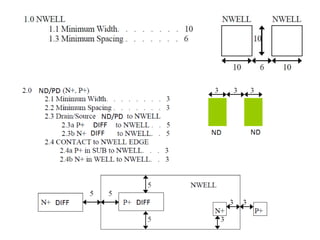
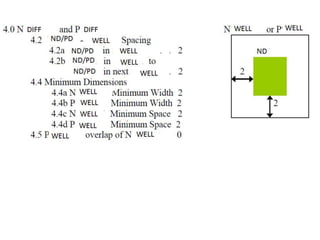
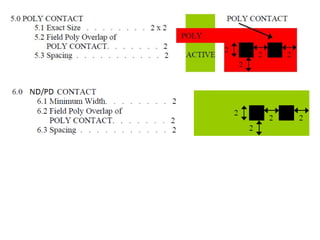
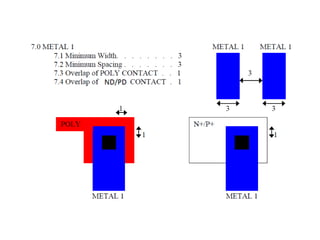
➢ Design Rules and Layout diagrams
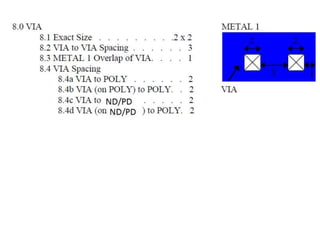
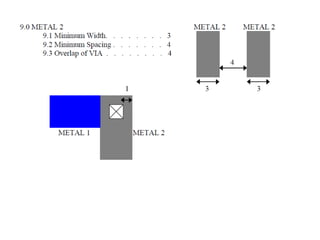
➢ 2µm Design Rules
➢ Layout Diagrams for Inverter, Logic gates
➢ Scaling of MOS
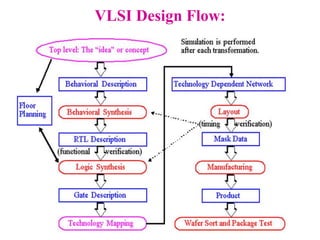
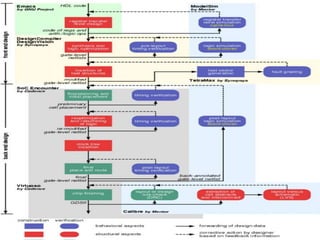
VLSI Design Flow:
MOS Layers :
There are 4 layers
• N-diffusion
• P-diffusion
• Poly Si
• Metal
Stick Diagrams :
➢ A stick diagram is a cartoon of a layout.
➢ Does show all components/ vias (except possibly tub
ties), relative placement.
➢ Does not show exact placement, transistor sizes, wire
lengths, wire widths, tub boundaries
• Key idea: "Stick figure cartoon" of a layout
• Useful for planning layout
o relative placement of transistors
o assignment of signals to layers
o connections between cells
o cell hierarchy
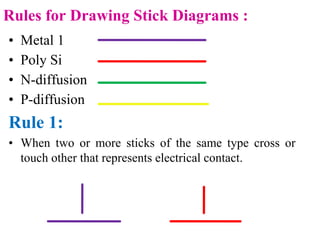
Rules for Drawing Stick Diagrams :
• Metal 1
• Poly Si
• N-diffusion
• P-diffusion
Rule 1:
• When two or more sticks of the same type cross or
touch other that represents electrical contact.
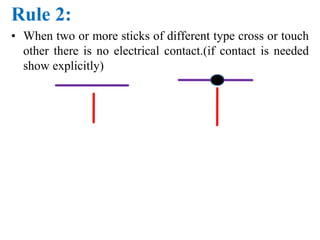
Rule 2:
• When two or more sticks of different type cross or touch
other there is no electrical contact.(if contact is needed
show explicitly)
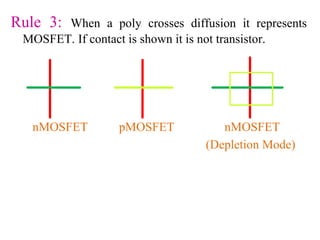
Rule 3: When a poly crosses diffusion it represents
MOSFET. If contact is shown it is not transistor.
nMOSFET pMOSFET nMOSFET
(Depletion Mode)
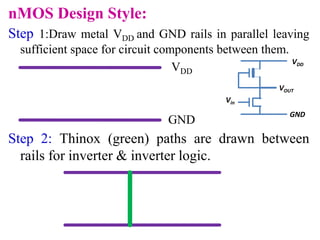
nMOS Design Style:
Step 1:Draw metal VDD and GND rails in parallel leaving
sufficient space for circuit components between them.
VDD
GND
Step 2: Thinox (green) paths are drawn between
rails for inverter & inverter logic.
Vin
VOUT
VDD
GND
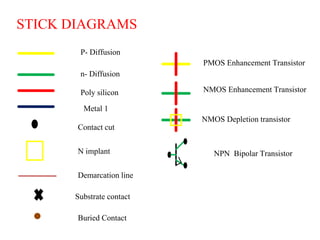
STICK DIAGRAMS
P- Diffusion
n- Diffusion
Poly silicon
Metal 1
Contact cut
N implant
Demarcation line
Substrate contact
PMOS Enhancement Transistor
NMOS Enhancement Transistor
NMOS Depletion transistor
NPN Bipolar Transistor
Buried Contact
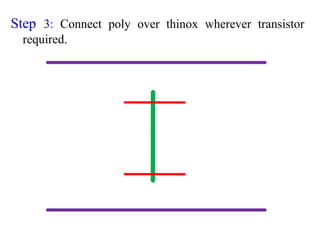
Step 3: Connect poly over thinox wherever transistor
required.
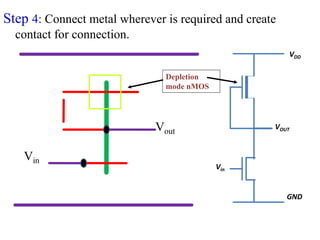
Step 4: Connect metal wherever is required and create
contact for connection.
Vout
Vin
Vin
VOUT
VDD
GND
Depletion
mode nMOS
VDD
GND
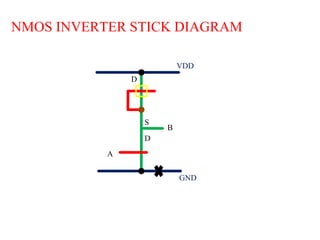
NMOS INVERTER STICK DIAGRAM
D
A
B
S
D
VDD
GND
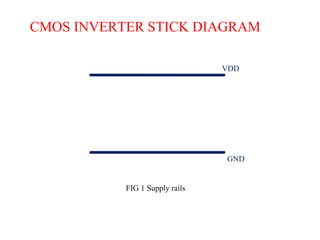
CMOS INVERTER STICK DIAGRAM
FIG 1 Supply rails
VDD
GND
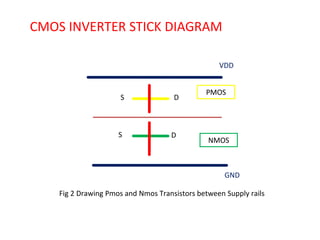
PMOS
NMOS
S
S
D
D
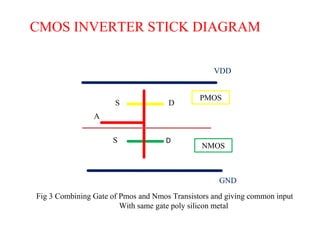
CMOS INVERTER STICK DIAGRAM
Fig 2 Drawing Pmos and Nmos Transistors between Supply rails
VDD
GND
PMOS
NMOS
A
S
S
D
D
CMOS INVERTER STICK DIAGRAM
Fig 3 Combining Gate of Pmos and Nmos Transistors and giving common input
With same gate poly silicon metal
VDD
GND
PMOS
NMOS
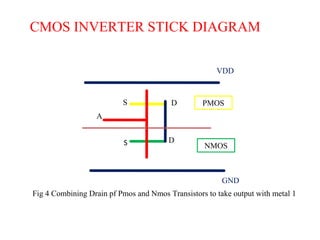
A
D
S
S D
CMOS INVERTER STICK DIAGRAM
Fig 4 Combining Drain pf Pmos and Nmos Transistors to take output with metal 1
VDD
GND
PMOS
NMOS
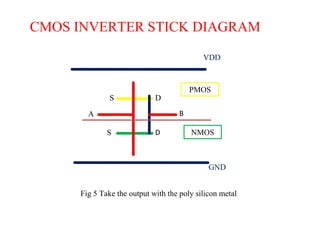
D
A
S
S D
B
CMOS INVERTER STICK DIAGRAM
Fig 5 Take the output with the poly silicon metal
VDD
GND
PMOS
NMOS
D
A
S
S D
B
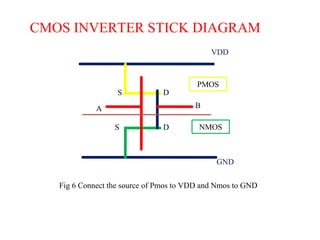
CMOS INVERTER STICK DIAGRAM
Fig 6 Connect the source of Pmos to VDD and Nmos to GND
VDD
GND
PMOS
NMOS
D
A
S
S D
B
CONTAC
T
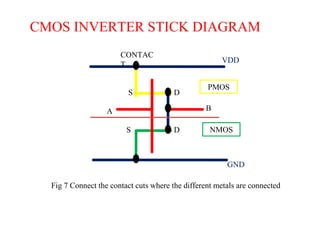
CMOS INVERTER STICK DIAGRAM
Fig 7 Connect the contact cuts where the different metals are connected
VDD
GND
PMOS
NMOS
D
A
S
S D
B
CONTAC
T
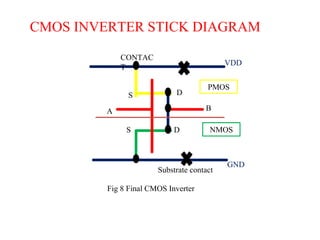
CMOS INVERTER STICK DIAGRAM
Fig 8 Final CMOS Inverter
Substrate contact
VDD
GND
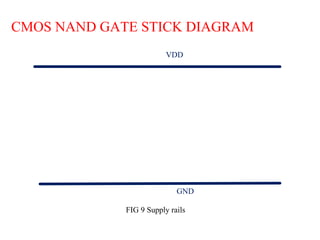
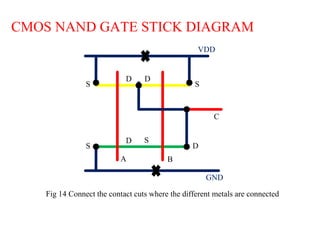
CMOS NAND GATE STICK DIAGRAM
FIG 9 Supply rails
VDD
GND
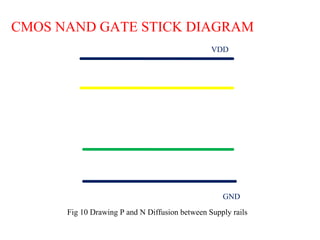
CMOS NAND GATE STICK DIAGRAM
Fig 10 Drawing P and N Diffusion between Supply rails
VDD
GND
S
S
S
D
D
D
D
S
A B
C
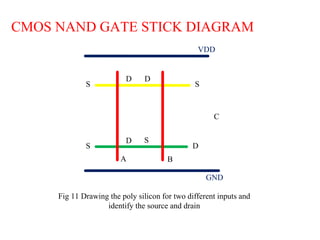
CMOS NAND GATE STICK DIAGRAM
Fig 11 Drawing the poly silicon for two different inputs and
identify the source and drain
VDD
GND
S
S
S
D
D
D
D
S
A B
C
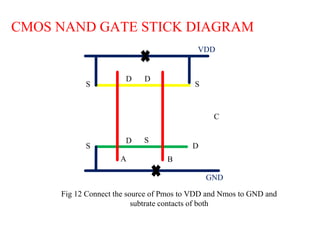
CMOS NAND GATE STICK DIAGRAM
Fig 12 Connect the source of Pmos to VDD and Nmos to GND and
subtrate contacts of both
VDD
GND
S
S
S
D
D
D
D
S
A B
C
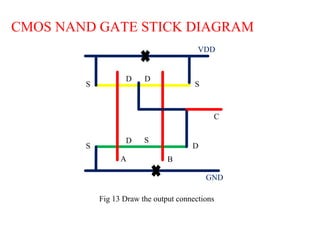
CMOS NAND GATE STICK DIAGRAM
Fig 13 Draw the output connections
VDD
GND
S
S
S
D
D
D
D
S
A B
C
CMOS NAND GATE STICK DIAGRAM
Fig 14 Connect the contact cuts where the different metals are connected
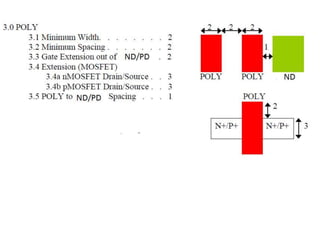
LAYOUT
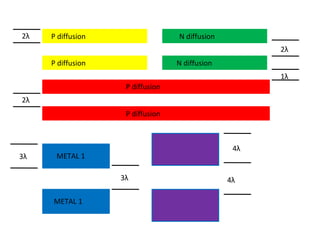
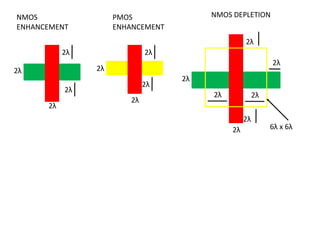
2λ
2λ
1λ
2λ
3λ
P diffusion N diffusion
P diffusion
P diffusion N diffusion
P diffusion
METAL 1
METAL 1
4λ
4λ
3λ
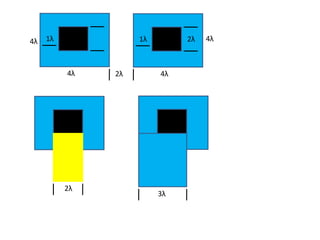
2λ
4λ
4λ
1λ 2λ 4λ
4λ
1λ
2λ
3λ
2λ
2λ
2λ
2λ
2λ
2λ
2λ
2λ
2λ
2λ
6λ x 6λ
2λ
2λ
2λ
2λ
2λ
NMOS
ENHANCEMENT
PMOS
ENHANCEMENT
NMOS DEPLETION
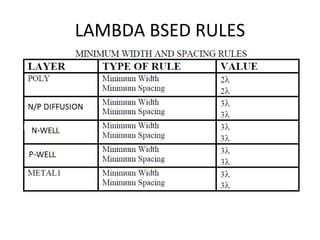
LAMBDA BSED RULES
Scaling
• VLSI technology is constantly evolving towards
smaller line widths
• Reduced feature size generally leads to
– better / faster performance
– More gate / chip
• More accurate description of modern technology
is ULSI (ultra large scale integration
Scaling Factors
• In our discussions we will consider 2 scaling
factors, α and β
• 1/ β is the scaling factor for VDD and oxide
thickness D
• 1/ α is scaling factor for all other linear
dimensions
• We will assume electric field is kept constant
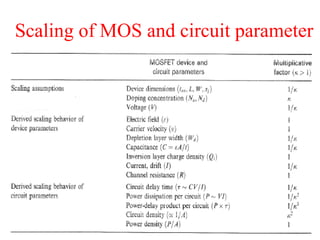
Scaling Factors for Device Parameters
Simple derivations showing the effects of scaling are derived in Pucknell
and Eshraghian pages 125 - 129
It is important that you understand how the following parameters are
effected by scaling.
• Gate Area
• Gate Capacitance per unit area
• Gate Capacitance
• Charge in Channel
• Channel Resistance
• Transistor Delay
• Maximum Operating Frequency
• Transistor Current
• Switching Energy
• Power Dissipation Per Gate (Static and Dynamic)
• Power Dissipation Per Unit Area
• Power - Speed Product
MOSFET Scaling
❑ Constant Field Scaling
❑ Constant Voltage Scaling
❑ Lateral Scaling
❑SCALING - refers to ordered reduction in dimensions of the
MOSFET and other VLSI features
❑Reduce Size of VLSI chips.
❑Change operational characteristics of MOSFETs and parasitic.
❑Physical limits restrict degree of scaling that can be achieved.
Constant Field Scaling
❑ The electric field E is kept constant, and the scaled device is
obtained by applying a dimensionless scale-factor α (such
that E is unchanged):
❑ all dimensions, including those vertical to the
surface (1/α)
❑ device voltages (1/α)
❑ the concentration densities (α).
Constant Voltage Scaling
❑ Vdd is kept constant.
❑ All dimensions, including those vertical to the surface
are scaled.
❑ Concentration densities are scaled.
Lateral Scaling
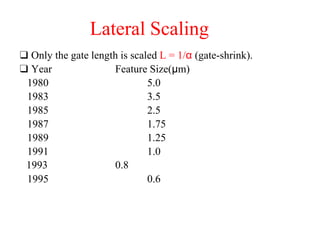
❑ Only the gate length is scaled L = 1/α (gate-shrink).
❑ Year Feature Size(μm)
1980 5.0
1983 3.5
1985 2.5
1987 1.75
1989 1.25
1991 1.0
1993 0.8
1995 0.6
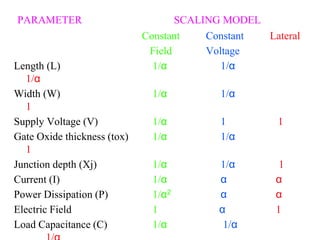
PARAMETER SCALING MODEL
Constant Constant Lateral
Field Voltage
Length (L) 1/α 1/α
1/α
Width (W) 1/α 1/α
1
Supply Voltage (V) 1/α 1 1
Gate Oxide thickness (tox) 1/α 1/α
1
Junction depth (Xj) 1/α 1/α 1
Current (I) 1/α α α
Power Dissipation (P) 1/α2 α α
Electric Field 1 α 1
Load Capacitance (C) 1/α 1/α
Scaling of Interconnects
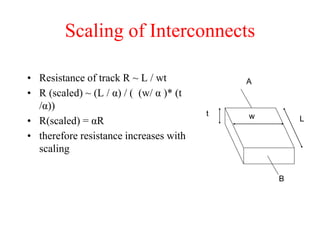
• Resistance of track R ~ L / wt
• R (scaled) ~ (L / α) / ( (w/ α )* (t
/α))
• R(scaled) = αR
• therefore resistance increases with
scaling
t w L
A
B
Scaling - Time Constant
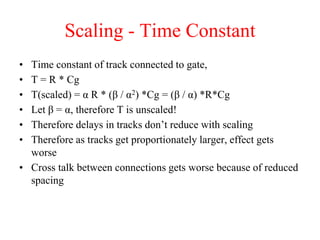
• Time constant of track connected to gate,
• T = R * Cg
• T(scaled) = α R * (β / α2) *Cg = (β / α) *R*Cg
• Let β = α, therefore T is unscaled!
• Therefore delays in tracks don’t reduce with scaling
• Therefore as tracks get proportionately larger, effect gets
worse
• Cross talk between connections gets worse because of reduced
spacing
Scaling of MOS and circuit parameter

Vasbesaggvlsiunit-3 VLSI circuit design.pptx

  • 1.
  • 2.
    CONTENTS: ➢ VLSI designflow ➢ MOS layers ➢ Stick Diagrams ➢ Design Rules and Layout diagrams ➢ 2µm Design Rules ➢ Layout Diagrams for Inverter, Logic gates ➢ Scaling of MOS
  • 3.
  • 5.
    MOS Layers : Thereare 4 layers • N-diffusion • P-diffusion • Poly Si • Metal
  • 6.
    Stick Diagrams : ➢A stick diagram is a cartoon of a layout. ➢ Does show all components/ vias (except possibly tub ties), relative placement. ➢ Does not show exact placement, transistor sizes, wire lengths, wire widths, tub boundaries
  • 7.
    • Key idea:"Stick figure cartoon" of a layout • Useful for planning layout o relative placement of transistors o assignment of signals to layers o connections between cells o cell hierarchy
  • 8.
    Rules for DrawingStick Diagrams : • Metal 1 • Poly Si • N-diffusion • P-diffusion Rule 1: • When two or more sticks of the same type cross or touch other that represents electrical contact.
  • 9.
    Rule 2: • Whentwo or more sticks of different type cross or touch other there is no electrical contact.(if contact is needed show explicitly)
  • 10.
    Rule 3: Whena poly crosses diffusion it represents MOSFET. If contact is shown it is not transistor. nMOSFET pMOSFET nMOSFET (Depletion Mode)
  • 11.
    nMOS Design Style: Step1:Draw metal VDD and GND rails in parallel leaving sufficient space for circuit components between them. VDD GND Step 2: Thinox (green) paths are drawn between rails for inverter & inverter logic. Vin VOUT VDD GND
  • 12.
    STICK DIAGRAMS P- Diffusion n-Diffusion Poly silicon Metal 1 Contact cut N implant Demarcation line Substrate contact PMOS Enhancement Transistor NMOS Enhancement Transistor NMOS Depletion transistor NPN Bipolar Transistor Buried Contact
  • 13.
    Step 3: Connectpoly over thinox wherever transistor required.
  • 14.
    Step 4: Connectmetal wherever is required and create contact for connection. Vout Vin Vin VOUT VDD GND Depletion mode nMOS
  • 15.
    VDD GND NMOS INVERTER STICKDIAGRAM D A B S D
  • 16.
    VDD GND CMOS INVERTER STICKDIAGRAM FIG 1 Supply rails
  • 17.
    VDD GND PMOS NMOS S S D D CMOS INVERTER STICKDIAGRAM Fig 2 Drawing Pmos and Nmos Transistors between Supply rails
  • 18.
    VDD GND PMOS NMOS A S S D D CMOS INVERTER STICKDIAGRAM Fig 3 Combining Gate of Pmos and Nmos Transistors and giving common input With same gate poly silicon metal
  • 19.
    VDD GND PMOS NMOS A D S S D CMOS INVERTERSTICK DIAGRAM Fig 4 Combining Drain pf Pmos and Nmos Transistors to take output with metal 1
  • 20.
    VDD GND PMOS NMOS D A S S D B CMOS INVERTERSTICK DIAGRAM Fig 5 Take the output with the poly silicon metal
  • 21.
    VDD GND PMOS NMOS D A S S D B CMOS INVERTERSTICK DIAGRAM Fig 6 Connect the source of Pmos to VDD and Nmos to GND
  • 22.
    VDD GND PMOS NMOS D A S S D B CONTAC T CMOS INVERTERSTICK DIAGRAM Fig 7 Connect the contact cuts where the different metals are connected
  • 23.
    VDD GND PMOS NMOS D A S S D B CONTAC T CMOS INVERTERSTICK DIAGRAM Fig 8 Final CMOS Inverter Substrate contact
  • 24.
    VDD GND CMOS NAND GATESTICK DIAGRAM FIG 9 Supply rails
  • 25.
    VDD GND CMOS NAND GATESTICK DIAGRAM Fig 10 Drawing P and N Diffusion between Supply rails
  • 26.
    VDD GND S S S D D D D S A B C CMOS NANDGATE STICK DIAGRAM Fig 11 Drawing the poly silicon for two different inputs and identify the source and drain
  • 27.
    VDD GND S S S D D D D S A B C CMOS NANDGATE STICK DIAGRAM Fig 12 Connect the source of Pmos to VDD and Nmos to GND and subtrate contacts of both
  • 28.
    VDD GND S S S D D D D S A B C CMOS NANDGATE STICK DIAGRAM Fig 13 Draw the output connections
  • 29.
    VDD GND S S S D D D D S A B C CMOS NANDGATE STICK DIAGRAM Fig 14 Connect the contact cuts where the different metals are connected
  • 30.
  • 31.
    2λ 2λ 1λ 2λ 3λ P diffusion Ndiffusion P diffusion P diffusion N diffusion P diffusion METAL 1 METAL 1 4λ 4λ 3λ
  • 32.
  • 33.
  • 34.
  • 44.
    Scaling • VLSI technologyis constantly evolving towards smaller line widths • Reduced feature size generally leads to – better / faster performance – More gate / chip • More accurate description of modern technology is ULSI (ultra large scale integration
  • 45.
    Scaling Factors • Inour discussions we will consider 2 scaling factors, α and β • 1/ β is the scaling factor for VDD and oxide thickness D • 1/ α is scaling factor for all other linear dimensions • We will assume electric field is kept constant
  • 46.
    Scaling Factors forDevice Parameters Simple derivations showing the effects of scaling are derived in Pucknell and Eshraghian pages 125 - 129 It is important that you understand how the following parameters are effected by scaling. • Gate Area • Gate Capacitance per unit area • Gate Capacitance • Charge in Channel • Channel Resistance • Transistor Delay • Maximum Operating Frequency • Transistor Current • Switching Energy • Power Dissipation Per Gate (Static and Dynamic) • Power Dissipation Per Unit Area • Power - Speed Product
  • 47.
    MOSFET Scaling ❑ ConstantField Scaling ❑ Constant Voltage Scaling ❑ Lateral Scaling ❑SCALING - refers to ordered reduction in dimensions of the MOSFET and other VLSI features ❑Reduce Size of VLSI chips. ❑Change operational characteristics of MOSFETs and parasitic. ❑Physical limits restrict degree of scaling that can be achieved.
  • 48.
    Constant Field Scaling ❑The electric field E is kept constant, and the scaled device is obtained by applying a dimensionless scale-factor α (such that E is unchanged): ❑ all dimensions, including those vertical to the surface (1/α) ❑ device voltages (1/α) ❑ the concentration densities (α).
  • 49.
    Constant Voltage Scaling ❑Vdd is kept constant. ❑ All dimensions, including those vertical to the surface are scaled. ❑ Concentration densities are scaled.
  • 50.
    Lateral Scaling ❑ Onlythe gate length is scaled L = 1/α (gate-shrink). ❑ Year Feature Size(μm) 1980 5.0 1983 3.5 1985 2.5 1987 1.75 1989 1.25 1991 1.0 1993 0.8 1995 0.6
  • 51.
    PARAMETER SCALING MODEL ConstantConstant Lateral Field Voltage Length (L) 1/α 1/α 1/α Width (W) 1/α 1/α 1 Supply Voltage (V) 1/α 1 1 Gate Oxide thickness (tox) 1/α 1/α 1 Junction depth (Xj) 1/α 1/α 1 Current (I) 1/α α α Power Dissipation (P) 1/α2 α α Electric Field 1 α 1 Load Capacitance (C) 1/α 1/α
  • 52.
    Scaling of Interconnects •Resistance of track R ~ L / wt • R (scaled) ~ (L / α) / ( (w/ α )* (t /α)) • R(scaled) = αR • therefore resistance increases with scaling t w L A B
  • 53.
    Scaling - TimeConstant • Time constant of track connected to gate, • T = R * Cg • T(scaled) = α R * (β / α2) *Cg = (β / α) *R*Cg • Let β = α, therefore T is unscaled! • Therefore delays in tracks don’t reduce with scaling • Therefore as tracks get proportionately larger, effect gets worse • Cross talk between connections gets worse because of reduced spacing
  • 54.
    Scaling of MOSand circuit parameter