Studocu is not sponsored or endorsed by any college or university
Module 2 MOS AND Bi CMOS Circuit Design Process
Vlsi Design (Delhi Technological University)
Studocu is not sponsored or endorsed by any college or university
Module 2 MOS AND Bi CMOS Circuit Design Process
Vlsi Design (Delhi Technological University)
Downloaded by Mr. RAVI KUMAR I (iravikumar@biet.ac.in)
lOMoARcPSD|3283145
.
Module 2
MOS and BiCMOS Circuit Design Processes
2.1 MOS Layers:
• MOS circuits are basically formed by 4 layers
 Metal
 Polysilicon
 N diffusion
 P diffusion
• Here all the 4 layers are isolated from each other through thick or thin oxide layer (i.e., silicon
dioxide layer)
• The thin oxide (thinox) layer includes n-diffusion, p-diffusion and transistor channel.
2.2 Stick diagram:
• Stick diagrams are a means of capturing topography and layer information using simple
diagrams.
• They convey layer information through color codes (or monochrome encoding).
• Acts as an interface between symbolic circuit and the actual layout.
• Stick diagrams do show all components/vias(contacts), relative placement of components and
helps in planning and routing. It goes one step closer to layout.
• However they do not show exact placement of components, transistor sizes, length and width
of wires also the boundaries. Thus we can say that it does not give any low level details.
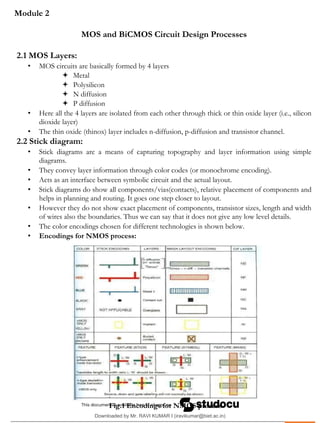
• The color encodings chosen for different technologies is shown below.
• Encodings for NMOS process:
Fig.1 Encodings for NMOS process
Downloaded by Mr. RAVI KUMAR I (iravikumar@biet.ac.in)
lOMoARcPSD|3283145
.
Procedure to draw Stick Diagram:
2.3 Nmos Design Process.
1) Draw two metal lines/ power rails providing sufficient space to accommodate all transistors. i.e:
Vdd & Vss.
2) Draw common n+ diffusion layer for all the transistors.
3) Provide Vdd and Vss contacts.
4) Draw polysilicon to cross n+ diffusion layer to form transistors.
5) Create buried contact for depletion transistor.
6) Provide input and output connection.
2.4 CMOS Design Process:
• Two type of transistors are used i.e: Nmos and Pmos, thus in stick diagram demarcation line is
used to separate them.
• All Pmos transistors are placed above Demarcation line and Nmos transistors below
demarcation line.
• While drawing stick Diagram
1. Diffusion paths must not cross the demarcation line 2. N-
diffusion and P-diffusion wires must not join.
3. Nmos and Pmos transistors are joined by Metal layer when it is required.
4. Cross must be placed on Vdd and Vss which represent substrate and P-well connection
respectively.
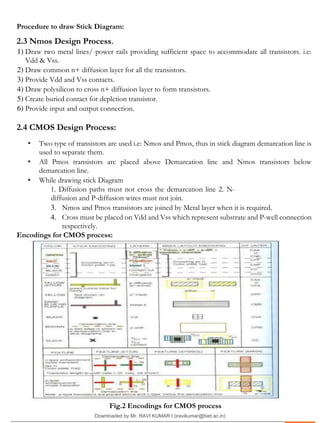
Encodings for CMOS process:
Fig.2 Encodings for CMOS process
Downloaded by Mr. RAVI KUMAR I (iravikumar@biet.ac.in)
lOMoARcPSD|3283145
.
Procedure to draw Stick Diagram:
1) Draw two metal lines/ power rails providing sufficient space to accommodate all transistors. i.e:
Vdd & Vss.
2) Draw demarcation line in the middle of the two power lines.
3) Draw P+ diffusion above demarcation and N+ diffusion below demarcation
4) Draw polysilicon to represent Pmos and Nmos which represents gates of the transistor.
5) Connect source terminal of transistors to supply.
6) Drain terminals of transistor are connected using metal 1.
7) Place contact cuts wherever necessary.
8) Draw X which represents substrate and P-well contact on power lines.
2.5 DESIGN RULES AND LAYOUTS
Layout: describes actual layers and geometry on silicon substrate to implement a function
(Expressions).
[Diffusion region where transistor can be formed is called active region, polysilicon serves as the gate
of MOS transistor. L defines channel length and W represents width of channel/active region]
Design rules: are set of guidelines which specify minimum dimension and spacing allowed in layout
drawing. Design rules also acts a communication link between circuit designers and process engineers
during manufacturing phase.
Goal of design rule: is to achieve optimum yield. Yield = (No. of good chips on wafer)/(Total no. of
chips on wafer).
Design rules are also called layout rules. If the circuit performance has to be increased then rules must
be more aggressive. Else this leads to non-function of the circuit or yield reduction.
There are two rules.
1. Micron Rule - Absolute Dimension rule, here all sizes and spacing are specified in micron. Here
the circuit density is the important goal.
2. Lambda (λ) Based Rules - The Lambda based design rules are proposed by Mead and Conway.
Scalable design rules, here this design rule normalizes all geometric design rule by parameter lambda
(λ) also called as scaling factor/feature size. In this all mask patterns are expressed as multiples of
lambda.
Advantages of lambda based design rules:
1. The mask layout can be scaled down proportionally if the feature size of the fabrication process is
reduced.
2. Design rules are conservative.
3. This rule enable technology changes and design reuse and reduced design cost.
Disadvantages:
1. Linear scaling cannot be extended and is limited over range of dimension (1-3 μm)
2. As rules are conservative, results in over dimension and density of design is less.
Downloaded by Mr. RAVI KUMAR I (iravikumar@biet.ac.in)
lOMoARcPSD|3283145
.
2.6 Lambda (λ) Based Rules
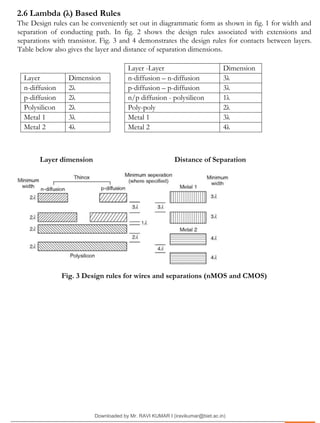
The Design rules can be conveniently set out in diagrammatic form as shown in fig. 1 for width and
separation of conducting path. In fig. 2 shows the design rules associated with extensions and
separations with transistor. Fig. 3 and 4 demonstrates the design rules for contacts between layers.
Table below also gives the layer and distance of separation dimensions.
Layer Dimension
n-diffusion 2λ
p-diffusion 2λ
Polysilicon 2λ
Metal 1 3λ
Metal 2 4λ
Layer -Layer Dimension
n-diffusion – n-diffusion 3λ
p-diffusion – p-diffusion 3λ
n/p diffusion - polysilicon 1λ
Poly-poly 2λ
Metal 1 3λ
Metal 2 4λ
Layer dimension Distance of Separation
Fig. 3 Design rules for wires and separations (nMOS and CMOS)
Downloaded by Mr. RAVI KUMAR I (iravikumar@biet.ac.in)
lOMoARcPSD|3283145
.
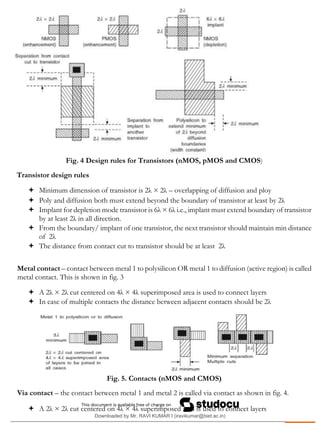
Fig. 4 Design rules for Transistors (nMOS, pMOS and CMOS)
Transistor design rules
 Minimum dimension of transistor is 2λ × 2λ – overlapping of diffusion and ploy
 Poly and diffusion both must extend beyond the boundary of transistor at least by 2λ
 Implant for depletion mode transistor is 6λ × 6λ i.e., implant must extend boundary of transistor
by at least 2λ in all direction.
 From the boundary/ implant of one transistor, the next transistor should maintain min distance
of 2λ
 The distance from contact cut to transistor should be at least 2λ
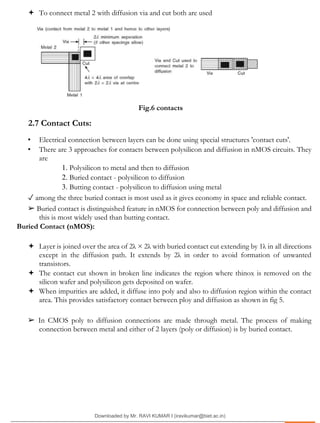
Metal contact – contact between metal 1 to polysilicon OR metal 1 to diffusion (active region) is called
metal contact. This is shown in fig. 3
 A 2λ × 2λ cut centered on 4λ × 4λ superimposed area is used to connect layers
 In case of multiple contacts the distance between adjacent contacts should be 2λ
Fig. 5. Contacts (nMOS and CMOS)
Via contact – the contact between metal 1 and metal 2 is called via contact as shown in fig. 4.
 A 2λ × 2λ cut centered on 4λ × 4λ superimposed area is used to connect layers
Downloaded by Mr. RAVI KUMAR I (iravikumar@biet.ac.in)
lOMoARcPSD|3283145
.
 To connect metal 2 with diffusion via and cut both are used
Fig.6 contacts
2.7 Contact Cuts:
• Electrical connection between layers can be done using special structures 'contact cuts'.
• There are 3 approaches for contacts between polysilicon and diffusion in nMOS circuits. They
are
1. Polysilicon to metal and then to diffusion
2. Buried contact - polysilicon to diffusion
3. Butting contact - polysilicon to diffusion using metal
✓ among the three buried contact is most used as it gives economy in space and reliable contact.
➢ Buried contact is distinguished feature in nMOS for connection between poly and diffusion and
this is most widely used than butting contact.
Buried Contact (nMOS):
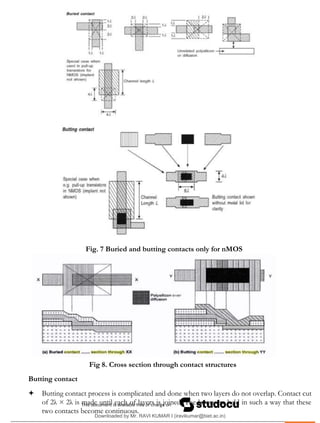
 Layer is joined over the area of 2λ × 2λ with buried contact cut extending by 1λ in all directions
except in the diffusion path. It extends by 2λ in order to avoid formation of unwanted
transistors.
 The contact cut shown in broken line indicates the region where thinox is removed on the
silicon wafer and polysilicon gets deposited on wafer.
 When impurities are added, it diffuse into poly and also to diffusion region within the contact
area. This provides satisfactory contact between ploy and diffusion as shown in fig 5.
➢ In CMOS poly to diffusion connections are made through metal. The process of making
connection between metal and either of 2 layers (poly or diffusion) is by buried contact.
Downloaded by Mr. RAVI KUMAR I (iravikumar@biet.ac.in)
lOMoARcPSD|3283145
.
Fig. 7 Buried and butting contacts only for nMOS
Fig 8. Cross section through contact structures
Butting contact
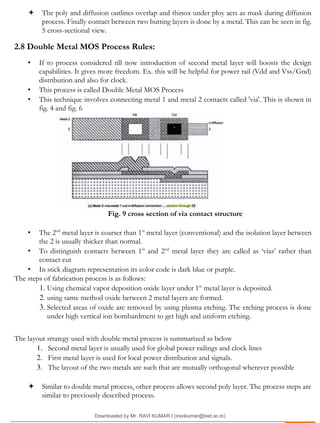
 Butting contact process is complicated and done when two layers do not overlap. Contact cut
of 2λ × 2λ is made until each of layers is joined. The layers are held in such a way that these
two contacts become continuous.
Downloaded by Mr. RAVI KUMAR I (iravikumar@biet.ac.in)
lOMoARcPSD|3283145
.
 The poly and diffusion outlines overlap and thinox under ploy acts as mask during diffusion
process. Finally contact between two butting layers is done by a metal. This can be seen in fig.
5 cross-sectional view.
2.8 Double Metal MOS Process Rules:
• If to process considered till now introduction of second metal layer will boosts the design
capabilities. It gives more freedom. Ex. this will be helpful for power rail (Vdd and Vss/Gnd)
distribution and also for clock.
• This process is called Double Metal MOS Process
• This technique involves connecting metal 1 and metal 2 contacts called 'via'. This is shown in
fig. 4 and fig. 6
Fig. 9 cross section of via contact structure
• The 2nd
metal layer is coarser than 1st
metal layer (conventional) and the isolation layer between
the 2 is usually thicker than normal.
• To distinguish contacts between 1st
and 2nd
metal layer they are called as ‘vias’ rather than
contact cut
• In stick diagram representation its color code is dark blue or purple.
The steps of fabrication process is as follows:
1. Using chemical vapor deposition oxide layer under 1st
metal layer is deposited.
2. using same method oxide between 2 metal layers are formed.
3. Selected areas of oxide are removed by using plasma etching. The etching process is done
under high vertical ion bombardment to get high and uniform etching.
The layout strategy used with double metal process is summarized as below
1. Second metal layer is usually used for global power railings and clock lines
2. First metal layer is used for local power distribution and signals.
3. The layout of the two metals are such that are mutually orthogonal wherever possible
 Similar to double metal process, other process allows second poly layer. The process steps are
similar to previously described process.
Downloaded by Mr. RAVI KUMAR I (iravikumar@biet.ac.in)
lOMoARcPSD|3283145
.
 The first polysilicon (poly 1) layer is deposited and patterned on this a second thinox (thin
oxide) layer is grown. On this the second polysilicon (poly 2) layer is deposited and patterned.
Thus 2nd
thinox isolated the poly layers.
 Presence of poly 2 provides greater flexibility in interconnections and allows transistors to be
formed by intersection of poly 2 and diffusion.
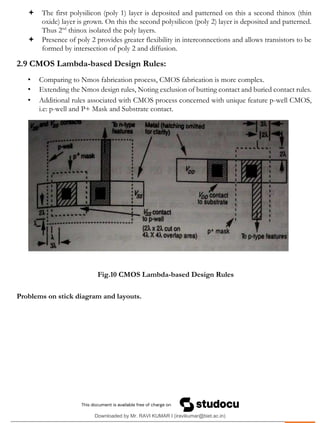
2.9 CMOS Lambda-based Design Rules:
• Comparing to Nmos fabrication process, CMOS fabrication is more complex.
• Extending the Nmos design rules, Noting exclusion of butting contact and buried contact rules.
• Additional rules associated with CMOS process concerned with unique feature p-well CMOS,
i.e: p-well and P+ Mask and Substrate contact.
Fig.10 CMOS Lambda-based Design Rules
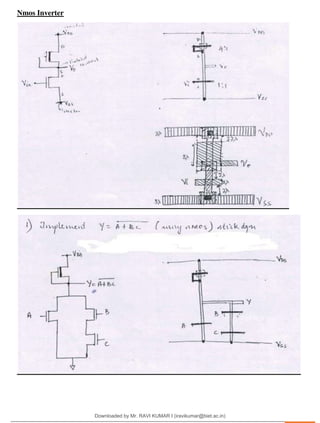
Problems on stick diagram and layouts.
Downloaded by Mr. RAVI KUMAR I (iravikumar@biet.ac.in)
lOMoARcPSD|3283145
.
Nmos Inverter
Downloaded by Mr. RAVI KUMAR I (iravikumar@biet.ac.in)
lOMoARcPSD|3283145
.
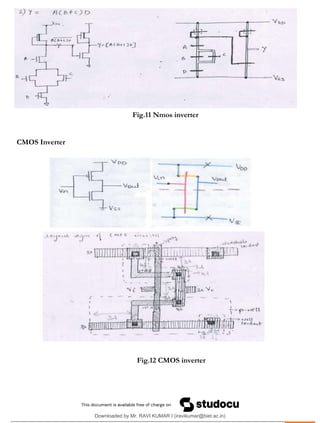
Fig.11 Nmos inverter
CMOS Inverter
Fig.12 CMOS inverter
Downloaded by Mr. RAVI KUMAR I (iravikumar@biet.ac.in)
lOMoARcPSD|3283145
.
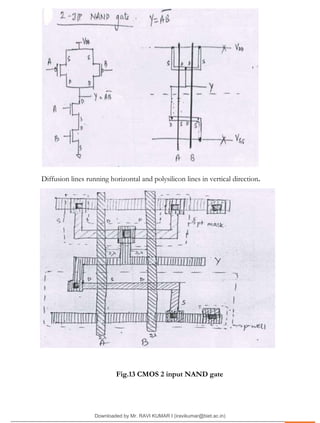
Diffusion lines running horizontal and polysilicon lines in vertical direction.
Fig.13 CMOS 2 input NAND gate
Downloaded by Mr. RAVI KUMAR I (iravikumar@biet.ac.in)
lOMoARcPSD|3283145
.
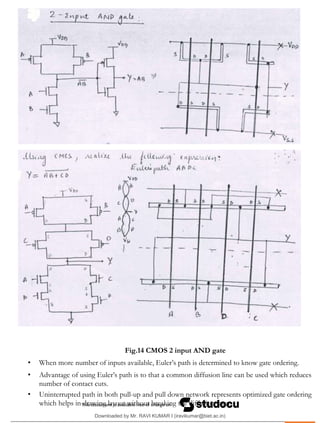
Fig.14 CMOS 2 input AND gate
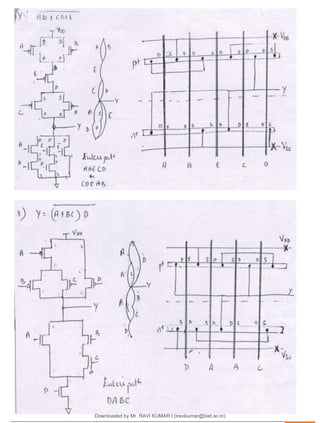
• When more number of inputs available, Euler’s path is determined to know gate ordering.
• Advantage of using Euler’s path is to that a common diffusion line can be used which reduces
number of contact cuts.
• Uninterrupted path in both pull-up and pull down network represents optimized gate ordering
which helps in drawing layout without breaking the diffusion layer.
Downloaded by Mr. RAVI KUMAR I (iravikumar@biet.ac.in)
lOMoARcPSD|3283145
.
Downloaded by Mr. RAVI KUMAR I (iravikumar@biet.ac.in)
lOMoARcPSD|3283145
.
Fig.15 CMOS design
Downloaded by Mr. RAVI KUMAR I (iravikumar@biet.ac.in)
lOMoARcPSD|3283145
.
Downloaded by Mr. RAVI KUMAR I (iravikumar@biet.ac.in)
lOMoARcPSD|3283145
.
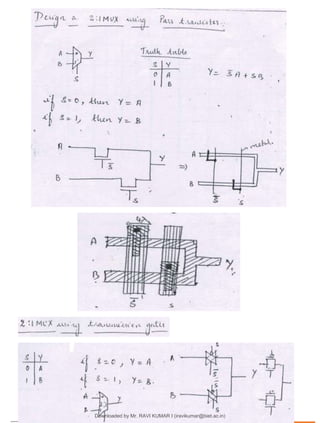
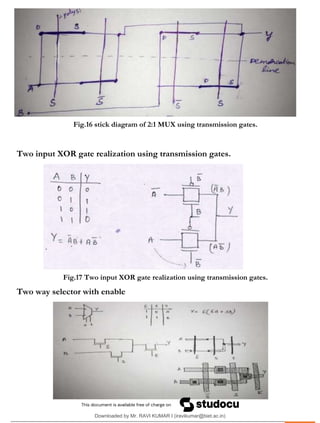
Fig.16 stick diagram of 2:1 MUX using transmission gates.
Two input XOR gate realization using transmission gates.
Fig.17 Two input XOR gate realization using transmission gates.
Two way selector with enable
Downloaded by Mr. RAVI KUMAR I (iravikumar@biet.ac.in)
lOMoARcPSD|3283145
.
Fig 18. Two way selector with enable
Downloaded by Mr. RAVI KUMAR I (iravikumar@biet.ac.in)
lOMoARcPSD|3283145
VLSI DESIGN| MODULE 2 : MOS AND BICMOS CIRCUIT DESIGN PROCESS 1 7 E C 6 3
M I T M Y S O R E | D E P T . O F E L E C T R O N I C S & C O M M U N I C A T I O N E N G G . 19
Basic circuit concepts
• In MOS technology, Active devices are dealt with some measurement.
• Wiring up of circuits is done through various conductive layers which is produced by MOS
Processing.
• Therefore it is necessary to be aware of resistive and capacitive characteristics of each layers.
• For evaluating the effects of wiring, input and output capacitances, sheet resistance and
standard unit capacitances are used.
• Further delay associated with wiring, inverters are evaluated by the term delay unit τ.
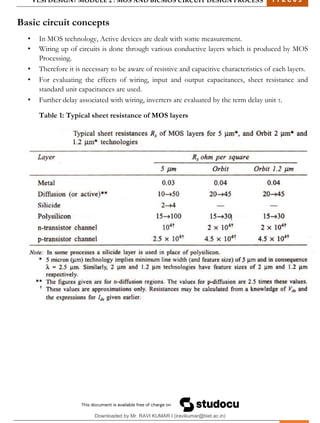
Table 1: Typical sheet resistance of MOS layers
Downloaded by Mr. RAVI KUMAR I (iravikumar@biet.ac.in)
lOMoARcPSD|3283145
VLSI DESIGN| MODULE 2 : MOS AND BICMOS CIRCUIT DESIGN PROCESS 1 7 E C 6 3
M I T M Y S O R E | D E P T . O F E L E C T R O N I C S & C O M M U N I C A T I O N E N G G . 20
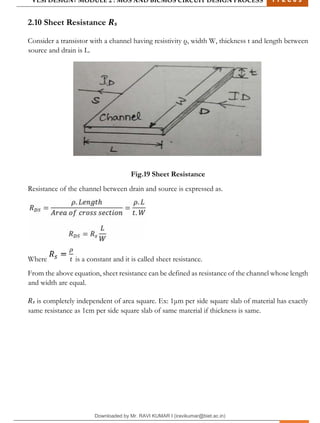
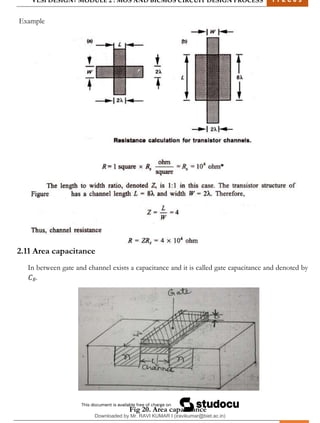
2.10 Sheet Resistance 𝑹𝒔
Consider a transistor with a channel having resistivity ρ, width W, thickness t and length between
source and drain is L.
Fig.19 Sheet Resistance
Resistance of the channel between drain and source is expressed as.
Where is a constant and it is called sheet resistance.
From the above equation, sheet resistance can be defined as resistance of the channel whose length
and width are equal.
𝑅𝑠 is completely independent of area square. Ex: 1μm per side square slab of material has exactly
same resistance as 1cm per side square slab of same material if thickness is same.
Downloaded by Mr. RAVI KUMAR I (iravikumar@biet.ac.in)
lOMoARcPSD|3283145
VLSI DESIGN| MODULE 2 : MOS AND BICMOS CIRCUIT DESIGN PROCESS 1 7 E C 6 3
M I T M Y S O R E | D E P T . O F E L E C T R O N I C S & C O M M U N I C A T I O N E N G G . 21
Example
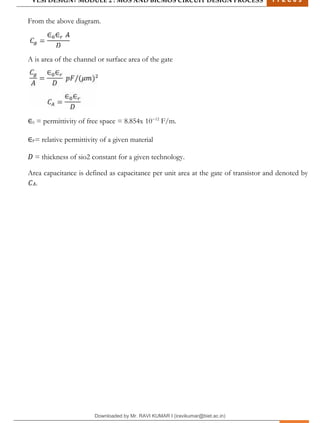
2.11 Area capacitance
In between gate and channel exists a capacitance and it is called gate capacitance and denoted by
𝐶𝑔.
Fig 20. Area capacitance
Downloaded by Mr. RAVI KUMAR I (iravikumar@biet.ac.in)
lOMoARcPSD|3283145
VLSI DESIGN| MODULE 2 : MOS AND BICMOS CIRCUIT DESIGN PROCESS 1 7 E C 6 3
M I T M Y S O R E | D E P T . O F E L E C T R O N I C S & C O M M U N I C A T I O N E N G G . 22
From the above diagram.
A is area of the channel or surface area of the gate
∈0 = permittivity of free space = 8.854x 10⁻¹²
F/m.
∈𝑟= relative permittivity of a given material
𝐷 = thickness of sio2 constant for a given technology.
Area capacitance is defined as capacitance per unit area at the gate of transistor and denoted by
𝐶𝐴.
Downloaded by Mr. RAVI KUMAR I (iravikumar@biet.ac.in)
lOMoARcPSD|3283145
VLSI DESIGN| MODULE 2 : MOS AND BICMOS CIRCUIT DESIGN PROCESS 1 7 E C 6 3
M I T M Y S O R E | D E P T . O F E L E C T R O N I C S & C O M M U N I C A T I O N E N G G . 23
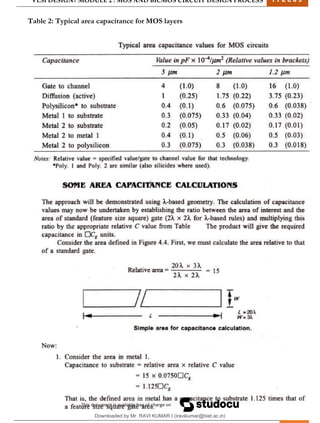
Table 2: Typical area capacitance for MOS layers
Downloaded by Mr. RAVI KUMAR I (iravikumar@biet.ac.in)
lOMoARcPSD|3283145
VLSI DESIGN| MODULE 2 : MOS AND BICMOS CIRCUIT DESIGN PROCESS 1 7 E C 6 3
M I T M Y S O R E | D E P T . O F E L E C T R O N I C S & C O M M U N I C A T I O N E N G G . 24
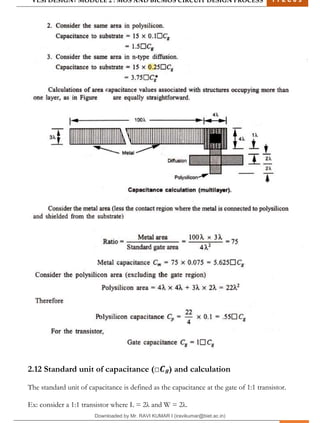
2.12 Standard unit of capacitance (□𝑪𝒈) and calculation
The standard unit of capacitance is defined as the capacitance at the gate of 1:1 transistor.
Ex: consider a 1:1 transistor where L = 2λ and W = 2λ.
Downloaded by Mr. RAVI KUMAR I (iravikumar@biet.ac.in)
lOMoARcPSD|3283145
VLSI DESIGN| MODULE 2 : MOS AND BICMOS CIRCUIT DESIGN PROCESS 1 7 E C 6 3
M I T M Y S O R E | D E P T . O F E L E C T R O N I C S & C O M M U N I C A T I O N E N G G . 25
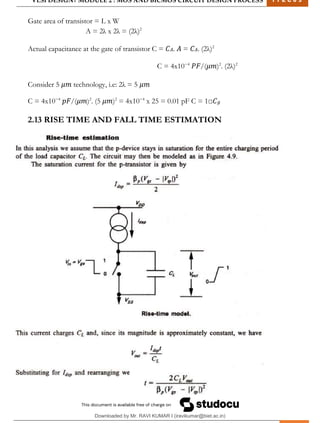
Gate area of transistor = L x W
A = 2λ x 2λ = (2λ)2
Actual capacitance at the gate of transistor C = 𝐶𝐴. 𝐴 = 𝐶𝐴. (2λ)2
C = 4x10⁻⁴
𝑃𝐹/(𝜇𝑚)2
. (2λ)2
Consider 5 𝜇𝑚 technology, i.e: 2λ = 5 𝜇𝑚
C = 4x10⁻⁴
𝑝𝐹/(𝜇𝑚)2
. (5 𝜇𝑚)2
= 4x10−4
x 25 = 0.01 pF C = 1□𝐶𝑔
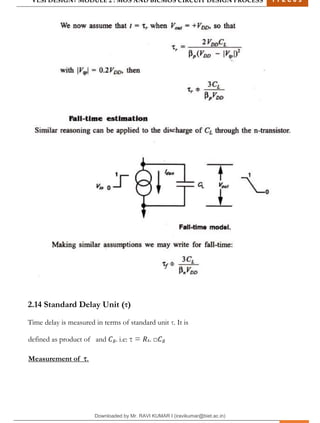
2.13 RISE TIME AND FALL TIME ESTIMATION
Downloaded by Mr. RAVI KUMAR I (iravikumar@biet.ac.in)
lOMoARcPSD|3283145
VLSI DESIGN| MODULE 2 : MOS AND BICMOS CIRCUIT DESIGN PROCESS 1 7 E C 6 3
M I T M Y S O R E | D E P T . O F E L E C T R O N I C S & C O M M U N I C A T I O N E N G G . 26
2.14 Standard Delay Unit (τ)
Time delay is measured in terms of standard unit τ. It is
defined as product of and 𝐶𝑔. i.e: τ = 𝑅𝑠. □𝐶𝑔
Measurement of τ.
Downloaded by Mr. RAVI KUMAR I (iravikumar@biet.ac.in)
lOMoARcPSD|3283145
VLSI DESIGN| MODULE 2 : MOS AND BICMOS CIRCUIT DESIGN PROCESS 1 7 E C 6 3
M I T M Y S O R E | D E P T . O F E L E C T R O N I C S & C O M M U N I C A T I O N E N G G . 27
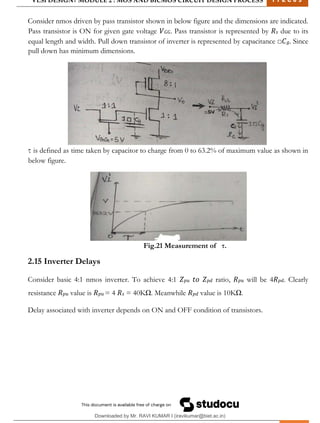
Consider nmos driven by pass transistor shown in below figure and the dimensions are indicated.
Pass transistor is ON for given gate voltage 𝑉𝐺𝐺. Pass transistor is represented by 𝑅𝑠 due to its
equal length and width. Pull down transistor of inverter is represented by capacitance □𝐶𝑔. Since
pull down has minimum dimensions.
τ is defined as time taken by capacitor to charge from 0 to 63.2% of maximum value as shown in
below figure.
Fig.21 Measurement of τ.
2.15 Inverter Delays
Consider basic 4:1 nmos inverter. To achieve 4:1 𝑍𝑝𝑢 𝑡𝑜 𝑍𝑝𝑑 ratio, 𝑅𝑝𝑢 will be 4𝑅𝑝𝑑. Clearly
resistance 𝑅𝑝𝑢 value is 𝑅𝑝𝑢 = 4 𝑅𝑠 = 40KΩ. Meanwhile 𝑅𝑝𝑑 value is 10KΩ.
Delay associated with inverter depends on ON and OFF condition of transistors.
Downloaded by Mr. RAVI KUMAR I (iravikumar@biet.ac.in)
lOMoARcPSD|3283145
VLSI DESIGN| MODULE 2 : MOS AND BICMOS CIRCUIT DESIGN PROCESS 1 7 E C 6 3
M I T M Y S O R E | D E P T . O F E L E C T R O N I C S & C O M M U N I C A T I O N E N G G . 28
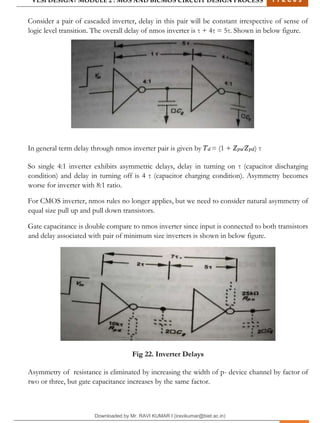
Consider a pair of cascaded inverter, delay in this pair will be constant irrespective of sense of
logic level transition. The overall delay of nmos inverter is τ + 4τ = 5τ. Shown in below figure.
In general term delay through nmos inverter pair is given by 𝑇𝑑 = (1 + 𝑍𝑝𝑢⁄𝑍𝑝𝑑) τ
So single 4:1 inverter exhibits asymmetric delays, delay in turning on τ (capacitor discharging
condition) and delay in turning off is 4 τ (capacitor charging condition). Asymmetry becomes
worse for inverter with 8:1 ratio.
For CMOS inverter, nmos rules no longer applies, but we need to consider natural asymmetry of
equal size pull up and pull down transistors.
Gate capacitance is double compare to nmos inverter since input is connected to both transistors
and delay associated with pair of minimum size inverters is shown in below figure.
Fig 22. Inverter Delays
Asymmetry of resistance is eliminated by increasing the width of p- device channel by factor of
two or three, but gate capacitance increases by the same factor.
Downloaded by Mr. RAVI KUMAR I (iravikumar@biet.ac.in)
lOMoARcPSD|3283145
VLSI DESIGN| MODULE 2 : MOS AND BICMOS CIRCUIT DESIGN PROCESS 1 7 E C 6 3
M I T M Y S O R E | D E P T . O F E L E C T R O N I C S & C O M M U N I C A T I O N E N G G . 29
2.16 Driving large capacitive loads
• A large capacitive loads problem arises when a signal to be transmitted from On chip to
Off chip destinations.
• Off chip capacitance is is generally higher than On chip □𝐶𝑔.And it is denoted by .
𝐶𝐿 ≥ 104
□𝐶𝑔
• A capacitance of this order to be driven through low resistance otherwise long delays will
occur.
2.17 Cascaded Inverters as drivers
• Inverters to drive large capacitive loads resistance associated with pull up and pull down
transistors to be low.
• Low resistance values of 𝑍𝑝𝑢 and 𝑍𝑝𝑑 implies low L:W ratio or channel width must be
made wider to reduce channel resistance but consequently inverter occupies large area.
• Gate area LxW is more significant and large capacitance present at input which slows
down rate of change of voltage at input.
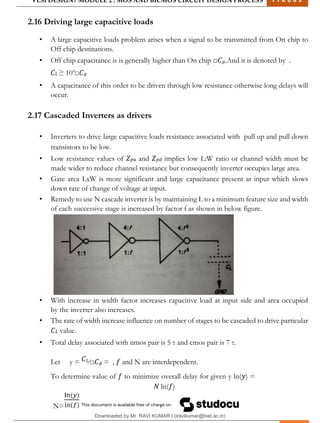
• Remedy to use N cascade inverter is by maintaining L to a minimum feature size and width
of each successive stage is increased by factor f as shown in below figure.
• With increase in width factor increases capacitive load at input side and area occupied
by the inverter also increases.
• The rate of width increase influence on number of stages to be cascaded to drive particular
𝐶𝐿 value.
• Total delay associated with nmos pair is 5 τ and cmos pair is 7 τ.
Let y = 𝐶𝐿⁄□𝐶𝑔 = , 𝑓 and N are interdependent.
To determine value of 𝑓 to minimize overall delay for given y ln(𝑦) =
𝑁 ln(𝑓)
N=
Downloaded by Mr. RAVI KUMAR I (iravikumar@biet.ac.in)
lOMoARcPSD|3283145
VLSI DESIGN| MODULE 2 : MOS AND BICMOS CIRCUIT DESIGN PROCESS 1 7 E C 6 3
M I T M Y S O R E | D E P T . O F E L E C T R O N I C S & C O M M U N I C A T I O N E N G G . 30
For N even, total delay = τ = 2.5 𝑓 τ (nmos) or
τ = 3.5 𝑓 τ (cmos)
In all cases, delay ἀ N
• Total delay is minimized If 𝑓 assumes the value e. i.e: each stage is approximately 2.7
times wider than its predecessor and it is applicable for both cmos and nmos inverters.
Thus assuming 𝑓 = 𝑒, we have
Number of stages N= ln(𝑦)
And overall delay 𝑡𝑑
N even: 𝑡𝑑= 2.5 N τ (NMOS) or 𝑡𝑑= 3.5 N τ (CMOS)
N odd: 𝑡𝑑= [2.5 (N-1)+1]e τ (NMOS) or 𝑡𝑑= [3.5 (N-1)+1]e τ (CMOS) For
ΔVin which indicates logic 0 to 1 transistion of Vin.
𝑡𝑑= [2.5 (N-1)+4]e τ (NMOS) or 𝑡𝑑= [3.5 (N-1)+5]e τ (CMOS) For
ΔVin which indicates logic 1 to 0 transistion of Vin.
2.18 Super buffers
• Asymmetry of conventional inverter gives rise to significant delay problems when used to
drive large capacitive loads.
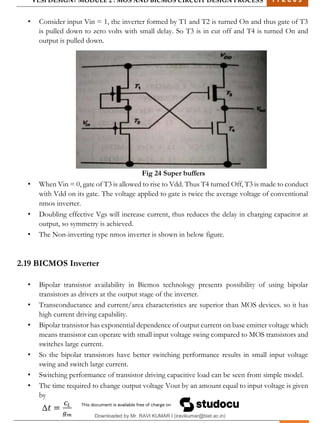
Common approach used in nmos inverter is to use super buffers an inverting type nmos super
buffer is shown in figure.
Fig 23. nmos super buffer
Downloaded by Mr. RAVI KUMAR I (iravikumar@biet.ac.in)
lOMoARcPSD|3283145
VLSI DESIGN| MODULE 2 : MOS AND BICMOS CIRCUIT DESIGN PROCESS 1 7 E C 6 3
M I T M Y S O R E | D E P T . O F E L E C T R O N I C S & C O M M U N I C A T I O N E N G G . 31
• Consider input Vin = 1, the inverter formed by T1 and T2 is turned On and thus gate of T3
is pulled down to zero volts with small delay. So T3 is in cut off and T4 is turned On and
output is pulled down.
Fig 24 Super buffers
• When Vin = 0, gate of T3 is allowed to rise to Vdd. Thus T4 turned Off, T3 is made to conduct
with Vdd on its gate. The voltage applied to gate is twice the average voltage of conventional
nmos inverter.
• Doubling effective Vgs will increase current, thus reduces the delay in charging capacitor at
output, so symmetry is achieved.
• The Non-inverting type nmos inverter is shown in below figure.
2.19 BICMOS Inverter
• Bipolar transistor availability in Bicmos technology presents possibility of using bipolar
transistors as drivers at the output stage of the inverter.
• Transconductance and current/area characteristics are superior than MOS devices. so it has
high current driving capability.
• Bipolar transistor has exponential dependence of output current on base emitter voltage which
means transistor can operate with small input voltage swing compared to MOS transistors and
switches large current.
• So the bipolar transistors have better switching performance results in small input voltage
swing and switch large current.
• Switching performance of transistor driving capacitive load can be seen from simple model.
• The time required to change output voltage Vout by an amount equal to input voltage is given
by
Downloaded by Mr. RAVI KUMAR I (iravikumar@biet.ac.in)
lOMoARcPSD|3283145
VLSI DESIGN| MODULE 2 : MOS AND BICMOS CIRCUIT DESIGN PROCESS 1 7 E C 6 3
M I T M Y S O R E | D E P T . O F E L E C T R O N I C S & C O M M U N I C A T I O N E N G G . 32
Where is trans conductance of bipolar transistor. As increases Δ𝑡 decreases.
• Bipolar transistor delay has 2 main components Tin and 𝑇𝐿.
• Tin is the initial time required to charge the B-E junction of the transistor. It is time taken to
charge the input gate capacitance.
• 𝑇𝐿 is time taken to charge the output load capacitance 𝐶𝐿. This value is less for bipolar by
factor of ℎ𝑓𝑒.
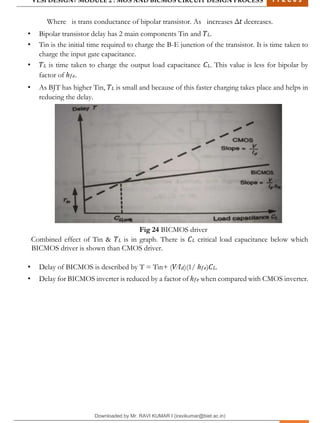
• As BJT has higher Tin, 𝑇𝐿 is small and because of this faster charging takes place and helps in
reducing the delay.
Fig 24 BICMOS driver
Combined effect of Tin & 𝑇𝐿 is in graph. There is 𝐶𝐿 critical load capacitance below which
BICMOS driver is shown than CMOS driver.
• Delay of BICMOS is described by T = Tin+ (𝑉⁄𝐼𝑑)(1/ ℎ𝑓𝑒)𝐶𝐿.
• Delay for BICMOS inverter is reduced by a factor of ℎ𝑓𝑒 when compared with CMOS inverter.
Downloaded by Mr. RAVI KUMAR I (iravikumar@biet.ac.in)
lOMoARcPSD|3283145
VLSI DESIGN| MODULE 2 : MOS AND BICMOS CIRCUIT DESIGN PROCESS 1 7 E C 6 3
M I T M Y S O R E | D E P T . O F E L E C T R O N I C S & C O M M U N I C A T I O N E N G G . 33
Downloaded by Mr. RAVI KUMAR I (iravikumar@biet.ac.in)
lOMoARcPSD|3283145

VLSI-Design2

  • 1.
    Studocu is notsponsored or endorsed by any college or university Module 2 MOS AND Bi CMOS Circuit Design Process Vlsi Design (Delhi Technological University) Studocu is not sponsored or endorsed by any college or university Module 2 MOS AND Bi CMOS Circuit Design Process Vlsi Design (Delhi Technological University) Downloaded by Mr. RAVI KUMAR I (iravikumar@biet.ac.in) lOMoARcPSD|3283145
  • 2.
    . Module 2 MOS andBiCMOS Circuit Design Processes 2.1 MOS Layers: • MOS circuits are basically formed by 4 layers  Metal  Polysilicon  N diffusion  P diffusion • Here all the 4 layers are isolated from each other through thick or thin oxide layer (i.e., silicon dioxide layer) • The thin oxide (thinox) layer includes n-diffusion, p-diffusion and transistor channel. 2.2 Stick diagram: • Stick diagrams are a means of capturing topography and layer information using simple diagrams. • They convey layer information through color codes (or monochrome encoding). • Acts as an interface between symbolic circuit and the actual layout. • Stick diagrams do show all components/vias(contacts), relative placement of components and helps in planning and routing. It goes one step closer to layout. • However they do not show exact placement of components, transistor sizes, length and width of wires also the boundaries. Thus we can say that it does not give any low level details. • The color encodings chosen for different technologies is shown below. • Encodings for NMOS process: Fig.1 Encodings for NMOS process Downloaded by Mr. RAVI KUMAR I (iravikumar@biet.ac.in) lOMoARcPSD|3283145
  • 3.
    . Procedure to drawStick Diagram: 2.3 Nmos Design Process. 1) Draw two metal lines/ power rails providing sufficient space to accommodate all transistors. i.e: Vdd & Vss. 2) Draw common n+ diffusion layer for all the transistors. 3) Provide Vdd and Vss contacts. 4) Draw polysilicon to cross n+ diffusion layer to form transistors. 5) Create buried contact for depletion transistor. 6) Provide input and output connection. 2.4 CMOS Design Process: • Two type of transistors are used i.e: Nmos and Pmos, thus in stick diagram demarcation line is used to separate them. • All Pmos transistors are placed above Demarcation line and Nmos transistors below demarcation line. • While drawing stick Diagram 1. Diffusion paths must not cross the demarcation line 2. N- diffusion and P-diffusion wires must not join. 3. Nmos and Pmos transistors are joined by Metal layer when it is required. 4. Cross must be placed on Vdd and Vss which represent substrate and P-well connection respectively. Encodings for CMOS process: Fig.2 Encodings for CMOS process Downloaded by Mr. RAVI KUMAR I (iravikumar@biet.ac.in) lOMoARcPSD|3283145
  • 4.
    . Procedure to drawStick Diagram: 1) Draw two metal lines/ power rails providing sufficient space to accommodate all transistors. i.e: Vdd & Vss. 2) Draw demarcation line in the middle of the two power lines. 3) Draw P+ diffusion above demarcation and N+ diffusion below demarcation 4) Draw polysilicon to represent Pmos and Nmos which represents gates of the transistor. 5) Connect source terminal of transistors to supply. 6) Drain terminals of transistor are connected using metal 1. 7) Place contact cuts wherever necessary. 8) Draw X which represents substrate and P-well contact on power lines. 2.5 DESIGN RULES AND LAYOUTS Layout: describes actual layers and geometry on silicon substrate to implement a function (Expressions). [Diffusion region where transistor can be formed is called active region, polysilicon serves as the gate of MOS transistor. L defines channel length and W represents width of channel/active region] Design rules: are set of guidelines which specify minimum dimension and spacing allowed in layout drawing. Design rules also acts a communication link between circuit designers and process engineers during manufacturing phase. Goal of design rule: is to achieve optimum yield. Yield = (No. of good chips on wafer)/(Total no. of chips on wafer). Design rules are also called layout rules. If the circuit performance has to be increased then rules must be more aggressive. Else this leads to non-function of the circuit or yield reduction. There are two rules. 1. Micron Rule - Absolute Dimension rule, here all sizes and spacing are specified in micron. Here the circuit density is the important goal. 2. Lambda (λ) Based Rules - The Lambda based design rules are proposed by Mead and Conway. Scalable design rules, here this design rule normalizes all geometric design rule by parameter lambda (λ) also called as scaling factor/feature size. In this all mask patterns are expressed as multiples of lambda. Advantages of lambda based design rules: 1. The mask layout can be scaled down proportionally if the feature size of the fabrication process is reduced. 2. Design rules are conservative. 3. This rule enable technology changes and design reuse and reduced design cost. Disadvantages: 1. Linear scaling cannot be extended and is limited over range of dimension (1-3 μm) 2. As rules are conservative, results in over dimension and density of design is less. Downloaded by Mr. RAVI KUMAR I (iravikumar@biet.ac.in) lOMoARcPSD|3283145
  • 5.
    . 2.6 Lambda (λ)Based Rules The Design rules can be conveniently set out in diagrammatic form as shown in fig. 1 for width and separation of conducting path. In fig. 2 shows the design rules associated with extensions and separations with transistor. Fig. 3 and 4 demonstrates the design rules for contacts between layers. Table below also gives the layer and distance of separation dimensions. Layer Dimension n-diffusion 2λ p-diffusion 2λ Polysilicon 2λ Metal 1 3λ Metal 2 4λ Layer -Layer Dimension n-diffusion – n-diffusion 3λ p-diffusion – p-diffusion 3λ n/p diffusion - polysilicon 1λ Poly-poly 2λ Metal 1 3λ Metal 2 4λ Layer dimension Distance of Separation Fig. 3 Design rules for wires and separations (nMOS and CMOS) Downloaded by Mr. RAVI KUMAR I (iravikumar@biet.ac.in) lOMoARcPSD|3283145
  • 6.
    . Fig. 4 Designrules for Transistors (nMOS, pMOS and CMOS) Transistor design rules  Minimum dimension of transistor is 2λ × 2λ – overlapping of diffusion and ploy  Poly and diffusion both must extend beyond the boundary of transistor at least by 2λ  Implant for depletion mode transistor is 6λ × 6λ i.e., implant must extend boundary of transistor by at least 2λ in all direction.  From the boundary/ implant of one transistor, the next transistor should maintain min distance of 2λ  The distance from contact cut to transistor should be at least 2λ Metal contact – contact between metal 1 to polysilicon OR metal 1 to diffusion (active region) is called metal contact. This is shown in fig. 3  A 2λ × 2λ cut centered on 4λ × 4λ superimposed area is used to connect layers  In case of multiple contacts the distance between adjacent contacts should be 2λ Fig. 5. Contacts (nMOS and CMOS) Via contact – the contact between metal 1 and metal 2 is called via contact as shown in fig. 4.  A 2λ × 2λ cut centered on 4λ × 4λ superimposed area is used to connect layers Downloaded by Mr. RAVI KUMAR I (iravikumar@biet.ac.in) lOMoARcPSD|3283145
  • 7.
    .  To connectmetal 2 with diffusion via and cut both are used Fig.6 contacts 2.7 Contact Cuts: • Electrical connection between layers can be done using special structures 'contact cuts'. • There are 3 approaches for contacts between polysilicon and diffusion in nMOS circuits. They are 1. Polysilicon to metal and then to diffusion 2. Buried contact - polysilicon to diffusion 3. Butting contact - polysilicon to diffusion using metal ✓ among the three buried contact is most used as it gives economy in space and reliable contact. ➢ Buried contact is distinguished feature in nMOS for connection between poly and diffusion and this is most widely used than butting contact. Buried Contact (nMOS):  Layer is joined over the area of 2λ × 2λ with buried contact cut extending by 1λ in all directions except in the diffusion path. It extends by 2λ in order to avoid formation of unwanted transistors.  The contact cut shown in broken line indicates the region where thinox is removed on the silicon wafer and polysilicon gets deposited on wafer.  When impurities are added, it diffuse into poly and also to diffusion region within the contact area. This provides satisfactory contact between ploy and diffusion as shown in fig 5. ➢ In CMOS poly to diffusion connections are made through metal. The process of making connection between metal and either of 2 layers (poly or diffusion) is by buried contact. Downloaded by Mr. RAVI KUMAR I (iravikumar@biet.ac.in) lOMoARcPSD|3283145
  • 8.
    . Fig. 7 Buriedand butting contacts only for nMOS Fig 8. Cross section through contact structures Butting contact  Butting contact process is complicated and done when two layers do not overlap. Contact cut of 2λ × 2λ is made until each of layers is joined. The layers are held in such a way that these two contacts become continuous. Downloaded by Mr. RAVI KUMAR I (iravikumar@biet.ac.in) lOMoARcPSD|3283145
  • 9.
    .  The polyand diffusion outlines overlap and thinox under ploy acts as mask during diffusion process. Finally contact between two butting layers is done by a metal. This can be seen in fig. 5 cross-sectional view. 2.8 Double Metal MOS Process Rules: • If to process considered till now introduction of second metal layer will boosts the design capabilities. It gives more freedom. Ex. this will be helpful for power rail (Vdd and Vss/Gnd) distribution and also for clock. • This process is called Double Metal MOS Process • This technique involves connecting metal 1 and metal 2 contacts called 'via'. This is shown in fig. 4 and fig. 6 Fig. 9 cross section of via contact structure • The 2nd metal layer is coarser than 1st metal layer (conventional) and the isolation layer between the 2 is usually thicker than normal. • To distinguish contacts between 1st and 2nd metal layer they are called as ‘vias’ rather than contact cut • In stick diagram representation its color code is dark blue or purple. The steps of fabrication process is as follows: 1. Using chemical vapor deposition oxide layer under 1st metal layer is deposited. 2. using same method oxide between 2 metal layers are formed. 3. Selected areas of oxide are removed by using plasma etching. The etching process is done under high vertical ion bombardment to get high and uniform etching. The layout strategy used with double metal process is summarized as below 1. Second metal layer is usually used for global power railings and clock lines 2. First metal layer is used for local power distribution and signals. 3. The layout of the two metals are such that are mutually orthogonal wherever possible  Similar to double metal process, other process allows second poly layer. The process steps are similar to previously described process. Downloaded by Mr. RAVI KUMAR I (iravikumar@biet.ac.in) lOMoARcPSD|3283145
  • 10.
    .  The firstpolysilicon (poly 1) layer is deposited and patterned on this a second thinox (thin oxide) layer is grown. On this the second polysilicon (poly 2) layer is deposited and patterned. Thus 2nd thinox isolated the poly layers.  Presence of poly 2 provides greater flexibility in interconnections and allows transistors to be formed by intersection of poly 2 and diffusion. 2.9 CMOS Lambda-based Design Rules: • Comparing to Nmos fabrication process, CMOS fabrication is more complex. • Extending the Nmos design rules, Noting exclusion of butting contact and buried contact rules. • Additional rules associated with CMOS process concerned with unique feature p-well CMOS, i.e: p-well and P+ Mask and Substrate contact. Fig.10 CMOS Lambda-based Design Rules Problems on stick diagram and layouts. Downloaded by Mr. RAVI KUMAR I (iravikumar@biet.ac.in) lOMoARcPSD|3283145
  • 11.
    . Nmos Inverter Downloaded byMr. RAVI KUMAR I (iravikumar@biet.ac.in) lOMoARcPSD|3283145
  • 12.
    . Fig.11 Nmos inverter CMOSInverter Fig.12 CMOS inverter Downloaded by Mr. RAVI KUMAR I (iravikumar@biet.ac.in) lOMoARcPSD|3283145
  • 13.
    . Diffusion lines runninghorizontal and polysilicon lines in vertical direction. Fig.13 CMOS 2 input NAND gate Downloaded by Mr. RAVI KUMAR I (iravikumar@biet.ac.in) lOMoARcPSD|3283145
  • 14.
    . Fig.14 CMOS 2input AND gate • When more number of inputs available, Euler’s path is determined to know gate ordering. • Advantage of using Euler’s path is to that a common diffusion line can be used which reduces number of contact cuts. • Uninterrupted path in both pull-up and pull down network represents optimized gate ordering which helps in drawing layout without breaking the diffusion layer. Downloaded by Mr. RAVI KUMAR I (iravikumar@biet.ac.in) lOMoARcPSD|3283145
  • 15.
    . Downloaded by Mr.RAVI KUMAR I (iravikumar@biet.ac.in) lOMoARcPSD|3283145
  • 16.
    . Fig.15 CMOS design Downloadedby Mr. RAVI KUMAR I (iravikumar@biet.ac.in) lOMoARcPSD|3283145
  • 17.
    . Downloaded by Mr.RAVI KUMAR I (iravikumar@biet.ac.in) lOMoARcPSD|3283145
  • 18.
    . Fig.16 stick diagramof 2:1 MUX using transmission gates. Two input XOR gate realization using transmission gates. Fig.17 Two input XOR gate realization using transmission gates. Two way selector with enable Downloaded by Mr. RAVI KUMAR I (iravikumar@biet.ac.in) lOMoARcPSD|3283145
  • 19.
    . Fig 18. Twoway selector with enable Downloaded by Mr. RAVI KUMAR I (iravikumar@biet.ac.in) lOMoARcPSD|3283145
  • 20.
    VLSI DESIGN| MODULE2 : MOS AND BICMOS CIRCUIT DESIGN PROCESS 1 7 E C 6 3 M I T M Y S O R E | D E P T . O F E L E C T R O N I C S & C O M M U N I C A T I O N E N G G . 19 Basic circuit concepts • In MOS technology, Active devices are dealt with some measurement. • Wiring up of circuits is done through various conductive layers which is produced by MOS Processing. • Therefore it is necessary to be aware of resistive and capacitive characteristics of each layers. • For evaluating the effects of wiring, input and output capacitances, sheet resistance and standard unit capacitances are used. • Further delay associated with wiring, inverters are evaluated by the term delay unit τ. Table 1: Typical sheet resistance of MOS layers Downloaded by Mr. RAVI KUMAR I (iravikumar@biet.ac.in) lOMoARcPSD|3283145
  • 21.
    VLSI DESIGN| MODULE2 : MOS AND BICMOS CIRCUIT DESIGN PROCESS 1 7 E C 6 3 M I T M Y S O R E | D E P T . O F E L E C T R O N I C S & C O M M U N I C A T I O N E N G G . 20 2.10 Sheet Resistance 𝑹𝒔 Consider a transistor with a channel having resistivity ρ, width W, thickness t and length between source and drain is L. Fig.19 Sheet Resistance Resistance of the channel between drain and source is expressed as. Where is a constant and it is called sheet resistance. From the above equation, sheet resistance can be defined as resistance of the channel whose length and width are equal. 𝑅𝑠 is completely independent of area square. Ex: 1μm per side square slab of material has exactly same resistance as 1cm per side square slab of same material if thickness is same. Downloaded by Mr. RAVI KUMAR I (iravikumar@biet.ac.in) lOMoARcPSD|3283145
  • 22.
    VLSI DESIGN| MODULE2 : MOS AND BICMOS CIRCUIT DESIGN PROCESS 1 7 E C 6 3 M I T M Y S O R E | D E P T . O F E L E C T R O N I C S & C O M M U N I C A T I O N E N G G . 21 Example 2.11 Area capacitance In between gate and channel exists a capacitance and it is called gate capacitance and denoted by 𝐶𝑔. Fig 20. Area capacitance Downloaded by Mr. RAVI KUMAR I (iravikumar@biet.ac.in) lOMoARcPSD|3283145
  • 23.
    VLSI DESIGN| MODULE2 : MOS AND BICMOS CIRCUIT DESIGN PROCESS 1 7 E C 6 3 M I T M Y S O R E | D E P T . O F E L E C T R O N I C S & C O M M U N I C A T I O N E N G G . 22 From the above diagram. A is area of the channel or surface area of the gate ∈0 = permittivity of free space = 8.854x 10⁻¹² F/m. ∈𝑟= relative permittivity of a given material 𝐷 = thickness of sio2 constant for a given technology. Area capacitance is defined as capacitance per unit area at the gate of transistor and denoted by 𝐶𝐴. Downloaded by Mr. RAVI KUMAR I (iravikumar@biet.ac.in) lOMoARcPSD|3283145
  • 24.
    VLSI DESIGN| MODULE2 : MOS AND BICMOS CIRCUIT DESIGN PROCESS 1 7 E C 6 3 M I T M Y S O R E | D E P T . O F E L E C T R O N I C S & C O M M U N I C A T I O N E N G G . 23 Table 2: Typical area capacitance for MOS layers Downloaded by Mr. RAVI KUMAR I (iravikumar@biet.ac.in) lOMoARcPSD|3283145
  • 25.
    VLSI DESIGN| MODULE2 : MOS AND BICMOS CIRCUIT DESIGN PROCESS 1 7 E C 6 3 M I T M Y S O R E | D E P T . O F E L E C T R O N I C S & C O M M U N I C A T I O N E N G G . 24 2.12 Standard unit of capacitance (□𝑪𝒈) and calculation The standard unit of capacitance is defined as the capacitance at the gate of 1:1 transistor. Ex: consider a 1:1 transistor where L = 2λ and W = 2λ. Downloaded by Mr. RAVI KUMAR I (iravikumar@biet.ac.in) lOMoARcPSD|3283145
  • 26.
    VLSI DESIGN| MODULE2 : MOS AND BICMOS CIRCUIT DESIGN PROCESS 1 7 E C 6 3 M I T M Y S O R E | D E P T . O F E L E C T R O N I C S & C O M M U N I C A T I O N E N G G . 25 Gate area of transistor = L x W A = 2λ x 2λ = (2λ)2 Actual capacitance at the gate of transistor C = 𝐶𝐴. 𝐴 = 𝐶𝐴. (2λ)2 C = 4x10⁻⁴ 𝑃𝐹/(𝜇𝑚)2 . (2λ)2 Consider 5 𝜇𝑚 technology, i.e: 2λ = 5 𝜇𝑚 C = 4x10⁻⁴ 𝑝𝐹/(𝜇𝑚)2 . (5 𝜇𝑚)2 = 4x10−4 x 25 = 0.01 pF C = 1□𝐶𝑔 2.13 RISE TIME AND FALL TIME ESTIMATION Downloaded by Mr. RAVI KUMAR I (iravikumar@biet.ac.in) lOMoARcPSD|3283145
  • 27.
    VLSI DESIGN| MODULE2 : MOS AND BICMOS CIRCUIT DESIGN PROCESS 1 7 E C 6 3 M I T M Y S O R E | D E P T . O F E L E C T R O N I C S & C O M M U N I C A T I O N E N G G . 26 2.14 Standard Delay Unit (τ) Time delay is measured in terms of standard unit τ. It is defined as product of and 𝐶𝑔. i.e: τ = 𝑅𝑠. □𝐶𝑔 Measurement of τ. Downloaded by Mr. RAVI KUMAR I (iravikumar@biet.ac.in) lOMoARcPSD|3283145
  • 28.
    VLSI DESIGN| MODULE2 : MOS AND BICMOS CIRCUIT DESIGN PROCESS 1 7 E C 6 3 M I T M Y S O R E | D E P T . O F E L E C T R O N I C S & C O M M U N I C A T I O N E N G G . 27 Consider nmos driven by pass transistor shown in below figure and the dimensions are indicated. Pass transistor is ON for given gate voltage 𝑉𝐺𝐺. Pass transistor is represented by 𝑅𝑠 due to its equal length and width. Pull down transistor of inverter is represented by capacitance □𝐶𝑔. Since pull down has minimum dimensions. τ is defined as time taken by capacitor to charge from 0 to 63.2% of maximum value as shown in below figure. Fig.21 Measurement of τ. 2.15 Inverter Delays Consider basic 4:1 nmos inverter. To achieve 4:1 𝑍𝑝𝑢 𝑡𝑜 𝑍𝑝𝑑 ratio, 𝑅𝑝𝑢 will be 4𝑅𝑝𝑑. Clearly resistance 𝑅𝑝𝑢 value is 𝑅𝑝𝑢 = 4 𝑅𝑠 = 40KΩ. Meanwhile 𝑅𝑝𝑑 value is 10KΩ. Delay associated with inverter depends on ON and OFF condition of transistors. Downloaded by Mr. RAVI KUMAR I (iravikumar@biet.ac.in) lOMoARcPSD|3283145
  • 29.
    VLSI DESIGN| MODULE2 : MOS AND BICMOS CIRCUIT DESIGN PROCESS 1 7 E C 6 3 M I T M Y S O R E | D E P T . O F E L E C T R O N I C S & C O M M U N I C A T I O N E N G G . 28 Consider a pair of cascaded inverter, delay in this pair will be constant irrespective of sense of logic level transition. The overall delay of nmos inverter is τ + 4τ = 5τ. Shown in below figure. In general term delay through nmos inverter pair is given by 𝑇𝑑 = (1 + 𝑍𝑝𝑢⁄𝑍𝑝𝑑) τ So single 4:1 inverter exhibits asymmetric delays, delay in turning on τ (capacitor discharging condition) and delay in turning off is 4 τ (capacitor charging condition). Asymmetry becomes worse for inverter with 8:1 ratio. For CMOS inverter, nmos rules no longer applies, but we need to consider natural asymmetry of equal size pull up and pull down transistors. Gate capacitance is double compare to nmos inverter since input is connected to both transistors and delay associated with pair of minimum size inverters is shown in below figure. Fig 22. Inverter Delays Asymmetry of resistance is eliminated by increasing the width of p- device channel by factor of two or three, but gate capacitance increases by the same factor. Downloaded by Mr. RAVI KUMAR I (iravikumar@biet.ac.in) lOMoARcPSD|3283145
  • 30.
    VLSI DESIGN| MODULE2 : MOS AND BICMOS CIRCUIT DESIGN PROCESS 1 7 E C 6 3 M I T M Y S O R E | D E P T . O F E L E C T R O N I C S & C O M M U N I C A T I O N E N G G . 29 2.16 Driving large capacitive loads • A large capacitive loads problem arises when a signal to be transmitted from On chip to Off chip destinations. • Off chip capacitance is is generally higher than On chip □𝐶𝑔.And it is denoted by . 𝐶𝐿 ≥ 104 □𝐶𝑔 • A capacitance of this order to be driven through low resistance otherwise long delays will occur. 2.17 Cascaded Inverters as drivers • Inverters to drive large capacitive loads resistance associated with pull up and pull down transistors to be low. • Low resistance values of 𝑍𝑝𝑢 and 𝑍𝑝𝑑 implies low L:W ratio or channel width must be made wider to reduce channel resistance but consequently inverter occupies large area. • Gate area LxW is more significant and large capacitance present at input which slows down rate of change of voltage at input. • Remedy to use N cascade inverter is by maintaining L to a minimum feature size and width of each successive stage is increased by factor f as shown in below figure. • With increase in width factor increases capacitive load at input side and area occupied by the inverter also increases. • The rate of width increase influence on number of stages to be cascaded to drive particular 𝐶𝐿 value. • Total delay associated with nmos pair is 5 τ and cmos pair is 7 τ. Let y = 𝐶𝐿⁄□𝐶𝑔 = , 𝑓 and N are interdependent. To determine value of 𝑓 to minimize overall delay for given y ln(𝑦) = 𝑁 ln(𝑓) N= Downloaded by Mr. RAVI KUMAR I (iravikumar@biet.ac.in) lOMoARcPSD|3283145
  • 31.
    VLSI DESIGN| MODULE2 : MOS AND BICMOS CIRCUIT DESIGN PROCESS 1 7 E C 6 3 M I T M Y S O R E | D E P T . O F E L E C T R O N I C S & C O M M U N I C A T I O N E N G G . 30 For N even, total delay = τ = 2.5 𝑓 τ (nmos) or τ = 3.5 𝑓 τ (cmos) In all cases, delay ἀ N • Total delay is minimized If 𝑓 assumes the value e. i.e: each stage is approximately 2.7 times wider than its predecessor and it is applicable for both cmos and nmos inverters. Thus assuming 𝑓 = 𝑒, we have Number of stages N= ln(𝑦) And overall delay 𝑡𝑑 N even: 𝑡𝑑= 2.5 N τ (NMOS) or 𝑡𝑑= 3.5 N τ (CMOS) N odd: 𝑡𝑑= [2.5 (N-1)+1]e τ (NMOS) or 𝑡𝑑= [3.5 (N-1)+1]e τ (CMOS) For ΔVin which indicates logic 0 to 1 transistion of Vin. 𝑡𝑑= [2.5 (N-1)+4]e τ (NMOS) or 𝑡𝑑= [3.5 (N-1)+5]e τ (CMOS) For ΔVin which indicates logic 1 to 0 transistion of Vin. 2.18 Super buffers • Asymmetry of conventional inverter gives rise to significant delay problems when used to drive large capacitive loads. Common approach used in nmos inverter is to use super buffers an inverting type nmos super buffer is shown in figure. Fig 23. nmos super buffer Downloaded by Mr. RAVI KUMAR I (iravikumar@biet.ac.in) lOMoARcPSD|3283145
  • 32.
    VLSI DESIGN| MODULE2 : MOS AND BICMOS CIRCUIT DESIGN PROCESS 1 7 E C 6 3 M I T M Y S O R E | D E P T . O F E L E C T R O N I C S & C O M M U N I C A T I O N E N G G . 31 • Consider input Vin = 1, the inverter formed by T1 and T2 is turned On and thus gate of T3 is pulled down to zero volts with small delay. So T3 is in cut off and T4 is turned On and output is pulled down. Fig 24 Super buffers • When Vin = 0, gate of T3 is allowed to rise to Vdd. Thus T4 turned Off, T3 is made to conduct with Vdd on its gate. The voltage applied to gate is twice the average voltage of conventional nmos inverter. • Doubling effective Vgs will increase current, thus reduces the delay in charging capacitor at output, so symmetry is achieved. • The Non-inverting type nmos inverter is shown in below figure. 2.19 BICMOS Inverter • Bipolar transistor availability in Bicmos technology presents possibility of using bipolar transistors as drivers at the output stage of the inverter. • Transconductance and current/area characteristics are superior than MOS devices. so it has high current driving capability. • Bipolar transistor has exponential dependence of output current on base emitter voltage which means transistor can operate with small input voltage swing compared to MOS transistors and switches large current. • So the bipolar transistors have better switching performance results in small input voltage swing and switch large current. • Switching performance of transistor driving capacitive load can be seen from simple model. • The time required to change output voltage Vout by an amount equal to input voltage is given by Downloaded by Mr. RAVI KUMAR I (iravikumar@biet.ac.in) lOMoARcPSD|3283145
  • 33.
    VLSI DESIGN| MODULE2 : MOS AND BICMOS CIRCUIT DESIGN PROCESS 1 7 E C 6 3 M I T M Y S O R E | D E P T . O F E L E C T R O N I C S & C O M M U N I C A T I O N E N G G . 32 Where is trans conductance of bipolar transistor. As increases Δ𝑡 decreases. • Bipolar transistor delay has 2 main components Tin and 𝑇𝐿. • Tin is the initial time required to charge the B-E junction of the transistor. It is time taken to charge the input gate capacitance. • 𝑇𝐿 is time taken to charge the output load capacitance 𝐶𝐿. This value is less for bipolar by factor of ℎ𝑓𝑒. • As BJT has higher Tin, 𝑇𝐿 is small and because of this faster charging takes place and helps in reducing the delay. Fig 24 BICMOS driver Combined effect of Tin & 𝑇𝐿 is in graph. There is 𝐶𝐿 critical load capacitance below which BICMOS driver is shown than CMOS driver. • Delay of BICMOS is described by T = Tin+ (𝑉⁄𝐼𝑑)(1/ ℎ𝑓𝑒)𝐶𝐿. • Delay for BICMOS inverter is reduced by a factor of ℎ𝑓𝑒 when compared with CMOS inverter. Downloaded by Mr. RAVI KUMAR I (iravikumar@biet.ac.in) lOMoARcPSD|3283145
  • 34.
    VLSI DESIGN| MODULE2 : MOS AND BICMOS CIRCUIT DESIGN PROCESS 1 7 E C 6 3 M I T M Y S O R E | D E P T . O F E L E C T R O N I C S & C O M M U N I C A T I O N E N G G . 33 Downloaded by Mr. RAVI KUMAR I (iravikumar@biet.ac.in) lOMoARcPSD|3283145