ENVIRONMENTAL EDUCATION
Man, as a part and parcel
of the environment, has to
recognize the role and
importance of environment
in order to protect it and to
get protection from it, for this,
he needs environmental
education.
DEFINITION
International Union for the
Conservation of Nature (IUCN;
1971)
"... the process of recognizing values
and clarifying concepts in order to
develop skills and attitudes
necessary to understand and
appreciate the interrelatedness
among men, his culture and his
biophysical surroundings. EE also
entails practice in decision-making
and self-formulation of a code of
behaviour about issues concerning
environmental quality.”
GOALS
OF ENVIRONMENTAL EDUCATION
To improve the quality of
environment.
To create an awareness among
the people on environmental
problems and conversation.
To create an atmosphere so that
people participate in decision-
making and develop the
capabilities to evaluate the
developmental programmes.
OBJECTIVES
OF ENVIRONMENTAL EDUCATION
SCOPE
OF ENVIRONMENTAL EDUCATION
Awareness
Real life situations
Conservation
Sustainable development
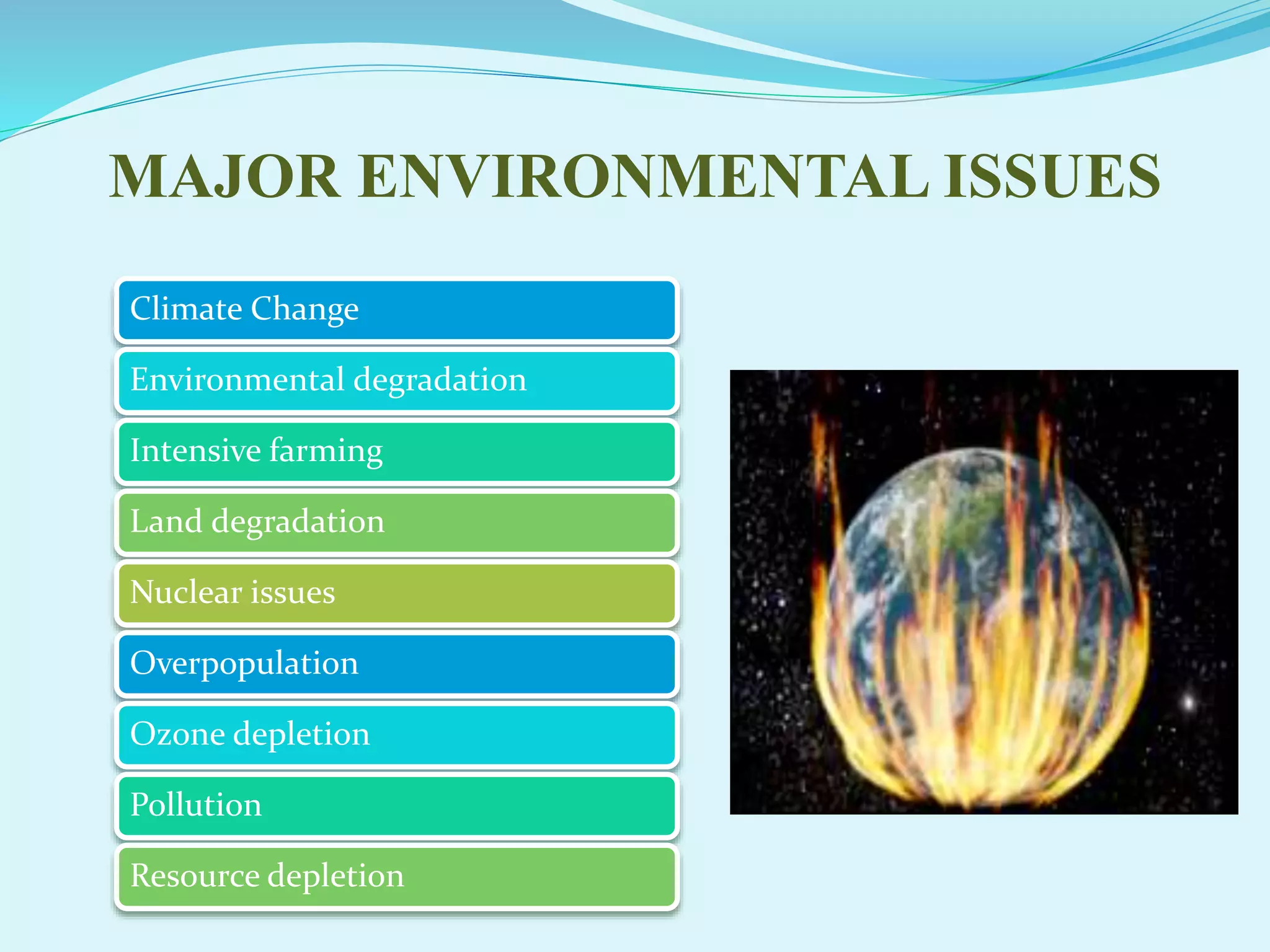
MAJOR ENVIRONMENTAL ISSUES
Climate Change
Environmental degradation
Intensive farming
Land degradation
Nuclear issues
Overpopulation
Ozone depletion
Pollution
Resource depletion
ENVIRONMENTAL AWARENESS
IS ESSENTIAL FOR
o Protection of the atmosphere
o Protection of land resources
o Conservation of biological diversity
o Environmentally sound management of biotechnology
and hazardous wastes
o Prevention of illegal traffic in toxic products and wastes
o Improvement in living and working conditions of the
poor by eradicating poverty and stopping environmental
degradation.
SUSTAINABLE DEVELOPMENT
Sustainable development is a
development that meets the
needs of the present without
comprising the ability of
future generations to meet
their own needs (World
Commission, 1987)
THE UNDERLYING PRINCIPLES OF
SUSTAINABLE DEVELOPMENT
Symbiotic relationship between consumerist human race
and producer natural systems.
Environmental mistakes of the past need not be
repeated.
Healthy environment is essential for sustainable
development and healthy economy.
It should stand for broader goals of social
transformation.
PROVIDING ENVIRONMENTAL EDUCATION AT
DIFFERENT LEVELS OF EDUCATION
Level Objectives
Primary education Awareness of environment
(Knowledge)
Secondary education Relevance for real-life situation of
environment (Understanding)
Higher secondary education Conservation of natural resources of
environment (Skills)
College & University Education Sustainable development by solving
problems of environment
(Attitude and Evaluation)
INTERDISCIPLINARY APPROACH
Life Sciences Vocational Studies Physical Sciences
Earth Sciences Environmental Mathematics
Education
Social Studies Communications, Arts Humanities
MULTIDISCIPLINARY APPROACH
Life Sciences Vocational Studies Physical Sciences
Earth Sciences Environmental Mathematics
Education
Social Studies Communications, Arts Humanities
ROLE OF TEACHERS IN
ENVIRONMENTAL EDUCATION
 To arouse the children’s interest in the
environment and to raise challenging
problems
 To discuss the approach to problems or
topics
 To arrange visits
 To provide materials needed for practical
work
 To arrange for visiting speakers
 To initiate and develop discussion and
debate; and
 To provide facilities for displays and
exhibitions of the work carried out.
CONCLUSION
Chinese say about the need
to educate
“If you plan for a year, plant
rice, if you plan for the
years, plant trees, but if you
plan for a century educate
the people.”
REFERNCES
 V. Krishnamacharyulu and G.S. Reddy, Environmental Education,
Neelkamal Publications PVT. LTD., New Delhi.
 Suresh Bhatnagar, Anamika Saxena, Sanjay Kumar and Naresh Pratap,
Development of Educational System in India, R. Lall Book Depot,
Meerut.
 Dr. K. Nagarajan, Dr. P. Sivakumar, Mrs. N. Nithyasri and Dr. R.
Srinivasan, Environmental Education, Ram Publishers, Chennai.
 M.S.Singh, Quality Impact in Teacher Education, Adhyayan Publishers
& Distributors, Delhi.
 R.A. Sharma, C, R. Lall Book Depot, Meerut.
 Arul Jothi, D.L. Balaji and Rajesh Verma, Environmental Education,
Centrum Press, New Delhi.
 S.P. Ruhela and Raj Kumar Nayak, Value Education and Human
Rights Education Volume-1, Neelkamal Publications PVT. LTD., New
Delhi.
Environmental Education ppt

Environmental Education ppt

  • 2.
    ENVIRONMENTAL EDUCATION Man, asa part and parcel of the environment, has to recognize the role and importance of environment in order to protect it and to get protection from it, for this, he needs environmental education.
  • 3.
    DEFINITION International Union forthe Conservation of Nature (IUCN; 1971) "... the process of recognizing values and clarifying concepts in order to develop skills and attitudes necessary to understand and appreciate the interrelatedness among men, his culture and his biophysical surroundings. EE also entails practice in decision-making and self-formulation of a code of behaviour about issues concerning environmental quality.”
  • 4.
    GOALS OF ENVIRONMENTAL EDUCATION Toimprove the quality of environment. To create an awareness among the people on environmental problems and conversation. To create an atmosphere so that people participate in decision- making and develop the capabilities to evaluate the developmental programmes.
  • 5.
  • 6.
    SCOPE OF ENVIRONMENTAL EDUCATION Awareness Reallife situations Conservation Sustainable development
  • 7.
    MAJOR ENVIRONMENTAL ISSUES ClimateChange Environmental degradation Intensive farming Land degradation Nuclear issues Overpopulation Ozone depletion Pollution Resource depletion
  • 8.
    ENVIRONMENTAL AWARENESS IS ESSENTIALFOR o Protection of the atmosphere o Protection of land resources o Conservation of biological diversity o Environmentally sound management of biotechnology and hazardous wastes o Prevention of illegal traffic in toxic products and wastes o Improvement in living and working conditions of the poor by eradicating poverty and stopping environmental degradation.
  • 9.
    SUSTAINABLE DEVELOPMENT Sustainable developmentis a development that meets the needs of the present without comprising the ability of future generations to meet their own needs (World Commission, 1987)
  • 10.
    THE UNDERLYING PRINCIPLESOF SUSTAINABLE DEVELOPMENT Symbiotic relationship between consumerist human race and producer natural systems. Environmental mistakes of the past need not be repeated. Healthy environment is essential for sustainable development and healthy economy. It should stand for broader goals of social transformation.
  • 11.
    PROVIDING ENVIRONMENTAL EDUCATIONAT DIFFERENT LEVELS OF EDUCATION Level Objectives Primary education Awareness of environment (Knowledge) Secondary education Relevance for real-life situation of environment (Understanding) Higher secondary education Conservation of natural resources of environment (Skills) College & University Education Sustainable development by solving problems of environment (Attitude and Evaluation)
  • 12.
    INTERDISCIPLINARY APPROACH Life SciencesVocational Studies Physical Sciences Earth Sciences Environmental Mathematics Education Social Studies Communications, Arts Humanities
  • 13.
    MULTIDISCIPLINARY APPROACH Life SciencesVocational Studies Physical Sciences Earth Sciences Environmental Mathematics Education Social Studies Communications, Arts Humanities
  • 14.
    ROLE OF TEACHERSIN ENVIRONMENTAL EDUCATION  To arouse the children’s interest in the environment and to raise challenging problems  To discuss the approach to problems or topics  To arrange visits  To provide materials needed for practical work  To arrange for visiting speakers  To initiate and develop discussion and debate; and  To provide facilities for displays and exhibitions of the work carried out.
  • 15.
    CONCLUSION Chinese say aboutthe need to educate “If you plan for a year, plant rice, if you plan for the years, plant trees, but if you plan for a century educate the people.”
  • 16.
    REFERNCES  V. Krishnamacharyuluand G.S. Reddy, Environmental Education, Neelkamal Publications PVT. LTD., New Delhi.  Suresh Bhatnagar, Anamika Saxena, Sanjay Kumar and Naresh Pratap, Development of Educational System in India, R. Lall Book Depot, Meerut.  Dr. K. Nagarajan, Dr. P. Sivakumar, Mrs. N. Nithyasri and Dr. R. Srinivasan, Environmental Education, Ram Publishers, Chennai.  M.S.Singh, Quality Impact in Teacher Education, Adhyayan Publishers & Distributors, Delhi.  R.A. Sharma, C, R. Lall Book Depot, Meerut.  Arul Jothi, D.L. Balaji and Rajesh Verma, Environmental Education, Centrum Press, New Delhi.  S.P. Ruhela and Raj Kumar Nayak, Value Education and Human Rights Education Volume-1, Neelkamal Publications PVT. LTD., New Delhi.