Dr. R.Ramamoorthy M.Sc.,M.Ed.,M.Phil.,Ph.D.,
Assistant Professor in Biological Science
Arasan Ganesan College of Preceptors, Sivakasi
UNIT
1
VIDEO
3
1.9. OBJECTIVES OF
ENVIRONMENTAL
EDUCATION
Formal and Non-formal
1982- Department of Environment
Centre for Environmental Education-
Ahamedabad
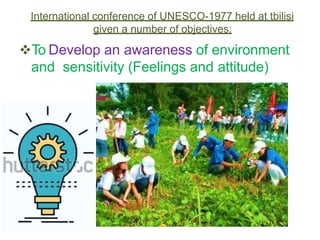
To Develop an awareness of environment
and sensitivity (Feelings and attitude)
International conference of UNESCO-1977 held at tbilisi
given a number of objectives:
 To help Acquiring knowledge and
variety of
experiences of EVE.
 To Develop basic Understanding of Structure,
Processes and Environmental Problems
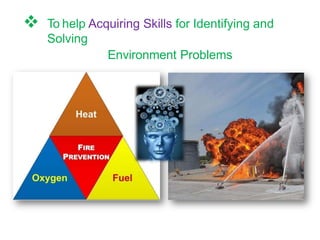
 To help Acquiring Skills for Identifying and
Solving
Environment Problems
 To develop attitudes, a set of values,
feelings, motivation for participation in
protection and
improvement of EVE
 To Provide an opportunity for an
active participation or practice
 To provide an ability for evaluating
environmental components of educational
programmes
Above All objectives are related to all levels and
for both formal and non-formal
system
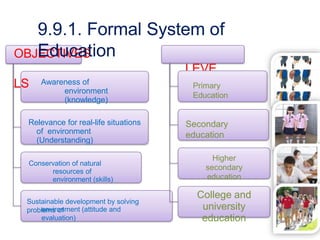
Awareness of
environment
(knowledge)
Relevance for real-life situations
of environment
(Understanding)
Conservation of natural
resources of
environment (skills)
Sustainable development by solving
problems ofenvironment (attitude and
evaluation)
OBJECTIVES
LEVE
LS Primary
Education
Secondary
education
Higher
secondary
education
College and
university
education
9.9.1. Formal System of
Education
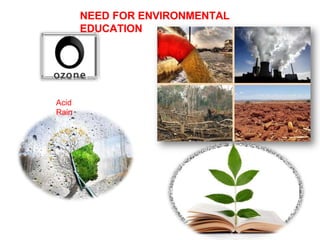
1.10. NEED FOR
ENVIRONMENTAL
EDUCATION
Acid
Rain
NEED FOR ENVIRONMENTAL
EDUCATION
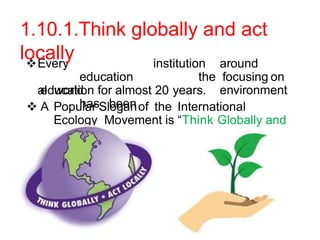
Every
education
al world
has been
institution around
the focusing on
environmenteducation for almost 20 years.
 A Popular Sloganof the International
Ecology Movement is “Think Globally and
act Locally”
1.10.1.Think globally and act
locally
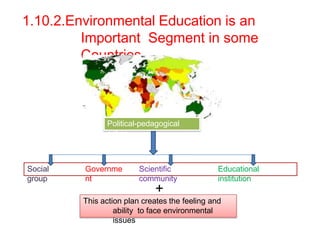
1.10.2.Environmental Education is an
Important Segment in some
Countries
Social
group
Governme
nt
Scientific
community
Educational
institution
Political-pedagogical
action
+
This action plan creates the feeling and
ability to face environmental
issues
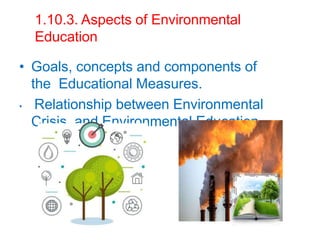
1.10.3. Aspects of Environmental
Education
• Goals, concepts and components of
the Educational Measures.
• Relationship between Environmental
Crisis and Environmental Education.
Aspects of Environmental
Education
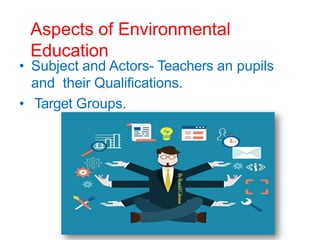
• Subject and Actors- Teachers an pupils
and their Qualifications.
• Target Groups.
Aspects of Environmental
Education
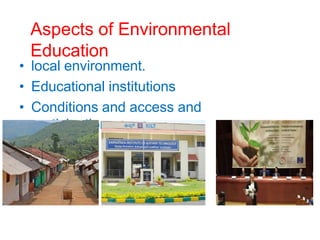
• local environment.
• Educational institutions
• Conditions and access and
participation
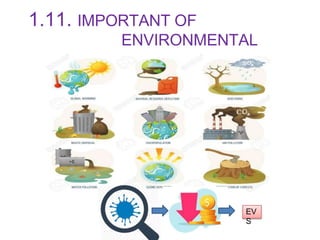
1.11. IMPORTANT OF
ENVIRONMENTAL
EDUCATION
EV
S
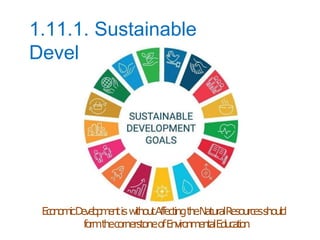
1.11.1. Sustainable
Development
EconomicDevelopmentiswithoutAffectingtheNaturalResourcesshould
formthecornerstoneofEnvironmentalEducation
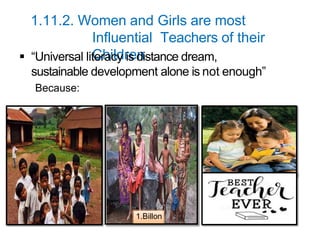
1.11.2. Women and Girls are most
Influential Teachers of their
Children “Universal literacy is distance dream,
sustainable development alone is not enough”
Because:
1.Billon
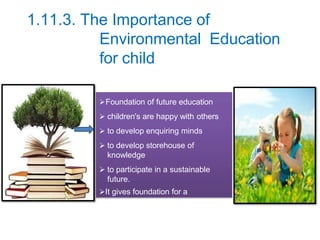
1.11.3. The Importance of
Environmental Education
for child
Foundation of future education
 children's are happy with others
 to develop enquiring minds
 to develop storehouse of
knowledge
 to participate in a sustainable
future.
It gives foundation for a
lifelong learning
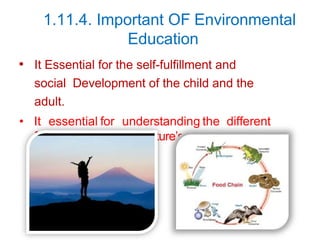
1.11.4. Important OF Environmental
Education
• It Essential for the self-fulfillment and
social Development of the child and the
adult.
• It essential for understanding the different
food chain and the nature’s ecological balance.
• It is used for making a living and
promoting material culture.
• It enables one to appreciate and enjoy
nature and society.
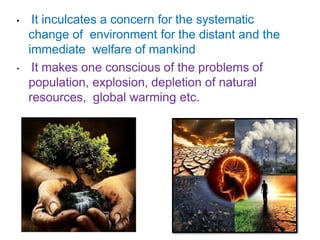
• It inculcates a concern for the systematic
change of environment for the distant and the
immediate welfare of mankind
• It makes one conscious of the problems of
population, explosion, depletion of natural
resources, global warming etc.
1.12. CORE THE OF
ENVIRONMENTAL
EDUCATION
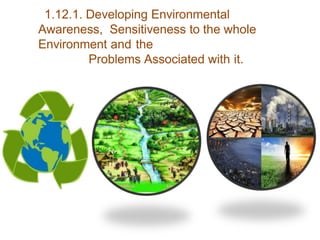
1.12.1. Developing Environmental
Awareness, Sensitiveness to the whole
Environment and the
Problems Associated with it.
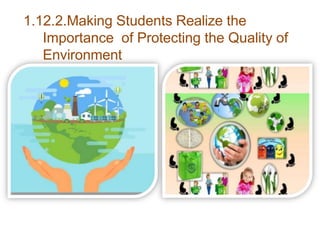
1.12.2.Making Students Realize the
Importance of Protecting the Quality of
Environment
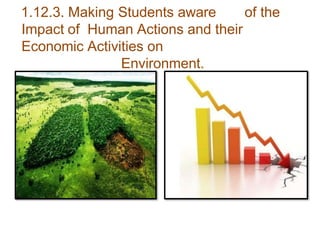
1.12.3. Making Students aware of the
Impact of Human Actions and their
Economic Activities on
Environment.
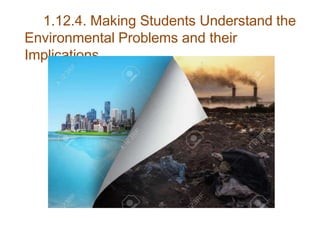
1.12.4. Making Students Understand the
Environmental Problems and their
Implications
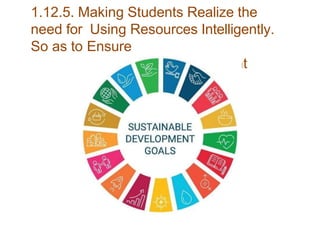
1.12.5. Making Students Realize the
need for Using Resources Intelligently.
So as to Ensure
Sustainable Development
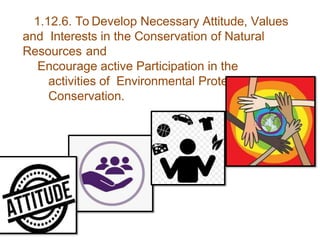
1.12.6. To Develop Necessary Attitude, Values
and Interests in the Conservation of Natural
Resources and
Encourage active Participation in the
activities of Environmental Protection and
Conservation.

ENVIRONMENTAL EDUCATION UNIT-1 PPT-3 (TNTEU)