Heart Sounds & Murmurs
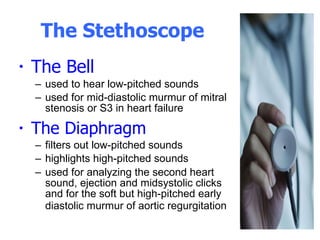
The Stethoscope  The Bell  used to hear low-pitched sounds used for mid-diastolic murmur of mitral stenosis or S3 in heart failure The Diaphragm filters out low-pitched sounds highlights high-pitched sounds used for analyzing the second heart sound, ejection and midsystolic clicks and for the soft but high-pitched early diastolic murmur of aortic regurgitation
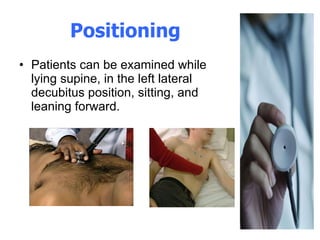
Positioning Patients can be examined while lying supine, in the left lateral decubitus position, sitting, and leaning forward.
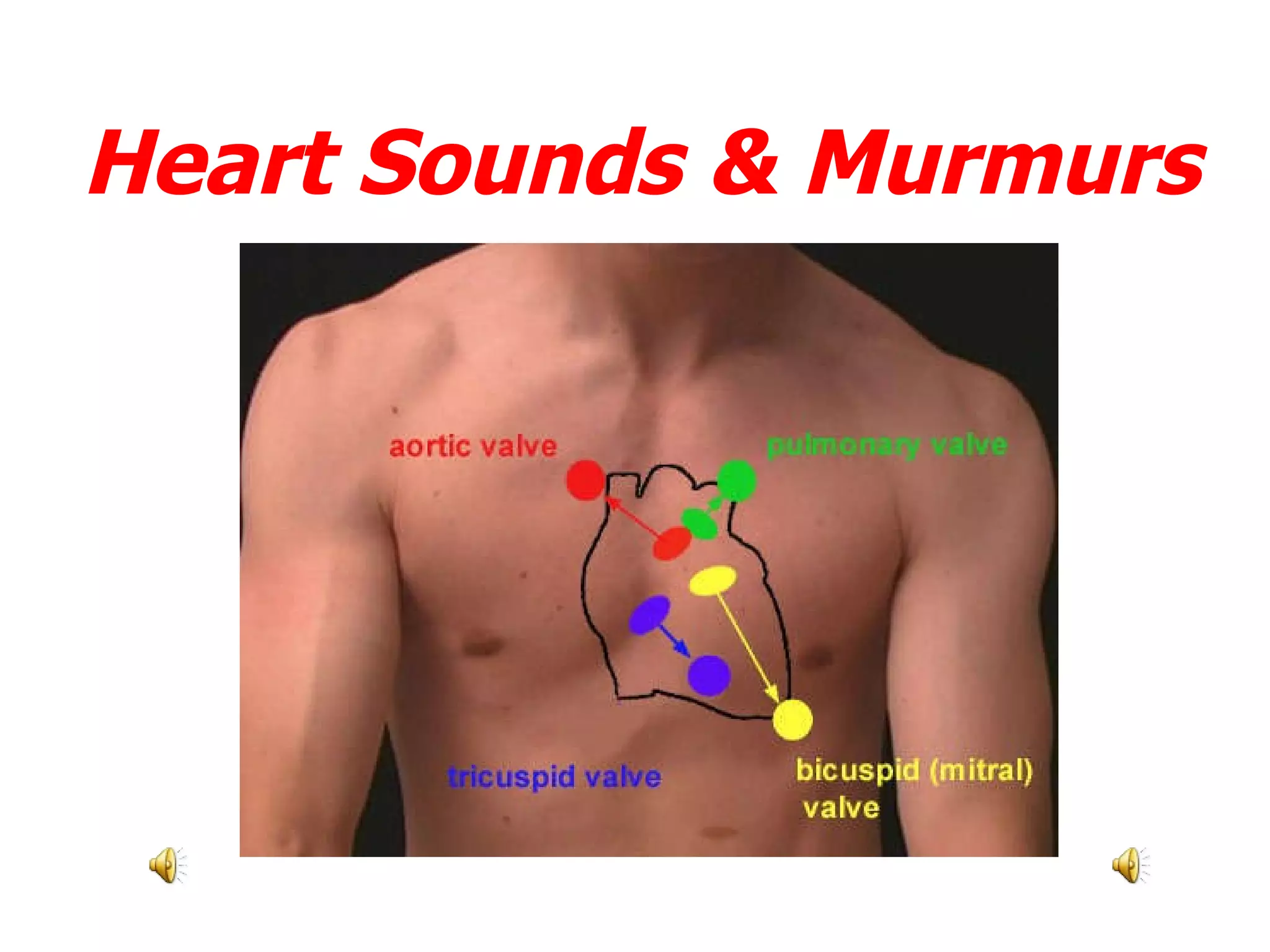
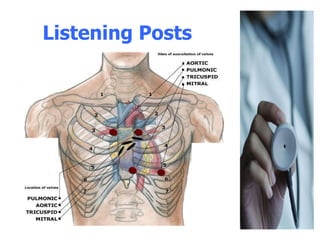
Listening Posts
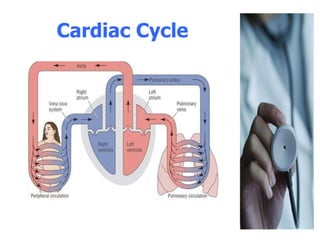
Cardiac Cycle
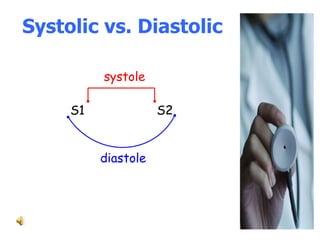
Systolic vs. Diastolic  systole S1     S2 diastole
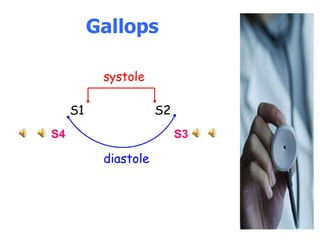
Gallops   systole S1     S2 S4   S3 diastole
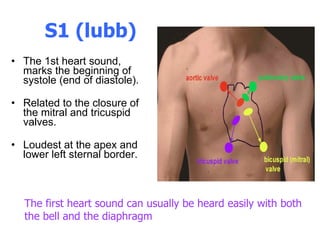
S1 (lubb) The 1st heart sound, marks the beginning of systole (end of diastole).  Related to the closure of the mitral and tricuspid valves.  Loudest at the apex and lower left sternal border.  The first heart sound can usually be heard easily with both the bell and the diaphragm
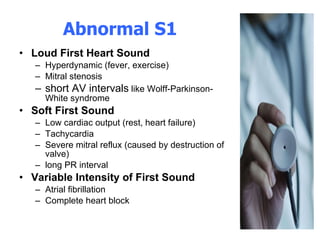
Abnormal S1 Loud First Heart Sound Hyperdynamic (fever, exercise)  Mitral stenosis  short AV intervals  like Wolff-Parkinson-White syndrome  Soft First Sound Low cardiac output (rest, heart failure)  Tachycardia  Severe mitral reflux (caused by destruction of valve)  long PR interval  Variable Intensity of First Sound Atrial fibrillation  Complete heart block
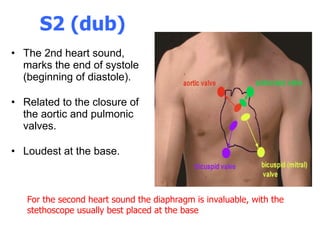
S2 (dub) The 2nd heart sound, marks the end of systole (beginning of diastole).  Related to the closure of the aortic and pulmonic valves.  Loudest at the base.  For the second heart sound the diaphragm is invaluable, with the stethoscope usually best placed at the base
Abnormal S2 Loud Second Heart Sound (aortic) Systemic hypertension  Dilated aortic root  Soft Second Heart Sound (aortic) Calcified aortic stenosis  Loud Second Heart Sound (pulmonary) Pulmonary hypertension
S3 Heart Sound  Heard in  early diastole   Lub-dub-by cadence similar to "Kentucky“ SLOSH’-ing-in  It can be thought of as a sound which is generated when the ventricle is forced to dilate beyond its normal range because the atrium has overloaded volume. As seen in  congestive heart failure, which is the most common cause of a S3.   May be normal physiological finding in patients less than age 30. S3 is low frequency and thus best heard with the bell of the stethoscope at the apex while the patient is in the left lateral decubitus position.   .
S4 Heart Sound Low frequency sound in  late diastole   Le-lub-Dub cadence similar to "Tennessee" a-STIFF’-wall                   Caused by the atrial kick into a noncompliant ventricle Seen in patients with stiffened left ventricles, resulting from conditions such as hypertension, aortic stenosis, ischemic or hypertrophic cardiomyopathy, acute MI.  In patient with mitral regurgitation, suggestive of acute onset of regurgitation due to the rupture of the chorda tendinae that anchor the Valvular leaflets. It is heard best with the bell of the stethoscope at the apex.
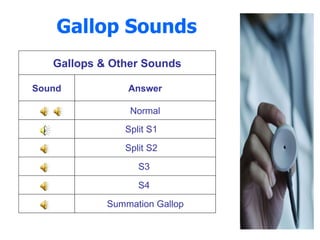
Gallop Sounds Split S1 Split S2 S3 S4 Summation Gallop Gallops & Other Sounds Sound Answer Normal
Murmurs Blood flow through a structure normally  closed  during systole (mitral or tricuspid valves). Regurgitation  Blood flow through a valve normally  open  in systole but abnormally narrowed (e.g. aortic or pulmonary). Stenosis Increased blood flow through a normal valve High flow states like… pregnancy, fever, anemia, hypothyroidism  Due to structural cardiac abnormality and increased flow ventricular septal defect  atrial septal defect  mitral regurgitation
Murmur Assessment note where it is heard best and where it radiates to  try to discern if the murmur occurs  in systole or diastole by timing it against S1 and S2  Note the sound of the murmur, is  it blowing or grating? Note the intensity of the murmur

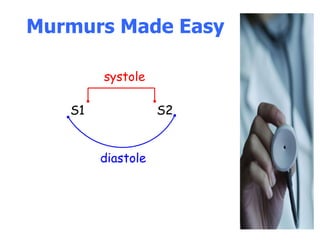
Murmurs Made Easy systole S1     S2 diastole
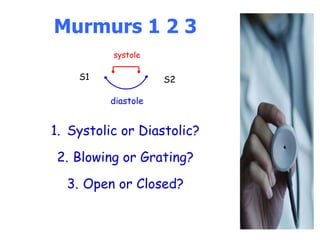
Murmurs 1 2 3 systole diastole S1 S2 Systolic or Diastolic? Blowing or Grating? Open or Closed?
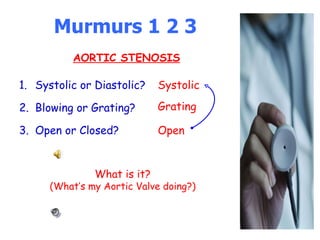
Murmurs 1 2 3 Systolic or Diastolic? Blowing or Grating? Open or Closed? Systolic What is it? (What’s my Aortic Valve doing?) Grating Open AORTIC STENOSIS
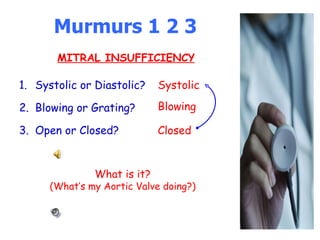
Murmurs 1 2 3 Systolic or Diastolic? Blowing or Grating? Open or Closed? Systolic What is it? (What’s my Aortic Valve doing?) Blowing Closed MITRAL INSUFFICIENCY
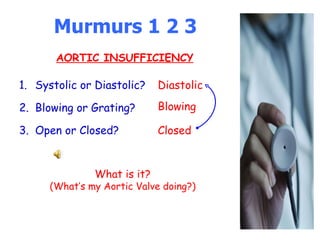
Murmurs 1 2 3 Systolic or Diastolic? Blowing or Grating? Open or Closed? Diastolic What is it? (What’s my Aortic Valve doing?) Blowing Closed AORTIC INSUFFICIENCY
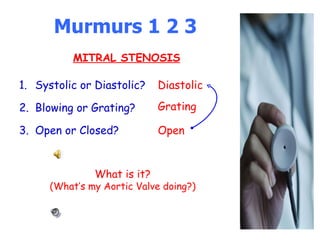
Murmurs 1 2 3 Systolic or Diastolic? Blowing or Grating? Open or Closed? Diastolic What is it? (What’s my Aortic Valve doing?) Grating Open MITRAL STENOSIS
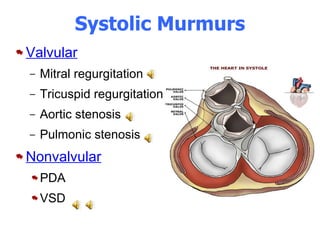
Systolic Murmurs Valvular Mitral regurgitation Tricuspid regurgitation Aortic stenosis  Pulmonic stenosis  Nonvalvular PDA  VSD
Systolic Valvular Murmurs  Mitral regurgitation high pitch pansystolic (holosystolic) murmur with blowing quality best heard at the apex radiation into the axilla.  plateau shaped  May follow MVP  Mitral valve prolapse (MVP)   resulting in a mid-systolic click after the click, a brief crescendo-decrescendo murmur  usually best at the apex
Systolic Valvular Murmurs Tricuspid regurgitation high pitch pansystolic blowing quality  Best at tricuspid area (4 th   ICS LSB) little radiation
Systolic Valvular Murmurs Aortic stenosis  medium to high pitch rough, harsh quality heard best over the “aortic area” or right second intercostal space radiation into the right neck. This radiation is such a sensitive finding that its absence should cause the physician to question the diagnosis of aortic stenosis.
Systolic Valvular Murmurs Pulmonic stenosis Medium to high pitch with a harsh, grinding quality  the second intercostal space along the left sternal border radiating into the neck or the back
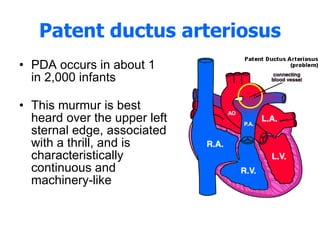
Patent ductus arteriosus PDA occurs in about 1 in 2,000 infants  This murmur is best heard over the upper left sternal edge, associated with a thrill, and is characteristically continuous and machinery-like
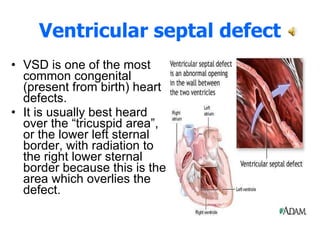
Ventricular septal defect VSD is one of the most common congenital (present from birth) heart defects. It is usually best heard over the “tricuspid area”, or the lower left sternal border, with radiation to the right lower sternal border because this is the area which overlies the defect.
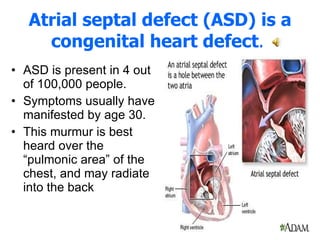
Atrial septal defect (ASD) is a congenital heart defect .   ASD is present in 4 out of 100,000 people.  Symptoms usually have manifested by age 30.  This murmur is best heard over the “pulmonic area” of the chest, and may radiate into the back
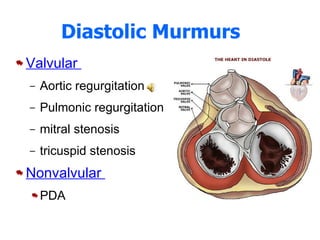
Diastolic Murmurs   Valvular  Aortic regurgitation Pulmonic regurgitation mitral stenosis tricuspid stenosis Nonvalvular  PDA
Diastolic Valvular Murmurs Mitral stenosis low pitched, decrescendo pattern, quiet to loud with thrill, rough, rumble quality best heard at the apex Tricuspid stenosis medium pitch quiet murmur, louder with inspiration. Rumble quality best heard at 4 th  ICS LSB
Diastolic Valvular Murmurs Aortic regurgitation high pitch, faint to medium in intensity, decrescendo pattern, blowing quality 2 nd  ICS RSB & 3 rd  ICS LSB Radiation to the neck Pulmonic regurgitation Medium pitch, faint intensity, and blowing quality These can sound alike but only aortic regurgitation will be associated with a bounding arterial pulses…”water hammer pulse” brisk femoral pulsation
Pericardial Friction Rub Caused by the beating of the heart against an inflamed pericardium or lung pleura, which itself has a wide variety of etiologies.  This sound is usually continuous, and heard diffusely over the chest.  If the rub completely disappears when the patient holds his breath it is more likely due to pleural, not pericardial, origin.
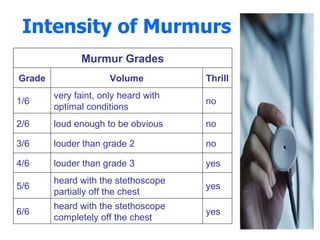
Intensity of Murmurs Murmur Grades Grade Volume Thrill 1/6 very faint, only heard with  optimal conditions no 2/6 loud enough to be obvious no 3/6 louder than grade 2 no 4/6 louder than grade 3 yes 5/6 heard with the stethoscope partially off the chest yes 6/6 heard with the stethoscope completely off the chest yes
Significant or not? consider is the clinical scenario  presence of symptoms such as effort syncope, chest pain, palpitations, shortness of breath, or paroxysmal nocturnal dyspnea  some common variations of normal heart sounds without an underlying structural pathology  Split S2 and flow murmurs
Sites for practice http://depts.washington.edu/physdx/heart/tech.html http://www.med.ucla.edu/wilkes/Systolic.htm http://www.medstudents.com.br/cardio/heartsounds/heartsou.htm http://www.uni-duesseldorf.de/WWW/MedFak/Herz-Kreislauf-Physiologie/lehre/sounds/intro.html Laptop has download as well. Cardiac Auscultation (heart sounds) from 3M Littmann Stethoscopes
Now you have a whole new meaning to the phrase “listen to your heart.”

Heart Sounds And Murmurs

  • 1.
  • 2.
    The Stethoscope The Bell used to hear low-pitched sounds used for mid-diastolic murmur of mitral stenosis or S3 in heart failure The Diaphragm filters out low-pitched sounds highlights high-pitched sounds used for analyzing the second heart sound, ejection and midsystolic clicks and for the soft but high-pitched early diastolic murmur of aortic regurgitation
  • 3.
    Positioning Patients canbe examined while lying supine, in the left lateral decubitus position, sitting, and leaning forward.
  • 4.
  • 5.
  • 6.
    Systolic vs. Diastolic systole S1 S2 diastole
  • 7.
    Gallops systole S1 S2 S4 S3 diastole
  • 8.
    S1 (lubb) The1st heart sound, marks the beginning of systole (end of diastole). Related to the closure of the mitral and tricuspid valves. Loudest at the apex and lower left sternal border. The first heart sound can usually be heard easily with both the bell and the diaphragm
  • 9.
    Abnormal S1 LoudFirst Heart Sound Hyperdynamic (fever, exercise) Mitral stenosis short AV intervals like Wolff-Parkinson-White syndrome Soft First Sound Low cardiac output (rest, heart failure) Tachycardia Severe mitral reflux (caused by destruction of valve) long PR interval Variable Intensity of First Sound Atrial fibrillation Complete heart block
  • 10.
    S2 (dub) The2nd heart sound, marks the end of systole (beginning of diastole). Related to the closure of the aortic and pulmonic valves. Loudest at the base. For the second heart sound the diaphragm is invaluable, with the stethoscope usually best placed at the base
  • 11.
    Abnormal S2 LoudSecond Heart Sound (aortic) Systemic hypertension Dilated aortic root Soft Second Heart Sound (aortic) Calcified aortic stenosis Loud Second Heart Sound (pulmonary) Pulmonary hypertension
  • 12.
    S3 Heart Sound Heard in early diastole Lub-dub-by cadence similar to "Kentucky“ SLOSH’-ing-in It can be thought of as a sound which is generated when the ventricle is forced to dilate beyond its normal range because the atrium has overloaded volume. As seen in congestive heart failure, which is the most common cause of a S3. May be normal physiological finding in patients less than age 30. S3 is low frequency and thus best heard with the bell of the stethoscope at the apex while the patient is in the left lateral decubitus position. .
  • 13.
    S4 Heart SoundLow frequency sound in late diastole Le-lub-Dub cadence similar to "Tennessee" a-STIFF’-wall                  Caused by the atrial kick into a noncompliant ventricle Seen in patients with stiffened left ventricles, resulting from conditions such as hypertension, aortic stenosis, ischemic or hypertrophic cardiomyopathy, acute MI. In patient with mitral regurgitation, suggestive of acute onset of regurgitation due to the rupture of the chorda tendinae that anchor the Valvular leaflets. It is heard best with the bell of the stethoscope at the apex.
  • 14.
    Gallop Sounds SplitS1 Split S2 S3 S4 Summation Gallop Gallops & Other Sounds Sound Answer Normal
  • 15.
    Murmurs Blood flowthrough a structure normally closed during systole (mitral or tricuspid valves). Regurgitation Blood flow through a valve normally open in systole but abnormally narrowed (e.g. aortic or pulmonary). Stenosis Increased blood flow through a normal valve High flow states like… pregnancy, fever, anemia, hypothyroidism Due to structural cardiac abnormality and increased flow ventricular septal defect atrial septal defect mitral regurgitation
  • 16.
    Murmur Assessment notewhere it is heard best and where it radiates to try to discern if the murmur occurs in systole or diastole by timing it against S1 and S2 Note the sound of the murmur, is it blowing or grating? Note the intensity of the murmur
  • 17.
    Murmurs Made Easysystole S1 S2 diastole
  • 18.
    Murmurs 1 23 systole diastole S1 S2 Systolic or Diastolic? Blowing or Grating? Open or Closed?
  • 19.
    Murmurs 1 23 Systolic or Diastolic? Blowing or Grating? Open or Closed? Systolic What is it? (What’s my Aortic Valve doing?) Grating Open AORTIC STENOSIS
  • 20.
    Murmurs 1 23 Systolic or Diastolic? Blowing or Grating? Open or Closed? Systolic What is it? (What’s my Aortic Valve doing?) Blowing Closed MITRAL INSUFFICIENCY
  • 21.
    Murmurs 1 23 Systolic or Diastolic? Blowing or Grating? Open or Closed? Diastolic What is it? (What’s my Aortic Valve doing?) Blowing Closed AORTIC INSUFFICIENCY
  • 22.
    Murmurs 1 23 Systolic or Diastolic? Blowing or Grating? Open or Closed? Diastolic What is it? (What’s my Aortic Valve doing?) Grating Open MITRAL STENOSIS
  • 23.
    Systolic Murmurs ValvularMitral regurgitation Tricuspid regurgitation Aortic stenosis Pulmonic stenosis Nonvalvular PDA VSD
  • 24.
    Systolic Valvular Murmurs Mitral regurgitation high pitch pansystolic (holosystolic) murmur with blowing quality best heard at the apex radiation into the axilla. plateau shaped May follow MVP Mitral valve prolapse (MVP) resulting in a mid-systolic click after the click, a brief crescendo-decrescendo murmur usually best at the apex
  • 25.
    Systolic Valvular MurmursTricuspid regurgitation high pitch pansystolic blowing quality Best at tricuspid area (4 th ICS LSB) little radiation
  • 26.
    Systolic Valvular MurmursAortic stenosis medium to high pitch rough, harsh quality heard best over the “aortic area” or right second intercostal space radiation into the right neck. This radiation is such a sensitive finding that its absence should cause the physician to question the diagnosis of aortic stenosis.
  • 27.
    Systolic Valvular MurmursPulmonic stenosis Medium to high pitch with a harsh, grinding quality the second intercostal space along the left sternal border radiating into the neck or the back
  • 28.
    Patent ductus arteriosusPDA occurs in about 1 in 2,000 infants This murmur is best heard over the upper left sternal edge, associated with a thrill, and is characteristically continuous and machinery-like
  • 29.
    Ventricular septal defectVSD is one of the most common congenital (present from birth) heart defects. It is usually best heard over the “tricuspid area”, or the lower left sternal border, with radiation to the right lower sternal border because this is the area which overlies the defect.
  • 30.
    Atrial septal defect(ASD) is a congenital heart defect . ASD is present in 4 out of 100,000 people. Symptoms usually have manifested by age 30. This murmur is best heard over the “pulmonic area” of the chest, and may radiate into the back
  • 31.
    Diastolic Murmurs Valvular Aortic regurgitation Pulmonic regurgitation mitral stenosis tricuspid stenosis Nonvalvular PDA
  • 32.
    Diastolic Valvular MurmursMitral stenosis low pitched, decrescendo pattern, quiet to loud with thrill, rough, rumble quality best heard at the apex Tricuspid stenosis medium pitch quiet murmur, louder with inspiration. Rumble quality best heard at 4 th ICS LSB
  • 33.
    Diastolic Valvular MurmursAortic regurgitation high pitch, faint to medium in intensity, decrescendo pattern, blowing quality 2 nd ICS RSB & 3 rd ICS LSB Radiation to the neck Pulmonic regurgitation Medium pitch, faint intensity, and blowing quality These can sound alike but only aortic regurgitation will be associated with a bounding arterial pulses…”water hammer pulse” brisk femoral pulsation
  • 34.
    Pericardial Friction RubCaused by the beating of the heart against an inflamed pericardium or lung pleura, which itself has a wide variety of etiologies. This sound is usually continuous, and heard diffusely over the chest. If the rub completely disappears when the patient holds his breath it is more likely due to pleural, not pericardial, origin.
  • 35.
    Intensity of MurmursMurmur Grades Grade Volume Thrill 1/6 very faint, only heard with optimal conditions no 2/6 loud enough to be obvious no 3/6 louder than grade 2 no 4/6 louder than grade 3 yes 5/6 heard with the stethoscope partially off the chest yes 6/6 heard with the stethoscope completely off the chest yes
  • 36.
    Significant or not?consider is the clinical scenario presence of symptoms such as effort syncope, chest pain, palpitations, shortness of breath, or paroxysmal nocturnal dyspnea some common variations of normal heart sounds without an underlying structural pathology Split S2 and flow murmurs
  • 37.
    Sites for practicehttp://depts.washington.edu/physdx/heart/tech.html http://www.med.ucla.edu/wilkes/Systolic.htm http://www.medstudents.com.br/cardio/heartsounds/heartsou.htm http://www.uni-duesseldorf.de/WWW/MedFak/Herz-Kreislauf-Physiologie/lehre/sounds/intro.html Laptop has download as well. Cardiac Auscultation (heart sounds) from 3M Littmann Stethoscopes
  • 38.
    Now you havea whole new meaning to the phrase “listen to your heart.”

Editor's Notes