CNS PERCUSSION &
AUSCULTATION.
Krishna Patel
PERCUSSION
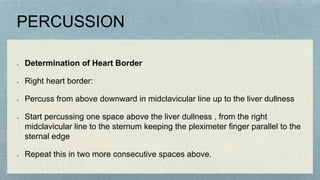
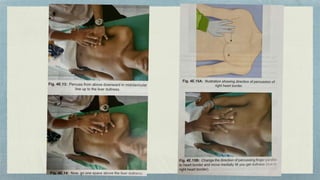
Determination of Heart Border
Right heart border:
Percuss from above downward in midclavicular line up to the liver dullness
Start percussing one space above the liver dullness , from the right
midclavicular line to the sternum keeping the pleximeter finger parallel to the
sternal edge
Repeat this in two more consecutive spaces above.
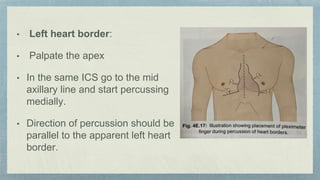
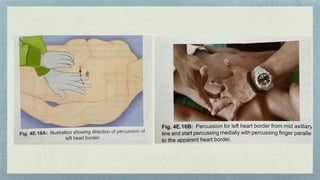
• Left heart border:
• Palpate the apex
• In the same ICS go to the mid
axillary line and start percussing
medially.
• Direction of percussion should be
parallel to the apparent left heart
border.
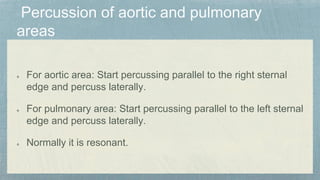
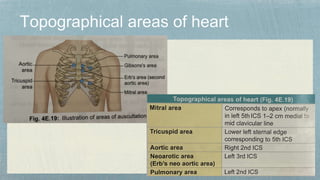
For aortic area: Start percussing parallel to the right sternal
edge and percuss laterally.
For pulmonary area: Start percussing parallel to the left sternal
edge and percuss laterally.
Normally it is resonant.
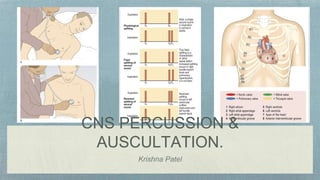
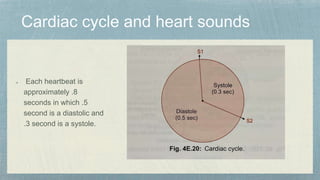
Each heartbeat is
approximately .8
seconds in which .5
second is a diastolic and
.3 second is a systole.
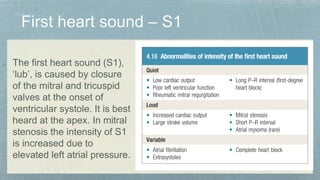
The first heart sound (S1),
‘lub’, is caused by closure
of the mitral and tricuspid
valves at the onset of
ventricular systole. It is best
heard at the apex. In mitral
stenosis the intensity of S1
is increased due to
elevated left atrial pressure.
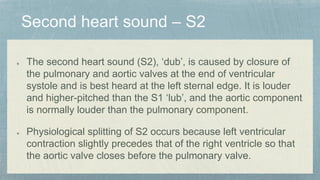
The second heart sound (S2), ‘dub’, is caused by closure of
the pulmonary and aortic valves at the end of ventricular
systole and is best heard at the left sternal edge. It is louder
and higher-pitched than the S1 ‘lub’, and the aortic component
is normally louder than the pulmonary component.
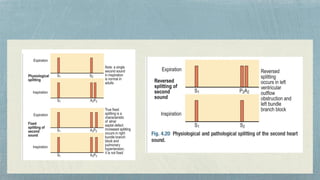
Physiological splitting of S2 occurs because left ventricular
contraction slightly precedes that of the right ventricle so that
the aortic valve closes before the pulmonary valve.
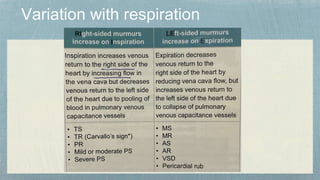
This splitting increases at end-inspiration because increased
venous filling of the right ventricle further delays pulmonary valve
closure.
The separation disappears on expiration . On auscultation, ‘lub d-
dub’ (inspiration) ‘lub-dub’ (expiration) is heard.
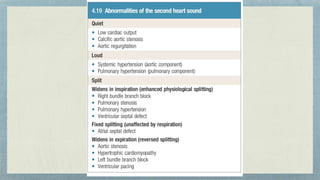
The aortic component of S2 is sometimes quiet or absent in calcific
aortic stenosis and reduced in aortic regurgitation . The aortic
component of S2 is loud in systemic hypertension, and the
pulmonary component is increased in pulmonary hypertension.
Wide splitting of S2, but with normal respiratory variation, occurs in
conditions that delay right ventricular emptying, such as right
bundle branch block or pulmonary hypertension. Fixed splitting of
S2, with no variation with respiration, is a feature of atrial septal
defect .
In this condition the right ventricular stroke volume is larger than
the left, and the splitting is fixed because the defect equalises the
pressure between the two atria throughout the respiratory cycle.
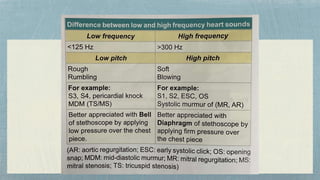
The third heart sound (S3) is a low-pitched early diastolic
sound best heard with the bell at the apex. It coincides with
rapid ventricular filling immediately after opening of the
atrioventricular valves and is therefore heard after the second
heart sound as ‘lub-dub-dum’.
It is a normal physiological finding in children, young adults
and febrile patients, and during pregnancy, but is usually
pathological after the age of 40 years.
• The most common causes are left ventricular failure, when it is
an early sign, and mitral regurgitation, due to volume loading
of the ventricle.
• In heart failure, S3 occurs with a tachycardia, referred to as a
‘gallop’ rhythm, and S1 and S2 are quiet (lub-da-dub).
The fourth heart sound (S4) is less common. It is soft and low-
pitched, best heard with the bell at the apex. It occurs just
before S1 (da-lub-dub). It is always pathological and is caused
by forceful atrial contraction against a non-compliant or stiff
ventricle. A S4 is most often heard with left ventricular
hypertrophy (due to hypertension, aortic stenosis or
hypertrophic cardiomyopathy). It cannot occur when there is
atrial fibrillation.
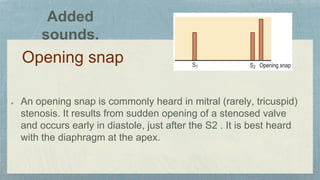
Opening snap
An opening snap is commonly heard in mitral (rarely, tricuspid)
stenosis. It results from sudden opening of a stenosed valve
and occurs early in diastole, just after the S2 . It is best heard
with the diaphragm at the apex.
Added
sounds.
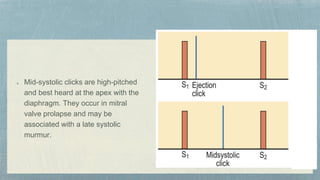
Ejection clicks are high-pitched sounds best heard with the
diaphragm. They occur early in systole just after the S1, in
patients with congenital pulmonary or aortic stenosis .
The mechanism is similar to that of an opening snap. Ejection
clicks do not occur in calcific aortic stenosis because the
cusps are rigid.
Mid-systolic clicks are high-pitched
and best heard at the apex with the
diaphragm. They occur in mitral
valve prolapse and may be
associated with a late systolic
murmur.
Pericardial rub (friction rub) is a coarse scratching sound, often with systolic
and diastolic components. It is best heard using the diaphragm with the
patient holding their breath in expiration. It may be audible over any part of
the precordium but is often localised, varying in intensity over time and with
the position of the patient.
It is most often heard in acute pericarditis or a few days after an extensive
myocardial infarction. A pleuropericardial rub is a similar sound that occurs
in time with the cardiac cycle, but is also influenced by respiration and is
pleural in origin. Occasionally, a ‘crunching’ noise can be heard, caused by
gas in the pericardium (pneumopericardium).
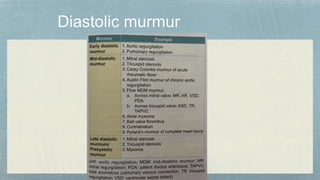
Heart murmurs are produced by turbulent
flow across an abnormal valve, septal
defect or outflow obstruction. ‘Innocent’
murmurs are caused by increased
velocity of flow through a normal valve
and occur when stroke volume is
increased, as in pregnant women,
athletes with resting bradycardia or
patients with fever.
1. Timing
2. Duration
3. Character & pitch
4. Intensity
5. Location
6. Radiation
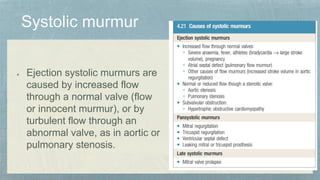
Ejection systolic murmurs are
caused by increased flow
through a normal valve (flow
or innocent murmur), or by
turbulent flow through an
abnormal valve, as in aortic or
pulmonary stenosis.
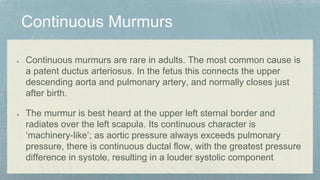
Continuous murmurs are rare in adults. The most common cause is
a patent ductus arteriosus. In the fetus this connects the upper
descending aorta and pulmonary artery, and normally closes just
after birth.
The murmur is best heard at the upper left sternal border and
radiates over the left scapula. Its continuous character is
‘machinery-like’; as aortic pressure always exceeds pulmonary
pressure, there is continuous ductal flow, with the greatest pressure
difference in systole, resulting in a louder systolic component
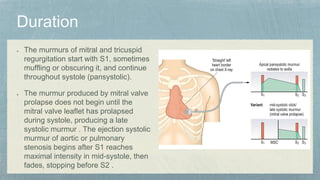
The murmurs of mitral and tricuspid
regurgitation start with S1, sometimes
muffling or obscuring it, and continue
throughout systole (pansystolic).
The murmur produced by mitral valve
prolapse does not begin until the
mitral valve leaflet has prolapsed
during systole, producing a late
systolic murmur . The ejection systolic
murmur of aortic or pulmonary
stenosis begins after S1 reaches
maximal intensity in mid-systole, then
fades, stopping before S2 .
The quality of a murmur is subjective but terms such as harsh,
blowing, musical, rumbling and high- or low-pitched can be
useful.
High-pitched murmurs often correspond to high-pressure
gradients, so the diastolic murmur of aortic regurgitation is
higher-pitched than that of mitral stenosis.
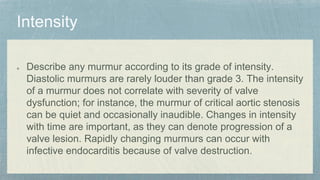
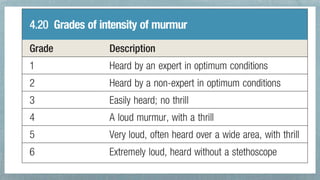
Describe any murmur according to its grade of intensity.
Diastolic murmurs are rarely louder than grade 3. The intensity
of a murmur does not correlate with severity of valve
dysfunction; for instance, the murmur of critical aortic stenosis
can be quiet and occasionally inaudible. Changes in intensity
with time are important, as they can denote progression of a
valve lesion. Rapidly changing murmurs can occur with
infective endocarditis because of valve destruction.
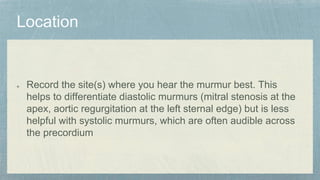
Record the site(s) where you hear the murmur best. This
helps to differentiate diastolic murmurs (mitral stenosis at the
apex, aortic regurgitation at the left sternal edge) but is less
helpful with systolic murmurs, which are often audible across
the precordium
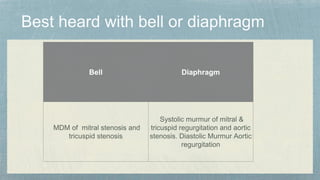
Bell Diaphragm
MDM of mitral stenosis and
tricuspid stenosis
Systolic murmur of mitral &
tricuspid regurgitation and aortic
stenosis. Diastolic Murmur Aortic
regurgitation
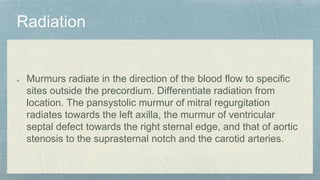
Murmurs radiate in the direction of the blood flow to specific
sites outside the precordium. Differentiate radiation from
location. The pansystolic murmur of mitral regurgitation
radiates towards the left axilla, the murmur of ventricular
septal defect towards the right sternal edge, and that of aortic
stenosis to the suprasternal notch and the carotid arteries.
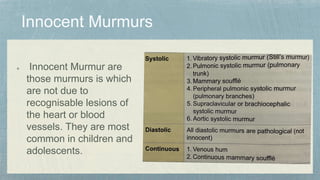
Innocent Murmur are
those murmurs is which
are not due to
recognisable lesions of
the heart or blood
vessels. They are most
common in children and
adolescents.
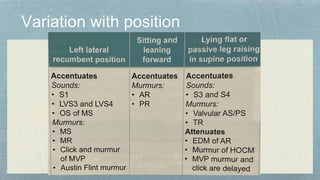
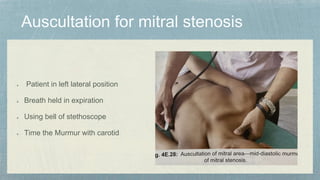
Patient in left lateral position
Breath held in expiration
Using bell of stethoscope
Time the Murmur with carotid
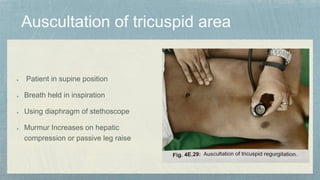
Patient in supine position
Breath held in inspiration
Using diaphragm of stethoscope
Murmur Increases on hepatic
compression or passive leg raise
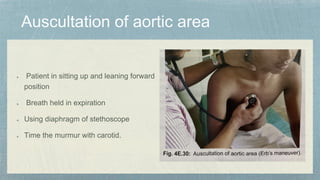
Patient in sitting up and leaning forward
position
Breath held in expiration
Using diaphragm of stethoscope
Time the murmur with carotid.
Thank you

Cns- percussion & auscultation

  • 1.
  • 2.
    PERCUSSION Determination of HeartBorder Right heart border: Percuss from above downward in midclavicular line up to the liver dullness Start percussing one space above the liver dullness , from the right midclavicular line to the sternum keeping the pleximeter finger parallel to the sternal edge Repeat this in two more consecutive spaces above.
  • 4.
    • Left heartborder: • Palpate the apex • In the same ICS go to the mid axillary line and start percussing medially. • Direction of percussion should be parallel to the apparent left heart border.
  • 6.
    For aortic area:Start percussing parallel to the right sternal edge and percuss laterally. For pulmonary area: Start percussing parallel to the left sternal edge and percuss laterally. Normally it is resonant.
  • 9.
    Each heartbeat is approximately.8 seconds in which .5 second is a diastolic and .3 second is a systole.
  • 10.
    The first heartsound (S1), ‘lub’, is caused by closure of the mitral and tricuspid valves at the onset of ventricular systole. It is best heard at the apex. In mitral stenosis the intensity of S1 is increased due to elevated left atrial pressure.
  • 11.
    The second heartsound (S2), ‘dub’, is caused by closure of the pulmonary and aortic valves at the end of ventricular systole and is best heard at the left sternal edge. It is louder and higher-pitched than the S1 ‘lub’, and the aortic component is normally louder than the pulmonary component. Physiological splitting of S2 occurs because left ventricular contraction slightly precedes that of the right ventricle so that the aortic valve closes before the pulmonary valve.
  • 12.
    This splitting increasesat end-inspiration because increased venous filling of the right ventricle further delays pulmonary valve closure. The separation disappears on expiration . On auscultation, ‘lub d- dub’ (inspiration) ‘lub-dub’ (expiration) is heard. The aortic component of S2 is sometimes quiet or absent in calcific aortic stenosis and reduced in aortic regurgitation . The aortic component of S2 is loud in systemic hypertension, and the pulmonary component is increased in pulmonary hypertension.
  • 13.
    Wide splitting ofS2, but with normal respiratory variation, occurs in conditions that delay right ventricular emptying, such as right bundle branch block or pulmonary hypertension. Fixed splitting of S2, with no variation with respiration, is a feature of atrial septal defect . In this condition the right ventricular stroke volume is larger than the left, and the splitting is fixed because the defect equalises the pressure between the two atria throughout the respiratory cycle.
  • 16.
    The third heartsound (S3) is a low-pitched early diastolic sound best heard with the bell at the apex. It coincides with rapid ventricular filling immediately after opening of the atrioventricular valves and is therefore heard after the second heart sound as ‘lub-dub-dum’. It is a normal physiological finding in children, young adults and febrile patients, and during pregnancy, but is usually pathological after the age of 40 years.
  • 17.
    • The mostcommon causes are left ventricular failure, when it is an early sign, and mitral regurgitation, due to volume loading of the ventricle. • In heart failure, S3 occurs with a tachycardia, referred to as a ‘gallop’ rhythm, and S1 and S2 are quiet (lub-da-dub).
  • 18.
    The fourth heartsound (S4) is less common. It is soft and low- pitched, best heard with the bell at the apex. It occurs just before S1 (da-lub-dub). It is always pathological and is caused by forceful atrial contraction against a non-compliant or stiff ventricle. A S4 is most often heard with left ventricular hypertrophy (due to hypertension, aortic stenosis or hypertrophic cardiomyopathy). It cannot occur when there is atrial fibrillation.
  • 19.
    Opening snap An openingsnap is commonly heard in mitral (rarely, tricuspid) stenosis. It results from sudden opening of a stenosed valve and occurs early in diastole, just after the S2 . It is best heard with the diaphragm at the apex. Added sounds.
  • 20.
    Ejection clicks arehigh-pitched sounds best heard with the diaphragm. They occur early in systole just after the S1, in patients with congenital pulmonary or aortic stenosis . The mechanism is similar to that of an opening snap. Ejection clicks do not occur in calcific aortic stenosis because the cusps are rigid.
  • 21.
    Mid-systolic clicks arehigh-pitched and best heard at the apex with the diaphragm. They occur in mitral valve prolapse and may be associated with a late systolic murmur.
  • 22.
    Pericardial rub (frictionrub) is a coarse scratching sound, often with systolic and diastolic components. It is best heard using the diaphragm with the patient holding their breath in expiration. It may be audible over any part of the precordium but is often localised, varying in intensity over time and with the position of the patient. It is most often heard in acute pericarditis or a few days after an extensive myocardial infarction. A pleuropericardial rub is a similar sound that occurs in time with the cardiac cycle, but is also influenced by respiration and is pleural in origin. Occasionally, a ‘crunching’ noise can be heard, caused by gas in the pericardium (pneumopericardium).
  • 23.
    Heart murmurs areproduced by turbulent flow across an abnormal valve, septal defect or outflow obstruction. ‘Innocent’ murmurs are caused by increased velocity of flow through a normal valve and occur when stroke volume is increased, as in pregnant women, athletes with resting bradycardia or patients with fever. 1. Timing 2. Duration 3. Character & pitch 4. Intensity 5. Location 6. Radiation
  • 24.
    Ejection systolic murmursare caused by increased flow through a normal valve (flow or innocent murmur), or by turbulent flow through an abnormal valve, as in aortic or pulmonary stenosis.
  • 26.
    Continuous murmurs arerare in adults. The most common cause is a patent ductus arteriosus. In the fetus this connects the upper descending aorta and pulmonary artery, and normally closes just after birth. The murmur is best heard at the upper left sternal border and radiates over the left scapula. Its continuous character is ‘machinery-like’; as aortic pressure always exceeds pulmonary pressure, there is continuous ductal flow, with the greatest pressure difference in systole, resulting in a louder systolic component
  • 27.
    The murmurs ofmitral and tricuspid regurgitation start with S1, sometimes muffling or obscuring it, and continue throughout systole (pansystolic). The murmur produced by mitral valve prolapse does not begin until the mitral valve leaflet has prolapsed during systole, producing a late systolic murmur . The ejection systolic murmur of aortic or pulmonary stenosis begins after S1 reaches maximal intensity in mid-systole, then fades, stopping before S2 .
  • 28.
    The quality ofa murmur is subjective but terms such as harsh, blowing, musical, rumbling and high- or low-pitched can be useful. High-pitched murmurs often correspond to high-pressure gradients, so the diastolic murmur of aortic regurgitation is higher-pitched than that of mitral stenosis.
  • 29.
    Describe any murmuraccording to its grade of intensity. Diastolic murmurs are rarely louder than grade 3. The intensity of a murmur does not correlate with severity of valve dysfunction; for instance, the murmur of critical aortic stenosis can be quiet and occasionally inaudible. Changes in intensity with time are important, as they can denote progression of a valve lesion. Rapidly changing murmurs can occur with infective endocarditis because of valve destruction.
  • 31.
    Record the site(s)where you hear the murmur best. This helps to differentiate diastolic murmurs (mitral stenosis at the apex, aortic regurgitation at the left sternal edge) but is less helpful with systolic murmurs, which are often audible across the precordium
  • 32.
    Bell Diaphragm MDM ofmitral stenosis and tricuspid stenosis Systolic murmur of mitral & tricuspid regurgitation and aortic stenosis. Diastolic Murmur Aortic regurgitation
  • 33.
    Murmurs radiate inthe direction of the blood flow to specific sites outside the precordium. Differentiate radiation from location. The pansystolic murmur of mitral regurgitation radiates towards the left axilla, the murmur of ventricular septal defect towards the right sternal edge, and that of aortic stenosis to the suprasternal notch and the carotid arteries.
  • 36.
    Innocent Murmur are thosemurmurs is which are not due to recognisable lesions of the heart or blood vessels. They are most common in children and adolescents.
  • 37.
    Patient in leftlateral position Breath held in expiration Using bell of stethoscope Time the Murmur with carotid
  • 38.
    Patient in supineposition Breath held in inspiration Using diaphragm of stethoscope Murmur Increases on hepatic compression or passive leg raise
  • 39.
    Patient in sittingup and leaning forward position Breath held in expiration Using diaphragm of stethoscope Time the murmur with carotid.
  • 40.