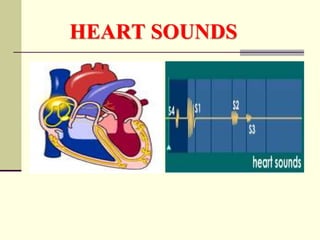
HEART SOUNDS
LECTURE OUTLI NES / OBJECTIVES
 List the major types of normal heart sounds
 Understand the physiological basis for the
production of normal heart sounds
 Understand the patho-physiological basis for the
production of heart murmurs
STUDENTS ABLE TO UNDERSTAND:
HEART SOUNDS
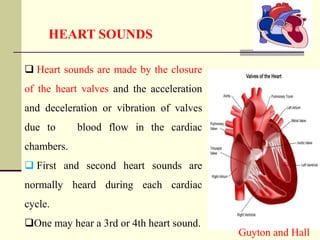
 Heart sounds are made by the closure
of the heart valves and the acceleration
and deceleration or vibration of valves
due to blood flow in the cardiac
chambers.
 First and second heart sounds are
normally heard during each cardiac
cycle.
One may hear a 3rd or 4th heart sound.
Guyton and Hall
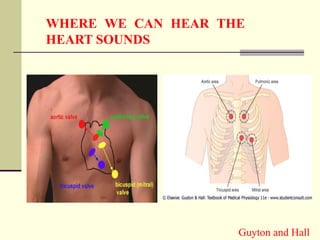
WHERE WE CAN HEAR THE
HEART SOUNDS
Guyton and Hall
FIRST HEART SOUND (S1)
 First heart sound is produced due to the closure of Atrio-
ventricular valves (Tricuspid and Mitral).
 It occurs at the beginning of the systole
 Sounds like LUB
 Frequency: 25-45 CPS (cycles per second) or Hz.
 Soft when the heart rate is slow because ventricles are well
filled with blood and the leaflets of the A-V valves float
together before systole begins.
 Time: 0.14 sec [Guyton]; 0.15 Sec [Ganongs] Guyton and Hall
Ganongs
SECOND HEART SOUND (S2)
 This sound is produced by the vibration associated with the
closure of the semilunar valves (aortic and pulmonary) at the
end of ventricular systole.
 ECG relationship: The second heart sound occur soon
after the T-wave of ECG.
 Duration: 0. 11 sec [Guyton]; 0.12 [Ganong].
 Frequency: 50 Hz or CPS.
 This sound is sharp and loud and described as “DUB.”
 Two sub components
 Pulmonary component heard at the level of 2nd left
intercostal space.
 Aortic component is heard at the level of the 2nd right
interscostal space near the right border of the sternum.
Guyton and Hall; Ganong
SECOND HEART SOUND (S2)
The S2 duration is 0.11 Sec and S1 is about 0.14 second
The reason for the shorter S2 is that semilunar valves are more tight
than A-V valves, so they vibrate for a shorter time than A-V valve
The S2 has higher frequency than the S1 for two reasons:
 1. The tautness of the semilunar valves than A-V valves
 2. The greater elastic coefficient of the taut arterial walls that
provide the principal vibrating chambers for the S2.
 Second heart sound has physiological inspiratory splitting
Guyton and Hall
Chest wall expands during inspiration
Intrathoracic pressure becomes more negative to form a vacuum
Venous return from the body to the right heart increases, venous return from the lungs to the left heart
decreases
THIRD HEART SOUND (S3)
 Occurs at the beginning of middle third of Diastole
 Cause of third heart sound
 Rush of blood from Atria to Ventricle during rapid
filling phase of Cardiac Cycle.
 It causes vibration in the blood
 Frequency:20-30 Htz
 Time: 0.1 sec
FOURTH HEART SOUND (S4)
OR ATRIAL SOUND
 Occurs at the last one third of Diastole [Just before S1]
 Produced due to Atrial contraction which causes rapid flow of
blood from Atria to Ventricle and vibration in the blood.
 Frequency: 20 cycles / sec or less [Htz]
 Third and Fourth heart sound are low pitched sounds therefore
not easily audible normally with stethoscope
 S3 may be heard in children and young adults
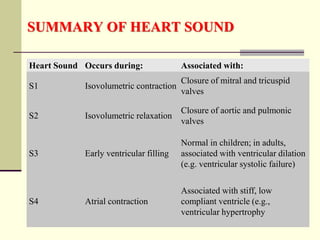
Heart Sound Occurs during: Associated with:
S1 Isovolumetric contraction
Closure of mitral and tricuspid
valves
S2 Isovolumetric relaxation
Closure of aortic and pulmonic
valves
S3 Early ventricular filling
Normal in children; in adults,
associated with ventricular dilation
(e.g. ventricular systolic failure)
S4 Atrial contraction
Associated with stiff, low
compliant ventricle (e.g.,
ventricular hypertrophy
SUMMARY OF HEART SOUND
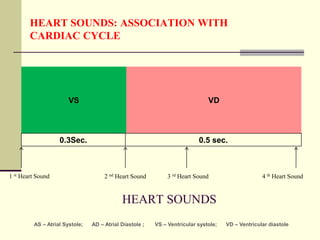
VS VD
HEART SOUNDS: ASSOCIATION WITH
CARDIAC CYCLE
HEART SOUNDS
0.3Sec. 0.5 sec.
1 st Heart Sound 2 nd Heart Sound 3 rd Heart Sound 4 th Heart Sound
AS – Atrial Systole; AD – Atrial Diastole ; VS – Ventricular systole; VD – Ventricular diastole
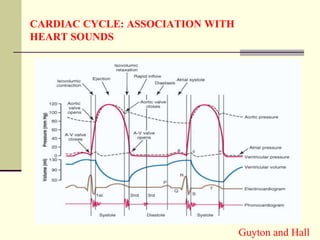
CARDIAC CYCLE: ASSOCIATION WITH
HEART SOUNDS
Guyton and Hall
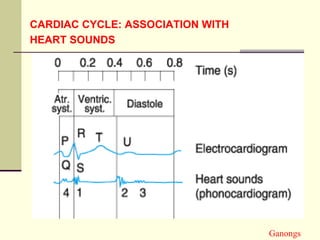
CARDIAC CYCLE: ASSOCIATION WITH
HEART SOUNDS
Ganongs
GALLOPS
 In some heart diseases (specially left veutricular failure) and
certain other conditions (e.g. severe anemia and thyrotoxicosis),
the 3rd or 4h heart sound is augmented and becomes audible
 More than 2 sounds will be heard during each cardiac cycle, and
these sounds follow each other in a rhythm similar to that
produced by a galloping horse

Heart sounds

  • 1.
  • 2.
    LECTURE OUTLI NES/ OBJECTIVES  List the major types of normal heart sounds  Understand the physiological basis for the production of normal heart sounds  Understand the patho-physiological basis for the production of heart murmurs STUDENTS ABLE TO UNDERSTAND:
  • 3.
    HEART SOUNDS  Heartsounds are made by the closure of the heart valves and the acceleration and deceleration or vibration of valves due to blood flow in the cardiac chambers.  First and second heart sounds are normally heard during each cardiac cycle. One may hear a 3rd or 4th heart sound. Guyton and Hall
  • 4.
    WHERE WE CANHEAR THE HEART SOUNDS Guyton and Hall
  • 5.
    FIRST HEART SOUND(S1)  First heart sound is produced due to the closure of Atrio- ventricular valves (Tricuspid and Mitral).  It occurs at the beginning of the systole  Sounds like LUB  Frequency: 25-45 CPS (cycles per second) or Hz.  Soft when the heart rate is slow because ventricles are well filled with blood and the leaflets of the A-V valves float together before systole begins.  Time: 0.14 sec [Guyton]; 0.15 Sec [Ganongs] Guyton and Hall Ganongs
  • 6.
    SECOND HEART SOUND(S2)  This sound is produced by the vibration associated with the closure of the semilunar valves (aortic and pulmonary) at the end of ventricular systole.  ECG relationship: The second heart sound occur soon after the T-wave of ECG.  Duration: 0. 11 sec [Guyton]; 0.12 [Ganong].  Frequency: 50 Hz or CPS.  This sound is sharp and loud and described as “DUB.”  Two sub components  Pulmonary component heard at the level of 2nd left intercostal space.  Aortic component is heard at the level of the 2nd right interscostal space near the right border of the sternum. Guyton and Hall; Ganong
  • 7.
    SECOND HEART SOUND(S2) The S2 duration is 0.11 Sec and S1 is about 0.14 second The reason for the shorter S2 is that semilunar valves are more tight than A-V valves, so they vibrate for a shorter time than A-V valve The S2 has higher frequency than the S1 for two reasons:  1. The tautness of the semilunar valves than A-V valves  2. The greater elastic coefficient of the taut arterial walls that provide the principal vibrating chambers for the S2.  Second heart sound has physiological inspiratory splitting Guyton and Hall Chest wall expands during inspiration Intrathoracic pressure becomes more negative to form a vacuum Venous return from the body to the right heart increases, venous return from the lungs to the left heart decreases
  • 8.
    THIRD HEART SOUND(S3)  Occurs at the beginning of middle third of Diastole  Cause of third heart sound  Rush of blood from Atria to Ventricle during rapid filling phase of Cardiac Cycle.  It causes vibration in the blood  Frequency:20-30 Htz  Time: 0.1 sec
  • 9.
    FOURTH HEART SOUND(S4) OR ATRIAL SOUND  Occurs at the last one third of Diastole [Just before S1]  Produced due to Atrial contraction which causes rapid flow of blood from Atria to Ventricle and vibration in the blood.  Frequency: 20 cycles / sec or less [Htz]  Third and Fourth heart sound are low pitched sounds therefore not easily audible normally with stethoscope  S3 may be heard in children and young adults
  • 10.
    Heart Sound Occursduring: Associated with: S1 Isovolumetric contraction Closure of mitral and tricuspid valves S2 Isovolumetric relaxation Closure of aortic and pulmonic valves S3 Early ventricular filling Normal in children; in adults, associated with ventricular dilation (e.g. ventricular systolic failure) S4 Atrial contraction Associated with stiff, low compliant ventricle (e.g., ventricular hypertrophy SUMMARY OF HEART SOUND
  • 11.
    VS VD HEART SOUNDS:ASSOCIATION WITH CARDIAC CYCLE HEART SOUNDS 0.3Sec. 0.5 sec. 1 st Heart Sound 2 nd Heart Sound 3 rd Heart Sound 4 th Heart Sound AS – Atrial Systole; AD – Atrial Diastole ; VS – Ventricular systole; VD – Ventricular diastole
  • 12.
    CARDIAC CYCLE: ASSOCIATIONWITH HEART SOUNDS Guyton and Hall
  • 13.
    CARDIAC CYCLE: ASSOCIATIONWITH HEART SOUNDS Ganongs
  • 14.
    GALLOPS  In someheart diseases (specially left veutricular failure) and certain other conditions (e.g. severe anemia and thyrotoxicosis), the 3rd or 4h heart sound is augmented and becomes audible  More than 2 sounds will be heard during each cardiac cycle, and these sounds follow each other in a rhythm similar to that produced by a galloping horse