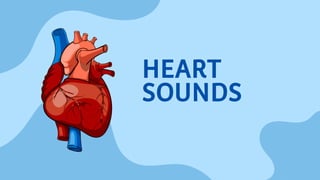
HEART
SOUNDS
Heart sounds are generated by blood flowing in
and out of the heart’s chambers through the
valves as they open and close.
Listening to the heart sounds through a
stethoscope (auscultation) is one of the first
steps a physician takes in evaluating a patient’s
medical condition.
Heart sounds provide the doctor valuable
information about heart function. Auscultation
is used to detect abnormal heart sounds and
decide on further course of action.
INTRODUCTION
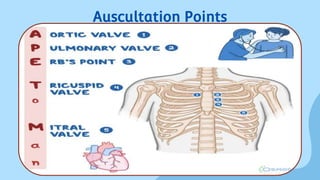
Auscultation Points
WHAT
CREATES
HEART
SOUNDS?
Blood flow creates vibrations in the heart chambers and valves which produce audible
sounds that can be heard through a stethoscope.
Smooth, low-resistance blood flow is called a laminar flow.
When the flow is rough with high resistance it is known as a turbulent flow.
Vibrations increase along with blood flow turbulence and depend on the diameter of the
blood vessel as well as the blood’s
• viscosity
• density
• velocity
Some of the functions of the heart that generate heart sounds are
• Opening or closing of the heart valves
• Flow of blood through the valve opening
• Flow of blood into the heart’s ventricles
• Rubbing of cardiac surfaces
WHAT CREATES HEART SOUNDS?
Types of Heart Sounds
S1
S2
S3
S4
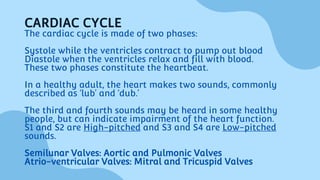
CARDIAC CYCLE
The cardiac cycle is made of two phases:
Systole while the ventricles contract to pump out blood
Diastole when the ventricles relax and fill with blood.
These two phases constitute the heartbeat.
In a healthy adult, the heart makes two sounds, commonly
described as ‘lub’ and ‘dub.’
The third and fourth sounds may be heard in some healthy
people, but can indicate impairment of the heart function.
S1 and S2 are High-pitched and S3 and S4 are Low-pitched
sounds.
Semilunar Valves: Aortic and Pulmonic Valves
Atrio-ventricular Valves: Mitral and Tricuspid Valves
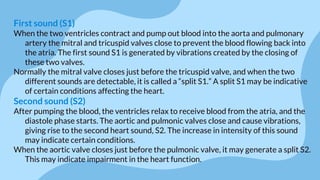
First sound (S1)
When the two ventricles contract and pump out blood into the aorta and pulmonary
artery the mitral and tricuspid valves close to prevent the blood flowing back into
the atria. The first sound S1 is generated by vibrations created by the closing of
these two valves.
Normally the mitral valve closes just before the tricuspid valve, and when the two
different sounds are detectable, it is called a “split S1.” A split S1 may be indicative
of certain conditions affecting the heart.
Second sound (S2)
After pumping the blood, the ventricles relax to receive blood from the atria, and the
diastole phase starts. The aortic and pulmonic valves close and cause vibrations,
giving rise to the second heart sound, S2. The increase in intensity of this sound
may indicate certain conditions.
When the aortic valve closes just before the pulmonic valve, it may generate a split S2.
This may indicate impairment in the heart function.
Third sound (S3)
The third heart sound is a low-pitched sound audible with the rapid rush of
blood from the atrium into the ventricle as it starts relaxing. This may be a
normal sound in some people but in people with heart conditions, S3 may
indicate heart failure.
Fourth sound (S4)
The fourth is a low-intensity sound heard just before S1 in the cardiac cycle.
The sudden slowing of blood flow by the ventricle as the atrium contracts
causes this sound, which may be a sign of heart disease.
In addition to normal heart sounds, a variety of other sounds may be present
including heart murmurs, adventitious sounds, and gallop rhythms S3 and S4.
Opening snap (OS) is a high-pitched sound that is caused by rapid opening of the
mitral or tricuspid valve following the aortic valve closing sound (S2). This may
indicate narrowing (stenosis) of the mitral or tricuspid valve; the closer in time the
OS is to S2, the more severe the stenosis.
Ejection systolic sounds
These sounds are heard during the early part of the ventricular contraction, which
may be
• Valvular ejection sounds due to defects in the aortic or pulmonic valves
• Vascular ejection sounds due to defects of the aortic or pulmonary artery
• Nonejection systolic click due to mitral or tricuspid valve prolapse
Abnormal Heart Sounds
What Are Heart Murmurs?
A Heart murmur is an unusual sound heard between heartbeats. In some
people, heart murmurs are just the sound of blood flow characteristic to
that person. Doctors call this an “innocent heart murmur.”
Heart murmurs are also generated by turbulent flow of blood across the
heart valves indicating a heart disease and a murmur to be heard as
turbulent flow must require pressure difference of at least 30 mm of Hg
between the chambers and the pressure dominant chamber will outflow
the blood to non-dominant chamber in diseased condition which leads to
Left-to-right shunt or Right-to-left shunt based on the pressure
dominance.
Turbulence may occur inside or outside the heart; if it occurs outside the
heart then the turbulence is called bruit or vascular murmur.
Abnormal Heart Sounds cont’d
Murmurs may be physiological (benign) or pathological (abnormal).
Abnormal murmurs can be caused by stenosis restricting the opening of a heart valve,
resulting in turbulence as blood flows through it.
Abnormal murmurs may also occur with valvular insufficiency (regurgitation), which allows
backflow of blood when the incompetent valve closes with only partial effectiveness.
Different murmurs are audible in different parts of the cardiac cycle, depending on the
cause of the murmur.
Other abnormal sounds
Clicks – Heart clicks are short, high-pitched sounds that can be appreciated with modern
non-invasive imaging techniques.
Rubs – The pericardial friction rub can be heard in pericarditis, an inflammation of the
pericardium, the sac surrounding the heart. This is a characteristic scratching, creaking,
high-pitched sound emanating from the rubbing of both layers of inflamed pericardium. It is
the loudest in systole, but can often be heard at the beginning and at the end of diastole. It
is very dependent on body position and breathing, and changes from hour to hour.
Abnormal Heart Sounds cont’d
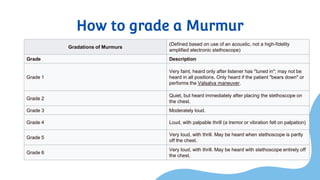
How to grade a Murmur
Gradations of Murmurs
(Defined based on use of an acoustic, not a high-fidelity
amplified electronic stethoscope)
Grade Description
Grade 1
Very faint, heard only after listener has "tuned in"; may not be
heard in all positions. Only heard if the patient "bears down" or
performs the Valsalva maneuver.
Grade 2
Quiet, but heard immediately after placing the stethoscope on
the chest.
Grade 3 Moderately loud.
Grade 4 Loud, with palpable thrill (a tremor or vibration felt on palpation)
Grade 5
Very loud, with thrill. May be heard when stethoscope is partly
off the chest.
Grade 6
Very loud, with thrill. May be heard with stethoscope entirely off
the chest.
1. Which of the following Pair is correctly Matched?
A. Dub- sudden opening of semilunar valves at the beginning of Ventricle
Diastole
B. Lub- sharp closing of AV valves at the beginning of ventricular systole.
C. Pulsation of radial artery valves in blood vessels.
D. Initiation of heart beat- Purkinji fibers.
2. A heart Murmur indicates a defect in the
A. Heart Valves
B. Bundle of HIS
C. SA Node
D. Av Node
Quiz
3. Which instrument is used to listen to the internal sounds of the Human
Body?
A. Stethoscope
B. Sphygmomanometer
C. Reflex Hammer
D. Suction Device
4. Turbulence occurring outside the Heart is known as
A. Opening Snap
B. Vascular Ejection sound
C. Bruit
D. S3 gallop
Quiz cont’d
● https://www.medicinenet.com/what_are_the_four_heart_sounds/articl
e.htm
● https://en.wikipedia.org/wiki/Heart_sounds
● https://www.utmb.edu/pedi_ed/CoreV2/CardiologyPart1/CardiologyP
art12.html
● https://www.google.com/url?sa=i&url=https%3A%2F%2Fwww.osmosis
.org%2Fanswers%2Fape-to-man-heart-sounds-
mnemonic&psig=AOvVaw2uFw5ppyBuWpxXb_zuGkDy&ust=166504
7641482000&source=images&cd=vfe&ved=0CAsQjRxqFwoTCJDnp_v
fyPoCFQAAAAAdAAAAABAE
REFERENCES
THANK YOU

Heart Sounds.pptx

  • 1.
  • 2.
    Heart sounds aregenerated by blood flowing in and out of the heart’s chambers through the valves as they open and close. Listening to the heart sounds through a stethoscope (auscultation) is one of the first steps a physician takes in evaluating a patient’s medical condition. Heart sounds provide the doctor valuable information about heart function. Auscultation is used to detect abnormal heart sounds and decide on further course of action. INTRODUCTION
  • 3.
  • 4.
  • 5.
    Blood flow createsvibrations in the heart chambers and valves which produce audible sounds that can be heard through a stethoscope. Smooth, low-resistance blood flow is called a laminar flow. When the flow is rough with high resistance it is known as a turbulent flow. Vibrations increase along with blood flow turbulence and depend on the diameter of the blood vessel as well as the blood’s • viscosity • density • velocity Some of the functions of the heart that generate heart sounds are • Opening or closing of the heart valves • Flow of blood through the valve opening • Flow of blood into the heart’s ventricles • Rubbing of cardiac surfaces WHAT CREATES HEART SOUNDS?
  • 6.
    Types of HeartSounds S1 S2 S3 S4
  • 7.
    CARDIAC CYCLE The cardiaccycle is made of two phases: Systole while the ventricles contract to pump out blood Diastole when the ventricles relax and fill with blood. These two phases constitute the heartbeat. In a healthy adult, the heart makes two sounds, commonly described as ‘lub’ and ‘dub.’ The third and fourth sounds may be heard in some healthy people, but can indicate impairment of the heart function. S1 and S2 are High-pitched and S3 and S4 are Low-pitched sounds. Semilunar Valves: Aortic and Pulmonic Valves Atrio-ventricular Valves: Mitral and Tricuspid Valves
  • 8.
    First sound (S1) Whenthe two ventricles contract and pump out blood into the aorta and pulmonary artery the mitral and tricuspid valves close to prevent the blood flowing back into the atria. The first sound S1 is generated by vibrations created by the closing of these two valves. Normally the mitral valve closes just before the tricuspid valve, and when the two different sounds are detectable, it is called a “split S1.” A split S1 may be indicative of certain conditions affecting the heart. Second sound (S2) After pumping the blood, the ventricles relax to receive blood from the atria, and the diastole phase starts. The aortic and pulmonic valves close and cause vibrations, giving rise to the second heart sound, S2. The increase in intensity of this sound may indicate certain conditions. When the aortic valve closes just before the pulmonic valve, it may generate a split S2. This may indicate impairment in the heart function.
  • 9.
    Third sound (S3) Thethird heart sound is a low-pitched sound audible with the rapid rush of blood from the atrium into the ventricle as it starts relaxing. This may be a normal sound in some people but in people with heart conditions, S3 may indicate heart failure. Fourth sound (S4) The fourth is a low-intensity sound heard just before S1 in the cardiac cycle. The sudden slowing of blood flow by the ventricle as the atrium contracts causes this sound, which may be a sign of heart disease.
  • 10.
    In addition tonormal heart sounds, a variety of other sounds may be present including heart murmurs, adventitious sounds, and gallop rhythms S3 and S4. Opening snap (OS) is a high-pitched sound that is caused by rapid opening of the mitral or tricuspid valve following the aortic valve closing sound (S2). This may indicate narrowing (stenosis) of the mitral or tricuspid valve; the closer in time the OS is to S2, the more severe the stenosis. Ejection systolic sounds These sounds are heard during the early part of the ventricular contraction, which may be • Valvular ejection sounds due to defects in the aortic or pulmonic valves • Vascular ejection sounds due to defects of the aortic or pulmonary artery • Nonejection systolic click due to mitral or tricuspid valve prolapse Abnormal Heart Sounds
  • 11.
    What Are HeartMurmurs? A Heart murmur is an unusual sound heard between heartbeats. In some people, heart murmurs are just the sound of blood flow characteristic to that person. Doctors call this an “innocent heart murmur.” Heart murmurs are also generated by turbulent flow of blood across the heart valves indicating a heart disease and a murmur to be heard as turbulent flow must require pressure difference of at least 30 mm of Hg between the chambers and the pressure dominant chamber will outflow the blood to non-dominant chamber in diseased condition which leads to Left-to-right shunt or Right-to-left shunt based on the pressure dominance. Turbulence may occur inside or outside the heart; if it occurs outside the heart then the turbulence is called bruit or vascular murmur. Abnormal Heart Sounds cont’d
  • 12.
    Murmurs may bephysiological (benign) or pathological (abnormal). Abnormal murmurs can be caused by stenosis restricting the opening of a heart valve, resulting in turbulence as blood flows through it. Abnormal murmurs may also occur with valvular insufficiency (regurgitation), which allows backflow of blood when the incompetent valve closes with only partial effectiveness. Different murmurs are audible in different parts of the cardiac cycle, depending on the cause of the murmur. Other abnormal sounds Clicks – Heart clicks are short, high-pitched sounds that can be appreciated with modern non-invasive imaging techniques. Rubs – The pericardial friction rub can be heard in pericarditis, an inflammation of the pericardium, the sac surrounding the heart. This is a characteristic scratching, creaking, high-pitched sound emanating from the rubbing of both layers of inflamed pericardium. It is the loudest in systole, but can often be heard at the beginning and at the end of diastole. It is very dependent on body position and breathing, and changes from hour to hour. Abnormal Heart Sounds cont’d
  • 13.
    How to gradea Murmur Gradations of Murmurs (Defined based on use of an acoustic, not a high-fidelity amplified electronic stethoscope) Grade Description Grade 1 Very faint, heard only after listener has "tuned in"; may not be heard in all positions. Only heard if the patient "bears down" or performs the Valsalva maneuver. Grade 2 Quiet, but heard immediately after placing the stethoscope on the chest. Grade 3 Moderately loud. Grade 4 Loud, with palpable thrill (a tremor or vibration felt on palpation) Grade 5 Very loud, with thrill. May be heard when stethoscope is partly off the chest. Grade 6 Very loud, with thrill. May be heard with stethoscope entirely off the chest.
  • 14.
    1. Which ofthe following Pair is correctly Matched? A. Dub- sudden opening of semilunar valves at the beginning of Ventricle Diastole B. Lub- sharp closing of AV valves at the beginning of ventricular systole. C. Pulsation of radial artery valves in blood vessels. D. Initiation of heart beat- Purkinji fibers. 2. A heart Murmur indicates a defect in the A. Heart Valves B. Bundle of HIS C. SA Node D. Av Node Quiz
  • 15.
    3. Which instrumentis used to listen to the internal sounds of the Human Body? A. Stethoscope B. Sphygmomanometer C. Reflex Hammer D. Suction Device 4. Turbulence occurring outside the Heart is known as A. Opening Snap B. Vascular Ejection sound C. Bruit D. S3 gallop Quiz cont’d
  • 16.
    ● https://www.medicinenet.com/what_are_the_four_heart_sounds/articl e.htm ● https://en.wikipedia.org/wiki/Heart_sounds ●https://www.utmb.edu/pedi_ed/CoreV2/CardiologyPart1/CardiologyP art12.html ● https://www.google.com/url?sa=i&url=https%3A%2F%2Fwww.osmosis .org%2Fanswers%2Fape-to-man-heart-sounds- mnemonic&psig=AOvVaw2uFw5ppyBuWpxXb_zuGkDy&ust=166504 7641482000&source=images&cd=vfe&ved=0CAsQjRxqFwoTCJDnp_v fyPoCFQAAAAAdAAAAABAE REFERENCES
  • 17.