DATA MINING
TECHNIQUES
(DECISION TREES )
Presented by:
Shweta Ghate
MIT College OF Engineering
What is Data Mining ???
• Data Mining is all about automating the
process of searching for patterns in the
data.
• Data mining is the discovery of hidden
knowledge, unexpected patterns and new rules in
large databases..
Data Mining Techniques
Key techniques
 Association
 Classification
Decision Trees
 Clustering Techniques
 Regression
Classification
 Classification is a most familiar and most popular data mining
technique.
 Classification applications includes image and pattern
recognition, loan approval, detecting faults in industrial
applications.
 All approaches to performing classification assumes some
knowledge of the data.
 Training set is used to develop specific parameters required by
the technique.
 The goal of classification is to build a concise model that can
be use to predict the class of records whose class label is not
know.
Classification
Classification consists of assigning a class
label to a set of unclassified cases.
1. Supervised Classification
The set of possible classes is known in
advance.
2. Unsupervised Classification
Set of possible classes is not known. After
classification we can try to assign a name to
that class. Unsupervised classification is
called clustering.
Decision tree
 Classification scheme
 Generates a tree and a set of rules
 Set of records divide into 2 subsets
◦ -training set (deriving the classifier)
◦ - test set (measure the accuracy of classifier)
• Attributes are divided into 2 types
-numerical attribute
-categorical attribute
Decision tree
 Decision tree
◦ A flow-chart-like tree structure
◦ Internal node denotes a test on an attribute
◦ Branch represents an outcome of the test
◦ Leaf nodes represent class labels or class
distribution or rule.
 Use of decision tree: Classifying an unknown sample
◦ Test the attribute values of the sample against the
decision tree
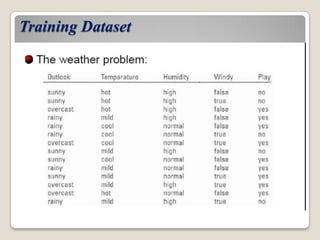
Training Dataset
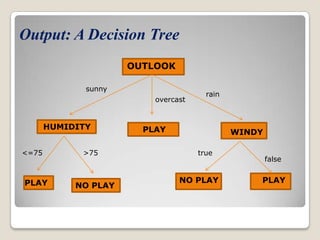
Output: A Decision Tree
OUTLOOK
HUMIDITY PLAY WINDY
PLAY NO PLAY
NO PLAY PLAY
sunny
overcast
rain
<=75 >75 true
false
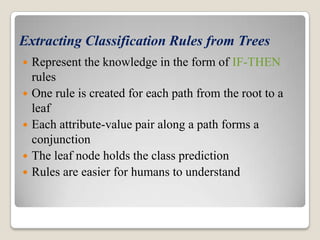
Extracting Classification Rules from Trees
 Represent the knowledge in the form of IF-THEN
rules
 One rule is created for each path from the root to a
leaf
 Each attribute-value pair along a path forms a
conjunction
 The leaf node holds the class prediction
 Rules are easier for humans to understand
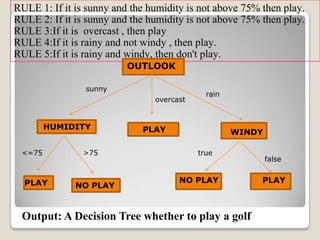
RULE 1: If it is sunny and the humidity is not above 75% then play.
RULE 2: If it is sunny and the humidity is not above 75% then play.
RULE 3:If it is overcast , then play
RULE 4:If it is rainy and not windy , then play.
RULE 5:If it is rainy and windy, then don't play.
Output: A Decision Tree whether to play a golf
OUTLOOK
HUMIDITY PLAY WINDY
PLAY NO PLAY
NO PLAY PLAY
sunny
overcast
rain
<=75 >75 true
false
Example
 The classification of an unknown input vector is done
by traversing the tree from the root node to the leaf
node.
 e.g: outlook= rain, temp=70,humidity=65,
and weather=true…..then find the value of Class
attribute?????
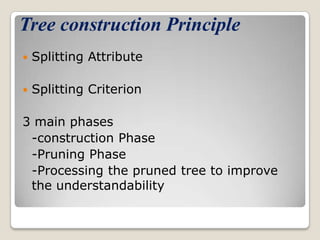
Tree construction Principle
 Splitting Attribute
 Splitting Criterion
3 main phases
-construction Phase
-Pruning Phase
-Processing the pruned tree to improve
the understandability
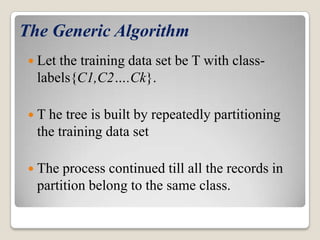
The Generic Algorithm
 Let the training data set be T with class-
labels{C1,C2….Ck}.
 T he tree is built by repeatedly partitioning
the training data set
 The process continued till all the records in
partition belong to the same class.
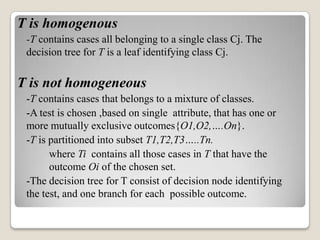
T is homogenous
-T contains cases all belonging to a single class Cj. The
decision tree for T is a leaf identifying class Cj.
T is not homogeneous
-T contains cases that belongs to a mixture of classes.
-A test is chosen ,based on single attribute, that has one or
more mutually exclusive outcomes{O1,O2,….On}.
-T is partitioned into subset T1,T2,T3…..Tn.
where Ti contains all those cases in T that have the
outcome Oi of the chosen set.
-The decision tree for T consist of decision node identifying
the test, and one branch for each possible outcome.
-The same tree building method is applied
recursively to each subset of training cases.
- n is taken 2,and a binary decision tree is generated.
T is trivial
- T contains no cases.
- The decision tree T is a leaf ,but the class to be
associated with the leaf must be determined from
information other than T.
Decision Tree Construction Algorithms
 CART(Classification And Regression Tree)
 ID3(Iterative Dichotomizer 3)
 C4.5
Advantages
 Generate understandable rules
 Able to handle both numeric and
categorical attributes
 They provide clear indication of which
fields are most important for prediction or
classification.
Weaknesses
 Some decision trees can only deal with
binary-valued target classes
 Others can assign records to an arbitrary
number of classes ,but are error-prone
when the number of training examples are
class gets small.
 Process of growing a decision tree is
computationally expensive.
References
• http://www.ibm.com/developerworks/opensource/library/
ba-data-mining-techniques/index.html
• Data Mining: Concepts and Techniques (Chapter 7 Slide for
textbook), Jiawei Han and Micheline Kamber, Intelligent
Database Systems Research Lab, School of Computing
Science, Simon Fraser University, Canada
• Data Mining Techiques: Second edition by Arun K.
Pujari.
Data mining technique (decision tree)

Data mining technique (decision tree)

  • 1.
    DATA MINING TECHNIQUES (DECISION TREES) Presented by: Shweta Ghate MIT College OF Engineering
  • 2.
    What is DataMining ??? • Data Mining is all about automating the process of searching for patterns in the data. • Data mining is the discovery of hidden knowledge, unexpected patterns and new rules in large databases..
  • 3.
    Data Mining Techniques Keytechniques  Association  Classification Decision Trees  Clustering Techniques  Regression
  • 4.
    Classification  Classification isa most familiar and most popular data mining technique.  Classification applications includes image and pattern recognition, loan approval, detecting faults in industrial applications.  All approaches to performing classification assumes some knowledge of the data.  Training set is used to develop specific parameters required by the technique.  The goal of classification is to build a concise model that can be use to predict the class of records whose class label is not know.
  • 5.
    Classification Classification consists ofassigning a class label to a set of unclassified cases. 1. Supervised Classification The set of possible classes is known in advance. 2. Unsupervised Classification Set of possible classes is not known. After classification we can try to assign a name to that class. Unsupervised classification is called clustering.
  • 6.
    Decision tree  Classificationscheme  Generates a tree and a set of rules  Set of records divide into 2 subsets ◦ -training set (deriving the classifier) ◦ - test set (measure the accuracy of classifier) • Attributes are divided into 2 types -numerical attribute -categorical attribute
  • 7.
    Decision tree  Decisiontree ◦ A flow-chart-like tree structure ◦ Internal node denotes a test on an attribute ◦ Branch represents an outcome of the test ◦ Leaf nodes represent class labels or class distribution or rule.  Use of decision tree: Classifying an unknown sample ◦ Test the attribute values of the sample against the decision tree
  • 8.
  • 9.
    Output: A DecisionTree OUTLOOK HUMIDITY PLAY WINDY PLAY NO PLAY NO PLAY PLAY sunny overcast rain <=75 >75 true false
  • 10.
    Extracting Classification Rulesfrom Trees  Represent the knowledge in the form of IF-THEN rules  One rule is created for each path from the root to a leaf  Each attribute-value pair along a path forms a conjunction  The leaf node holds the class prediction  Rules are easier for humans to understand
  • 11.
    RULE 1: Ifit is sunny and the humidity is not above 75% then play. RULE 2: If it is sunny and the humidity is not above 75% then play. RULE 3:If it is overcast , then play RULE 4:If it is rainy and not windy , then play. RULE 5:If it is rainy and windy, then don't play. Output: A Decision Tree whether to play a golf OUTLOOK HUMIDITY PLAY WINDY PLAY NO PLAY NO PLAY PLAY sunny overcast rain <=75 >75 true false
  • 12.
    Example  The classificationof an unknown input vector is done by traversing the tree from the root node to the leaf node.  e.g: outlook= rain, temp=70,humidity=65, and weather=true…..then find the value of Class attribute?????
  • 13.
    Tree construction Principle Splitting Attribute  Splitting Criterion 3 main phases -construction Phase -Pruning Phase -Processing the pruned tree to improve the understandability
  • 14.
    The Generic Algorithm Let the training data set be T with class- labels{C1,C2….Ck}.  T he tree is built by repeatedly partitioning the training data set  The process continued till all the records in partition belong to the same class.
  • 15.
    T is homogenous -Tcontains cases all belonging to a single class Cj. The decision tree for T is a leaf identifying class Cj. T is not homogeneous -T contains cases that belongs to a mixture of classes. -A test is chosen ,based on single attribute, that has one or more mutually exclusive outcomes{O1,O2,….On}. -T is partitioned into subset T1,T2,T3…..Tn. where Ti contains all those cases in T that have the outcome Oi of the chosen set. -The decision tree for T consist of decision node identifying the test, and one branch for each possible outcome.
  • 16.
    -The same treebuilding method is applied recursively to each subset of training cases. - n is taken 2,and a binary decision tree is generated. T is trivial - T contains no cases. - The decision tree T is a leaf ,but the class to be associated with the leaf must be determined from information other than T.
  • 17.
    Decision Tree ConstructionAlgorithms  CART(Classification And Regression Tree)  ID3(Iterative Dichotomizer 3)  C4.5
  • 18.
    Advantages  Generate understandablerules  Able to handle both numeric and categorical attributes  They provide clear indication of which fields are most important for prediction or classification.
  • 19.
    Weaknesses  Some decisiontrees can only deal with binary-valued target classes  Others can assign records to an arbitrary number of classes ,but are error-prone when the number of training examples are class gets small.  Process of growing a decision tree is computationally expensive.
  • 20.
    References • http://www.ibm.com/developerworks/opensource/library/ ba-data-mining-techniques/index.html • DataMining: Concepts and Techniques (Chapter 7 Slide for textbook), Jiawei Han and Micheline Kamber, Intelligent Database Systems Research Lab, School of Computing Science, Simon Fraser University, Canada • Data Mining Techiques: Second edition by Arun K. Pujari.