Lesson 1:
Overview of
Machine Learning
and Data Analysis
Introduction
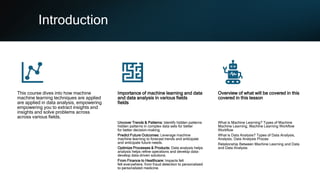
This course dives into how machine
machine learning techniques are applied
are applied in data analysis, empowering
empowering you to extract insights and
insights and solve problems across
across various fields.
Importance of machine learning and data
and data analysis in various fields
fields
Uncover Trends & Patterns: Identify hidden patterns
hidden patterns in complex data sets for better
for better decision-making.
Predict Future Outcomes: Leverage machine
machine learning to forecast trends and anticipate
and anticipate future needs.
Optimize Processes & Products: Data analysis helps
analysis helps refine operations and develop data-
develop data-driven solutions.
From Finance to Healthcare: Impacts felt
felt everywhere, from fraud detection to personalized
to personalized medicine.
Overview of what will be covered in this
covered in this lesson
What is Machine Learning? Types of Machine
Machine Learning, Machine Learning Workflow
Workflow
What is Data Analysis? Types of Data Analysis,
Analysis, Data Analysis Proces
Relationship Between Machine Learning and Data
and Data Analysis
What is Machine Learning?
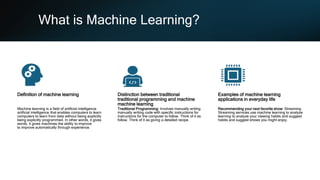
Definition of machine learning
Machine learning is a field of artificial intelligence
artificial intelligence that enables computers to learn
computers to learn from data without being explicitly
being explicitly programmed. In other words, it gives
words, it gives machines the ability to improve
to improve automatically through experience.
Distinction between traditional
traditional programming and machine
machine learning
Traditional Programming: Involves manually writing
manually writing code with specific instructions for
instructions for the computer to follow. Think of it as
follow. Think of it as giving a detailed recipe.
Examples of machine learning
applications in everyday life
Recommending your next favorite show: Streaming
Streaming services use machine learning to analyze
learning to analyze your viewing habits and suggest
habits and suggest shows you might enjoy.
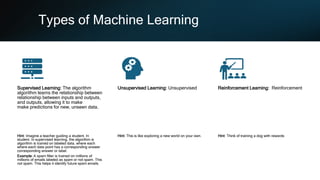
Types of Machine Learning
Supervised Learning: The algorithm
algorithm learns the relationship between
relationship between inputs and outputs,
and outputs, allowing it to make
make predictions for new, unseen data.
Hint: Imagine a teacher guiding a student. In
student. In supervised learning, the algorithm is
algorithm is trained on labeled data, where each
where each data point has a corresponding answer
corresponding answer or label.
Example: A spam filter is trained on millions of
millions of emails labeled as spam or not spam. This
not spam. This helps it identify future spam emails.
Unsupervised Learning: Unsupervised
Hint: This is like exploring a new world on your own.
Reinforcement Learning: Reinforcement
Hint: Think of training a dog with rewards
Machine Learning Workflow
The machine learning process can be broken down into five key stages:
1. Define the Problem: This initial step involves clearly outlining the goal you want your machine learning model to
achieve. What question are you trying to answer or what prediction are you aiming to make?
2. Prepare the Data: Data is the fuel for machine learning. Here, you collect, clean, and organize your data to ensure it's
suitable for training the model. This might involve handling missing values, formatting inconsistencies, and ensuring
data quality.
3. Choose a Model: There are various machine learning algorithms, each with its strengths and weaknesses. Selecting
the right model depends on the type of problem you're tackling and the nature of your data.
4. Train the Model: This is where the magic happens! The chosen model is exposed to your prepared data. Through an
iterative process, the model learns from the data, identifying patterns and relationships. As it trains, the model refines
itself to improve its ability to achieve the desired outcome.
5. Evaluate the Model: Once trained, the model's performance needs to be assessed. This involves testing the model on
unseen data to measure its accuracy, generalizability, and potential biases. If the results are satisfactory, the model
can be deployed for real-world use. If not, you may need to revisit earlier stages and refine your approach.
What is Data
Analysis?
Definition of data analysis
• Data analysis is the process of sifting through and inspecting data to extract meaningful information. In
essence, it's about turning raw data into usable insights that can inform conclusions and support data-
driven decisions.
• This involves various techniques like:
• Cleaning and organizing the data to ensure accuracy.
• Identifying patterns and trends within the data.
• Summarizing key findings through statistical analysis or visualization.
Importance of data analysis in decision-making processes
• Reduces Bias: Data analysis replaces gut feeling with objective insights, minimizing the influence of
personal biases.
• Identifies Trends & Patterns: Unearths hidden patterns in data, revealing trends that might be missed
otherwise, leading to more informed decisions.
• Supports Predictions: Data analysis empowers the creation of forecasts, allowing for proactive decision-
making based on anticipated outcomes.
• Measures Performance: Tracks the effectiveness of past decisions, enabling adjustments and
improvements for future actions.
• Optimizes Strategies: Provides data-driven insights to refine strategies and approaches for better results.
Role of data analysis in extracting insights from data
• Identifying patterns and trends: Data analysis reveals patterns and trends that might be invisible to the
naked eye, providing a deeper understanding of the information.
• Statistical analysis: Techniques like averages, correlations, and hypothesis testing summarize the data
and uncover its significance.
• Data visualization: Charts, graphs, and other visuals make complex data readily interpretable, allowing
for clearer communication of insights.
Types of
Data
Analysis
Data analysis can be viewed as a ladder, with each rung revealing progressively
deeper insights from your data. Here's a breakdown of the four key stages:
1. Descriptive Analytics (What Happened?)
a) Focus: Summarizing past events.
b) Example: A retail store analyzes sales data, identifying top-selling products
and peak sales periods (e.g., monthly reports, charts showing sales trends).
2. Diagnostic Analytics (Why Did it Happen?)
a) Focus: Understanding the root causes behind past events.
b) Example: The same store uses customer demographics and purchase data
to see if specific customer groups favor certain products (e.g., data mining to
identify correlations).
3. Predictive Analytics (What Will Happen?)
a) Focus: Forecasting future trends and probabilities.
b) Example: The store uses past sales data and weather patterns to predict
future demand for seasonal products (e.g., statistical models to forecast
sales based on historical trends and weather data).
4. Prescriptive Analytics (What Should We Do?)
a) Focus: Offering recommendations for optimal actions.
b) Example: Based on the predictions, the store prescribes stocking up on
inventory for high-demand items before the season arrives (e.g.,
recommending targeted promotions or adjustments to ordering quantities).
By climbing this ladder of analysis, you gain a comprehensive understanding of your
data, moving from summarizing the past to predicting the future and prescribing
actions for optimal outcomes.
Data
Analysis
Proces
From Chaos to Clarity: The Data Analysis Journey
• Data Collection: Gather the raw materials - relevant
data for your analysis.
• Data Cleaning: Refine the data - address
inconsistencies, missing values, and errors to ensure
accuracy.
• Data Exploration: Get acquainted - uncover initial
patterns and trends within the data.
• Analysis: Dig deeper - apply statistical methods to
extract meaningful insights.
• Visualization: Tell the story - present your findings
through clear and impactful charts or graphs.
Relationship Between Machine Learning
and Data Analysis
• Machine learning and data analysis are two sides of the same coin, working together to
extract knowledge from data. Data analysis provides the foundation for machine learning by
preparing and understanding the data. Machine learning, in turn, automates complex data
analysis tasks and generates insights that might be difficult to uncover manually. This
symbiotic relationship empowers data scientists to solve problems and make data-driven
decisions more efficiently.
• Machine Learning Automates Data Analysis Tasks
• Repetitive tasks like data cleaning and feature engineering.
• Identifying patterns and trends in large datasets.
• Building predictive models for forecasting future outcomes.
• Machine Learning Techniques for Data Analysis
• Classification: Categorizes data points into predefined classes (e.g., spam
detection).
• Clustering: Groups similar data points together (e.g., customer segmentation).
• Regression: Models the relationship between variables to predict continuous
outcomes (e.g., sales forecasting).
• By leveraging machine learning's automation capabilities, data analysts can focus on higher-
level tasks like interpreting results and drawing actionable insights. This collaboration
between data analysis and machine learning fuels discovery and innovation across various
fields.
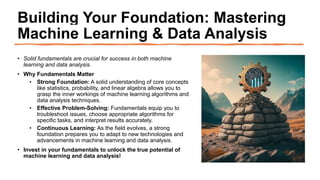
Building Your Foundation: Mastering
Machine Learning & Data Analysis
• Solid fundamentals are crucial for success in both machine
learning and data analysis.
• Why Fundamentals Matter
• Strong Foundation: A solid understanding of core concepts
like statistics, probability, and linear algebra allows you to
grasp the inner workings of machine learning algorithms and
data analysis techniques.
• Effective Problem-Solving: Fundamentals equip you to
troubleshoot issues, choose appropriate algorithms for
specific tasks, and interpret results accurately.
• Continuous Learning: As the field evolves, a strong
foundation prepares you to adapt to new technologies and
advancements in machine learning and data analysis.
• Invest in your fundamentals to unlock the true potential of
machine learning and data analysis!
Conclusion
Unleash the Power of Data: Dive Deeper into
Machine Learning & Data Analysis!
Spark your curiosity. Fuel innovation.
• A World of Discovery Awaits: Explore the vast
potential of machine learning and data analysis to
solve real-world problems.
• From Healthcare to Finance: Impact a wide range of
fields, making data-driven decisions that improve lives.
• Empower Yourself: Develop in-demand skills that are
revolutionizing businesses and industries.
• The Journey Begins Now: Explore online resources,
take courses, and join online communities to keep
learning and growing.
Let's unlock the hidden potential within data,
together!
Questions and Discussion
Questions from the audience
audience
Discussion Contact information for further
further inquiries
sondm@uit.edu.vn

Lesson 1 - Overview of Machine Learning and Data Analysis.pptx

  • 1.
    Lesson 1: Overview of MachineLearning and Data Analysis
  • 2.
    Introduction This course divesinto how machine machine learning techniques are applied are applied in data analysis, empowering empowering you to extract insights and insights and solve problems across across various fields. Importance of machine learning and data and data analysis in various fields fields Uncover Trends & Patterns: Identify hidden patterns hidden patterns in complex data sets for better for better decision-making. Predict Future Outcomes: Leverage machine machine learning to forecast trends and anticipate and anticipate future needs. Optimize Processes & Products: Data analysis helps analysis helps refine operations and develop data- develop data-driven solutions. From Finance to Healthcare: Impacts felt felt everywhere, from fraud detection to personalized to personalized medicine. Overview of what will be covered in this covered in this lesson What is Machine Learning? Types of Machine Machine Learning, Machine Learning Workflow Workflow What is Data Analysis? Types of Data Analysis, Analysis, Data Analysis Proces Relationship Between Machine Learning and Data and Data Analysis
  • 3.
    What is MachineLearning? Definition of machine learning Machine learning is a field of artificial intelligence artificial intelligence that enables computers to learn computers to learn from data without being explicitly being explicitly programmed. In other words, it gives words, it gives machines the ability to improve to improve automatically through experience. Distinction between traditional traditional programming and machine machine learning Traditional Programming: Involves manually writing manually writing code with specific instructions for instructions for the computer to follow. Think of it as follow. Think of it as giving a detailed recipe. Examples of machine learning applications in everyday life Recommending your next favorite show: Streaming Streaming services use machine learning to analyze learning to analyze your viewing habits and suggest habits and suggest shows you might enjoy.
  • 4.
    Types of MachineLearning Supervised Learning: The algorithm algorithm learns the relationship between relationship between inputs and outputs, and outputs, allowing it to make make predictions for new, unseen data. Hint: Imagine a teacher guiding a student. In student. In supervised learning, the algorithm is algorithm is trained on labeled data, where each where each data point has a corresponding answer corresponding answer or label. Example: A spam filter is trained on millions of millions of emails labeled as spam or not spam. This not spam. This helps it identify future spam emails. Unsupervised Learning: Unsupervised Hint: This is like exploring a new world on your own. Reinforcement Learning: Reinforcement Hint: Think of training a dog with rewards
  • 5.
    Machine Learning Workflow Themachine learning process can be broken down into five key stages: 1. Define the Problem: This initial step involves clearly outlining the goal you want your machine learning model to achieve. What question are you trying to answer or what prediction are you aiming to make? 2. Prepare the Data: Data is the fuel for machine learning. Here, you collect, clean, and organize your data to ensure it's suitable for training the model. This might involve handling missing values, formatting inconsistencies, and ensuring data quality. 3. Choose a Model: There are various machine learning algorithms, each with its strengths and weaknesses. Selecting the right model depends on the type of problem you're tackling and the nature of your data. 4. Train the Model: This is where the magic happens! The chosen model is exposed to your prepared data. Through an iterative process, the model learns from the data, identifying patterns and relationships. As it trains, the model refines itself to improve its ability to achieve the desired outcome. 5. Evaluate the Model: Once trained, the model's performance needs to be assessed. This involves testing the model on unseen data to measure its accuracy, generalizability, and potential biases. If the results are satisfactory, the model can be deployed for real-world use. If not, you may need to revisit earlier stages and refine your approach.
  • 6.
    What is Data Analysis? Definitionof data analysis • Data analysis is the process of sifting through and inspecting data to extract meaningful information. In essence, it's about turning raw data into usable insights that can inform conclusions and support data- driven decisions. • This involves various techniques like: • Cleaning and organizing the data to ensure accuracy. • Identifying patterns and trends within the data. • Summarizing key findings through statistical analysis or visualization. Importance of data analysis in decision-making processes • Reduces Bias: Data analysis replaces gut feeling with objective insights, minimizing the influence of personal biases. • Identifies Trends & Patterns: Unearths hidden patterns in data, revealing trends that might be missed otherwise, leading to more informed decisions. • Supports Predictions: Data analysis empowers the creation of forecasts, allowing for proactive decision- making based on anticipated outcomes. • Measures Performance: Tracks the effectiveness of past decisions, enabling adjustments and improvements for future actions. • Optimizes Strategies: Provides data-driven insights to refine strategies and approaches for better results. Role of data analysis in extracting insights from data • Identifying patterns and trends: Data analysis reveals patterns and trends that might be invisible to the naked eye, providing a deeper understanding of the information. • Statistical analysis: Techniques like averages, correlations, and hypothesis testing summarize the data and uncover its significance. • Data visualization: Charts, graphs, and other visuals make complex data readily interpretable, allowing for clearer communication of insights.
  • 7.
    Types of Data Analysis Data analysiscan be viewed as a ladder, with each rung revealing progressively deeper insights from your data. Here's a breakdown of the four key stages: 1. Descriptive Analytics (What Happened?) a) Focus: Summarizing past events. b) Example: A retail store analyzes sales data, identifying top-selling products and peak sales periods (e.g., monthly reports, charts showing sales trends). 2. Diagnostic Analytics (Why Did it Happen?) a) Focus: Understanding the root causes behind past events. b) Example: The same store uses customer demographics and purchase data to see if specific customer groups favor certain products (e.g., data mining to identify correlations). 3. Predictive Analytics (What Will Happen?) a) Focus: Forecasting future trends and probabilities. b) Example: The store uses past sales data and weather patterns to predict future demand for seasonal products (e.g., statistical models to forecast sales based on historical trends and weather data). 4. Prescriptive Analytics (What Should We Do?) a) Focus: Offering recommendations for optimal actions. b) Example: Based on the predictions, the store prescribes stocking up on inventory for high-demand items before the season arrives (e.g., recommending targeted promotions or adjustments to ordering quantities). By climbing this ladder of analysis, you gain a comprehensive understanding of your data, moving from summarizing the past to predicting the future and prescribing actions for optimal outcomes.
  • 8.
    Data Analysis Proces From Chaos toClarity: The Data Analysis Journey • Data Collection: Gather the raw materials - relevant data for your analysis. • Data Cleaning: Refine the data - address inconsistencies, missing values, and errors to ensure accuracy. • Data Exploration: Get acquainted - uncover initial patterns and trends within the data. • Analysis: Dig deeper - apply statistical methods to extract meaningful insights. • Visualization: Tell the story - present your findings through clear and impactful charts or graphs.
  • 9.
    Relationship Between MachineLearning and Data Analysis • Machine learning and data analysis are two sides of the same coin, working together to extract knowledge from data. Data analysis provides the foundation for machine learning by preparing and understanding the data. Machine learning, in turn, automates complex data analysis tasks and generates insights that might be difficult to uncover manually. This symbiotic relationship empowers data scientists to solve problems and make data-driven decisions more efficiently. • Machine Learning Automates Data Analysis Tasks • Repetitive tasks like data cleaning and feature engineering. • Identifying patterns and trends in large datasets. • Building predictive models for forecasting future outcomes. • Machine Learning Techniques for Data Analysis • Classification: Categorizes data points into predefined classes (e.g., spam detection). • Clustering: Groups similar data points together (e.g., customer segmentation). • Regression: Models the relationship between variables to predict continuous outcomes (e.g., sales forecasting). • By leveraging machine learning's automation capabilities, data analysts can focus on higher- level tasks like interpreting results and drawing actionable insights. This collaboration between data analysis and machine learning fuels discovery and innovation across various fields.
  • 10.
    Building Your Foundation:Mastering Machine Learning & Data Analysis • Solid fundamentals are crucial for success in both machine learning and data analysis. • Why Fundamentals Matter • Strong Foundation: A solid understanding of core concepts like statistics, probability, and linear algebra allows you to grasp the inner workings of machine learning algorithms and data analysis techniques. • Effective Problem-Solving: Fundamentals equip you to troubleshoot issues, choose appropriate algorithms for specific tasks, and interpret results accurately. • Continuous Learning: As the field evolves, a strong foundation prepares you to adapt to new technologies and advancements in machine learning and data analysis. • Invest in your fundamentals to unlock the true potential of machine learning and data analysis!
  • 11.
    Conclusion Unleash the Powerof Data: Dive Deeper into Machine Learning & Data Analysis! Spark your curiosity. Fuel innovation. • A World of Discovery Awaits: Explore the vast potential of machine learning and data analysis to solve real-world problems. • From Healthcare to Finance: Impact a wide range of fields, making data-driven decisions that improve lives. • Empower Yourself: Develop in-demand skills that are revolutionizing businesses and industries. • The Journey Begins Now: Explore online resources, take courses, and join online communities to keep learning and growing. Let's unlock the hidden potential within data, together!
  • 12.
    Questions and Discussion Questionsfrom the audience audience Discussion Contact information for further further inquiries sondm@uit.edu.vn