







Data preprocessing is a data mining technique
that involves transforming raw data into an
understandable format.
Data preprocessing is a proven method of
resolving such issues.
Data preprocessing prepares raw data for
further processing.
Data preprocessing is used database-driven
applications such as customer relationship
management and rule-based applications (like
neural networks).


Preprocess Steps


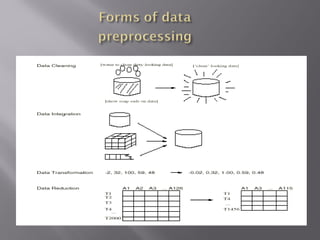
Data cleaning



Data integration



Datatransformation



Data reduction




Data in the real world is dirty
 incomplete: lacking attribute values, lacking certain
attributes of interest, or containing only aggregate
data
 noisy: containing errors or outliers
 inconsistent: containing discrepancies in codes or
names
No quality data, no quality mining results!
 Quality decisions must be based on quality data
 Data warehouse needs consistent integration of
quality data


A well-accepted multidimensional view:
Accuracy
 Completeness
 Consistency
 Timeliness
 Believability
 Value added
 Interpretability
 Accessibility



Data cleaning




Data integration




Integration of multiple databases, data cubes, or files

Data transformation




Fill in missing values, smooth noisy data, identify or remove
outliers, and resolve inconsistencies

Normalization and aggregation

Data reduction


Obtains reduced representation in volume but produces the
same or similar analytical results


Data cleaning tasks


Fill in missing values



Identify outliers and smooth out noisy data



Correct inconsistent data


Data is not always available




E.g., many tuples have no recorded value for several
attributes, such as customer income in sales data

Missing data may be due to



inconsistent with other recorded data and thus deleted



data not entered due to misunderstanding



certain data may not be considered important at the time of
entry




equipment malfunction

not register history or changes of the data

Missing data may need to be inferred.


Ignore the tuple: usually done when class label is missing
(assuming the tasks in classification—not effective when the
percentage of missing values per attribute varies considerably.



Fill in the missing value manually: tedious + infeasible?



Use a global constant to fill in the missing value: e.g., “unknown”,
a new class?!



Use the attribute mean to fill in the missing value



Use the attribute mean for all samples belonging to the same class
to fill in the missing value: smarter



Use the most probable value to fill in the missing value: inferencebased such as Bayesian formula or decision tree





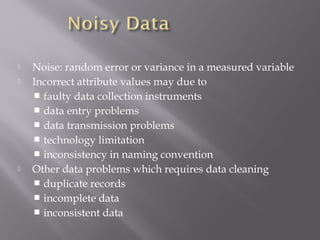
Noise: random error or variance in a measured variable
Incorrect attribute values may due to
 faulty data collection instruments
 data entry problems
 data transmission problems
 technology limitation
 inconsistency in naming convention
Other data problems which requires data cleaning
 duplicate records
 incomplete data
 inconsistent data


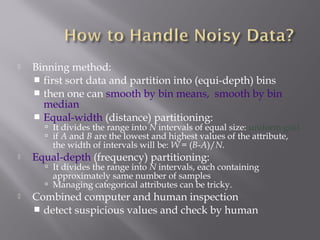
Binning method:
 first sort data and partition into (equi-depth) bins
 then one can smooth by bin means, smooth by bin
median
 Equal-width (distance) partitioning:

 It divides the range into N intervals of equal size: uniform grid
 if A and B are the lowest and highest values of the attribute,

the width of intervals will be: W = (B-A)/N.



Equal-depth (frequency) partitioning:

 It divides the range into N intervals, each containing

approximately same number of samples
 Managing categorical attributes can be tricky.


Combined computer and human inspection
 detect suspicious values and check by human
Clustering: detect and remove outliers
y
Regression:
smooth by fitting the
data into regression
functions

Y1

y=x+1

Y1’

X1

x




Data integration:
 combines data from multiple sources.
 Schema integration
 integrate metadata from different sources
 Entity identification problem: identify real world
entities from multiple data sources, e.g., A.cust-id ≡
B.cust-#
Detecting and resolving data value conflicts
 for the same real world entity, attribute values from
different sources are different
 possible reasons: different representations, different
scales, e.g., metric vs. British units


Redundant data occur often when integration of multiple
databases




One attribute may be a “derived” attribute in another
table.





The same attribute may have different names in
different databases

Redundant data may be able to be detected by
correlational analysis

Careful integration of the data from multiple sources
may help reduce/avoid redundancies and
inconsistencies and improve mining speed and quality







Smoothing: remove noise from data
Aggregation: summarization, data cube construction
Generalization: concept hierarchy climbing
Normalization: scaled to fall within a small, specified
range
 min-max normalization
 z-score normalization
 normalization by decimal scaling
Attribute/feature construction
 New attributes constructed from the given ones


min-max normalization


Min-max normalization performs a linear
transformation on the original data.



Suppose that mina and maxa are the minimum and
the maximum values for attribute A. Min-max
normalization maps a value v of A to v’ in the range
[new-mina, new-maxa] by computing:
 v’= ( (v-mina) / (maxa – mina) ) * (new-maxa – newmina)+

new-mina


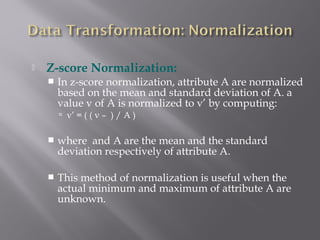
Z-score Normalization:


In z-score normalization, attribute A are normalized
based on the mean and standard deviation of A. a
value v of A is normalized to v’ by computing:
 v’ = ( ( v – ) / A )



where and A are the mean and the standard
deviation respectively of attribute A.



This method of normalization is useful when the
actual minimum and maximum of attribute A are
unknown.


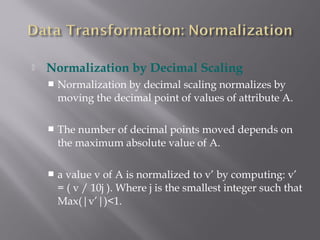
Normalization by Decimal Scaling


Normalization by decimal scaling normalizes by
moving the decimal point of values of attribute A.



The number of decimal points moved depends on
the maximum absolute value of A.



a value v of A is normalized to v’ by computing: v’
= ( v / 10j ). Where j is the smallest integer such that
Max(|v’|)<1.


Warehouse may store terabytes of data: Complex data
analysis/mining may take a very long time to run on the
complete data set



Data reduction
 Obtains a reduced representation of the data set that is
much smaller in volume but yet produces the same (or
almost the same) analytical results



Data reduction strategies
 Data cube aggregation
 Dimensionality reduction
 concept hierarchy generation

Data PreProcessing

  • 1.
        Data preprocessing isa data mining technique that involves transforming raw data into an understandable format. Data preprocessing is a proven method of resolving such issues. Data preprocessing prepares raw data for further processing. Data preprocessing is used database-driven applications such as customer relationship management and rule-based applications (like neural networks).
  • 2.
     Preprocess Steps  Data cleaning  Dataintegration  Datatransformation  Data reduction
  • 3.
      Data in thereal world is dirty  incomplete: lacking attribute values, lacking certain attributes of interest, or containing only aggregate data  noisy: containing errors or outliers  inconsistent: containing discrepancies in codes or names No quality data, no quality mining results!  Quality decisions must be based on quality data  Data warehouse needs consistent integration of quality data
  • 4.
     A well-accepted multidimensionalview: Accuracy  Completeness  Consistency  Timeliness  Believability  Value added  Interpretability  Accessibility 
  • 5.
     Data cleaning   Data integration   Integrationof multiple databases, data cubes, or files Data transformation   Fill in missing values, smooth noisy data, identify or remove outliers, and resolve inconsistencies Normalization and aggregation Data reduction  Obtains reduced representation in volume but produces the same or similar analytical results
  • 7.
     Data cleaning tasks  Fillin missing values  Identify outliers and smooth out noisy data  Correct inconsistent data
  • 8.
     Data is notalways available   E.g., many tuples have no recorded value for several attributes, such as customer income in sales data Missing data may be due to   inconsistent with other recorded data and thus deleted  data not entered due to misunderstanding  certain data may not be considered important at the time of entry   equipment malfunction not register history or changes of the data Missing data may need to be inferred.
  • 9.
     Ignore the tuple:usually done when class label is missing (assuming the tasks in classification—not effective when the percentage of missing values per attribute varies considerably.  Fill in the missing value manually: tedious + infeasible?  Use a global constant to fill in the missing value: e.g., “unknown”, a new class?!  Use the attribute mean to fill in the missing value  Use the attribute mean for all samples belonging to the same class to fill in the missing value: smarter  Use the most probable value to fill in the missing value: inferencebased such as Bayesian formula or decision tree
  • 10.
       Noise: random erroror variance in a measured variable Incorrect attribute values may due to  faulty data collection instruments  data entry problems  data transmission problems  technology limitation  inconsistency in naming convention Other data problems which requires data cleaning  duplicate records  incomplete data  inconsistent data
  • 11.
     Binning method:  firstsort data and partition into (equi-depth) bins  then one can smooth by bin means, smooth by bin median  Equal-width (distance) partitioning:  It divides the range into N intervals of equal size: uniform grid  if A and B are the lowest and highest values of the attribute, the width of intervals will be: W = (B-A)/N.  Equal-depth (frequency) partitioning:  It divides the range into N intervals, each containing approximately same number of samples  Managing categorical attributes can be tricky.  Combined computer and human inspection  detect suspicious values and check by human
  • 12.
    Clustering: detect andremove outliers
  • 13.
    y Regression: smooth by fittingthe data into regression functions Y1 y=x+1 Y1’ X1 x
  • 14.
      Data integration:  combinesdata from multiple sources.  Schema integration  integrate metadata from different sources  Entity identification problem: identify real world entities from multiple data sources, e.g., A.cust-id ≡ B.cust-# Detecting and resolving data value conflicts  for the same real world entity, attribute values from different sources are different  possible reasons: different representations, different scales, e.g., metric vs. British units
  • 15.
     Redundant data occuroften when integration of multiple databases   One attribute may be a “derived” attribute in another table.   The same attribute may have different names in different databases Redundant data may be able to be detected by correlational analysis Careful integration of the data from multiple sources may help reduce/avoid redundancies and inconsistencies and improve mining speed and quality
  • 16.
         Smoothing: remove noisefrom data Aggregation: summarization, data cube construction Generalization: concept hierarchy climbing Normalization: scaled to fall within a small, specified range  min-max normalization  z-score normalization  normalization by decimal scaling Attribute/feature construction  New attributes constructed from the given ones
  • 17.
     min-max normalization  Min-max normalizationperforms a linear transformation on the original data.  Suppose that mina and maxa are the minimum and the maximum values for attribute A. Min-max normalization maps a value v of A to v’ in the range [new-mina, new-maxa] by computing:  v’= ( (v-mina) / (maxa – mina) ) * (new-maxa – newmina)+ new-mina
  • 18.
     Z-score Normalization:  In z-scorenormalization, attribute A are normalized based on the mean and standard deviation of A. a value v of A is normalized to v’ by computing:  v’ = ( ( v – ) / A )  where and A are the mean and the standard deviation respectively of attribute A.  This method of normalization is useful when the actual minimum and maximum of attribute A are unknown.
  • 19.
     Normalization by DecimalScaling  Normalization by decimal scaling normalizes by moving the decimal point of values of attribute A.  The number of decimal points moved depends on the maximum absolute value of A.  a value v of A is normalized to v’ by computing: v’ = ( v / 10j ). Where j is the smallest integer such that Max(|v’|)<1.
  • 20.
     Warehouse may storeterabytes of data: Complex data analysis/mining may take a very long time to run on the complete data set  Data reduction  Obtains a reduced representation of the data set that is much smaller in volume but yet produces the same (or almost the same) analytical results  Data reduction strategies  Data cube aggregation  Dimensionality reduction  concept hierarchy generation