Handling concept drift in data
       stream mining
Student: Manuel Martín Salvador
Supervisors: Luis M. de Campos and Silvia Acid


         Master in Soft Computing and Intelligent Systems
      Department of Computer Science and Artificial Intelligence
                       University of Granada
Who am I?
1. Current: PhD Student in Bournemouth University
2. Previous:
  ●   Computer Engineering in University of Granada
      (2004-2009)
  ●   Programmer and SCRUM Master in Fundación
      I+D del Software Libre (2009-2010)
  ●   Master in Soft Computing and Intelligent
      Systems in University of Granada (2010-2011)
  ●   Researcher in Department of Computer Science
      and Artificial Intelligence of UGR (2010-2012)
Index
1. Data streams
2. Online Learning
3. Evaluation
4. Taxonomy of methods
5. Contributions
6. MOA
7. Experimentation
8. Conclusions and future work


                                 3
Data streams
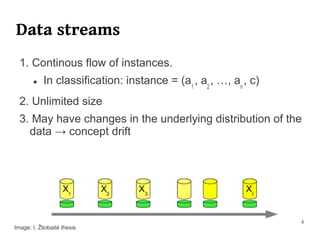
  1. Continous flow of instances.
       ●    In classification: instance = (a1 , a2 , …, an , c)
  2. Unlimited size
  3. May have changes in the underlying distribution of the
    data → concept drift


                                                                  4
Image: I. Žliobaitė thesis
Concept drifts
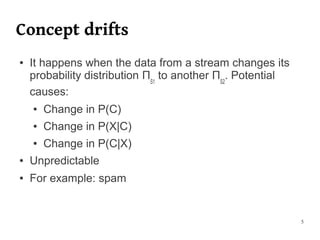
●   It happens when the data from a stream changes its
    probability distribution ПS1 to another ПS2. Potential
    causes:
    ●   Change in P(C)
    ●   Change in P(X|C)
    ●   Change in P(C|X)
●   Unpredictable
●   For example: spam


                                                             5
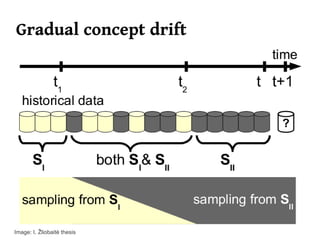
Gradual concept drift


                             6
Image: I. Žliobaitė thesis
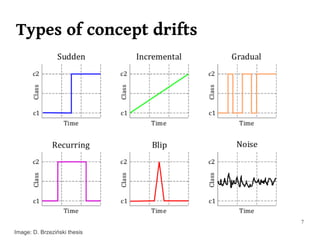
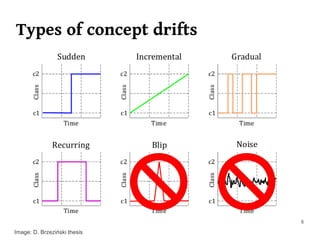
Types of concept drifts


                              7
Image: D. Brzeziński thesis
Types of concept drifts


                              8
Image: D. Brzeziński thesis
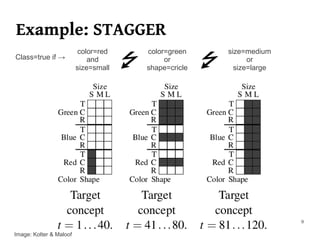
Example: STAGGER
                          color=red   color=green    size=medium
Class=true if →              and           or              or
                         size=small   shape=cricle     size=large


                                                                    9

Image: Kolter & Maloof
Online learning (incremental)
●   Goal: incrementally learn a classifier at least as
    accurate as if it had been trained in batch
●   Requirements:
    1. Incremental
    2. Single pass
    3. Limited time and memory
    4. Any-time learning: availability of the model


                                                         10
Online learning (incremental)
●   Goal: incrementally learn a classifier at least as
    accurate as if it had been trained in batch
●   Requirements:
    1. Incremental
    2. Single pass
    3. Limited time and memory
    4. Any-time learning: availability of the model
●   Nice to have: deal with concept drift.


                                                         11
Evaluation
Several criteria:
   ●   Time → seconds
   ●   Memory → RAM/hour
   ●   Generalizability of the model → % success
   ●   Detecting concept drift → detected drifts, false
       positives and false negatives


                                                          12
Evaluation
Several criteria:
   ●   Time → seconds
   ●   Memory → RAM/hour
   ●   Generalizability of the model → % success
   ●   Detecting concept drift → detected drifts, false
       positives and false negatives


Problem: we can't use the traditional techniques for
evaluation (i.e. cross validation). → Solution: new
strategies.
                                                          13
Evaluation: prequential
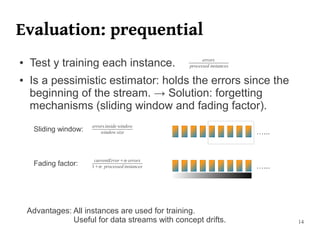
●   Test y training each instance.                     errors
                                                 processed instances

●   Is a pessimistic estimator: holds the errors since the
    beginning of the stream. → Solution: forgetting
    mechanisms (sliding window and fading factor).
                       errors inside window
     Sliding window:       window size                                 …...


                        currentError⋅errors
     Fading factor:    1⋅processed instances                         …...


    Advantages: All instances are used for training.
                Useful for data streams with concept drifts.                  14
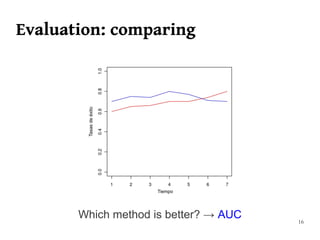
Evaluation: comparing


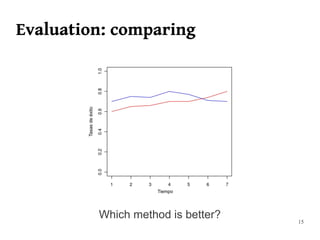
         Which method is better?   15
Evaluation: comparing


       Which method is better? → AUC   16
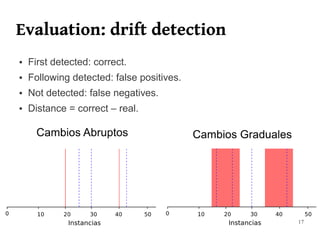
Evaluation: drift detection
●   First detected: correct.
●   Following detected: false positives.
●   Not detected: false negatives.
●   Distance = correct – real.


                                           17
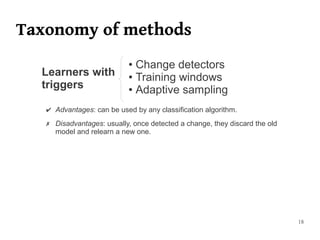
Taxonomy of methods
                            ● Change detectors
  Learners with             ● Training windows
  triggers                  ● Adaptive sampling


   ✔ Advantages: can be used by any classification algorithm.
   ✗ Disadvantages: usually, once detected a change, they discard the old
     model and relearn a new one.


                                                                            18
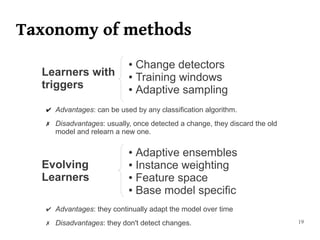
Taxonomy of methods
                            ● Change detectors
  Learners with             ● Training windows
  triggers                  ● Adaptive sampling


   ✔ Advantages: can be used by any classification algorithm.
   ✗ Disadvantages: usually, once detected a change, they discard the old
     model and relearn a new one.

                            ● Adaptive ensembles
  Evolving                  ● Instance weighting

  Learners                  ● Feature space

                            ● Base model specific


   ✔ Advantages: they continually adapt the model over time
   ✗ Disadvantages: they don't detect changes.                              19
Contributions
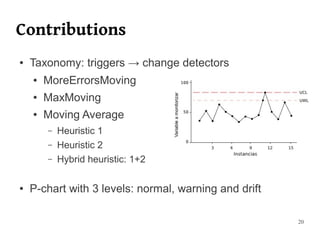
●   Taxonomy: triggers → change detectors
    ●   MoreErrorsMoving
    ●   MaxMoving
    ●   Moving Average
        –   Heuristic 1
        –   Heuristic 2
        –   Hybrid heuristic: 1+2

●   P-chart with 3 levels: normal, warning and drift

                                                       20
Contributions: MoreErrorsMoving
●   n latest results of classification are monitored →
    History = {ei , ei+1 , …, ei+n} (i.e. 0,0,1,1)

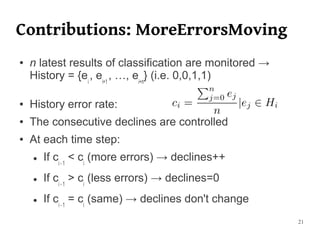
●   History error rate:
●   The consecutive declines are controlled
●   At each time step:
    ●   If ci - 1 < ci (more errors) → declines++
    ●   If ci - 1 > ci (less errors) → declines=0
    ●   If ci - 1 = ci (same) → declines don't change
                                                         21
Contributions: MoreErrorsMoving
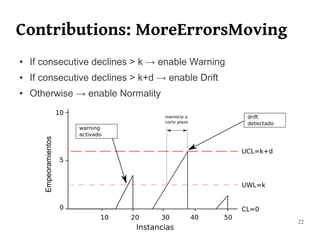
●   If consecutive declines > k → enable Warning
●   If consecutive declines > k+d → enable Drift
●   Otherwise → enable Normality


                                                   22
Contributions: MoreErrorsMoving
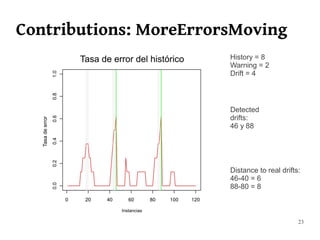
                        History = 8
                        Warning = 2
                        Drift = 4


                        Detected
                        drifts:
                        46 y 88


                        Distance to real drifts:
                        46-40 = 6
                        88-80 = 8


                                               23
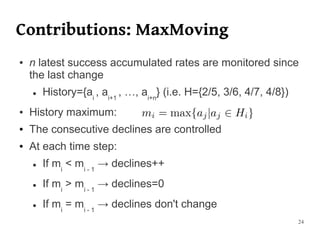
Contributions: MaxMoving
●   n latest success accumulated rates are monitored since
    the last change
    ●   History={ai , ai+1 , …, ai+n} (i.e. H={2/5, 3/6, 4/7, 4/8})
●   History maximum:
●   The consecutive declines are controlled
●   At each time step:
    ●   If mi < mi - 1 → declines++
    ●   If mi > mi - 1 → declines=0
    ●   If mi = mi - 1 → declines don't change
                                                                      24
Contributions: MaxMoving
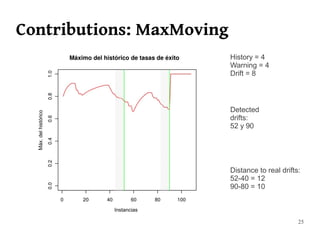
                           History = 4
                           Warning = 4
                           Drift = 8


                           Detected
                           drifts:
                           52 y 90


                           Distance to real drifts:
                           52-40 = 12
                           90-80 = 10


                                                  25
Contributions: Moving Average
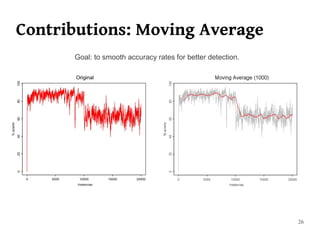
      Goal: to smooth accuracy rates for better detection.


                                                             26
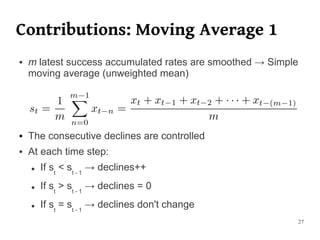
Contributions: Moving Average 1
●   m latest success accumulated rates are smoothed → Simple
    moving average (unweighted mean)


●   The consecutive declines are controlled
●   At each time step:
    ●   If st < st - 1 → declines++
    ●   If st > st - 1 → declines = 0
    ●   If st = st - 1 → declines don't change
                                                               27
Contributions: Moving Average 1
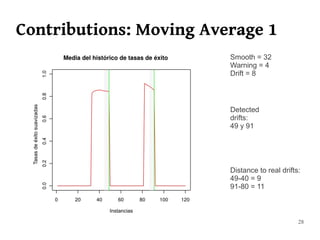
                         Smooth = 32
                         Warning = 4
                         Drift = 8


                         Detected
                         drifts:
                         49 y 91


                         Distance to real drifts:
                         49-40 = 9
                         91-80 = 11


                                                28
Contributions: Moving Average 2
●   History of size n with the smoothed success rates →
    History={si, si+1, …, si+n}
●   History maximum:
●   Difference between st and mt – 1 is monitored
●   At each time step:
    ●   If mt – 1 - st > u → enable Warning
    ●   If mt – 1 - st > v → enable Drift
    ●   Otherwise → enable Normality
●   Suitable for abrupt changes
                                                          29
Contributions: Moving Average 2
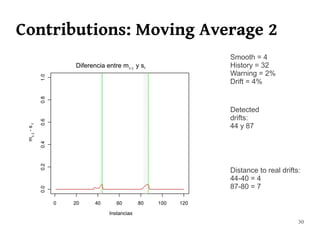
                         Smooth = 4
                         History = 32
                         Warning = 2%
                         Drift = 4%


                         Detected
                         drifts:
                         44 y 87


                         Distance to real drifts:
                         44-40 = 4
                         87-80 = 7


                                                30
Contributions: Moving Average Hybrid
 ●   Heuristics 1 and 2 are combined:
     ●   If Warning1 or Warning2 → enable Warning
     ●   If Drift1 or Drift2 → enable Drift
     ●   Otherwise → enable Normality


                                                    31
MOA: Massive Online Analysis
●   Framework for data stream mining. Algorithms for
    classification, regression and clustering.
●   University of Waikato → WEKA integration.
●   Graphical user interface and command line.
●   Data stream generators.
●   Evaluation methods (holdout and prequential).
●   Open source and free.


                                      http://moa.cs.waikato.ac.nz
                                                                    32
Experimentation
●   Our data streams:
    ●   5 synthetic with abrupt changes
    ●   2 synthetic with gradual changes
    ●   1 synthetic with noise
    ●   3 with real data


                                           33
Experimentation
●   Our data streams:
    ●   5 synthetic with abrupt changes
    ●   2 synthetic with gradual changes
    ●   1 synthetic with noise
    ●   3 with real data
●   Classification algorithm: Naive Bayes


                                            34
Experimentation
●   Our data streams:
    ●   5 synthetic with abrupt changes
    ●   2 synthetic with gradual changes
    ●   1 synthetic with noise
    ●   3 with real data
●   Classification algorithm: Naive Bayes
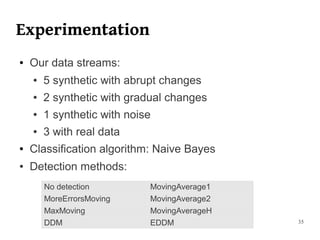
●   Detection methods:
        No detection         MovingAverage1
        MoreErrorsMoving     MovingAverage2
        MaxMoving            MovingAverageH
        DDM                  EDDM             35
Experimentation
●   Parameters tuning:
    ●   4 streams y 5 methods → 288 experiments


                                                  36
Experimentation
●   Parameters tuning:
    ●   4 streams y 5 methods → 288 experiments
●   Comparative study:
    ●   11 streams y 8+1 methods → 99 experiments


                                                    37
Experimentation
●   Parameters tuning:
    ●   4 streams y 5 methods → 288 experiments
●   Comparative study:
    ●   11 streams y 8+1 methods → 99 experiments
●   Evaluation: prequential


                                                    38
Experimentation
●   Parameters tuning:
    ●   4 streams y 5 methods → 288 experiments
●   Comparative study:
    ●   11 streams y 8+1 methods → 99 experiments
●   Evaluation: prequential
●   Measurements:
    ●   AUC: area under the curve of accumulated success
        rates
    ●   Number of correct drifts
    ●   Distance to drifts
    ●   False positives and false negatives                39
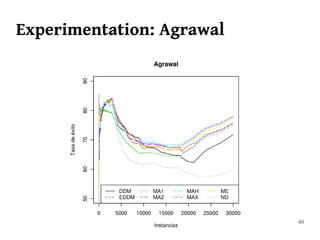
Experimentation: Agrawal


                           40
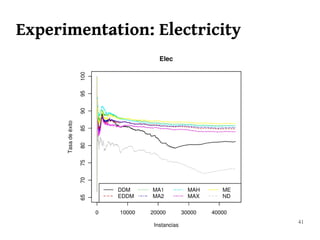
Experimentation: Electricity


                               41
Conclussions of experimentation
1. With abrupt changes:
  ●   More victories: DDM and MovingAverageH
  ●   Best in mean: MoreErrorsMoving → very responsive
2. With gradual changes:
  ●   Best: DDM and EDDM
  ●   Problem: many false positives → parameter tunning only with abrupt
      changes
3. With noise:
  ●   Only winner: DDM
  ●   Problem: noise sensitive → parameter tunning only with no-noise data
4. Real data:
  ●   Best: MovingAverage1 and MovingAverageH

                                                                             42
Conclussions of this work
1. Our methods are competitive, although sensitive to
  the parameters → Dynamic fit
2. Evaluation is not trivial → Standardization is needed
3. Large field of application in industry
4. Hot topic: last papers from 2011 + conferences


                                                           43
Future work
1. Dynamic adjustment of parameters.
2. Measuring the abruptness of change for:
  ●   Using differents forgetting mechanisms.
  ●   Setting the degree of change of the model.
3. Develop an incremental learning algorithm which
  allows partial changes of the model when a drift is
  detected.


                                                        44
Thank you


            45

Handling concept drift in data stream mining

  • 1.
    Handling concept driftin data stream mining Student: Manuel Martín Salvador Supervisors: Luis M. de Campos and Silvia Acid Master in Soft Computing and Intelligent Systems Department of Computer Science and Artificial Intelligence University of Granada
  • 2.
    Who am I? 1.Current: PhD Student in Bournemouth University 2. Previous: ● Computer Engineering in University of Granada (2004-2009) ● Programmer and SCRUM Master in Fundación I+D del Software Libre (2009-2010) ● Master in Soft Computing and Intelligent Systems in University of Granada (2010-2011) ● Researcher in Department of Computer Science and Artificial Intelligence of UGR (2010-2012)
  • 3.
    Index 1. Data streams 2.Online Learning 3. Evaluation 4. Taxonomy of methods 5. Contributions 6. MOA 7. Experimentation 8. Conclusions and future work 3
  • 4.
    Data streams 1. Continous flow of instances. ● In classification: instance = (a1 , a2 , …, an , c) 2. Unlimited size 3. May have changes in the underlying distribution of the data → concept drift 4 Image: I. Žliobaitė thesis
  • 5.
    Concept drifts ● It happens when the data from a stream changes its probability distribution ПS1 to another ПS2. Potential causes: ● Change in P(C) ● Change in P(X|C) ● Change in P(C|X) ● Unpredictable ● For example: spam 5
  • 6.
    Gradual concept drift 6 Image: I. Žliobaitė thesis
  • 7.
    Types of conceptdrifts 7 Image: D. Brzeziński thesis
  • 8.
    Types of conceptdrifts 8 Image: D. Brzeziński thesis
  • 9.
    Example: STAGGER color=red color=green size=medium Class=true if → and or or size=small shape=cricle size=large 9 Image: Kolter & Maloof
  • 10.
    Online learning (incremental) ● Goal: incrementally learn a classifier at least as accurate as if it had been trained in batch ● Requirements: 1. Incremental 2. Single pass 3. Limited time and memory 4. Any-time learning: availability of the model 10
  • 11.
    Online learning (incremental) ● Goal: incrementally learn a classifier at least as accurate as if it had been trained in batch ● Requirements: 1. Incremental 2. Single pass 3. Limited time and memory 4. Any-time learning: availability of the model ● Nice to have: deal with concept drift. 11
  • 12.
    Evaluation Several criteria: ● Time → seconds ● Memory → RAM/hour ● Generalizability of the model → % success ● Detecting concept drift → detected drifts, false positives and false negatives 12
  • 13.
    Evaluation Several criteria: ● Time → seconds ● Memory → RAM/hour ● Generalizability of the model → % success ● Detecting concept drift → detected drifts, false positives and false negatives Problem: we can't use the traditional techniques for evaluation (i.e. cross validation). → Solution: new strategies. 13
  • 14.
    Evaluation: prequential ● Test y training each instance. errors processed instances ● Is a pessimistic estimator: holds the errors since the beginning of the stream. → Solution: forgetting mechanisms (sliding window and fading factor). errors inside window Sliding window: window size …... currentError⋅errors Fading factor: 1⋅processed instances …... Advantages: All instances are used for training. Useful for data streams with concept drifts. 14
  • 15.
    Evaluation: comparing Which method is better? 15
  • 16.
    Evaluation: comparing Which method is better? → AUC 16
  • 17.
    Evaluation: drift detection ● First detected: correct. ● Following detected: false positives. ● Not detected: false negatives. ● Distance = correct – real. 17
  • 18.
    Taxonomy of methods ● Change detectors Learners with ● Training windows triggers ● Adaptive sampling ✔ Advantages: can be used by any classification algorithm. ✗ Disadvantages: usually, once detected a change, they discard the old model and relearn a new one. 18
  • 19.
    Taxonomy of methods ● Change detectors Learners with ● Training windows triggers ● Adaptive sampling ✔ Advantages: can be used by any classification algorithm. ✗ Disadvantages: usually, once detected a change, they discard the old model and relearn a new one. ● Adaptive ensembles Evolving ● Instance weighting Learners ● Feature space ● Base model specific ✔ Advantages: they continually adapt the model over time ✗ Disadvantages: they don't detect changes. 19
  • 20.
    Contributions ● Taxonomy: triggers → change detectors ● MoreErrorsMoving ● MaxMoving ● Moving Average – Heuristic 1 – Heuristic 2 – Hybrid heuristic: 1+2 ● P-chart with 3 levels: normal, warning and drift 20
  • 21.
    Contributions: MoreErrorsMoving ● n latest results of classification are monitored → History = {ei , ei+1 , …, ei+n} (i.e. 0,0,1,1) ● History error rate: ● The consecutive declines are controlled ● At each time step: ● If ci - 1 < ci (more errors) → declines++ ● If ci - 1 > ci (less errors) → declines=0 ● If ci - 1 = ci (same) → declines don't change 21
  • 22.
    Contributions: MoreErrorsMoving ● If consecutive declines > k → enable Warning ● If consecutive declines > k+d → enable Drift ● Otherwise → enable Normality 22
  • 23.
    Contributions: MoreErrorsMoving History = 8 Warning = 2 Drift = 4 Detected drifts: 46 y 88 Distance to real drifts: 46-40 = 6 88-80 = 8 23
  • 24.
    Contributions: MaxMoving ● n latest success accumulated rates are monitored since the last change ● History={ai , ai+1 , …, ai+n} (i.e. H={2/5, 3/6, 4/7, 4/8}) ● History maximum: ● The consecutive declines are controlled ● At each time step: ● If mi < mi - 1 → declines++ ● If mi > mi - 1 → declines=0 ● If mi = mi - 1 → declines don't change 24
  • 25.
    Contributions: MaxMoving History = 4 Warning = 4 Drift = 8 Detected drifts: 52 y 90 Distance to real drifts: 52-40 = 12 90-80 = 10 25
  • 26.
    Contributions: Moving Average Goal: to smooth accuracy rates for better detection. 26
  • 27.
    Contributions: Moving Average1 ● m latest success accumulated rates are smoothed → Simple moving average (unweighted mean) ● The consecutive declines are controlled ● At each time step: ● If st < st - 1 → declines++ ● If st > st - 1 → declines = 0 ● If st = st - 1 → declines don't change 27
  • 28.
    Contributions: Moving Average1 Smooth = 32 Warning = 4 Drift = 8 Detected drifts: 49 y 91 Distance to real drifts: 49-40 = 9 91-80 = 11 28
  • 29.
    Contributions: Moving Average2 ● History of size n with the smoothed success rates → History={si, si+1, …, si+n} ● History maximum: ● Difference between st and mt – 1 is monitored ● At each time step: ● If mt – 1 - st > u → enable Warning ● If mt – 1 - st > v → enable Drift ● Otherwise → enable Normality ● Suitable for abrupt changes 29
  • 30.
    Contributions: Moving Average2 Smooth = 4 History = 32 Warning = 2% Drift = 4% Detected drifts: 44 y 87 Distance to real drifts: 44-40 = 4 87-80 = 7 30
  • 31.
    Contributions: Moving AverageHybrid ● Heuristics 1 and 2 are combined: ● If Warning1 or Warning2 → enable Warning ● If Drift1 or Drift2 → enable Drift ● Otherwise → enable Normality 31
  • 32.
    MOA: Massive OnlineAnalysis ● Framework for data stream mining. Algorithms for classification, regression and clustering. ● University of Waikato → WEKA integration. ● Graphical user interface and command line. ● Data stream generators. ● Evaluation methods (holdout and prequential). ● Open source and free. http://moa.cs.waikato.ac.nz 32
  • 33.
    Experimentation ● Our data streams: ● 5 synthetic with abrupt changes ● 2 synthetic with gradual changes ● 1 synthetic with noise ● 3 with real data 33
  • 34.
    Experimentation ● Our data streams: ● 5 synthetic with abrupt changes ● 2 synthetic with gradual changes ● 1 synthetic with noise ● 3 with real data ● Classification algorithm: Naive Bayes 34
  • 35.
    Experimentation ● Our data streams: ● 5 synthetic with abrupt changes ● 2 synthetic with gradual changes ● 1 synthetic with noise ● 3 with real data ● Classification algorithm: Naive Bayes ● Detection methods: No detection MovingAverage1 MoreErrorsMoving MovingAverage2 MaxMoving MovingAverageH DDM EDDM 35
  • 36.
    Experimentation ● Parameters tuning: ● 4 streams y 5 methods → 288 experiments 36
  • 37.
    Experimentation ● Parameters tuning: ● 4 streams y 5 methods → 288 experiments ● Comparative study: ● 11 streams y 8+1 methods → 99 experiments 37
  • 38.
    Experimentation ● Parameters tuning: ● 4 streams y 5 methods → 288 experiments ● Comparative study: ● 11 streams y 8+1 methods → 99 experiments ● Evaluation: prequential 38
  • 39.
    Experimentation ● Parameters tuning: ● 4 streams y 5 methods → 288 experiments ● Comparative study: ● 11 streams y 8+1 methods → 99 experiments ● Evaluation: prequential ● Measurements: ● AUC: area under the curve of accumulated success rates ● Number of correct drifts ● Distance to drifts ● False positives and false negatives 39
  • 40.
  • 41.
  • 42.
    Conclussions of experimentation 1.With abrupt changes: ● More victories: DDM and MovingAverageH ● Best in mean: MoreErrorsMoving → very responsive 2. With gradual changes: ● Best: DDM and EDDM ● Problem: many false positives → parameter tunning only with abrupt changes 3. With noise: ● Only winner: DDM ● Problem: noise sensitive → parameter tunning only with no-noise data 4. Real data: ● Best: MovingAverage1 and MovingAverageH 42
  • 43.
    Conclussions of thiswork 1. Our methods are competitive, although sensitive to the parameters → Dynamic fit 2. Evaluation is not trivial → Standardization is needed 3. Large field of application in industry 4. Hot topic: last papers from 2011 + conferences 43
  • 44.
    Future work 1. Dynamicadjustment of parameters. 2. Measuring the abruptness of change for: ● Using differents forgetting mechanisms. ● Setting the degree of change of the model. 3. Develop an incremental learning algorithm which allows partial changes of the model when a drift is detected. 44
  • 45.