CH -10
Unsupervised Learning and Clustering
By:
Arshad Farhad
20177716
Contents
 Supervised vs Unsupervised learning
 Introduction to clustering
 K-means Clustering
 Hierarchical clustering
 Conclusion
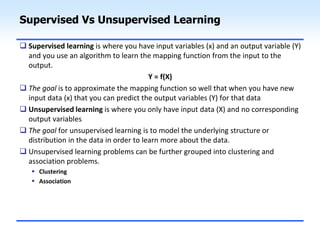
Supervised Vs Unsupervised Learning
 Supervised learning is where you have input variables (x) and an output variable (Y)
and you use an algorithm to learn the mapping function from the input to the
output.
Y = f(X)
 The goal is to approximate the mapping function so well that when you have new
input data (x) that you can predict the output variables (Y) for that data
 Unsupervised learning is where you only have input data (X) and no corresponding
output variables
 The goal for unsupervised learning is to model the underlying structure or
distribution in the data in order to learn more about the data.
 Unsupervised learning problems can be further grouped into clustering and
association problems.
 Clustering
 Association
What is clustering?
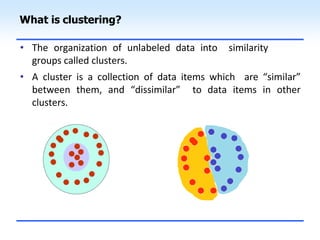
• The organization of unlabeled data into similarity
groups called clusters.
• A cluster is a collection of data items which are “similar”
between them, and “dissimilar” to data items in other
clusters.
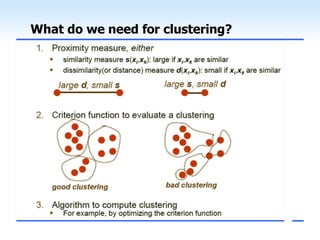
What do we need for clustering?
Distance (dissimilarity) measures
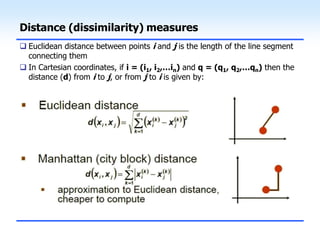
 Euclidean distance between points i and j is the length of the line segment
connecting them
 In Cartesian coordinates, if i = (i1, i2,…in) and q = (q1, q2,…qn) then the
distance (d) from i to j, or from j to i is given by:
Cluster Evaluation
• Intra-cluster cohesion (compactness):
– Cohesion measures how near the data points in a cluster
are to the cluster centroid.
– Sum of squared error (SSE) is a commonly used
measure.
• Inter-cluster separation (isolation):
– Separation means that different cluster centroids should
be far away from one another.
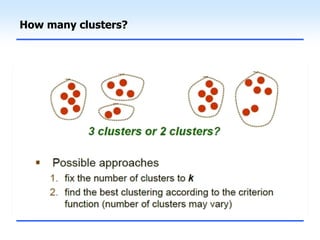
How many clusters?
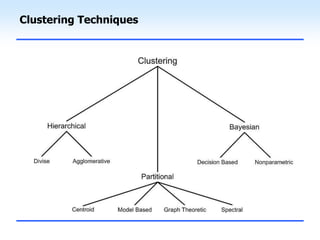
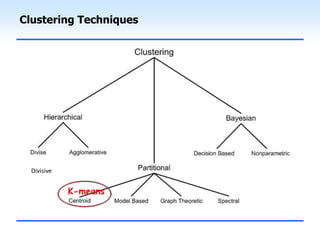
Clustering Techniques
Divisive
K-means
K-Means clustering
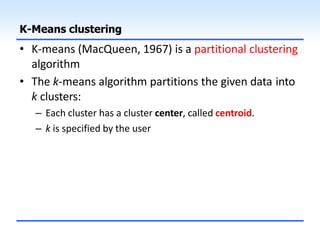
• K-means (MacQueen, 1967) is a partitional clustering
algorithm
• The k-means algorithm partitions the given data into
k clusters:
– Each cluster has a cluster center, called centroid.
– k is specified by the user
K-means algorithm
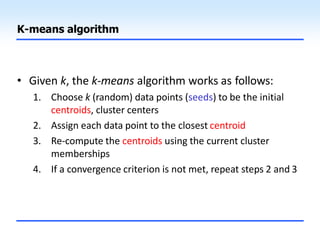
• Given k, the k-means algorithm works as follows:
1. Choose k (random) data points (seeds) to be the initial
centroids, cluster centers
2. Assign each data point to the closest centroid
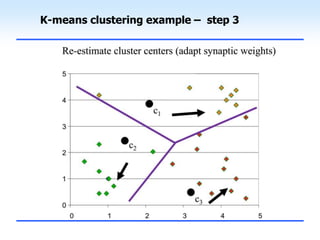
3. Re-compute the centroids using the current cluster
memberships
4. If a convergence criterion is not met, repeat steps 2 and 3
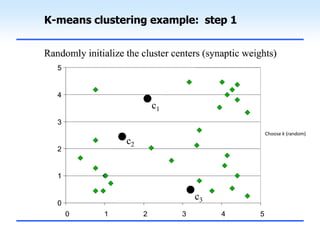
K-means clustering example: step 1
Choose k (random)
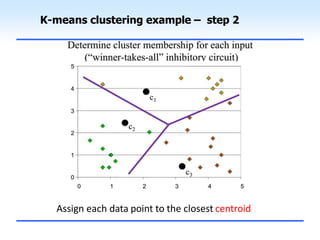
K-means clustering example – step 2
Assign each data point to the closest centroid
K-means clustering example – step 3
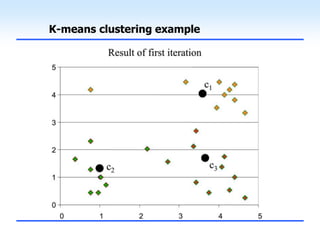
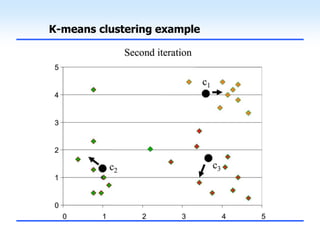
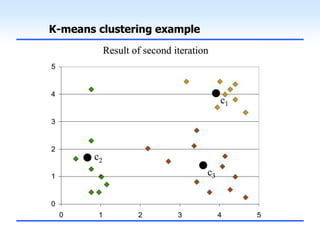
K-means clustering example
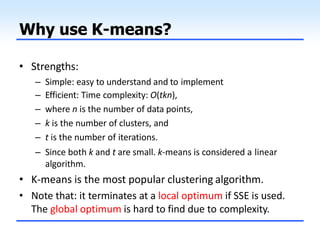
Why use K-means?
• Strengths:
– Simple: easy to understand and to implement
– Efficient: Time complexity: O(tkn),
– where n is the number of data points,
– k is the number of clusters, and
– t is the number of iterations.
– Since both k and t are small. k-means is considered a linear
algorithm.
• K-means is the most popular clustering algorithm.
• Note that: it terminates at a local optimum if SSE is used.
The global optimum is hard to find due to complexity.
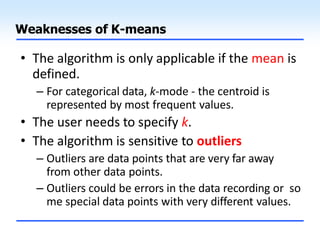
Weaknesses of K-means
• The algorithm is only applicable if the mean is
defined.
– For categorical data, k-mode - the centroid is
represented by most frequent values.
• The user needs to specify k.
• The algorithm is sensitive to outliers
– Outliers are data points that are very far away
from other data points.
– Outliers could be errors in the data recording or so
me special data points with very different values.
K-means summary
• Despite weaknesses, k-means is still the most
popular algorithm due to its simplicity and ef
ficiency
• No clear evidence that any other clustering
algorithm performs better in general
• Comparing different clustering algorithms is a
difficult task. No one knows the correct clust
ers!
`Thank You!’

Unsupervised learning clustering

  • 1.
    CH -10 Unsupervised Learningand Clustering By: Arshad Farhad 20177716
  • 2.
    Contents  Supervised vsUnsupervised learning  Introduction to clustering  K-means Clustering  Hierarchical clustering  Conclusion
  • 3.
    Supervised Vs UnsupervisedLearning  Supervised learning is where you have input variables (x) and an output variable (Y) and you use an algorithm to learn the mapping function from the input to the output. Y = f(X)  The goal is to approximate the mapping function so well that when you have new input data (x) that you can predict the output variables (Y) for that data  Unsupervised learning is where you only have input data (X) and no corresponding output variables  The goal for unsupervised learning is to model the underlying structure or distribution in the data in order to learn more about the data.  Unsupervised learning problems can be further grouped into clustering and association problems.  Clustering  Association
  • 4.
    What is clustering? •The organization of unlabeled data into similarity groups called clusters. • A cluster is a collection of data items which are “similar” between them, and “dissimilar” to data items in other clusters.
  • 5.
    What do weneed for clustering?
  • 6.
    Distance (dissimilarity) measures Euclidean distance between points i and j is the length of the line segment connecting them  In Cartesian coordinates, if i = (i1, i2,…in) and q = (q1, q2,…qn) then the distance (d) from i to j, or from j to i is given by:
  • 7.
    Cluster Evaluation • Intra-clustercohesion (compactness): – Cohesion measures how near the data points in a cluster are to the cluster centroid. – Sum of squared error (SSE) is a commonly used measure. • Inter-cluster separation (isolation): – Separation means that different cluster centroids should be far away from one another.
  • 8.
  • 9.
  • 10.
  • 11.
  • 12.
    K-Means clustering • K-means(MacQueen, 1967) is a partitional clustering algorithm • The k-means algorithm partitions the given data into k clusters: – Each cluster has a cluster center, called centroid. – k is specified by the user
  • 13.
    K-means algorithm • Givenk, the k-means algorithm works as follows: 1. Choose k (random) data points (seeds) to be the initial centroids, cluster centers 2. Assign each data point to the closest centroid 3. Re-compute the centroids using the current cluster memberships 4. If a convergence criterion is not met, repeat steps 2 and 3
  • 14.
    K-means clustering example:step 1 Choose k (random)
  • 15.
    K-means clustering example– step 2 Assign each data point to the closest centroid
  • 16.
  • 17.
  • 18.
  • 19.
  • 20.
    Why use K-means? •Strengths: – Simple: easy to understand and to implement – Efficient: Time complexity: O(tkn), – where n is the number of data points, – k is the number of clusters, and – t is the number of iterations. – Since both k and t are small. k-means is considered a linear algorithm. • K-means is the most popular clustering algorithm. • Note that: it terminates at a local optimum if SSE is used. The global optimum is hard to find due to complexity.
  • 21.
    Weaknesses of K-means •The algorithm is only applicable if the mean is defined. – For categorical data, k-mode - the centroid is represented by most frequent values. • The user needs to specify k. • The algorithm is sensitive to outliers – Outliers are data points that are very far away from other data points. – Outliers could be errors in the data recording or so me special data points with very different values.
  • 22.
    K-means summary • Despiteweaknesses, k-means is still the most popular algorithm due to its simplicity and ef ficiency • No clear evidence that any other clustering algorithm performs better in general • Comparing different clustering algorithms is a difficult task. No one knows the correct clust ers!
  • 23.