Lumbar Puncture & CSF
Analysis
Presenter: Shruti Shirke Evaluator: Mr. L Anand
M.Sc (N) Neuroscience Asso. Professor
CON AIIMS BBSR
02/9/2020
Introduction
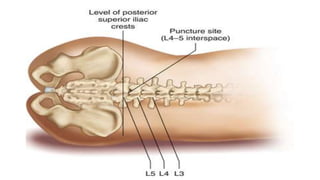
• The procedure is carried out by the doctor, who will insert the
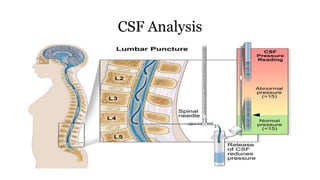
needle in the space between the third and fourth lumbar
vertebrae
• Insertion any higher up the spine would risk injury to the spinal
cord. The level is found by imagining a line drawn from one iliac
crest to the other, and noting where this line crosses the
vertebrae.
Definition
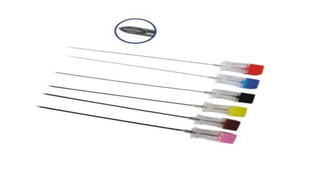
• A lumbar puncture is the insertion of a hollow tube needle
under local anesthetic into the subarachnoid space of the spinal
canal to obtain a sample of cerebrospinal fluid (CSF) for clinical
investigations or to inject medication (therapeutic & diagnostic)
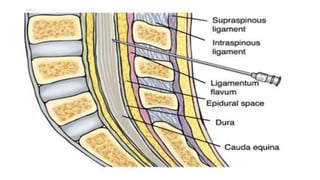
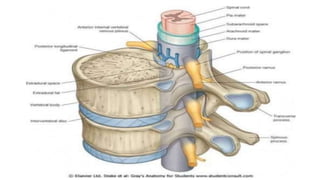
Anatomy
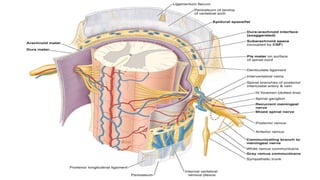
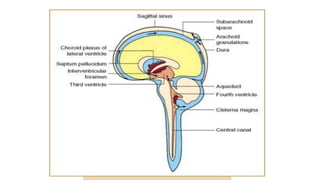
• The three coverings of the brain and spinal cord (meninges), are
separated by small spaces. The outer membrane, the dura mater, is
in two layers, with a space between containing fluid, blood vessels
and venous sinuses. Beneath the dura mater is a small subdural
space, followed by the arachnoid mater, which has a spider’s weblike
structure. Below this, the subarachnoid space is filled with CSF. The
innermost layer, the pia mater, rests on the brain and cord surface.
Purpose of lumbar puncture
• Lumbar puncture is done for one of three reasons:
• To acquire a sample of CSF for analysis.
• To measure and relieve the CSF pressure
• To introduce drugs into the spinal canal (called an intrathecal
injection).
Purpose of lumbar puncture Cont..
• Lumbar puncture may also be carried out to introduce a contrast
radio-opaque medium (one that shows up on X-ray), to provide
radiographic images of the spinal canal that do not show on ordinary
X-rays. This type of X-ray is called a myelogram and is used for two
purposes - the diagnosis of spinal lesions and to help plan surgery by
isolating the level of the lesion and selecting the most suitable spinal
segment for operation.
Indications
• Suspicion of meningitis.
• Suspicion of subarachnoid hemorrhage (SAH)
• Suspicion of nervous system diseases such as Guillain-Barré
syndrome and carcinomatous meningitis.
• Therapeutic relief of pseudotumor cerebri.
Contraindications
• Absolute contraindications for lumbar puncture are the presence of
infected skin over the needle entry site and the presence of unequal
pressures between the supratentorial and infratentorial compartments. i.e.
• Midline shift
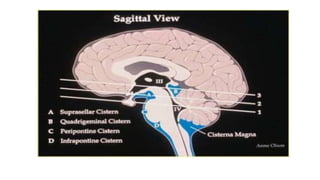
• Loss of suprachiasmatic and basilar cisterns
• Posterior fossa mass
• Loss of the superior cerebellar cistern
• Loss of the quadrigeminal plate cistern
Contraindications cont..
• Relative contraindications for lumbar puncture include the
following:
• Increased intracranial pressure (ICP)
• Coagulopathy
• Brain abscess
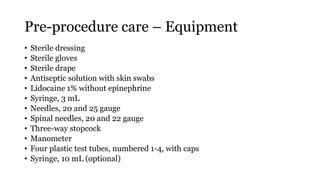
Pre-procedure care – Equipment
• Sterile dressing
• Sterile gloves
• Sterile drape
• Antiseptic solution with skin swabs
• Lidocaine 1% without epinephrine
• Syringe, 3 mL
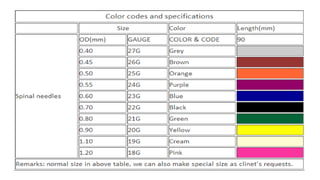
• Needles, 20 and 25 gauge
• Spinal needles, 20 and 22 gauge
• Three-way stopcock
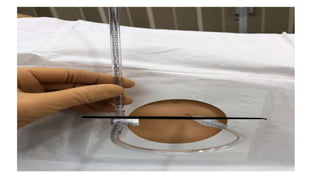
• Manometer
• Four plastic test tubes, numbered 1-4, with caps
• Syringe, 10 mL (optional)
Patient preparation
• The patient is placed in the lateral recumbent position with the
hips, knees, and chin flexed toward the chest so as to open the
interlaminar spaces. A pillow may be used to support the head.
• The sitting position may be a helpful alternative, especially in
obese patients, because it makes it easier to confirm the midline.
In order to open the interlaminar spaces.
Patient preparation cont..
• If the procedure is performed with the patient in the sitting
position and an opening pressure is required (as in the case of
pseudotumor cerebri), replace the stylet and have an assistant
help the patient into the left lateral recumbent position.
Procedure
Samples of CSF are taken for:
• Taking cell counts (a tiny number of white cells may normally be
present)
• Measuring glucose and protein (also present in small quantities)
• Cytology, i.e. looking for abnormal cells
• Immunoglobulin (antibody) studies
• Bacterial or viral tests
• Biochemical analysis.
Complications
• Post–spinal puncture headache
• Bloody tap
• Dry tap
• Infection
• Hemorrhage
• Dysesthesia (abnormal sensation of pain, itching, burning.)
• Post–dural puncture cerebral herniation
Complication prevention
• Explain the procedure, benefits, risks, complications, and alternative
options to the patient or the patient’s representative, and obtain a signed
informed consent.
• Before performing the lumbar puncture, ensure that patients are
hydrated so as to avoid a dry tap.
• Never allow a lumbar puncture or a pre–lumbar puncture CT scan to
delay administration of intravenous (IV) antibiotics; meningitis can
usually be inferred from the cell count, antigen detection, or both.
Complication prevention cont..
• Avoid lumbar puncture in patients in whom the disease process
has progressed to the neurologic findings associated with
impending cerebral herniation (ie, deteriorating level of
consciousness and brainstem signs that include pupillary changes,
posturing, irregular respirations, and very recent seizure)
Research evidence
• The smaller the needle used for the lumbar puncture, the lower the
risk that the patient will experience a post–lumbar puncture
headache. Data suggest an inverse linear relation between needle
gauge and headache incidence, and some authors recommend using
a 22-gauge needle regardless of what size needle is supplied with the
kit.
• Lambert DH, Hurley RJ, Hertwig L, Datta S. Role of needle gauge and tip configuration in the production
of lumbar puncture headache. Reg Anesth. 1997 Jan-Feb. 22(1):66-72. [Medline].
Research evidence cont..
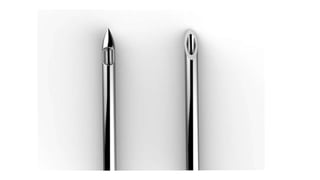
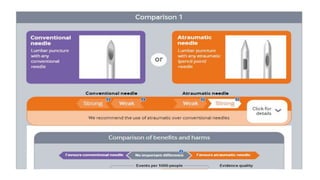
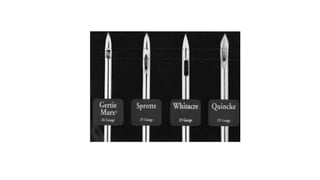
• The use of atraumatic needles has been shown to significantly
reduce the incidence of post–lumbar puncture headache (3%) when
compared to the use of standard spinal needles (approximately
30%). In addition, it may lead to cost savings. However, obtaining
pressures can be more difficult with atraumatic needles.
• Lavi R, Yarnitsky D, Yernitzky D, Rowe JM, Weissman A, Segal D. Standard vs atraumatic Whitacre
needle for diagnostic lumbar puncture: a randomized trial. Neurology. 2006 Oct 24. 67(8):1492-4.
[Medline].
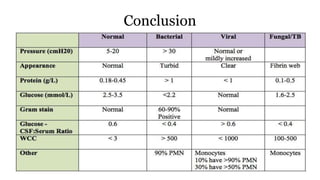
CSF Analysis
Normal results in adults
• Appearance: Clear
• Opening pressure: 10-20 cm H2 O
• WBC count: 0-5 cells/µL (< 2 polymorphonucleocytes [PMN]);
normal cell counts do not rule out meningitis or any other pathology
• Glucose level: >60% of serum glucose
• Protein level: < 45 mg/dL
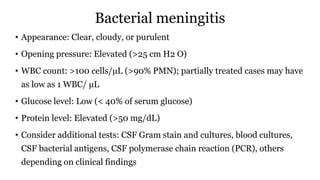
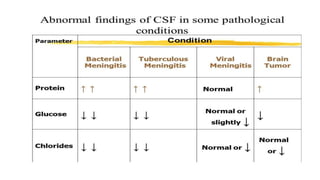
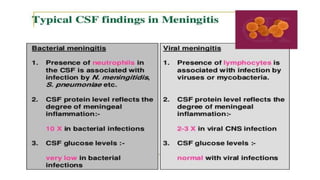
Bacterial meningitis
• Appearance: Clear, cloudy, or purulent
• Opening pressure: Elevated (>25 cm H2 O)
• WBC count: >100 cells/µL (>90% PMN); partially treated cases may have
as low as 1 WBC/ µL
• Glucose level: Low (< 40% of serum glucose)
• Protein level: Elevated (>50 mg/dL)
• Consider additional tests: CSF Gram stain and cultures, blood cultures,
CSF bacterial antigens, CSF polymerase chain reaction (PCR), others
depending on clinical findings
Aseptic (viral) meningitis
• Appearance: Clear
• Opening pressure: Normal or elevated
• WBC count: 10-1000 cells/µL (lymph but PMN early)
• Glucose level: >60% serum glucose (may be low in HSV infection)
• Protein level: Elevated (>50 mg/dL)
• Consider additional tests: CSF Gram stain and cultures, blood cultures, CSF
bacterial antigens, CSF PCR (eg, herpes simplex virus [HSV], varicella-
zoster virus [VZV]), others depending on clinical findings
Fungal meningitis
• Appearance: Clear or cloudy
• Opening pressure: Elevated WBC count: 10-500 cells/µL
• Glucose level: Low
• Protein level: Elevated
• Consider additional tests: CSF Gram stain and cultures, blood
cultures, CSF bacterial antigens, CSF PCR, CSF India ink, others
depending on clinical findings.
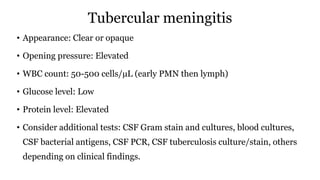
Tubercular meningitis
• Appearance: Clear or opaque
• Opening pressure: Elevated
• WBC count: 50-500 cells/µL (early PMN then lymph)
• Glucose level: Low
• Protein level: Elevated
• Consider additional tests: CSF Gram stain and cultures, blood cultures,
CSF bacterial antigens, CSF PCR, CSF tuberculosis culture/stain, others
depending on clinical findings.
Subarachnoid hemorrhage
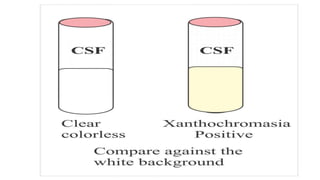
• Appearance: Xanthochromia, bloody, or clear
• Opening pressure: Elevated
• WBC count: (1 additional WBC per 1000 RBCs is considered normal
correction)
• Glucose level: Normal
• Protein level: Elevated
• Consider additional tests: CSF Gram stain and cultures, others depending
on clinical findings
Multiple sclerosis
• Appearance: Clear
• Opening pressure: Normal WBC count: 0-20 cells/µL (lymph)
• Glucose level: Normal
• Protein level: Mildly elevated (45-75 mg/dL)
• Consider additional tests: Oligoclonal band analysis (serum and
CSF), others depending on clinical findings.
Guillian barre syndrome
• Appearance: Clear or xanthochromia
• Opening pressure: Normal or elevated
• WBC count: Normal or elevated
• Glucose level: Normal
• Protein level: Elevated
• Consider additional tests: Others depending on clinical findings
Nursing considerations
• Lumbar puncture is a strict aseptic technique requiring full sterile
procedures.
• Positioned the patient carefully, laying on one side in a curled up
position with the lumbar spine exposed (knees drawn up to the
chest). Moving the patient’s back closer to the edge of the bed will
make access to the lumbar spine easier. Support the patient in this
position throughout the procedure.
Nursing consideration cont..
• Encourage patients to drink well before and after the procedure.
• A small local sterile dressing is applied to the spinal site after
removal of the needle.
• Headache is a common complaint following lumbar puncture. The
patient should lay flat for 6-12 hours afterwards, as sitting up may
make any headache worse.
Nursing consideration cont..
• In myelograms, the patient’s head should be kept raised for up
to 24 hours afterwards to prevent contrast medium in the spinal
canal from entering the skull. This may caused seizures if it
passes around the brain.
Conclusion
Thankyou

Lumbar puncture and CSF Analysis

  • 1.
    Lumbar Puncture &CSF Analysis Presenter: Shruti Shirke Evaluator: Mr. L Anand M.Sc (N) Neuroscience Asso. Professor CON AIIMS BBSR 02/9/2020
  • 2.
    Introduction • The procedureis carried out by the doctor, who will insert the needle in the space between the third and fourth lumbar vertebrae • Insertion any higher up the spine would risk injury to the spinal cord. The level is found by imagining a line drawn from one iliac crest to the other, and noting where this line crosses the vertebrae.
  • 4.
    Definition • A lumbarpuncture is the insertion of a hollow tube needle under local anesthetic into the subarachnoid space of the spinal canal to obtain a sample of cerebrospinal fluid (CSF) for clinical investigations or to inject medication (therapeutic & diagnostic)
  • 5.
    Anatomy • The threecoverings of the brain and spinal cord (meninges), are separated by small spaces. The outer membrane, the dura mater, is in two layers, with a space between containing fluid, blood vessels and venous sinuses. Beneath the dura mater is a small subdural space, followed by the arachnoid mater, which has a spider’s weblike structure. Below this, the subarachnoid space is filled with CSF. The innermost layer, the pia mater, rests on the brain and cord surface.
  • 10.
    Purpose of lumbarpuncture • Lumbar puncture is done for one of three reasons: • To acquire a sample of CSF for analysis. • To measure and relieve the CSF pressure • To introduce drugs into the spinal canal (called an intrathecal injection).
  • 11.
    Purpose of lumbarpuncture Cont.. • Lumbar puncture may also be carried out to introduce a contrast radio-opaque medium (one that shows up on X-ray), to provide radiographic images of the spinal canal that do not show on ordinary X-rays. This type of X-ray is called a myelogram and is used for two purposes - the diagnosis of spinal lesions and to help plan surgery by isolating the level of the lesion and selecting the most suitable spinal segment for operation.
  • 12.
    Indications • Suspicion ofmeningitis. • Suspicion of subarachnoid hemorrhage (SAH) • Suspicion of nervous system diseases such as Guillain-Barré syndrome and carcinomatous meningitis. • Therapeutic relief of pseudotumor cerebri.
  • 13.
    Contraindications • Absolute contraindicationsfor lumbar puncture are the presence of infected skin over the needle entry site and the presence of unequal pressures between the supratentorial and infratentorial compartments. i.e. • Midline shift • Loss of suprachiasmatic and basilar cisterns • Posterior fossa mass • Loss of the superior cerebellar cistern • Loss of the quadrigeminal plate cistern
  • 15.
    Contraindications cont.. • Relativecontraindications for lumbar puncture include the following: • Increased intracranial pressure (ICP) • Coagulopathy • Brain abscess
  • 16.
    Pre-procedure care –Equipment • Sterile dressing • Sterile gloves • Sterile drape • Antiseptic solution with skin swabs • Lidocaine 1% without epinephrine • Syringe, 3 mL • Needles, 20 and 25 gauge • Spinal needles, 20 and 22 gauge • Three-way stopcock • Manometer • Four plastic test tubes, numbered 1-4, with caps • Syringe, 10 mL (optional)
  • 17.
    Patient preparation • Thepatient is placed in the lateral recumbent position with the hips, knees, and chin flexed toward the chest so as to open the interlaminar spaces. A pillow may be used to support the head. • The sitting position may be a helpful alternative, especially in obese patients, because it makes it easier to confirm the midline. In order to open the interlaminar spaces.
  • 18.
    Patient preparation cont.. •If the procedure is performed with the patient in the sitting position and an opening pressure is required (as in the case of pseudotumor cerebri), replace the stylet and have an assistant help the patient into the left lateral recumbent position.
  • 19.
  • 20.
    Samples of CSFare taken for: • Taking cell counts (a tiny number of white cells may normally be present) • Measuring glucose and protein (also present in small quantities) • Cytology, i.e. looking for abnormal cells • Immunoglobulin (antibody) studies • Bacterial or viral tests • Biochemical analysis.
  • 21.
    Complications • Post–spinal punctureheadache • Bloody tap • Dry tap • Infection • Hemorrhage • Dysesthesia (abnormal sensation of pain, itching, burning.) • Post–dural puncture cerebral herniation
  • 22.
    Complication prevention • Explainthe procedure, benefits, risks, complications, and alternative options to the patient or the patient’s representative, and obtain a signed informed consent. • Before performing the lumbar puncture, ensure that patients are hydrated so as to avoid a dry tap. • Never allow a lumbar puncture or a pre–lumbar puncture CT scan to delay administration of intravenous (IV) antibiotics; meningitis can usually be inferred from the cell count, antigen detection, or both.
  • 23.
    Complication prevention cont.. •Avoid lumbar puncture in patients in whom the disease process has progressed to the neurologic findings associated with impending cerebral herniation (ie, deteriorating level of consciousness and brainstem signs that include pupillary changes, posturing, irregular respirations, and very recent seizure)
  • 24.
    Research evidence • Thesmaller the needle used for the lumbar puncture, the lower the risk that the patient will experience a post–lumbar puncture headache. Data suggest an inverse linear relation between needle gauge and headache incidence, and some authors recommend using a 22-gauge needle regardless of what size needle is supplied with the kit. • Lambert DH, Hurley RJ, Hertwig L, Datta S. Role of needle gauge and tip configuration in the production of lumbar puncture headache. Reg Anesth. 1997 Jan-Feb. 22(1):66-72. [Medline].
  • 27.
    Research evidence cont.. •The use of atraumatic needles has been shown to significantly reduce the incidence of post–lumbar puncture headache (3%) when compared to the use of standard spinal needles (approximately 30%). In addition, it may lead to cost savings. However, obtaining pressures can be more difficult with atraumatic needles. • Lavi R, Yarnitsky D, Yernitzky D, Rowe JM, Weissman A, Segal D. Standard vs atraumatic Whitacre needle for diagnostic lumbar puncture: a randomized trial. Neurology. 2006 Oct 24. 67(8):1492-4. [Medline].
  • 32.
  • 33.
    Normal results inadults • Appearance: Clear • Opening pressure: 10-20 cm H2 O • WBC count: 0-5 cells/µL (< 2 polymorphonucleocytes [PMN]); normal cell counts do not rule out meningitis or any other pathology • Glucose level: >60% of serum glucose • Protein level: < 45 mg/dL
  • 34.
    Bacterial meningitis • Appearance:Clear, cloudy, or purulent • Opening pressure: Elevated (>25 cm H2 O) • WBC count: >100 cells/µL (>90% PMN); partially treated cases may have as low as 1 WBC/ µL • Glucose level: Low (< 40% of serum glucose) • Protein level: Elevated (>50 mg/dL) • Consider additional tests: CSF Gram stain and cultures, blood cultures, CSF bacterial antigens, CSF polymerase chain reaction (PCR), others depending on clinical findings
  • 35.
    Aseptic (viral) meningitis •Appearance: Clear • Opening pressure: Normal or elevated • WBC count: 10-1000 cells/µL (lymph but PMN early) • Glucose level: >60% serum glucose (may be low in HSV infection) • Protein level: Elevated (>50 mg/dL) • Consider additional tests: CSF Gram stain and cultures, blood cultures, CSF bacterial antigens, CSF PCR (eg, herpes simplex virus [HSV], varicella- zoster virus [VZV]), others depending on clinical findings
  • 36.
    Fungal meningitis • Appearance:Clear or cloudy • Opening pressure: Elevated WBC count: 10-500 cells/µL • Glucose level: Low • Protein level: Elevated • Consider additional tests: CSF Gram stain and cultures, blood cultures, CSF bacterial antigens, CSF PCR, CSF India ink, others depending on clinical findings.
  • 37.
    Tubercular meningitis • Appearance:Clear or opaque • Opening pressure: Elevated • WBC count: 50-500 cells/µL (early PMN then lymph) • Glucose level: Low • Protein level: Elevated • Consider additional tests: CSF Gram stain and cultures, blood cultures, CSF bacterial antigens, CSF PCR, CSF tuberculosis culture/stain, others depending on clinical findings.
  • 38.
    Subarachnoid hemorrhage • Appearance:Xanthochromia, bloody, or clear • Opening pressure: Elevated • WBC count: (1 additional WBC per 1000 RBCs is considered normal correction) • Glucose level: Normal • Protein level: Elevated • Consider additional tests: CSF Gram stain and cultures, others depending on clinical findings
  • 40.
    Multiple sclerosis • Appearance:Clear • Opening pressure: Normal WBC count: 0-20 cells/µL (lymph) • Glucose level: Normal • Protein level: Mildly elevated (45-75 mg/dL) • Consider additional tests: Oligoclonal band analysis (serum and CSF), others depending on clinical findings.
  • 41.
    Guillian barre syndrome •Appearance: Clear or xanthochromia • Opening pressure: Normal or elevated • WBC count: Normal or elevated • Glucose level: Normal • Protein level: Elevated • Consider additional tests: Others depending on clinical findings
  • 42.
    Nursing considerations • Lumbarpuncture is a strict aseptic technique requiring full sterile procedures. • Positioned the patient carefully, laying on one side in a curled up position with the lumbar spine exposed (knees drawn up to the chest). Moving the patient’s back closer to the edge of the bed will make access to the lumbar spine easier. Support the patient in this position throughout the procedure.
  • 43.
    Nursing consideration cont.. •Encourage patients to drink well before and after the procedure. • A small local sterile dressing is applied to the spinal site after removal of the needle. • Headache is a common complaint following lumbar puncture. The patient should lay flat for 6-12 hours afterwards, as sitting up may make any headache worse.
  • 44.
    Nursing consideration cont.. •In myelograms, the patient’s head should be kept raised for up to 24 hours afterwards to prevent contrast medium in the spinal canal from entering the skull. This may caused seizures if it passes around the brain.
  • 45.
  • 48.