LUMBAR PUNCTURE (LP)
 Also known as spinal tap
 It is a medical procedure where cerebrospinal fluid (CSF) that
surrounding the brain and spinal cord was collected.
 During a lumbar puncture, a needle is carefully inserted into lower part
of the spine (lumbar area).
 Sample of CFS were collected in order to determine a condition that
may affect brain, spinal cord or other part of nervous system
 The samples are studied for
 Colour
 Blood cell counts
 Protein
 Glucose and other substances.
 Some of the sample may be put into a container with a growth
substance. This is called a culture. If any bacteria or fungi grow in the
culture, an infection may be present.
 The pressure of the CSF also is measured during the procedure.
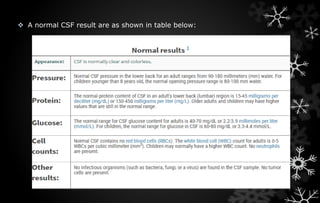
 A normal CSF result are as shown in table below:
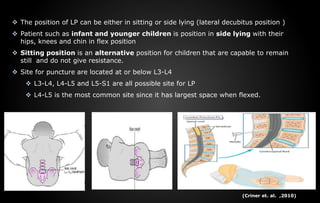
 The position of LP can be either in sitting or side lying (lateral decubitus position )
 Patient such as infant and younger children is position in side lying with their
hips, knees and chin in flex position
 Sitting position is an alternative position for children that are capable to remain
still and do not give resistance.
 Site for puncture are located at or below L3-L4
 L3-L4, L4-L5 and L5-S1 are all possible site for LP
 L4-L5 is the most common site since it has largest space when flexed.
(Criner et. al. ,2010)
INDICATION
A lumbar puncture is done to:
1. Diagnosis of
 CNS Infection e.g. meningitis, encephalitis and CNS syphilis
 Cancer
 Bleeding in area around the brain or spinal cord (subarachnoid hemorrhage)
2. Evaluation and diagnosis of demyelinating or inflammatory CNS processes
such as
 Multiple sclerosis
 Guillain-Barré syndrome.
3. Infusion of anaesthetic, chemotherapy or contrast agent into spinal canal
CONTRAINDICATION
1. Increase intracranial pressure
2. Patient with coagulation disorder or on anticoagulant therapy
3. Cutaneous infection at the site of procedure
4. Patient with history of back pain, lower extremity neuralgia or
sciatica
(Criner et. al. ,2010)
COMPLICATION
 Although complication or effect of LP is not common but there is a possible risk
that may happen right after LP such as:
1. Headache due to persistent CSF leak
 May resolve within 6-8 hours of bed rest, intake of fluid and analgesic
2. Localize back pain without neurological abnormalities
 Can be treated with acetaminophen and applied heat
 In rare cases infection or bleeding may occur
(Christopher & Henretig ,2008)
PREPARATION
1. Pre treatment evaluation
I. Subjectives
 History of pancytopenia, anticoagulation or aspirin use, renal insufficiency,
disseminated intravascular coagulation, liver dysfunction, seizures; cerebral
bleeding, head trauma or back surgery should be elicited.
 Review of systems: Headache, confusion, altered mental status, nuchal rigidity,
fever, bleeding, lower extremity or back pain, difficulty with elimination or
ambulation.
II. Patient evaluation
 General appearances, vital signs, fever.
 Complete a focused neurological and mental status examination. Assess for focal
neurologic findings. Evaluate for evidence of increased intracranial pressure: high
blood pressure, widening pulse pressure, papilledema, and decreased level of
consciousness. Evaluate for evidence of local infection or metabolic abnormalities.
III. Diagnostic
 Review for any previous lumbar puncture (MRI, CT results, if applicable).
 As indicated, current CBC with differential, PT/PTT, platelets, and/or other
chemistries as needed.
2. Patient preparation
I. After providing the purpose, risk and benefit and step of the procedure,
obtain inform consent from patient or family.
II. Perform the time out and document in patient record
III. The most important step is positioning the patient. The lateral decubitus
position may be used; firm bed, head on pillow, head flexed with chin on the
chest, legs maximally flexed toward the head. Alternatively, the patient may
be sitting, flexed forward and supported by stable table or assistant
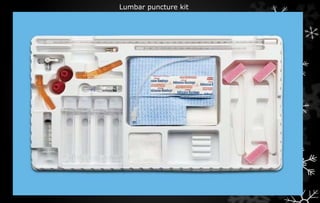
3. Basic equipment
 Mask
 Sterile glove
 Gown
 Skin prep solution
 Sterile towel
 Small basin
 4 x 4 gauze sponge
 Sponge forceps
 Local anesthetic
 4-5 sterile test tube with stoppers
 22-25 gauge needles
 Spinal needles
 Manometer and
 3 way stopcock
(Kupesic S. ,2017)
Lumbar puncture kit
4. Procedure
 Identify interspaces and mark puncture site at the L4-L5 interspaces in a perpendicular
line from the iliac crest. The L3-L4 interspace above this level may also be used.
 Recheck landmark, prep with iodine then clorhexidine
 Place sterile drape
 Using 1% lidocaine
 Infiltrate the skin and subcutaneous tissue with 22-25 gauge needle
 Insert spinal needle into the midway between spinous process of L3-L4 or L4-L5 interspace
and directed slightly cephalad
 Advance slowly until there is a decrease in resistance or a pop as the dura is penetrated
 Remove the stylet and wait 2 sec to look for CSF and if none, advance 1-2 mm at a time
 If bone is felt partially withdraw and reposition
 Once CSF is seen, use manometer to read the opening pressure in lateral decubitus.
Kupesic S. ,2017
 When CSF flow established, rotate the needle 90 degrees counter-clock wise for patients
in the lateral decubitus position.
 If the patient is in the sitting position no adjustment is needed.
 Remove 1-2ml of CSF in each of the four tubes.
 Replace the stylet fully into the spinal needle before withdrawing the needle (it help to
avoid aspiration of the nerve root and subarachnoid tissues on withdrawal)
 Remove the needle in one motion
 Keep the gauze ready in the opposite hand to apply on the puncture site for a short time
 Place Band Aid at the site
5. Post-procedure
 Cleanse procedure area using povidone iodine solution and place dry sterile dressing
 Advise patient to lie supine for ½-1 hour and to increase oral fluids over the next 12-24
hours.
 Assess patient for any adverse reactions to procedure.
Lumbar Puncture Video
REFERENCE
 Plavsic, S. K. (2017). Urgent procedures in medical practice. New Delhi: Jaypee
Brothers Medical .
 Criner, G. J., Barnette, R. E., & DAlonzo, G. E. (2010). Critical Care Study Guide
Text and Review. New York, NY: Springer New York.
 K. Christopher & Henretig F. M. (2008). Textbook of Pediatric Emergency
Procedures. Lippincott Williams & Wilkins

Lumbar Puncture

  • 2.
    LUMBAR PUNCTURE (LP) Also known as spinal tap  It is a medical procedure where cerebrospinal fluid (CSF) that surrounding the brain and spinal cord was collected.  During a lumbar puncture, a needle is carefully inserted into lower part of the spine (lumbar area).  Sample of CFS were collected in order to determine a condition that may affect brain, spinal cord or other part of nervous system  The samples are studied for  Colour  Blood cell counts  Protein  Glucose and other substances.  Some of the sample may be put into a container with a growth substance. This is called a culture. If any bacteria or fungi grow in the culture, an infection may be present.  The pressure of the CSF also is measured during the procedure.
  • 3.
     A normalCSF result are as shown in table below:
  • 4.
     The positionof LP can be either in sitting or side lying (lateral decubitus position )  Patient such as infant and younger children is position in side lying with their hips, knees and chin in flex position  Sitting position is an alternative position for children that are capable to remain still and do not give resistance.  Site for puncture are located at or below L3-L4  L3-L4, L4-L5 and L5-S1 are all possible site for LP  L4-L5 is the most common site since it has largest space when flexed. (Criner et. al. ,2010)
  • 5.
    INDICATION A lumbar punctureis done to: 1. Diagnosis of  CNS Infection e.g. meningitis, encephalitis and CNS syphilis  Cancer  Bleeding in area around the brain or spinal cord (subarachnoid hemorrhage) 2. Evaluation and diagnosis of demyelinating or inflammatory CNS processes such as  Multiple sclerosis  Guillain-Barré syndrome. 3. Infusion of anaesthetic, chemotherapy or contrast agent into spinal canal
  • 6.
    CONTRAINDICATION 1. Increase intracranialpressure 2. Patient with coagulation disorder or on anticoagulant therapy 3. Cutaneous infection at the site of procedure 4. Patient with history of back pain, lower extremity neuralgia or sciatica (Criner et. al. ,2010)
  • 7.
    COMPLICATION  Although complicationor effect of LP is not common but there is a possible risk that may happen right after LP such as: 1. Headache due to persistent CSF leak  May resolve within 6-8 hours of bed rest, intake of fluid and analgesic 2. Localize back pain without neurological abnormalities  Can be treated with acetaminophen and applied heat  In rare cases infection or bleeding may occur (Christopher & Henretig ,2008)
  • 8.
    PREPARATION 1. Pre treatmentevaluation I. Subjectives  History of pancytopenia, anticoagulation or aspirin use, renal insufficiency, disseminated intravascular coagulation, liver dysfunction, seizures; cerebral bleeding, head trauma or back surgery should be elicited.  Review of systems: Headache, confusion, altered mental status, nuchal rigidity, fever, bleeding, lower extremity or back pain, difficulty with elimination or ambulation. II. Patient evaluation  General appearances, vital signs, fever.  Complete a focused neurological and mental status examination. Assess for focal neurologic findings. Evaluate for evidence of increased intracranial pressure: high blood pressure, widening pulse pressure, papilledema, and decreased level of consciousness. Evaluate for evidence of local infection or metabolic abnormalities. III. Diagnostic  Review for any previous lumbar puncture (MRI, CT results, if applicable).  As indicated, current CBC with differential, PT/PTT, platelets, and/or other chemistries as needed.
  • 9.
    2. Patient preparation I.After providing the purpose, risk and benefit and step of the procedure, obtain inform consent from patient or family. II. Perform the time out and document in patient record III. The most important step is positioning the patient. The lateral decubitus position may be used; firm bed, head on pillow, head flexed with chin on the chest, legs maximally flexed toward the head. Alternatively, the patient may be sitting, flexed forward and supported by stable table or assistant 3. Basic equipment  Mask  Sterile glove  Gown  Skin prep solution  Sterile towel  Small basin  4 x 4 gauze sponge  Sponge forceps  Local anesthetic  4-5 sterile test tube with stoppers  22-25 gauge needles  Spinal needles  Manometer and  3 way stopcock (Kupesic S. ,2017)
  • 10.
  • 11.
    4. Procedure  Identifyinterspaces and mark puncture site at the L4-L5 interspaces in a perpendicular line from the iliac crest. The L3-L4 interspace above this level may also be used.  Recheck landmark, prep with iodine then clorhexidine  Place sterile drape  Using 1% lidocaine  Infiltrate the skin and subcutaneous tissue with 22-25 gauge needle  Insert spinal needle into the midway between spinous process of L3-L4 or L4-L5 interspace and directed slightly cephalad  Advance slowly until there is a decrease in resistance or a pop as the dura is penetrated  Remove the stylet and wait 2 sec to look for CSF and if none, advance 1-2 mm at a time  If bone is felt partially withdraw and reposition  Once CSF is seen, use manometer to read the opening pressure in lateral decubitus.
  • 12.
    Kupesic S. ,2017 When CSF flow established, rotate the needle 90 degrees counter-clock wise for patients in the lateral decubitus position.  If the patient is in the sitting position no adjustment is needed.  Remove 1-2ml of CSF in each of the four tubes.  Replace the stylet fully into the spinal needle before withdrawing the needle (it help to avoid aspiration of the nerve root and subarachnoid tissues on withdrawal)  Remove the needle in one motion  Keep the gauze ready in the opposite hand to apply on the puncture site for a short time  Place Band Aid at the site 5. Post-procedure  Cleanse procedure area using povidone iodine solution and place dry sterile dressing  Advise patient to lie supine for ½-1 hour and to increase oral fluids over the next 12-24 hours.  Assess patient for any adverse reactions to procedure.
  • 13.
  • 14.
    REFERENCE  Plavsic, S.K. (2017). Urgent procedures in medical practice. New Delhi: Jaypee Brothers Medical .  Criner, G. J., Barnette, R. E., & DAlonzo, G. E. (2010). Critical Care Study Guide Text and Review. New York, NY: Springer New York.  K. Christopher & Henretig F. M. (2008). Textbook of Pediatric Emergency Procedures. Lippincott Williams & Wilkins

Editor's Notes

  • #12 Identify – mark landmark – prep with iodine – drape – infiltrate using lidocaine – insert needle – measure pressure CSF – establish CSF flow – remove CSF into tube – remove needle – band aid at site