Dr. Harisingh Gour Vishwavidyalaya, Sagar
(A Central university)
Presentation
On
Stereographic projection of crystals
Anshul Sahu
(M.Tech I year 2018-19)
Submitted to
Prof. R.K Trivedi
Content
 Introduction
 Types of stereonet
 Projection of line
 Projection of plane
 Mirror and polygon symbol
 Convention
 Rules
 Examples.
Introduction
 Crystals have a set of 3D geometric relationships
among their planar and linear features
 These include the angle between crystal faces, normal
(pole) to these faces, and the line of intersection of these
faces
 Planar features: crystal faces, mirror planes
 Linear features: pole to crystal faces, zone axis, crystal
axes
Stereographic Projection
 Projection of 3D orientation data and symmetry
of a crystal into 2D by preserving all the angular
relationships
 First introduced by F.E Neuman and further
developed by W.H Miller
 In mineralogy, it involves projection of faces,
edges, mirror planes, and rotation axes onto a
flat equatorial plane of a sphere, in correct
angular relationships
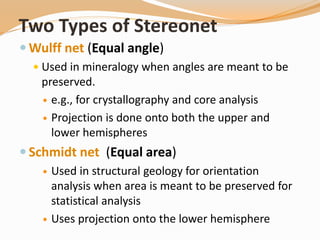
Two Types of Stereonet
 Wulff net (Equal angle)
 Used in mineralogy when angles are meant to be
preserved.
 e.g., for crystallography and core analysis
 Projection is done onto both the upper and
lower hemispheres
 Schmidt net (Equal area)
 Used in structural geology for orientation
analysis when area is meant to be preserved for
statistical analysis
 Uses projection onto the lower hemisphere
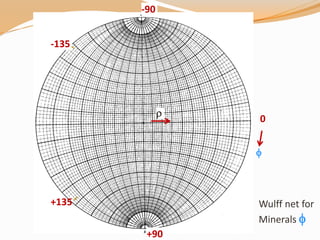
Wulff net for
Minerals 
-90
0
+90
-135
+135


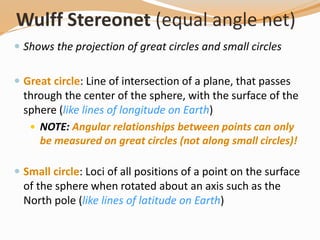
Wulff Stereonet (equal angle net)
 Shows the projection of great circles and small circles
 Great circle: Line of intersection of a plane, that passes
through the center of the sphere, with the surface of the
sphere (like lines of longitude on Earth)
 NOTE: Angular relationships between points can only
be measured on great circles (not along small circles)!
 Small circle: Loci of all positions of a point on the surface
of the sphere when rotated about an axis such as the
North pole (like lines of latitude on Earth)
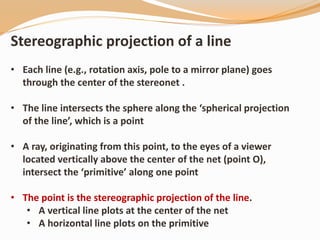
Stereographic projection of a line
• Each line (e.g., rotation axis, pole to a mirror plane) goes
through the center of the stereonet .
• The line intersects the sphere along the ‘spherical projection
of the line’, which is a point
• A ray, originating from this point, to the eyes of a viewer
located vertically above the center of the net (point O),
intersect the ‘primitive’ along one point
• The point is the stereographic projection of the line.
• A vertical line plots at the center of the net
• A horizontal line plots on the primitive
Special cases of lines
 Vertical lines (e.g., rotation axes, edges) plot at the
center of the equatorial plane
 Horizontal lines plot on the primitive
 Inclined lines plot between the primitive and the
center
Projection of Planar Elements
 Crystals have faces and mirror planes which are
planes, so they intersect the surface of the sphere
along lines
 These elements can be represented either as:
 Planes, which become great circle after projection
 Poles (normals) to the planes, which become
points after projection
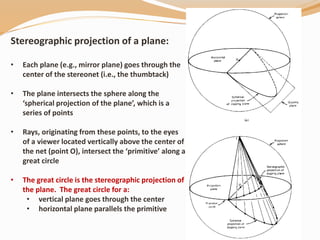
Stereographic projection of a plane:
• Each plane (e.g., mirror plane) goes through the
center of the stereonet (i.e., the thumbtack)
• The plane intersects the sphere along the
‘spherical projection of the plane’, which is a
series of points
• Rays, originating from these points, to the eyes
of a viewer located vertically above the center of
the net (point O), intersect the ‘primitive’ along a
great circle
• The great circle is the stereographic projection of
the plane. The great circle for a:
• vertical plane goes through the center
• horizontal plane parallels the primitive
Special cases of planes
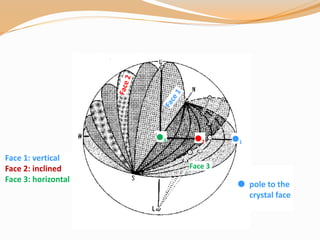
 Stereographic projection of a horizontal face or mirror
plane is along the primitive (perimeter) of the equatorial
plane
 Stereographic projection of a vertical face or mirror plane
is along the straight diameters of the equatorial plane
 They pass through the center
 They are straight ‘great circles’
 Inclined faces and mirror planes plot along curved great
circles that do not pass through the center
12
3
Face 3
 pole to the
crystal face
Face 1: vertical
Face 2: inclined
Face 3: horizontal
Preparing to plot
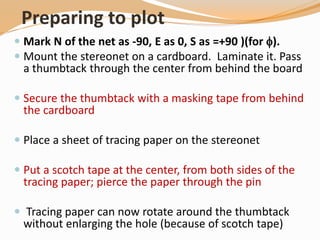
 Mark N of the net as -90, E as 0, S as =+90 )(for ).
 Mount the stereonet on a cardboard. Laminate it. Pass
a thumbtack through the center from behind the board
 Secure the thumbtack with a masking tape from behind
the cardboard
 Place a sheet of tracing paper on the stereonet
 Put a scotch tape at the center, from both sides of the
tracing paper; pierce the paper through the pin
 Tracing paper can now rotate around the thumbtack
without enlarging the hole (because of scotch tape)
Symbols used
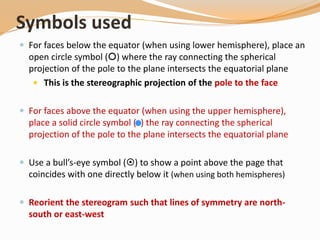
 For faces below the equator (when using lower hemisphere), place an
open circle symbol () where the ray connecting the spherical
projection of the pole to the plane intersects the equatorial plane
 This is the stereographic projection of the pole to the face
 For faces above the equator (when using the upper hemisphere),
place a solid circle symbol ( ) the ray connecting the spherical
projection of the pole to the plane intersects the equatorial plane
 Use a bull’s-eye symbol () to show a point above the page that
coincides with one directly below it (when using both hemispheres)
 Reorient the stereogram such that lines of symmetry are north-
south or east-west

Mirror and Polygon Symbols
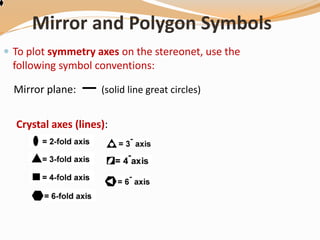
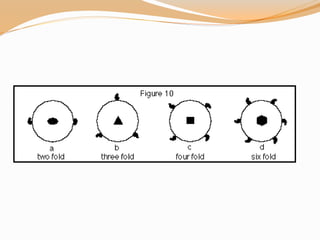
 To plot symmetry axes on the stereonet, use the
following symbol conventions:
Mirror plane: ― (solid line great circles)
Crystal axes (lines):
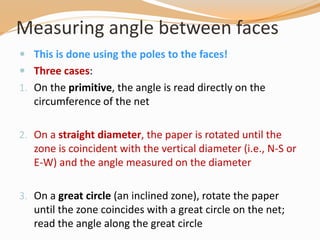
Measuring angle between faces
 This is done using the poles to the faces!
 Three cases:
1. On the primitive, the angle is read directly on the
circumference of the net
2. On a straight diameter, the paper is rotated until the
zone is coincident with the vertical diameter (i.e., N-S or
E-W) and the angle measured on the diameter
3. On a great circle (an inclined zone), rotate the paper
until the zone coincides with a great circle on the net;
read the angle along the great circle
Convention
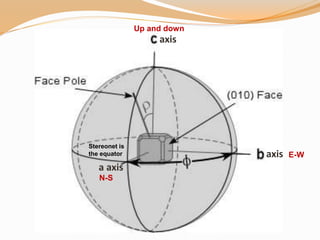
 By convention (Klein and Hurlbut, p.62), we place the
crystal at the center of the sphere such that the:
 c-axis (normal of face 001) is the vertical axis
 b-axis (normal of face 010) is east-west
 a-axis (normal of face 100) is north-south
 See next slide!
axis
axis
a axis
E-W
Up and down
N-S
Stereonet is
the equator
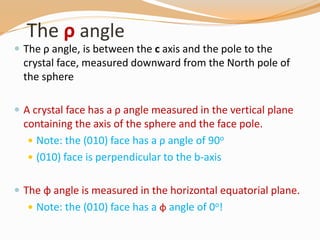
The ρ angle
 The ρ angle, is between the c axis and the pole to the
crystal face, measured downward from the North pole of
the sphere
 A crystal face has a ρ angle measured in the vertical plane
containing the axis of the sphere and the face pole.
 Note: the (010) face has a ρ angle of 90o
 (010) face is perpendicular to the b-axis
 The φ angle is measured in the horizontal equatorial plane.
 Note: the (010) face has a φ angle of 0o!
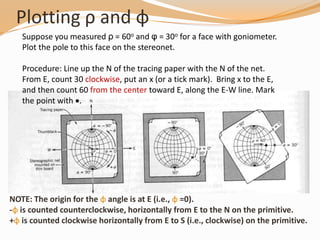
Plotting ρ and φ
Suppose you measured ρ = 60o and φ = 30o for a face with goniometer.
Plot the pole to this face on the stereonet.
Procedure: Line up the N of the tracing paper with the N of the net.
From E, count 30 clockwise, put an x (or a tick mark). Bring x to the E,
and then count 60 from the center toward E, along the E-W line. Mark
the point with .
NOTE: The origin for the φ angle is at E (i.e., φ =0).
-φ is counted counterclockwise, horizontally from E to the N on the primitive.
+φ is counted clockwise horizontally from E to S (i.e., clockwise) on the primitive.
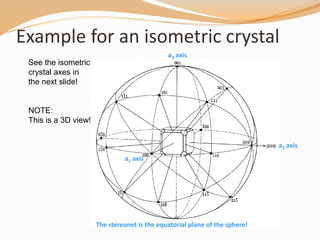
Example for an isometric crystal
See the isometric
crystal axes in
the next slide!
NOTE:
This is a 3D view!
a2 axis
a1 axis
a3 axis
The stereonet is the equatorial plane of the sphere!
a2 axis
a1 axis
(011)
(1-11)
(111)
(001)
(101)
(11-1)
(01-1)
(1-1-1)
(1-01)
(1-10)


 
 


(010)
(1-00)






(11-0)
(1-1-0)
(01-0)
(110)
(100)
a3
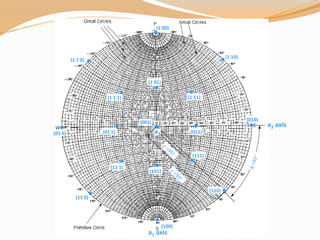
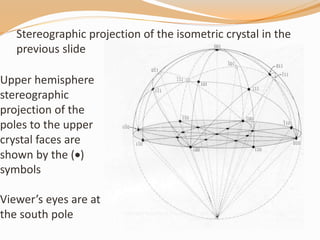
Upper hemisphere
stereographic
projection of the
poles to the upper
crystal faces are
shown by the ()
symbols
Viewer’s eyes are at
the south pole
Stereographic projection of the isometric crystal in the
previous slide
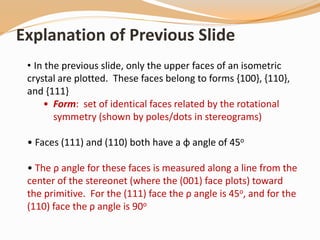
• In the previous slide, only the upper faces of an isometric
crystal are plotted. These faces belong to forms {100}, {110},
and {111}
• Form: set of identical faces related by the rotational
symmetry (shown by poles/dots in stereograms)
• Faces (111) and (110) both have a φ angle of 45o
• The ρ angle for these faces is measured along a line from the
center of the stereonet (where the (001) face plots) toward
the primitive. For the (111) face the ρ angle is 45o, and for the
(110) face the ρ angle is 90o
Explanation of Previous Slide
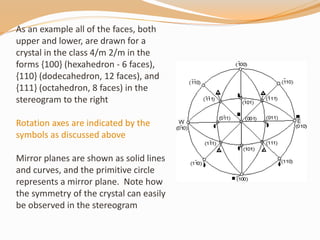
As an example all of the faces, both
upper and lower, are drawn for a
crystal in the class 4/m 2/m in the
forms {100} (hexahedron - 6 faces),
{110} (dodecahedron, 12 faces), and
{111} (octahedron, 8 faces) in the
stereogram to the right
Rotation axes are indicated by the
symbols as discussed above
Mirror planes are shown as solid lines
and curves, and the primitive circle
represents a mirror plane. Note how
the symmetry of the crystal can easily
be observed in the stereogram
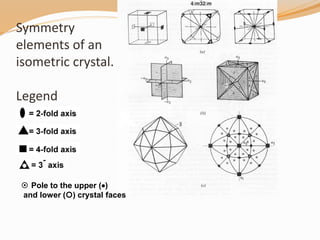
Symmetry
elements of an
isometric crystal.
Legend
 Pole to the upper ()
and lower () crystal faces
The following rules are applied:
 All crystal faces are plotted as poles (lines perpendicular to the
crystal face. Thus, angles between crystal faces are really
angles between poles to crystal faces
 The b crystallographic axis is taken as the starting point. Such
an axis will be perpendicular to the (010) crystal face in any
crystal system. The [010] axis (note the zone symbol) or (010)
crystal face will therefore plot at φ = 0o and ρ = 90o
 Positive φ angles will be measured clockwise on the stereonet,
and negative φ angles will be measured counter-clockwise on
the stereonet
Rules cont’d
 Crystal faces that are on the top of the crystal (ρ < 90o) will be
plotted with the closed circles () symbol, and crystal faces on
the bottom of the crystal (ρ > 90o) will be plotted with the ""
symbol
 Place a sheet of tracing paper on the stereonet and trace the
outermost great circle. Make a reference mark on the right
side of the circle (East)
 To plot a face, first measure the φ angle along the outermost
great circle, and make a mark on your tracing paper. Next
rotate the tracing paper so that the mark lies at the end of the
E-W axis of the stereonet
Stereographic Projection
 References:
 Dexter Perkins, 2002, Mineralogy, 2nd edition.
Prentice Hall, New Jersey, 483 p.
 Bloss, F.D., 1971, Crystallography and Crystal
Chemistry: Holt, Reinhardt, and Winston, New
York, 545 p.
Thank you

Stereographic projection crystallography

  • 1.
    Dr. Harisingh GourVishwavidyalaya, Sagar (A Central university) Presentation On Stereographic projection of crystals Anshul Sahu (M.Tech I year 2018-19) Submitted to Prof. R.K Trivedi
  • 2.
    Content  Introduction  Typesof stereonet  Projection of line  Projection of plane  Mirror and polygon symbol  Convention  Rules  Examples.
  • 3.
    Introduction  Crystals havea set of 3D geometric relationships among their planar and linear features  These include the angle between crystal faces, normal (pole) to these faces, and the line of intersection of these faces  Planar features: crystal faces, mirror planes  Linear features: pole to crystal faces, zone axis, crystal axes
  • 4.
    Stereographic Projection  Projectionof 3D orientation data and symmetry of a crystal into 2D by preserving all the angular relationships  First introduced by F.E Neuman and further developed by W.H Miller  In mineralogy, it involves projection of faces, edges, mirror planes, and rotation axes onto a flat equatorial plane of a sphere, in correct angular relationships
  • 5.
    Two Types ofStereonet  Wulff net (Equal angle)  Used in mineralogy when angles are meant to be preserved.  e.g., for crystallography and core analysis  Projection is done onto both the upper and lower hemispheres  Schmidt net (Equal area)  Used in structural geology for orientation analysis when area is meant to be preserved for statistical analysis  Uses projection onto the lower hemisphere
  • 6.
    Wulff net for Minerals -90 0 +90 -135 +135  
  • 7.
    Wulff Stereonet (equalangle net)  Shows the projection of great circles and small circles  Great circle: Line of intersection of a plane, that passes through the center of the sphere, with the surface of the sphere (like lines of longitude on Earth)  NOTE: Angular relationships between points can only be measured on great circles (not along small circles)!  Small circle: Loci of all positions of a point on the surface of the sphere when rotated about an axis such as the North pole (like lines of latitude on Earth)
  • 8.
    Stereographic projection ofa line • Each line (e.g., rotation axis, pole to a mirror plane) goes through the center of the stereonet . • The line intersects the sphere along the ‘spherical projection of the line’, which is a point • A ray, originating from this point, to the eyes of a viewer located vertically above the center of the net (point O), intersect the ‘primitive’ along one point • The point is the stereographic projection of the line. • A vertical line plots at the center of the net • A horizontal line plots on the primitive
  • 9.
    Special cases oflines  Vertical lines (e.g., rotation axes, edges) plot at the center of the equatorial plane  Horizontal lines plot on the primitive  Inclined lines plot between the primitive and the center
  • 10.
    Projection of PlanarElements  Crystals have faces and mirror planes which are planes, so they intersect the surface of the sphere along lines  These elements can be represented either as:  Planes, which become great circle after projection  Poles (normals) to the planes, which become points after projection
  • 11.
    Stereographic projection ofa plane: • Each plane (e.g., mirror plane) goes through the center of the stereonet (i.e., the thumbtack) • The plane intersects the sphere along the ‘spherical projection of the plane’, which is a series of points • Rays, originating from these points, to the eyes of a viewer located vertically above the center of the net (point O), intersect the ‘primitive’ along a great circle • The great circle is the stereographic projection of the plane. The great circle for a: • vertical plane goes through the center • horizontal plane parallels the primitive
  • 12.
    Special cases ofplanes  Stereographic projection of a horizontal face or mirror plane is along the primitive (perimeter) of the equatorial plane  Stereographic projection of a vertical face or mirror plane is along the straight diameters of the equatorial plane  They pass through the center  They are straight ‘great circles’  Inclined faces and mirror planes plot along curved great circles that do not pass through the center
  • 13.
    12 3 Face 3  poleto the crystal face Face 1: vertical Face 2: inclined Face 3: horizontal
  • 14.
    Preparing to plot Mark N of the net as -90, E as 0, S as =+90 )(for ).  Mount the stereonet on a cardboard. Laminate it. Pass a thumbtack through the center from behind the board  Secure the thumbtack with a masking tape from behind the cardboard  Place a sheet of tracing paper on the stereonet  Put a scotch tape at the center, from both sides of the tracing paper; pierce the paper through the pin  Tracing paper can now rotate around the thumbtack without enlarging the hole (because of scotch tape)
  • 15.
    Symbols used  Forfaces below the equator (when using lower hemisphere), place an open circle symbol () where the ray connecting the spherical projection of the pole to the plane intersects the equatorial plane  This is the stereographic projection of the pole to the face  For faces above the equator (when using the upper hemisphere), place a solid circle symbol ( ) the ray connecting the spherical projection of the pole to the plane intersects the equatorial plane  Use a bull’s-eye symbol () to show a point above the page that coincides with one directly below it (when using both hemispheres)  Reorient the stereogram such that lines of symmetry are north- south or east-west 
  • 16.
    Mirror and PolygonSymbols  To plot symmetry axes on the stereonet, use the following symbol conventions: Mirror plane: ― (solid line great circles) Crystal axes (lines):
  • 18.
    Measuring angle betweenfaces  This is done using the poles to the faces!  Three cases: 1. On the primitive, the angle is read directly on the circumference of the net 2. On a straight diameter, the paper is rotated until the zone is coincident with the vertical diameter (i.e., N-S or E-W) and the angle measured on the diameter 3. On a great circle (an inclined zone), rotate the paper until the zone coincides with a great circle on the net; read the angle along the great circle
  • 19.
    Convention  By convention(Klein and Hurlbut, p.62), we place the crystal at the center of the sphere such that the:  c-axis (normal of face 001) is the vertical axis  b-axis (normal of face 010) is east-west  a-axis (normal of face 100) is north-south  See next slide!
  • 20.
    axis axis a axis E-W Up anddown N-S Stereonet is the equator
  • 21.
    The ρ angle The ρ angle, is between the c axis and the pole to the crystal face, measured downward from the North pole of the sphere  A crystal face has a ρ angle measured in the vertical plane containing the axis of the sphere and the face pole.  Note: the (010) face has a ρ angle of 90o  (010) face is perpendicular to the b-axis  The φ angle is measured in the horizontal equatorial plane.  Note: the (010) face has a φ angle of 0o!
  • 22.
    Plotting ρ andφ Suppose you measured ρ = 60o and φ = 30o for a face with goniometer. Plot the pole to this face on the stereonet. Procedure: Line up the N of the tracing paper with the N of the net. From E, count 30 clockwise, put an x (or a tick mark). Bring x to the E, and then count 60 from the center toward E, along the E-W line. Mark the point with . NOTE: The origin for the φ angle is at E (i.e., φ =0). -φ is counted counterclockwise, horizontally from E to the N on the primitive. +φ is counted clockwise horizontally from E to S (i.e., clockwise) on the primitive.
  • 23.
    Example for anisometric crystal See the isometric crystal axes in the next slide! NOTE: This is a 3D view! a2 axis a1 axis a3 axis The stereonet is the equatorial plane of the sphere!
  • 24.
    a2 axis a1 axis (011) (1-11) (111) (001) (101) (11-1) (01-1) (1-1-1) (1-01) (1-10)        (010) (1-00)       (11-0) (1-1-0) (01-0) (110) (100) a3
  • 25.
    Upper hemisphere stereographic projection ofthe poles to the upper crystal faces are shown by the () symbols Viewer’s eyes are at the south pole Stereographic projection of the isometric crystal in the previous slide
  • 26.
    • In theprevious slide, only the upper faces of an isometric crystal are plotted. These faces belong to forms {100}, {110}, and {111} • Form: set of identical faces related by the rotational symmetry (shown by poles/dots in stereograms) • Faces (111) and (110) both have a φ angle of 45o • The ρ angle for these faces is measured along a line from the center of the stereonet (where the (001) face plots) toward the primitive. For the (111) face the ρ angle is 45o, and for the (110) face the ρ angle is 90o Explanation of Previous Slide
  • 27.
    As an exampleall of the faces, both upper and lower, are drawn for a crystal in the class 4/m 2/m in the forms {100} (hexahedron - 6 faces), {110} (dodecahedron, 12 faces), and {111} (octahedron, 8 faces) in the stereogram to the right Rotation axes are indicated by the symbols as discussed above Mirror planes are shown as solid lines and curves, and the primitive circle represents a mirror plane. Note how the symmetry of the crystal can easily be observed in the stereogram
  • 28.
    Symmetry elements of an isometriccrystal. Legend  Pole to the upper () and lower () crystal faces
  • 29.
    The following rulesare applied:  All crystal faces are plotted as poles (lines perpendicular to the crystal face. Thus, angles between crystal faces are really angles between poles to crystal faces  The b crystallographic axis is taken as the starting point. Such an axis will be perpendicular to the (010) crystal face in any crystal system. The [010] axis (note the zone symbol) or (010) crystal face will therefore plot at φ = 0o and ρ = 90o  Positive φ angles will be measured clockwise on the stereonet, and negative φ angles will be measured counter-clockwise on the stereonet
  • 30.
    Rules cont’d  Crystalfaces that are on the top of the crystal (ρ < 90o) will be plotted with the closed circles () symbol, and crystal faces on the bottom of the crystal (ρ > 90o) will be plotted with the "" symbol  Place a sheet of tracing paper on the stereonet and trace the outermost great circle. Make a reference mark on the right side of the circle (East)  To plot a face, first measure the φ angle along the outermost great circle, and make a mark on your tracing paper. Next rotate the tracing paper so that the mark lies at the end of the E-W axis of the stereonet
  • 31.
    Stereographic Projection  References: Dexter Perkins, 2002, Mineralogy, 2nd edition. Prentice Hall, New Jersey, 483 p.  Bloss, F.D., 1971, Crystallography and Crystal Chemistry: Holt, Reinhardt, and Winston, New York, 545 p.
  • 32.