Crystallography and Mineral Optics (Geol 2031)
Aspiron Hangibayna (PhD candidate)
Arba Minch University
Collage of Natural & Computational Sciences
Department of Geology
Chapter – Six
Oct, 2023 1
6| Optical Mineralogy
Topic Outlines
• Light and its Properties
• Examination of crystals in plane-polarized light
• Opacity, color, refractive index and pleochroism
• Examination of crystals under crossed polars
• Isotropic and anisotropic crystals: uniaxial and biaxial minerals
• Examination of crystals in convergent light
2
3
6| Optical Mineralogy
Chapter Objectives
Having completed this chapter, you should be able to:
 understand light and its properties
Examination of minerals:
Under plane polarized light
Under crossed polarized light
 under converged light
Light and its properties
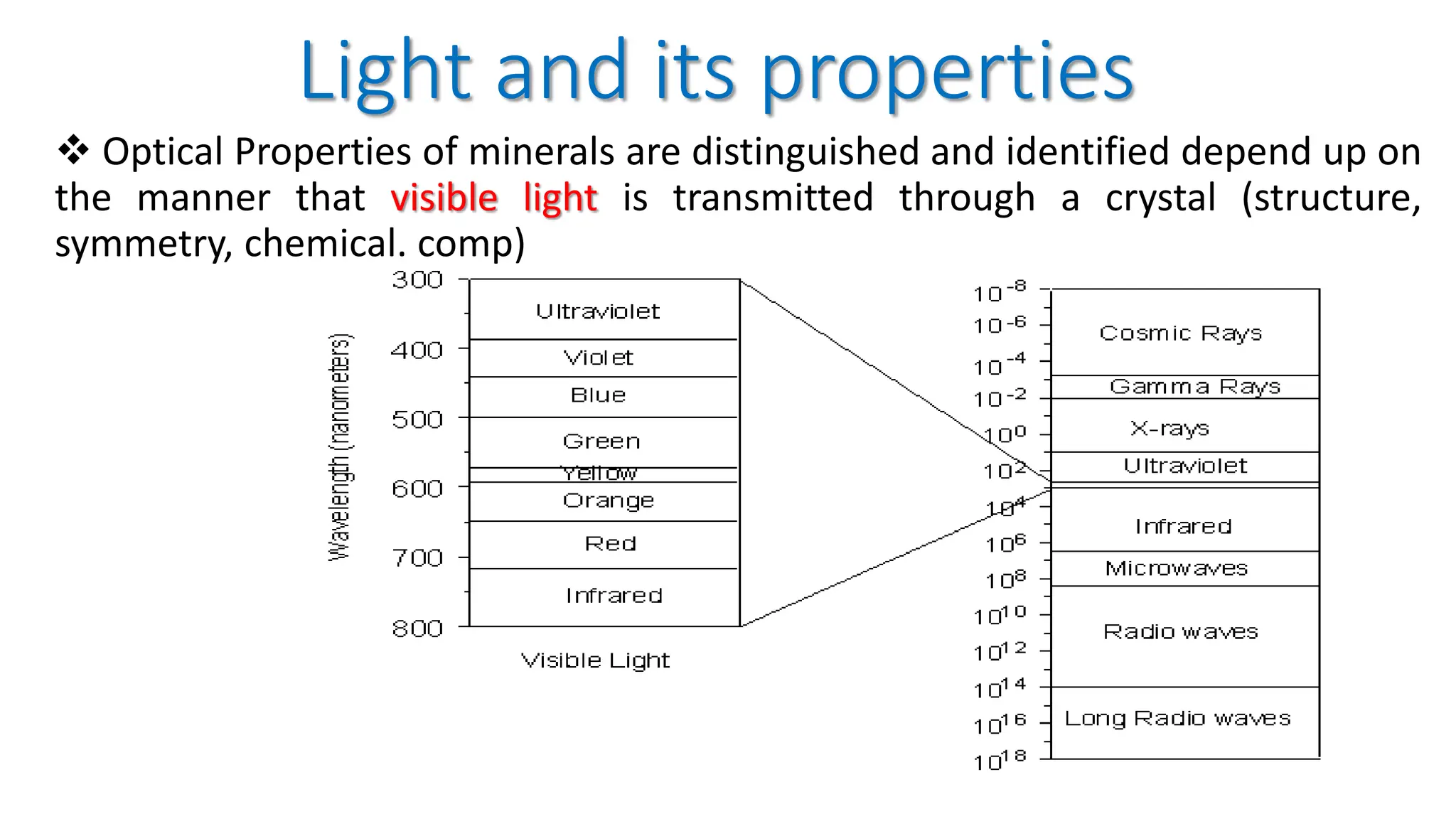
 Optical Properties of minerals are distinguished and identified depend up on
the manner that visible light is transmitted through a crystal (structure,
symmetry, chemical. comp)
Our eyes and light
How our eyes interpret these wavelengths?
monochromatic light: single wavelength is present in the visible spectrum
white light: all wavelengths of visible light are present in the spectrum
dark: no wavelength is present in the visible range
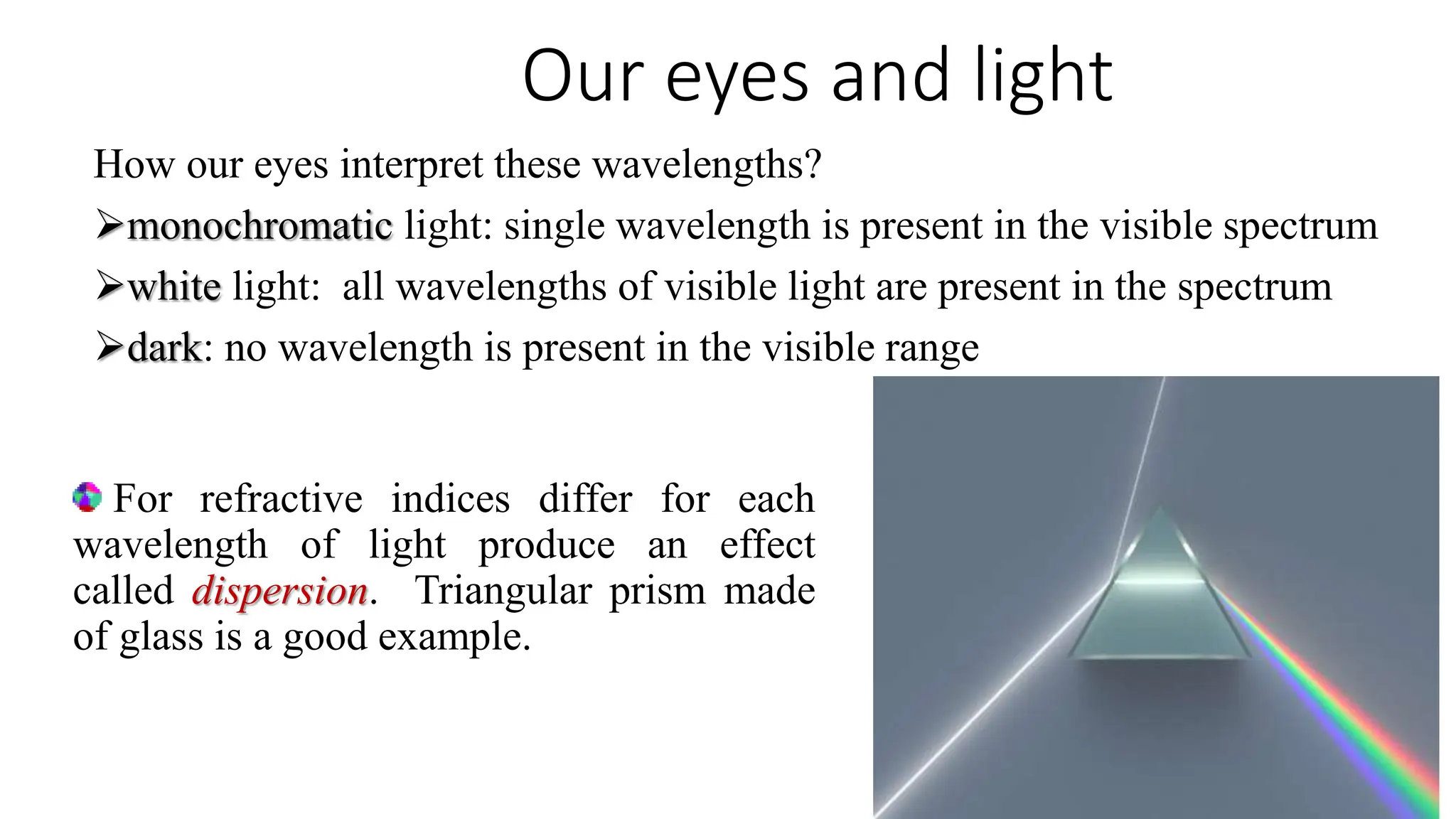
For refractive indices differ for each
wavelength of light produce an effect
called dispersion. Triangular prism made
of glass is a good example.
Velocity of light and refractive index
Light is an electromagnetic wave that passes through various materials with
different speeds.
Refractive index, n, of a material or substance as the ratio of the speed of light
in a vacuum, C(~3x10⁸m/s), to the speed of light in a material through which
it passes, Cm.
n=C/Cm
Refractive indices, in general depend on density of a material. Therefore,
higher density materials will have higher refractive indices.
The refractive index of any material depends on the wavelength of light, i.e.
n~ .
Based on how the velocity of light of a particular wavelength varies in the
material it can be:-
 Isotropic materials- v of light does not depend on its direction.
Anisotropic materials- v depends on the direction light
A. Uniaxial- has two extreme refractive indices
B. Biaxial- has three extreme refractive indices
Reflection and Refraction of Light
When light strikes an interface between two substances with different
refractive indices it:-
 reflected off at the same angle with incident ray
 Refracted/bent- in transparent material, the light will enter the substance with
different refractive index, and will be refracted at an angle.
Snell’s Law:-
ni sin(i) = nr sin(r)
sin(ic) = nr/ni - for critical angle when total internal reflection takes place
where angle r = 90o
Absorption of Light and Pleochroism
What happen to light when it enters into transparent material?
• some of it preferentially absorbed
• some of it transmitted through–results absorption color
•Some crystals of substances exhibit more than one absorption color said to
have pleochroism
Polarization of Light
 normal light vibrates in all drxs
 if it forced to vibrate in one plane- known as
PPL
 two common ways to polarize light are:-
• reflection off it from a non-metallic surface
• passing the light through a substance that
absorbs light
•Polarizer device is used- Polaroid plastic film
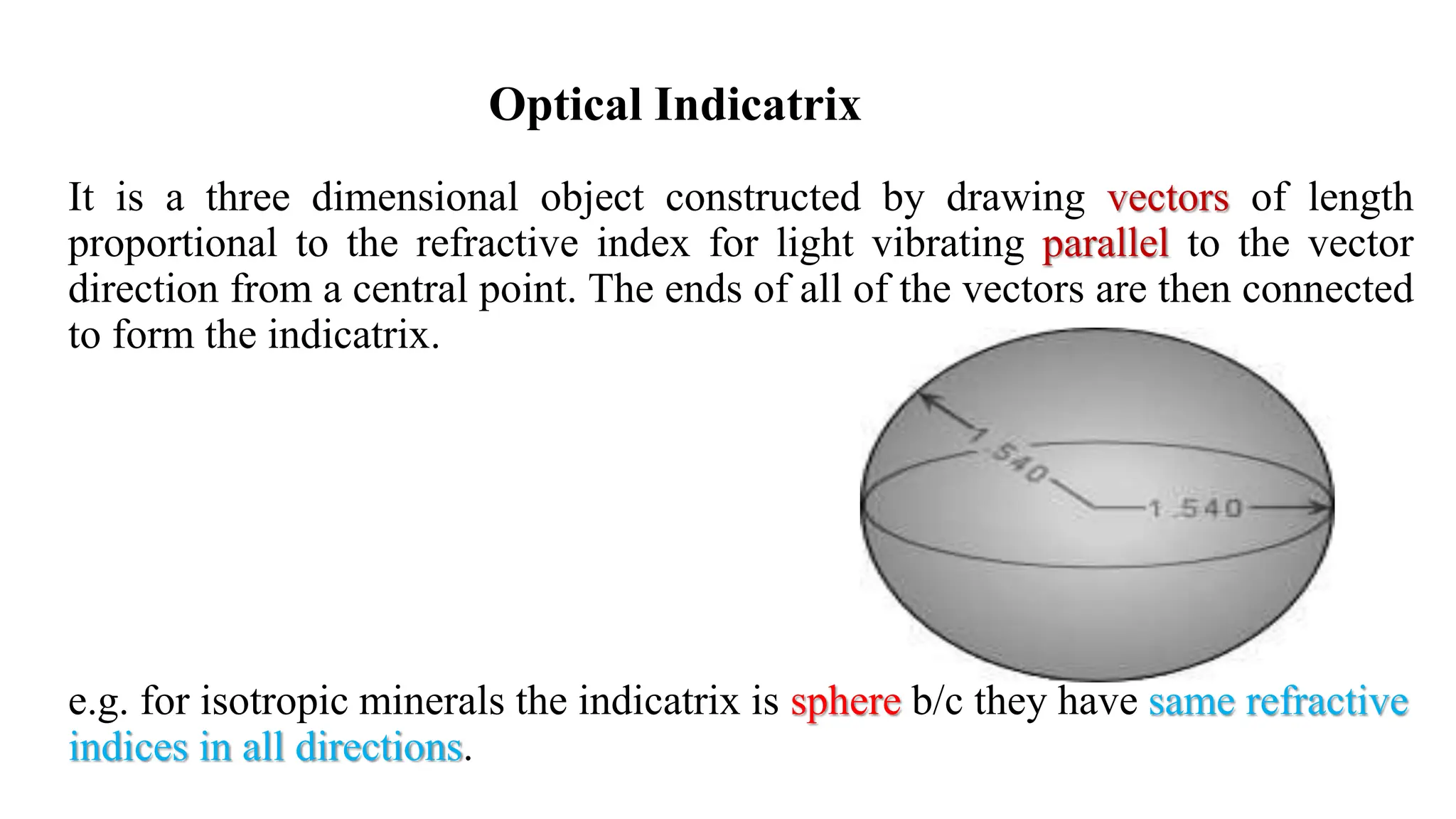
Optical Indicatrix
It is a three dimensional object constructed by drawing vectors of length
proportional to the refractive index for light vibrating parallel to the vector
direction from a central point. The ends of all of the vectors are then connected
to form the indicatrix.
e.g. for isotropic minerals the indicatrix is sphere b/c they have same refractive
indices in all directions.
Isotropic Substances & Polarized Light-isometric
For polarizing microscope:
• Polarizer- produces E-W vibrating light
•Analyzer- produces N-S vibrating light
• Since, Isotropic substances do not
change the vibration direction of light as
the light passes through the
substance=extinct when analyzer is in
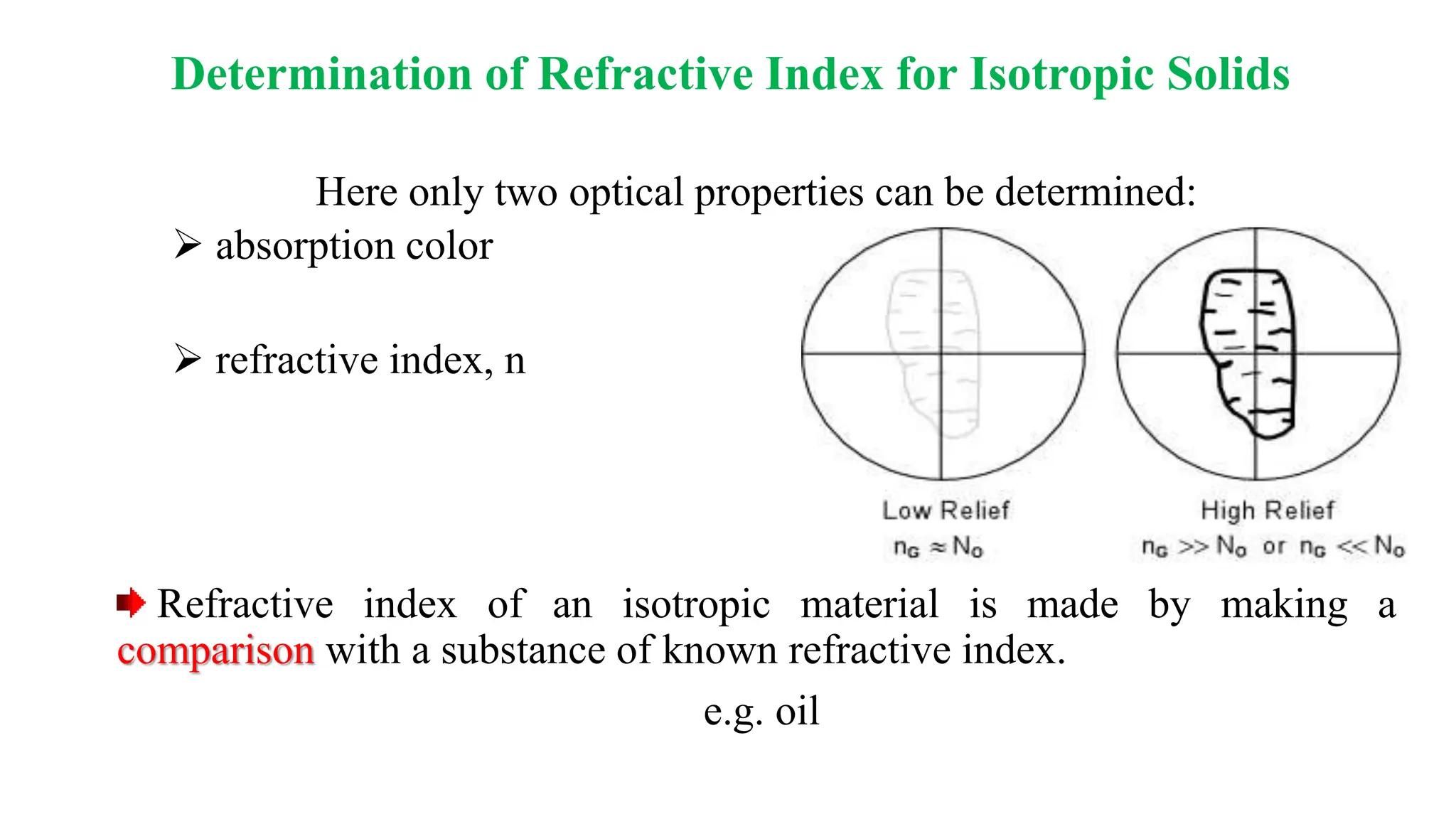
Determination of Refractive Index for Isotropic Solids
Here only two optical properties can be determined:
 absorption color
 refractive index, n
Refractive index of an isotropic material is made by making a
comparison with a substance of known refractive index.
e.g. oil
The Becke Line Method
If a grain surrounded by oil is viewed via
microscope, we see:
• dark line
• bright line- The Becke line
 The Becke line always occur closest to the
substance with a higher refractive index.
 the grain is positioned above the sharpest focus
Iris diaphragm is used to cut down the incoming
light
 during changing focal distance, the Becke line
moves inward or outward depending n.
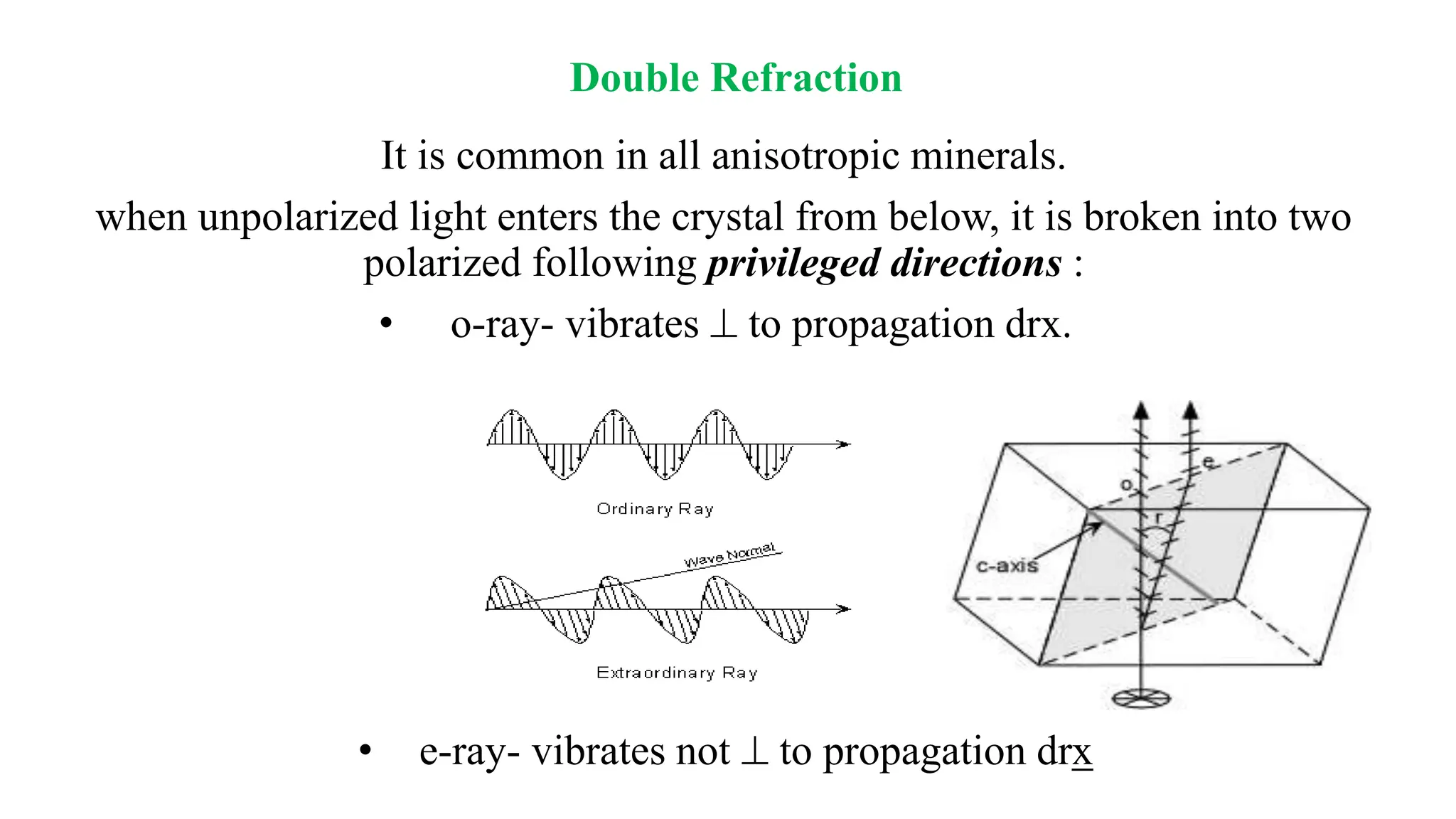
Double Refraction
It is common in all anisotropic minerals.
when unpolarized light enters the crystal from below, it is broken into two
polarized following privileged directions :
• o-ray- vibrates  to propagation drx.
• e-ray- vibrates not  to propagation drx
Uniaxial Indicatrix (tetragonal & hexagonal)
• 1st mineral is orienting with its optic-axis vertical, so the light vibrates  to
this axis and  to n drx.
• 2nd light breaks in to two, one (e-ray) vibrating  to c-axis or .
Circular section-a circle with radius 
Principal section-  direction &  axis
Random section- ' direction &  axis
• 3rd light breaks in to two, one vibrates parallel to ‘ & other  direction.
Optic Sign
Uniaxial minerals can be divided into 2 classes:
1. If ’ is greater than  the optic sign is negative and the uniaxial indicatrix
would take the form of an oblate spheroid
2. If ’ is less than  the optic sign is positive and the uniaxial indicatrix
would take the form of a prolate spheroid.
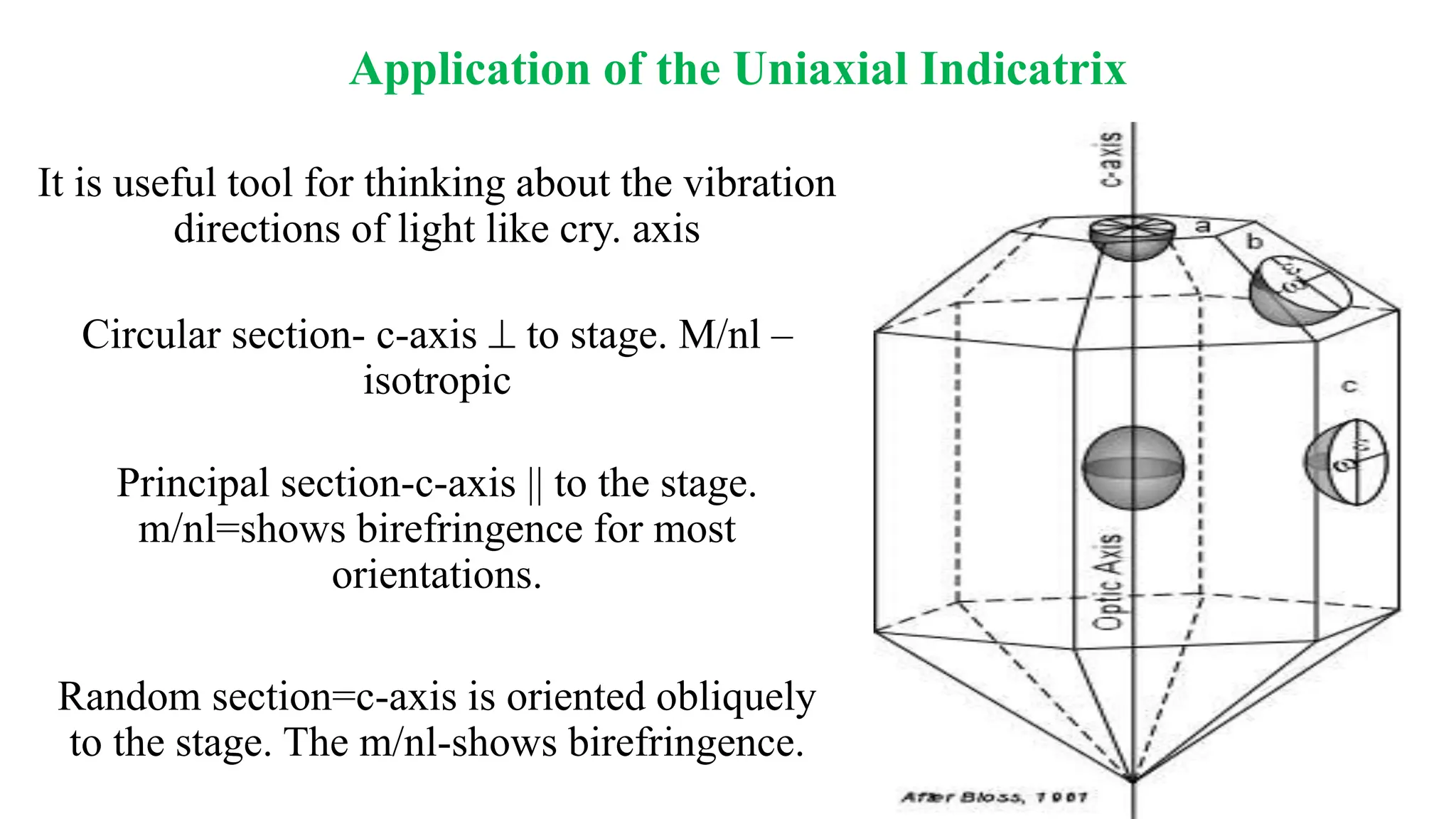
Application of the Uniaxial Indicatrix
It is useful tool for thinking about the vibration
directions of light like cry. axis
Circular section- c-axis  to stage. M/nl –
isotropic
Principal section-c-axis  to the stage.
m/nl=shows birefringence for most
orientations.
Random section=c-axis is oriented obliquely
to the stage. The m/nl-shows birefringence.
Conoscopic Examination of Uniaxial Minerals
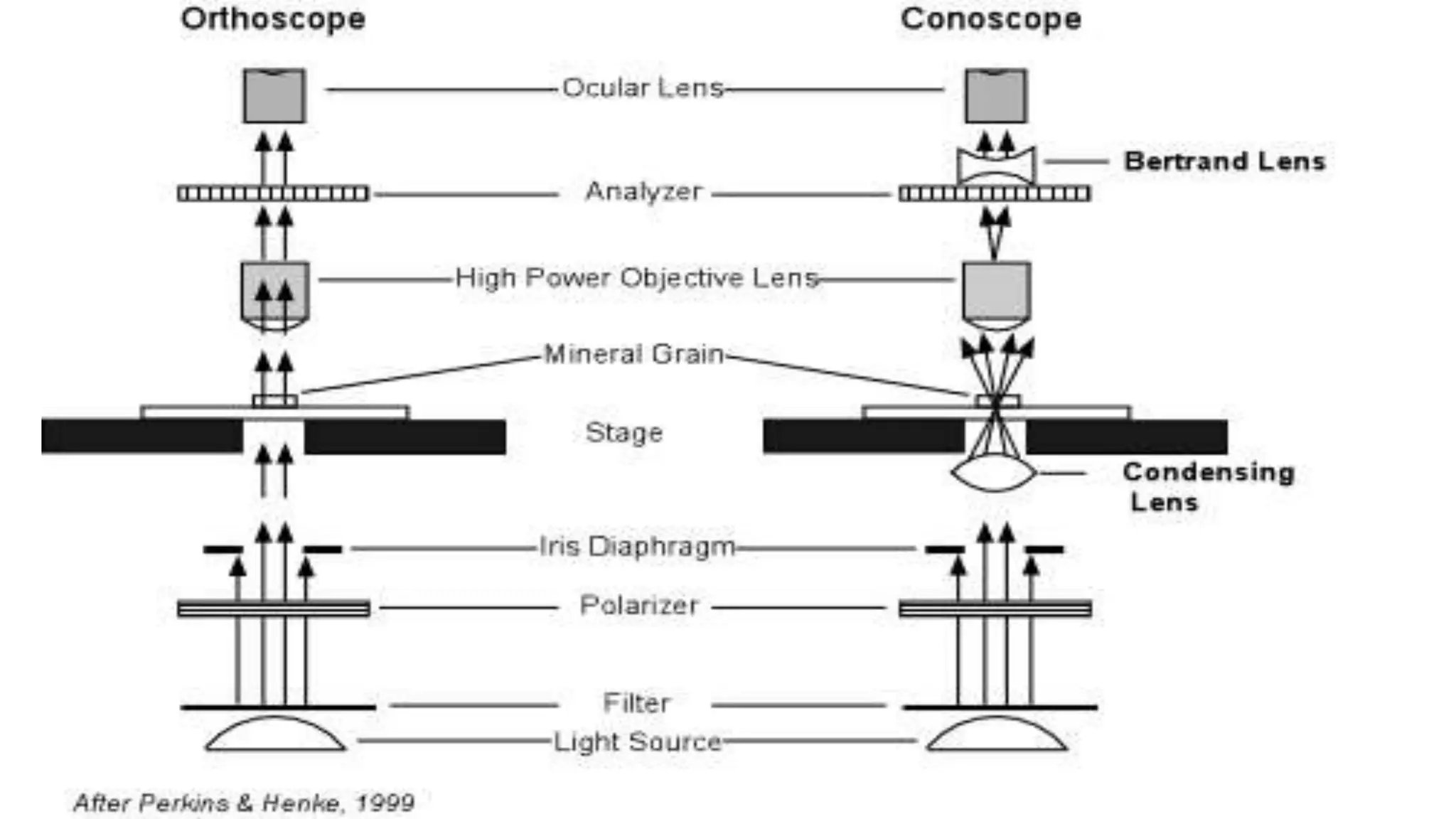
In orthoscope mode, light incident on & passing through crystals on the stage
is perpendicular to the lower and upper surfaces of a crystal.
In conoscope mode, a lens, called a condensing lens is inserted between the
light source and the crystals.
It is focused such the incident light is no longer perpendicular to the top and
bottom of the crystal, but crosses within the crystal.
In addition, another lens, called the Bertrand Lens is inserted between the
objective and ocular lenses.
Centered uniaxial mineral figure consists
Isogyres- dark bands that cross field of view
Isochromes- concentric color bands that circle the center.
Melatops- the intersection of the bars
Off-center optic axis
 if grain is off-centered it shows the ff properties:
• It is a grain that shows ω refractive index and an έ refractive index that is
close the ω refractive index,
• Thus, it will show only a small change in relief change upon rotation.
• It would also show very low order (1o gray interference colors between
extinction positions if the analyzer is inserted in orthoscope mode.
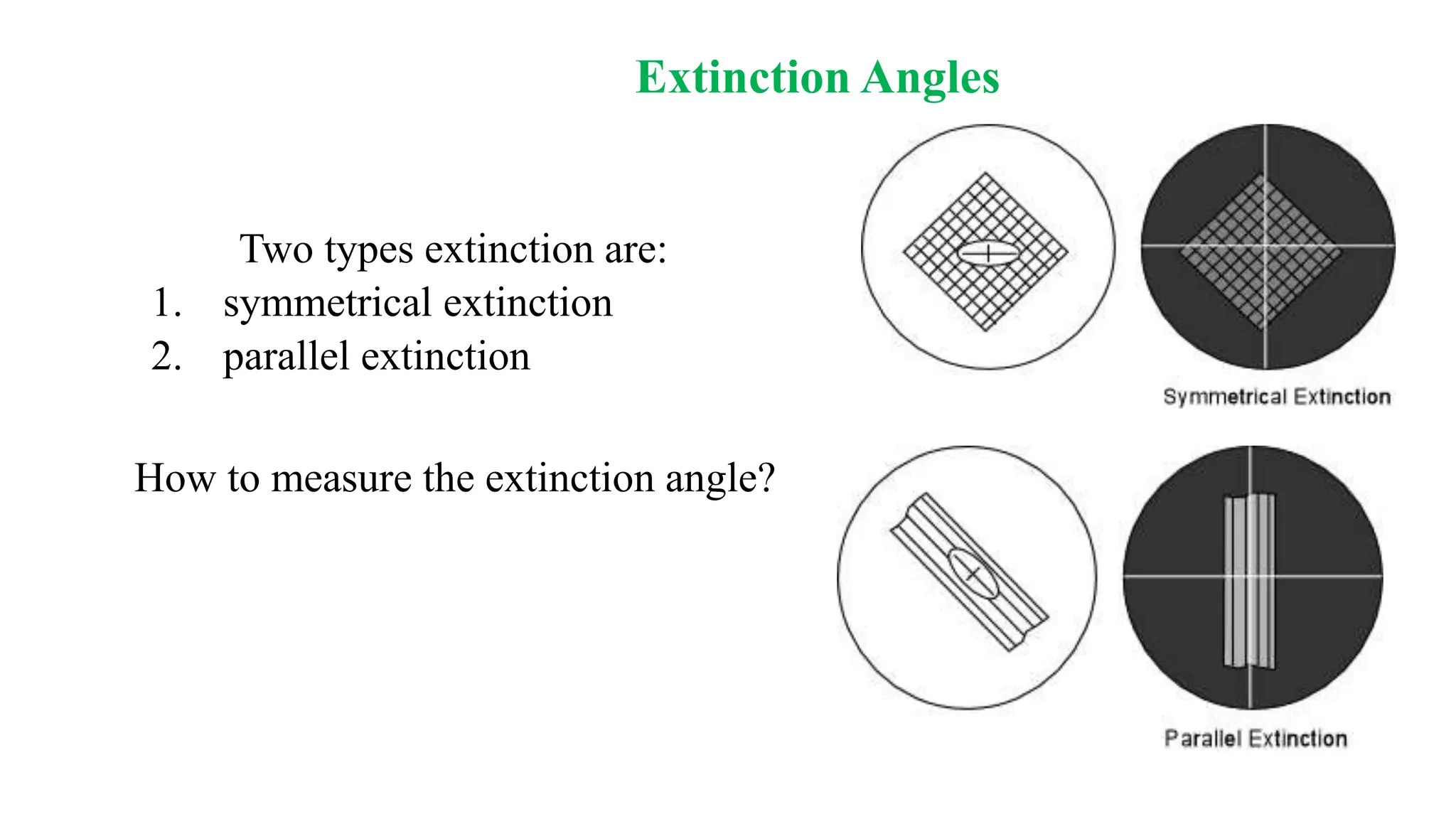
Extinction Angles
Two types extinction are:
1. symmetrical extinction
2. parallel extinction
How to measure the extinction angle?
Biaxial Minerals
(orthorhombic, monoclinic, & triclinic crystal systems)
They have two optical axes
 And three refractive indices:
The smallest refractive index is given the symbol  (X).
The intermediate refractive index is given the symbol  (Y).
The largest refractive index is given the symbol  (Z).
• In orthorhombic crystals the optical directions correspond to the crystallographic axes, i.e.
the X direction and its corresponding refractive index,  can be either the a, b, or c
crystallographic axes, the Y direction and  can be parallel to either a, b, or c, and the Z
direction or , can be parallel to either a, b, or c.
• In monoclinic crystals, one of the X (a), Y (b), or Z (g) drxs or indices is parallel to the b
crystallographic axis, others not.
• In triclinic crystals none of the optical directions or indices coincides with crystallographic
directions. But in rare case one of them coincide with one of the two.
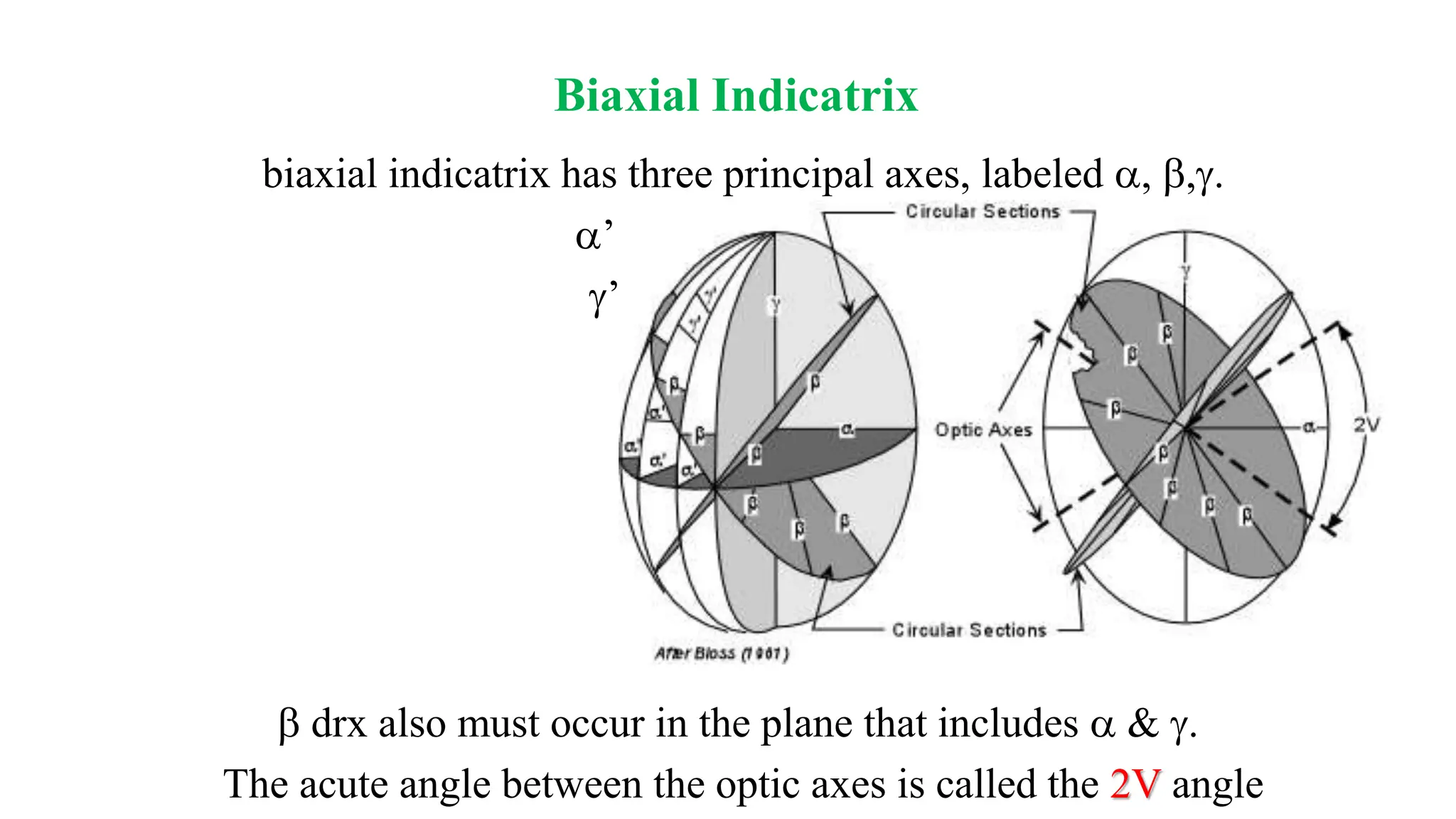
Biaxial Indicatrix
biaxial indicatrix has three principal axes, labeled , ,.
’ drx= b/n  and 
’ drx= b/n  and 
 drx also must occur in the plane that includes  & .
The acute angle between the optic axes is called the 2V angle
26

Chapter-6 Geol 2031 Optical Mineralogy.pptx

  • 1.
    Crystallography and MineralOptics (Geol 2031) Aspiron Hangibayna (PhD candidate) Arba Minch University Collage of Natural & Computational Sciences Department of Geology Chapter – Six Oct, 2023 1
  • 2.
    6| Optical Mineralogy TopicOutlines • Light and its Properties • Examination of crystals in plane-polarized light • Opacity, color, refractive index and pleochroism • Examination of crystals under crossed polars • Isotropic and anisotropic crystals: uniaxial and biaxial minerals • Examination of crystals in convergent light 2
  • 3.
    3 6| Optical Mineralogy ChapterObjectives Having completed this chapter, you should be able to:  understand light and its properties Examination of minerals: Under plane polarized light Under crossed polarized light  under converged light
  • 4.
    Light and itsproperties  Optical Properties of minerals are distinguished and identified depend up on the manner that visible light is transmitted through a crystal (structure, symmetry, chemical. comp)
  • 5.
    Our eyes andlight How our eyes interpret these wavelengths? monochromatic light: single wavelength is present in the visible spectrum white light: all wavelengths of visible light are present in the spectrum dark: no wavelength is present in the visible range For refractive indices differ for each wavelength of light produce an effect called dispersion. Triangular prism made of glass is a good example.
  • 6.
    Velocity of lightand refractive index Light is an electromagnetic wave that passes through various materials with different speeds. Refractive index, n, of a material or substance as the ratio of the speed of light in a vacuum, C(~3x10⁸m/s), to the speed of light in a material through which it passes, Cm. n=C/Cm Refractive indices, in general depend on density of a material. Therefore, higher density materials will have higher refractive indices. The refractive index of any material depends on the wavelength of light, i.e. n~ .
  • 7.
    Based on howthe velocity of light of a particular wavelength varies in the material it can be:-  Isotropic materials- v of light does not depend on its direction. Anisotropic materials- v depends on the direction light A. Uniaxial- has two extreme refractive indices B. Biaxial- has three extreme refractive indices Reflection and Refraction of Light When light strikes an interface between two substances with different refractive indices it:-  reflected off at the same angle with incident ray  Refracted/bent- in transparent material, the light will enter the substance with different refractive index, and will be refracted at an angle.
  • 8.
    Snell’s Law:- ni sin(i)= nr sin(r) sin(ic) = nr/ni - for critical angle when total internal reflection takes place where angle r = 90o
  • 9.
    Absorption of Lightand Pleochroism What happen to light when it enters into transparent material? • some of it preferentially absorbed • some of it transmitted through–results absorption color •Some crystals of substances exhibit more than one absorption color said to have pleochroism
  • 10.
    Polarization of Light normal light vibrates in all drxs  if it forced to vibrate in one plane- known as PPL  two common ways to polarize light are:- • reflection off it from a non-metallic surface • passing the light through a substance that absorbs light •Polarizer device is used- Polaroid plastic film
  • 11.
    Optical Indicatrix It isa three dimensional object constructed by drawing vectors of length proportional to the refractive index for light vibrating parallel to the vector direction from a central point. The ends of all of the vectors are then connected to form the indicatrix. e.g. for isotropic minerals the indicatrix is sphere b/c they have same refractive indices in all directions.
  • 12.
    Isotropic Substances &Polarized Light-isometric For polarizing microscope: • Polarizer- produces E-W vibrating light •Analyzer- produces N-S vibrating light • Since, Isotropic substances do not change the vibration direction of light as the light passes through the substance=extinct when analyzer is in
  • 13.
    Determination of RefractiveIndex for Isotropic Solids Here only two optical properties can be determined:  absorption color  refractive index, n Refractive index of an isotropic material is made by making a comparison with a substance of known refractive index. e.g. oil
  • 14.
    The Becke LineMethod If a grain surrounded by oil is viewed via microscope, we see: • dark line • bright line- The Becke line  The Becke line always occur closest to the substance with a higher refractive index.  the grain is positioned above the sharpest focus Iris diaphragm is used to cut down the incoming light  during changing focal distance, the Becke line moves inward or outward depending n.
  • 15.
    Double Refraction It iscommon in all anisotropic minerals. when unpolarized light enters the crystal from below, it is broken into two polarized following privileged directions : • o-ray- vibrates  to propagation drx. • e-ray- vibrates not  to propagation drx
  • 16.
    Uniaxial Indicatrix (tetragonal& hexagonal) • 1st mineral is orienting with its optic-axis vertical, so the light vibrates  to this axis and  to n drx. • 2nd light breaks in to two, one (e-ray) vibrating  to c-axis or . Circular section-a circle with radius  Principal section-  direction &  axis Random section- ' direction &  axis • 3rd light breaks in to two, one vibrates parallel to ‘ & other  direction.
  • 17.
    Optic Sign Uniaxial mineralscan be divided into 2 classes: 1. If ’ is greater than  the optic sign is negative and the uniaxial indicatrix would take the form of an oblate spheroid 2. If ’ is less than  the optic sign is positive and the uniaxial indicatrix would take the form of a prolate spheroid.
  • 18.
    Application of theUniaxial Indicatrix It is useful tool for thinking about the vibration directions of light like cry. axis Circular section- c-axis  to stage. M/nl – isotropic Principal section-c-axis  to the stage. m/nl=shows birefringence for most orientations. Random section=c-axis is oriented obliquely to the stage. The m/nl-shows birefringence.
  • 19.
    Conoscopic Examination ofUniaxial Minerals In orthoscope mode, light incident on & passing through crystals on the stage is perpendicular to the lower and upper surfaces of a crystal. In conoscope mode, a lens, called a condensing lens is inserted between the light source and the crystals. It is focused such the incident light is no longer perpendicular to the top and bottom of the crystal, but crosses within the crystal. In addition, another lens, called the Bertrand Lens is inserted between the objective and ocular lenses.
  • 21.
    Centered uniaxial mineralfigure consists Isogyres- dark bands that cross field of view Isochromes- concentric color bands that circle the center. Melatops- the intersection of the bars Off-center optic axis  if grain is off-centered it shows the ff properties: • It is a grain that shows ω refractive index and an έ refractive index that is close the ω refractive index, • Thus, it will show only a small change in relief change upon rotation. • It would also show very low order (1o gray interference colors between extinction positions if the analyzer is inserted in orthoscope mode.
  • 23.
    Extinction Angles Two typesextinction are: 1. symmetrical extinction 2. parallel extinction How to measure the extinction angle?
  • 24.
    Biaxial Minerals (orthorhombic, monoclinic,& triclinic crystal systems) They have two optical axes  And three refractive indices: The smallest refractive index is given the symbol  (X). The intermediate refractive index is given the symbol  (Y). The largest refractive index is given the symbol  (Z). • In orthorhombic crystals the optical directions correspond to the crystallographic axes, i.e. the X direction and its corresponding refractive index,  can be either the a, b, or c crystallographic axes, the Y direction and  can be parallel to either a, b, or c, and the Z direction or , can be parallel to either a, b, or c. • In monoclinic crystals, one of the X (a), Y (b), or Z (g) drxs or indices is parallel to the b crystallographic axis, others not. • In triclinic crystals none of the optical directions or indices coincides with crystallographic directions. But in rare case one of them coincide with one of the two.
  • 25.
    Biaxial Indicatrix biaxial indicatrixhas three principal axes, labeled , ,. ’ drx= b/n  and  ’ drx= b/n  and   drx also must occur in the plane that includes  & . The acute angle between the optic axes is called the 2V angle
  • 26.