COMPRESSED GAS CYLINDERS
AND PRESSURE GAUGE
Dr.R.Selvakumar.M.D.D.A.DNB
Professor of Anaesthesiology
K.A.P.Viswanatham Govt Medical College,
Trichirapalli
Tamilnadu - India
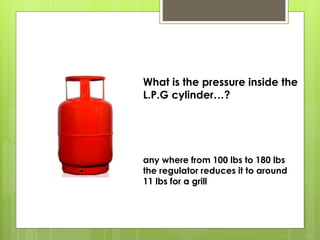
What is the pressure inside the
L.P.G cylinder…?
any where from 100 lbs to 180 lbs
the regulator reduces it to around
11 lbs for a grill
CYLINDERS:
• COMPRESSED GAS CONTAINERS
• SHOULD WITHSTAND THE PRESSURE
OF THE COMPRESSED GAS
• SHOULD WITHSTAND THE ADVERSE
TRANSPORT CONDITIONS
• SHOULD NOT CHEMICALLY REACT
WITH THE GASES
• MALLEABLE
• LIGHT WEIGHT
MATERIAL USED FOR THE CONSTRUCTION OF CYLINDERS
 LOW CARBON STEEL
 HIGH CARBON STEEL
 MANGANESE STEEL -1946
 MOLYBDENUM STEEL
 CHROME MOLYBDENUM STEEL
 ALUMINIUM
 COMPOSITE (Aluminium wrapped in carbon fibre)
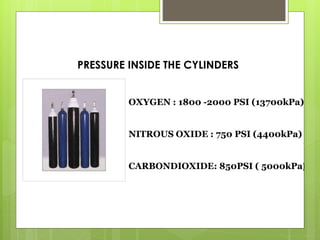
PRESSURE INSIDE THE CYLINDERS
OXYGEN : 1800 -2000 PSI (13700kPa)
NITROUS OXIDE : 750 PSI (4400kPa)
CARBONDIOXIDE: 850PSI ( 5000kPa)
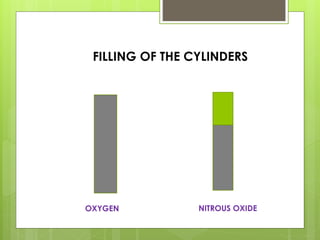
FILLING OF THE CYLINDERS
OXYGEN NITROUS OXIDE
++
+
+
+
+
+
+
+
+
+
+
+
+
+
+
+
+
+
+
+
+
+
+
+
+
+
+
+
+
++
+
+
+
+
+
+
+
+
+
+
+
+
+
+
+
+
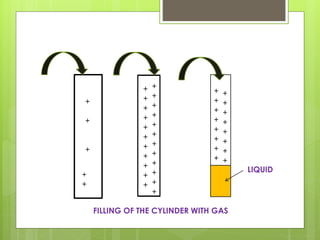
FILLING OF THE CYLINDER WITH GAS
LIQUID
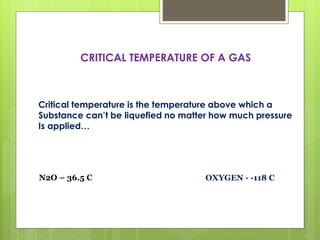
CRITICAL TEMPERATURE OF A GAS
Critical temperature is the temperature above which a
Substance can’t be liquefied no matter how much pressure
Is applied…
N2O – 36.5 C OXYGEN - -118 C
SOME DEFINITIONS…
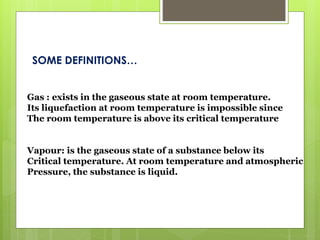
Gas : exists in the gaseous state at room temperature.
Its liquefaction at room temperature is impossible since
The room temperature is above its critical temperature
Vapour: is the gaseous state of a substance below its
Critical temperature. At room temperature and atmospheric
Pressure, the substance is liquid.
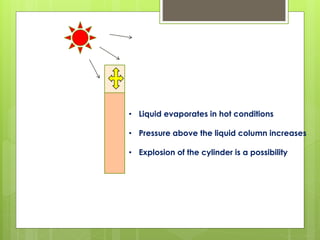
• Liquid evaporates in hot conditions
• Pressure above the liquid column increases
• Explosion of the cylinder is a possibility
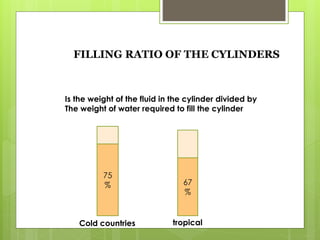
FILLING RATIO OF THE CYLINDERS
Is the weight of the fluid in the cylinder divided by
The weight of water required to fill the cylinder
67
%
75
%
Cold countries tropical
FILLING OF CYLINDERS
SERVICE PRESSURE : Maximum pressure up to which the
Cylinder can be filled at 70 F
Testing Pressure : 1.66 times the working pressure
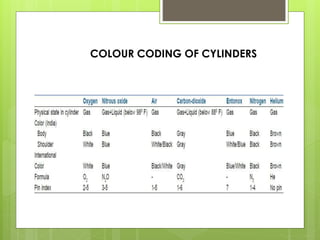
COLOUR CODING OF CYLINDERS
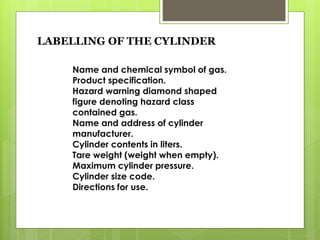
LABELLING OF THE CYLINDER
Name and chemical symbol of gas.
Product specification.
Hazard warning diamond shaped
figure denoting hazard class
contained gas.
Name and address of cylinder
manufacturer.
Cylinder contents in liters.
Tare weight (weight when empty).
Maximum cylinder pressure.
Cylinder size code.
Directions for use.
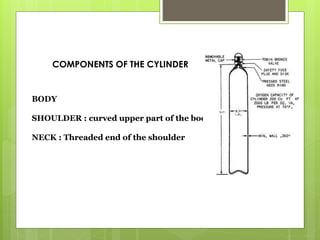
COMPONENTS OF THE CYLINDER
BODY
SHOULDER : curved upper part of the body
NECK : Threaded end of the shoulder
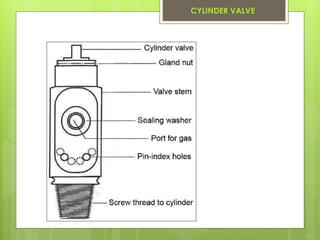
CYLINDER VALVE
Pressure relief device is fitted on
cylinders with the aim to vent the
cylinder contents to atmosphere if the
pressure in the cylinder increases to a
dangerous level as a result of high
temperature or overfilling.
They are of three types: Burst disk,
fusible plug, and combination of two.
Burst disk is most commonly used. It is
a small metal gasket which bursts at a
pre-determined pressure.
SAFETY DEVICE IN THE CYLINDER VALVE
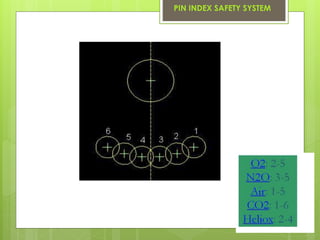
PIN INDEX SYSTEM
unique configuration of holes and
pins which match precisely to
eliminate connection of the wrong
cylinder to equipment, thus
prevents delivery of wrong gas to
patients
PIN INDEX SAFETY SYSTEM
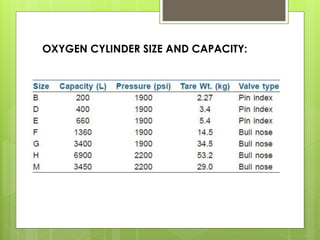
OXYGEN CYLINDER SIZE AND CAPACITY:
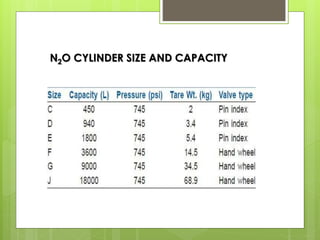
N2O CYLINDER SIZE AND CAPACITY
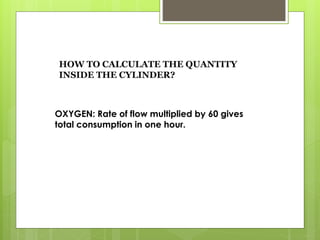
HOW TO CALCULATE THE QUANTITY
INSIDE THE CYLINDER?
OXYGEN: Rate of flow multiplied by 60 gives
total consumption in one hour.
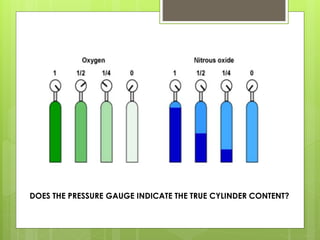
DOES THE PRESSURE GAUGE INDICATE THE TRUE CYLINDER CONTENT?
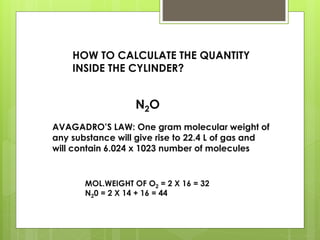
HOW TO CALCULATE THE QUANTITY
INSIDE THE CYLINDER?
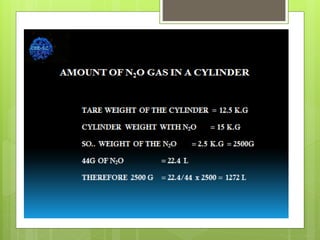
N2O
AVAGADRO’S LAW: One gram molecular weight of
any substance will give rise to 22.4 L of gas and
will contain 6.024 x 10²³ number of molecules
MOL.WEIGHT OF O2 = 2 X 16 = 32
N20 = 2 X 14 + 16 = 44
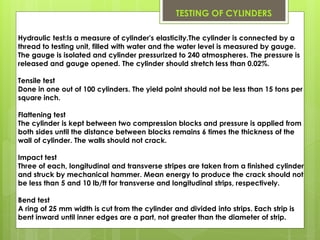
Hydraulic test:Is a measure of cylinder's elasticity.The cylinder is connected by a
thread to testing unit, filled with water and the water level is measured by gauge.
The gauge is isolated and cylinder pressurized to 240 atmospheres. The pressure is
released and gauge opened. The cylinder should stretch less than 0.02%.
Tensile test
Done in one out of 100 cylinders. The yield point should not be less than 15 tons per
square inch.
Flattening test
The cylinder is kept between two compression blocks and pressure is applied from
both sides until the distance between blocks remains 6 times the thickness of the
wall of cylinder. The walls should not crack.
Impact test
Three of each, longitudinal and transverse stripes are taken from a finished cylinder
and struck by mechanical hammer. Mean energy to produce the crack should not
be less than 5 and 10 lb/ft for transverse and longitudinal strips, respectively.
Bend test
A ring of 25 mm width is cut from the cylinder and divided into strips. Each strip is
bent inward until inner edges are a part, not greater than the diameter of strip.
TESTING OF CYLINDERS
The storage area should be cool, dry, ventilated, clean area
constructed of fire resistant material[16]
Have good access for deliveries and a reasonable level floor surface
Should have segregation of “Full” and “Empty cylinders”
Cylinders with an oldest fill date should be used first
Cylinders should not be stored in direct sunlight[10]
Easily visible sign such as no smoking, no open flames or sparks, no
oil or grease etc., should be displayed
Cylinders should not be exposed to dampness, corrosive chemicals,
fumes as they may damage cylinders and/or cause valve protection
caps stick
The temperature should not go below 10°C where Entonox cylinders
are stored
Cylinders should always be kept in place with chain or any other
restraining device
The suitable trolley/cart should be used to transport and support the
cylinders.
STORAGE OF CYLINDERS
Handling and installation
Before using, the contents of the cylinder must be identified by reading the label[7] and
also seeing the color of the cylinder
Full cylinders are fitted with tamper evident seal, usually a shrink wrapped around the
valve, should be removed immediately before use[2]
Before connecting to yoke, the cylinder valve be cracked (i.e., Opened only slightly) to
blow away any dust or flammable silting on the valve.
The person opening the cylinder should be positioned so that the valve outlet and/or the
face of pressure gauge points away from self, patient and machine
Care should be taken to see that sealing washer (Bodok Seal) is present on the yoke
and is in good condition to prevent leakage.[6,7] More than one washer should never
be used as it can default PISS
The valve should be opened slowly to release the pressure gradually. Sudden opening
can produce a shock wave in the pressure gauge and regulator and can damage
parts. Also, if gas passes quickly in the space between the valve and yoke or regulator,
it can generate a large amount of heat. As there is almost no time to dissipate, this
constitutes an adiabatic process[1] (no heat is lost or gained from surrounding). The heat
generated can ignite grease or any dust particle present, causing flash fire or explosion
The cylinders should never stand upright without support
Handling should only be by trained staff.
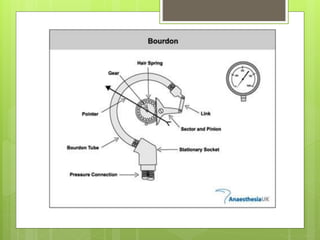
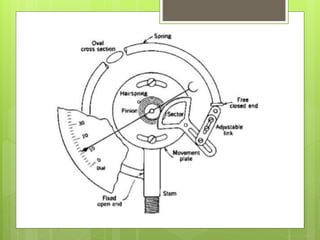
BOURDON PRESSURE GAUGE:
Dr.R.Selvakumar
Professor of Anaesthesiology
K.A.P.Viswanatham Govt medical college
Trichy

Medical Gas Cylinders

  • 1.
    COMPRESSED GAS CYLINDERS ANDPRESSURE GAUGE Dr.R.Selvakumar.M.D.D.A.DNB Professor of Anaesthesiology K.A.P.Viswanatham Govt Medical College, Trichirapalli Tamilnadu - India
  • 2.
    What is thepressure inside the L.P.G cylinder…? any where from 100 lbs to 180 lbs the regulator reduces it to around 11 lbs for a grill
  • 3.
    CYLINDERS: • COMPRESSED GASCONTAINERS • SHOULD WITHSTAND THE PRESSURE OF THE COMPRESSED GAS • SHOULD WITHSTAND THE ADVERSE TRANSPORT CONDITIONS • SHOULD NOT CHEMICALLY REACT WITH THE GASES • MALLEABLE • LIGHT WEIGHT
  • 4.
    MATERIAL USED FORTHE CONSTRUCTION OF CYLINDERS  LOW CARBON STEEL  HIGH CARBON STEEL  MANGANESE STEEL -1946  MOLYBDENUM STEEL  CHROME MOLYBDENUM STEEL  ALUMINIUM  COMPOSITE (Aluminium wrapped in carbon fibre)
  • 5.
    PRESSURE INSIDE THECYLINDERS OXYGEN : 1800 -2000 PSI (13700kPa) NITROUS OXIDE : 750 PSI (4400kPa) CARBONDIOXIDE: 850PSI ( 5000kPa)
  • 6.
    FILLING OF THECYLINDERS OXYGEN NITROUS OXIDE
  • 7.
  • 8.
    CRITICAL TEMPERATURE OFA GAS Critical temperature is the temperature above which a Substance can’t be liquefied no matter how much pressure Is applied… N2O – 36.5 C OXYGEN - -118 C
  • 9.
    SOME DEFINITIONS… Gas :exists in the gaseous state at room temperature. Its liquefaction at room temperature is impossible since The room temperature is above its critical temperature Vapour: is the gaseous state of a substance below its Critical temperature. At room temperature and atmospheric Pressure, the substance is liquid.
  • 10.
    • Liquid evaporatesin hot conditions • Pressure above the liquid column increases • Explosion of the cylinder is a possibility
  • 11.
    FILLING RATIO OFTHE CYLINDERS Is the weight of the fluid in the cylinder divided by The weight of water required to fill the cylinder 67 % 75 % Cold countries tropical
  • 12.
    FILLING OF CYLINDERS SERVICEPRESSURE : Maximum pressure up to which the Cylinder can be filled at 70 F Testing Pressure : 1.66 times the working pressure
  • 13.
  • 14.
    LABELLING OF THECYLINDER Name and chemical symbol of gas. Product specification. Hazard warning diamond shaped figure denoting hazard class contained gas. Name and address of cylinder manufacturer. Cylinder contents in liters. Tare weight (weight when empty). Maximum cylinder pressure. Cylinder size code. Directions for use.
  • 15.
    COMPONENTS OF THECYLINDER BODY SHOULDER : curved upper part of the body NECK : Threaded end of the shoulder
  • 16.
  • 17.
    Pressure relief deviceis fitted on cylinders with the aim to vent the cylinder contents to atmosphere if the pressure in the cylinder increases to a dangerous level as a result of high temperature or overfilling. They are of three types: Burst disk, fusible plug, and combination of two. Burst disk is most commonly used. It is a small metal gasket which bursts at a pre-determined pressure. SAFETY DEVICE IN THE CYLINDER VALVE
  • 18.
    PIN INDEX SYSTEM uniqueconfiguration of holes and pins which match precisely to eliminate connection of the wrong cylinder to equipment, thus prevents delivery of wrong gas to patients
  • 19.
  • 20.
    OXYGEN CYLINDER SIZEAND CAPACITY:
  • 21.
    N2O CYLINDER SIZEAND CAPACITY
  • 22.
    HOW TO CALCULATETHE QUANTITY INSIDE THE CYLINDER? OXYGEN: Rate of flow multiplied by 60 gives total consumption in one hour.
  • 23.
    DOES THE PRESSUREGAUGE INDICATE THE TRUE CYLINDER CONTENT?
  • 24.
    HOW TO CALCULATETHE QUANTITY INSIDE THE CYLINDER? N2O AVAGADRO’S LAW: One gram molecular weight of any substance will give rise to 22.4 L of gas and will contain 6.024 x 10²³ number of molecules MOL.WEIGHT OF O2 = 2 X 16 = 32 N20 = 2 X 14 + 16 = 44
  • 26.
    Hydraulic test:Is ameasure of cylinder's elasticity.The cylinder is connected by a thread to testing unit, filled with water and the water level is measured by gauge. The gauge is isolated and cylinder pressurized to 240 atmospheres. The pressure is released and gauge opened. The cylinder should stretch less than 0.02%. Tensile test Done in one out of 100 cylinders. The yield point should not be less than 15 tons per square inch. Flattening test The cylinder is kept between two compression blocks and pressure is applied from both sides until the distance between blocks remains 6 times the thickness of the wall of cylinder. The walls should not crack. Impact test Three of each, longitudinal and transverse stripes are taken from a finished cylinder and struck by mechanical hammer. Mean energy to produce the crack should not be less than 5 and 10 lb/ft for transverse and longitudinal strips, respectively. Bend test A ring of 25 mm width is cut from the cylinder and divided into strips. Each strip is bent inward until inner edges are a part, not greater than the diameter of strip. TESTING OF CYLINDERS
  • 27.
    The storage areashould be cool, dry, ventilated, clean area constructed of fire resistant material[16] Have good access for deliveries and a reasonable level floor surface Should have segregation of “Full” and “Empty cylinders” Cylinders with an oldest fill date should be used first Cylinders should not be stored in direct sunlight[10] Easily visible sign such as no smoking, no open flames or sparks, no oil or grease etc., should be displayed Cylinders should not be exposed to dampness, corrosive chemicals, fumes as they may damage cylinders and/or cause valve protection caps stick The temperature should not go below 10°C where Entonox cylinders are stored Cylinders should always be kept in place with chain or any other restraining device The suitable trolley/cart should be used to transport and support the cylinders. STORAGE OF CYLINDERS
  • 28.
    Handling and installation Beforeusing, the contents of the cylinder must be identified by reading the label[7] and also seeing the color of the cylinder Full cylinders are fitted with tamper evident seal, usually a shrink wrapped around the valve, should be removed immediately before use[2] Before connecting to yoke, the cylinder valve be cracked (i.e., Opened only slightly) to blow away any dust or flammable silting on the valve. The person opening the cylinder should be positioned so that the valve outlet and/or the face of pressure gauge points away from self, patient and machine Care should be taken to see that sealing washer (Bodok Seal) is present on the yoke and is in good condition to prevent leakage.[6,7] More than one washer should never be used as it can default PISS The valve should be opened slowly to release the pressure gradually. Sudden opening can produce a shock wave in the pressure gauge and regulator and can damage parts. Also, if gas passes quickly in the space between the valve and yoke or regulator, it can generate a large amount of heat. As there is almost no time to dissipate, this constitutes an adiabatic process[1] (no heat is lost or gained from surrounding). The heat generated can ignite grease or any dust particle present, causing flash fire or explosion The cylinders should never stand upright without support Handling should only be by trained staff.
  • 29.
  • 33.