medical gas cylinders
By Dr. Dharun Sharukh
1st year Anaesthesia PG
DEFINITIONS AND ABBREVIATIONS
• Psi- stands for pounds per square inch
• Psig- stands for pounds per square inch gauge which is the difference between
the measured pressure and surrounding atmospheric pressure. Most gauges are
constructed to read zero at atmospheric pressure.
• Psia- stands for pounds per square inch absolute. Psia = psig plus the local
atmospheric pressure.
• Units of pressure - kpa , cm H2O , psi , mbar , mm Hg
• 1 atmosphere = 100 kPa = 1000 mbar = 760 mm Hg = 1030 cm H2O =
14.7 psi
• Critical temperature – As the temperature below which no gas can be
liquified irrespective of which pressure is applied .
• Critical pressure – As the minimum pressure required to liquify a gas at
its critical temperature .
Non-liquified Gas
• A nonliquefied compressed gas is a gas that does not liquefy at
ordinary ambient temperatures regardless of the pressure
applied .
• Examples include oxygen, nitrogen air, and helium. These
gases do become liquids at very low temperatures, at which
point they are referred to as cryogenic liquids.
Liquified Compressed Gas
• A liquefied compressed gas is one that becomes liquid to a
large extent in containers at ambient temperature and at
pressures from 25 to 1500 psig
• Examples include nitrous oxide and carbon dioxide.
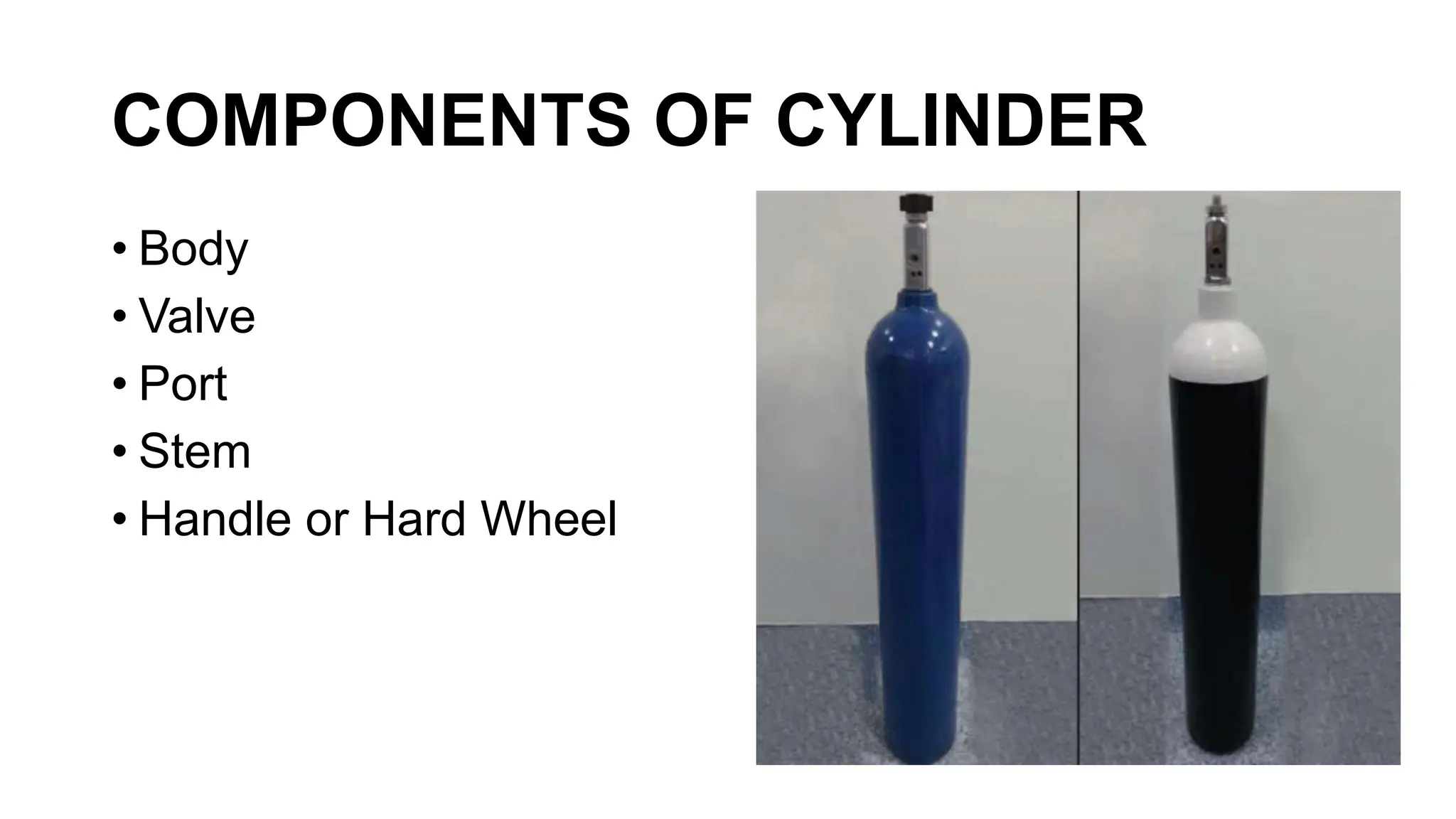
COMPONENTS OF CYLINDER
• Body
• Valve
• Port
• Stem
• Handle or Hard Wheel
Body
• In recent years , manufacturers have moved from
steel cylinders towards steel carbon fibre cylinder –
can hold more gas and light in weight
• Modern Cylinders are made of molybdenum steel.
Alloy containing molybdenum (0.15–0.25%) and/or
chromium (0.8–1.1%) is used to increase strength and
to minimize weight and wall thickness.
• Magnetic resonance imaging (MRI) compatible
cylinders are made of aluminum.
• Cylinders that have marked “3AA” are manufactured by
using steel. The marking “3AL”or “3ALM” indicates that
the cylinders made from aluminum.
• Bodies of the cylinders have flat or concave bases.
• The other end taper into a neck with screw threads to
which is fitted the cylinder valve.
• The body of the cylinders have a label and certain
markings engraved on the body.
Valve
• Cylinders are filled and discharged through the cylinder valve
(spindle shape) attached to the neck.
• The cylinder outlet valves are made of bronze or brass, which is
heavily plated with nickel and chromium so as to allow a rapid
dissipation of heat of compression.
• A sleeve or washer of soft alloy (containing a high proportion of
lead) completes the gas-tight seal as the valve is screwed into
the neck of a cylinder.
• The spindle or screw-pin (stem) of the valve is made of very
hard steel.
• The valve is marked with the chemical symbol of gas that it
contains, tare weight of the cylinder, pressure at the last
hydraulic test and a serial number.
• Leaks are prevented by the compression of a nylon ring around
the spindle.
• A safety outlet is fitted between the cylinder neck and the valve
block. This melts at relatively low temperatures to allow gas to
escape in case of fire and minimize the risk of explosion.
• Valve are of various types. Those to be used on anesthesia
machines are “flush” type which fits with the pin index system
on the machine and for the medium and large capacity cylinders
the valves are “bullnose” type.
Cylinder valve are of two types- packed
type and diaphragm type
Packed type
• Capable of withstanding high pressures.
• This is also called as direct acting valve.
• Stem is sealed by a resilient packing, such as Teflon
which prevents leaks around the threads.
• It withstands high pressure.
• It is opened by two to three full turns.
• Used in most of the cylinder
Diaphragm type
• Stem is separated from the seat.
• Closure between the cylinder interior and the atmosphere is
accomplished by using a seal and a bonnet nut that clamps one or
more circular disks
• These discs separates upper and lower stems which is permanently
attached to the diaphragms.
• The upper stem is actuated by a manual or automatic means
whereas the lower stem shuts or permits flow through the valve.
• Can be opened fully by ½ to 3/4 turns
• The seat does not turn and therefore it is less likely to leak.
• Preferred only when pressures are relatively low and no leaks can be
allowed
• It is expensive than the packed type.
Port
• The point of exit for the gas.
• It fits into the nipple on the hanger yoke of the
anesthesia machine.
• It should be protected in transit by a covering.
• When installing cylinder on anesthesia machine, it is
important for the user not to mistake the port for the
conical depression.
• Conical depression is situated on the opposite side of
the port on the cylinder valve and is situated above the
safety relief device.
• It is present on those cylinders which are designed to fit
on anesthesia machines.
• The conical depression is designed to receive the
retaining screw the yoke of the anesthesia machine.
• Screwing the retaining screw into the port may damage
the port.
Stem
• Each valve contains a stem (spindle/screw-pin) or shaft that
is rotated to open or close the cylinder valve.
• It is made up of very hard steel.
• To close the valve the stem seals against the seat that is part
of the valve body.
• When the valve is opened, the stem moves upward and
allows the gas to flow to the port.
Handle or Hand wheel
• A handle or handwheel is used to open or close a
cylinder valve.
• It is turned counterclockwise to open the valve and
clockwise to close it, This causes the stem to turn.
SAFETY FEATURES OF CYLINDER
• Color-coding for each gas or vapor
• Pin-index system: This prevents the accidental connection of a
cylinder/yoke of one gas to the hanger yoke of another gas on the
anesthesia machine or work station
• Bodok seals (bonded disk): These are noncombustible small metal
and neoprene seal to ensure a gas-tight fit between the cylinder and
anesthetic machine yoke
• Cylinder pressure indicator (gauge): Bourdon pressure gauges are
fitted adjacent to each yoke and pipeline connection on the machine.
• Pressure Relief Devices
Color coding
GAS SHOULDER BODY
OXYGEN WHITE BLACK
NITROUS OXIDE BLUE BLUE
CYCLOPROPANE ORANGE ORANGE
CARBON DI OXIDE GREY GREY
AIR WHITE GREY
NITROGEN BLACK BLACK
ENTONOX WHITE BLUE
Pin index safety system
• In order to ensure that the correct cylinder or central pipeline supply
is attached to the appropriate hanger yoke of the anesthesia
machine/work station.
• A series of pins on the hanger yoke is made to fit into corresponding
indentations (pits/holes) drilled into the cylinder valve or yoke block.
This pin-index system is used on small cylinder (sizes A to E) valves
and yoke blocks.
• The indentations (pits/holes) on the cylinder valve/yoke block are
counted 1–6 from left to right whereas pins on hanger yoke of the
machine are counted 1–6 from right to left
• The pins are 4.75 mm in diameter and 6 mm long, except for pin
number 7.
• Pin number 7 is slightly thicker and it is placed in the center, between
pin number 3 and 4
GAS PIN INDEX
AIR 1,5
OXYGEN 2,5
NITROUS OXIDE 3,5
NITROGEN 1,4
O2 - CO2 (CO2<7.5%) 2,6
O2 - CO2 (CO2>7.5%) 1,6
ENTONOX 7
Bodok Seal
• A small disk of neoprene with metal periphery
ensures a gas-tight fit between the cylinder and
anesthetic machine yoke .
• Before attaching a full cylinder to the machine ,
open and close the cylinder valve to clear any dirt
from the port. This is called cracking the cylinder.
Cylinder Pressure Indicator Gauge
• The indicator may be located near the cylinders or on a panel
on the front of the machine .
• A hollow metal tube is bent into a curve. One end is sealed and
linked to a clocklike mechanism. The other end which is open is
connected to the gas source.
• Increase in gas pressure inside the tube makes the curved tube
to straighten whereas when the pressure falls it resumes its
curved shape.
• Some electronic machines have light-emitting diodes (LED) to
indicate cylinder pressure. LED is green if the pressure is
adequate . If inadequate LED will flash red.
Pressure Relief Devices
• Every cylinder is fitted with pressure relief (safety relief/safety) device
• The whole purpose of this device is to vent the cylinder’s content to
atmosphere rather than the cylinder bursting if the pressure of enclosed
gas increases to dangerous level.
• Types
- Rupture disc
-Fusible plug
-Combination of both
-Pressure relief valve (spring loaded).
Rupture disc
• When predetermined pressure is reached, the disk ruptures
and allows the cylinder content to be discharged.
• It is a non-reclosing device held against an orifice.
• It protects against excess pressure as a result of high
temperature or overfilling.
Fusible plug
• It is thermally operated.
• It is a non-reclosing pressure relief device where the plug
held against the discharge channel.
• It gives protection from excessive pressure caused by a high
temperature but does not protect against exce from
overfilling.
• The yield temperature is the temperature at which the
fusible material becomes sufficiently soft to extrude from its
holder so that cylinder contents are discharged.
Combination Rupture Disc/ Fusible Plug
• It is used to prevent bursting at a predetermined pressure unless the
temperature is high enough to cause the fusible material to yield.
• Devices with a yield temperature of 165◦F may be found on cylinders
of air, oxygen, nitrogen, nitrous oxide, helium, helium-oxygen
mixtures, carbon dioxide, and carbon dioxide–oxygen mixtures.
• Because these devices function only in the presence of both excessive
heat and excessive pressure, they do not offer protection from high
pressure due to overfilling.
Spring Loaded Pressure Relief Device
• It is a reclosing device.
• When the set pressure is exceeded, the pressure
in the cylinder forces the spring to open the
channel for letting out gases
• Gas flows around the safety valve seat to the
discharge channel till the excess pressure is
relieved.
Sizes
• Gas suppliers classify cylinders by using a letter code, with A
being the smallest.
• volume and pressure of gas in a particular size cylinder vary
• O2 and air – similar ; CO2 and N2O – similar
• Size E is the cylinder most commonly used on anesthesia
machines and for patient transport and resuscitation
• Size D cylinders are used for limited supplies of gases where
size and weight considerations are important .
O2/AIR N2O/CO2
SIZE D - LITRES 400 940
PRESSURE IN PSIG 1900 745/832
SIZE E – LITRES 660 1590
PRESSURE IN PSIG 1900 745/838
SIZE – LITRES 6900 15800
PRESSURE IN PSIG 2200 745
TESTING
• A cylinder must be inspected and tested at least every 5 years
or, with a special permit, up to every 10 years.
• The test date (month and year) must be permanently stamped
on the cylinder .
• Each cylinder must pass an internal and external visual check
for corrosion and evidence ofphysical impact or distortion.
• Cylinders are checked for leaks and retention of structural
strength by testing to a minimum of 1.66 times their service
pressures .
• The service pressure is the maximum pressure to which the
cylinder may be filled at 70◦ F.
FILLING
• If a cylinder containing gas under a safe pressure at normal
temperature is subjected to higher temperatures, the pressure
may increase to a dangerous level .
• To prevent this –
The pressure in a filled cylinder at 70◦F may not exceed the service
pressure marked on the cylinder
Cylinder containing a liquefied gas, the pressure will remain nearly
constant as long as there is liquid in the cylinder.
Non liquified gas - may be allowed an additional 10%.
The filling density is the percent ratio of the weight of gas in a
cylinder to the weight of water that the cylinder would hold at 60◦F .
MARKING / LABELLING/TAGS
• Important for identification.
• To check test date.
• In case of flammable gases – caution/ danger/
warning label is needed
• Tags should contain either full/in use/empty.
HAZARDS
• Incorrect Cylinder
• Incorrect Contents
• Incorrect Valve
• Incorrect Color
• Incorre ct Lab e ling
• Damaged Valve / Inperable valve
• Asphyxia
• Suffocation/ fire explosion
• Overfilled contents
• Contaminated contents in cylinders
• Thermal injury
Rule for safe use of cylinder
1. Cylinders should be handled only by personnel who have been trained in
safe practices
2. No part of any cylinder should ever be subjected to a temperature above
54◦C or below –7◦C
3. The discharge port of a pressure relief device or the valve outlet must not
be obstructed
4. The valve should be kept closed at all times except when the cylinder is
in use.
5. Markings, labels, decals, or tags must not be defaced, altered, or
removed.
6. Cylinders should not be dropped, dragged, slid, orrolled, even for short
distances.
7. Cylinders should never be used where they could become contaminated
by other gases
8. A definite area should be designated for storing cylinders.
THANK YOU

medical gas cylinders ppt medicabfdrtsds

  • 1.
    medical gas cylinders ByDr. Dharun Sharukh 1st year Anaesthesia PG
  • 2.
    DEFINITIONS AND ABBREVIATIONS •Psi- stands for pounds per square inch • Psig- stands for pounds per square inch gauge which is the difference between the measured pressure and surrounding atmospheric pressure. Most gauges are constructed to read zero at atmospheric pressure. • Psia- stands for pounds per square inch absolute. Psia = psig plus the local atmospheric pressure. • Units of pressure - kpa , cm H2O , psi , mbar , mm Hg • 1 atmosphere = 100 kPa = 1000 mbar = 760 mm Hg = 1030 cm H2O = 14.7 psi • Critical temperature – As the temperature below which no gas can be liquified irrespective of which pressure is applied . • Critical pressure – As the minimum pressure required to liquify a gas at its critical temperature .
  • 3.
    Non-liquified Gas • Anonliquefied compressed gas is a gas that does not liquefy at ordinary ambient temperatures regardless of the pressure applied . • Examples include oxygen, nitrogen air, and helium. These gases do become liquids at very low temperatures, at which point they are referred to as cryogenic liquids. Liquified Compressed Gas • A liquefied compressed gas is one that becomes liquid to a large extent in containers at ambient temperature and at pressures from 25 to 1500 psig • Examples include nitrous oxide and carbon dioxide.
  • 4.
    COMPONENTS OF CYLINDER •Body • Valve • Port • Stem • Handle or Hard Wheel
  • 5.
    Body • In recentyears , manufacturers have moved from steel cylinders towards steel carbon fibre cylinder – can hold more gas and light in weight • Modern Cylinders are made of molybdenum steel. Alloy containing molybdenum (0.15–0.25%) and/or chromium (0.8–1.1%) is used to increase strength and to minimize weight and wall thickness. • Magnetic resonance imaging (MRI) compatible cylinders are made of aluminum.
  • 6.
    • Cylinders thathave marked “3AA” are manufactured by using steel. The marking “3AL”or “3ALM” indicates that the cylinders made from aluminum. • Bodies of the cylinders have flat or concave bases. • The other end taper into a neck with screw threads to which is fitted the cylinder valve. • The body of the cylinders have a label and certain markings engraved on the body.
  • 8.
    Valve • Cylinders arefilled and discharged through the cylinder valve (spindle shape) attached to the neck. • The cylinder outlet valves are made of bronze or brass, which is heavily plated with nickel and chromium so as to allow a rapid dissipation of heat of compression. • A sleeve or washer of soft alloy (containing a high proportion of lead) completes the gas-tight seal as the valve is screwed into the neck of a cylinder. • The spindle or screw-pin (stem) of the valve is made of very hard steel.
  • 9.
    • The valveis marked with the chemical symbol of gas that it contains, tare weight of the cylinder, pressure at the last hydraulic test and a serial number. • Leaks are prevented by the compression of a nylon ring around the spindle. • A safety outlet is fitted between the cylinder neck and the valve block. This melts at relatively low temperatures to allow gas to escape in case of fire and minimize the risk of explosion. • Valve are of various types. Those to be used on anesthesia machines are “flush” type which fits with the pin index system on the machine and for the medium and large capacity cylinders the valves are “bullnose” type.
  • 11.
    Cylinder valve areof two types- packed type and diaphragm type Packed type • Capable of withstanding high pressures. • This is also called as direct acting valve. • Stem is sealed by a resilient packing, such as Teflon which prevents leaks around the threads. • It withstands high pressure. • It is opened by two to three full turns. • Used in most of the cylinder
  • 12.
    Diaphragm type • Stemis separated from the seat. • Closure between the cylinder interior and the atmosphere is accomplished by using a seal and a bonnet nut that clamps one or more circular disks • These discs separates upper and lower stems which is permanently attached to the diaphragms. • The upper stem is actuated by a manual or automatic means whereas the lower stem shuts or permits flow through the valve. • Can be opened fully by ½ to 3/4 turns • The seat does not turn and therefore it is less likely to leak. • Preferred only when pressures are relatively low and no leaks can be allowed • It is expensive than the packed type.
  • 13.
    Port • The pointof exit for the gas. • It fits into the nipple on the hanger yoke of the anesthesia machine. • It should be protected in transit by a covering. • When installing cylinder on anesthesia machine, it is important for the user not to mistake the port for the conical depression.
  • 14.
    • Conical depressionis situated on the opposite side of the port on the cylinder valve and is situated above the safety relief device. • It is present on those cylinders which are designed to fit on anesthesia machines. • The conical depression is designed to receive the retaining screw the yoke of the anesthesia machine. • Screwing the retaining screw into the port may damage the port.
  • 16.
    Stem • Each valvecontains a stem (spindle/screw-pin) or shaft that is rotated to open or close the cylinder valve. • It is made up of very hard steel. • To close the valve the stem seals against the seat that is part of the valve body. • When the valve is opened, the stem moves upward and allows the gas to flow to the port.
  • 17.
    Handle or Handwheel • A handle or handwheel is used to open or close a cylinder valve. • It is turned counterclockwise to open the valve and clockwise to close it, This causes the stem to turn.
  • 19.
    SAFETY FEATURES OFCYLINDER • Color-coding for each gas or vapor • Pin-index system: This prevents the accidental connection of a cylinder/yoke of one gas to the hanger yoke of another gas on the anesthesia machine or work station • Bodok seals (bonded disk): These are noncombustible small metal and neoprene seal to ensure a gas-tight fit between the cylinder and anesthetic machine yoke • Cylinder pressure indicator (gauge): Bourdon pressure gauges are fitted adjacent to each yoke and pipeline connection on the machine. • Pressure Relief Devices
  • 20.
    Color coding GAS SHOULDERBODY OXYGEN WHITE BLACK NITROUS OXIDE BLUE BLUE CYCLOPROPANE ORANGE ORANGE CARBON DI OXIDE GREY GREY AIR WHITE GREY NITROGEN BLACK BLACK ENTONOX WHITE BLUE
  • 21.
    Pin index safetysystem • In order to ensure that the correct cylinder or central pipeline supply is attached to the appropriate hanger yoke of the anesthesia machine/work station. • A series of pins on the hanger yoke is made to fit into corresponding indentations (pits/holes) drilled into the cylinder valve or yoke block. This pin-index system is used on small cylinder (sizes A to E) valves and yoke blocks. • The indentations (pits/holes) on the cylinder valve/yoke block are counted 1–6 from left to right whereas pins on hanger yoke of the machine are counted 1–6 from right to left
  • 22.
    • The pinsare 4.75 mm in diameter and 6 mm long, except for pin number 7. • Pin number 7 is slightly thicker and it is placed in the center, between pin number 3 and 4 GAS PIN INDEX AIR 1,5 OXYGEN 2,5 NITROUS OXIDE 3,5 NITROGEN 1,4 O2 - CO2 (CO2<7.5%) 2,6 O2 - CO2 (CO2>7.5%) 1,6 ENTONOX 7
  • 24.
    Bodok Seal • Asmall disk of neoprene with metal periphery ensures a gas-tight fit between the cylinder and anesthetic machine yoke . • Before attaching a full cylinder to the machine , open and close the cylinder valve to clear any dirt from the port. This is called cracking the cylinder.
  • 26.
    Cylinder Pressure IndicatorGauge • The indicator may be located near the cylinders or on a panel on the front of the machine . • A hollow metal tube is bent into a curve. One end is sealed and linked to a clocklike mechanism. The other end which is open is connected to the gas source. • Increase in gas pressure inside the tube makes the curved tube to straighten whereas when the pressure falls it resumes its curved shape. • Some electronic machines have light-emitting diodes (LED) to indicate cylinder pressure. LED is green if the pressure is adequate . If inadequate LED will flash red.
  • 28.
    Pressure Relief Devices •Every cylinder is fitted with pressure relief (safety relief/safety) device • The whole purpose of this device is to vent the cylinder’s content to atmosphere rather than the cylinder bursting if the pressure of enclosed gas increases to dangerous level. • Types - Rupture disc -Fusible plug -Combination of both -Pressure relief valve (spring loaded).
  • 29.
    Rupture disc • Whenpredetermined pressure is reached, the disk ruptures and allows the cylinder content to be discharged. • It is a non-reclosing device held against an orifice. • It protects against excess pressure as a result of high temperature or overfilling.
  • 30.
    Fusible plug • Itis thermally operated. • It is a non-reclosing pressure relief device where the plug held against the discharge channel. • It gives protection from excessive pressure caused by a high temperature but does not protect against exce from overfilling. • The yield temperature is the temperature at which the fusible material becomes sufficiently soft to extrude from its holder so that cylinder contents are discharged.
  • 31.
    Combination Rupture Disc/Fusible Plug • It is used to prevent bursting at a predetermined pressure unless the temperature is high enough to cause the fusible material to yield. • Devices with a yield temperature of 165◦F may be found on cylinders of air, oxygen, nitrogen, nitrous oxide, helium, helium-oxygen mixtures, carbon dioxide, and carbon dioxide–oxygen mixtures. • Because these devices function only in the presence of both excessive heat and excessive pressure, they do not offer protection from high pressure due to overfilling.
  • 32.
    Spring Loaded PressureRelief Device • It is a reclosing device. • When the set pressure is exceeded, the pressure in the cylinder forces the spring to open the channel for letting out gases • Gas flows around the safety valve seat to the discharge channel till the excess pressure is relieved.
  • 33.
    Sizes • Gas suppliersclassify cylinders by using a letter code, with A being the smallest. • volume and pressure of gas in a particular size cylinder vary • O2 and air – similar ; CO2 and N2O – similar • Size E is the cylinder most commonly used on anesthesia machines and for patient transport and resuscitation • Size D cylinders are used for limited supplies of gases where size and weight considerations are important .
  • 34.
    O2/AIR N2O/CO2 SIZE D- LITRES 400 940 PRESSURE IN PSIG 1900 745/832 SIZE E – LITRES 660 1590 PRESSURE IN PSIG 1900 745/838 SIZE – LITRES 6900 15800 PRESSURE IN PSIG 2200 745
  • 36.
    TESTING • A cylindermust be inspected and tested at least every 5 years or, with a special permit, up to every 10 years. • The test date (month and year) must be permanently stamped on the cylinder . • Each cylinder must pass an internal and external visual check for corrosion and evidence ofphysical impact or distortion. • Cylinders are checked for leaks and retention of structural strength by testing to a minimum of 1.66 times their service pressures . • The service pressure is the maximum pressure to which the cylinder may be filled at 70◦ F.
  • 37.
    FILLING • If acylinder containing gas under a safe pressure at normal temperature is subjected to higher temperatures, the pressure may increase to a dangerous level . • To prevent this – The pressure in a filled cylinder at 70◦F may not exceed the service pressure marked on the cylinder Cylinder containing a liquefied gas, the pressure will remain nearly constant as long as there is liquid in the cylinder. Non liquified gas - may be allowed an additional 10%. The filling density is the percent ratio of the weight of gas in a cylinder to the weight of water that the cylinder would hold at 60◦F .
  • 38.
    MARKING / LABELLING/TAGS •Important for identification. • To check test date. • In case of flammable gases – caution/ danger/ warning label is needed • Tags should contain either full/in use/empty.
  • 39.
    HAZARDS • Incorrect Cylinder •Incorrect Contents • Incorrect Valve • Incorrect Color • Incorre ct Lab e ling • Damaged Valve / Inperable valve • Asphyxia • Suffocation/ fire explosion • Overfilled contents • Contaminated contents in cylinders • Thermal injury
  • 40.
    Rule for safeuse of cylinder 1. Cylinders should be handled only by personnel who have been trained in safe practices 2. No part of any cylinder should ever be subjected to a temperature above 54◦C or below –7◦C 3. The discharge port of a pressure relief device or the valve outlet must not be obstructed 4. The valve should be kept closed at all times except when the cylinder is in use. 5. Markings, labels, decals, or tags must not be defaced, altered, or removed. 6. Cylinders should not be dropped, dragged, slid, orrolled, even for short distances. 7. Cylinders should never be used where they could become contaminated by other gases 8. A definite area should be designated for storing cylinders.
  • 41.