MEDICAL
GAS
CYLINDERS
PRESENTER – DR. SHILPA
M
MODERATOR - DR. MERIN
TOPICS FOR DISCUSSION
• DEFINITIONS
• CONTENT AND PRESSURE
• SIZES
• PARTS
• TESTING AND FILLING
• MARKINGS AND LABELING
• PIN INDEX
• COLOUR CODING
• SAFE USAGE RULES
• HAZARDS
• SAFETY FEATURES
Definitions
• Psi: Pounds per square inch
• Psig: Pounds per square inch gauge(difference between
measured pressure and surrounding atmospheric pressure)
• Psia: pounds per square inch absolute
Psia = psig + local atmospheric pressure
Eg : At sea level – atmospheric pressure is 0 but psia is 14.7 psia
Units of Pressure : 1 Atmosphere = 14.7psi / 760 mmHg
1030cm of H2o
1000mbar
100Kpa
Definitions
• Critical Temperature:
-Defined as the temperature below which no gas can be
liquefied irrespective of which pressure is applied
• Critical Pressure:
-Defined as the minimum pressure required to liquefy a gas
at its critical temperature
Compressed Gas
• It is defined as any mixture having in a container an absolute
pressure exceeding 40 psi at 700
F
OR
• Regardless of the pressure at 700
F having a absolute
pressure exceeding 104 psi at 1300
F
OR
• Any liquid having a vapor pressure exceeding 40 psia at
1000
F
Non-Liquified Gas
• These are gases that do not liquefy at ambient temperatures
regardless of the required pressures applied
• These gases do become liquids at lower temperatures-
called as CRYOGENIC LIQUIDS
• Example: Oxygen, Nitrogen, Air, Helium
Liquified Compressed Gases
• These are gases which become liquid at ambient temperatures
at pressures varying from 25-100psig (172-10340Kpa)
• Example : N2o ,CO2
Sizes
• Cylinders are manufactured in different Sizes (A - J)
• A being the smallest and J is the biggest size, A and H are not
used for medical gases
• Volume and Pressure of gas in a particular size cylinder vary
• O2 & Air are similar, CO2 and N2o are similar
• Size E is the most commonly used in anesthesia machine and
for patient transport and resuscitation
• Size D are used limited supplies where size and weight
considerations are important
Sizes
Sizes
Contents and Pressure
•In a cylinder containing a Non - liquefied gas
pressure declines as contents are withdrawn ,Hence
pressure can be used to measure cylinder volume
Contents and Pressure
• In a cylinder containing liquified gas, the pressure depends
on Vapor Pressure of the liquid and is not an indication of
the amount of gas remaining in the cylinder as long as
contents are partly in the liquid state
• Pressure remains nearly constant till all the liquid has
evaporated
• After which pressure declines till cylinder is exhausted
Contents and Pressure
Parts of Cylinder
• Components Consists of:
• Body
• Valve
• Port
• Stem
• Pressure relief devices
Body
• Most of the medical gas cylinders are made of steel with
various alloys
• In recent years , manufacturers have moved from traditional
steel cylinders towards steel-carbon fiber cylinders
• Gas holding capacity is more and light weight
• MRI compatible cylinders are made of aluminum
• Modern cylinders are made of
Alloy of Molybdenum + Steel +/- Chromium
• It is used to increase strength and to minimize weight and
wall thickness
Body
• Walls of the cylinders vary from 5/64 to ¼ inch thick
• Cylinders that have a marking 3AA are made of steel
or 3ALM 3AL indicates that the cylinder is made
from aluminum
• Cylinder have a flat or a concave base .
• The other end tapers into the neck that is fitted
with tapered screw threads that attach to the
cylinder valve
Valve
• Cylinders are filled and
discharged through a
valve(spindle shaped)
attached to the neck
• It is made of bronze or brass
which is heavily plated with
nickel/Chromium so as to
allow rapid dissipation of
heat of compression
Valve
• The end which enters the neck of the cylinders is threaded to fit a
corresponding screw thread inside the neck itself
• A sleeve or washer of soft alloy (containing high lead content)
completes the gas tight seal the valve is screwed into the neck of
the cylinder
• Woods metal – Is a fusible alloy of 50% bismuth, 26.7%
lead, 13.3% tin, and 10% cadmium by mass. It has a
melting point of approximately 70 °C (158 °F).
• Wood's metal seal which melts in fire, allowing the gas to
escape and reducing the risk of gas explosion. Wood's
metal is commonly used as a filler when bending thin-
walled metal tubes. For this use the tubing is filled with
molten Wood's metal.
Valve
• Cylinder Valves are of various types -Those used on
anaesthesia machines are ‘Flush’ types which fit the pin
index system
• For medium and large capacity cylinders - Bull nose valves
are used
Types of Valves:
a) Packed type
b) Diaphragm type
Packed Type
• Capable of withstanding high pressure
• Stem is sealed by resilient packing
such as Teflon which prevents leaks
around threads
• Opened by 2-3 turns
• Used in most of the cylinders
Diaphragm Type
• Stem is separated from the seat
• Closure between the cylinder interior and atmosphere is
accomplished by using a seal & a Bonnet nut that clamps one or
more circular discs
• These discs separate upper & lower stems which may be
permanently attached to the diaphragms
Diaphragm Type
• Upper stem is actuated by
manual/automatic means & Lower
stem shuts/permits flow through valve
• Can be opened by ½ to ¾ turns
• Seat does not turn-so less likely to leak
• Generally preferred when pressures are
relatively low and no leaks can be
allowed
• Expensive
Port
• It is the point of exit for the gas
• It fits into the nipple on the hanger yoke of the anaesthesia
machine
• It should be protected in transit by covering
• When installing a cylinder on the anaesthesia machine it is
important for the user to not mistake the part for the conical
depression
Conical Depression
Conical Depression
• Conical Depression is situated on the opposite side of the port on the
cylinder valve and is situated above the safety relief device
• It is present on the those cylinders which are designed to fit on anesthesia
machine
• Conical depression is designed to receive the retaining screw on the yoke
of anesthesia machine
• If the retaining screw is fixed into the port it will cause damage to it
Stem
• Each valve contains a stem(spindle/screw-
pin) or shaft that is rotated to open or close
the cylinder valve
• It is made up of steel
• To close the valve the stem seals against
the seat that is part of the valve
• When the valve is opened-stem is moved
upwards and allows the gas to flow to the
port
Pressure Relief Devices
• Every cylinder is fitted with pressure relief devices whose
purpose is to vent the cylinder’s contents to the atmosphere
• If the pressure of enclosed gas increases to dangerous levels
Types of pressure relief devices
• Rupture Disc
• Fusible Plug
• Combination of both
• Pressure Relief valve(spring loaded)
Rupture Disc
• When Pre-determined pressure is reached
the disc ruptures & allows the gas contents
to be discharged
• It is a non-reclosing device held against an
orifice
• It protects against excess pressure as a
result of high temperature/overfilling
Rupture Disc
Fusible Plug
• It is thermally operated which is made up of woods metal blue,
of bronze , brass or gunmetal black
• It is a non-reclosing pressure relief device where the plug is held against
the discharge channel
• It provides protection against excess pressure due to high temperature but
not overfilling
• Yield Temperature : Temperature at which the fusible material becomes
sufficiently soft to extrude from its holder so that the cylinder contents are
discharged.
Yield temperature – 90 to 105 degree Celsius or
70 to 75 degree Celsius
Spring Loaded Pressure Relief Device
• It is a reclosing device
• When set pressure is exceeded, the
pressure in the cylinder forces the spring to
open the channel for letting out the gases
• Gas flows around the safety valve seat to
discharge channel till excess pressure is
relieved
Handle/Hand wheel
Handle/Hand wheel
•It is used to open or close a cylinder valve
•It is turned counter-clockwise to open and clockwise to
close causes the stem to turn
•A good practice is to attach a handle to each anesthesia
machine/ other apparatus for which it is needed
•Each large cylinder has a permanent attached handle
that uses a spring & nut to hold it firmly in place
Non - Interchangeable Safety Systems
• With widespread use of cylinders containing different
gases, a potential hazard that is encountered is connection
of a cylinder to equipment intended for a different gas
• For safety purposes
• Color coding for each gas
• Pin Index Safety System
Color Coding Of Cylinders
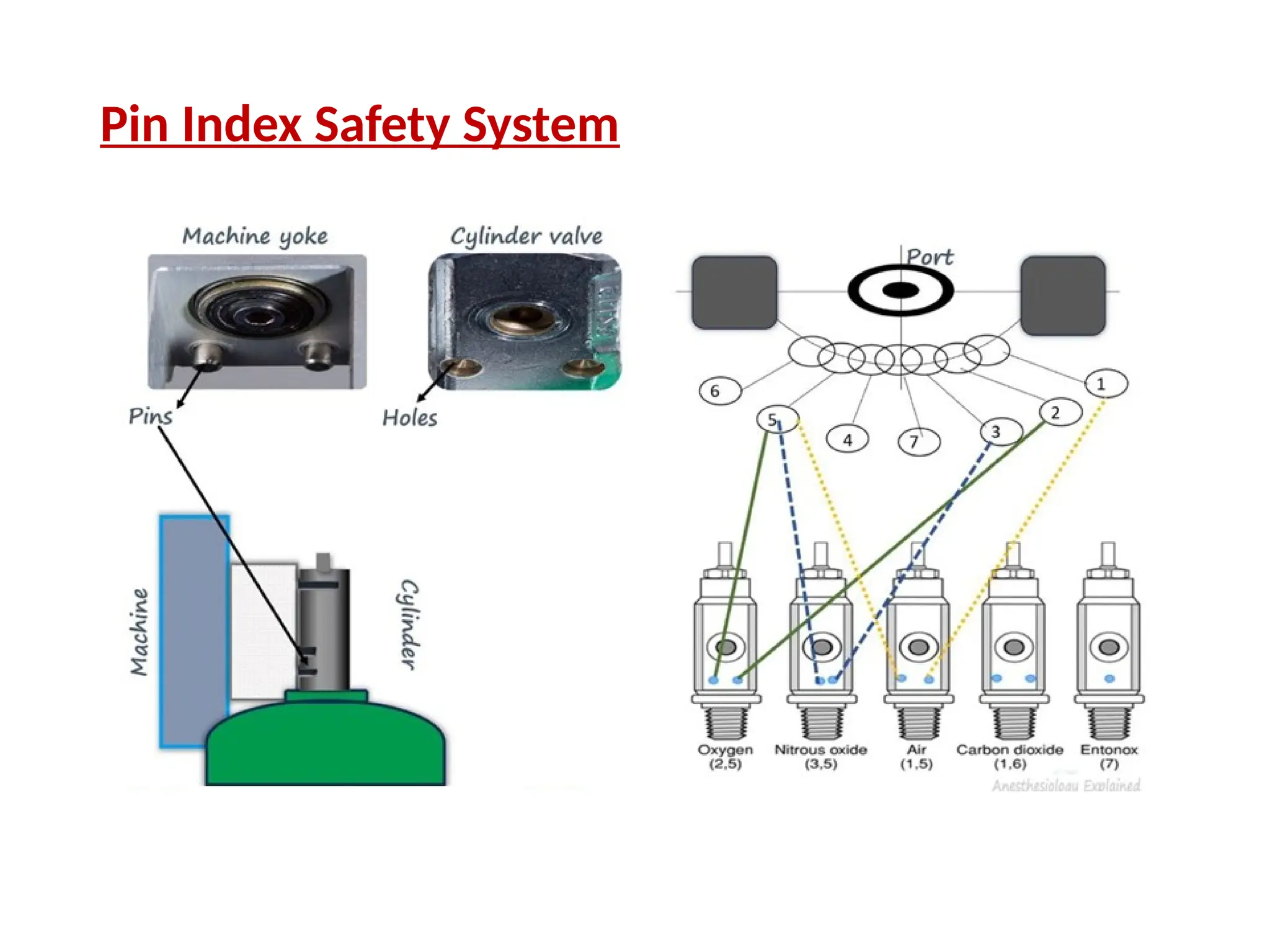
Pin Index Safety System
• The use of PISS began in 1952 which is introduced by us fire
association together with CGA along with the Ameican society of
Anesthioslogist
• In order to ensure that the correct cylinder is attached to the
appropriate hanger yoke of the anesthesia machine/workstation
• A series of pins on the hanger yoke is made to fit into the
corresponding indentations(pins/holes) drilled into cylinder valve
Pin Index Safety System
• It consists of holes on the cylinder valve positioned in an
arc below the outlet port
• Position of the cylinder valve are the circumference of a
circle of 9/16 inch(14.3mm) radius centered on the port
• The port has a diameter of 7mm
• The distance between the centre and lower part of the
yoke is 20.6mm
Pin Index Safety System
• Unless the pins and holes are aligned, the/yoke
port will not seat
• The indentations on the cylinder valve block are
counted 1-6 from left to right
• The distance between the centre of the 1st
& 6th
pin should be 16mm
• There are 7 positions for pins and holes
Pin Index Safety System
• The pins are 4.75 mm in diameter and 6mm long except for
pin number 7 which is slightly thicker and placed at the center
(between port 3 & 4). 6 holes placed at an angle of 12 degrees
from port
Bodok Seal
• A small disk of neoprene with metal periphery ensures a gas tight fit
between the cylinder and the anesthetic machine yoke in the form of seal
• Oil should not be used as a seal because the pressurized gases give of heat
as they are released from the cylinder and may cause explosions
Cylinder Pressure Gauge
• Displays the cylinder pressure for each gas
• The indicator is located near the cylinders / on a panel in front
of the machine
• The scale is 33% greater than the maximum filing pressure of
the cylinder(full indication position)
• Many of the indicators are of the Bourdon tube (Bourdon
spring elastic element)
OXYGEN : Rate of flow multiplied by 60 gives total
consumption in one hour.
How to calculate the quantity inside the cylinder ?
N2O
AVAGADRO'S LAW : One-gram molecular weight of any
substance will give rise to 22.4 L of gas and will contain
6.024 x 10²³ number of molecules
MOL.WEIGHT OF O2 = 2 X 16 = 32
N2O = 2 X 14+ 16 = 44
How to calculate the quantity inside the cylinder ?
Amount of N2O Gas in a cylinder
•Tare weight of the cylinder = 12.5 Kg
•Cylinder weight with N2O = 15 Kg
•Weight of the N2O = 2.5 Kg = 2500G
•44 G OF N2O = 22.4 L
•Therefore 2500G = 22.4/44 x 2500 – 1272 L
How to calculate the quantity inside the cylinder ?
Estimating duration of liquid oxygen cylinder gas flow
• Weight of gas must be known to determine volume of gas
in liquid-filled cylinder
• 1L of liquid O2 weighs 2.5 lb & produces 860 L of O2 in its gaseous state
• Amount of gas = Liquid O2 weight (lb) x 860/2.5 lb/L
• Duration of gas (min) = Amount of gas in container (L)/ Flow (L/min)
Duration of gas flow
An E cylinders contain 22 cubic feet (cu ft) of oxygen
when full (2200 psi pressure).
One cubic foot of oxygen equals 28.3 L.
Now, Tank Factor: (22 × 28.3) L/2200 psi = 0.28 L/psi.
Therefore, the time duration for which the tank would last
(in minutes).
= (Tank factor [gauge pressure – 500])/L flow.
= (0.28L/psi [2000 psi – 500 psi])/8 L/min.
= 52.5 min.
• A hollow metal tube which is
curved
• One end is sealed and linked
to a clocklike mechanism
• The other end which is open is
connected to the gas source
• MOA: As pressure increases
the curved tube becomes
straight
Cylinder Pressure Gauge
They are calibrated in kg/cm2
,
pounds/inch2
kilo Pascals(kPa)
Testing
• A cylinder must be inspected and tested at least every 5
years or with special permit up to every 10 years
• The test date must be permanently stamped on the cylinder
• Each cylinder must be an internal & external visual check
for corrosion and evidence of physical impact or distortion
• Cylinders are checked for leaks and retention of structural
strength by testing to minimum of 1.66 times there service
pressure
Testing
• Service Pressure: It is the maximum pressure to which the
cylinder may be filled at 700
F
• Other Tests Done
Hydraulic Test
Tensile Test
Flattening Test
Bend Test
Impact Test
• These are carried on at least one out of every 100 cylinders
Testing
Hydraulic test - Is a measure of cylinder’s elasticity. The
cylinder is connected by a thread to testing unit, filled with
water and the water level is measured by gauge. The gauge is
isolated, and cylinder pressurized to 240 atmospheres. The
pressure is released, and gauge opened. The cylinder should
stretch less than 0.02%.
Testing
Tensile test - Done in one out of 100 cylinders. The yield point
should not be less than 15 tons per square inch.
Flattening test - The cylinder is kept between two
compression blocks and pressure is applied from both sides
until the distance between blocks remains 6 times the
thickness of the wall of cylinder. The walls should not crack.
Testing
Impact test - Three of each, longitudinal and transverse
stripes are taken from a finished cylinder and struck by
mechanical hammer. Mean energy to produce the crack
should not be less than 5 and 10 lb/ft for transverse and
longitudinal strips, respectively.
Bend test - A ring of 25 mm width is cut from the cylinder and
divided into strips. Each strip is bent inward until inner edges
are a part, not greater than the diameter of strip.
Filling
• If a cylinder containing a gas under a safe pressure at normal
temperature is subjected to higher temperature the pressure may
increase to dangerous levels
• To prevent this , regulations have been drawn limiting the amount
of gas a cylinder may contain
• Non-Liquefied Gases : are allowed an additional 10 % filling
• Liquefied gas containing cylinders : Pressure will remain constant
as long as there is liquid in the cylinder
Filling
• To prevent cylinder being overfilled the maximum amount of gas
allowed is defined by the filling density(filling ratio for each gas)
• Filling Density: Percent of ratio of weight of the gas in a cylinder to
the weight of water that the cylinder would hold at 600
F
• N2o -68%.
• O2- 68%
• Filling Limits :- Gas in closed
container
Rise in temp will cause rise in press
Pressures can rise to dangerous
levels
Cylinder may explode.
Filling
• Filling Limits :- Gas in closed container
Rise in temp will cause rise in press
Pressures can rise to dangerous levels
Cylinder may explode.
To prevent this, the dept of transportation has regulations
Entonox
• This is 50:50 mixtures of nitrous oxide and oxygen.
• The premixed contents remain in gaseous phase at pressures and
temperature at which N2 O by itself would normally be a liquid.
• Entonox is compressed in cylinders at a pressure of 13,700 kPa. Cylinders
are colored blue with white quadrants on the shoulder.
• For filling, the cylinders are first filled with the correct weight of nitrous
oxide.
• The cylinder is then inverted and oxygen is bubbled through. As oxygen
dissolves in nitrous oxide, the latter vaporizes until all the liquid is
vaporized.
• The mixture remains in gaseous state unless the temperature falls to −7°.
Entonox
The pseudocritical temperature of Entonox is approximately -
7°C. Below this temperature nitrous oxide converts to the liquid
phase, with an increasing concentration of oxygen in the gaseous
phase. As the oxygen is consumed, the oxygen concentration will
eventually drop and a hypoxic gas mixture may develop.
Poynting Effect
When two gases, one of high and another of low critical
temperature are mixed in a container, Ci the critical temperature
of the gas with a high critical temperature will decrease to a
lower level (pseudo critical temperature) and the mixture will
remain as a gas above this pseudo critical temperature.
Entonox
Heliox
Heliox is a mixture of oxygen and
helium. The latter is 86% less dense
(0.179 g/L) than air (1.293 g/L).
A mixture of 21% oxygen and 79% of
helium named as Heliox 21 is used to
improve gaseous exchange in acute
exacerbation of asthma and COPD.
Marking/ Labelling /Tags
• Important for identification
• To check the test date
• In case of flammable gases-Caution/Danger/Warning label is
needed
• Tags should contain either full/in use/empty
Cleaning of cylinders
1. The cleaning & disinfection procedure should be performed at
the hospital in a designated area.
2. For initial cleaning, hot portable water with detergents, not
exceeding 50 degree Celsius (50 C) should be used for
cleaning cylinders, wheeled cylinder trolley, spanner, keys,
regulators and wrench. Valves & inlets should be closed &
covered so that the water doesn’t get inside the
cylinders/containers. Under no circumstances medical gas
cylinder/container should be immersed in water.
3. After cleaning the cylinder/accessories with water and soap,
the cylinder/container should be cleaned with 1% sodium
hypochlorite solution. Fogging is a suitable alternative.
Cleaning of cylinders
4. While cleaning the cylinder/container, avoid cleaning agents
that contain ammonia, amine based compounds or chlorine
based compounds as they can cause corrosion of steel or
aluminum alloy components or stress cracking of brass,
including copper alloy components.
5. Personal involved in filling, storing, handling & transporting of
Medical Gas Cylinder/Container should be trained in this
procedure and should be wearing protective gear at all times
as per MoHFW guidelines.
Transportation of cylinders
1) Upright position.
2) Wear protective footwear, gloves & goggles.
3) Do not lift by protective cap or guard.
4) Do not subject to temp extremes.
5) Do not drag or role cylinders. Always use cart.
6) Secure with chain all times when kept upright. Otherwise keep
them flat on the ground.
7) Ensure cylinders are properly labelled to its contents.
Storage of cylinders
• Storage area should be cool , dry, ventilated , clean area constructed of fire-
resistant material
• should have good access for deliveries and reasonable level floor surface should
have segregation pf full and empty cylinders
• cylinder with an oldest date should be used first
• cylinders should not be stored in direct sunlight
• easily visible signs such as no smoking , no open flames or sparks , no oil grease
etc. should be displayed
• cylinders should not be exposed to dampness , corrosive chemicals fumes as
they may damage cylinders and cause valve protection caps stick
• the temperature should not go below 10 degree Celsius where Entonox cylinders
are stored
• cylinders should always be krpt in place with chain or any other restraining
device
• the suitable trolley/ cart should be used to transport and support the cylinder
Hazards
•Incorrect Cylinder
•Incorrect Valve
•Incorrect color/Labelling
•Damaged Valve
•Fire Explosion
•Overfilled contents in cylinder
•Nitrous Oxide Theft
•Contaminated contents in cylinders
•Thermal Injury
Rules for safe use of cylinders
• To be handled by trained staff
• Store cylinders in a cool, clean room with adequate ventilation
• Do not drape cylinder with any material during storage
• Cylinders are best stored upright in a cylinder stand
• Keep the valve closed when not in use
• Remove protective covering before use
• Remove dust/ foreign bodies before connecting
Rules for safe use of cylinders
• Identify contents by label
• ‘Cracking’ a cylinder refers to opening valve slightly and closing
it quickly to blow out dust or dirt from value outlet and port
should be point away from the user and any other personal
Rules for safe use of cylinders
Always open the valve slowly & before connecting to Anaesthesia machine:-
If valve is opened fast
gas passes quickly between valve & the yoke or regulator
sudden recompression of the gas
large amount of heat generated (Joule-Thompson effect)
if any dust or grease in the space
may be ignited by the heat
fire & explosion,
Rules for safe use of cylinders
Sudden release of gases
Pressure gauge & regulator damage
• Thus;-
1. Valve should always be opened slowly,
2. Opened before connecting to the anaesthesia mach.
3. Never apply grease.
Never keep the cylinder valve always open when the cylinder
is not being used
Slow depletion of gases from the cylinder when pipeline
pressures drop down
No reserve will be available i.c.o pipeline supply failure.
Rules for safe use of cylinders
• Identify contents by label
• ‘Cracking’ a cylinder refers to opening valve slightly and closing it
quickly to blow out dust or dirt from value outlet and port should be
point away from the user and any other personal
• if gas passes quickly into the space between the valve and the yoke,
the rapid recompression will generate a large amount of heat. This is an
adiabatic process (heat is neither lost nor gained from environment).
Particles of dust, grease present in this space may be ignited by heat,
causing a flash fire or explosion. The valve should be opened slowly
when attached to the anaesthesia machine or regulator.
Rules for safe use of cylinders
• Flow control valves should be closed before cylinders opened
• Quick opening to be avoided as it can generate heat leading
to form flames
• Valve should be fully opened when in use
• To be kept away from oil, Rubber and combustible substances
• Do not expose cylinder to heat or higher temperatures
Safety Features of Cylinders
• Label of the cylinder and marking
• Seamless body
• Symbol of the gas on the cylinder valve
• Color coding and Safety relief devices
• Pin index safety system
• Molybdenum steel for stronger and lighter
• Bodak seal
• Cylinder pressure gauge indicator
• Tare weight and sizes
REFRENCES
• Understanding Anaesthetic Equipment & Procedures A
Practical Approach,2015;Dwarkadas Baheti
• Understanding anaesthesia equipment and procedures ,south
asian edition.5th
Edition Jerry A Dorsch and Susan E Dorsch
Thank You.

Cylinder And Pipeline System.pptx final.pptx

  • 1.
    MEDICAL GAS CYLINDERS PRESENTER – DR.SHILPA M MODERATOR - DR. MERIN
  • 2.
    TOPICS FOR DISCUSSION •DEFINITIONS • CONTENT AND PRESSURE • SIZES • PARTS • TESTING AND FILLING • MARKINGS AND LABELING • PIN INDEX • COLOUR CODING • SAFE USAGE RULES • HAZARDS • SAFETY FEATURES
  • 3.
    Definitions • Psi: Poundsper square inch • Psig: Pounds per square inch gauge(difference between measured pressure and surrounding atmospheric pressure) • Psia: pounds per square inch absolute Psia = psig + local atmospheric pressure Eg : At sea level – atmospheric pressure is 0 but psia is 14.7 psia Units of Pressure : 1 Atmosphere = 14.7psi / 760 mmHg 1030cm of H2o 1000mbar 100Kpa
  • 4.
    Definitions • Critical Temperature: -Definedas the temperature below which no gas can be liquefied irrespective of which pressure is applied • Critical Pressure: -Defined as the minimum pressure required to liquefy a gas at its critical temperature
  • 5.
    Compressed Gas • Itis defined as any mixture having in a container an absolute pressure exceeding 40 psi at 700 F OR • Regardless of the pressure at 700 F having a absolute pressure exceeding 104 psi at 1300 F OR • Any liquid having a vapor pressure exceeding 40 psia at 1000 F
  • 6.
    Non-Liquified Gas • Theseare gases that do not liquefy at ambient temperatures regardless of the required pressures applied • These gases do become liquids at lower temperatures- called as CRYOGENIC LIQUIDS • Example: Oxygen, Nitrogen, Air, Helium Liquified Compressed Gases • These are gases which become liquid at ambient temperatures at pressures varying from 25-100psig (172-10340Kpa) • Example : N2o ,CO2
  • 7.
    Sizes • Cylinders aremanufactured in different Sizes (A - J) • A being the smallest and J is the biggest size, A and H are not used for medical gases • Volume and Pressure of gas in a particular size cylinder vary • O2 & Air are similar, CO2 and N2o are similar • Size E is the most commonly used in anesthesia machine and for patient transport and resuscitation • Size D are used limited supplies where size and weight considerations are important
  • 8.
  • 9.
  • 10.
    Contents and Pressure •Ina cylinder containing a Non - liquefied gas pressure declines as contents are withdrawn ,Hence pressure can be used to measure cylinder volume
  • 11.
    Contents and Pressure •In a cylinder containing liquified gas, the pressure depends on Vapor Pressure of the liquid and is not an indication of the amount of gas remaining in the cylinder as long as contents are partly in the liquid state • Pressure remains nearly constant till all the liquid has evaporated • After which pressure declines till cylinder is exhausted
  • 12.
  • 13.
    Parts of Cylinder •Components Consists of: • Body • Valve • Port • Stem • Pressure relief devices
  • 14.
    Body • Most ofthe medical gas cylinders are made of steel with various alloys • In recent years , manufacturers have moved from traditional steel cylinders towards steel-carbon fiber cylinders • Gas holding capacity is more and light weight • MRI compatible cylinders are made of aluminum • Modern cylinders are made of Alloy of Molybdenum + Steel +/- Chromium • It is used to increase strength and to minimize weight and wall thickness
  • 15.
    Body • Walls ofthe cylinders vary from 5/64 to ¼ inch thick • Cylinders that have a marking 3AA are made of steel or 3ALM 3AL indicates that the cylinder is made from aluminum • Cylinder have a flat or a concave base . • The other end tapers into the neck that is fitted with tapered screw threads that attach to the cylinder valve
  • 16.
    Valve • Cylinders arefilled and discharged through a valve(spindle shaped) attached to the neck • It is made of bronze or brass which is heavily plated with nickel/Chromium so as to allow rapid dissipation of heat of compression
  • 17.
    Valve • The endwhich enters the neck of the cylinders is threaded to fit a corresponding screw thread inside the neck itself • A sleeve or washer of soft alloy (containing high lead content) completes the gas tight seal the valve is screwed into the neck of the cylinder • Woods metal – Is a fusible alloy of 50% bismuth, 26.7% lead, 13.3% tin, and 10% cadmium by mass. It has a melting point of approximately 70 °C (158 °F). • Wood's metal seal which melts in fire, allowing the gas to escape and reducing the risk of gas explosion. Wood's metal is commonly used as a filler when bending thin- walled metal tubes. For this use the tubing is filled with molten Wood's metal.
  • 18.
    Valve • Cylinder Valvesare of various types -Those used on anaesthesia machines are ‘Flush’ types which fit the pin index system • For medium and large capacity cylinders - Bull nose valves are used Types of Valves: a) Packed type b) Diaphragm type
  • 19.
    Packed Type • Capableof withstanding high pressure • Stem is sealed by resilient packing such as Teflon which prevents leaks around threads • Opened by 2-3 turns • Used in most of the cylinders
  • 20.
    Diaphragm Type • Stemis separated from the seat • Closure between the cylinder interior and atmosphere is accomplished by using a seal & a Bonnet nut that clamps one or more circular discs • These discs separate upper & lower stems which may be permanently attached to the diaphragms
  • 21.
    Diaphragm Type • Upperstem is actuated by manual/automatic means & Lower stem shuts/permits flow through valve • Can be opened by ½ to ¾ turns • Seat does not turn-so less likely to leak • Generally preferred when pressures are relatively low and no leaks can be allowed • Expensive
  • 22.
    Port • It isthe point of exit for the gas • It fits into the nipple on the hanger yoke of the anaesthesia machine • It should be protected in transit by covering • When installing a cylinder on the anaesthesia machine it is important for the user to not mistake the part for the conical depression
  • 23.
  • 24.
    Conical Depression • ConicalDepression is situated on the opposite side of the port on the cylinder valve and is situated above the safety relief device • It is present on the those cylinders which are designed to fit on anesthesia machine • Conical depression is designed to receive the retaining screw on the yoke of anesthesia machine • If the retaining screw is fixed into the port it will cause damage to it
  • 26.
    Stem • Each valvecontains a stem(spindle/screw- pin) or shaft that is rotated to open or close the cylinder valve • It is made up of steel • To close the valve the stem seals against the seat that is part of the valve • When the valve is opened-stem is moved upwards and allows the gas to flow to the port
  • 27.
    Pressure Relief Devices •Every cylinder is fitted with pressure relief devices whose purpose is to vent the cylinder’s contents to the atmosphere • If the pressure of enclosed gas increases to dangerous levels Types of pressure relief devices • Rupture Disc • Fusible Plug • Combination of both • Pressure Relief valve(spring loaded)
  • 28.
    Rupture Disc • WhenPre-determined pressure is reached the disc ruptures & allows the gas contents to be discharged • It is a non-reclosing device held against an orifice • It protects against excess pressure as a result of high temperature/overfilling
  • 29.
  • 30.
    Fusible Plug • Itis thermally operated which is made up of woods metal blue, of bronze , brass or gunmetal black • It is a non-reclosing pressure relief device where the plug is held against the discharge channel • It provides protection against excess pressure due to high temperature but not overfilling • Yield Temperature : Temperature at which the fusible material becomes sufficiently soft to extrude from its holder so that the cylinder contents are discharged. Yield temperature – 90 to 105 degree Celsius or 70 to 75 degree Celsius
  • 31.
    Spring Loaded PressureRelief Device • It is a reclosing device • When set pressure is exceeded, the pressure in the cylinder forces the spring to open the channel for letting out the gases • Gas flows around the safety valve seat to discharge channel till excess pressure is relieved
  • 32.
  • 33.
    Handle/Hand wheel •It isused to open or close a cylinder valve •It is turned counter-clockwise to open and clockwise to close causes the stem to turn •A good practice is to attach a handle to each anesthesia machine/ other apparatus for which it is needed •Each large cylinder has a permanent attached handle that uses a spring & nut to hold it firmly in place
  • 34.
    Non - InterchangeableSafety Systems • With widespread use of cylinders containing different gases, a potential hazard that is encountered is connection of a cylinder to equipment intended for a different gas • For safety purposes • Color coding for each gas • Pin Index Safety System
  • 35.
    Color Coding OfCylinders
  • 36.
    Pin Index SafetySystem • The use of PISS began in 1952 which is introduced by us fire association together with CGA along with the Ameican society of Anesthioslogist • In order to ensure that the correct cylinder is attached to the appropriate hanger yoke of the anesthesia machine/workstation • A series of pins on the hanger yoke is made to fit into the corresponding indentations(pins/holes) drilled into cylinder valve
  • 37.
  • 38.
    Pin Index SafetySystem • It consists of holes on the cylinder valve positioned in an arc below the outlet port • Position of the cylinder valve are the circumference of a circle of 9/16 inch(14.3mm) radius centered on the port • The port has a diameter of 7mm • The distance between the centre and lower part of the yoke is 20.6mm
  • 39.
    Pin Index SafetySystem • Unless the pins and holes are aligned, the/yoke port will not seat • The indentations on the cylinder valve block are counted 1-6 from left to right • The distance between the centre of the 1st & 6th pin should be 16mm • There are 7 positions for pins and holes
  • 40.
    Pin Index SafetySystem • The pins are 4.75 mm in diameter and 6mm long except for pin number 7 which is slightly thicker and placed at the center (between port 3 & 4). 6 holes placed at an angle of 12 degrees from port
  • 41.
    Bodok Seal • Asmall disk of neoprene with metal periphery ensures a gas tight fit between the cylinder and the anesthetic machine yoke in the form of seal • Oil should not be used as a seal because the pressurized gases give of heat as they are released from the cylinder and may cause explosions
  • 42.
    Cylinder Pressure Gauge •Displays the cylinder pressure for each gas • The indicator is located near the cylinders / on a panel in front of the machine • The scale is 33% greater than the maximum filing pressure of the cylinder(full indication position) • Many of the indicators are of the Bourdon tube (Bourdon spring elastic element)
  • 43.
    OXYGEN : Rateof flow multiplied by 60 gives total consumption in one hour. How to calculate the quantity inside the cylinder ? N2O AVAGADRO'S LAW : One-gram molecular weight of any substance will give rise to 22.4 L of gas and will contain 6.024 x 10²³ number of molecules MOL.WEIGHT OF O2 = 2 X 16 = 32 N2O = 2 X 14+ 16 = 44
  • 44.
    How to calculatethe quantity inside the cylinder ? Amount of N2O Gas in a cylinder •Tare weight of the cylinder = 12.5 Kg •Cylinder weight with N2O = 15 Kg •Weight of the N2O = 2.5 Kg = 2500G •44 G OF N2O = 22.4 L •Therefore 2500G = 22.4/44 x 2500 – 1272 L
  • 45.
    How to calculatethe quantity inside the cylinder ? Estimating duration of liquid oxygen cylinder gas flow • Weight of gas must be known to determine volume of gas in liquid-filled cylinder • 1L of liquid O2 weighs 2.5 lb & produces 860 L of O2 in its gaseous state • Amount of gas = Liquid O2 weight (lb) x 860/2.5 lb/L • Duration of gas (min) = Amount of gas in container (L)/ Flow (L/min)
  • 46.
    Duration of gasflow An E cylinders contain 22 cubic feet (cu ft) of oxygen when full (2200 psi pressure). One cubic foot of oxygen equals 28.3 L. Now, Tank Factor: (22 × 28.3) L/2200 psi = 0.28 L/psi. Therefore, the time duration for which the tank would last (in minutes). = (Tank factor [gauge pressure – 500])/L flow. = (0.28L/psi [2000 psi – 500 psi])/8 L/min. = 52.5 min.
  • 47.
    • A hollowmetal tube which is curved • One end is sealed and linked to a clocklike mechanism • The other end which is open is connected to the gas source • MOA: As pressure increases the curved tube becomes straight Cylinder Pressure Gauge They are calibrated in kg/cm2 , pounds/inch2 kilo Pascals(kPa)
  • 48.
    Testing • A cylindermust be inspected and tested at least every 5 years or with special permit up to every 10 years • The test date must be permanently stamped on the cylinder • Each cylinder must be an internal & external visual check for corrosion and evidence of physical impact or distortion • Cylinders are checked for leaks and retention of structural strength by testing to minimum of 1.66 times there service pressure
  • 49.
    Testing • Service Pressure:It is the maximum pressure to which the cylinder may be filled at 700 F • Other Tests Done Hydraulic Test Tensile Test Flattening Test Bend Test Impact Test • These are carried on at least one out of every 100 cylinders
  • 50.
    Testing Hydraulic test -Is a measure of cylinder’s elasticity. The cylinder is connected by a thread to testing unit, filled with water and the water level is measured by gauge. The gauge is isolated, and cylinder pressurized to 240 atmospheres. The pressure is released, and gauge opened. The cylinder should stretch less than 0.02%.
  • 51.
    Testing Tensile test -Done in one out of 100 cylinders. The yield point should not be less than 15 tons per square inch. Flattening test - The cylinder is kept between two compression blocks and pressure is applied from both sides until the distance between blocks remains 6 times the thickness of the wall of cylinder. The walls should not crack.
  • 52.
    Testing Impact test -Three of each, longitudinal and transverse stripes are taken from a finished cylinder and struck by mechanical hammer. Mean energy to produce the crack should not be less than 5 and 10 lb/ft for transverse and longitudinal strips, respectively. Bend test - A ring of 25 mm width is cut from the cylinder and divided into strips. Each strip is bent inward until inner edges are a part, not greater than the diameter of strip.
  • 53.
    Filling • If acylinder containing a gas under a safe pressure at normal temperature is subjected to higher temperature the pressure may increase to dangerous levels • To prevent this , regulations have been drawn limiting the amount of gas a cylinder may contain • Non-Liquefied Gases : are allowed an additional 10 % filling • Liquefied gas containing cylinders : Pressure will remain constant as long as there is liquid in the cylinder
  • 54.
    Filling • To preventcylinder being overfilled the maximum amount of gas allowed is defined by the filling density(filling ratio for each gas) • Filling Density: Percent of ratio of weight of the gas in a cylinder to the weight of water that the cylinder would hold at 600 F • N2o -68%. • O2- 68% • Filling Limits :- Gas in closed container Rise in temp will cause rise in press Pressures can rise to dangerous levels Cylinder may explode.
  • 55.
    Filling • Filling Limits:- Gas in closed container Rise in temp will cause rise in press Pressures can rise to dangerous levels Cylinder may explode. To prevent this, the dept of transportation has regulations
  • 56.
    Entonox • This is50:50 mixtures of nitrous oxide and oxygen. • The premixed contents remain in gaseous phase at pressures and temperature at which N2 O by itself would normally be a liquid. • Entonox is compressed in cylinders at a pressure of 13,700 kPa. Cylinders are colored blue with white quadrants on the shoulder. • For filling, the cylinders are first filled with the correct weight of nitrous oxide. • The cylinder is then inverted and oxygen is bubbled through. As oxygen dissolves in nitrous oxide, the latter vaporizes until all the liquid is vaporized. • The mixture remains in gaseous state unless the temperature falls to −7°.
  • 57.
    Entonox The pseudocritical temperatureof Entonox is approximately - 7°C. Below this temperature nitrous oxide converts to the liquid phase, with an increasing concentration of oxygen in the gaseous phase. As the oxygen is consumed, the oxygen concentration will eventually drop and a hypoxic gas mixture may develop. Poynting Effect When two gases, one of high and another of low critical temperature are mixed in a container, Ci the critical temperature of the gas with a high critical temperature will decrease to a lower level (pseudo critical temperature) and the mixture will remain as a gas above this pseudo critical temperature.
  • 58.
  • 59.
    Heliox Heliox is amixture of oxygen and helium. The latter is 86% less dense (0.179 g/L) than air (1.293 g/L). A mixture of 21% oxygen and 79% of helium named as Heliox 21 is used to improve gaseous exchange in acute exacerbation of asthma and COPD.
  • 60.
    Marking/ Labelling /Tags •Important for identification • To check the test date • In case of flammable gases-Caution/Danger/Warning label is needed • Tags should contain either full/in use/empty
  • 61.
    Cleaning of cylinders 1.The cleaning & disinfection procedure should be performed at the hospital in a designated area. 2. For initial cleaning, hot portable water with detergents, not exceeding 50 degree Celsius (50 C) should be used for cleaning cylinders, wheeled cylinder trolley, spanner, keys, regulators and wrench. Valves & inlets should be closed & covered so that the water doesn’t get inside the cylinders/containers. Under no circumstances medical gas cylinder/container should be immersed in water. 3. After cleaning the cylinder/accessories with water and soap, the cylinder/container should be cleaned with 1% sodium hypochlorite solution. Fogging is a suitable alternative.
  • 62.
    Cleaning of cylinders 4.While cleaning the cylinder/container, avoid cleaning agents that contain ammonia, amine based compounds or chlorine based compounds as they can cause corrosion of steel or aluminum alloy components or stress cracking of brass, including copper alloy components. 5. Personal involved in filling, storing, handling & transporting of Medical Gas Cylinder/Container should be trained in this procedure and should be wearing protective gear at all times as per MoHFW guidelines.
  • 63.
    Transportation of cylinders 1)Upright position. 2) Wear protective footwear, gloves & goggles. 3) Do not lift by protective cap or guard. 4) Do not subject to temp extremes. 5) Do not drag or role cylinders. Always use cart. 6) Secure with chain all times when kept upright. Otherwise keep them flat on the ground. 7) Ensure cylinders are properly labelled to its contents.
  • 64.
    Storage of cylinders •Storage area should be cool , dry, ventilated , clean area constructed of fire- resistant material • should have good access for deliveries and reasonable level floor surface should have segregation pf full and empty cylinders • cylinder with an oldest date should be used first • cylinders should not be stored in direct sunlight • easily visible signs such as no smoking , no open flames or sparks , no oil grease etc. should be displayed • cylinders should not be exposed to dampness , corrosive chemicals fumes as they may damage cylinders and cause valve protection caps stick • the temperature should not go below 10 degree Celsius where Entonox cylinders are stored • cylinders should always be krpt in place with chain or any other restraining device • the suitable trolley/ cart should be used to transport and support the cylinder
  • 65.
    Hazards •Incorrect Cylinder •Incorrect Valve •Incorrectcolor/Labelling •Damaged Valve •Fire Explosion •Overfilled contents in cylinder •Nitrous Oxide Theft •Contaminated contents in cylinders •Thermal Injury
  • 66.
    Rules for safeuse of cylinders • To be handled by trained staff • Store cylinders in a cool, clean room with adequate ventilation • Do not drape cylinder with any material during storage • Cylinders are best stored upright in a cylinder stand • Keep the valve closed when not in use • Remove protective covering before use • Remove dust/ foreign bodies before connecting
  • 67.
    Rules for safeuse of cylinders • Identify contents by label • ‘Cracking’ a cylinder refers to opening valve slightly and closing it quickly to blow out dust or dirt from value outlet and port should be point away from the user and any other personal
  • 68.
    Rules for safeuse of cylinders Always open the valve slowly & before connecting to Anaesthesia machine:- If valve is opened fast gas passes quickly between valve & the yoke or regulator sudden recompression of the gas large amount of heat generated (Joule-Thompson effect) if any dust or grease in the space may be ignited by the heat fire & explosion,
  • 69.
    Rules for safeuse of cylinders Sudden release of gases Pressure gauge & regulator damage • Thus;- 1. Valve should always be opened slowly, 2. Opened before connecting to the anaesthesia mach. 3. Never apply grease. Never keep the cylinder valve always open when the cylinder is not being used Slow depletion of gases from the cylinder when pipeline pressures drop down No reserve will be available i.c.o pipeline supply failure.
  • 70.
    Rules for safeuse of cylinders • Identify contents by label • ‘Cracking’ a cylinder refers to opening valve slightly and closing it quickly to blow out dust or dirt from value outlet and port should be point away from the user and any other personal • if gas passes quickly into the space between the valve and the yoke, the rapid recompression will generate a large amount of heat. This is an adiabatic process (heat is neither lost nor gained from environment). Particles of dust, grease present in this space may be ignited by heat, causing a flash fire or explosion. The valve should be opened slowly when attached to the anaesthesia machine or regulator.
  • 71.
    Rules for safeuse of cylinders • Flow control valves should be closed before cylinders opened • Quick opening to be avoided as it can generate heat leading to form flames • Valve should be fully opened when in use • To be kept away from oil, Rubber and combustible substances • Do not expose cylinder to heat or higher temperatures
  • 72.
    Safety Features ofCylinders • Label of the cylinder and marking • Seamless body • Symbol of the gas on the cylinder valve • Color coding and Safety relief devices • Pin index safety system • Molybdenum steel for stronger and lighter • Bodak seal • Cylinder pressure gauge indicator • Tare weight and sizes
  • 73.
    REFRENCES • Understanding AnaestheticEquipment & Procedures A Practical Approach,2015;Dwarkadas Baheti • Understanding anaesthesia equipment and procedures ,south asian edition.5th Edition Jerry A Dorsch and Susan E Dorsch
  • 74.